
Smart Materials Shape Memory Alloys What is a

- Slides: 7
Smart Materials Shape Memory Alloys
What is a shape memory alloy • Typically mixture of metals – Nickel and Titanium most common alloy Nitinol – These metals have two atomic arrangements • One at high temperature (cubic) • One at low temperature (monoclinic) • The cubic phase remembers its shape
How does it work? • One way memory effect – Original shape is formed at hot temperatures when material is cubic – Upon cooling the material transforms to the monoclinic or slanted arrangement – Material is deformed at room temperature into any shape and it will hold that shape – However upon heating it will return to the cubic phase and the original shape it took when hot
History • Nitinol was accidently discovered in 1962 when a sample bent many times was presented at a meeting and one of the participants decided to hold his pipe up to the material and it returned to its original shape
Applications • Automotive – Valve used to control the lumbar support for car seats • Cell Phones – Auto focus actuator on your smart phone • Medicine – Stents and braces • Eyeglasses – Eyeglass frames like Flexon and Titanflex – Transition temp below RT so they can undergo large deformations and return to their original shae at Room Temp. • Construction – Reinforcing concrete
Other smart materials • Piezoelectric PZT for concrete monitoring • Peizoelectric PZT and concrete for tightening bolts remotely • Fiber optic sensors for monitoring • Thermal Conductivity monitoring for corrosion monitoring • New concretes that are stronger • Future applications in concrete?
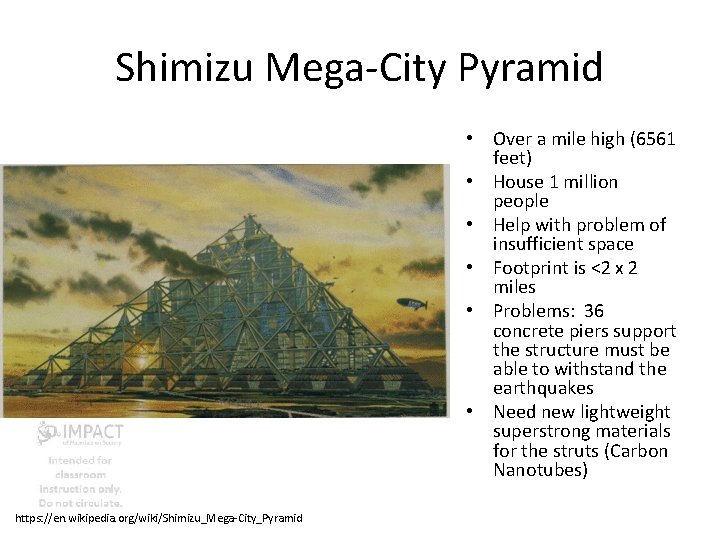
Shimizu Mega-City Pyramid • Over a mile high (6561 feet) • House 1 million people • Help with problem of insufficient space • Footprint is <2 x 2 miles • Problems: 36 concrete piers support the structure must be able to withstand the earthquakes • Need new lightweight superstrong materials for the struts (Carbon Nanotubes) https: //en. wikipedia. org/wiki/Shimizu_Mega-City_Pyramid