
Smart Inverters 101 ISEA Business Member Webinar August
Smart Inverters 101 ISEA Business Member Webinar August 22, 2017
Agenda • Introductions • Overview of Smart Inverter Provisions in FEJA • What are “Smart” Inverters? • Overview of Codes and Standards • Perspectives from California • Policy Considerations • Q&A
Overview of Smart Inverter Provisions in FEJA • Requires Com. Ed and Ameren to offer a rebate to customers who own or operate a DG project (up to 2 MW AC) • In exchange for the rebate, the utility shall be permitted to operate and control the smart inverter tied to the DG project for the purpose of preserving reliability during dist. system reliability events • Smart Inverter Definition: “Smart Inverter” means a device that converts DC into AC and can autonomously contribute to grid support during excursions from normal operating voltage and frequency conditions by providing each of the following: dynamic reactive and real power support, voltage and frequency ride-through, ramp rate controls, communication systems with the ability to accept external commands and other functions from the electric utility. • Systems installed after June 1, 2017 must have smart inverter associated with DG project to be eligible for the rebate • $250/k. W DC rebate initially available to non-residential net-metered customers and community solar • The tariff outlining the rebate will also identify additional uses of the smart inverter that shall be separately compensated. These utility tariffs will be reviewed and approved by the ICC • Expect utility tariff filing late September 2017
What are “Smart” Inverters? Speaker: Jason Bobruk August 2017 © Solar. Edge
Agenda The future of (grid connected) solar Solar. Edge Technology Why do we need Smart Inverters? What is a Smart Inverter? What are the features of Smart Inverters? 5 © Solar. Edge
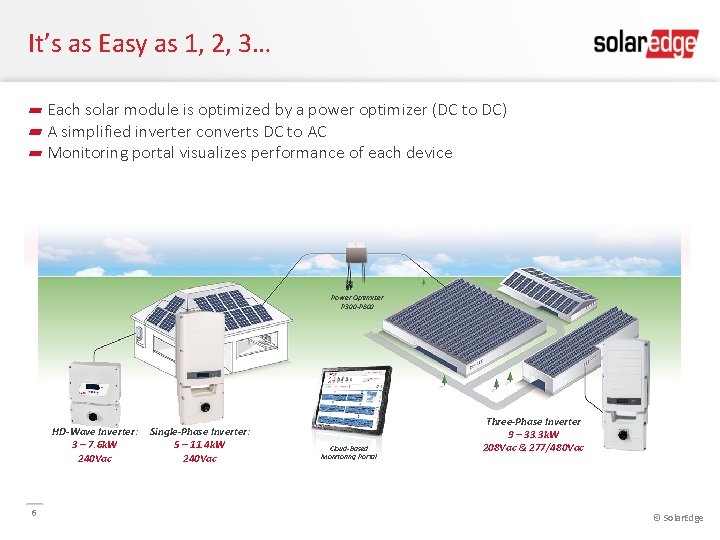
It’s as Easy as 1, 2, 3… Each solar module is optimized by a power optimizer (DC to DC) A simplified inverter converts DC to AC Monitoring portal visualizes performance of each device Power Optimizer P 300 -P 800 HD-Wave Inverter: 3 – 7. 6 k. W 240 Vac 6 Single-Phase Inverter: 5 – 11. 4 k. W 240 Vac Cloud-Based Monitoring Portal Three-Phase Inverter 9 – 33. 3 k. W 208 Vac & 277/480 Vac © Solar. Edge
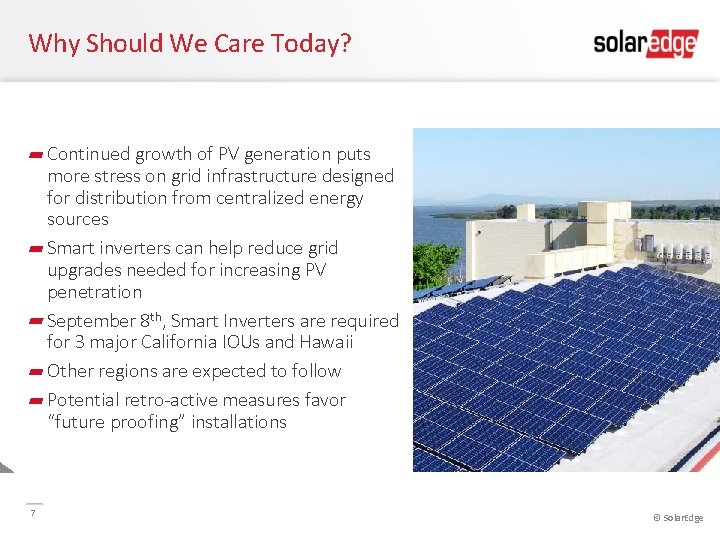
Why Should We Care Today? Continued growth of PV generation puts more stress on grid infrastructure designed for distribution from centralized energy sources Smart inverters can help reduce grid upgrades needed for increasing PV penetration September 8 th, Smart Inverters are required for 3 major California IOUs and Hawaii Other regions are expected to follow Potential retro-active measures favor “future proofing” installations 7 © Solar. Edge

What is a Smart Inverter? Smart inverters are PV inverters that stay connected and provide additional functions to help actively support the grid- mainly voltage and frequency Smart Inverters can receive commands from grid operators and report information Traditional inverters simply disconnected when the grid voltage or frequency went out of range. Examples: California Electric Rule 21, Hawaii Rule 14 H Pilots: Arizona Public Service, Green Mountain Power, National Grid 8 © Solar. Edge
Which Inverters are Smart Inverters? Solar. Edge uses the same hardware and the same model numbers Software enables special features – Customizable for each region ( California, Hawaii, Japan, Australia, Germany) Hardware + software together is evaluated and tested by a NRTL (Nationally Recognized Testing Laboratory) to UL 1741 Supplement A Inverters are labeled with: “Grid Support Inverter” vs. only “Grid Interactive” http: //www. gosolarcalifornia. ca. gov/equipment/inverters. php (downloadable Excel table) 9 © Solar. Edge

Smart Inverter Functions Anti-islanding with Grid Support Functions Enabled Low/High Voltage Ride-Through Low/High Frequency Ride-Through Dynamic Volt/VAr Mode Ramp Rates /Reconnect by Soft-Start Fixed Power Factor Frequency-Watt Volt-Watt Reactive Power Control Remote Shutdown / Power Reduction Grid Monitoring Before Connection DC Injection Detection Remote configurability / scheduling Export Limiting / Curtailment 10 © Solar. Edge
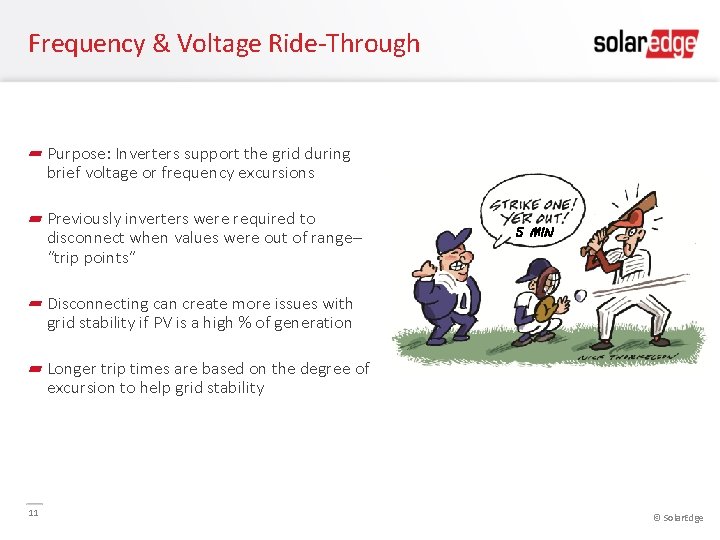
Frequency & Voltage Ride-Through Purpose: Inverters support the grid during brief voltage or frequency excursions Previously inverters were required to disconnect when values were out of range– “trip points” 5 MIN Disconnecting can create more issues with grid stability if PV is a high % of generation Longer trip times are based on the degree of excursion to help grid stability 11 © Solar. Edge
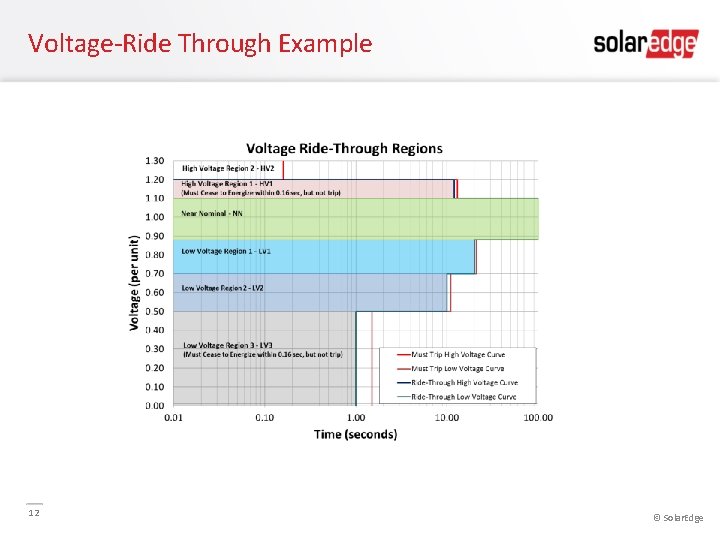
Voltage-Ride Through Example 12 © Solar. Edge
Volt/VAr Mode Purpose: Variable Power Factor provides active voltage stabilization Grid voltage nominal, purely active power Grid voltage high, add ‘inductive’ reactive power Grid voltage low, add ‘capacitive’ reactive power Adjusting VArs keeps grid voltage from oscillating; acts like a shock absorber Intended result is automatic stabilization of grid voltage Only used when needed -“deadband” 13 © Solar. Edge
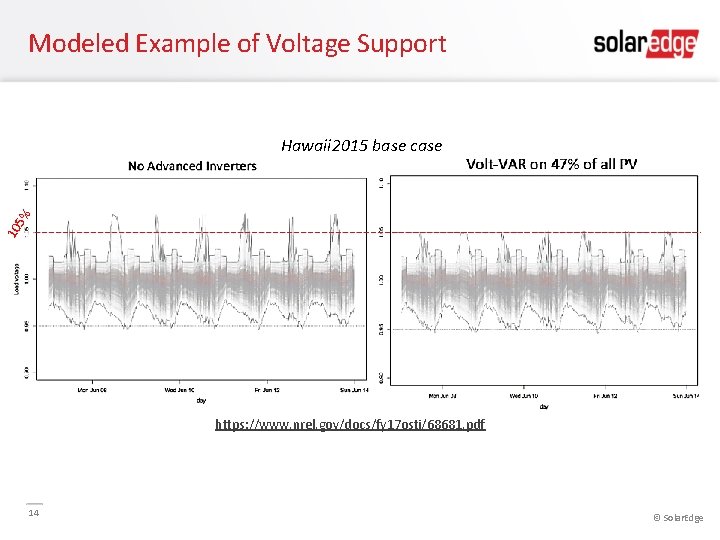
Modeled Example of Voltage Support 10 5% Hawaii 2015 base case https: //www. nrel. gov/docs/fy 17 osti/68681. pdf 14 © Solar. Edge
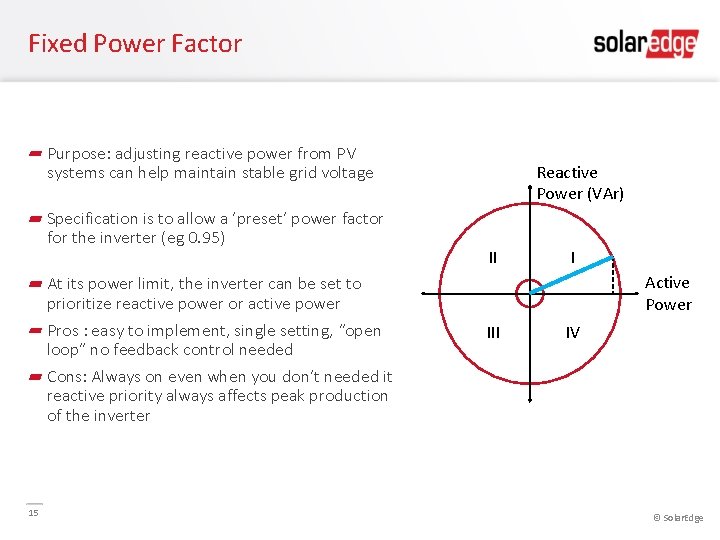
Fixed Power Factor Purpose: adjusting reactive power from PV systems can help maintain stable grid voltage Specification is to allow a ‘preset’ power factor for the inverter (eg 0. 95) At its power limit, the inverter can be set to prioritize reactive power or active power Pros : easy to implement, single setting, “open loop” no feedback control needed Cons: Always on even when you don’t needed it reactive priority always affects peak production of the inverter 15 Reactive Power (VAr) II I Active Power III IV © Solar. Edge
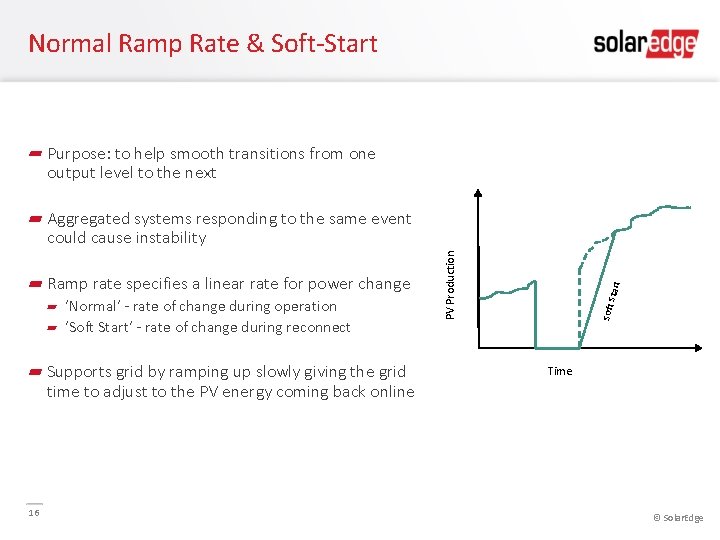
Normal Ramp Rate & Soft-Start Purpose: to help smooth transitions from one output level to the next Supports grid by ramping up slowly giving the grid time to adjust to the PV energy coming back online 16 Start ‘Normal’ - rate of change during operation ‘Soft Start’ - rate of change during reconnect Soft Ramp rate specifies a linear rate for power change PV Production Aggregated systems responding to the same event could cause instability Time © Solar. Edge
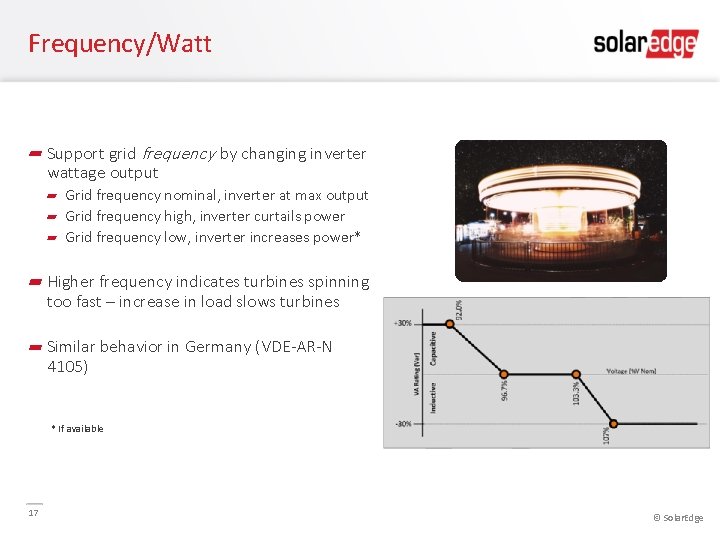
Frequency/Watt Support grid frequency by changing inverter wattage output Grid frequency nominal, inverter at max output Grid frequency high, inverter curtails power Grid frequency low, inverter increases power* Higher frequency indicates turbines spinning too fast – increase in load slows turbines Similar behavior in Germany (VDE-AR-N 4105) * If available 17 © Solar. Edge
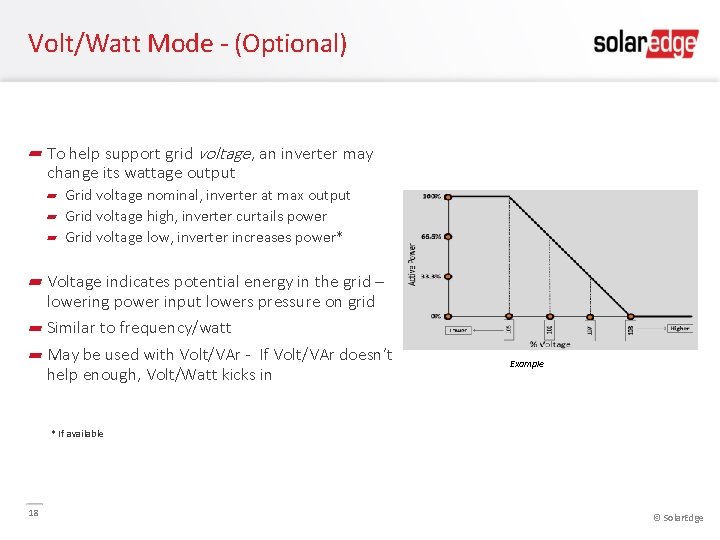
Volt/Watt Mode - (Optional) To help support grid voltage , an inverter may change its wattage output Grid voltage nominal, inverter at max output Grid voltage high, inverter curtails power Grid voltage low, inverter increases power* Voltage indicates potential energy in the grid – lowering power input lowers pressure on grid Similar to frequency/watt May be used with Volt/VAr - If Volt/VAr doesn’t help enough, Volt/Watt kicks in Example * If available 18 © Solar. Edge
Smart Active Inverter Features The market is changing – advanced inverter functions can improve PV penetration and grid stability Solar Generation is evolving to provide similar functionality to other grid sources of energy Inverters are taking a more active role Smart Inverter Functionality Storage / Demand Response Communications & Aggregation Cyber security More? 19 © Solar. Edge
THANK YOU! info@solaredge. com twitter. com/Solar. Edge. PV solaredge. com/blog solaredge. com Cautionary Note Regarding Market Data & Industry Forecasts This power point presentation contains market data and industry forecasts from certain third-party sources. This information is based on industry surveys and the preparer’s expertise in the industry and there can be no assurance that any such market data is accurate or that any such industry forecasts will be achieved. Although we have not independently verified the accuracy of such market data and industry forecasts, we believe that the market data is reliable and that the industry forecasts are reasonable. © Solar. Edge
Codes & Standards for Advanced Inverter Grid Support Ken Boyce, UL UL and the UL Logo are trademarks of UL LLC © 2017. All rights reserved. No portion of this material may be reprinted in any form without the express written permission of UL LLC. or as otherwise provided in writing.
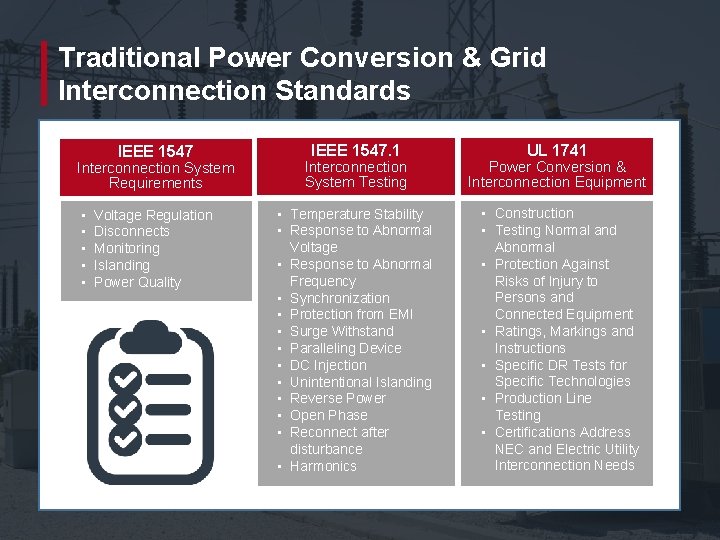
Traditional Power Conversion & Grid Interconnection Standards IEEE 1547 Interconnection System Requirements • • • Voltage Regulation Disconnects Monitoring Islanding Power Quality IEEE 1547. 1 Interconnection System Testing • Temperature Stability • Response to Abnormal Voltage • Response to Abnormal Frequency • Synchronization • Protection from EMI • Surge Withstand • Paralleling Device • DC Injection • Unintentional Islanding • Reverse Power • Open Phase • Reconnect after disturbance • Harmonics UL 1741 Power Conversion & Interconnection Equipment • Construction • Testing Normal and Abnormal • Protection Against Risks of Injury to Persons and Connected Equipment • Ratings, Markings and Instructions • Specific DR Tests for Specific Technologies • Production Line Testing • Certifications Address NEC and Electric Utility Interconnection Needs
New UL 1741 Supplement A (SA) for Advanced Technology Developed specifically for advanced inverters through a cross functional Task Group • Key participation from: - State Regulators - Electric Utilities – CA, HI, and AZ - Inverter Manufacturers - U. S. National Labs – Sandia and NREL - Electrical Power Research Institute (EPRI) - Other interested parties UL 1741 SA reached consensus and was incorporated into UL 1741 in September 2016 after addressing over 650 comments.
Advanced Inverter Movement Which Standards are Used for Advanced Inverter Testing? • UL 1741 SA specifies the test methods to be used with one or more Source Requirement Documents (SRD) for limits and parameter settings. • State of California Electric Rule 21, including inverter revisions, issued by the California Public Utility Commission (CPUC) comprise an SRD which can be used with UL 1741 SA. Other SRD’s may also be used with the SA.
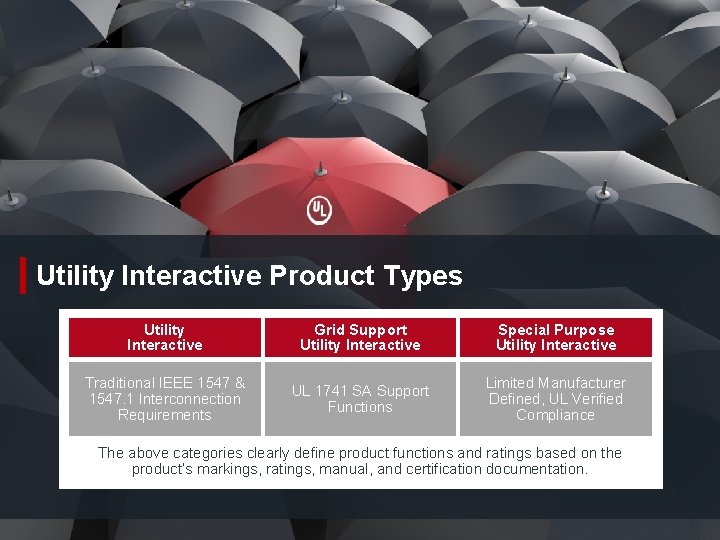
Utility Interactive Product Types Utility Interactive Grid Support Utility Interactive Special Purpose Utility Interactive Traditional IEEE 1547 & 1547. 1 Interconnection Requirements UL 1741 SA Support Functions Limited Manufacturer Defined, UL Verified Compliance The above categories clearly define product functions and ratings based on the product’s markings, ratings, manual, and certification documentation.
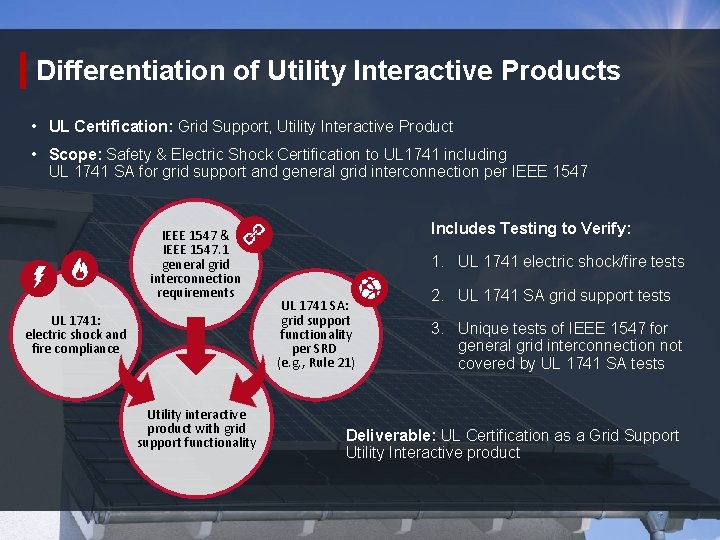
Differentiation of Utility Interactive Products • UL Certification: Grid Support, Utility Interactive Product • Scope: Safety & Electric Shock Certification to UL 1741 including UL 1741 SA for grid support and general grid interconnection per IEEE 1547 & IEEE 1547. 1 general grid interconnection requirements UL 1741: electric shock and fire compliance Utility interactive product with grid support functionality Includes Testing to Verify: 1. UL 1741 electric shock/fire tests UL 1741 SA: grid support functionality per SRD (e. g. , Rule 21) 2. UL 1741 SA grid support tests 3. Unique tests of IEEE 1547 for general grid interconnection not covered by UL 1741 SA tests Deliverable: UL Certification as a Grid Support Utility Interactive product
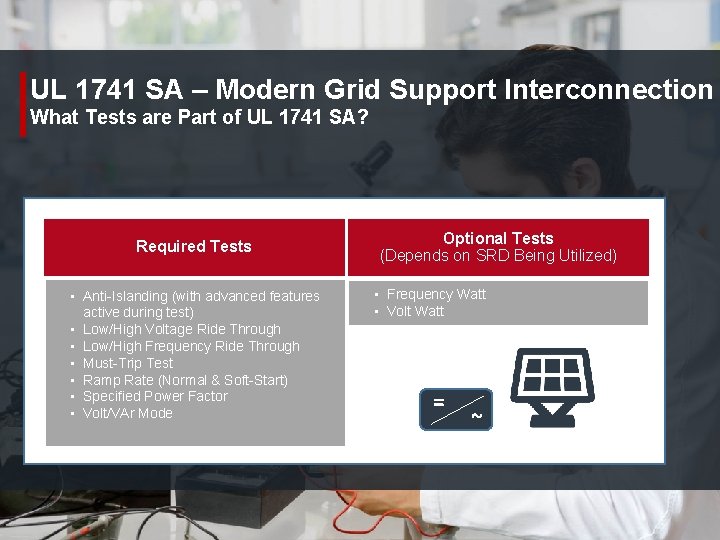
UL 1741 SA – Modern Grid Support Interconnection What Tests are Part of UL 1741 SA? Required Tests • Anti-Islanding (with advanced features active during test) • Low/High Voltage Ride Through • Low/High Frequency Ride Through • Must-Trip Test • Ramp Rate (Normal & Soft-Start) • Specified Power Factor • Volt/VAr Mode Optional Tests (Depends on SRD Being Utilized) • Frequency Watt • Volt Watt = ~
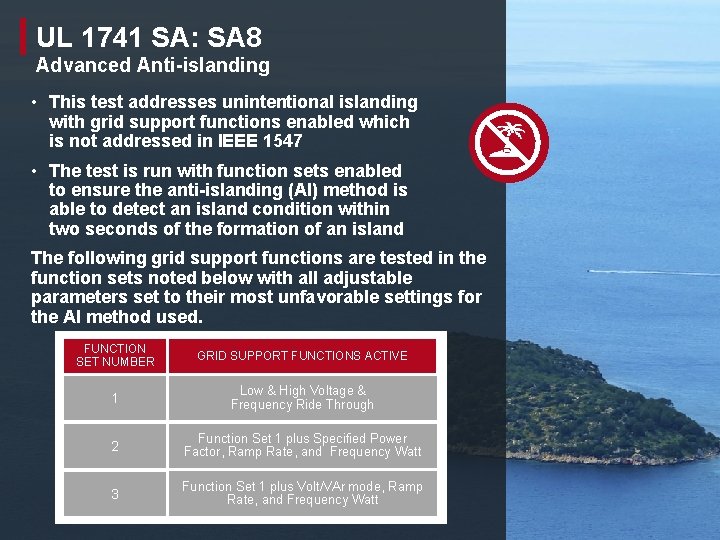
UL 1741 SA: SA 8 Advanced Anti-islanding • This test addresses unintentional islanding with grid support functions enabled which is not addressed in IEEE 1547 • The test is run with function sets enabled to ensure the anti-islanding (AI) method is able to detect an island condition within two seconds of the formation of an island The following grid support functions are tested in the function sets noted below with all adjustable parameters set to their most unfavorable settings for the AI method used. FUNCTION SET NUMBER GRID SUPPORT FUNCTIONS ACTIVE 1 Low & High Voltage & Frequency Ride Through 2 Function Set 1 plus Specified Power Factor, Ramp Rate, and Frequency Watt 3 Function Set 1 plus Volt/VAr mode, Ramp Rate, and Frequency Watt
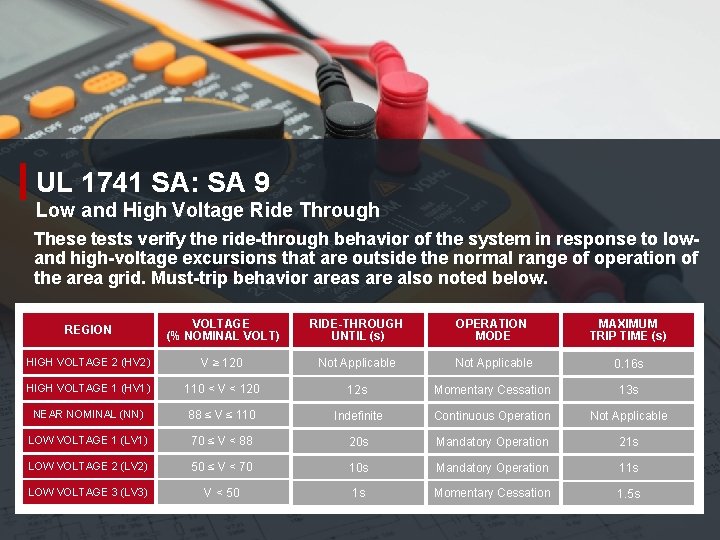
UL 1741 SA: SA 9 Low and High Voltage Ride Through These tests verify the ride-through behavior of the system in response to lowand high-voltage excursions that are outside the normal range of operation of the area grid. Must-trip behavior areas are also noted below. REGION VOLTAGE (% NOMINAL VOLT) RIDE-THROUGH UNTIL (s) OPERATION MODE MAXIMUM TRIP TIME (s) HIGH VOLTAGE 2 (HV 2) V ≥ 120 Not Applicable 0. 16 s HIGH VOLTAGE 1 (HV 1) 110 < V < 120 12 s Momentary Cessation 13 s NEAR NOMINAL (NN) 88 ≤ V ≤ 110 Indefinite Continuous Operation Not Applicable LOW VOLTAGE 1 (LV 1) 70 ≤ V < 88 20 s Mandatory Operation 21 s LOW VOLTAGE 2 (LV 2) 50 ≤ V < 70 10 s Mandatory Operation 11 s LOW VOLTAGE 3 (LV 3) V < 50 1 s Momentary Cessation 1. 5 s
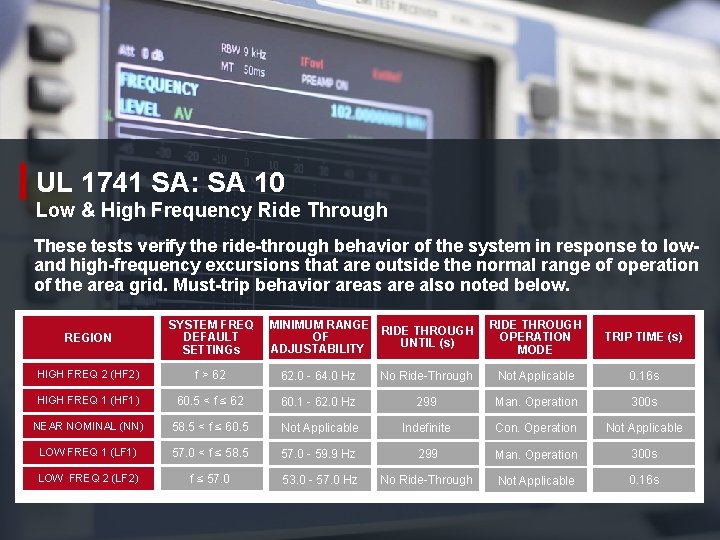
UL 1741 SA: SA 10 Low & High Frequency Ride Through These tests verify the ride-through behavior of the system in response to lowand high-frequency excursions that are outside the normal range of operation of the area grid. Must-trip behavior areas are also noted below. MINIMUM RANGE RIDE THROUGH OF UNTIL (s) ADJUSTABILITY RIDE THROUGH OPERATION MODE TRIP TIME (s) No Ride-Through Not Applicable 0. 16 s 60. 1 - 62. 0 Hz 299 Man. Operation 300 s 58. 5 < f ≤ 60. 5 Not Applicable Indefinite Con. Operation Not Applicable LOW FREQ 1 (LF 1) 57. 0 < f ≤ 58. 5 57. 0 - 59. 9 Hz 299 Man. Operation 300 s LOW FREQ 2 (LF 2) f ≤ 57. 0 53. 0 - 57. 0 Hz No Ride-Through Not Applicable 0. 16 s REGION SYSTEM FREQ DEFAULT SETTINGs HIGH FREQ 2 (HF 2) f > 62 62. 0 - 64. 0 Hz HIGH FREQ 1 (HF 1) 60. 5 < f ≤ 62 NEAR NOMINAL (NN)
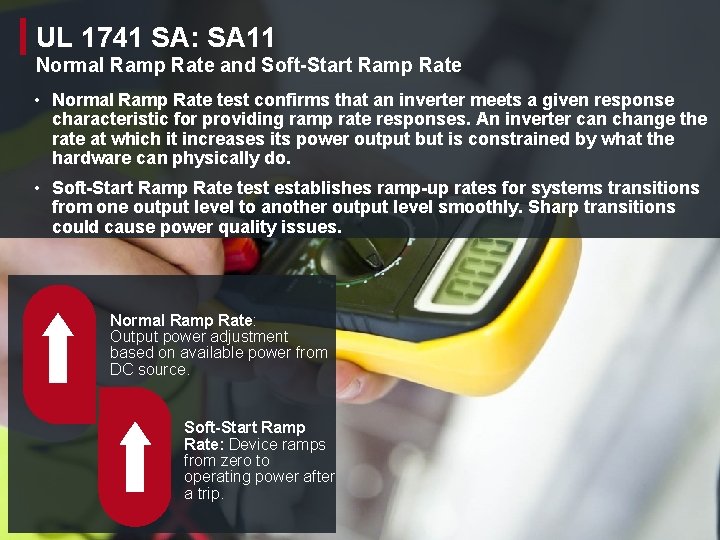
UL 1741 SA: SA 11 Normal Ramp Rate and Soft-Start Ramp Rate • Normal Ramp Rate test confirms that an inverter meets a given response characteristic for providing ramp rate responses. An inverter can change the rate at which it increases its power output but is constrained by what the hardware can physically do. • Soft-Start Ramp Rate test establishes ramp-up rates for systems transitions from one output level to another output level smoothly. Sharp transitions could cause power quality issues. Normal Ramp Rate: Output power adjustment based on available power from DC source. Soft-Start Ramp Rate: Device ramps from zero to operating power after a trip.
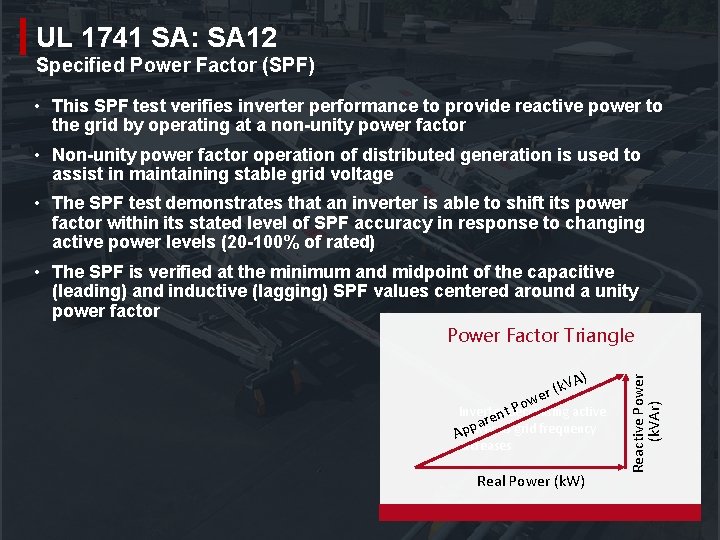
UL 1741 SA: SA 12 Specified Power Factor (SPF) • This SPF test verifies inverter performance to provide reactive power to the grid by operating at a non-unity power factor • Non-unity power factor operation of distributed generation is used to assist in maintaining stable grid voltage • The SPF test demonstrates that an inverter is able to shift its power factor within its stated level of SPF accuracy in response to changing active power levels (20 -100% of rated) A) k. V er ( ow P Inverter active ntdecreasing e r a p as grid frequency p Apower increases Real Power (k. W) Reactive Power (k. VAr) • The SPF is verified at the minimum and midpoint of the capacitive (leading) and inductive (lagging) SPF values centered around a unity power factor Power Factor Triangle
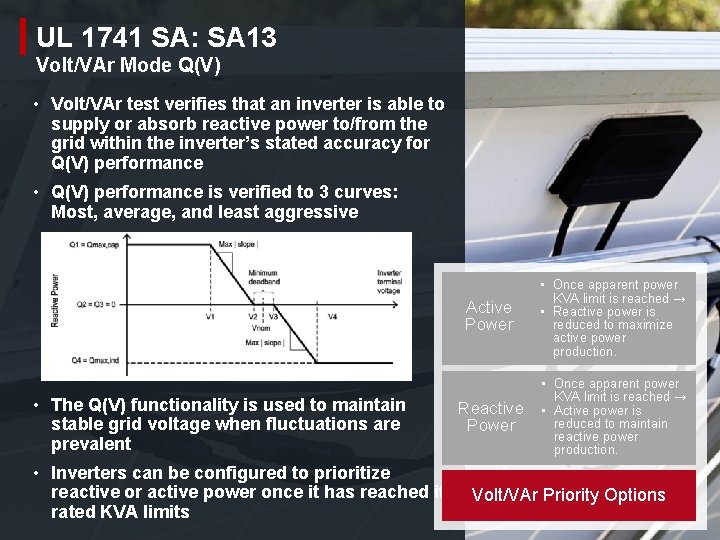
UL 1741 SA: SA 13 Volt/VAr Mode Q(V) • Volt/VAr test verifies that an inverter is able to supply or absorb reactive power to/from the grid within the inverter’s stated accuracy for Q(V) performance • Q(V) performance is verified to 3 curves: Most, average, and least aggressive • The Q(V) functionality is used to maintain stable grid voltage when fluctuations are prevalent Active Power • Once apparent power KVA limit is reached → • Reactive power is reduced to maximize active power production. Reactive Power • Once apparent power KVA limit is reached → • Active power is reduced to maintain reactive power production. • Inverters can be configured to prioritize reactive or active power once it has reached its Volt/VAr Priority Options rated KVA limits
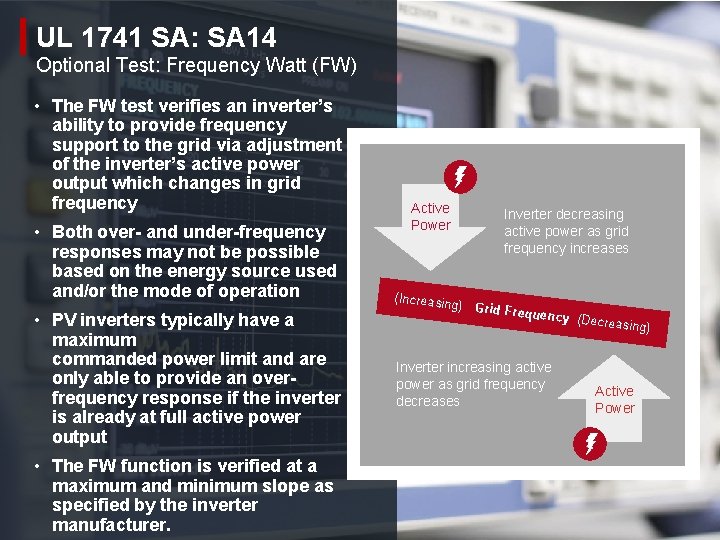
UL 1741 SA: SA 14 Optional Test: Frequency Watt (FW) • The FW test verifies an inverter’s ability to provide frequency support to the grid via adjustment of the inverter’s active power output which changes in grid frequency • Both over- and under-frequency responses may not be possible based on the energy source used and/or the mode of operation • PV inverters typically have a maximum commanded power limit and are only able to provide an overfrequency response if the inverter is already at full active power output • The FW function is verified at a maximum and minimum slope as specified by the inverter manufacturer. Active Power (Increasin g) Inverter decreasing active power as grid frequency increases Grid Freq uency (D ecreasin Inverter increasing active power as grid frequency decreases g) Active Power
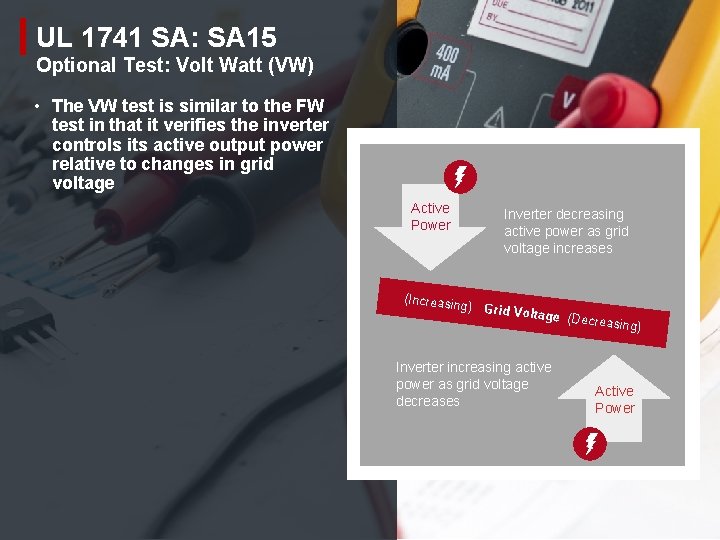
UL 1741 SA: SA 15 Optional Test: Volt Watt (VW) • The VW test is similar to the FW test in that it verifies the inverter controls its active output power relative to changes in grid voltage Active Power (Increasin Inverter decreasing active power as grid voltage increases g) Grid V o ltage (De creasing Inverter increasing active power as grid voltage decreases ) Active Power
Advanced Inverter Movement UL has taken the lead with AIT, Rule 21, and UL 1741 SA • UL involved from the beginning with developing the requirements • Creation of global AIT labs with qualified, highly trained staff support delivery of complete test results for various SRDs • Short turnaround times for testing in automated UL labs has resulted in short time-to-market certifications to UL 1741 SA

Thank you! Kenneth Boyce, P. E. UL LLC +1. 847. 664. 2318 Kenneth. p. boyce@ul. com UL and the UL Logo are trademarks of UL LLC © 2016. All rights reserved. No portion of this material may be reprinted in any form without the express written permission of UL LLC. or as otherwise provided in writing. .
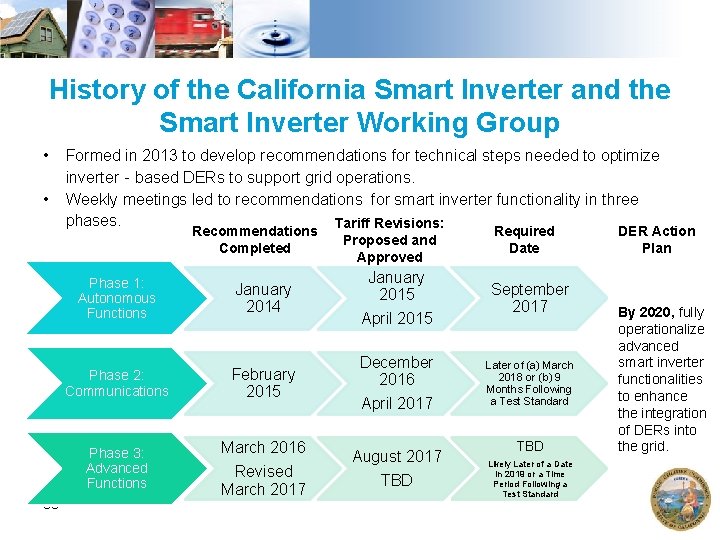
History of the California Smart Inverter and the Smart Inverter Working Group • • Formed in 2013 to develop recommendations for technical steps needed to optimize inverter‐based DERs to support grid operations. Weekly meetings led to recommendations for smart inverter functionality in three phases. Tariff Revisions: Recommendations Completed Phase 1: Autonomous Functions January 2014 Phase 2: Communications February 2015 Phase 3: Advanced Functions 38 March 2016 Revised March 2017 Proposed and Approved January 2015 April 2015 December 2016 April 2017 August 2017 TBD Required Date September 2017 Later of (a) March 2018 or (b) 9 Months Following a Test Standard TBD Likely Later of a Date in 2019 or a Time Period Following a Test Standard DER Action Plan By 2020, fully operationalize advanced smart inverter functionalities to enhance the integration of DERs into the grid.
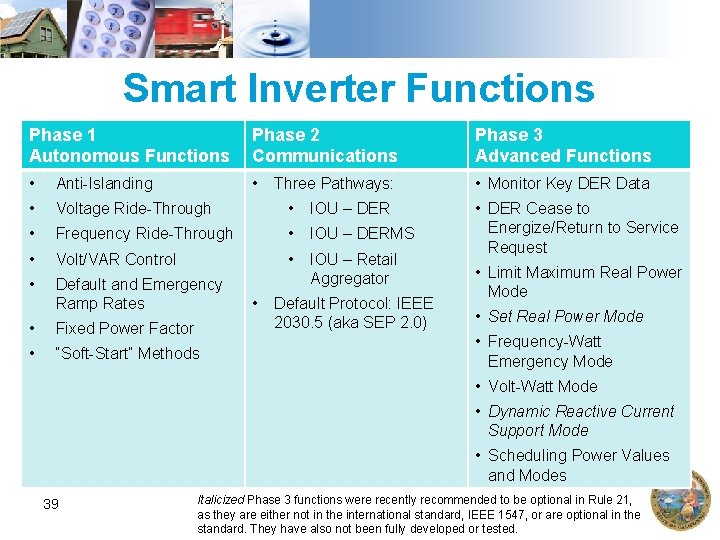
Smart Inverter Functions Phase 1 Autonomous Functions Phase 2 Communications Phase 3 Advanced Functions • Anti-Islanding • • Monitor Key DER Data • Voltage Ride-Through • IOU – DER • Frequency Ride-Through • IOU – DERMS • Volt/VAR Control • • Default and Emergency Ramp Rates IOU – Retail Aggregator • Fixed Power Factor • “Soft-Start” Methods • Three Pathways: Default Protocol: IEEE 2030. 5 (aka SEP 2. 0) • DER Cease to Energize/Return to Service Request • Limit Maximum Real Power Mode • Set Real Power Mode • Frequency-Watt Emergency Mode • Volt-Watt Mode • Dynamic Reactive Current Support Mode • Scheduling Power Values and Modes 39 Italicized Phase 3 functions were recently recommended to be optional in Rule 21, as they are either not in the international standard, IEEE 1547, or are optional in the standard. They have also not been fully developed or tested.
Smart Inverter Policy: Presentation to the Illinois Solar Energy Industries Association Brandon Smithwood, Director of California State Affairs, SEIA August 22, 2017
Policy Considerations • California’s Smart Inverter Working Group has defined capabilities for communications and advanced functions • Only Phase 1 (autonomous) functions must be operational in the near term • Illinois’ standard on utility control for a “reliability event” is beyond the rules established in California • Debate: where does being a “good grid citizen” end and providing “distribution grid services” begin? • voltage and frequency ride through, anti-islanding, “soft start”… some functions needed to maintain bulk and distribution system at high penetrations of distributed energy resources • Provision of data to the utility, conversation voltage reduction through coordinated volt/VAR and utility operations, …some functions are services to the grid which should be compensated 41
How to Define a “Reliability Event” • Recommendation: “The unplanned loss of power due to an abnormal condition on the electric distribution system or, when power can be restored by neighboring distribution systems, an abnormal condition on the sub-transmission or transmission system. The utility shall use best efforts to restore control of the smart inverter to normal operations as soon as the reliability event has been resolved. ” • The utility can take control of the smart inverter during a reliability event only after the utility has exhausted all other resources. The utility will program their responses to automatically utilize the smart inverter as the last resort resource per recommended use in the draft IEEE 1547. 1 standard. • Group Ask: Data from the utility on historical reliability events to be provided prior to filing the initial DG rebate and smart inverter tariff. 42
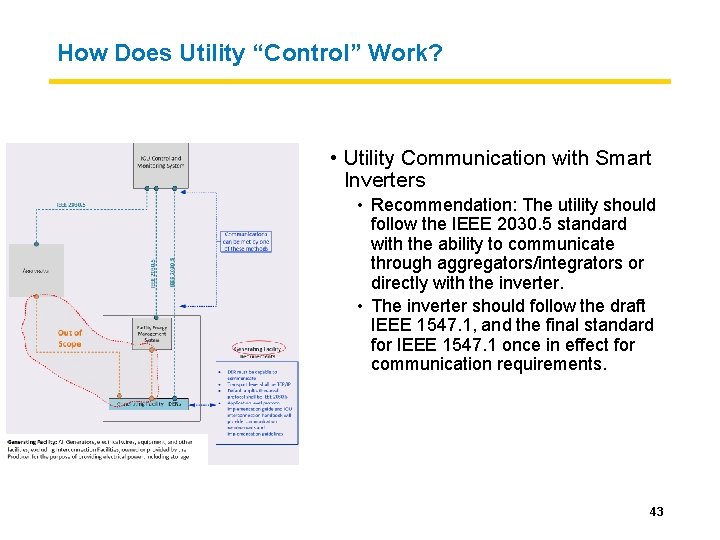
How Does Utility “Control” Work? • Utility Communication with Smart Inverters • Recommendation: The utility should follow the IEEE 2030. 5 standard with the ability to communicate through aggregators/integrators or directly with the inverter. • The inverter should follow the draft IEEE 1547. 1, and the final standard for IEEE 1547. 1 once in effect for communication requirements. 43
Testing Capabilities and Compensation Needed • Recommendation: The utility shall implement pilot programs and shall provide reasonable compensation as part of such programs. • Recommended pilots include but are not limited to exploring: • 1. Communication with the smart inverter through an aggregator/integrator or directly with the inverter • 2. Data collection from the smart inverter • 3. Basic testing of smart inverter capabilities • 4. Future capabilities of a smart inverter • 5. High penetration renewable feeder pilot • 6. Wide area renewable penetration pilot • 7. Value of future alternate compensation streams 44
Contacts The Solar Energy Industries Association (SEIA) is the national trade association for the US solar industry — one of the world’s fastest growing solar markets. Our 1, 000+ member companies encompass all segments of the industry – project developers, manufacturers, suppliers, financers, distributors, installers, service providers, utilities, engineering firms, consultants, law firms and many others. Rick Umoff, Regulatory Counsel and Director of State Affairs, Solar Energy Industries Association - manages SEIA Midwest Committee - rumoff@seia. org Brandon Smithwood, Director of California State Affairs - bsmithwood@seia. org 45
Questions?
- Slides: 46