
Smart Inverter Working Group SIWG December 3 2020
Smart Inverter Working Group (SIWG) December 3, 2020 Meeting 1 -2: 30 PM PST 1 Please keep yourself muted when not speaking and do NOT put the call on hold. If muted by the leader, press *6 to unmute.
Agenda 2 Topic Time Presenter Intro and Agenda 1: 00 – 5 minutes Sophie Meyer Discussion of Remaining IEEE 1547. 1 Clause 6 Issues 1: 05 – 20 minutes Tom Bialek of SDG&E IEEE 1547. 1 Clause 4 Issues 1: 25 – 60 minutes Roger Salas of SCE Wrap Up and Next Steps 2: 25 – 5 minutes Sophie Meyer Please keep yourself muted when not speaking and do NOT put the call on hold. If muted by the leader, press *6 to unmute.
Rule 21 Update with IEEE 1547 -2018/IEEE 1547. 12020 IEEE 1547 -2018 Clause 4 and 6 Discussion Smart Inverter Working Group 12/3/2020 DRAFT 3
Agenda • • • Welcome Review of the schedule Discussion of remaining Clause 6 issues Commence discussion of Clause 4 Q&A DRAFT 4
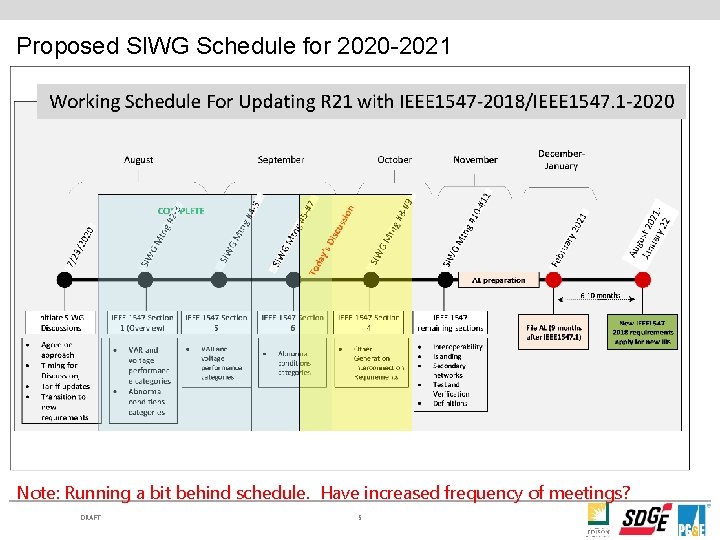
Proposed SIWG Schedule for 2020 -2021 Note: Running a bit behind schedule. Have increased frequency of meetings? DRAFT 5

1547 -2018 Clause 6: Area EPS Abnormal Conditions 6. 4. 1 Mandatory Voltage Tripping Requirements Proposal: Replace Table Hh-1 with the following table into Rule 21 as Hh-1 a to comport with IEEE 1547 -2018: DRAFT 6
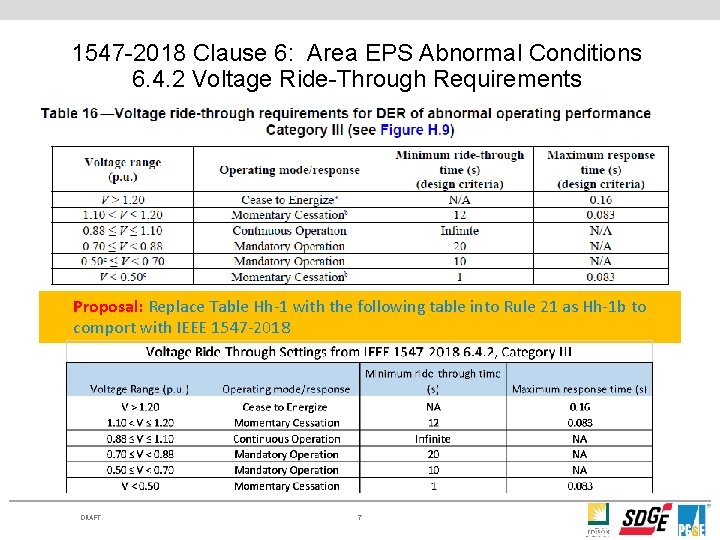
1547 -2018 Clause 6: Area EPS Abnormal Conditions 6. 4. 2 Voltage Ride-Through Requirements Proposal: Replace Table Hh-1 with the following table into Rule 21 as Hh-1 b to comport with IEEE 1547 -2018 DRAFT 7
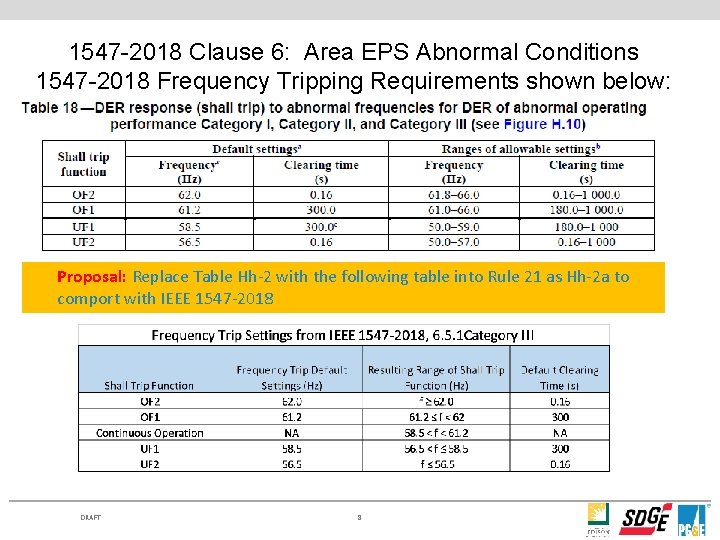
1547 -2018 Clause 6: Area EPS Abnormal Conditions 1547 -2018 Frequency Tripping Requirements shown below: Proposal: Replace Table Hh-2 with the following table into Rule 21 as Hh-2 a to comport with IEEE 1547 -2018 DRAFT 8
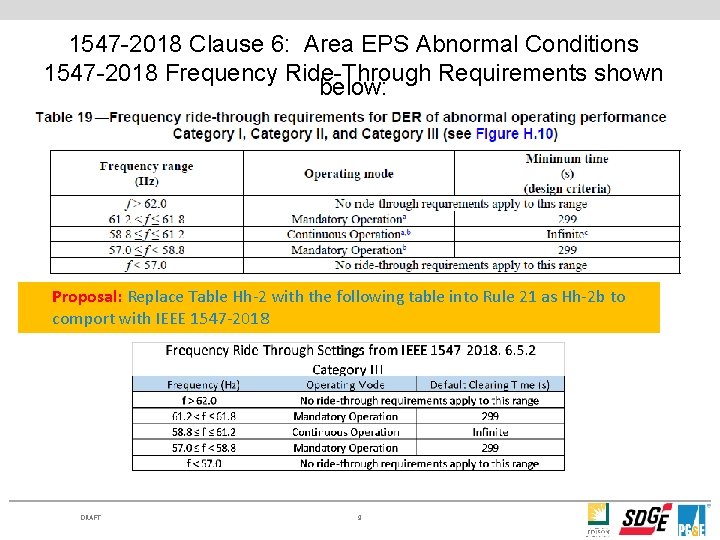
1547 -2018 Clause 6: Area EPS Abnormal Conditions 1547 -2018 Frequency Ride-Through Requirements shown below: Proposal: Replace Table Hh-2 with the following table into Rule 21 as Hh-2 b to comport with IEEE 1547 -2018 DRAFT 9
1547 -2018 Clause 6: Area EPS Abnormal Conditions Additional sections to consider including in Rule 21 : • 6. 5. 2. 5 Rate of change of frequency (ROCOF) ride-through ROCOF tripping disabled – conflicts with continuous operation and ride through requirements. • 6. 5. 2. 7 Frequency-droop (frequency power) – Retain Values in Rule 21 and incorporate language in IEEE 1547 -2018 into Hh. 2. L (replace most existing language) DRAFT 10
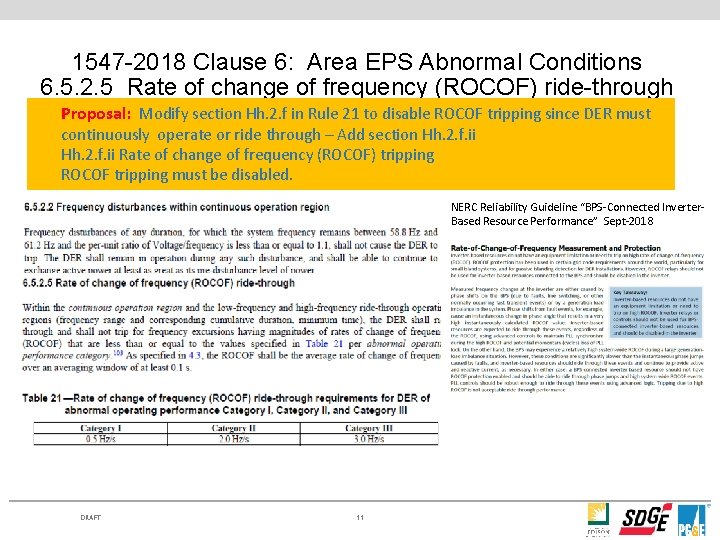
1547 -2018 Clause 6: Area EPS Abnormal Conditions 6. 5. 2. 5 Rate of change of frequency (ROCOF) ride-through Proposal: Modify section Hh. 2. f in Rule 21 to disable ROCOF tripping since DER must continuously operate or ride through – Add section Hh. 2. f. ii Rate of change of frequency (ROCOF) tripping ROCOF tripping must be disabled. NERC Reliability Guideline “BPS-Connected Inverter. Based Resource Performance” Sept-2018 DRAFT 11
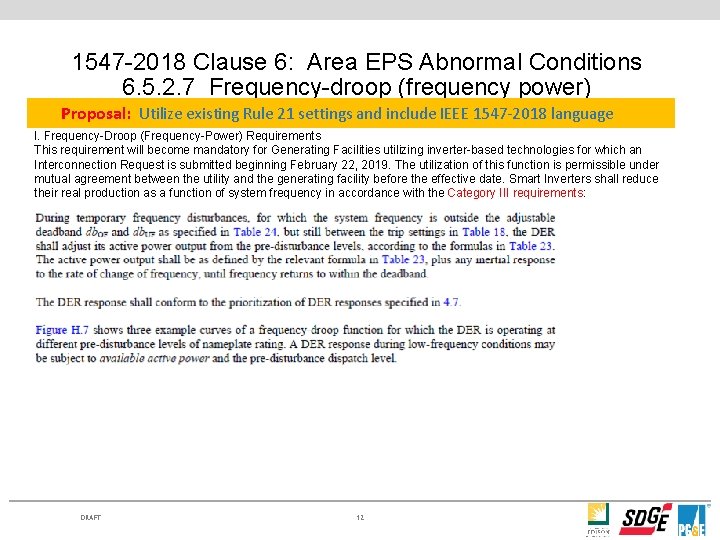
1547 -2018 Clause 6: Area EPS Abnormal Conditions 6. 5. 2. 7 Frequency-droop (frequency power) Proposal: Utilize existing Rule 21 settings and include IEEE 1547 -2018 language l. Frequency-Droop (Frequency-Power) Requirements This requirement will become mandatory for Generating Facilities utilizing inverter-based technologies for which an Interconnection Request is submitted beginning February 22, 2019. The utilization of this function is permissible under mutual agreement between the utility and the generating facility before the effective date. Smart Inverters shall reduce their real production as a function of system frequency in accordance with the Category III requirements: DRAFT 12
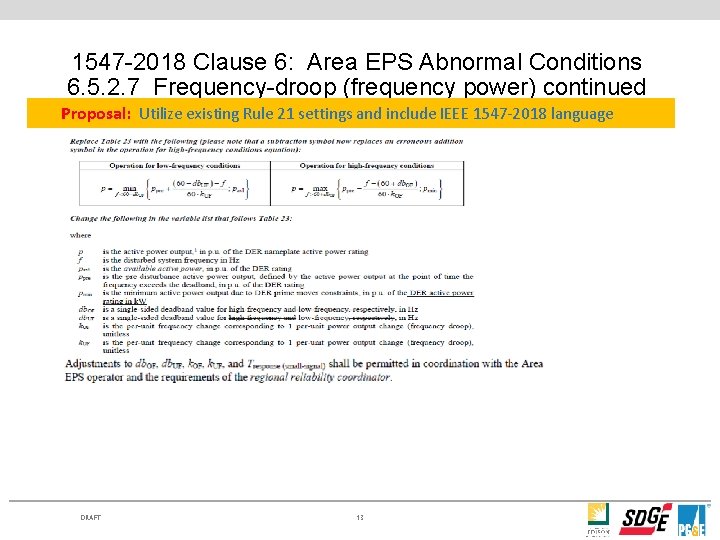
1547 -2018 Clause 6: Area EPS Abnormal Conditions 6. 5. 2. 7 Frequency-droop (frequency power) continued Proposal: Utilize existing Rule 21 settings and include IEEE 1547 -2018 language DRAFT 13
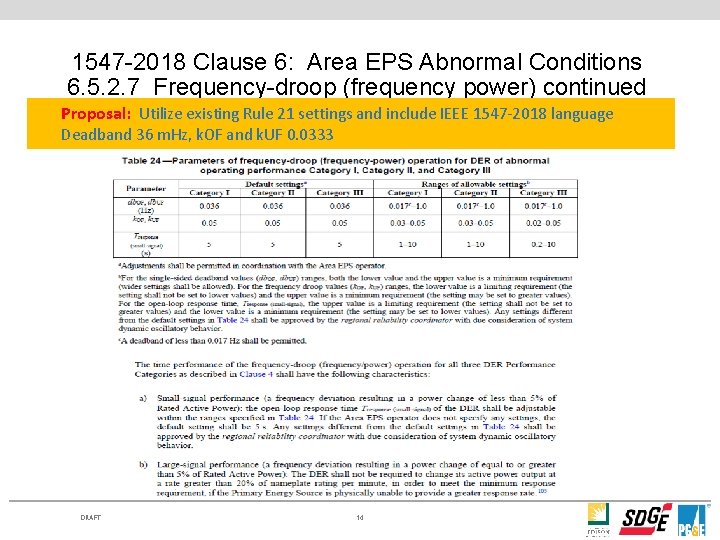
1547 -2018 Clause 6: Area EPS Abnormal Conditions 6. 5. 2. 7 Frequency-droop (frequency power) continued Proposal: Utilize existing Rule 21 settings and include IEEE 1547 -2018 language Deadband 36 m. Hz, k. OF and k. UF 0. 0333 DRAFT 14
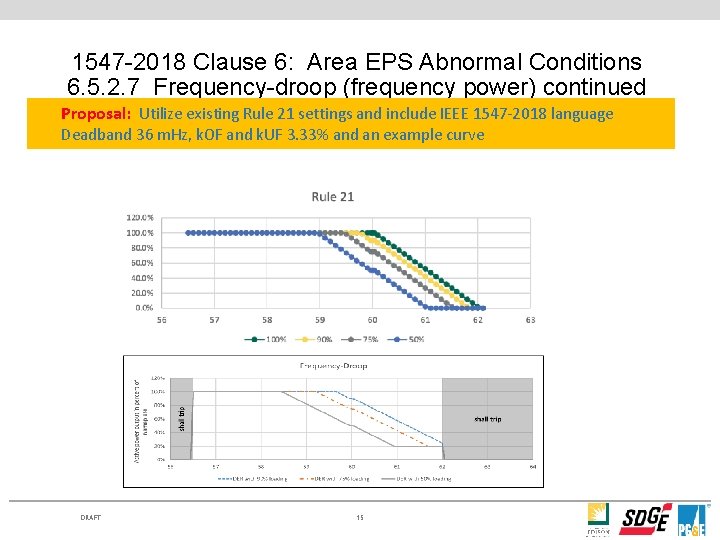
1547 -2018 Clause 6: Area EPS Abnormal Conditions 6. 5. 2. 7 Frequency-droop (frequency power) continued Proposal: Utilize existing Rule 21 settings and include IEEE 1547 -2018 language Deadband 36 m. Hz, k. OF and k. UF 3. 33% and an example curve DRAFT 15
Clause 4 DRAFT
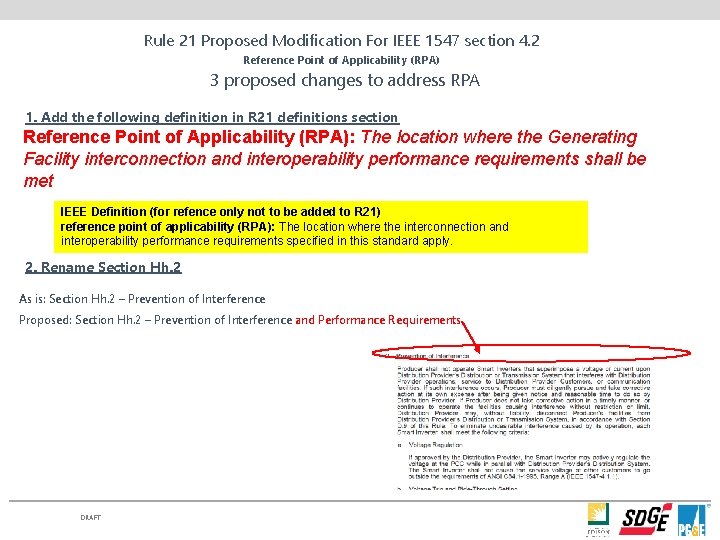
Rule 21 Proposed Modification For IEEE 1547 section 4. 2 Reference Point of Applicability (RPA) 3 proposed changes to address RPA 1. Add the following definition in R 21 definitions section Reference Point of Applicability (RPA): The location where the Generating Facility interconnection and interoperability performance requirements shall be met IEEE Definition (for refence only not to be added to R 21) reference point of applicability (RPA): The location where the interconnection and interoperability performance requirements specified in this standard apply. 2. Rename Section Hh. 2 As is: Section Hh. 2 – Prevention of Interference Proposed: Section Hh. 2 – Prevention of Interference and Performance Requirements DRAFT
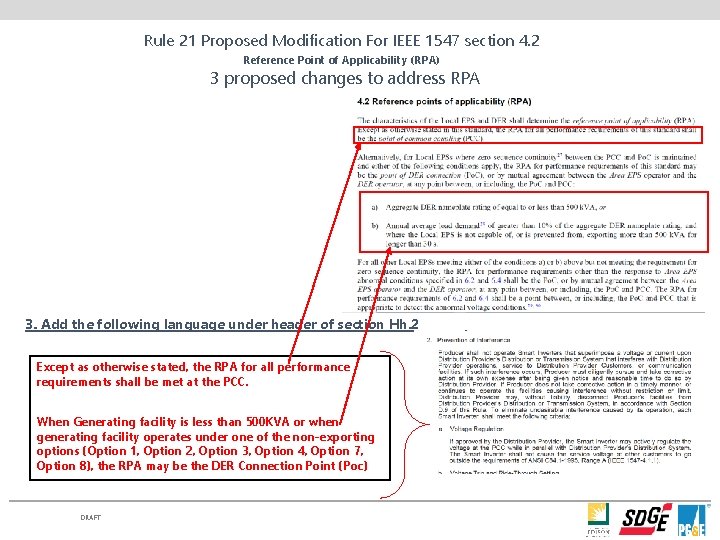
Rule 21 Proposed Modification For IEEE 1547 section 4. 2 Reference Point of Applicability (RPA) 3 proposed changes to address RPA 3. Add the following language under header of section Hh. 2 Except as otherwise stated, the RPA for all performance requirements shall be met at the PCC. When Generating facility is less than 500 KVA or when generating facility operates under one of the non-exporting options (Option 1, Option 2, Option 3, Option 4, Option 7, Option 8), the RPA may be the DER Connection Point (Poc) DRAFT
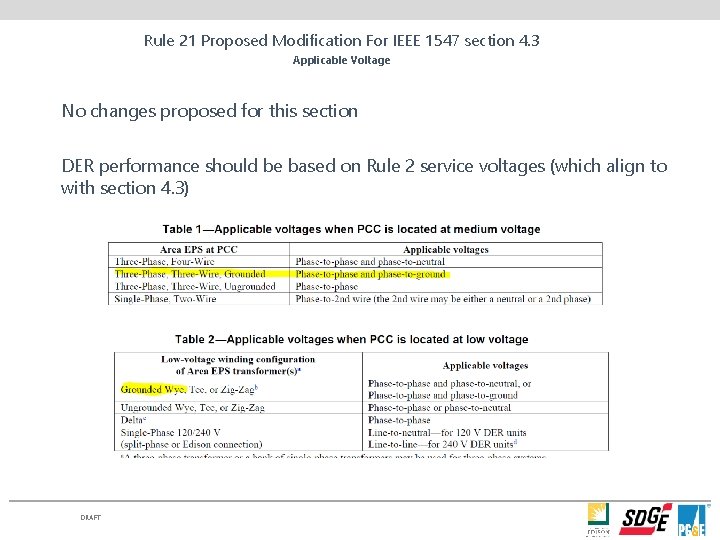
Rule 21 Proposed Modification For IEEE 1547 section 4. 3 Applicable Voltage No changes proposed for this section DER performance should be based on Rule 2 service voltages (which align to with section 4. 3) DRAFT
Rule 21 Proposed Modification For IEEE 1547 section 4. 4 Measurement Accuracy 1 changes proposed for this section 1. Add new section to R 21 section Hh 2 ? . Smart Inverter shall meet minimum steady-state and transient measurement and calculation accuracy as required in IEEE 1547 -2018 DRAFT
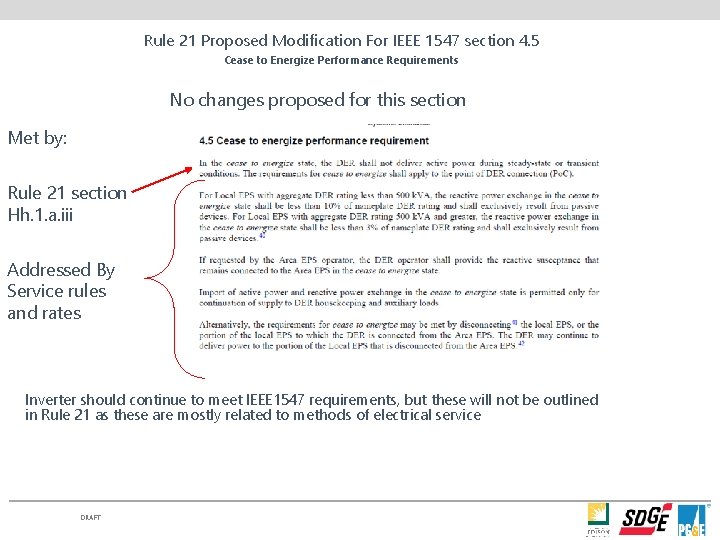
Rule 21 Proposed Modification For IEEE 1547 section 4. 5 Cease to Energize Performance Requirements No changes proposed for this section Met by: Rule 21 section Hh. 1. a. iii Addressed By Service rules and rates Inverter should continue to meet IEEE 1547 requirements, but these will not be outlined in Rule 21 as these are mostly related to methods of electrical service DRAFT
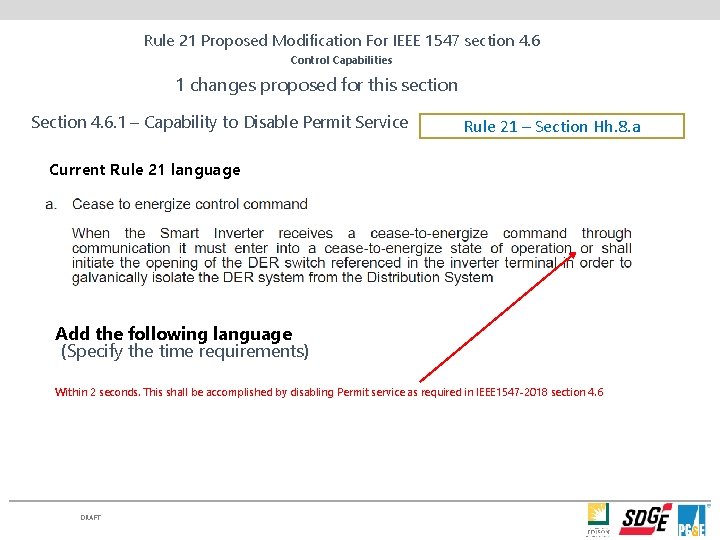
Rule 21 Proposed Modification For IEEE 1547 section 4. 6 Control Capabilities 1 changes proposed for this section Section 4. 6. 1 – Capability to Disable Permit Service Rule 21 – Section Hh. 8. a Current Rule 21 language Add the following language (Specify the time requirements) Within 2 seconds. This shall be accomplished by disabling Permit service as required in IEEE 1547 -2018 section 4. 6 DRAFT
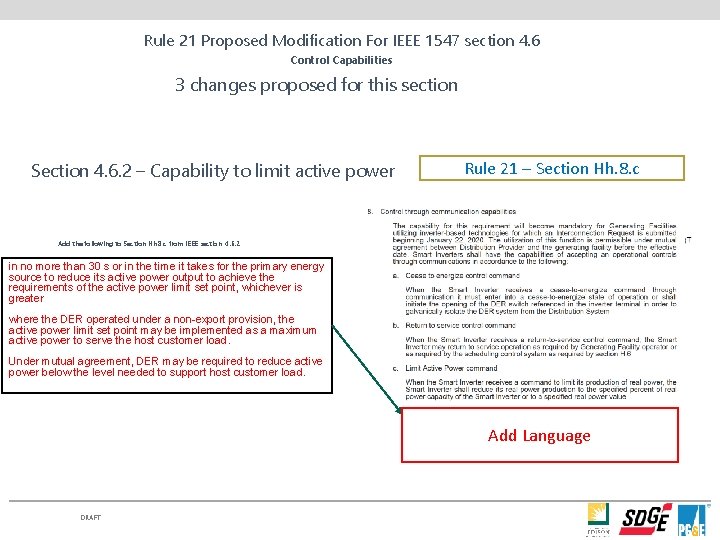
Rule 21 Proposed Modification For IEEE 1547 section 4. 6 Control Capabilities 3 changes proposed for this section Section 4. 6. 2 – Capability to limit active power Rule 21 – Section Hh. 8. c Add the following to Section Hh. 8. c from IEEE section 4. 6. 2 in no more than 30 s or in the time it takes for the primary energy source to reduce its active power output to achieve the requirements of the active power limit set point, whichever is greater where the DER operated under a non-export provision, the active power limit set point may be implemented as a maximum active power to serve the host customer load. Under mutual agreement, DER may be required to reduce active power below the level needed to support host customer load. Add Language DRAFT
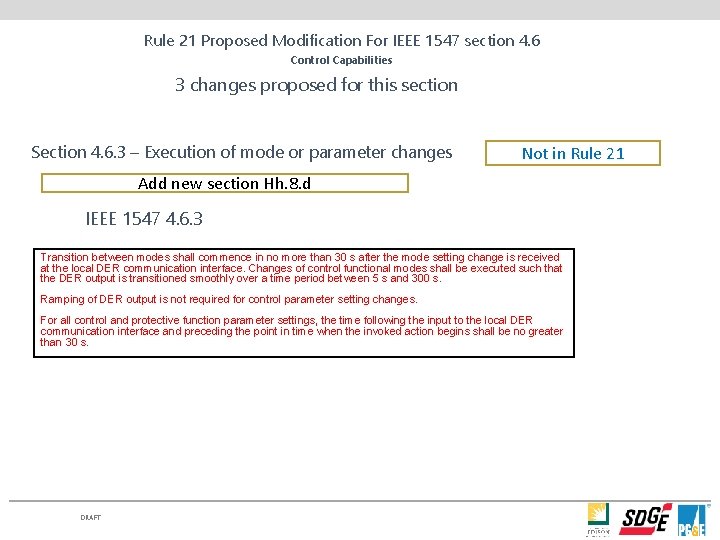
Rule 21 Proposed Modification For IEEE 1547 section 4. 6 Control Capabilities 3 changes proposed for this section Section 4. 6. 3 – Execution of mode or parameter changes Not in Rule 21 Add new section Hh. 8. d IEEE 1547 4. 6. 3 Transition between modes shall commence in no more than 30 s after the mode setting change is received at the local DER communication interface. Changes of control functional modes shall be executed such that the DER output is transitioned smoothly over a time period between 5 s and 300 s. Ramping of DER output is not required for control parameter setting changes. For all control and protective function parameter settings, the time following the input to the local DER communication interface and preceding the point in time when the invoked action begins shall be no greater than 30 s. DRAFT
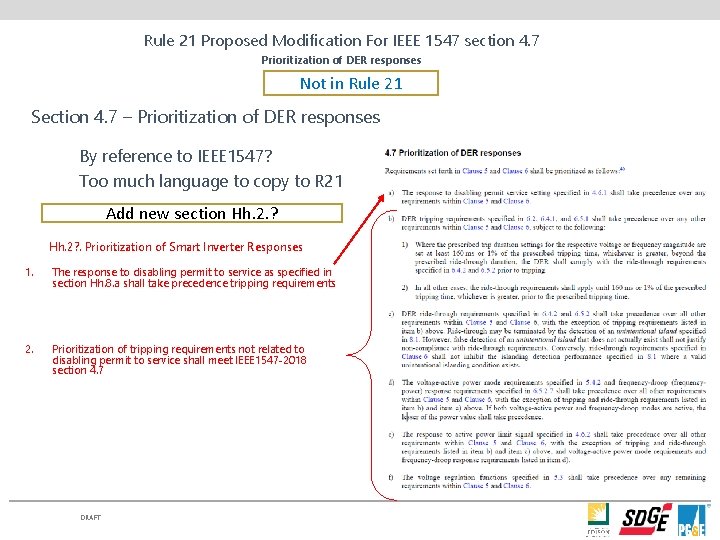
Rule 21 Proposed Modification For IEEE 1547 section 4. 7 Prioritization of DER responses Not in Rule 21 Section 4. 7 – Prioritization of DER responses By reference to IEEE 1547? Too much language to copy to R 21 Add new section Hh. 2. ? Hh. 2? . Prioritization of Smart Inverter Responses 1. The response to disabling permit to service as specified in section Hh. 8. a shall take precedence tripping requirements 2. Prioritization of tripping requirements not related to disabling permit to service shall meet IEEE 1547 -2018 section 4. 7 DRAFT
Rule 21 Proposed Modification For IEEE 1547 section 4. 8 Isolation Device Section 4. 8 – Isolation Device Rule 21 Section Hh. 1. d No changes proposed for this section DRAFT
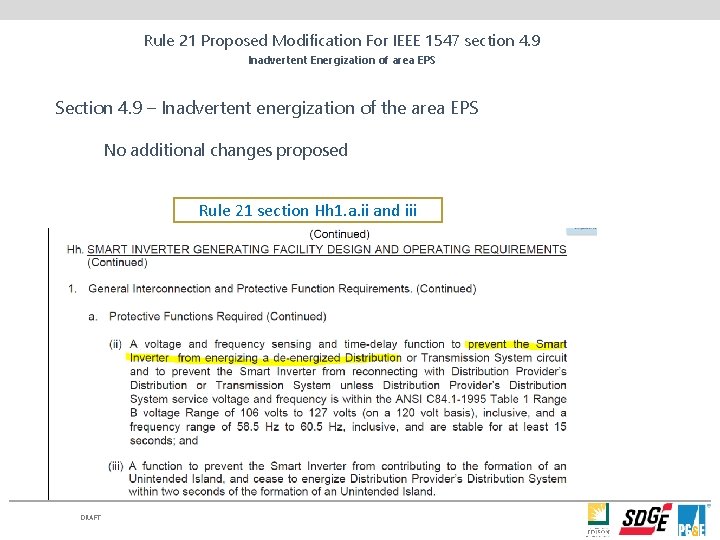
Rule 21 Proposed Modification For IEEE 1547 section 4. 9 Inadvertent Energization of area EPS Section 4. 9 – Inadvertent energization of the area EPS No additional changes proposed Rule 21 section Hh 1. a. ii and iii DRAFT
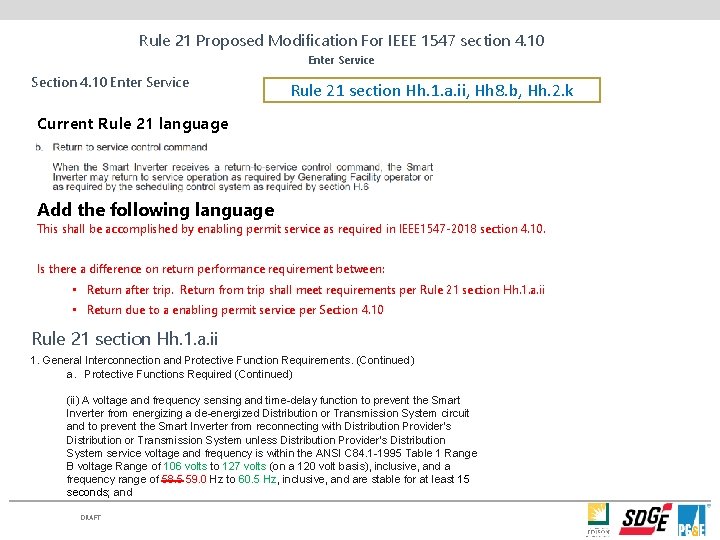
Rule 21 Proposed Modification For IEEE 1547 section 4. 10 Enter Service Section 4. 10 Enter Service Rule 21 section Hh. 1. a. ii, Hh 8. b, Hh. 2. k Current Rule 21 language Add the following language This shall be accomplished by enabling permit service as required in IEEE 1547 -2018 section 4. 10. Is there a difference on return performance requirement between: • Return after trip. Return from trip shall meet requirements per Rule 21 section Hh. 1. a. ii • Return due to a enabling permit service per Section 4. 10 Rule 21 section Hh. 1. a. ii 1. General Interconnection and Protective Function Requirements. (Continued) a. Protective Functions Required (Continued) (ii) A voltage and frequency sensing and time-delay function to prevent the Smart Inverter from energizing a de-energized Distribution or Transmission System circuit and to prevent the Smart Inverter from reconnecting with Distribution Provider’s Distribution or Transmission System unless Distribution Provider’s Distribution System service voltage and frequency is within the ANSI C 84. 1 -1995 Table 1 Range B voltage Range of 106 volts to 127 volts (on a 120 volt basis), inclusive, and a frequency range of 58. 5 59. 0 Hz to 60. 5 Hz, inclusive, and are stable for at least 15 seconds; and DRAFT
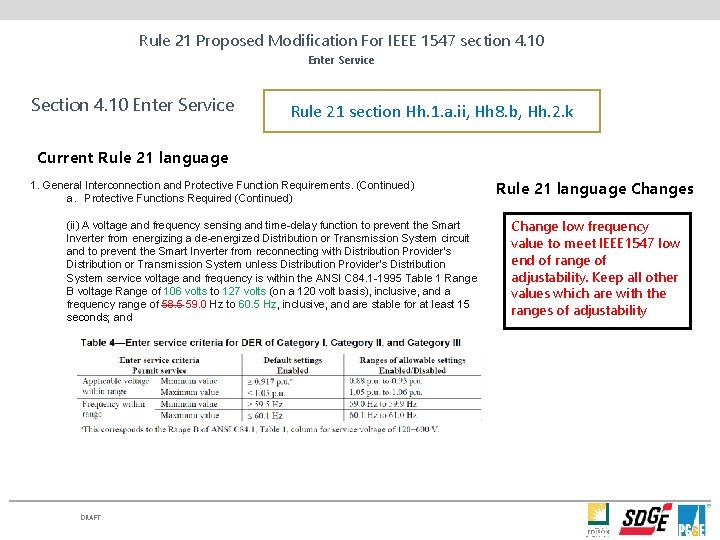
Rule 21 Proposed Modification For IEEE 1547 section 4. 10 Enter Service Section 4. 10 Enter Service Rule 21 section Hh. 1. a. ii, Hh 8. b, Hh. 2. k Current Rule 21 language 1. General Interconnection and Protective Function Requirements. (Continued) a. Protective Functions Required (Continued) (ii) A voltage and frequency sensing and time-delay function to prevent the Smart Inverter from energizing a de-energized Distribution or Transmission System circuit and to prevent the Smart Inverter from reconnecting with Distribution Provider’s Distribution or Transmission System unless Distribution Provider’s Distribution System service voltage and frequency is within the ANSI C 84. 1 -1995 Table 1 Range B voltage Range of 106 volts to 127 volts (on a 120 volt basis), inclusive, and a frequency range of 58. 5 59. 0 Hz to 60. 5 Hz, inclusive, and are stable for at least 15 seconds; and DRAFT Rule 21 language Changes Change low frequency value to meet IEEE 1547 low end of range of adjustability. Keep all other values which are with the ranges of adjustability
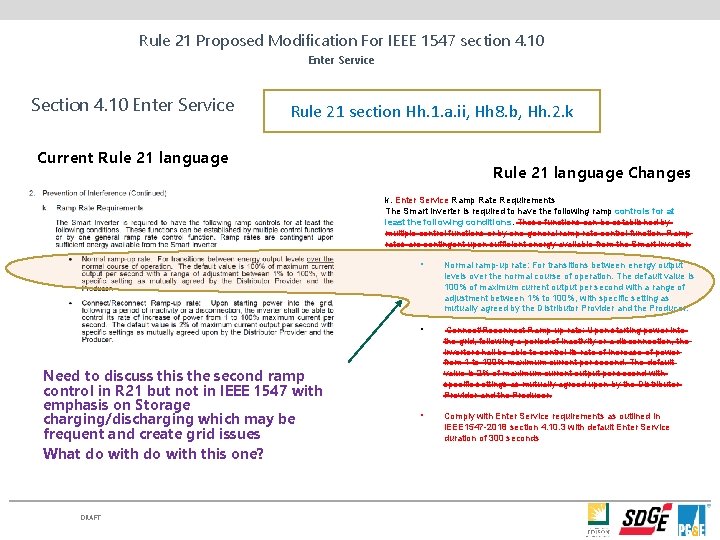
Rule 21 Proposed Modification For IEEE 1547 section 4. 10 Enter Service Section 4. 10 Enter Service Rule 21 section Hh. 1. a. ii, Hh 8. b, Hh. 2. k Current Rule 21 language Changes k. Enter Service Ramp Rate Requirements The Smart Inverter is required to have the following ramp controls for at least the following conditions. These functions can be established by multiple control functions or by one general ramp rate control function. Ramp rates are contingent upon sufficient energy available from the Smart Inverter. Need to discuss this the second ramp control in R 21 but not in IEEE 1547 with emphasis on Storage charging/discharging which may be frequent and create grid issues What do with this one? DRAFT • Normal ramp-up rate: For transitions between energy output levels over the normal course of operation. The default value is 100% of maximum current output per second with a range of adjustment between 1% to 100%, with specific setting as mutually agreed by the Distributor Provider and the Producer. • Connect/Reconnect Ramp-up rate: Upon starting power into the grid, following a period of inactivity or a disconnection, the inverter shall be able to control its rate of increase of power from 1 to 100% maximum current per second. The default value is 2% of maximum current output per second with specific settings as mutually agreed upon by the Distributor Provider and the Producer. • Comply with Enter Service requirements as outlined in IEEE 1547 -2018 section 4. 10. 3 with default Enter Service duration of 300 seconds
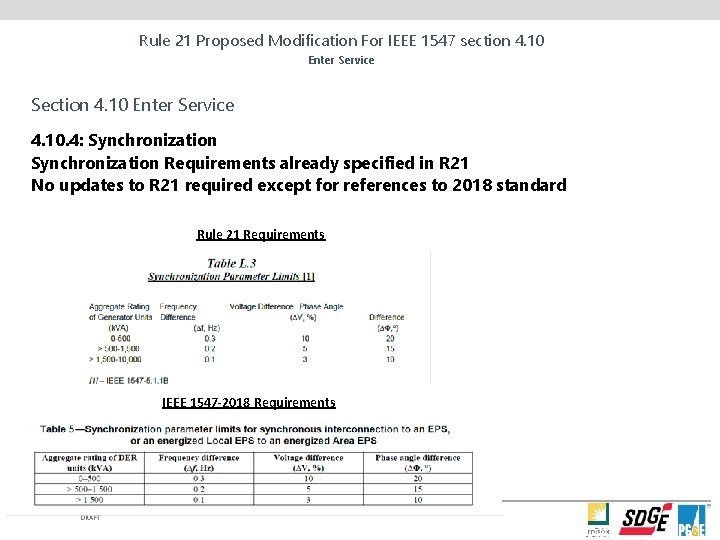
Rule 21 Proposed Modification For IEEE 1547 section 4. 10 Enter Service Section 4. 10 Enter Service 4. 10. 4: Synchronization Requirements already specified in R 21 No updates to R 21 required except for references to 2018 standard Rule 21 Requirements IEEE 1547 -2018 Requirements DRAFT
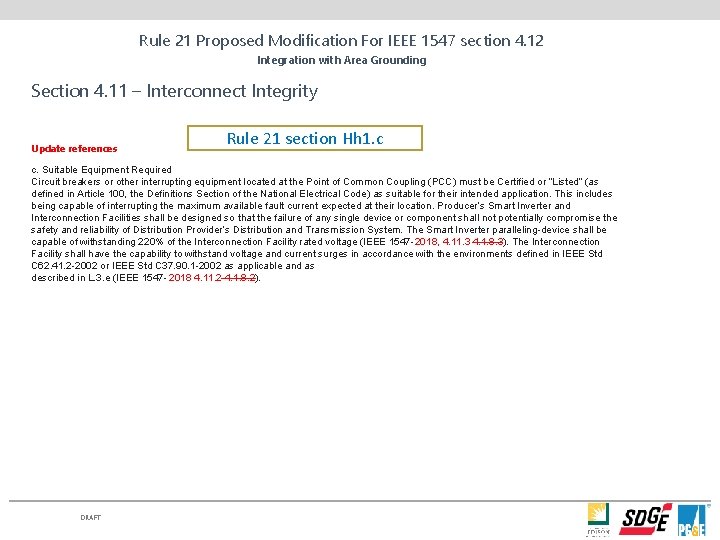
Rule 21 Proposed Modification For IEEE 1547 section 4. 12 Integration with Area Grounding Section 4. 11 – Interconnect Integrity Update references Rule 21 section Hh 1. c c. Suitable Equipment Required Circuit breakers or other interrupting equipment located at the Point of Common Coupling (PCC) must be Certified or “Listed” (as defined in Article 100, the Definitions Section of the National Electrical Code) as suitable for their intended application. This includes being capable of interrupting the maximum available fault current expected at their location. Producer’s Smart Inverter and Interconnection Facilities shall be designed so that the failure of any single device or component shall not potentially compromise the safety and reliability of Distribution Provider’s Distribution and Transmission System. The Smart Inverter paralleling-device shall be capable of withstanding 220% of the Interconnection Facility rated voltage (IEEE 1547 - 2018, 4. 11. 3 4. 1. 8. 3). The Interconnection Facility shall have the capability to withstand voltage and current surges in accordance with the environments defined in IEEE Std C 62. 41. 2 -2002 or IEEE Std C 37. 90. 1 -2002 as applicable and as described in L. 3. e (IEEE 1547 - 2018 4. 11. 2 -4. 1. 8. 2). DRAFT
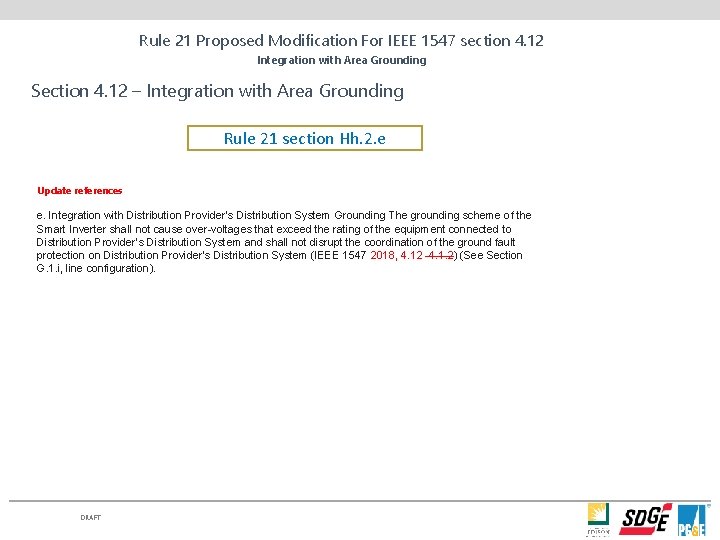
Rule 21 Proposed Modification For IEEE 1547 section 4. 12 Integration with Area Grounding Section 4. 12 – Integration with Area Grounding Rule 21 section Hh. 2. e Update references e. Integration with Distribution Provider’s Distribution System Grounding The grounding scheme of the Smart Inverter shall not cause over-voltages that exceed the rating of the equipment connected to Distribution Provider’s Distribution System and shall not disrupt the coordination of the ground fault protection on Distribution Provider’s Distribution System (IEEE 1547 2018, 4. 12 -4. 1. 2) (See Section G. 1. i, line configuration). DRAFT
Rule 21 Proposed Modification For IEEE 1547 section 4. 13 Exception for emergency systems and standby DER Section 4. 13 – Exemption for emergency systems and standby DER Not covered by R 21 DRAFT
Discussion DRAFT
Thank you! For Additional Information visit: http: //www. cpuc. ca. gov/General. aspx? id=4154 or contact Sophie Meyer at: sme@cpuc. ca. gov 36
- Slides: 36