
Smart Inverter Working Group SIWG August 15 2018


- Slides: 16
Smart Inverter Working Group (SIWG) August 15, 2018 Meeting 1 -4 PM PST 1
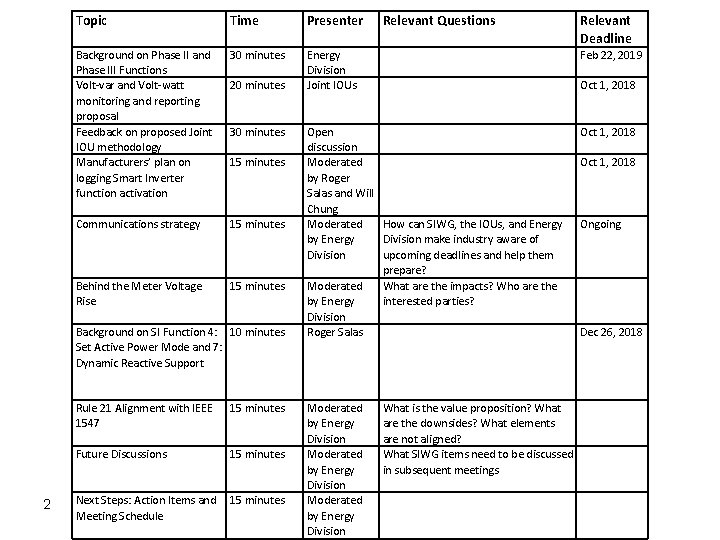
Topic Time Presenter Relevant Questions Relevant Deadline Background on Phase II and Phase III Functions Volt-var and Volt-watt monitoring and reporting proposal Feedback on proposed Joint IOU methodology Manufacturers’ plan on logging Smart Inverter function activation 30 minutes Energy Division Joint IOUs Feb 22, 2019 Oct 1, 2018 Communications strategy 15 minutes Open discussion Moderated by Roger Salas and Will Chung Moderated by Energy Division Ongoing Behind the Meter Voltage Rise 15 minutes How can SIWG, the IOUs, and Energy Division make industry aware of upcoming deadlines and help them prepare? What are the impacts? Who are the interested parties? Dec 26, 2018 20 minutes 30 minutes 15 minutes Background on SI Function 4: 10 minutes Set Active Power Mode and 7: Dynamic Reactive Support 2 Rule 21 Alignment with IEEE 1547 15 minutes Future Discussions 15 minutes Next Steps: Action Items and 15 minutes Meeting Schedule Moderated by Energy Division Roger Salas Moderated by Energy Division What is the value proposition? What are the downsides? What elements are not aligned? What SIWG items need to be discussed in subsequent meetings
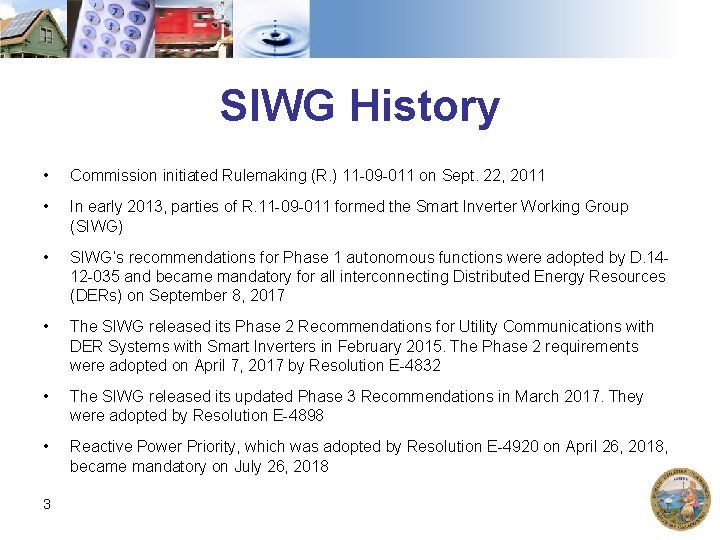
SIWG History • Commission initiated Rulemaking (R. ) 11 -09 -011 on Sept. 22, 2011 • In early 2013, parties of R. 11 -09 -011 formed the Smart Inverter Working Group (SIWG) • SIWG’s recommendations for Phase 1 autonomous functions were adopted by D. 1412 -035 and became mandatory for all interconnecting Distributed Energy Resources (DERs) on September 8, 2017 • The SIWG released its Phase 2 Recommendations for Utility Communications with DER Systems with Smart Inverters in February 2015. The Phase 2 requirements were adopted on April 7, 2017 by Resolution E-4832 • The SIWG released its updated Phase 3 Recommendations in March 2017. They were adopted by Resolution E-4898 • Reactive Power Priority, which was adopted by Resolution E-4920 on April 26, 2018, became mandatory on July 26, 2018 3
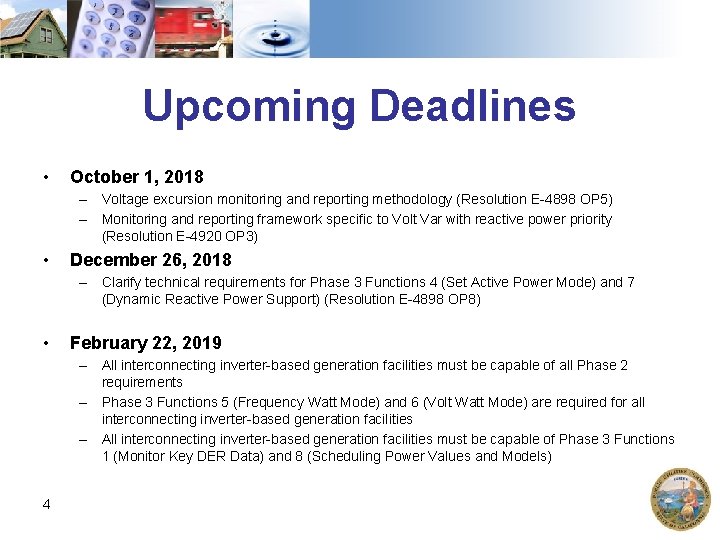
Upcoming Deadlines • October 1, 2018 – Voltage excursion monitoring and reporting methodology (Resolution E-4898 OP 5) – Monitoring and reporting framework specific to Volt Var with reactive power priority (Resolution E-4920 OP 3) • December 26, 2018 – Clarify technical requirements for Phase 3 Functions 4 (Set Active Power Mode) and 7 (Dynamic Reactive Power Support) (Resolution E-4898 OP 8) • February 22, 2019 – All interconnecting inverter-based generation facilities must be capable of all Phase 2 requirements – Phase 3 Functions 5 (Frequency Watt Mode) and 6 (Volt Watt Mode) are required for all interconnecting inverter-based generation facilities – All interconnecting inverter-based generation facilities must be capable of Phase 3 Functions 1 (Monitor Key DER Data) and 8 (Scheduling Power Values and Models) 4
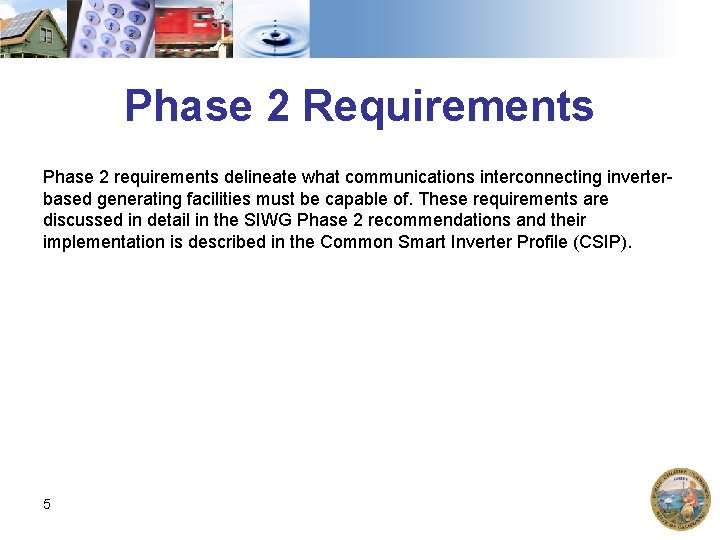
Phase 2 Requirements Phase 2 requirements delineate what communications interconnecting inverterbased generating facilities must be capable of. These requirements are discussed in detail in the SIWG Phase 2 recommendations and their implementation is described in the Common Smart Inverter Profile (CSIP). 5
Phase 3 Functions The Phase 3 Functions are summarized in Resolution E-4898: 1. Monitor Key DER Data 2. DER Disconnect and Reconnect Command (Cease to Energize and Return to Service) 3. Limit Maximum Active Power Mode 4. Set Active Power Mode 5. Frequency Watt Mode 6. Volt Watt Mode 7. Dynamic Reactive Support 8. Scheduling Power Values and Models 6
Phase 3 Function 1 Monitor Key DER Data: The inverter takes measurements as it converts power. With the ability to communicate, the inverter or aggregator can send this information, such as voltage and active and reactive power, to the utility. Required data types are listed in CSIP Table 2. 7
Phase 3 Function 2 DER Disconnect and Reconnect Command (Cease to Energize and Return to Service): In certain situations, the utility may need to de-energize circuits to perform maintenance or repairs, or to prevent unsafe conditions during an emergency. With this function, the utility can send a command to the inverter to disconnect the DER from the local electrical system or prevent the DER from energizing the local system. 8
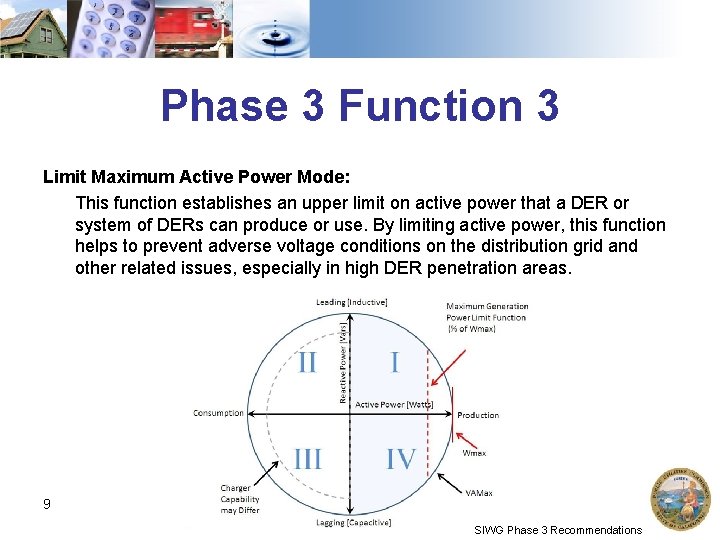
Phase 3 Function 3 Limit Maximum Active Power Mode: This function establishes an upper limit on active power that a DER or system of DERs can produce or use. By limiting active power, this function helps to prevent adverse voltage conditions on the distribution grid and other related issues, especially in high DER penetration areas. 9 SIWG Phase 3 Recommendations
Phase 3 Function 4 Set Active Power Mode: Similar to the previous function, this function establishes the active power that a DER or a system of DERs can produce or use. 10
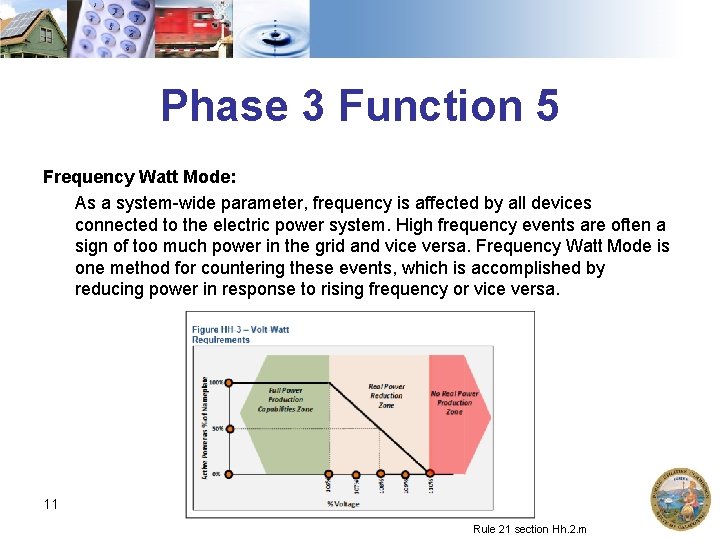
Phase 3 Function 5 Frequency Watt Mode: As a system-wide parameter, frequency is affected by all devices connected to the electric power system. High frequency events are often a sign of too much power in the grid and vice versa. Frequency Watt Mode is one method for countering these events, which is accomplished by reducing power in response to rising frequency or vice versa. 11 Rule 21 section Hh. 2. m
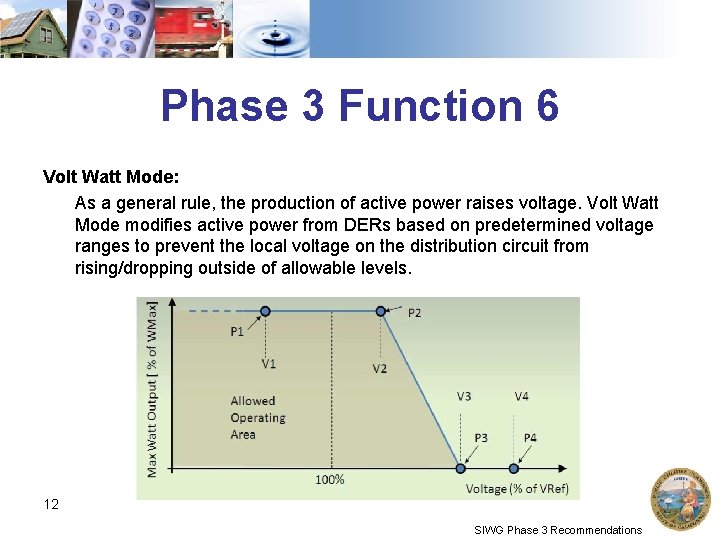
Phase 3 Function 6 Volt Watt Mode: As a general rule, the production of active power raises voltage. Volt Watt Mode modifies active power from DERs based on predetermined voltage ranges to prevent the local voltage on the distribution circuit from rising/dropping outside of allowable levels. 12 SIWG Phase 3 Recommendations
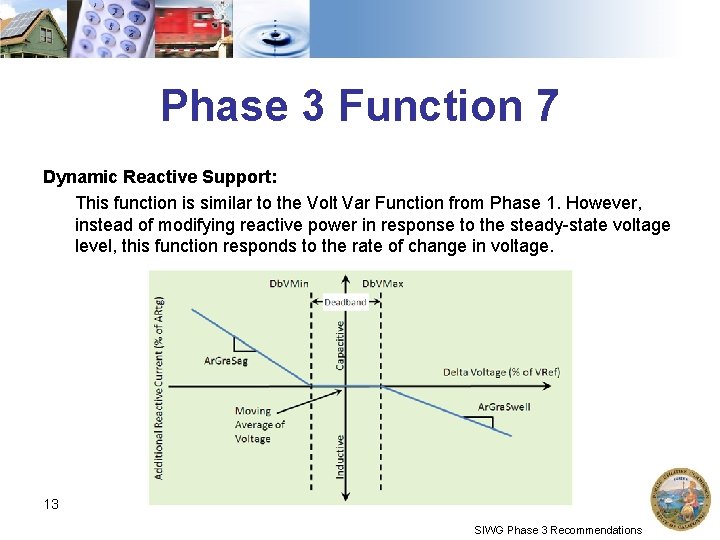
Phase 3 Function 7 Dynamic Reactive Support: This function is similar to the Volt Var Function from Phase 1. However, instead of modifying reactive power in response to the steady-state voltage level, this function responds to the rate of change in voltage. 13 SIWG Phase 3 Recommendations
Phase 3 Function 8 Scheduling Power Values and Models: This function enables scheduling of active and reactive power, as well as modification of settings of other functions. 14
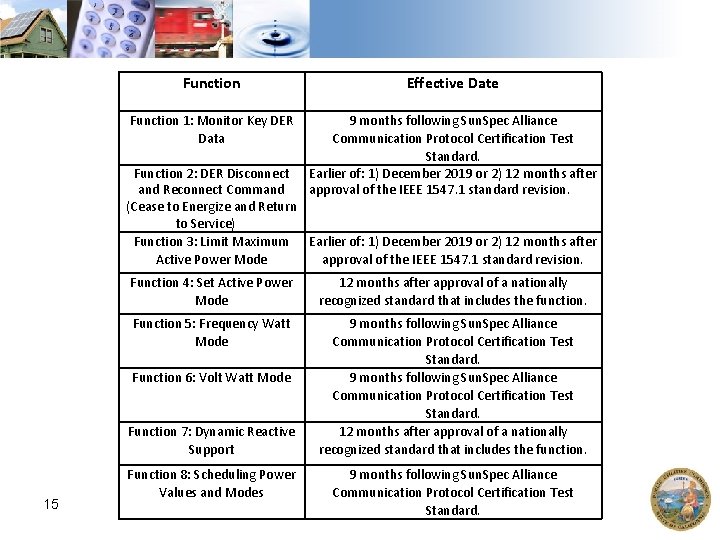
Function Effective Date Function 1: Monitor Key DER Data 9 months following Sun. Spec Alliance Communication Protocol Certification Test Standard. Earlier of: 1) December 2019 or 2) 12 months after approval of the IEEE 1547. 1 standard revision. Function 2: DER Disconnect and Reconnect Command (Cease to Energize and Return to Service) Function 3: Limit Maximum Earlier of: 1) December 2019 or 2) 12 months after Active Power Mode approval of the IEEE 1547. 1 standard revision. Function 4: Set Active Power Mode 12 months after approval of a nationally recognized standard that includes the function. Function 5: Frequency Watt Mode 9 months following Sun. Spec Alliance Communication Protocol Certification Test Standard. 12 months after approval of a nationally recognized standard that includes the function. Function 6: Volt Watt Mode Function 7: Dynamic Reactive Support 15 Function 8: Scheduling Power Values and Modes 9 months following Sun. Spec Alliance Communication Protocol Certification Test Standard.
Thank you! For Additional Information visit: http: //www. cpuc. ca. gov/General. aspx? id=4154 or contact Sophie Meyer at: sophie. meyer@cpuc. ca. gov 16