
Smart Home 4 th Annual Senior Design Symposium

- Slides: 17
Smart Home 4 th Annual Senior Design Symposium On Renewable & Sustainable Energy Friday, April 13, 2012 Department of electrical engineering and computer science Daniel Arnett · Joseph Vanciel · Brian Krueger Advisor: Dr. Samuel Richie Sponsor: Workforce Central Florida Mentor: Sean Donovan
Speaker: Dan Arnett Smart Home Motivation �Energy costs continue to rise �Energy independence is an important national issue, with energy conservation as a key component �With the advances in mobile technologies, people want increasingly more access and control over all aspects of their lives
Speaker: Dan Arnett Similar Technologies �There already companies in industry that have similar implementations such as Project Jarvis and Home Automation, Inc. �For our Senior Design project, we wanted to create a Smart Home that helped conserve energy, allowed for remote access over the internet, and allowed us to showcase our electrical and computer engineering skill sets.
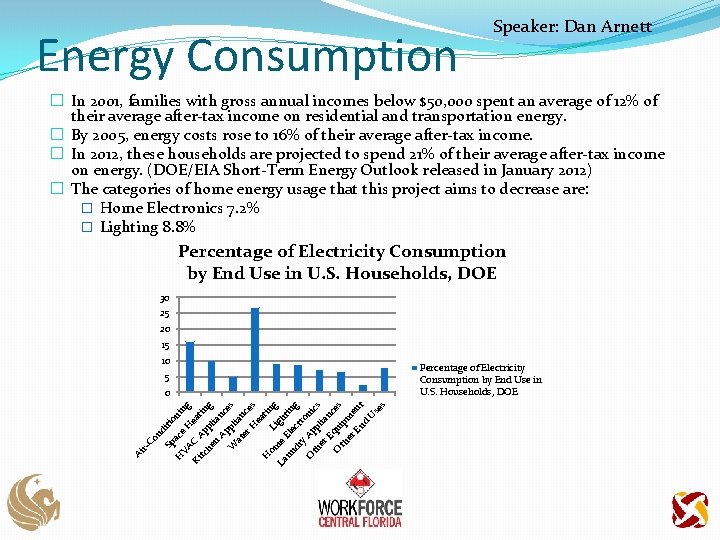
Energy Consumption Speaker: Dan Arnett � In 2001, families with gross annual incomes below $50, 000 spent an average of 12% of their average after-tax income on residential and transportation energy. � By 2005, energy costs rose to 16% of their average after-tax income. � In 2012, these households are projected to spend 21% of their average after-tax income on energy. (DOE/EIA Short-Term Energy Outlook released in January 2012) � The categories of home energy usage that this project aims to decrease are: � Home Electronics 7. 2% � Lighting 8. 8% Percentage of Electricity Consumption by End Use in U. S. Households, DOE 30 25 20 15 10 5 Ai r- Co nd Sp itio H ace nin VA g H Ki C A eat i tc he ppl ng i n Ap anc W pli es a at er nce H s ea tin H om L g La e igh t E un in l dr ect g ro y O Ap nic th er plia s n E O qui ces th pm er En ent d U se s 0 Percentage of Electricity Consumption by End Use in U. S. Households, DOE
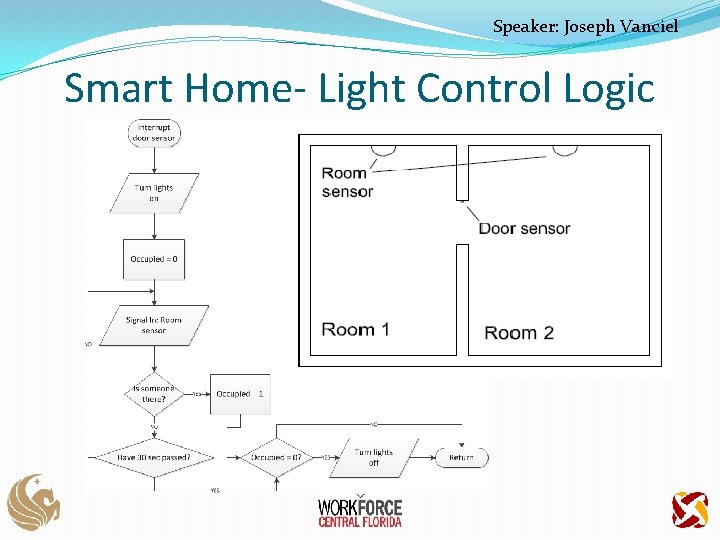
Speaker: Dan Arnett Smart Home – Energy Savings �The first component of the project reduces energy consumption by shutting off unused lights by automatically sensing when someone leaves a room. �The problem with a setup that uses continuous sensor inputs alone is that once the sensors do not sense any activity, the lights will shut off in that room. �This is a problem if someone is in a room, but not moving, and the lights go out since no activity was sensed after a period of time.
Speaker: Dan Arnett Smart Home – Energy Savings �This project gets around this problem by placing motion sensors in each room and at each doorway. �If someone walks through a doorway, the sensors in each room will look for motion, thereby detecting if someone has left the room, or entered the room. �This will prevent the lights from turning off unless someone has left the room. This setup will conveniently allow someone to go from one room to another without having to turn lights off and on as they leave and enter rooms. �That convenience will be combined with the energy savings of eliminating instances where someone forgets to turn off lights in unoccupied rooms.
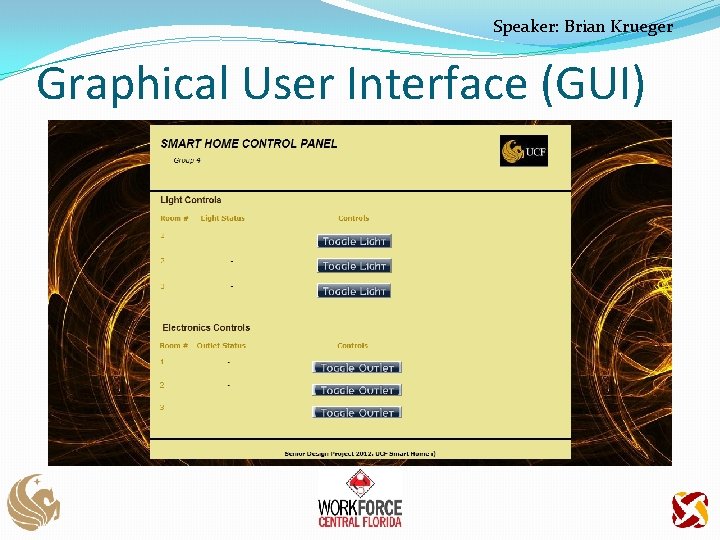
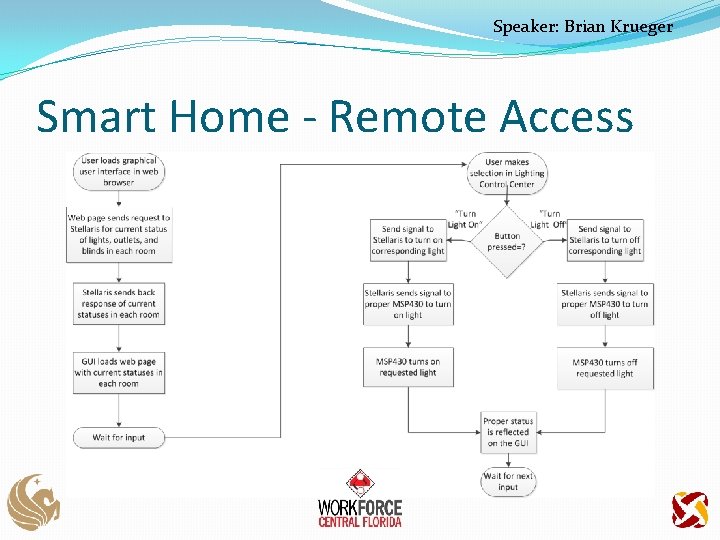
Speaker: Joseph Vanciel Smart Home – Remote Access �The second main component of the project is a website that is hosted on the main microcontroller that will allow a user to remotely access their devices connected to the network from any web browser. �There will be a graphical user interface on the website which will allow the user to view the status of and turn on and off lights and electronics in various rooms.
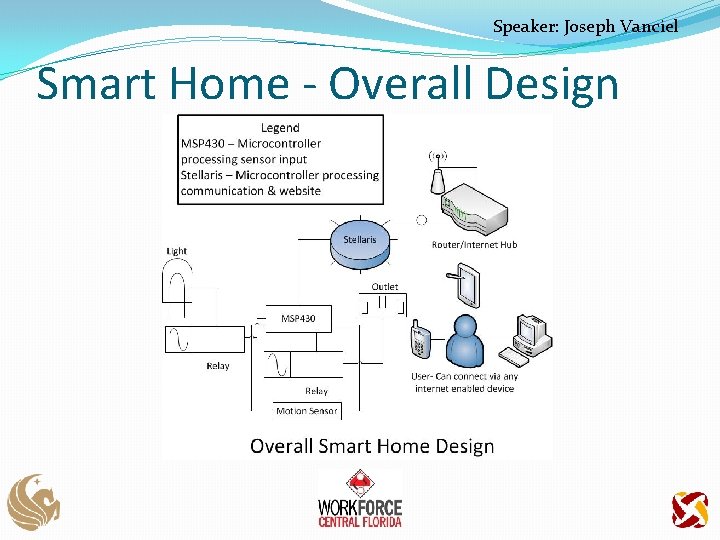
Speaker: Joseph Vanciel Smart Home – Key Components �TI MSP 430 – Microcontroller, used in our system to both configure our devices and processor input from the motion sensors �TI Stellaris – Microcontroller, used in our system to host our website and communicate all information from the MSP 430 to the website. �Na. Pi. On Passive Infrared Sensor – Motion sensor used for detecting motion within each room and at each doorway
Speaker: Joseph Vanciel Smart Home - Overall Design
Speaker: Joseph Vanciel Smart Home- Light Control Logic
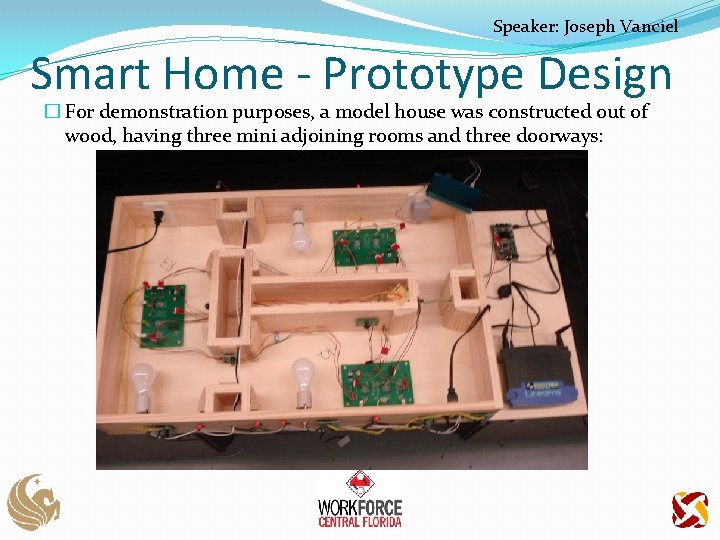
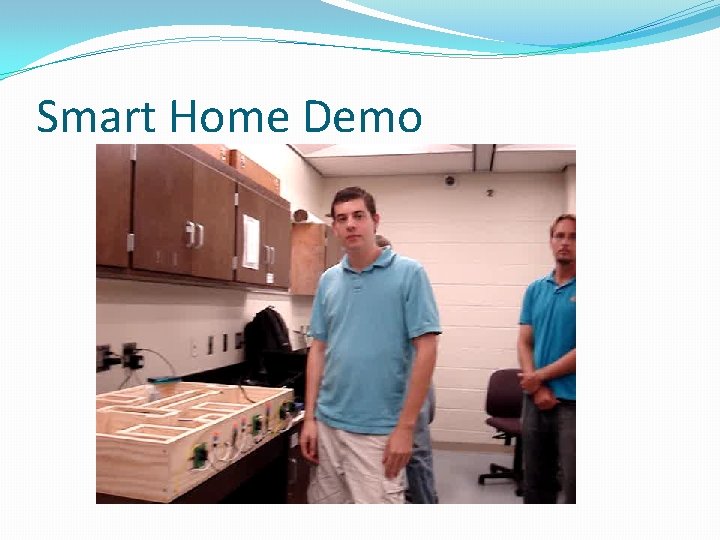
Speaker: Joseph Vanciel Smart Home - Prototype Design � For demonstration purposes, a model house was constructed out of wood, having three mini adjoining rooms and three doorways:
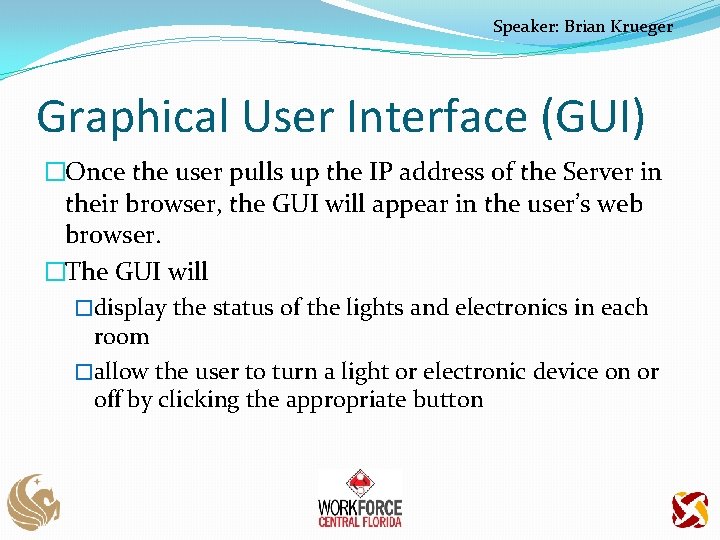
Speaker: Brian Krueger Graphical User Interface (GUI) �Once the user pulls up the IP address of the Server in their browser, the GUI will appear in the user’s web browser. �The GUI will �display the status of the lights and electronics in each room �allow the user to turn a light or electronic device on or off by clicking the appropriate button
Speaker: Brian Krueger Graphical User Interface (GUI)
Speaker: Brian Krueger Smart Home - Remote Access
Smart Home Demo
Speaker: Brian Krueger Summary �In conclusion, we took on this project because it interested us and it was a project where we knew we could put our theory learned in school into practice �We got the opportunity to learn all the business aspects of what goes into an engineering design and implementation �We also learned how to work with, write software for, and trouble shoot several different microcontrollers
Speaker: Brian Krueger Special thanks to: Workforce Central Florida Dr. Samuel Richie Sean Donovan for all their help and support!