
Smart Grid Strategic EMC Recommendations for the future

- Slides: 15
Smart Grid Strategic EMC Recommendations for the future ACIL Conformity Assessment Section 8 October 2019—Nashville meeting Part of Webinar sponsored by the Smart Electric Power Alliance (SEPA) Prepared by the SEPA Electromagnetic Interoperability Issues Working Group (EMIIWG) 1
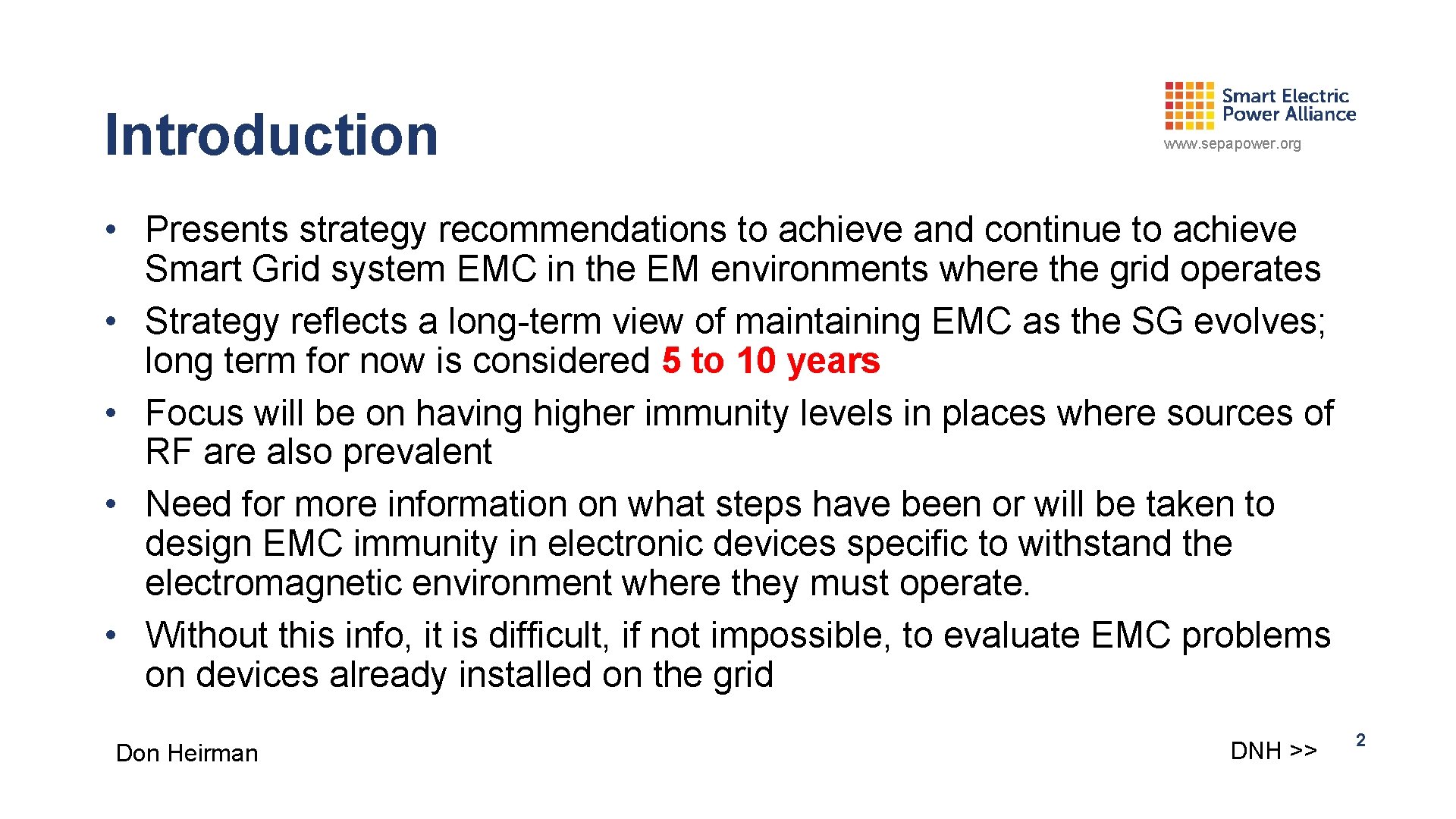
Introduction www. sepapower. org • Presents strategy recommendations to achieve and continue to achieve Smart Grid system EMC in the EM environments where the grid operates • Strategy reflects a long-term view of maintaining EMC as the SG evolves; long term for now is considered 5 to 10 years • Focus will be on having higher immunity levels in places where sources of RF are also prevalent • Need for more information on what steps have been or will be taken to design EMC immunity in electronic devices specific to withstand the electromagnetic environment where they must operate. • Without this info, it is difficult, if not impossible, to evaluate EMC problems on devices already installed on the grid Don Heirman DNH >> 2
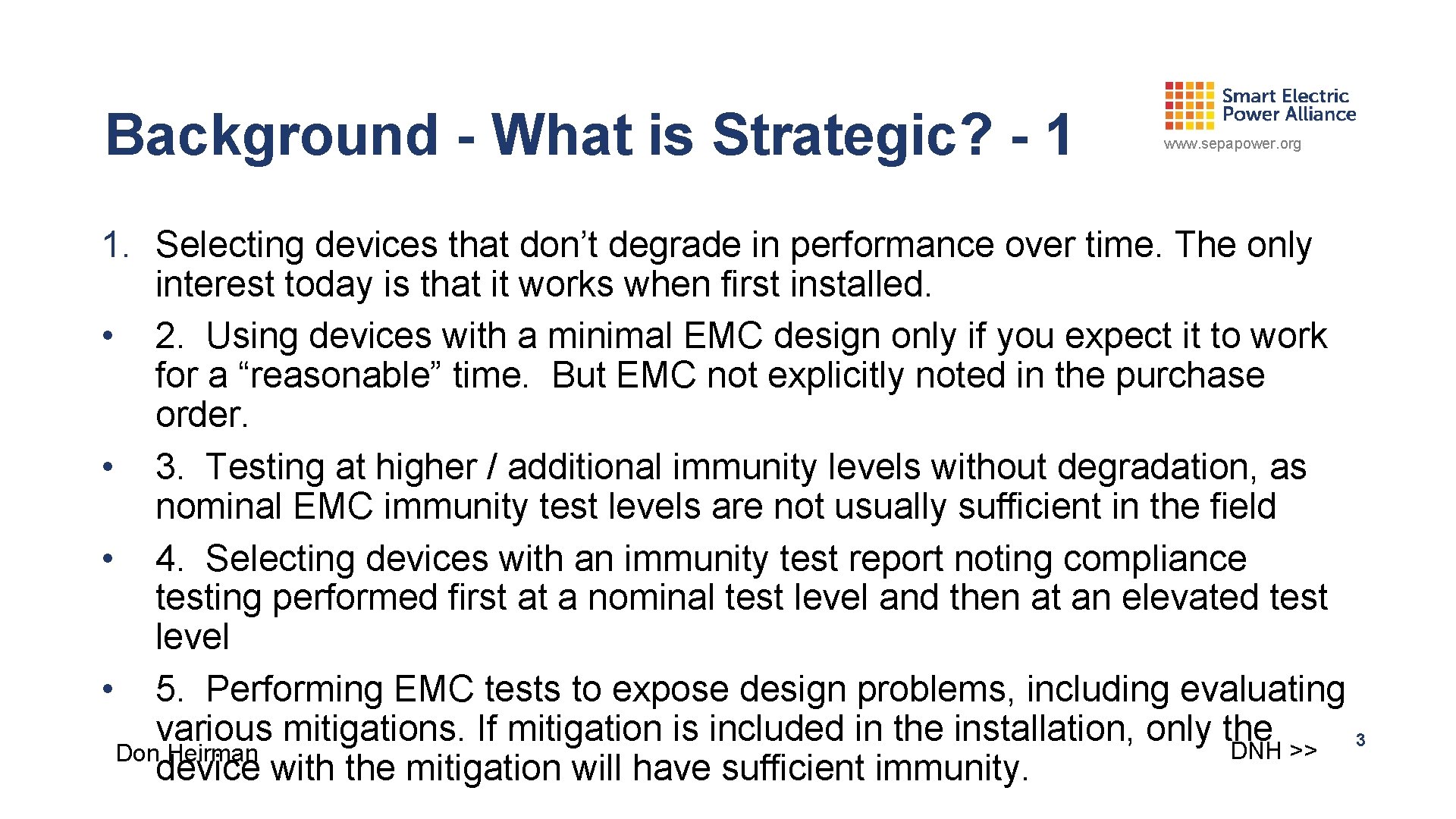
Background - What is Strategic? - 1 www. sepapower. org 1. Selecting devices that don’t degrade in performance over time. The only interest today is that it works when first installed. • 2. Using devices with a minimal EMC design only if you expect it to work for a “reasonable” time. But EMC not explicitly noted in the purchase order. • 3. Testing at higher / additional immunity levels without degradation, as nominal EMC immunity test levels are not usually sufficient in the field • 4. Selecting devices with an immunity test report noting compliance testing performed first at a nominal test level and then at an elevated test level • 5. Performing EMC tests to expose design problems, including evaluating various mitigations. If mitigation is included in the installation, only the 3 DNH >> Don Heirman device with the mitigation will have sufficient immunity.
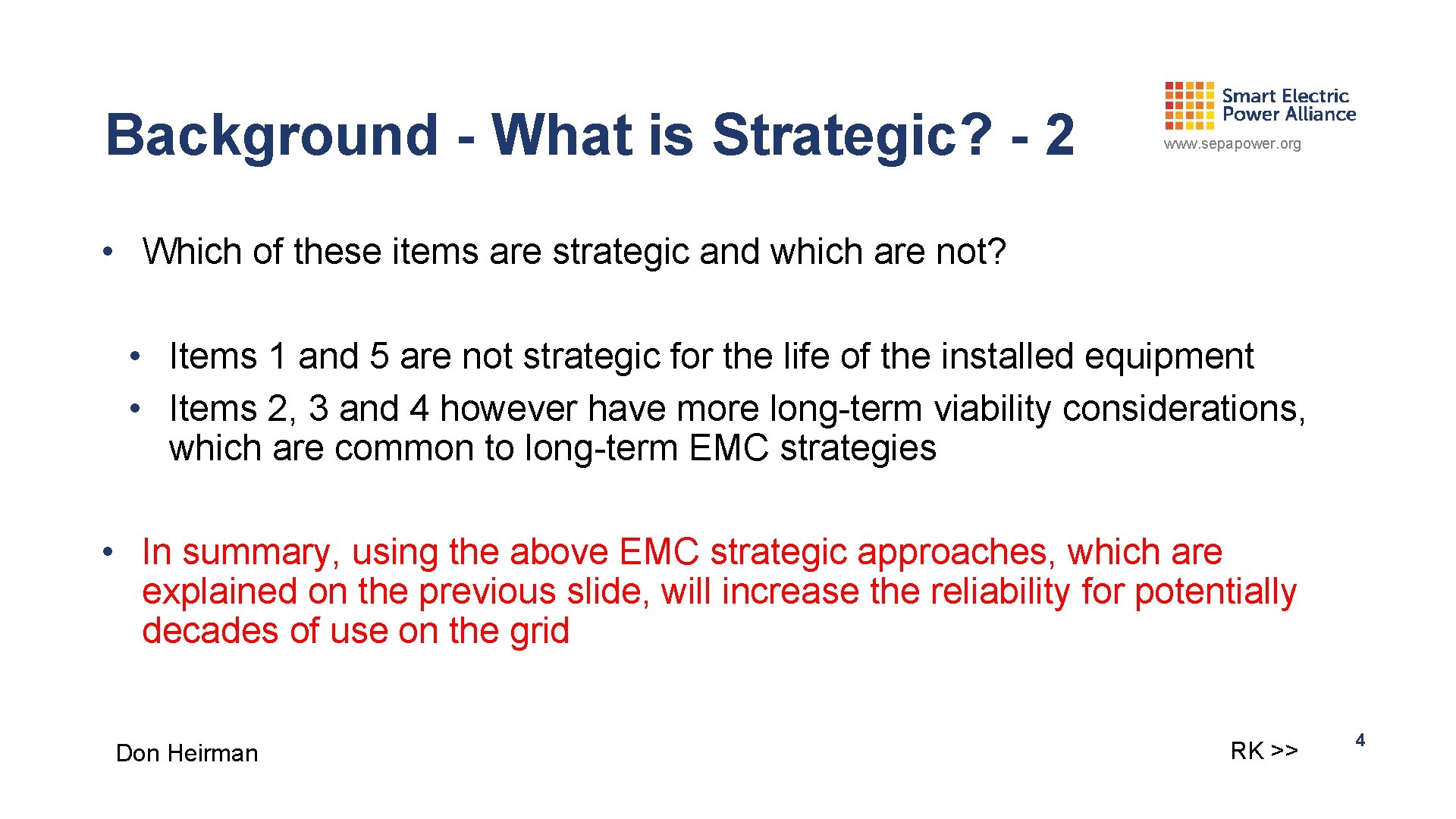
Background - What is Strategic? - 2 www. sepapower. org • Which of these items are strategic and which are not? • Items 1 and 5 are not strategic for the life of the installed equipment • Items 2, 3 and 4 however have more long-term viability considerations, which are common to long-term EMC strategies • In summary, using the above EMC strategic approaches, which are explained on the previous slide, will increase the reliability for potentially decades of use on the grid Don Heirman RK >> 4
EMC Tests that Support the Strategy-1 www. sepapower. org • The start of a SG project is the ideal time to consider EMC performance and testing • EMC performance is an integral part of a product’s development using industry standards for EMC testing of SG Devices • A robust conformity assessment program is a key consideration to applying EMC requirements to SG devices • Previous white papers by the EMIIWG describe the range of EMC tests for SG devices Ray Klouda RK >> 5
EMC Tests that Support the Strategy-2 www. sepapower. org • Further testing should be part of the strategy to maintain EMC performance as the SG installation and SG device matures • Some considerations include: • Replace SG devices in their entirely if they cannot continue to operate in the presence of the changing EM environment • Replace components in the SG device that have been shown to be the cause of loss of interoperability • Consider a new approach in how the SG devices are purchased in the future and what new devices need to be more reliable and hardened against EMC Ray Klouda CF >> 6
Roles of Stakeholders: EMC Test Labs www. sepapower. org • The EMC Test Labs play a key role to determine the EMC immunity of SG devices. • Thorough testing is required to demonstrate the SG Devices’ EMC performance. • The test labs need to be conversant on the device application and the importance of not only passing a “test” but in noting the margin with which the test is passed. This latter view is strategic in that if there are enough margins to cover anticipated future EM environment changes, then there is no need to increase the immunity design level, thereby end up with cost savings Ray Klouda Don Heirman WR >> 7
Roles of Stakeholders: Databases of Issues and Solutions www. sepapower. org • There has to be a way to capture EMC events not only at SG device installation • • but also as the device operates over time Ideally, power utility locations would be in the best place to record EMC issues that have affected their portion of the grid There are sensitivities in not publicizing such EMC-related issues and to keep that in-house, but this may prevent a fix to solve the problem However, the utility industry can use such information to make modification of SG devices based on what other utilities have found as a solution But where should such reports end up? Suggestion is made that a likely agency is FERC (Federal Energy Regulatory Commission) in the Dept of Energy. This would be part of a data base. Annex A shows one such data base used by the Federal Food and Drug Administration (FDA) Don Heirman JR >> 8
Roles of Stakeholders: Associations/power standards development www. sepapower. org • Who helps in developing appropriate EMC standards and testing to them? • There are trade organizations that have test labs that perform EMC immunity tests and assist in developing EMC test standards • A notable Trade Organization is the American Council of Independent Laboratories (ACIL) which has member labs that perform highly sought after “third party” testing • In the IEEE, there are societies such as the Power and Energy Society (PES) that are heavily involved in generating standards to keep power devices used in the SG reliable. Their work is assisted by the IEEE EMC Society so that EMC aspects are clearly included. Don Heirman WR >> 9
Medical Device Immunity Database - 1 www. sepapower. org • Medical devices manufacturers are required to report to the U. S. Food and Drug Administration (FDA) incidents in which their devices contributed to serious injury or death or malfunctioned in a way that could have caused serious injury or death. The reports are compiled in a database that has fields that include device manufacturer, product name, model, event type (malfunction, injury, death), patient problem, device problem, and a narrative of the incident. There is a public and a private version of the database. The public version includes all the information just noted and can be searched online at • www. accessdata. fda. gov/scripts/cdrh/cfdocs/cf. MAUDE/search. CF 10 M DNH >> Don Heirman •
Medical Device Immunity Database - 2 www. sepapower. org • The database includes device problem categories for electromagnetic interference, electromagnetic compatibility issues, radiofrequency interference, electrostatic discharge, wireless communication issue, wireless transmission issues, and radio signal problems. The FDA categorizes medical devices into classes, based on risk. Class II and III information must be submitted before marketing. This must include EMC information, preferably including demonstration of conformity with FDA recognized consensus standards • Class II – Moderate Risk • • Subject to general controls and special controls (e. g. , specific testing/labeling) Premarket clearance (510(k)) – if as safe and effective as legally marketed devices Examples: ventilators, non-invasive blood pressure monitors Class III – Highest Risk • Subject to general controls and premarket approval – if safe and effective Don Heirman • Examples: heart valves, implantable cardioverter defibrillators, AEDs DNH >> 11
Published white papers on SG EMC www. sepapower. org 1. “Evaluation of the Electromagnetic Phenomena Issues on Smart Grid reliability”, • 21 Feb 2017 • https: //sepapower. org/resource/evaluation-electromagnetic-phenomena-issues-smart-gridreliability/ • 2. “Guide for Products tested for EMC performance”, 7 November 2018 • https: //sepapower. org/resource/guide-for-products-tested-for-emc-performance/ • 3. “EMC Test Setups for Smart Grid Devices”, 3 Nov 2017 • https: //sepapower. org/resource/emc-test-setups-smart-grid-devices/ • 4. “Smart Grid Strategic EMC Recommendations for the Future, August 2019 12 DNH >> Don Heirman • https: //sepapower. org/resource/smart-grid-strategic-emc-recommendations-for-the-future/
Summary and Conclusions • www. sepapower. org A strategy has been presented for maintaining EMC for the reliability of the grid after the initial installation of SG devices and power system controls at substations and customer locations. A five to ten-year strategy window is considered a reasonable time to see how EMC applications provide grid reliability. It is further shown that such reliability will require not only initial EMC immunity testing but also later testing especially for devices that have failed in use due to EMC environmental conditions. • Don Heirman DNH >> 13
Thoughts for ACIL continued SEPA involvement • • • www. sepapower. org SEPA membership is a “free” advertisement of ACIL and its third-party testing contribution to well over 1000 SEPA members Renew SEPA membership for 2020 to continue to have a voice in participating in both: • Electromagnetic Interoperability Issues working group (EMIIWG) • Testing and Certification Subcommittee Highlight as a member service ACIL EMC Lab business opportunities Don Heirman DNH >> 14
Questions? 15