
Smart Grid Interoperability Panel SGIP Priority Action Plan

Smart Grid Interoperability Panel (SGIP) Priority Action Plan (PAP) 21: Harmonized Weather Information Susan Hoyler, Director, Technical Operations, SGIP shoyler@sgip. org Marty Burns, Technical Champion, PAP-21 marty@hypertek. us Open Geospatial Consortium Energy and Domain Working Group June 10, 2014 Accelerating Grid Modernization More information available on SGIP. org p: 781 -876 -8857 | e: info @SGIP. org
Agenda • The Smart Grid Interoperability Panel (SGIP) – Domain Expert Working Groups, Standing Committees, Priority Action Plans – Catalog of Standards • Priority Action Plan (PAP) – 21 – Process flow – Business Case – Towards harmonization of weather and environmental data exchange – Core weather model standards 11/1/2020 Accelerating Grid Modernization More information available on SGIP. org 2 p: 781 -876 -8857 | e: info @SGIP. org

SMART GRID INTEROPERABILITY PANEL 11/1/2020 Accelerating Grid Modernization More information available on SGIP. org p: 781 -876 -8857 | e: info @SGIP. org
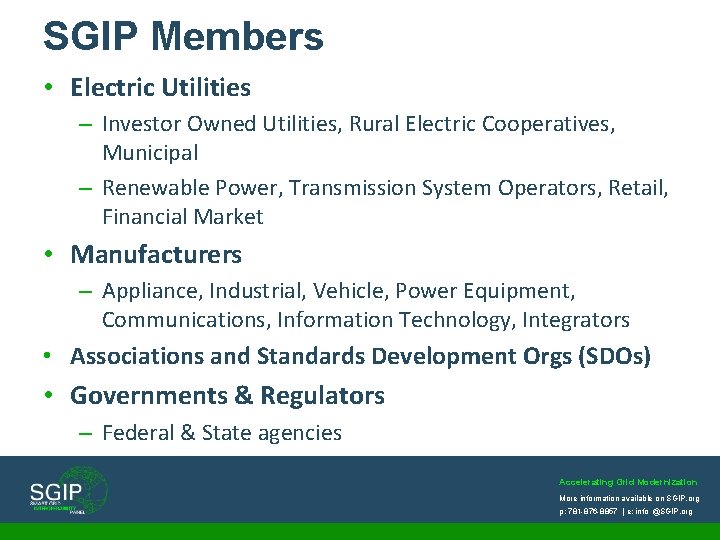
SGIP Members • Electric Utilities – Investor Owned Utilities, Rural Electric Cooperatives, Municipal – Renewable Power, Transmission System Operators, Retail, Financial Market • Manufacturers – Appliance, Industrial, Vehicle, Power Equipment, Communications, Information Technology, Integrators • Associations and Standards Development Orgs (SDOs) • Governments & Regulators – Federal & State agencies Accelerating Grid Modernization More information available on SGIP. org p: 781 -876 -8857 | e: info @SGIP. org
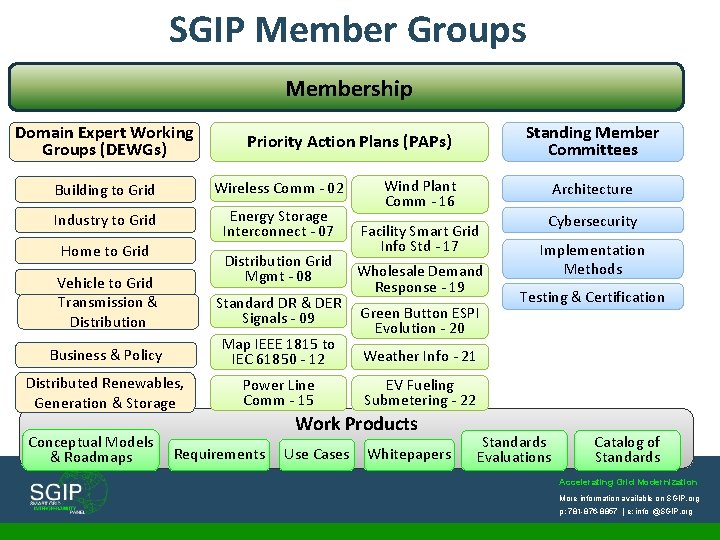
SGIP Member Groups Membership Domain Expert Working Groups (DEWGs) Building to Grid Wireless Comm - 02 Industry to Grid Energy Storage Interconnect - 07 Home to Grid Distribution Grid Mgmt - 08 Vehicle to Grid Transmission & Distribution Standard DR & DER Signals - 09 Business & Policy Map IEEE 1815 to IEC 61850 - 12 Distributed Renewables, Generation & Storage Power Line Comm - 15 Conceptual Models & Roadmaps Standing Member Committees Priority Action Plans (PAPs) Requirements Wind Plant Comm - 16 Facility Smart Grid Info Std - 17 Wholesale Demand Response - 19 Green Button ESPI Evolution - 20 Cybersecurity Implementation Methods Testing & Certification Weather Info - 21 EV Fueling Submetering - 22 Work Products Use Cases Architecture Whitepapers Standards Evaluations Catalog of Standards Accelerating Grid Modernization More information available on SGIP. org p: 781 -876 -8857 | e: info @SGIP. org
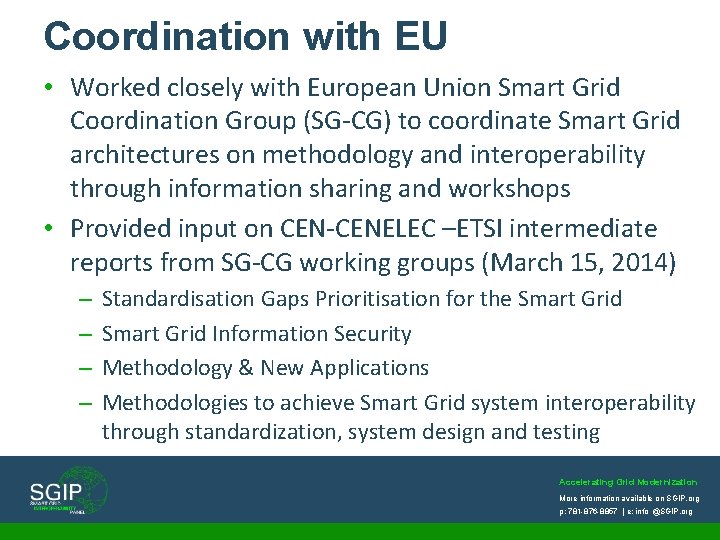
Coordination with EU • Worked closely with European Union Smart Grid Coordination Group (SG-CG) to coordinate Smart Grid architectures on methodology and interoperability through information sharing and workshops • Provided input on CEN-CENELEC –ETSI intermediate reports from SG-CG working groups (March 15, 2014) – – Standardisation Gaps Prioritisation for the Smart Grid Information Security Methodology & New Applications Methodologies to achieve Smart Grid system interoperability through standardization, system design and testing Accelerating Grid Modernization More information available on SGIP. org p: 781 -876 -8857 | e: info @SGIP. org
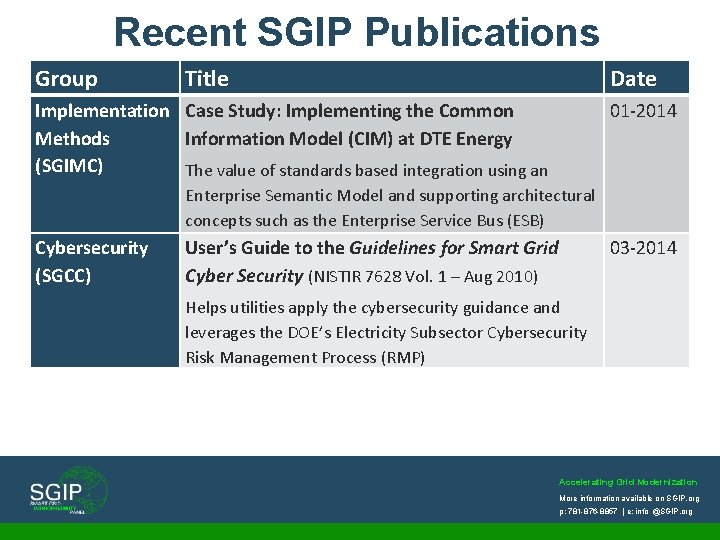
Recent SGIP Publications Group Title Date Implementation Case Study: Implementing the Common Methods Information Model (CIM) at DTE Energy (SGIMC) The value of standards based integration using an 01 -2014 Enterprise Semantic Model and supporting architectural concepts such as the Enterprise Service Bus (ESB) Cybersecurity (SGCC) User’s Guide to the Guidelines for Smart Grid Cyber Security (NISTIR 7628 Vol. 1 – Aug 2010) 03 -2014 Helps utilities apply the cybersecurity guidance and leverages the DOE’s Electricity Subsector Cybersecurity Risk Management Process (RMP) Accelerating Grid Modernization More information available on SGIP. org p: 781 -876 -8857 | e: info @SGIP. org
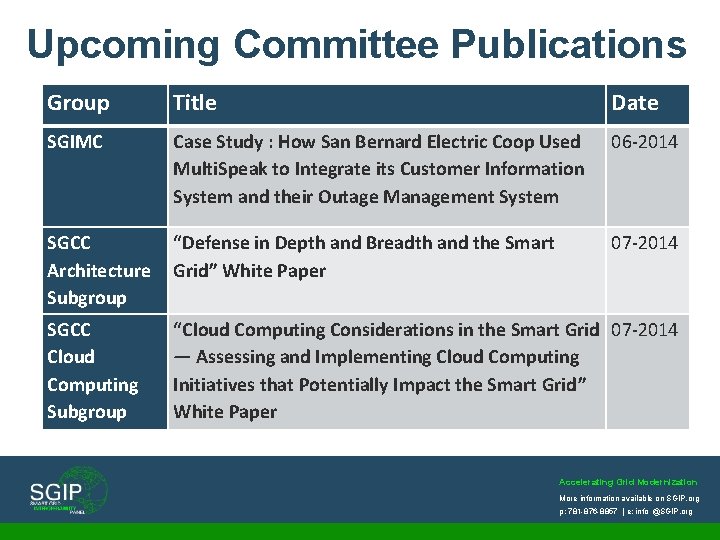
Upcoming Committee Publications Group Title Date SGIMC Case Study : How San Bernard Electric Coop Used Multi. Speak to Integrate its Customer Information System and their Outage Management System 06 -2014 SGCC “Defense in Depth and Breadth and the Smart Architecture Grid” White Paper Subgroup SGCC Cloud Computing Subgroup 07 -2014 “Cloud Computing Considerations in the Smart Grid 07 -2014 — Assessing and Implementing Cloud Computing Initiatives that Potentially Impact the Smart Grid” White Paper Accelerating Grid Modernization More information available on SGIP. org p: 781 -876 -8857 | e: info @SGIP. org
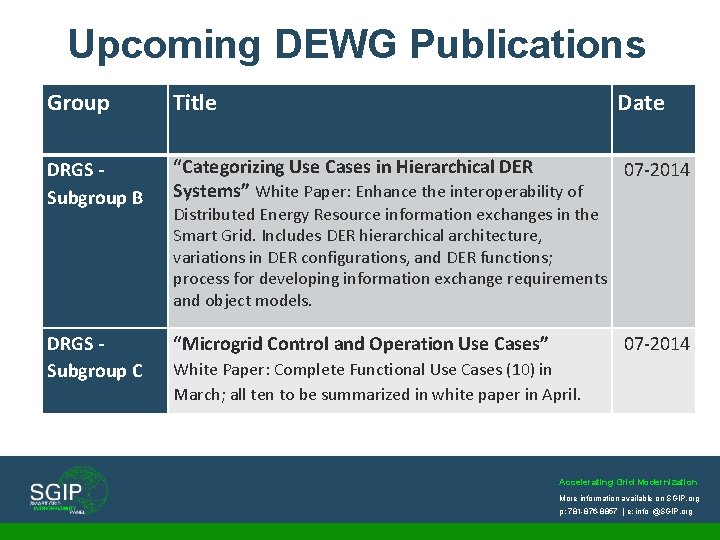
Upcoming DEWG Publications Group Title Date DRGS Subgroup B “Categorizing Use Cases in Hierarchical DER Systems” White Paper: Enhance the interoperability of 07 -2014 DRGS - Subgroup C “Microgrid Control and Operation Use Cases” 07 -2014 Distributed Energy Resource information exchanges in the Smart Grid. Includes DER hierarchical architecture, variations in DER configurations, and DER functions; process for developing information exchange requirements and object models. White Paper: Complete Functional Use Cases (10) in March; all ten to be summarized in white paper in April. Accelerating Grid Modernization More information available on SGIP. org p: 781 -876 -8857 | e: info @SGIP. org
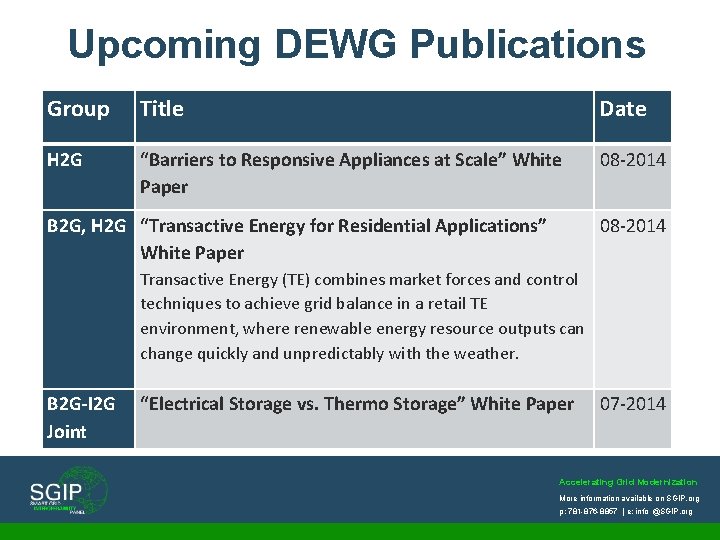
Upcoming DEWG Publications Group Title Date H 2 G “Barriers to Responsive Appliances at Scale” White Paper 08 -2014 B 2 G, H 2 G “Transactive Energy for Residential Applications” White Paper 08 -2014 Transactive Energy (TE) combines market forces and control techniques to achieve grid balance in a retail TE environment, where renewable energy resource outputs can change quickly and unpredictably with the weather. B 2 G-I 2 G “Electrical Storage vs. Thermo Storage” White Paper Joint 07 -2014 Accelerating Grid Modernization More information available on SGIP. org p: 781 -876 -8857 | e: info @SGIP. org
PRIORITY ACTION PLAN (PAP) – 21 HARMONIZED WEATHER INFORMATION 11/1/2020 Accelerating Grid Modernization More information available on SGIP. org p: 781 -876 -8857 | e: info @SGIP. org
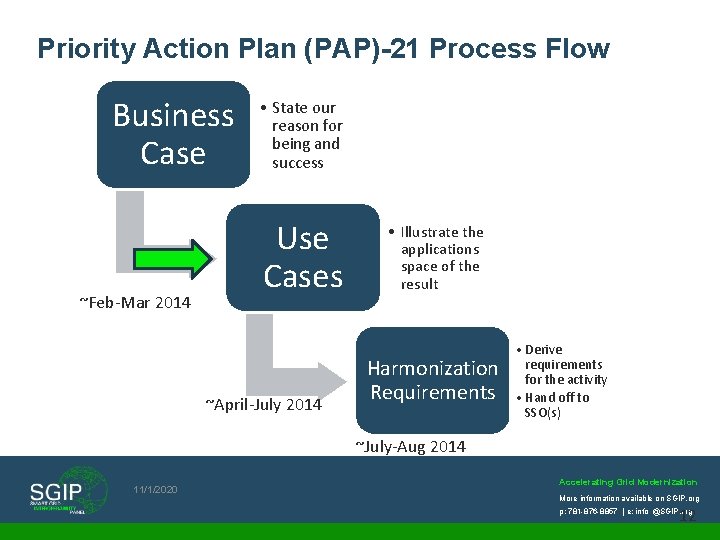
Priority Action Plan (PAP)-21 Process Flow Business Case ~Feb-Mar 2014 • State our reason for being and success Use Cases ~April-July 2014 • Illustrate the applications space of the result Harmonization Requirements • Derive requirements for the activity • Hand off to SSO(s) ~July-Aug 2014 11/1/2020 Accelerating Grid Modernization More information available on SGIP. org 12 p: 781 -876 -8857 | e: info @SGIP. org
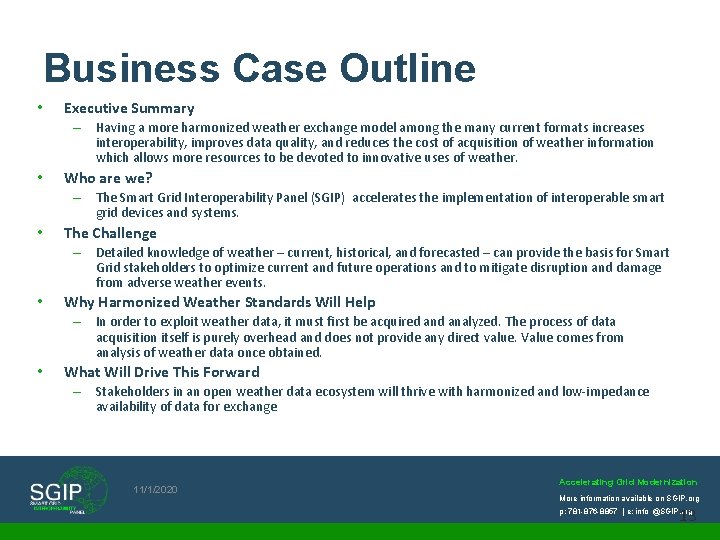
Business Case Outline • Executive Summary – Having a more harmonized weather exchange model among the many current formats increases interoperability, improves data quality, and reduces the cost of acquisition of weather information which allows more resources to be devoted to innovative uses of weather. • Who are we? – The Smart Grid Interoperability Panel (SGIP) accelerates the implementation of interoperable smart grid devices and systems. • The Challenge – Detailed knowledge of weather – current, historical, and forecasted – can provide the basis for Smart Grid stakeholders to optimize current and future operations and to mitigate disruption and damage from adverse weather events. • Why Harmonized Weather Standards Will Help – In order to exploit weather data, it must first be acquired analyzed. The process of data acquisition itself is purely overhead and does not provide any direct value. Value comes from analysis of weather data once obtained. • What Will Drive This Forward – Stakeholders in an open weather data ecosystem will thrive with harmonized and low-impedance availability of data for exchange 11/1/2020 Accelerating Grid Modernization More information available on SGIP. org 13 p: 781 -876 -8857 | e: info @SGIP. org
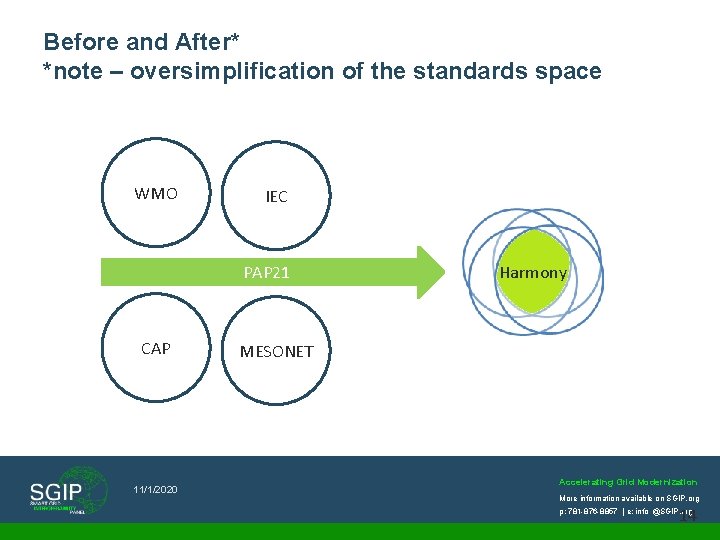
Before and After* *note – oversimplification of the standards space WMO IEC PAP 21 CAP 11/1/2020 Harmony MESONET Accelerating Grid Modernization More information available on SGIP. org 14 p: 781 -876 -8857 | e: info @SGIP. org
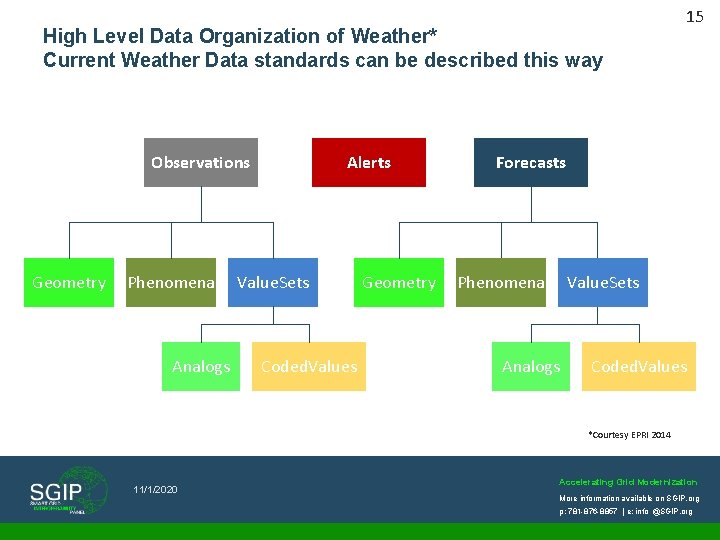
High Level Data Organization of Weather* Current Weather Data standards can be described this way Observations Geometry Phenomena Analogs Alerts Value. Sets Coded. Values Geometry 15 Forecasts Phenomena Value. Sets Analogs Coded. Values *Courtesy EPRI 2014 11/1/2020 Accelerating Grid Modernization More information available on SGIP. org p: 781 -876 -8857 | e: info @SGIP. org
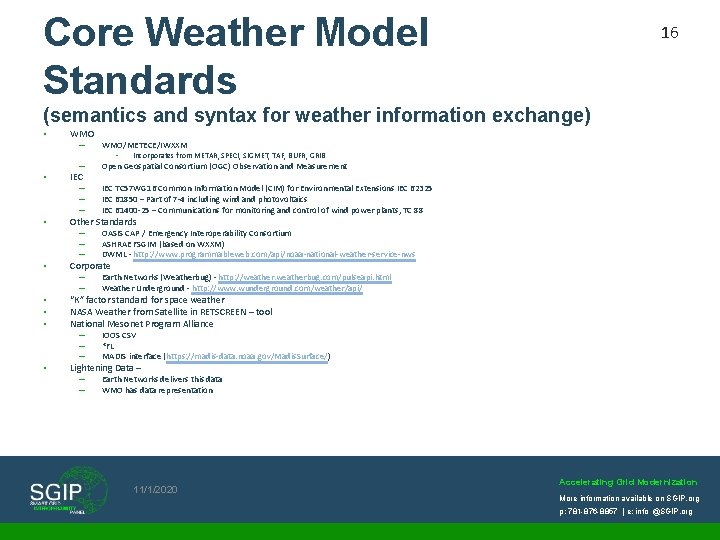
Core Weather Model Standards 16 (semantics and syntax for weather information exchange) • WMO – WMO/METECE/IWXXM – Open Geospatial Consortium (OGC) Observation and Measurement • • IEC – – – • Earth Networks (Weatherbug) - http: //weatherbug. com/pulseapi. html Weather Underground - http: //www. wunderground. com/weather/api/ “K” factor standard for space weather NASA Weather from Satellite in RETSCREEN – tool National Mesonet Program Alliance – – – • OASIS CAP / Emergency Interoperability Consortium ASHRAE FSGIM (based on WXXM) DWML - http: //www. programmableweb. com/api/noaa-national-weather-service-nws Corporate – – • • • IEC TC 57 WG 16 Common Information Model (CIM) for Environmental Extensions IEC 62325 IEC 61850 – Part of 7 -4 including wind and photovoltaics IEC 61400 -25 – Communications for monitoring and control of wind power plants, TC 88 Other Standards – – – • Incorporates from METAR, SPECI, SIGMET, TAF, BUFR, GRIB IOOS CSV *FL MADIS interface (https: //madis-data. noaa. gov/Madis. Surface/) Lightening Data – – – Earth Networks delivers this data WMO has data representation 11/1/2020 Accelerating Grid Modernization More information available on SGIP. org p: 781 -876 -8857 | e: info @SGIP. org
Scales of Motion in the atmosphere • • • Microscale: Atmospheric motions with Lagrangian Rossby numbers greater than 200 or spatial scales 2 km or less. Mesoscale: Pertaining to atmospheric phenomena having horizontal scales ranging from a few to several hundred kilometers, including thunderstorms, squall lines, fronts, precipitation bands in tropical and extratropical cyclones, and topographically generated weather systems such as mountain waves and sea and land breezes. From a dynamical perspective, this term pertains to processes with timescales ranging from the inverse of the Brunt–Väisälä frequency to a pendulum day, encompassing deep moist convection and the full spectrum of inertio-gravity waves but stopping short of synoptic-scale phenomena, which have Rossby numbers less than 1. Synoptic (cyclonic) scale: Used with respect to weather systems ranging in size from several hundred kilometers to several thousand kilometers, the scale of migratory high and low pressure systems (frontal cyclones) of the lower troposphere. The scale of the migratory high and low pressure systems (or cyclone waves) of the troposphere with wave lengths of 1000– 4000 km. 11/1/2020 Accelerating Grid Modernization More information available on SGIP. org p: 781 -876 -8857 | e: info @SGIP. org
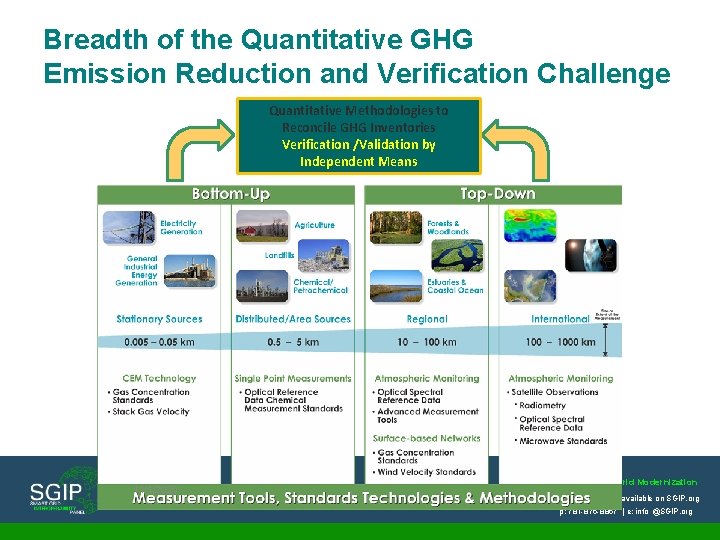
Breadth of the Quantitative GHG Emission Reduction and Verification Challenge Quantitative Methodologies to Reconcile GHG Inventories Verification /Validation by Independent Means 11/1/2020 Accelerating Grid Modernization More information available on SGIP. org p: 781 -876 -8857 | e: info @SGIP. org
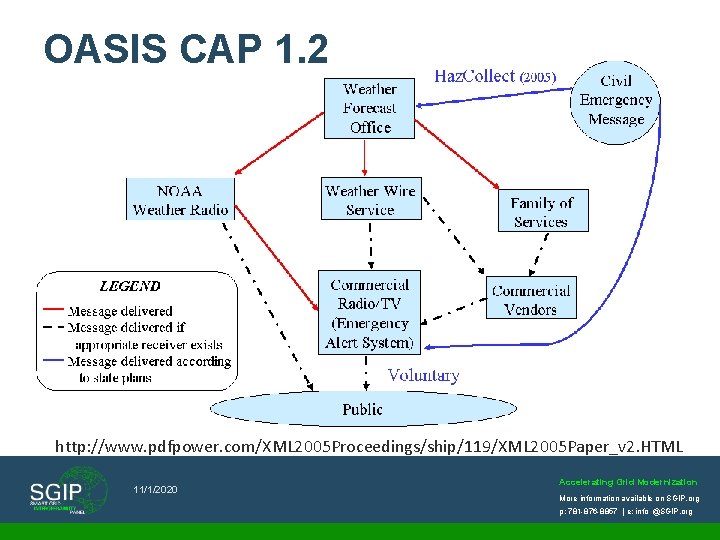
OASIS CAP 1. 2 http: //www. pdfpower. com/XML 2005 Proceedings/ship/119/XML 2005 Paper_v 2. HTML 11/1/2020 Accelerating Grid Modernization More information available on SGIP. org p: 781 -876 -8857 | e: info @SGIP. org
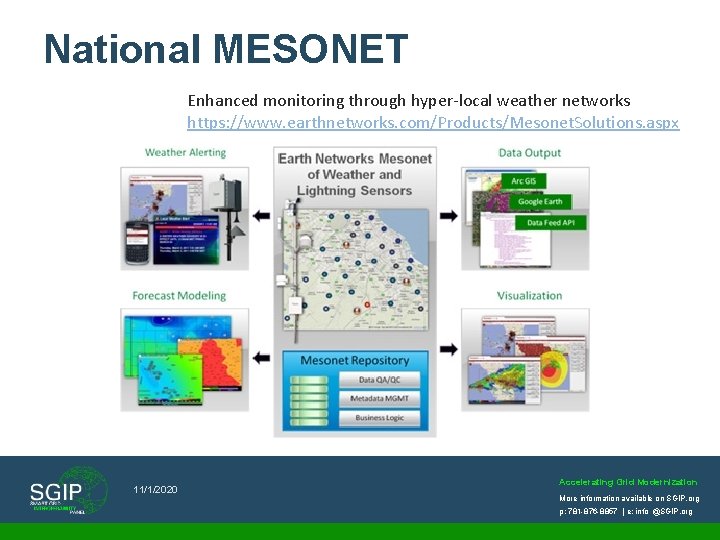
National MESONET Enhanced monitoring through hyper-local weather networks https: //www. earthnetworks. com/Products/Mesonet. Solutions. aspx 11/1/2020 Accelerating Grid Modernization More information available on SGIP. org p: 781 -876 -8857 | e: info @SGIP. org
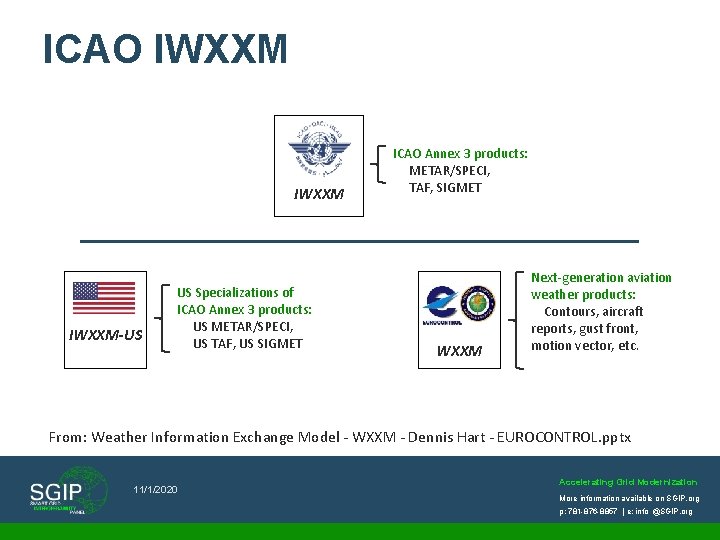
ICAO IWXXM-US US Specializations of ICAO Annex 3 products: US METAR/SPECI, US TAF, US SIGMET ICAO Annex 3 products: METAR/SPECI, TAF, SIGMET WXXM Next-generation aviation weather products: Contours, aircraft reports, gust front, motion vector, etc. From: Weather Information Exchange Model - WXXM - Dennis Hart - EUROCONTROL. pptx 11/1/2020 Accelerating Grid Modernization More information available on SGIP. org p: 781 -876 -8857 | e: info @SGIP. org
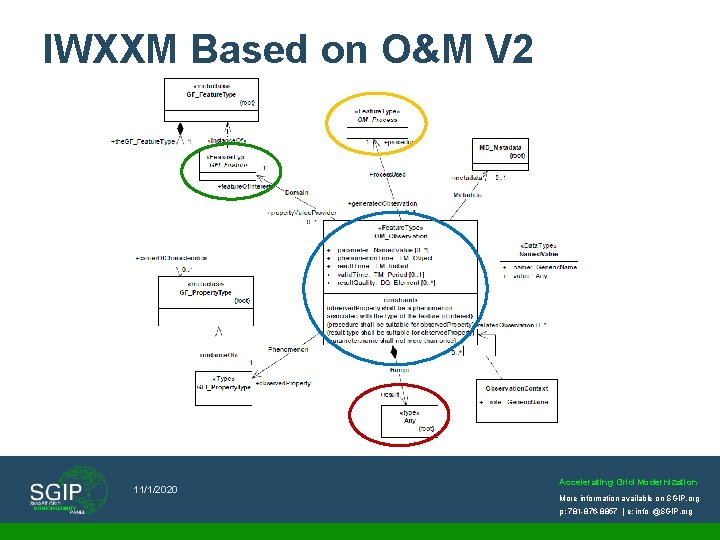
IWXXM Based on O&M V 2 11/1/2020 Accelerating Grid Modernization More information available on SGIP. org p: 781 -876 -8857 | e: info @SGIP. org
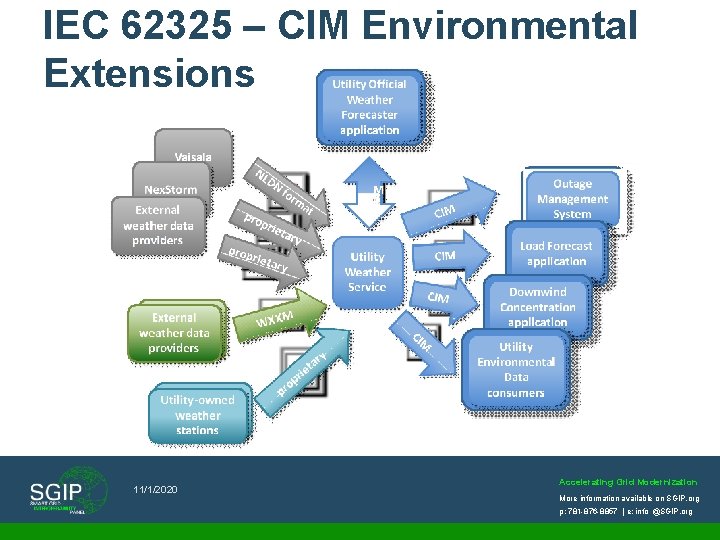
IEC 62325 – CIM Environmental Extensions 11/1/2020 Accelerating Grid Modernization More information available on SGIP. org p: 781 -876 -8857 | e: info @SGIP. org
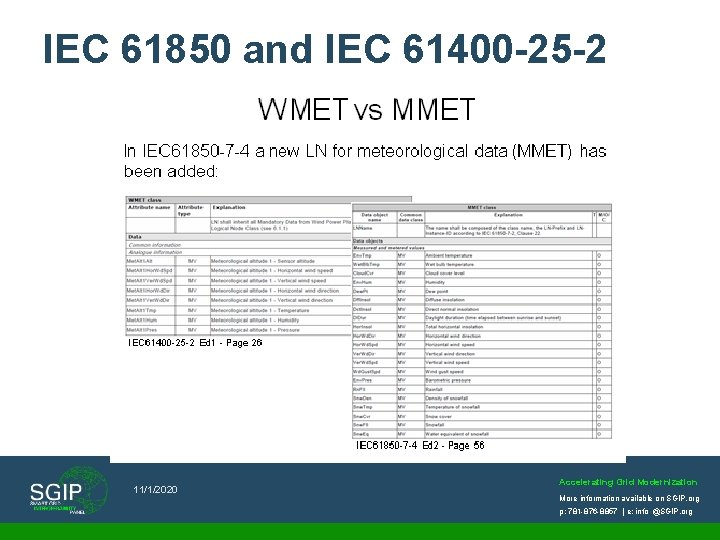
IEC 61850 and IEC 61400 -25 -2 11/1/2020 Accelerating Grid Modernization More information available on SGIP. org p: 781 -876 -8857 | e: info @SGIP. org

BIDIRECTIONAL CROSSDOMAIN USE CASES 11/1/2020 Accelerating Grid Modernization More information available on SGIP. org 25 p: 781 -876 -8857 | e: info @SGIP. org
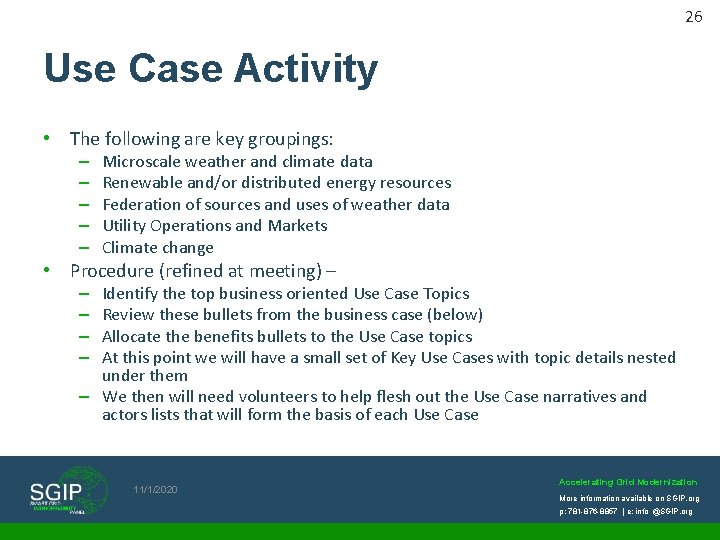
26 Use Case Activity • The following are key groupings: – – – Microscale weather and climate data Renewable and/or distributed energy resources Federation of sources and uses of weather data Utility Operations and Markets Climate change • Procedure (refined at meeting) – Identify the top business oriented Use Case Topics Review these bullets from the business case (below) Allocate the benefits bullets to the Use Case topics At this point we will have a small set of Key Use Cases with topic details nested under them – We then will need volunteers to help flesh out the Use Case narratives and actors lists that will form the basis of each Use Case – – 11/1/2020 Accelerating Grid Modernization More information available on SGIP. org p: 781 -876 -8857 | e: info @SGIP. org
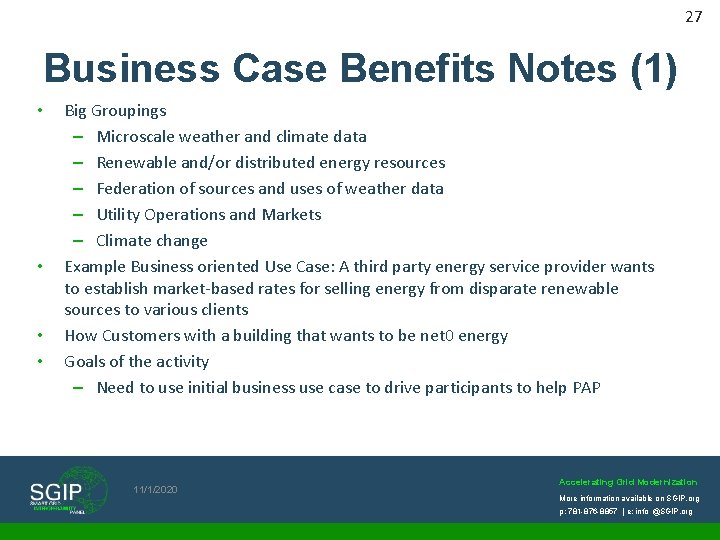
27 Business Case Benefits Notes (1) • • Big Groupings – Microscale weather and climate data – Renewable and/or distributed energy resources – Federation of sources and uses of weather data – Utility Operations and Markets – Climate change Example Business oriented Use Case: A third party energy service provider wants to establish market-based rates for selling energy from disparate renewable sources to various clients How Customers with a building that wants to be net 0 energy Goals of the activity – Need to use initial business use case to drive participants to help PAP 11/1/2020 Accelerating Grid Modernization More information available on SGIP. org p: 781 -876 -8857 | e: info @SGIP. org
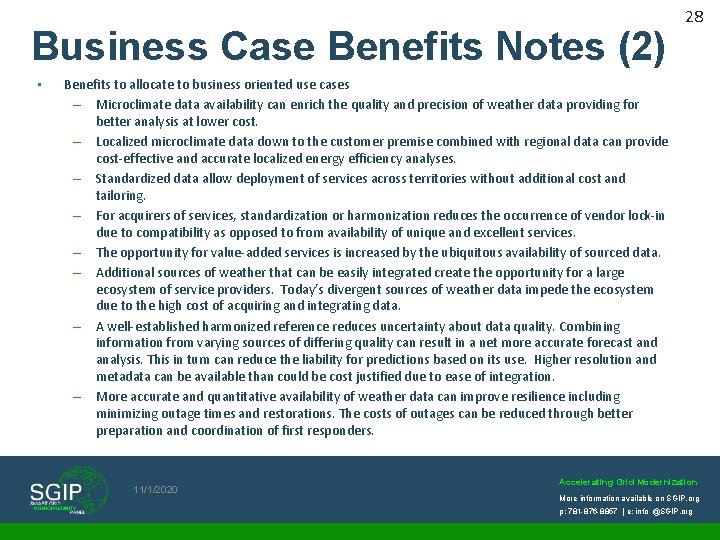
Business Case Benefits Notes (2) • 28 Benefits to allocate to business oriented use cases – Microclimate data availability can enrich the quality and precision of weather data providing for better analysis at lower cost. – Localized microclimate data down to the customer premise combined with regional data can provide cost-effective and accurate localized energy efficiency analyses. – Standardized data allow deployment of services across territories without additional cost and tailoring. – For acquirers of services, standardization or harmonization reduces the occurrence of vendor lock-in due to compatibility as opposed to from availability of unique and excellent services. – The opportunity for value-added services is increased by the ubiquitous availability of sourced data. – Additional sources of weather that can be easily integrated create the opportunity for a large ecosystem of service providers. Today’s divergent sources of weather data impede the ecosystem due to the high cost of acquiring and integrating data. – A well-established harmonized reference reduces uncertainty about data quality. Combining information from varying sources of differing quality can result in a net more accurate forecast and analysis. This in turn can reduce the liability for predictions based on its use. Higher resolution and metadata can be available than could be cost justified due to ease of integration. – More accurate and quantitative availability of weather data can improve resilience including minimizing outage times and restorations. The costs of outages can be reduced through better preparation and coordination of first responders. 11/1/2020 Accelerating Grid Modernization More information available on SGIP. org p: 781 -876 -8857 | e: info @SGIP. org
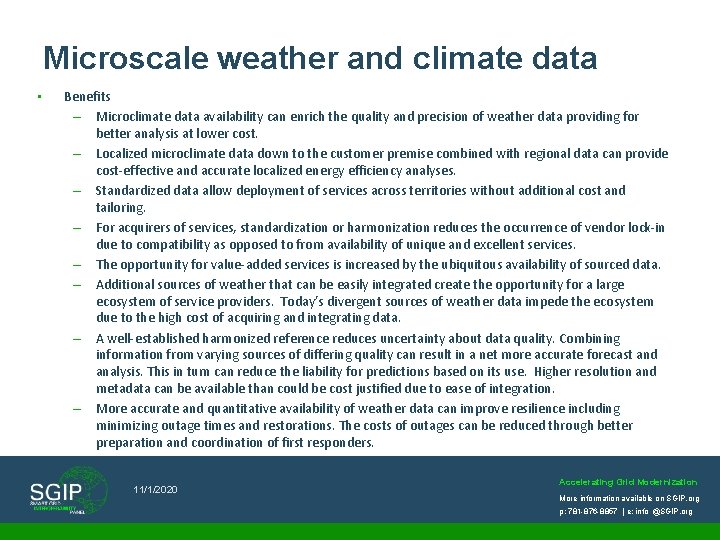
Microscale weather and climate data • Benefits – Microclimate data availability can enrich the quality and precision of weather data providing for better analysis at lower cost. – Localized microclimate data down to the customer premise combined with regional data can provide cost-effective and accurate localized energy efficiency analyses. – Standardized data allow deployment of services across territories without additional cost and tailoring. – For acquirers of services, standardization or harmonization reduces the occurrence of vendor lock-in due to compatibility as opposed to from availability of unique and excellent services. – The opportunity for value-added services is increased by the ubiquitous availability of sourced data. – Additional sources of weather that can be easily integrated create the opportunity for a large ecosystem of service providers. Today’s divergent sources of weather data impede the ecosystem due to the high cost of acquiring and integrating data. – A well-established harmonized reference reduces uncertainty about data quality. Combining information from varying sources of differing quality can result in a net more accurate forecast and analysis. This in turn can reduce the liability for predictions based on its use. Higher resolution and metadata can be available than could be cost justified due to ease of integration. – More accurate and quantitative availability of weather data can improve resilience including minimizing outage times and restorations. The costs of outages can be reduced through better preparation and coordination of first responders. 11/1/2020 Accelerating Grid Modernization More information available on SGIP. org p: 781 -876 -8857 | e: info @SGIP. org
Microscale weather and climate data • Relevant Use Cases 11/1/2020 Accelerating Grid Modernization More information available on SGIP. org p: 781 -876 -8857 | e: info @SGIP. org
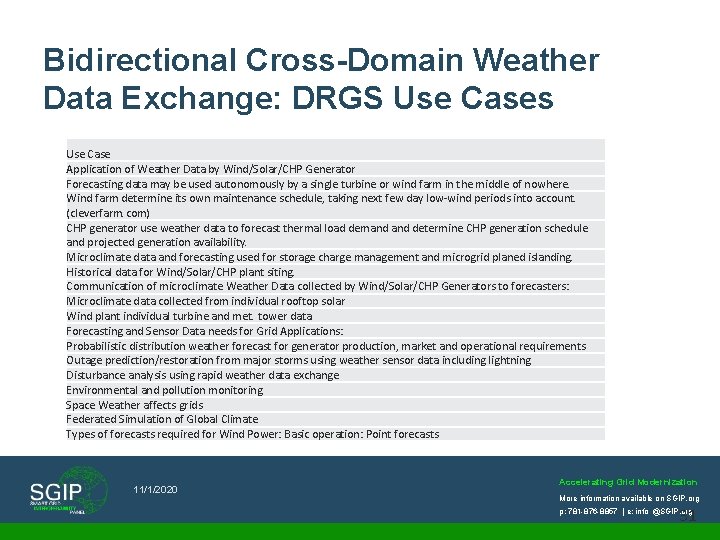
Bidirectional Cross-Domain Weather Data Exchange: DRGS Use Cases Use Case Application of Weather Data by Wind/Solar/CHP Generator Forecasting data may be used autonomously by a single turbine or wind farm in the middle of nowhere. Wind farm determine its own maintenance schedule, taking next few day low-wind periods into account. (cleverfarm. com) CHP generator use weather data to forecast thermal load demand determine CHP generation schedule and projected generation availability. Microclimate data and forecasting used for storage charge management and microgrid planed islanding. Historical data for Wind/Solar/CHP plant siting. Communication of microclimate Weather Data collected by Wind/Solar/CHP Generators to forecasters: Microclimate data collected from individual rooftop solar Wind plant individual turbine and met. tower data Forecasting and Sensor Data needs for Grid Applications: Probabilistic distribution weather forecast for generator production, market and operational requirements Outage prediction/restoration from major storms using weather sensor data including lightning Disturbance analysis using rapid weather data exchange Environmental and pollution monitoring Space Weather affects grids Federated Simulation of Global Climate Types of forecasts required for Wind Power: Basic operation: Point forecasts 11/1/2020 Accelerating Grid Modernization More information available on SGIP. org 31 p: 781 -876 -8857 | e: info @SGIP. org
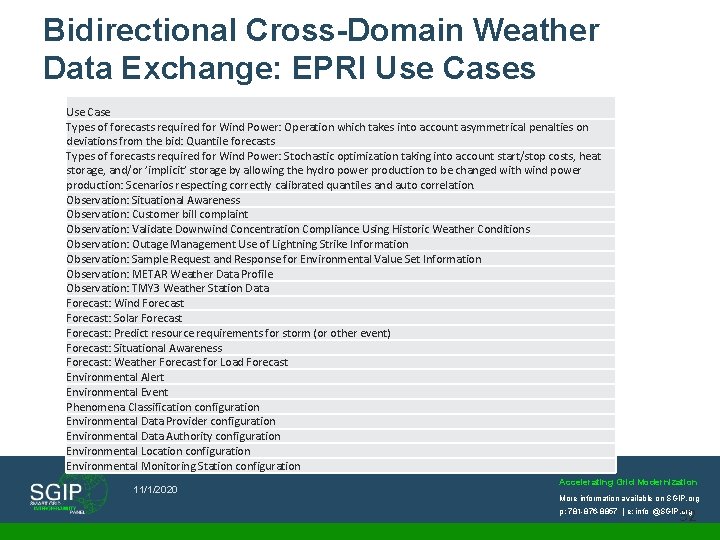
Bidirectional Cross-Domain Weather Data Exchange: EPRI Use Cases Use Case Types of forecasts required for Wind Power: Operation which takes into account asymmetrical penalties on deviations from the bid: Quantile forecasts Types of forecasts required for Wind Power: Stochastic optimization taking into account start/stop costs, heat storage, and/or ’implicit’ storage by allowing the hydro power production to be changed with wind power production: Scenarios respecting correctly calibrated quantiles and auto correlation. Observation: Situational Awareness Observation: Customer bill complaint Observation: Validate Downwind Concentration Compliance Using Historic Weather Conditions Observation: Outage Management Use of Lightning Strike Information Observation: Sample Request and Response for Environmental Value Set Information Observation: METAR Weather Data Profile Observation: TMY 3 Weather Station Data Forecast: Wind Forecast: Solar Forecast: Predict resource requirements for storm (or other event) Forecast: Situational Awareness Forecast: Weather Forecast for Load Forecast Environmental Alert Environmental Event Phenomena Classification configuration Environmental Data Provider configuration Environmental Data Authority configuration Environmental Location configuration Environmental Monitoring Station configuration 11/1/2020 Accelerating Grid Modernization More information available on SGIP. org 32 p: 781 -876 -8857 | e: info @SGIP. org
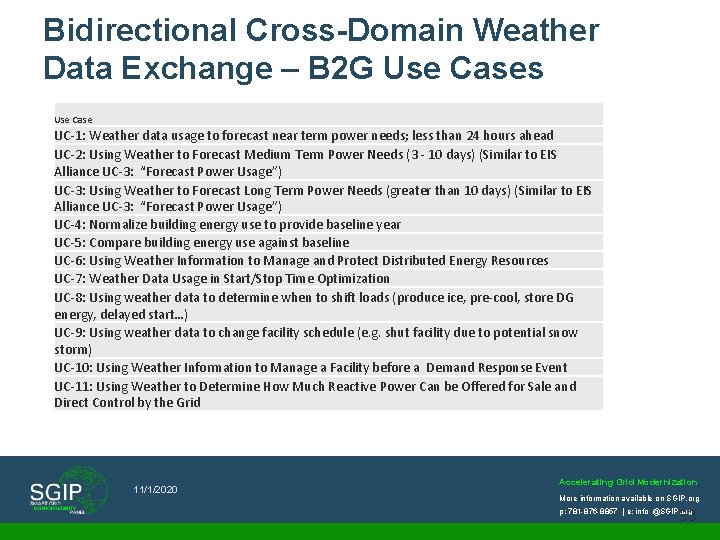
Bidirectional Cross-Domain Weather Data Exchange – B 2 G Use Cases Use Case UC-1: Weather data usage to forecast near term power needs; less than 24 hours ahead UC-2: Using Weather to Forecast Medium Term Power Needs (3 - 10 days) (Similar to EIS Alliance UC-3: “Forecast Power Usage”) UC-3: Using Weather to Forecast Long Term Power Needs (greater than 10 days) (Similar to EIS Alliance UC-3: “Forecast Power Usage”) UC-4: Normalize building energy use to provide baseline year UC-5: Compare building energy use against baseline UC-6: Using Weather Information to Manage and Protect Distributed Energy Resources UC-7: Weather Data Usage in Start/Stop Time Optimization UC-8: Using weather data to determine when to shift loads (produce ice, pre-cool, store DG energy, delayed start…) UC-9: Using weather data to change facility schedule (e. g. shut facility due to potential snow storm) UC-10: Using Weather Information to Manage a Facility before a Demand Response Event UC-11: Using Weather to Determine How Much Reactive Power Can be Offered for Sale and Direct Control by the Grid 11/1/2020 Accelerating Grid Modernization More information available on SGIP. org 33 p: 781 -876 -8857 | e: info @SGIP. org

ADDITIONAL BACKGROUND Accelerating Grid Modernization More information available on SGIP. org p: 781 -876 -8857 | e: info @SGIP. org
SGIP Member Groups Activities Accelerating Grid Modernization More information available on SGIP. org p: 781 -876 -8857 | e: info @SGIP. org
Business & Policy (Bn. P) DEWG Accelerating Grid Modernization More information available on SGIP. org p: 781 -876 -8857 | e: info @SGIP. org
Business & Policy (Bn. P) DEWG • Assist business decision-makers and regulators in implementing smart grid policies sensitive to interoperability – Green Button initiative • Engaged in discussions, education and outreach with utility regulatory commissioners & staff – Distributed Generation and Utilities Business Model – Differing State renewable portfolio standards – Interoperable Crew Management Systems for Storm Outage Restoration Mutual Aid Assistance scenarios Accelerating Grid Modernization More information available on SGIP. org p: 781 -876 -8857 | e: info @SGIP. org

WORKING GROUPS Accelerating Grid Modernization More information available on SGIP. org p: 781 -876 -8857 | e: info @SGIP. org
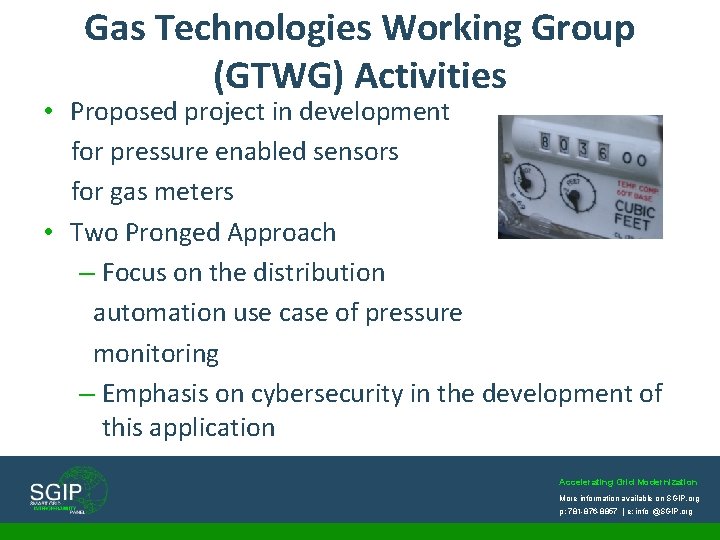
Gas Technologies Working Group (GTWG) Activities • Proposed project in development for pressure enabled sensors for gas meters • Two Pronged Approach – Focus on the distribution automation use case of pressure monitoring – Emphasis on cybersecurity in the development of this application Accelerating Grid Modernization More information available on SGIP. org p: 781 -876 -8857 | e: info @SGIP. org

PRIORITY ACTION PLANS Accelerating Grid Modernization More information available on SGIP. org p: 781 -876 -8857 | e: info @SGIP. org
PAP-21: Weather Information • Identify Use Cases (UCs) that illustrate the benefits of bi-directional weather data exchange • Coordinate development of UCs with inputs from a wide range of industries • Produce a set of information requirements designed to facilitate the harmonization of information models and exchange models Accelerating Grid Modernization More information available on SGIP. org p: 781 -876 -8857 | e: info @SGIP. org
PAP-22: EV Fueling Submetering Requirements • Separate metering of Personal Electric Vehicle loads • Tracking of PEV electrical consumption for credits • Utility monitoring PEV loads for predictive analysis • Requirements and standards needed to specify: • Accuracy, performance, security • Utility revenue grade billing data & 3 rd party billing • Data formats and certification Accelerating Grid Modernization More information available on SGIP. org p: 781 -876 -8857 | e: info @SGIP. org
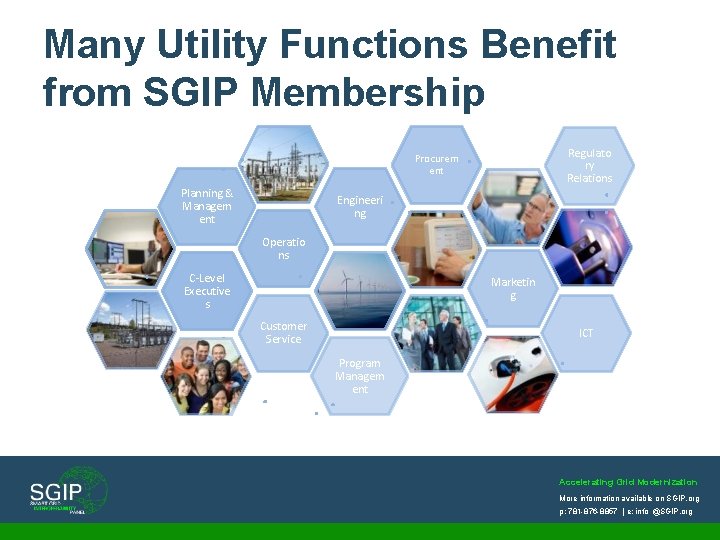
Many Utility Functions Benefit from SGIP Membership Regulato ry Relations Procurem ent Planning & Managem ent Engineeri ng Operatio ns C-Level Executive s Marketin g Customer Service ICT Program Managem ent Accelerating Grid Modernization More information available on SGIP. org p: 781 -876 -8857 | e: info @SGIP. org

For More Information Contact: Susan Hoyler: shoyler@sgip. org 941 -321 -3027 Visit www. sgip. org Talk to us today! Accelerating Grid Modernization More information available on SGIP. org p: 781 -876 -8857 | e: info @SGIP. org
- Slides: 44