
Smart contracting the new environment of business Matti
Smart contracting – the new environment of business Matti Rudanko
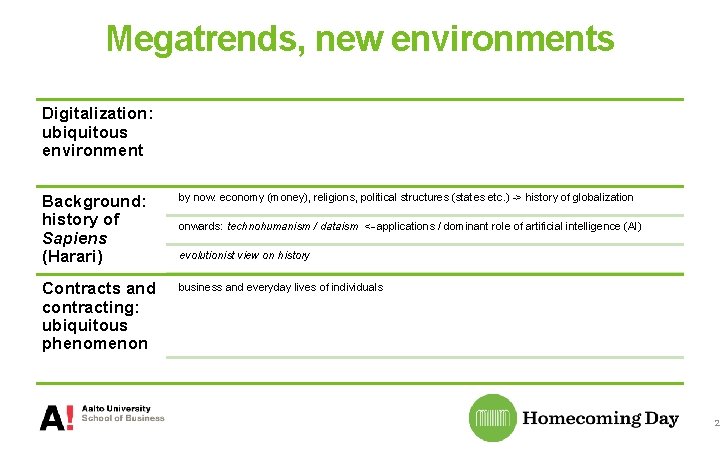
Megatrends, new environments Digitalization: ubiquitous environment Background: history of Sapiens (Harari) by now: economy (money), religions, political structures (states etc. ) -> history of globalization Contracts and contracting: ubiquitous phenomenon business and everyday lives of individuals onwards: technohumanism / dataism <- applications / dominant role of artificial intelligence (AI) evolutionist view on history 2
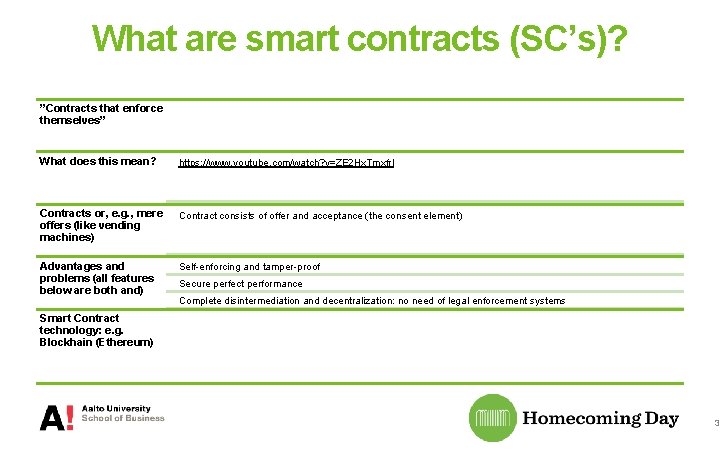
What are smart contracts (SC’s)? ”Contracts that enforce themselves” What does this mean? https: //www. youtube. com/watch? v=ZE 2 Hx. Tmxfr. I Contracts or, e. g. , mere offers (like vending machines) Contract consists of offer and acceptance (the consent element) Advantages and problems (all features below are both and) Self-enforcing and tamper-proof Secure perfect performance Complete disintermediation and decentralization: no need of legal enforcement systems Smart Contract technology: e. g. Blockhain (Ethereum) 3
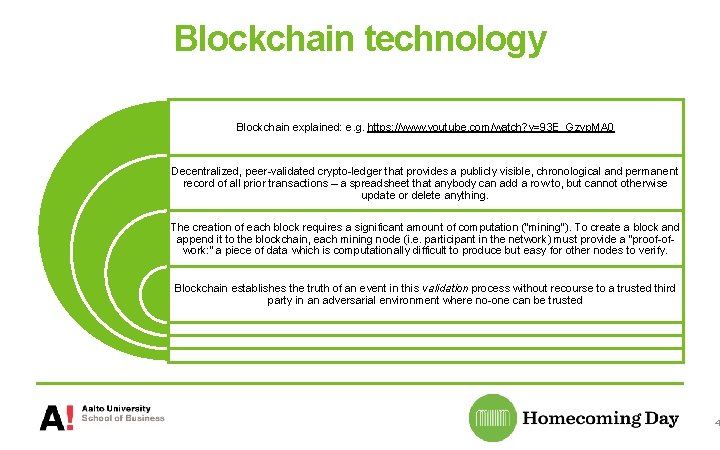
Blockchain technology Blockchain explained: e. g. https: //www. youtube. com/watch? v=93 E_Gzvp. MA 0 Decentralized, peer-validated crypto-ledger that provides a publicly visible, chronological and permanent record of all prior transactions – a spreadsheet that anybody can add a row to, but cannot otherwise update or delete anything. The creation of each block requires a significant amount of computation (“mining”). To create a block and append it to the blockchain, each mining node (i. e. participant in the network) must provide a “proof-ofwork: ” a piece of data which is computationally difficult to produce but easy for other nodes to verify. Blockchain establishes the truth of an event in this validation process without recourse to a trusted third party in an adversarial environment where no-one can be trusted 4
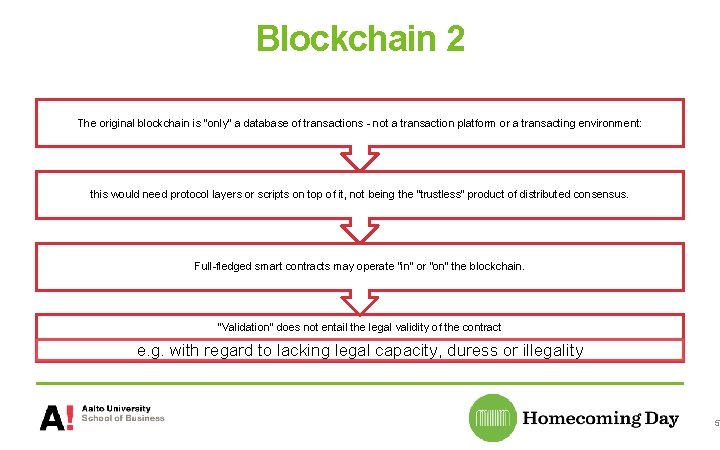
Blockchain 2 The original blockchain is “only” a database of transactions - not a transaction platform or a transacting environment: this would need protocol layers or scripts on top of it, not being the “trustless” product of distributed consensus. Full-fledged smart contracts may operate “in” or “on” the blockchain. “Validation” does not entail the legal validity of the contract e. g. with regard to lacking legal capacity, duress or illegality 5
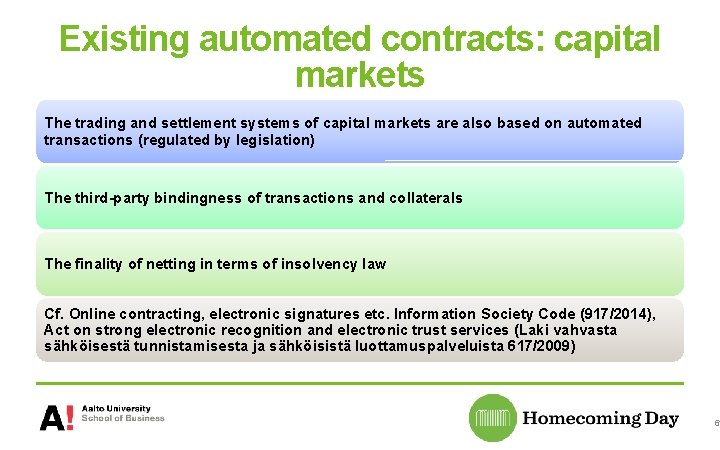
Existing automated contracts: capital markets The trading and settlement systems of capital markets are also based on automated transactions (regulated by legislation) The third-party bindingness of transactions and collaterals The finality of netting in terms of insolvency law Cf. Online contracting, electronic signatures etc. Information Society Code (917/2014), Act on strong electronic recognition and electronic trust services (Laki vahvasta sähköisestä tunnistamisesta ja sähköisistä luottamuspalveluista 617/2009) 6
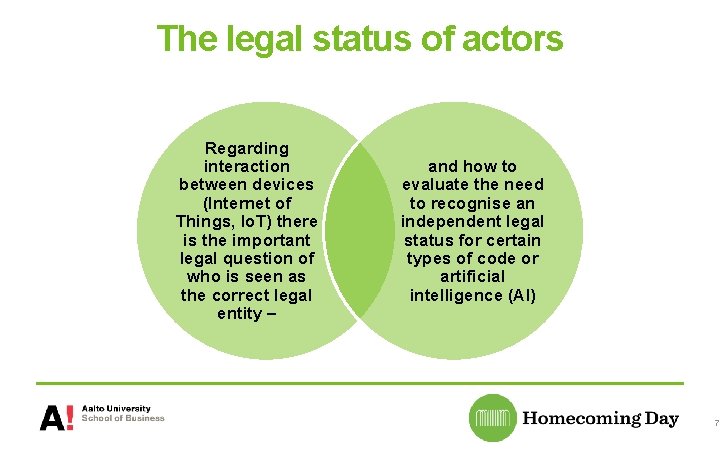
The legal status of actors Regarding interaction between devices (Internet of Things, Io. T) there is the important legal question of who is seen as the correct legal entity – and how to evaluate the need to recognise an independent legal status for certain types of code or artificial intelligence (AI) 7
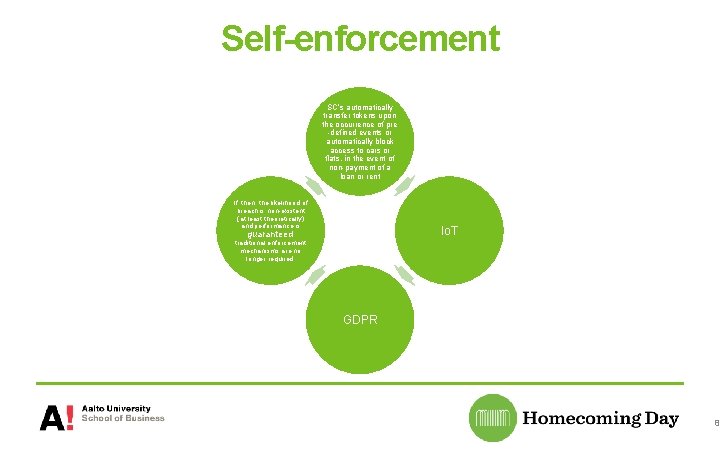
Self-enforcement SC’s automatically transfer tokens upon the occurrence of pre -defined events or automatically block access to cars or flats, in the event of non-payment of a loan or rent If, then, the likelihood of breach is non-existent (at least theoretically) and performance is guaranteed, traditional enforcement mechanisms are no longer required. Io. T GDPR 8
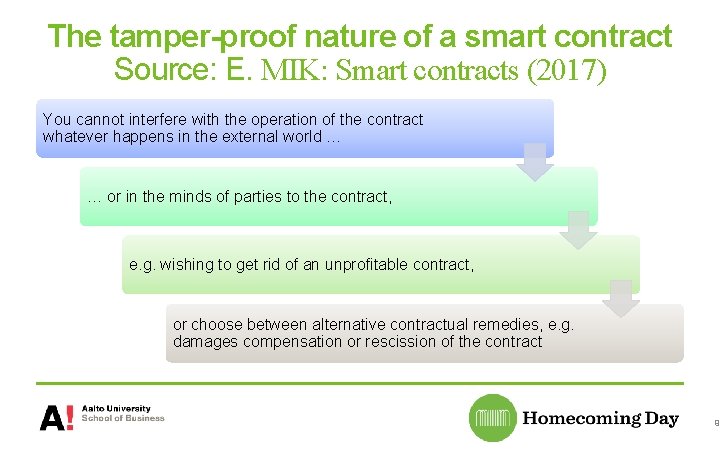
The tamper-proof nature of a smart contract Source: E. MIK: Smart contracts (2017) You cannot interfere with the operation of the contract whatever happens in the external world … … or in the minds of parties to the contract, e. g. wishing to get rid of an unprofitable contract, or choose between alternative contractual remedies, e. g. damages compensation or rescission of the contract 9
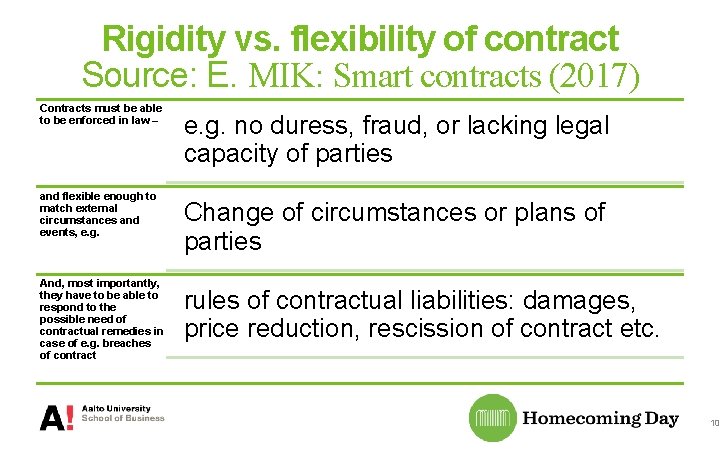
Rigidity vs. flexibility of contract Source: E. MIK: Smart contracts (2017) Contracts must be able to be enforced in law – and flexible enough to match external circumstances and events, e. g. And, most importantly, they have to be able to respond to the possible need of contractual remedies in case of e. g. breaches of contract e. g. no duress, fraud, or lacking legal capacity of parties Change of circumstances or plans of parties rules of contractual liabilities: damages, price reduction, rescission of contract etc. 10
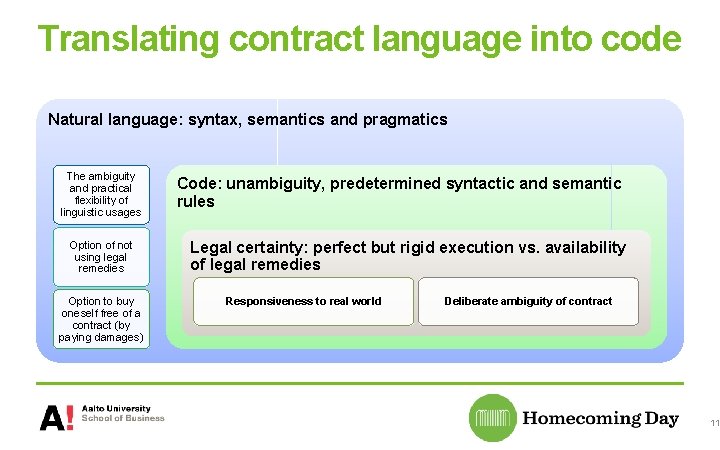
Translating contract language into code Natural language: syntax, semantics and pragmatics The ambiguity and practical flexibility of linguistic usages Option of not using legal remedies Option to buy oneself free of a contract (by paying damages) Code: unambiguity, predetermined syntactic and semantic rules Legal certainty: perfect but rigid execution vs. availability of legal remedies Responsiveness to real world Deliberate ambiguity of contract 11
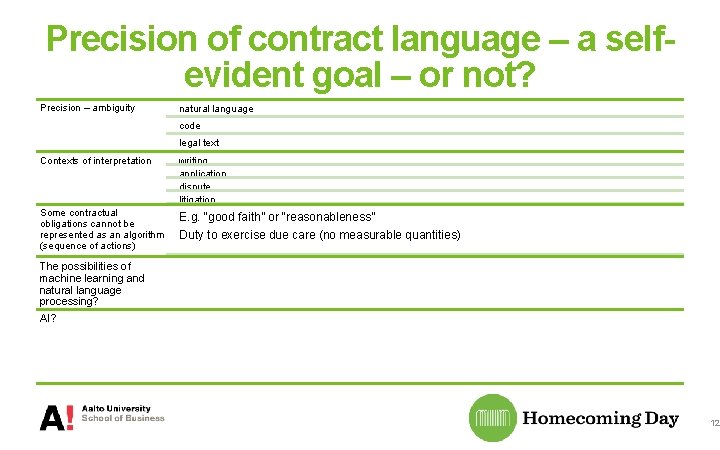
Precision of contract language – a selfevident goal – or not? Precision – ambiguity natural language code legal text Contexts of interpretation writing application dispute litigation Some contractual obligations cannot be represented as an algorithm (sequence of actions) E. g. “good faith” or “reasonableness” Duty to exercise due care (no measurable quantities) The possibilities of machine learning and natural language processing? AI? 12
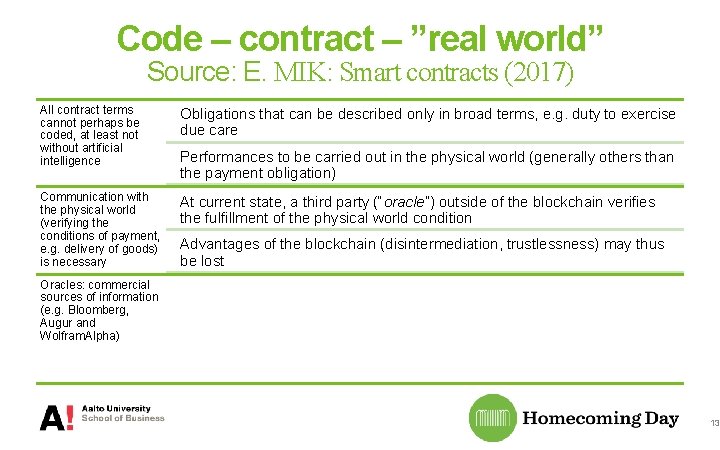
Code – contract – ”real world” Source: E. MIK: Smart contracts (2017) All contract terms cannot perhaps be coded, at least not without artificial intelligence Obligations that can be described only in broad terms, e. g. duty to exercise due care Communication with the physical world (verifying the conditions of payment, e. g. delivery of goods) is necessary At current state, a third party (“oracle”) outside of the blockchain verifies the fulfillment of the physical world condition Performances to be carried out in the physical world (generally others than the payment obligation) Advantages of the blockchain (disintermediation, trustlessness) may thus be lost Oracles: commercial sources of information (e. g. Bloomberg, Augur and Wolfram. Alpha) 13
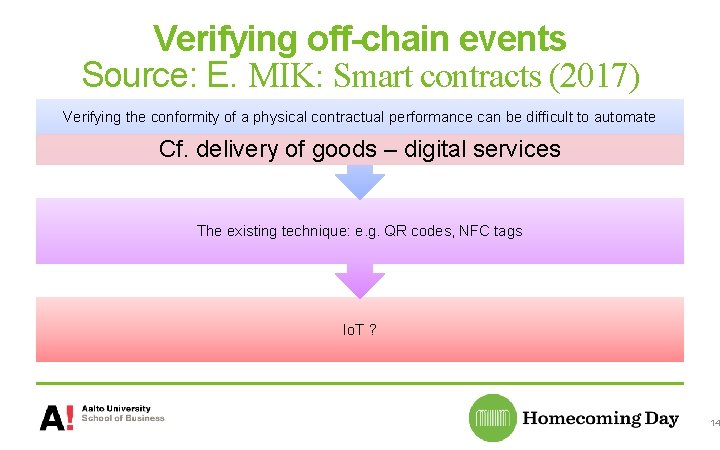
Verifying off-chain events Source: E. MIK: Smart contracts (2017) Verifying the conformity of a physical contractual performance can be difficult to automate Cf. delivery of goods – digital services The existing technique: e. g. QR codes, NFC tags Io. T ? 14
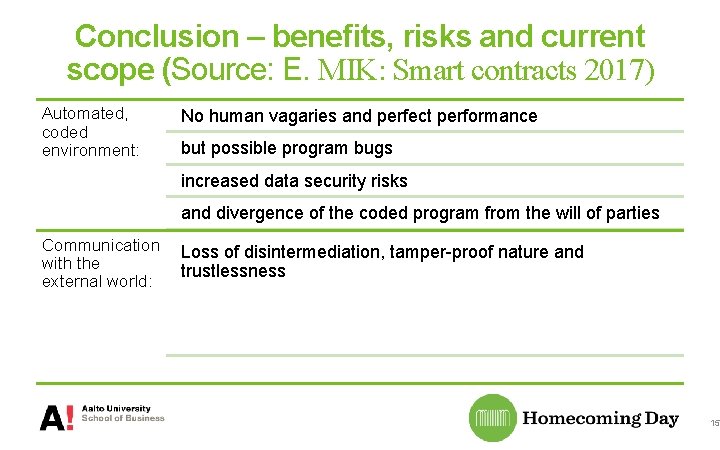
Conclusion – benefits, risks and current scope (Source: E. MIK: Smart contracts 2017) Automated, coded environment: No human vagaries and perfect performance but possible program bugs increased data security risks and divergence of the coded program from the will of parties Communication with the external world: Loss of disintermediation, tamper-proof nature and trustlessness 15
Literature and other sources • • • Solarte-Vásquez, María Claudia and Nyman-Metcalf, Katrin: Smart Contracting: A Multidisciplinary and Proactive Approach for the EU Digital Single Market. Baltic Journal of European Studies. Tallinn University of Technology (ISSN 2228 -0588), Vol. 7, No. 2 (23), p. 208 – 246 MIK, Eliza: Smart contracts: Terminology, technical limitations and real world complexity. (2017). Law, Innovation and Technology. 9, (2), 269 -300. Research Collection School Of Law Szabo, Nick: Smart Contracts: Formalizing and Securing Relationships on Public Networks (1997) 2 (9) First Monday 2 Koulu, Riikka: Blockchains and Online Dispute Resolution: Smart Contracts as an Alternative to Enforcement. SCRIPTed - A Journal of Law, Technology & Society. 13, 1/2016, p. 40 -69 Blockchain – Powering the Internet of Value (www. evry. com/financialservices ) 16
- Slides: 16