
SMART COMMUNITIES PROGRAM Presentation to the First Nations
- Slides: 24
SMART COMMUNITIES PROGRAM Presentation to the First Nations Connect Conference February 12, 2002 1
Smart Communities Program: Purpose/philosophy Smart Communities Program: l An innovative program that demonstrates the use of ICT for community economic, social and cultural development. 2
The Need: Promoting Community Development using ICT The old development philosophies are changing and communities are now increasingly being faced with: v Limited government resources, increased service demands from a growing population and the need to do more with less. v Exposure to international competition as information and communication technologies (ICT) are used to create a truly global marketplace. 3
ICT and Community Transformation v Given the financial and social pressures affecting them, governments and communities around the world have realized that ICT can be a powerful tool for use in the transformation of their economic and social bases: Ø To strengthen the economic and social foundations of their regions and Ø To market local goods and services nationally and internationally. 4
Key Impacts of a Smart Community (for Rural and Remote Communities) v Improved citizen access to information, knowledge and government services, including distance education, health and training. v Improved efficiency of business-to-government transactions v Increased ability of local businesses to market products and services beyond their community Ù Overall structural improvement in the economic and social foundations of the community and surrounding region 5
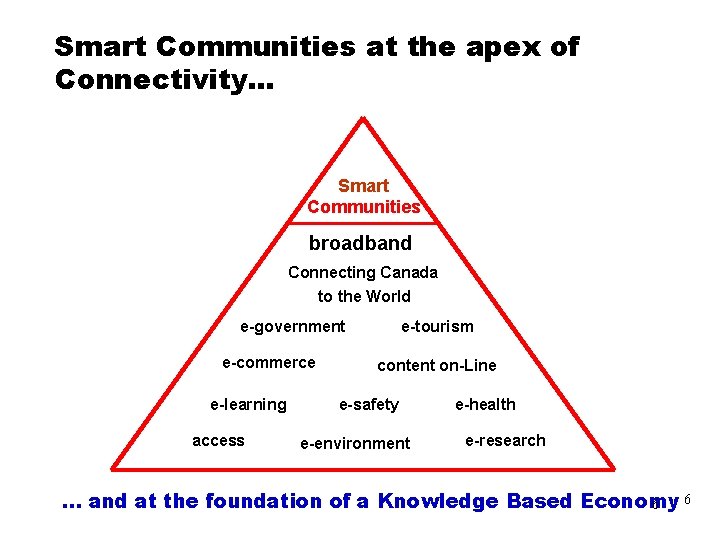
Smart Communities at the apex of Connectivity. . . Smart Communities broadband Connecting Canada to the World e-government e-commerce e-learning access e-tourism content on-Line e-safety e-environment e-health e-research 6. . . and at the foundation of a Knowledge Based Economy 6
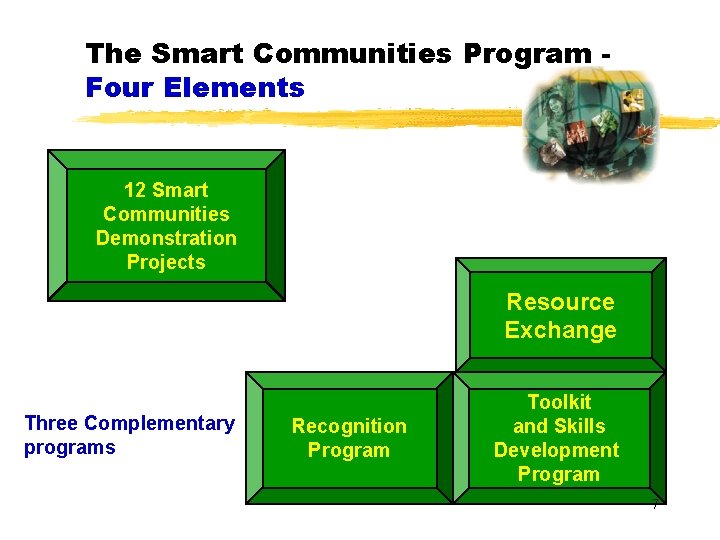
The Smart Communities Program Four Elements 12 Smart Communities Demonstration Projects Resource Exchange Three Complementary programs Recognition Program Toolkit and Skills Development Program 7
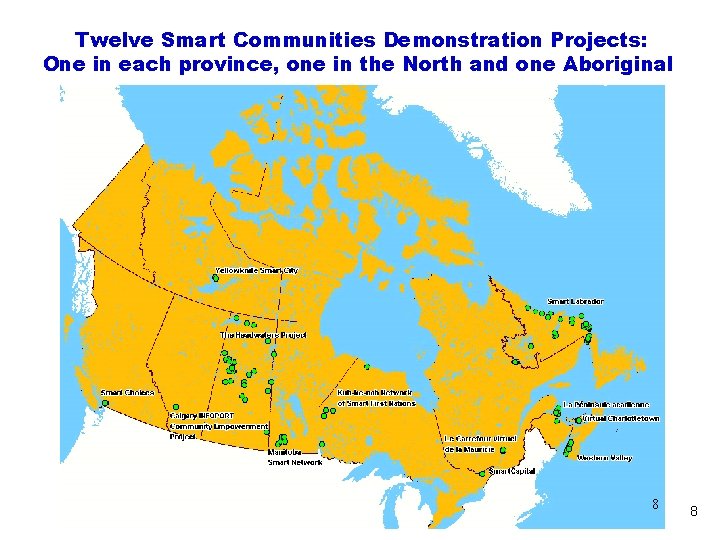
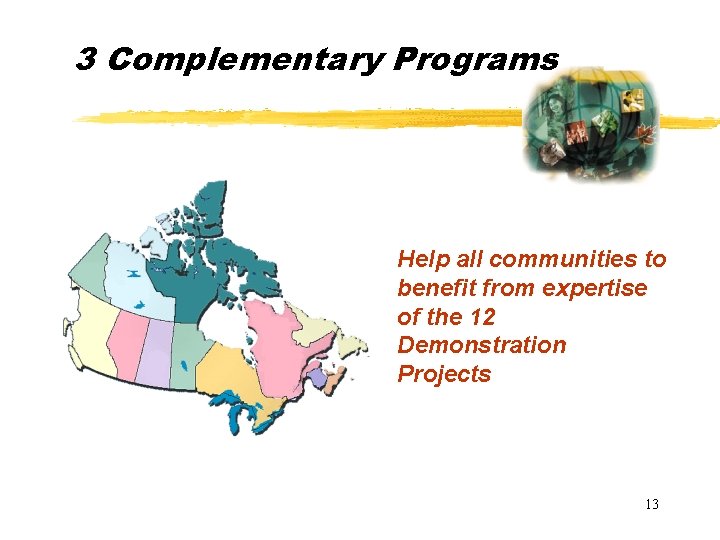
Twelve Smart Communities Demonstration Projects: One in each province, one in the North and one Aboriginal 8 8
First Nations prominent in three Smart Communities z ABORIGINAL: Kuh-ke-nah Network (K-Net) of Smart First Nations (5 First Nations Communities in Northwest Ontario) z SASKATCHEWAN: The Headwaters Project (Northern Saskatchewan including La Ronge) (60% of the 33, 000 target population belong to Cree and Dene First Nations) z NEWFOUNDLAND & LABRADOR: Technology on Top of the World: Smart Labrador Initiative (30% of the 30, 000 target population are Innu, Inuit or Métis) 9
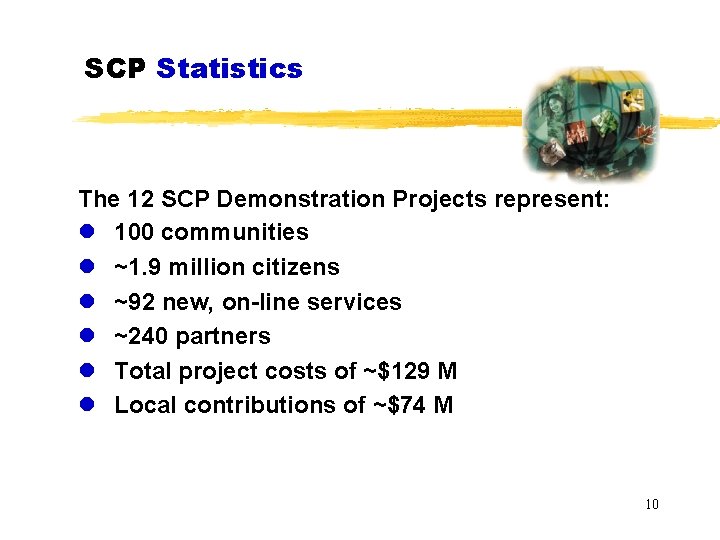
SCP Statistics The 12 SCP Demonstration Projects represent: l 100 communities l ~1. 9 million citizens l ~92 new, on-line services l ~240 partners l Total project costs of ~$129 M l Local contributions of ~$74 M 10
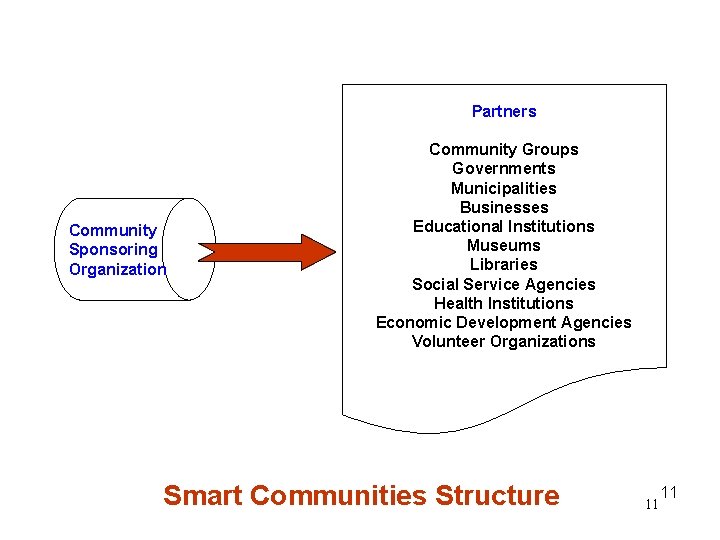
Partners Community Sponsoring Organization Community Groups Governments Municipalities Businesses Educational Institutions Museums Libraries Social Service Agencies Health Institutions Economic Development Agencies Volunteer Organizations Smart Communities Structure 11 11
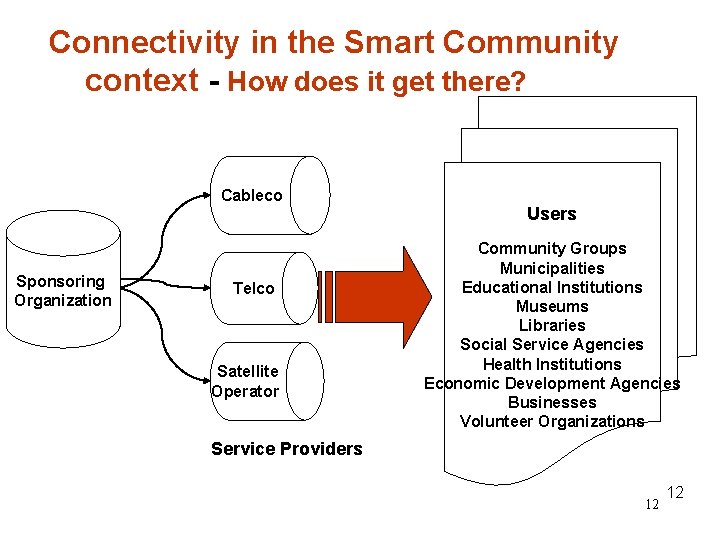
Connectivity in the Smart Community context - How does it get there? Cableco Sponsoring Organization Telco Satellite Operator Users Community Groups Municipalities Educational Institutions Museums Libraries Social Service Agencies Health Institutions Economic Development Agencies Businesses Volunteer Organizations Service Providers 12 12
3 Complementary Programs Help all communities to benefit from expertise of the 12 Demonstration Projects 13
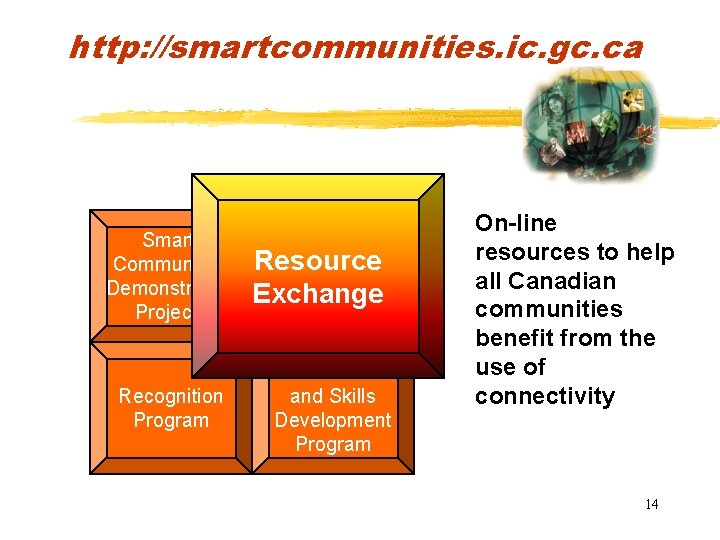
http: //smartcommunities. ic. gc. ca Smart Communities Demonstration Projects Recognition Program Resource Exchange Tool-Kit and Skills Development Program On-line resources to help all Canadian communities benefit from the use of connectivity 14
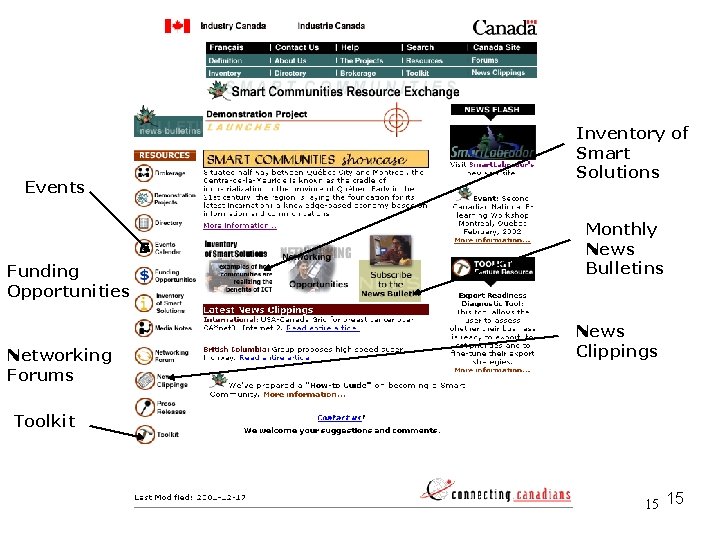
Events Funding Opportunities Networking Forums Inventory of Smart Solutions Monthly News Bulletins News Clippings Toolkit 15 15
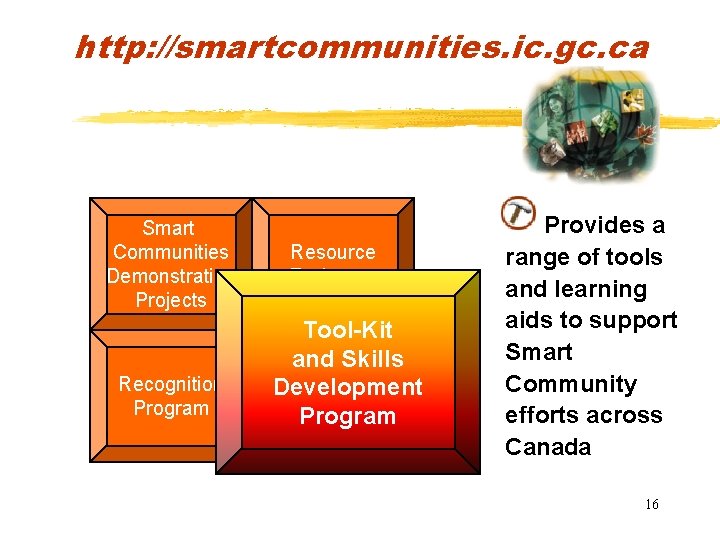
http: //smartcommunities. ic. gc. ca Smart Communities Demonstration Projects Recognition Program Resource Exchange Tool-Kit and Skills Development Program Provides a range of tools and learning aids to support Smart Community efforts across Canada 16
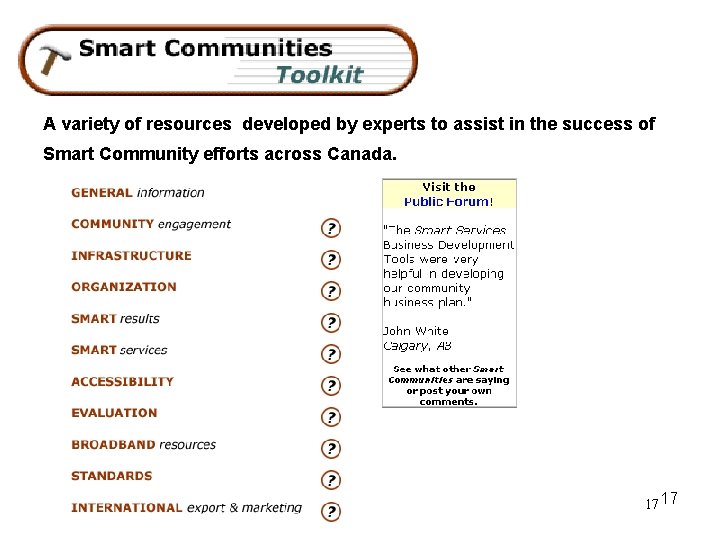
A variety of resources developed by experts to assist in the success of Smart Community efforts across Canada. 17 17
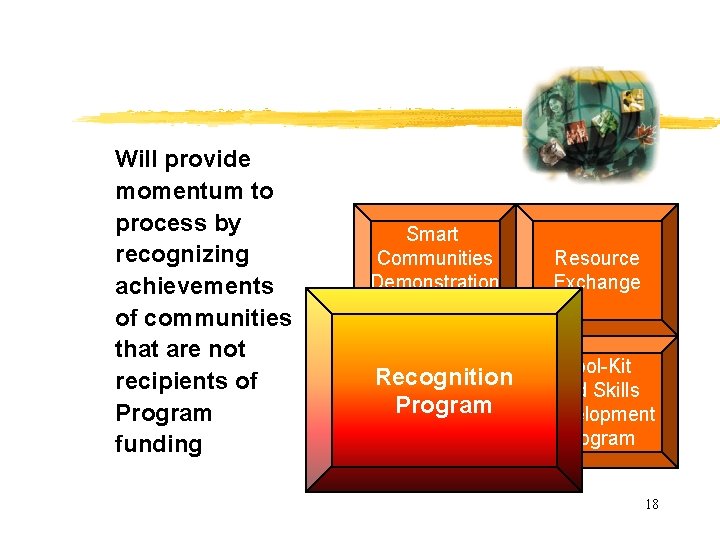
Will provide momentum to process by recognizing achievements of communities that are not recipients of Program funding Smart Communities Demonstration Projects Recognition Program Resource Exchange Tool-Kit and Skills Development Program 18
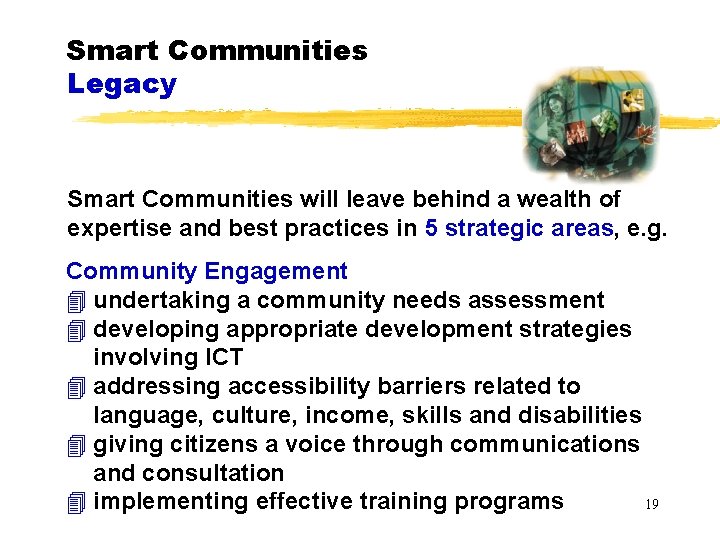
Smart Communities Legacy Smart Communities will leave behind a wealth of expertise and best practices in 5 strategic areas, e. g. Community Engagement 4 undertaking a community needs assessment 4 developing appropriate development strategies involving ICT 4 addressing accessibility barriers related to language, culture, income, skills and disabilities 4 giving citizens a voice through communications and consultation 19 4 implementing effective training programs
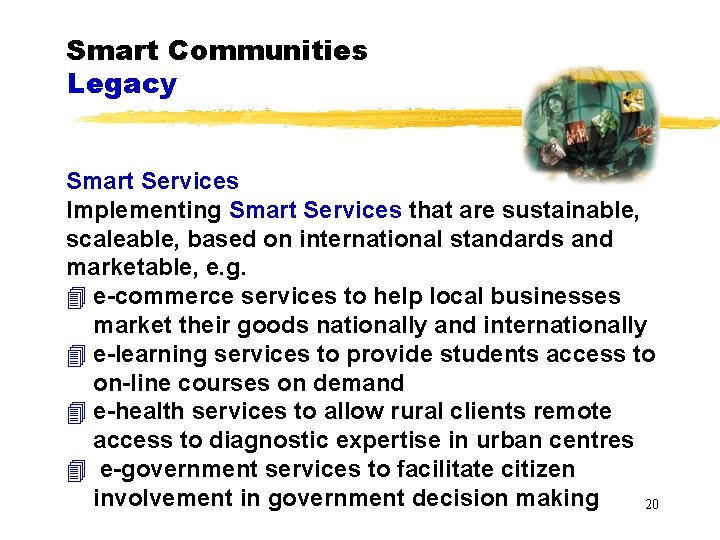
Smart Communities Legacy Smart Services Implementing Smart Services that are sustainable, scaleable, based on international standards and marketable, e. g. 4 e-commerce services to help local businesses market their goods nationally and internationally 4 e-learning services to provide students access to on-line courses on demand 4 e-health services to allow rural clients remote access to diagnostic expertise in urban centres 4 e-government services to facilitate citizen involvement in government decision making 20
Smart Communities Legacy Smart Infrastructure Designing and installing Smart infrastructure that: 4 is able to support a community’s current and future needs for high-speed two way services 4 is accessible by the majority of a community’s citizens 4 is built in partnership with a range of common carriers Organization Smart Results 21
Key Lessons Learned to Date v Successful Smart Communities strategies involve a coalition between private and public sectors v Project champions: Business leaders play a prominent, if not leading role as catalysts and brokers for the vision and strategic direction 4 Top-down vision must be combined with bottom up input from all stakeholders 4 A comprehensive analysis of local needs, opportunities and capacities must be undertaken 22
Key Lessons - Continued v Use existing technologies if possible 3 only develop new technologies if necessary 3 ensure scalability of projects 3 use open architectures and standards v There is no best organizational structure – the way in which people work together and get things done is more important v However – the management structure does need to be transparent and accountable to the community v Build in an evaluation process from the beginning 23 v Plan for project sustainability from day 1
Questions? For current information: v Visit our web site @ http: //smartcommunities. ic. gc. ca v E-mail: smartcom@ic. gc. ca 24