
Smart City Impact to Citizens Cyril Baloyi Group
“Smart City, Impact to Citizens” Cyril Baloyi: Group CTO
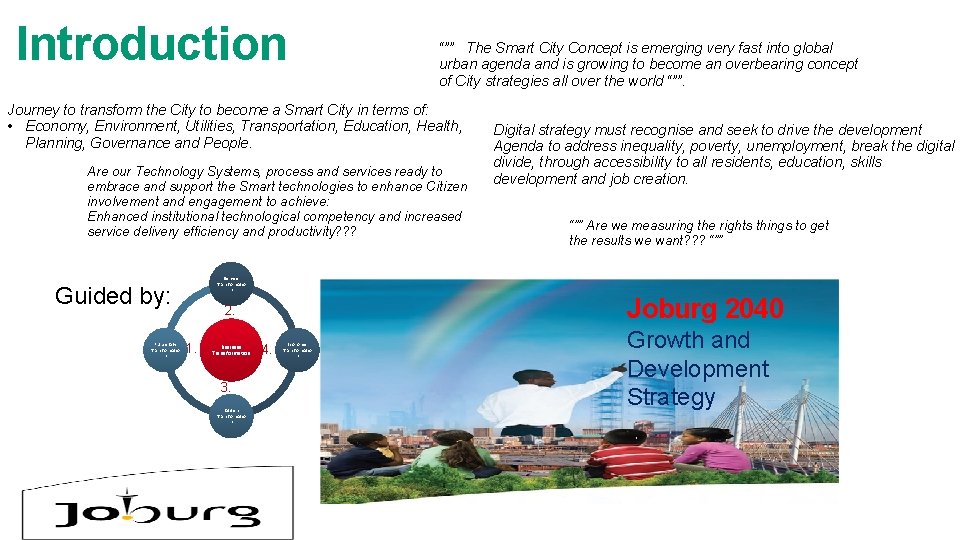
Introduction “”” The Smart City Concept is emerging very fast into global urban agenda and is growing to become an overbearing concept of City strategies all over the world “””. Journey to transform the City to become a Smart City in terms of: • Economy, Environment, Utilities, Transportation, Education, Health, Planning, Governance and People. Are our Technology Systems, process and services ready to embrace and support the Smart technologies to enhance Citizen involvement and engagement to achieve: Enhanced institutional technological competency and increased service delivery efficiency and productivity? ? ? “”” Are we measuring the rights things to get the results we want? ? ? “”” Service Transformatio n Guided by: Future City Transformatio n Digital strategy must recognise and seek to drive the development Agenda to address inequality, poverty, unemployment, break the digital divide, through accessibility to all residents, education, skills development and job creation. Joburg 2040 2. 1. Business Transformation 3. Citizen Transformatio n 4. Economic Transformatio n Growth and Development Strategy
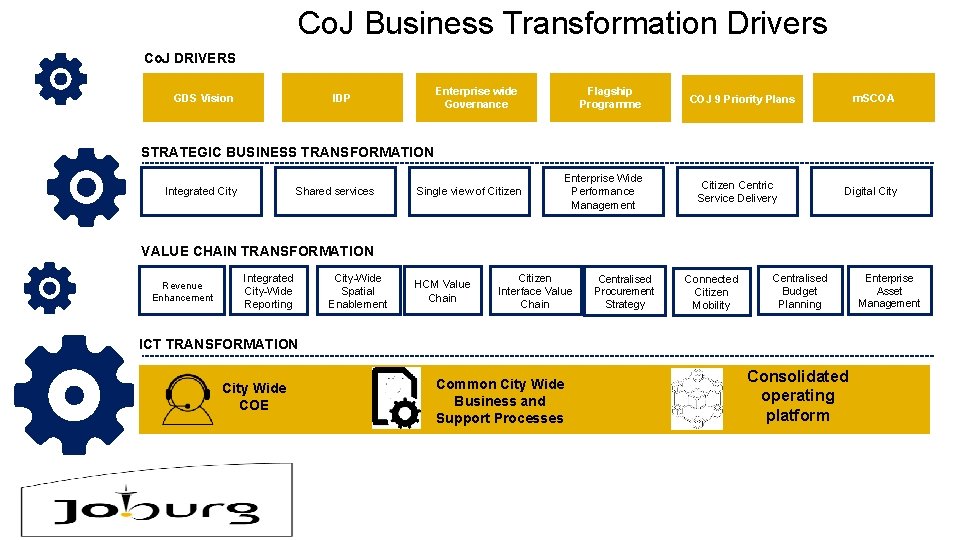
Co. J Business Transformation Drivers Co. J DRIVERS GDS Vision Enterprise wide Governance IDP Flagship Programme m. SCOA COJ 9 Priority Plans STRATEGIC BUSINESS TRANSFORMATION Integrated City Shared services Single view of Citizen Enterprise Wide Performance Management Citizen Centric Service Delivery Digital City VALUE CHAIN TRANSFORMATION Revenue Enhancement Integrated City-Wide Reporting City-Wide Spatial Enablement HCM Value Chain Citizen Interface Value Chain Centralised Procurement Strategy Connected Citizen Mobility Centralised Budget Planning ICT TRANSFORMATION City Wide COE Common City Wide Business and Support Processes Consolidated operating platform Enterprise Asset Management

Digital City Challenges
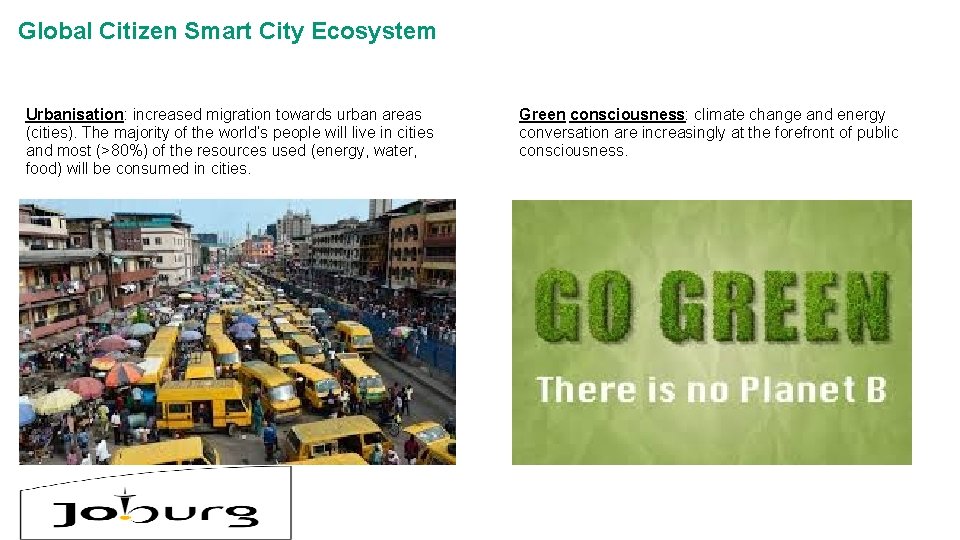
Global Citizen Smart City Ecosystem Urbanisation: increased migration towards urban areas (cities). The majority of the world’s people will live in cities and most (>80%) of the resources used (energy, water, food) will be consumed in cities. Green consciousness: climate change and energy conversation are increasingly at the forefront of public consciousness.

Global Citizen Smart City Ecosystem Interaction on the move: people expects always on systems, everywhere broadband connectivity and interconnectivity. Increased individualism: personalised and directed content suited to their preferences and styles. Increased spending on entertainment: increased consumer spending on gaming, apps, webentertainment and other digital entertainment.
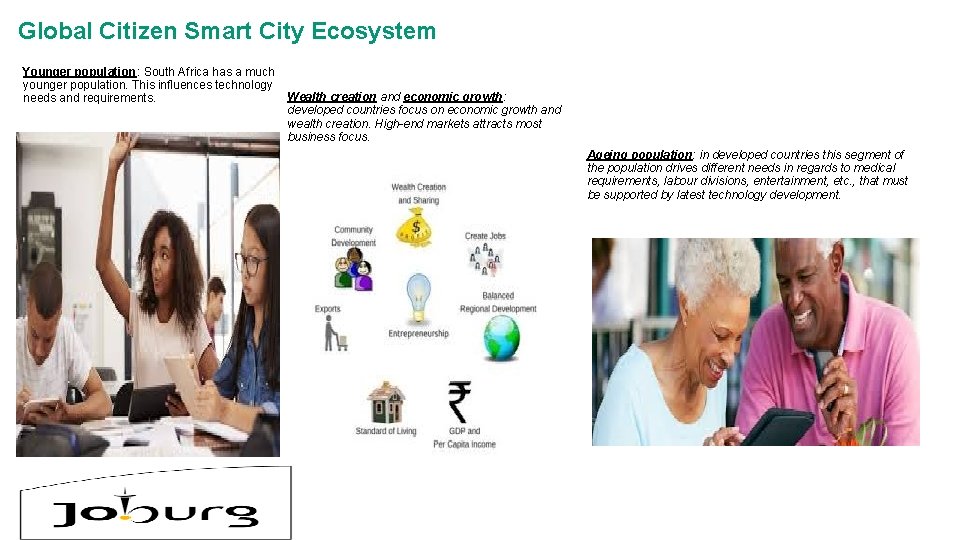
Global Citizen Smart City Ecosystem Younger population: South Africa has a much younger population. This influences technology needs and requirements. Wealth creation and economic growth: developed countries focus on economic growth and wealth creation. High-end markets attracts most business focus. Ageing population: in developed countries this segment of the population drives different needs in regards to medical requirements, labour divisions, entertainment, etc. , that must be supported by latest technology development.
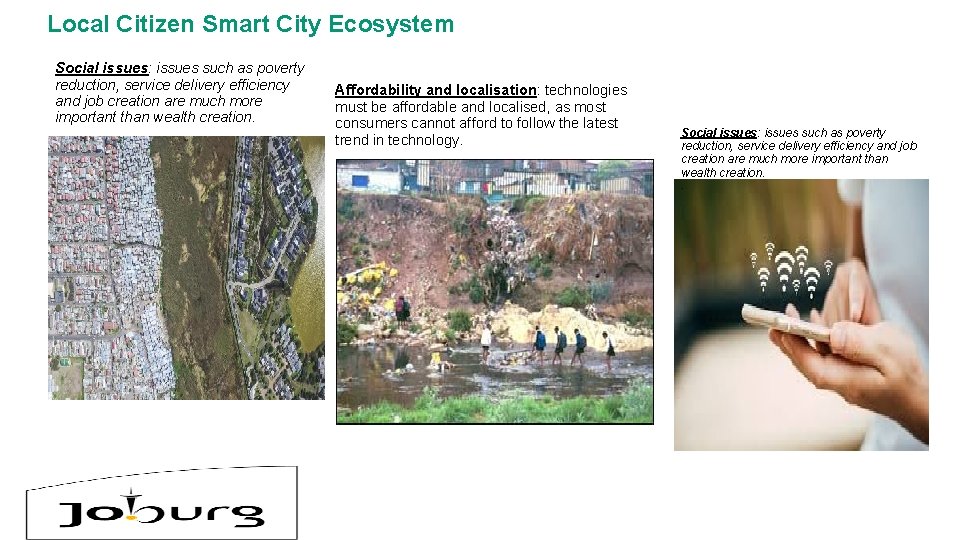
Local Citizen Smart City Ecosystem Social issues: issues such as poverty reduction, service delivery efficiency and job creation are much more important than wealth creation. . Affordability and localisation: technologies must be affordable and localised, as most consumers cannot afford to follow the latest trend in technology. Social issues: issues such as poverty reduction, service delivery efficiency and job creation are much more important than wealth creation. .
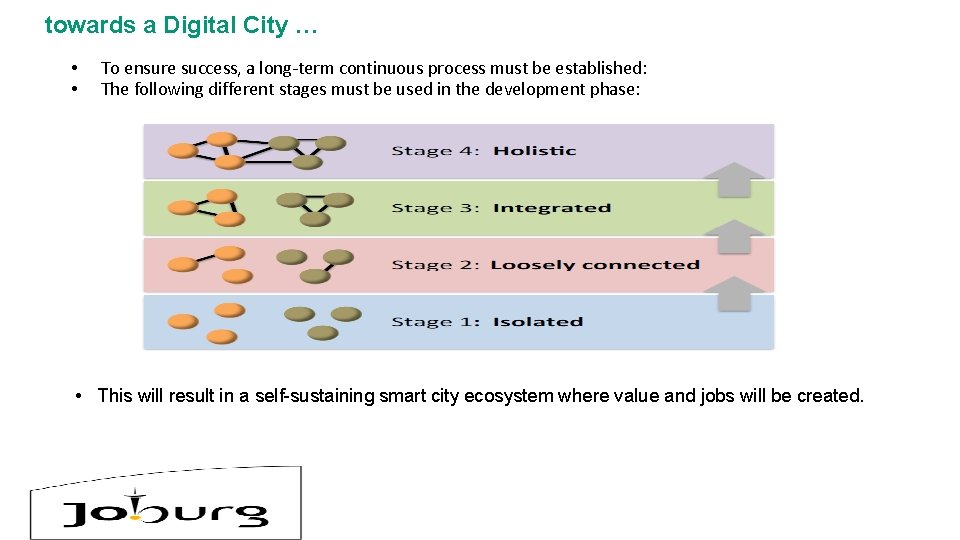
towards a Digital City … • • To ensure success, a long-term continuous process must be established: The following different stages must be used in the development phase: • This will result in a self-sustaining smart city ecosystem where value and jobs will be created.
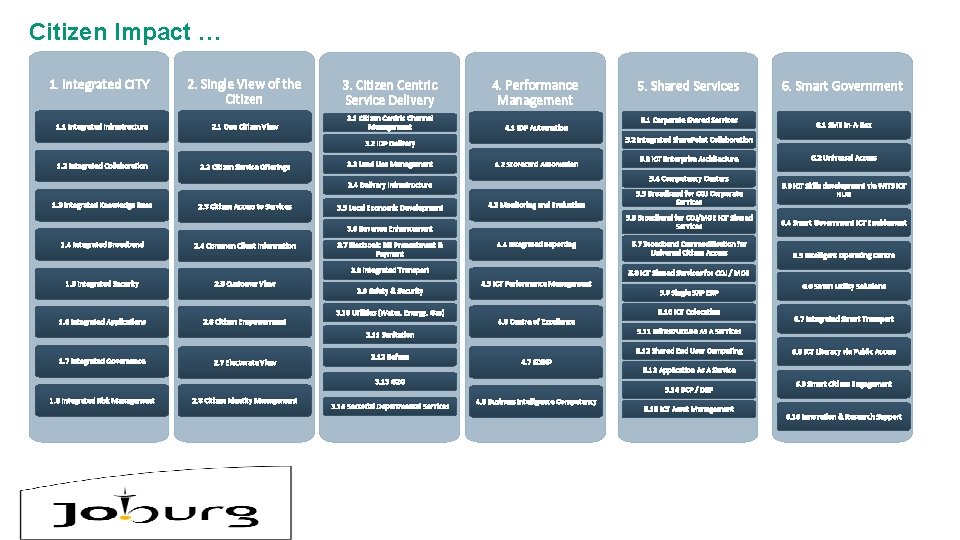
Citizen Impact … 1. Integrated CITY 1. 1 Integrated Infrastructure 2. Single View of the Citizen 3. Citizen Centric Service Delivery 4. Performance Management 2. 1 One Citizen View 3. 1 Citizen Centric Channel Management 4. 1 IDP Automation 2. 2 Citizen Service Offerings 3. 3 Land Use Management 4. 2 Scorecard Automation 2. 3 Citizen Access to Services 3. 5 Local Economic Development 4. 3 Monitoring and Evaluation 3. 6 Revenue Enhancement 1. 4 Integrated Broadband 2. 4 Common Client Information 3. 7 Electronic Bill Presentment & Payment 4. 4 Integrated Reporting 3. 8 Integrated Transport 1. 5 Integrated Security 2. 5 Customer View 1. 6 Integrated Applications 2. 6 Citizen Empowerment 3. 9 Safety & Security 3. 10 Utilities (Water, Energy, Gas) 2. 7 Electorate View 3. 12 Refuse 4. 6 Centre of Excellence 2. 8 Citizen Identity Management 3. 14 Sectorial Departmental Services 5. 5 Broadband for COJ Corporate Services 6. 2 Universal Access 6. 3 ICT Skills development via WITS ICT HUB 5. 6 Broadband for COJ/MOE ICT Shared Services 6. 4 Smart Government ICT Enablement 5. 7 Broadband Commoditisation for Universal Citizen Access 6. 5 Intelligent Operating Centre 5. 9 Single SAP ERP 5. 10 ICT Colocation 6. 7 Integrated Smart Transport 6. 8 ICT Literacy via Public Access 5. 13 Application As A Service 5. 14 BCP / DRP 4. 8 Business Intelligence Competency 6. 6 Smart Utility Solutions 5. 11 Infrastructure As A Services 5. 12 Shared End User Computing 4. 7 SDBIP 3. 13 G 2 G 1. 8 Integrated Risk Management 6. 1 SME In-A-Box 5. 8 ICT Shared Services for COJ / MOE 4. 5 ICT Performance Management 3. 11 Sanitation 1. 7 Integrated Governance 5. 3 ICT Enterprise Architecture 5. 4 Competency Centers 3. 4 Delivery Infrastructure 1. 3 Integrated Knowledge Base 5. 1 Corporate Shared Services 6. Smart Government 5. 2 Integrated Share. Point Collaboration 3. 2 IDP Delivery 1. 2 Integrated Collaboration 5. Shared Services 5. 15 ICT Asset Management 6. 9 Smart Citizen Engagement 6. 10 Innovation & Research Support
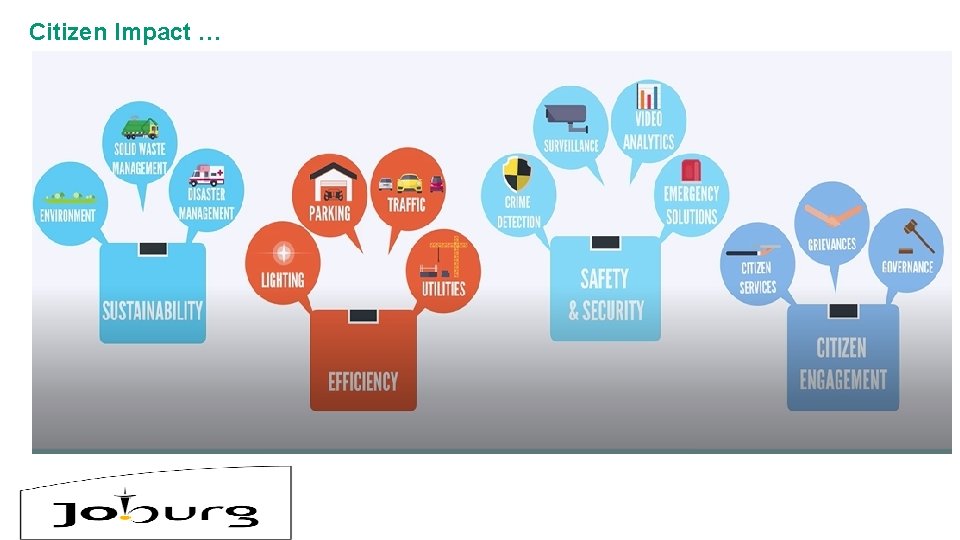
Citizen Impact …

- Slides: 12