
Smart Antennas in Cellular CDMA Systems Adrian Boukalov
Smart Antennas in Cellular CDMA- Systems Adrian Boukalov adrian. boukalov@hut. fi Helsinki University of Technology Merito Forum Radioverkko 2000 Communications Laboratory TKK/Tietoliikennelaboratorio A.
Content 1. Introduction 2. Smart Antennas classification. Basics of Smart Antennas (SA) techniques 3. Smart Antennas in CDMA systems 4. Network control and planning with Smart Antennas. System performance. 5. Future evolution. - Glossary - Bibliography 3/5/2021 Merito Forum Radioverkko 2000 TKK/Tietoliikennelaboratorio A. 2
"Spatial Processing remains as the most promising, if not the last frontier, in the evolution of multiple access systems" Andrew Viterbi There are very few techniques proposed today, which are able to improve radio network performance dramatically - Spatial processing - Multi-user detection - Channel reuse based on polarization - Advanced network control Spatial processing is among them and can be effectively combined with others techniques Merito Forum Radioverkko 2000 TKK/Tietoliikennelaboratorio A.
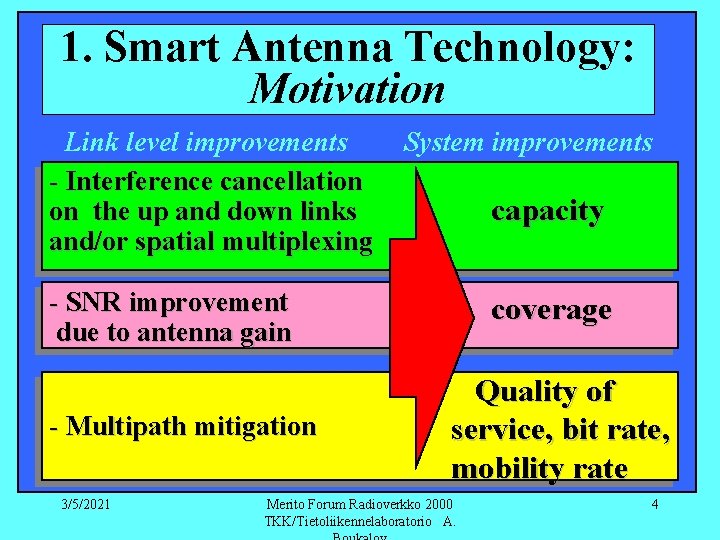
1. Smart Antenna Technology: Motivation Link level improvements - Interference cancellation on the up and down links and/or spatial multiplexing System improvements capacity - SNR improvement due to antenna gain - Multipath mitigation 3/5/2021 coverage Quality of service, bit rate, mobility rate Merito Forum Radioverkko 2000 TKK/Tietoliikennelaboratorio A. 4
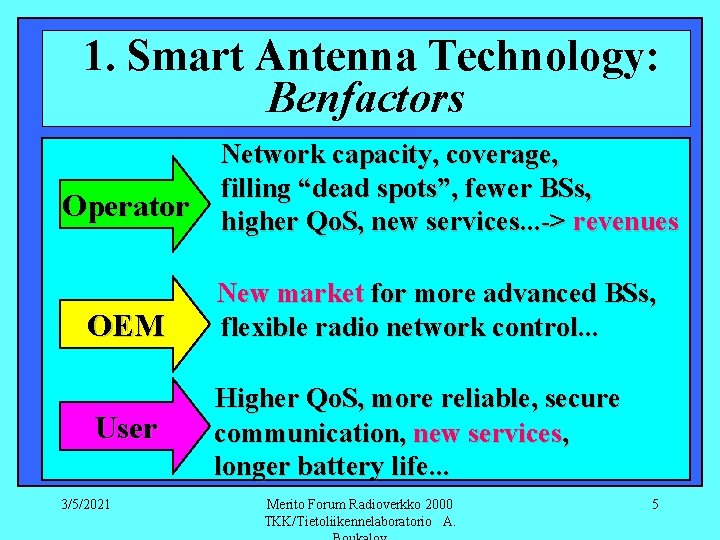
1. Smart Antenna Technology: Benfactors Operator OEM User 3/5/2021 Network capacity, coverage, filling “dead spots”, fewer BSs, higher Qo. S, new services. . . -> revenues New market for more advanced BSs, flexible radio network control. . . Higher Qo. S, more reliable, secure communication, new services, longer battery life. . . Merito Forum Radioverkko 2000 TKK/Tietoliikennelaboratorio A. 5
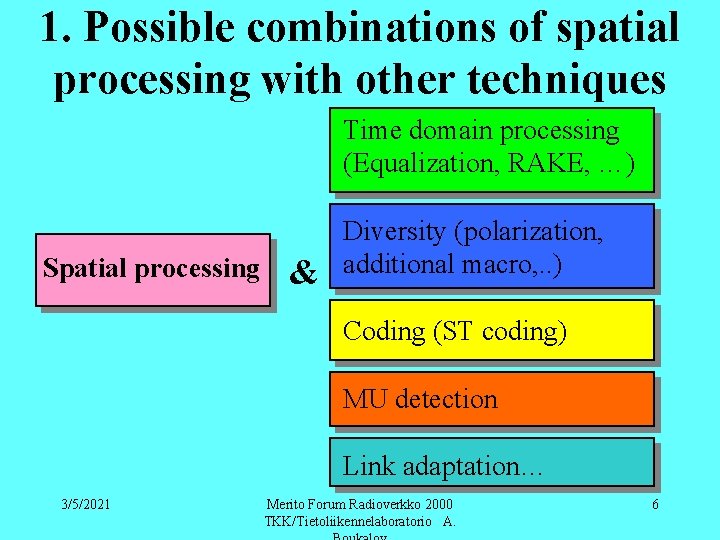
1. Possible combinations of spatial processing with other techniques Time domain processing (Equalization, RAKE, …) Spatial processing & Diversity (polarization, additional macro, . . ) Coding (ST coding) MU detection Link adaptation… 3/5/2021 Merito Forum Radioverkko 2000 TKK/Tietoliikennelaboratorio A. 6
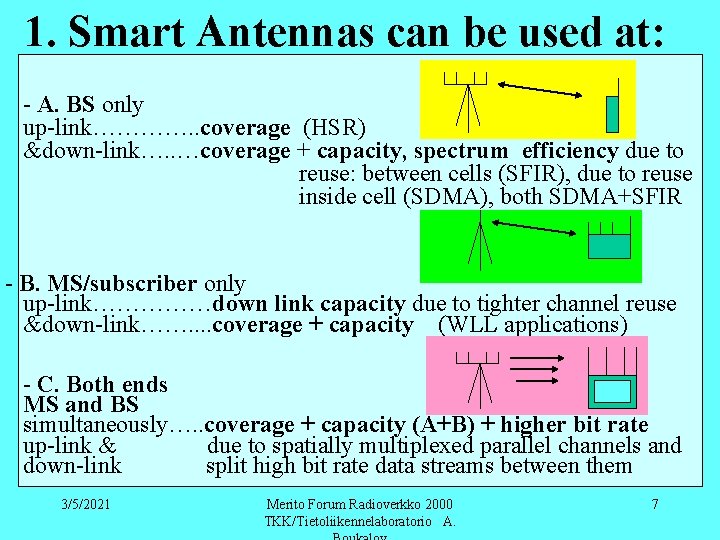
1. Smart Antennas can be used at: - A. BS only up-link…………. . coverage (HSR) &down-link…. . …coverage + capacity, spectrum efficiency due to reuse: between cells (SFIR), due to reuse inside cell (SDMA), both SDMA+SFIR - B. MS/subscriber only up-link……………down link capacity due to tighter channel reuse &down-link……. . coverage + capacity (WLL applications) - C. Both ends MS and BS simultaneously…. . coverage + capacity (A+B) + higher bit rate up-link & due to spatially multiplexed parallel channels and down-link split high bit rate data streams between them 3/5/2021 Merito Forum Radioverkko 2000 TKK/Tietoliikennelaboratorio A. 7
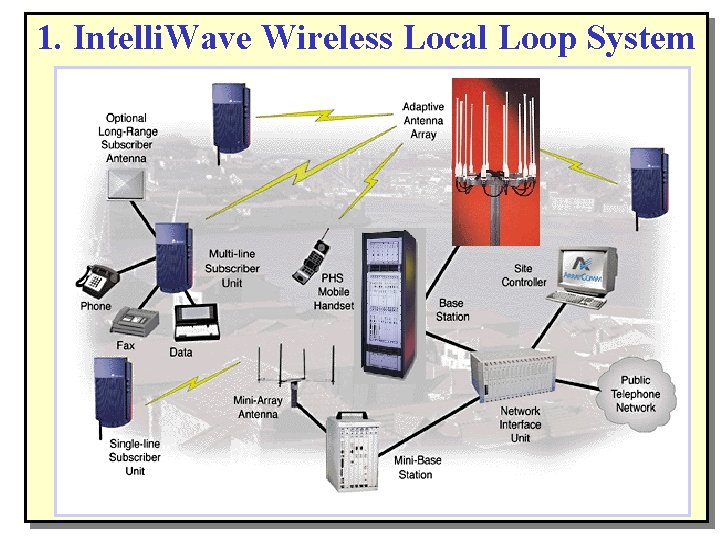
1. Intelli. Wave Wireless Local Loop System
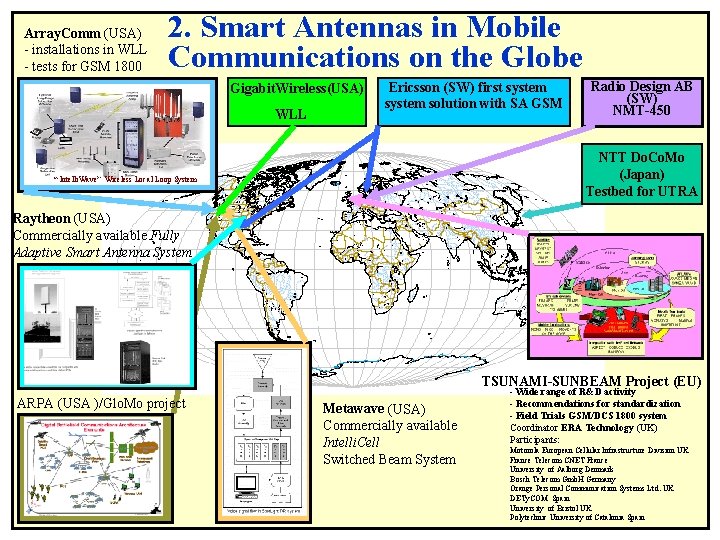
Array. Comm (USA) - installations in WLL - tests for GSM 1800 2. Smart Antennas in Mobile Communications on the Globe Gigabit. Wireless(USA) WLL Ericsson (SW) first system solution with SA GSM Radio Design AB (SW) NMT-450 NTT Do. Co. Mo (Japan) Testbed for UTRA “ Intelli. Wave” Wireless Local Loop System Raytheon (USA) Commercially available Fully Adaptive Smart Antenna System TSUNAMI-SUNBEAM Project (EU) ARPA (USA )/Glo. Mo project Metawave (USA) Commercially available Intelli. Cell Switched Beam System - Wide range of R&D activity - Recommendations for standardization - Field Trials GSM/DCS 1800 system Coordinator ERA Technology (UK) Participants: Motorola European Cellular Infrastructure Division UK France Telecom CNET France University of Aalborg Denmark Bosch Telecom Gmb. H Germany Orange Personal Communication Systems Ltd. UK DETy. COM Spain University of Bristol UK Polytechnic University of Catalonia Spain
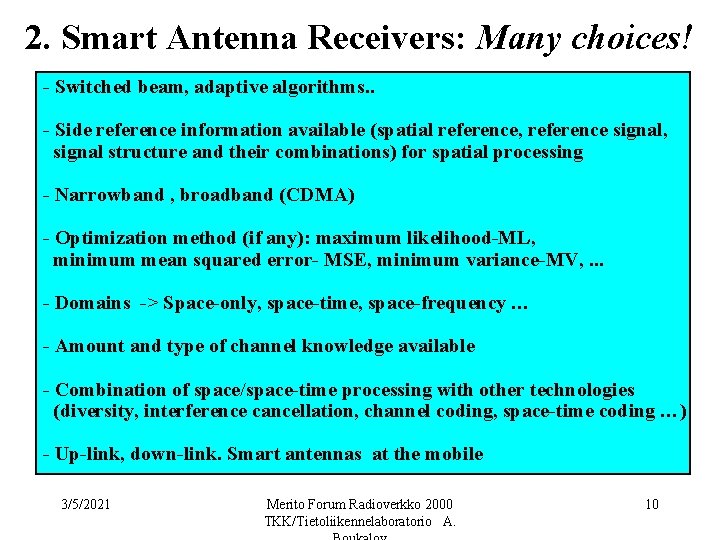
2. Smart Antenna Receivers: Many choices! - Switched beam, adaptive algorithms. . - Side reference information available (spatial reference, reference signal, signal structure and their combinations) for spatial processing - Narrowband , broadband (CDMA) - Optimization method (if any): maximum likelihood-ML, minimum mean squared error- MSE, minimum variance-MV, . . . - Domains -> Space-only, space-time, space-frequency … - Amount and type of channel knowledge available - Combination of space/space-time processing with other technologies (diversity, interference cancellation, channel coding, space-time coding …) - Up-link, down-link. Smart antennas at the mobile 3/5/2021 Merito Forum Radioverkko 2000 TKK/Tietoliikennelaboratorio A. 10
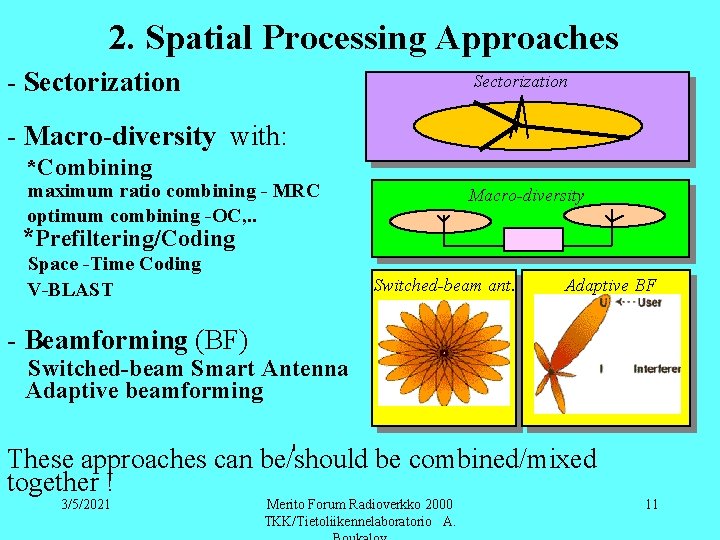
2. Spatial Processing Approaches - Sectorization - Macro-diversity with: *Combining maximum ratio combining - MRC optimum combining -OC, . . Macro-diversity *Prefiltering/Coding Space -Time Coding V-BLAST Switched-beam ant. Adaptive BF - Beamforming (BF) Switched-beam Smart Antenna Adaptive beamforming These approaches can be/should be combined/mixed together ! 3/5/2021 Merito Forum Radioverkko 2000 TKK/Tietoliikennelaboratorio A. 11
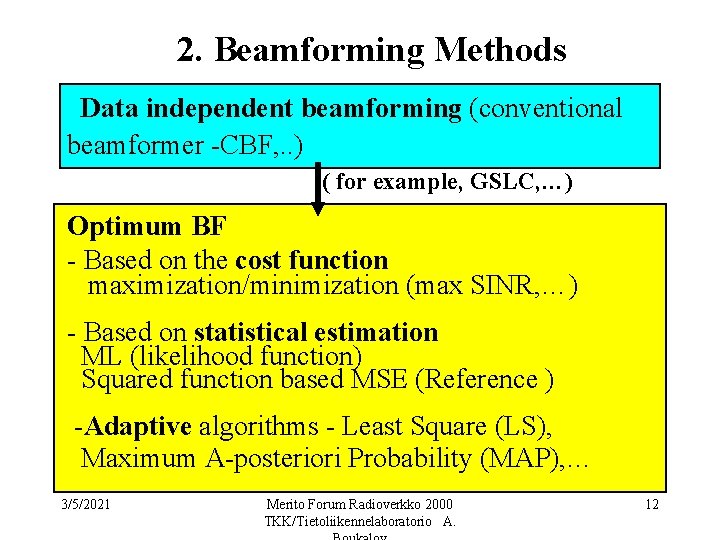
2. Beamforming Methods Data independent beamforming (conventional beamformer -CBF, . . ) ( for example, GSLC, …) Optimum BF - Based on the cost function maximization/minimization (max SINR, …) - Based on statistical estimation ML (likelihood function) Squared function based MSE (Reference ) -Adaptive algorithms - Least Square (LS), Maximum A-posteriori Probability (MAP), … 3/5/2021 Merito Forum Radioverkko 2000 TKK/Tietoliikennelaboratorio A. 12
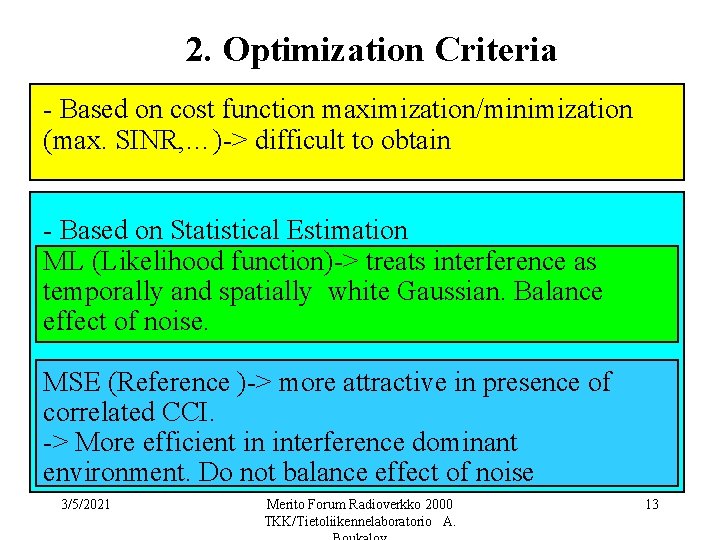
2. Optimization Criteria - Based on cost function maximization/minimization (max. SINR, …)-> difficult to obtain - Based on Statistical Estimation ML (Likelihood function)-> treats interference as temporally and spatially white Gaussian. Balance effect of noise. MSE (Reference )-> more attractive in presence of correlated CCI. -> More efficient in interference dominant environment. Do not balance effect of noise 3/5/2021 Merito Forum Radioverkko 2000 TKK/Tietoliikennelaboratorio A. 13
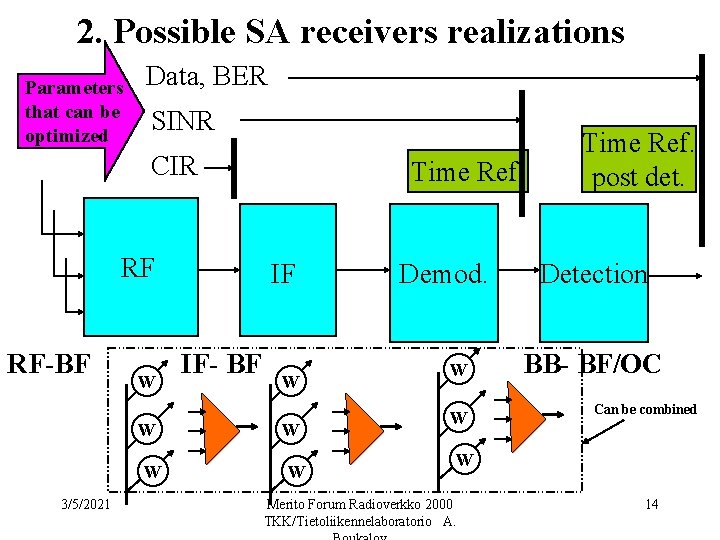
2. Possible SA receivers realizations Parameters that can be optimized Data, BER SINR CIR RF RF-BF W W W 3/5/2021 Time Ref. IF IF- BF W W W Demod. W W Time Ref. post det. Detection BB- BF/OC Can be combined W Merito Forum Radioverkko 2000 TKK/Tietoliikennelaboratorio A. 14
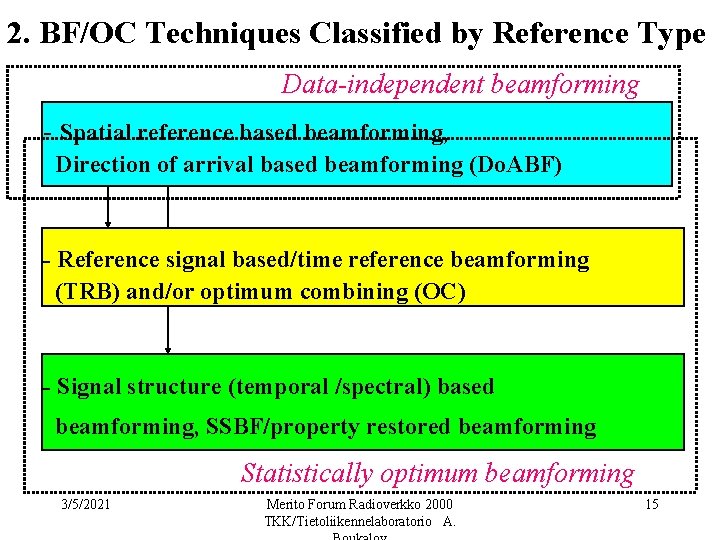
2. BF/OC Techniques Classified by Reference Type Data-independent beamforming - Spatial reference based beamforming, Direction of arrival based beamforming (Do. ABF) - Reference signal based/time reference beamforming (TRB) and/or optimum combining (OC) - Signal structure (temporal /spectral) based beamforming, SSBF/property restored beamforming Statistically optimum beamforming 3/5/2021 Merito Forum Radioverkko 2000 TKK/Tietoliikennelaboratorio A. 15
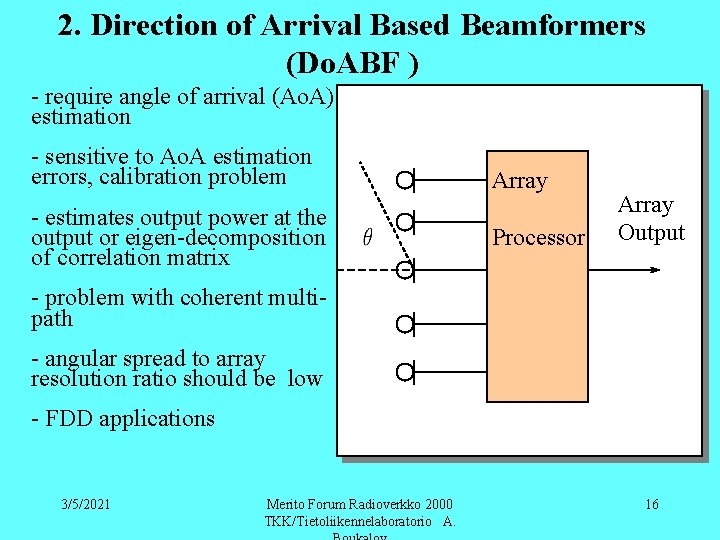
2. Direction of Arrival Based Beamformers (Do. ABF ) - require angle of arrival (Ao. A) estimation - sensitive to Ao. A estimation errors, calibration problem - estimates output power at the output or eigen-decomposition of correlation matrix Array Processor Array Output - problem with coherent multipath - angular spread to array resolution ratio should be low - FDD applications 3/5/2021 Merito Forum Radioverkko 2000 TKK/Tietoliikennelaboratorio A. 16
2. Ao. A estimation methods 1. Conventional techniques - poor angular resolution limited by aperture, search of peaks in spatial spectrum - MV (some degrees of freedom spent on interference cancellation, improved resolution) 2. Based on statistical model of signal and noise (optimal) - ML, MLM - data samples <-> Ao. A joint pdf of sampled data needed, very computationally extensive, can work well in low SNR (or number of signal samples is small) work well in correlated signal conditions, number of sources should be known, non-linear multi-dimensional optimisation (coincides with LS estimator if assumptions about noise do not hold) 3/5/2021 Merito Forum Radioverkko 2000 TKK/Tietoliikennelaboratorio A. 17
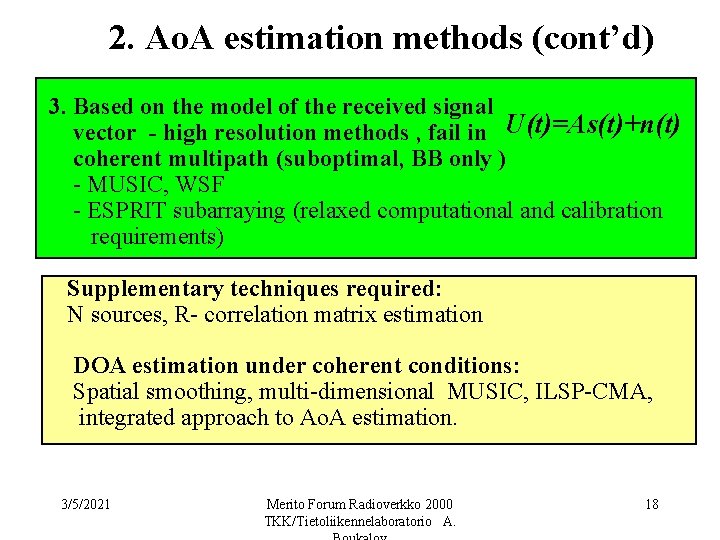
2. Ao. A estimation methods (cont’d) 3. Based on the model of the received signal vector - high resolution methods , fail in U(t)=As(t)+n(t) coherent multipath (suboptimal, BB only ) - MUSIC, WSF - ESPRIT subarraying (relaxed computational and calibration requirements) Supplementary techniques required: N sources, R- correlation matrix estimation DOA estimation under coherent conditions: Spatial smoothing, multi-dimensional MUSIC, ILSP-CMA, integrated approach to Ao. A estimation. 3/5/2021 Merito Forum Radioverkko 2000 TKK/Tietoliikennelaboratorio A. 18
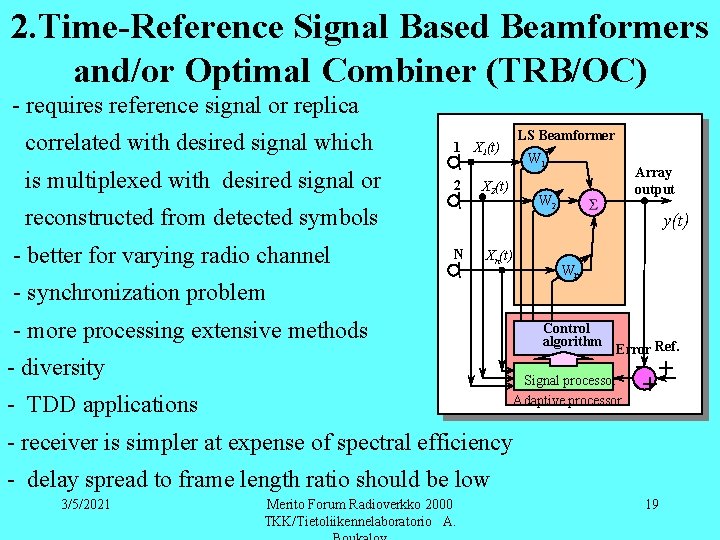
2. Time-Reference Signal Based Beamformers and/or Optimal Combiner (TRB/OC) - requires reference signal or replica correlated with desired signal which 1 X 1(t) is multiplexed with desired signal or 2 X 2(t) reconstructed from detected symbols - better for varying radio channel N Xn(t) - synchronization problem - more processing extensive methods - diversity LS Beamformer W 1 Array output W 2 y(t) Wn Control algorithm Error Ref. Signal processor Adaptive processor - TDD applications - + + - receiver is simpler at expense of spectral efficiency - delay spread to frame length ratio should be low 3/5/2021 Merito Forum Radioverkko 2000 TKK/Tietoliikennelaboratorio A. 19
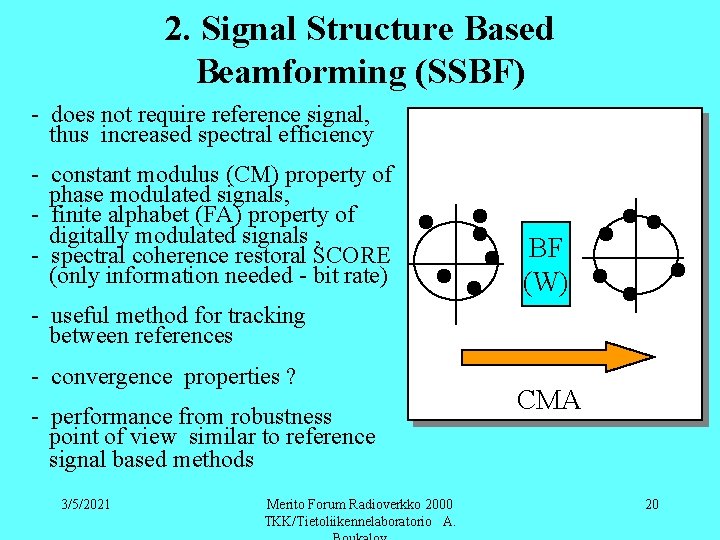
2. Signal Structure Based Beamforming (SSBF) - does not require reference signal, thus increased spectral efficiency - constant modulus (CM) property of phase modulated signals, - finite alphabet (FA) property of digitally modulated signals , - spectral coherence restoral SCORE (only information needed - bit rate) BF (W) - useful method for tracking between references - convergence properties ? - performance from robustness point of view similar to reference signal based methods 3/5/2021 Merito Forum Radioverkko 2000 TKK/Tietoliikennelaboratorio A. CMA 20
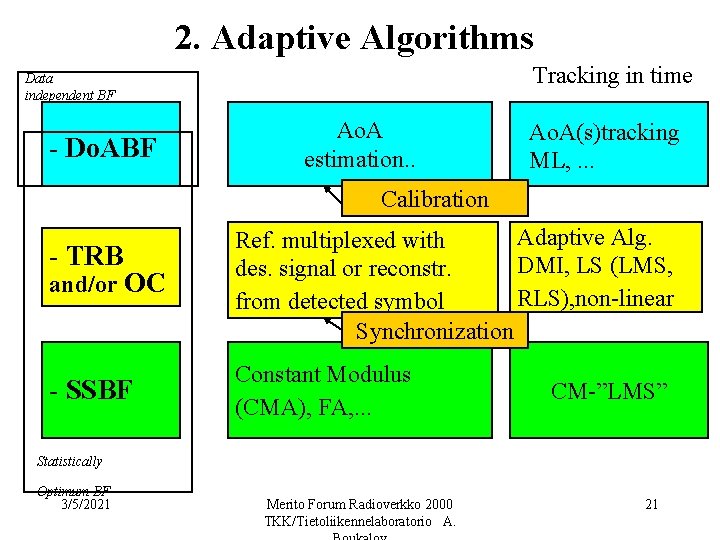
2. Adaptive Algorithms Tracking in time Data independent BF - Do. ABF Ao. A estimation. . Ao. A(s)tracking ML, . . . Calibration and/or OC Adaptive Alg. Ref. multiplexed with DMI, LS (LMS, des. signal or reconstr. RLS), non-linear from detected symbol Synchronization - SSBF Constant Modulus (CMA), FA, . . . - TRB CM-”LMS” Statistically Optimum BF 3/5/2021 Merito Forum Radioverkko 2000 TKK/Tietoliikennelaboratorio A. 21
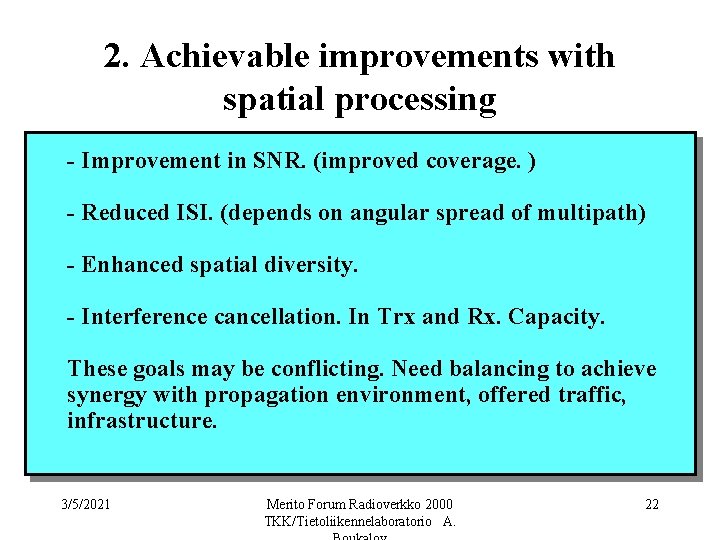
2. Achievable improvements with spatial processing - Improvement in SNR. (improved coverage. ) - Reduced ISI. (depends on angular spread of multipath) - Enhanced spatial diversity. - Interference cancellation. In Trx and Rx. Capacity. These goals may be conflicting. Need balancing to achieve synergy with propagation environment, offered traffic, infrastructure. 3/5/2021 Merito Forum Radioverkko 2000 TKK/Tietoliikennelaboratorio A. 22
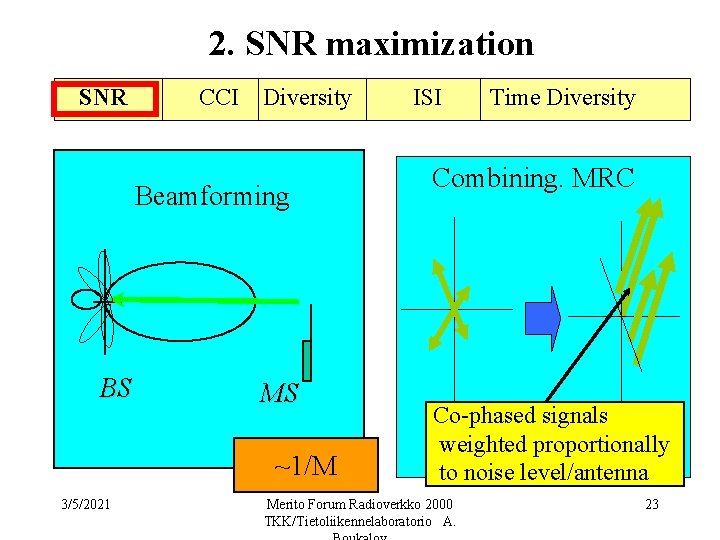
2. SNR maximization SNR CCI Diversity Beamforming BS MS ~1/M 3/5/2021 ISI Time Diversity Combining. MRC Co-phased signals weighted proportionally to noise level/antenna Merito Forum Radioverkko 2000 TKK/Tietoliikennelaboratorio A. 23
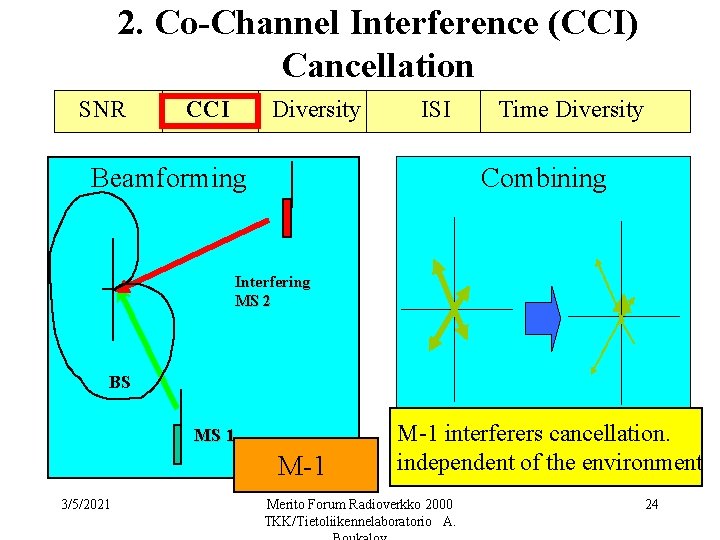
2. Co-Channel Interference (CCI) Cancellation SNR CCI Diversity ISI Beamforming Time Diversity Combining Interfering MS 2 BS MS 1 M-1 3/5/2021 M-1 interferers cancellation. independent of the environment Merito Forum Radioverkko 2000 TKK/Tietoliikennelaboratorio A. 24
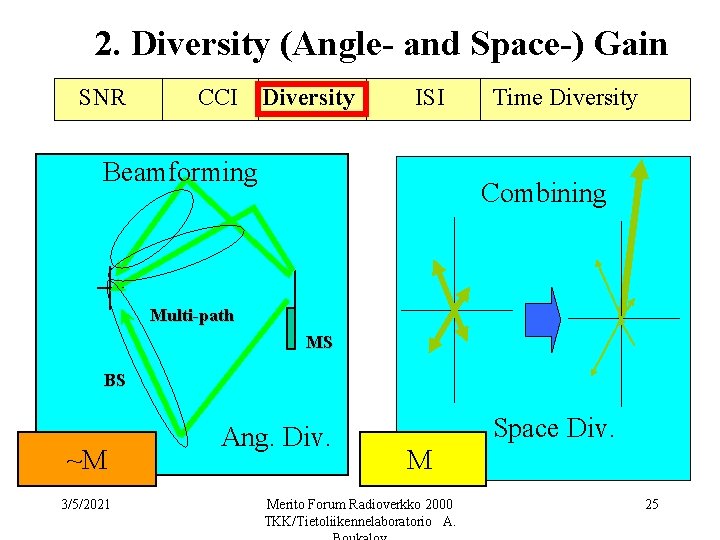
2. Diversity (Angle- and Space-) Gain SNR CCI Diversity ISI Beamforming Time Diversity Combining Multi-path MS BS ~M 3/5/2021 Ang. Div. Space Div. M Merito Forum Radioverkko 2000 TKK/Tietoliikennelaboratorio A. 25
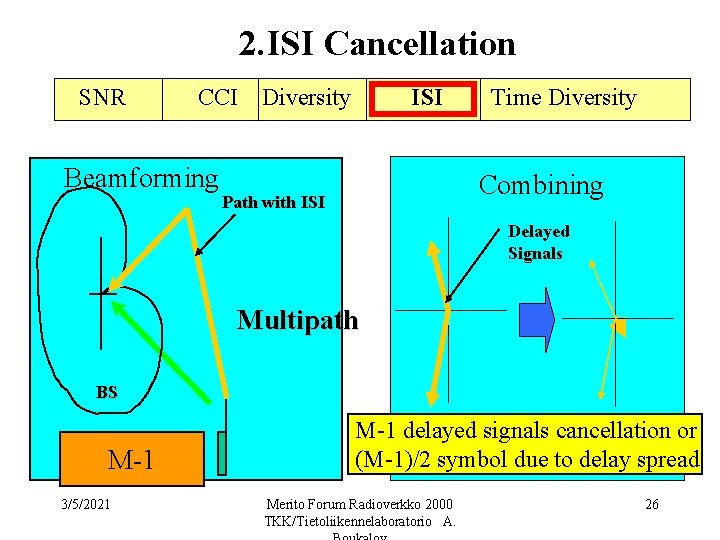
2. ISI Cancellation SNR CCI Beamforming Diversity ISI Time Diversity Combining Path with ISI Delayed Signals Multipath BS M-1 3/5/2021 M-1 delayed signals cancellation or (M-1)/2 symbol due to delay spread Merito Forum Radioverkko 2000 TKK/Tietoliikennelaboratorio A. 26
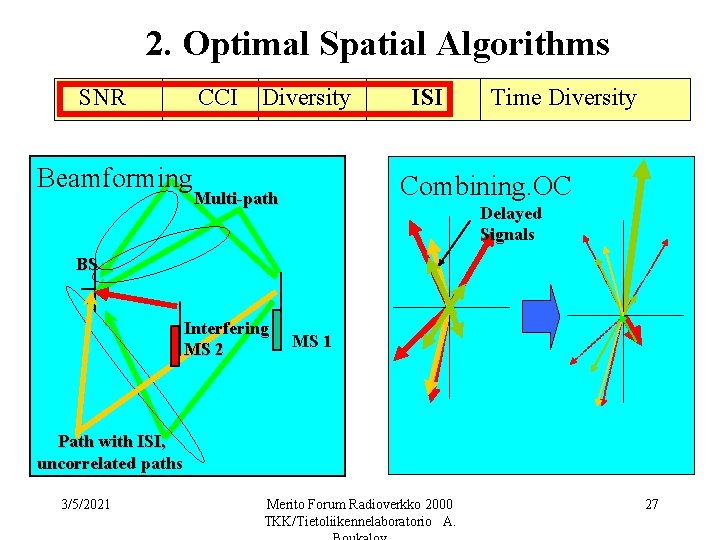
2. Optimal Spatial Algorithms SNR CCI Beamforming Diversity ISI Time Diversity Combining. OC Multi-path Delayed Signals BS Interfering MS 2 MS 1 Path with ISI, uncorrelated paths 3/5/2021 Merito Forum Radioverkko 2000 TKK/Tietoliikennelaboratorio A. 27
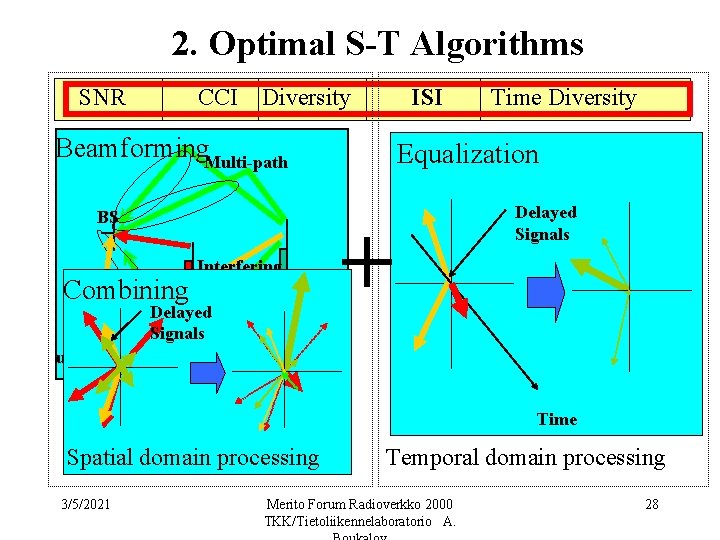
2. Optimal S-T Algorithms SNR CCI Diversity ISI Beamforming. Multi-path BS Interfering MS 1 Combining MS 2 Delayed Path with. Signals ISI, uncorrelated paths Time Diversity Equalization + Delayed Signals Time Spatial domain processing 3/5/2021 Temporal domain processing Merito Forum Radioverkko 2000 TKK/Tietoliikennelaboratorio A. 28
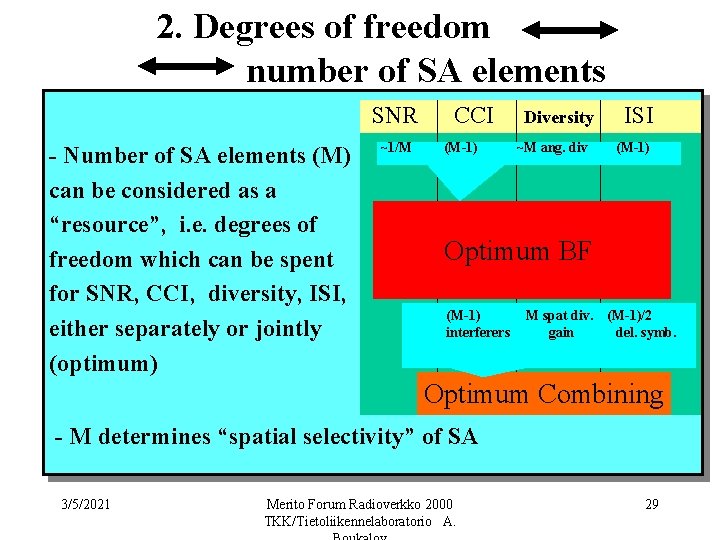
2. Degrees of freedom number of SA elements SNR - Number of SA elements (M) can be considered as a “resource”, i. e. degrees of freedom which can be spent for SNR, CCI, diversity, ISI, either separately or jointly (optimum) ~1/M CCI (M-1) Diversity ~M ang. div ISI (M-1) Optimum BF (M-1) interferers M spat div. gain (M-1)/2 del. symb. Optimum Combining - M determines “spatial selectivity” of SA 3/5/2021 Merito Forum Radioverkko 2000 TKK/Tietoliikennelaboratorio A. 29
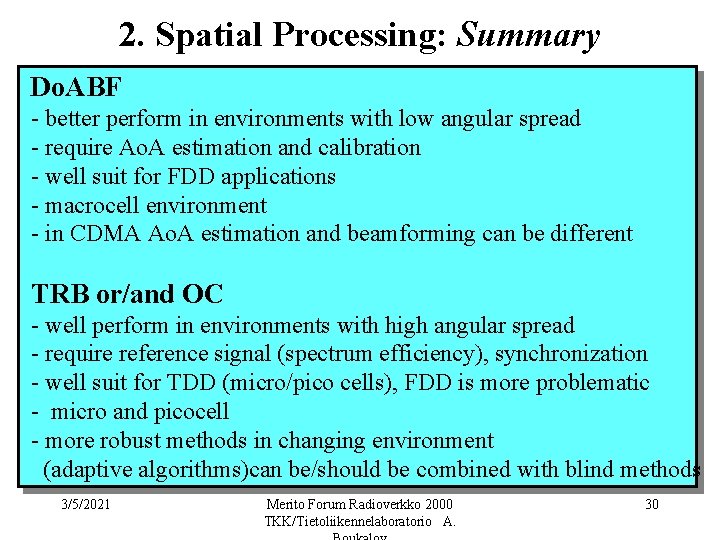
2. Spatial Processing: Summary Do. ABF - better perform in environments with low angular spread - require Ao. A estimation and calibration - well suit for FDD applications - macrocell environment - in CDMA Ao. A estimation and beamforming can be different TRB or/and OC - well perform in environments with high angular spread - require reference signal (spectrum efficiency), synchronization - well suit for TDD (micro/pico cells), FDD is more problematic - micro and picocell - more robust methods in changing environment (adaptive algorithms)can be/should be combined with blind methods 3/5/2021 Merito Forum Radioverkko 2000 TKK/Tietoliikennelaboratorio A. 30
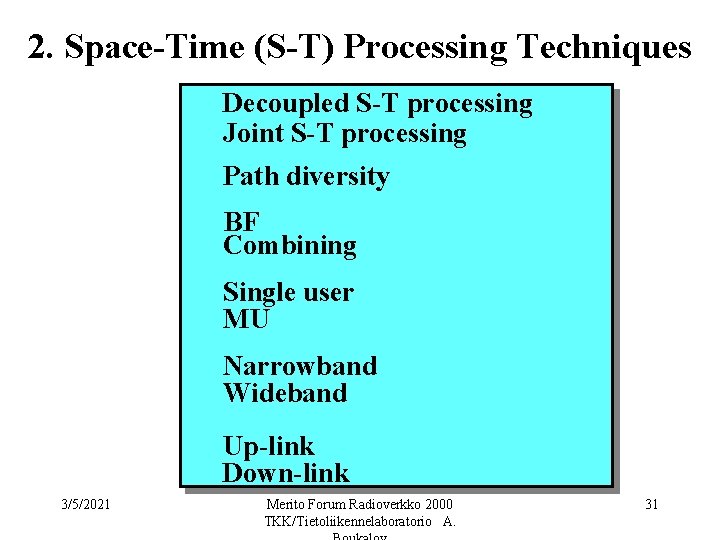
2. Space-Time (S-T) Processing Techniques Decoupled S-T processing Joint S-T processing Path diversity BF Combining Single user MU Narrowband Wideband Up-link Down-link 3/5/2021 Merito Forum Radioverkko 2000 TKK/Tietoliikennelaboratorio A. 31
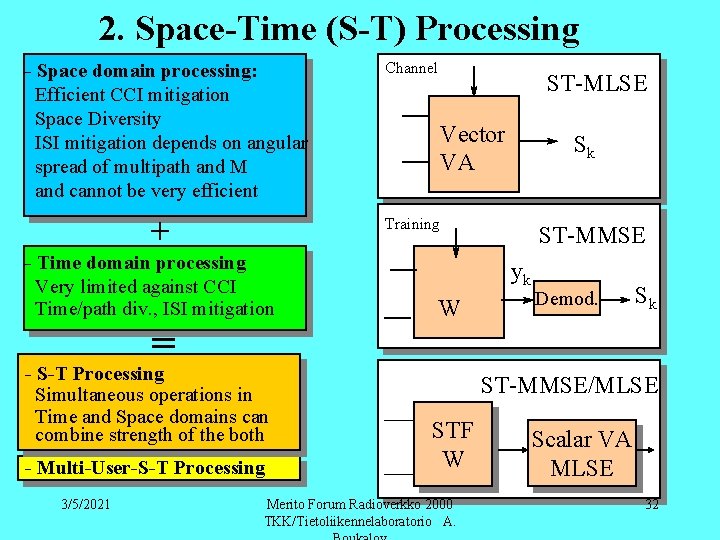
2. Space-Time (S-T) Processing - Space domain processing: Efficient CCI mitigation Space Diversity ISI mitigation depends on angular spread of multipath and M and cannot be very efficient Channel + Training - Time domain processing Very limited against CCI Time/path div. , ISI mitigation = - S-T Processing Simultaneous operations in Time and Space domains can combine strength of the both - Multi-User-S-T Processing 3/5/2021 ST-MLSE Vector VA Sk ST-MMSE yk W Demod. Sk ST-MMSE/MLSE STF W Merito Forum Radioverkko 2000 TKK/Tietoliikennelaboratorio A. Scalar VA MLSE 32
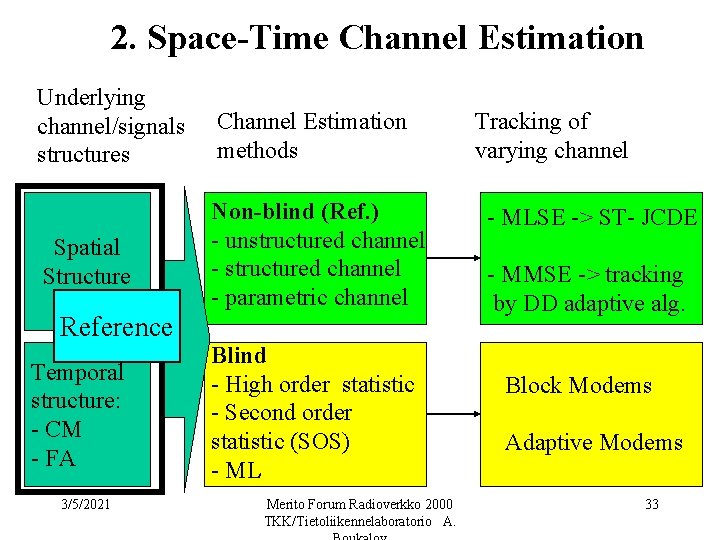
2. Space-Time Channel Estimation Underlying channel/signals structures Channel Estimation methods Spatial Structure Non-blind (Ref. ) - unstructured channel - parametric channel Reference Temporal structure: - CM - FA 3/5/2021 Blind - High order statistic - Second order statistic (SOS) - ML Merito Forum Radioverkko 2000 TKK/Tietoliikennelaboratorio A. Tracking of varying channel - MLSE -> ST- JCDE - MMSE -> tracking by DD adaptive alg. Block Modems Adaptive Modems 33
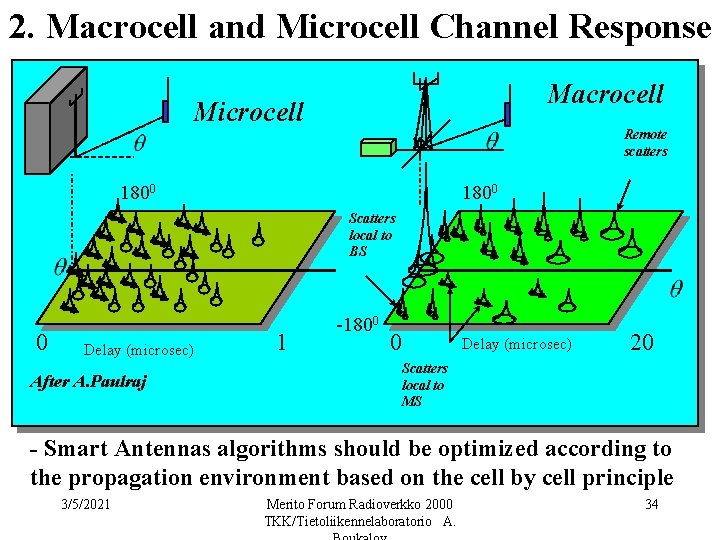
2. Macrocell and Microcell Channel Response Macrocell Microcell Remote scatters 1800 Scatters local to BS 0 Delay (microsec) After A. Paulraj 1 -1800 0 Delay (microsec) 20 Scatters local to MS - Smart Antennas algorithms should be optimized according to the propagation environment based on the cell by cell principle 3/5/2021 Merito Forum Radioverkko 2000 TKK/Tietoliikennelaboratorio A. 34
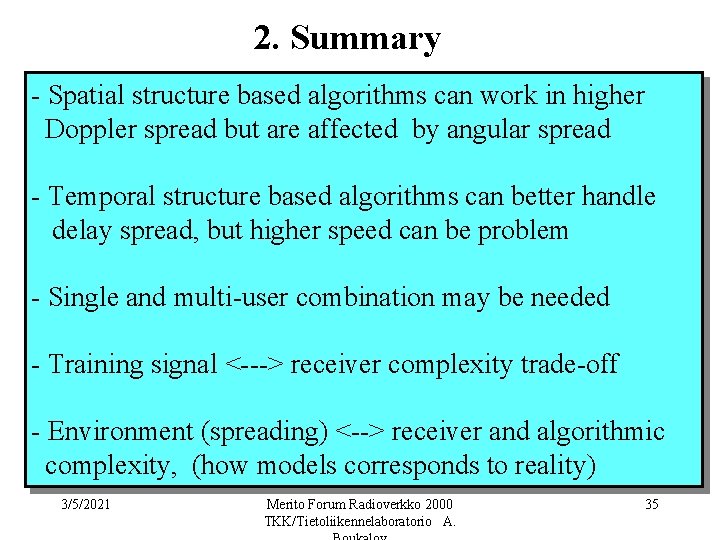
2. Summary - Spatial structure based algorithms can work in higher Doppler spread but are affected by angular spread - Temporal structure based algorithms can better handle delay spread, but higher speed can be problem - Single and multi-user combination may be needed - Training signal <---> receiver complexity trade-off - Environment (spreading) <--> receiver and algorithmic complexity, (how models corresponds to reality) 3/5/2021 Merito Forum Radioverkko 2000 TKK/Tietoliikennelaboratorio A. 35
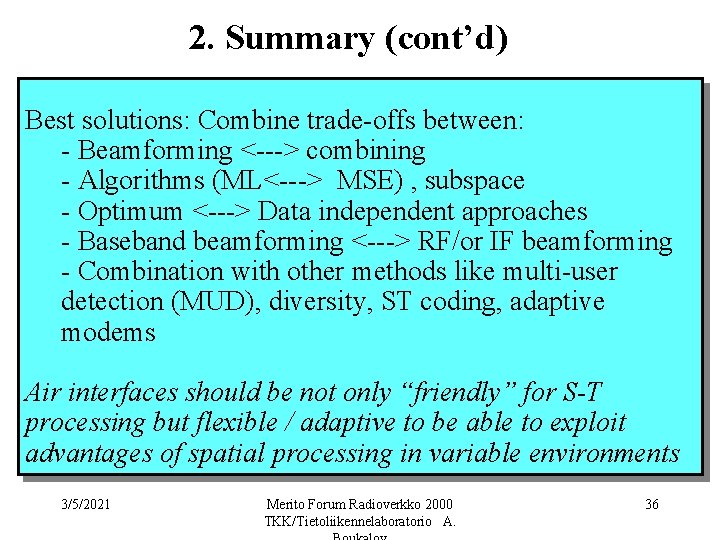
2. Summary (cont’d) Best solutions: Combine trade-offs between: - Beamforming <---> combining - Algorithms (ML<---> MSE) , subspace - Optimum <---> Data independent approaches - Baseband beamforming <---> RF/or IF beamforming - Combination with other methods like multi-user detection (MUD), diversity, ST coding, adaptive modems Air interfaces should be not only “friendly” for S-T processing but flexible / adaptive to be able to exploit advantages of spatial processing in variable environments 3/5/2021 Merito Forum Radioverkko 2000 TKK/Tietoliikennelaboratorio A. 36
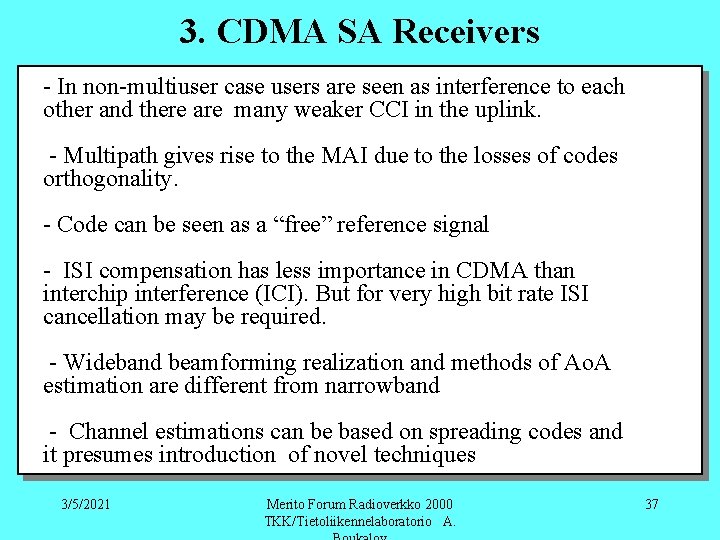
3. CDMA SA Receivers - In non-multiuser case users are seen as interference to each other and there are many weaker CCI in the uplink. - Multipath gives rise to the MAI due to the losses of codes orthogonality. - Code can be seen as a “free” reference signal - ISI compensation has less importance in CDMA than interchip interference (ICI). But for very high bit rate ISI cancellation may be required. - Wideband beamforming realization and methods of Ao. A estimation are different from narrowband - Channel estimations can be based on spreading codes and it presumes introduction of novel techniques 3/5/2021 Merito Forum Radioverkko 2000 TKK/Tietoliikennelaboratorio A. 37
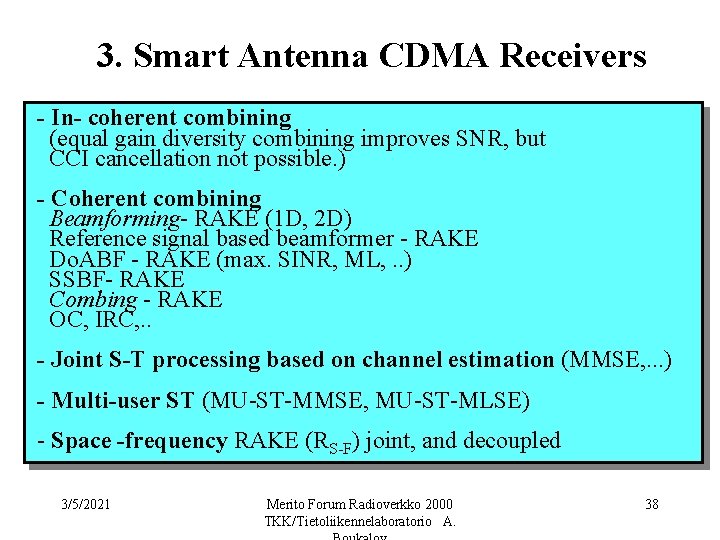
3. Smart Antenna CDMA Receivers - In- coherent combining (equal gain diversity combining improves SNR, but CCI cancellation not possible. ) - Coherent combining Beamforming- RAKE (1 D, 2 D) Reference signal based beamformer - RAKE Do. ABF - RAKE (max. SINR, ML, . . ) SSBF- RAKE Combing - RAKE OC, IRC, . . - Joint S-T processing based on channel estimation (MMSE, . . . ) - Multi-user ST (MU-ST-MMSE, MU-ST-MLSE) - Space -frequency RAKE (RS-F) joint, and decoupled 3/5/2021 Merito Forum Radioverkko 2000 TKK/Tietoliikennelaboratorio A. 38
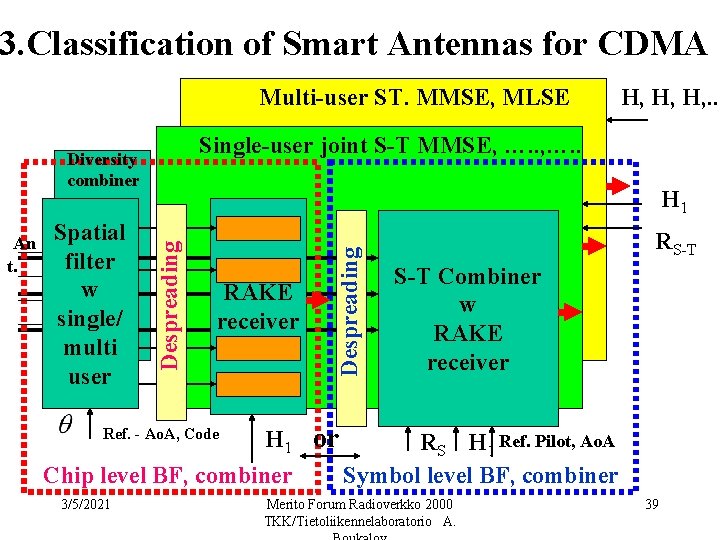
3. Classification of Smart Antennas for CDMA Multi-user ST. MMSE, MLSE Single-user joint S-T MMSE, …. . Diversity combiner RAKE receiver Despreading Spatial filter w single/ multi user H 1 Despreading An t. H, H, H, . . . RS-T Combiner w RAKE receiver H 1 or RS H 1 Ref. Pilot, Ao. A Chip level BF, combiner Symbol level BF, combiner Ref. - Ao. A, Code 3/5/2021 Merito Forum Radioverkko 2000 TKK/Tietoliikennelaboratorio A. 39
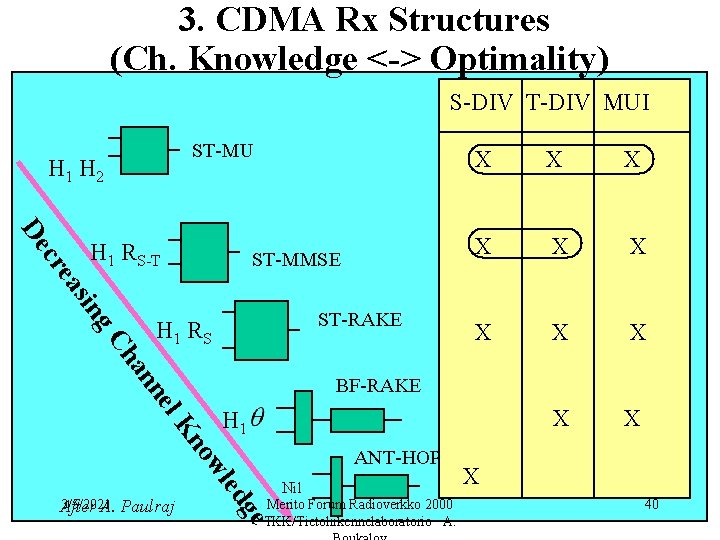
3. CDMA Rx Structures (Ch. Knowledge <-> Optimality) S-DIV T-DIV MUI ST-MU H 1 H 2 ST-MMSE ST-RAKE H 1 R S X X X X X H 1 w no K el ANT-HOP Nil Merito Forum Radioverkko 2000 TKK/Tietoliikennelaboratorio A. ge led 3/5/2021 After A. Paulraj X BF-RAKE nn ha g. C sin ea cr De H 1 RS-T X X 40
3. Performance of CDMA SA Receivers - For low SNR sophisticated spatial-based blind methods are not efficient (switched-beam) - User dedicated pilots at the up- and down-links - additional advantage for SA technology especially in highly loaded cells. - In CDMA the forward link channel estimation problem is simpler than in TDMA because it is possible to decouple the channel mapping for each path and deal with lower angle spread. - In CDMA SA receiver is less sensitive to channel estimation errors but beam pattern optimization can be is more complex. - In multi-bit rate CDMA SA receiver can successfully cancel interference coming from the limited number of high bit rate users thus considerably increase system capacity. 3/5/2021 Merito Forum Radioverkko 2000 TKK/Tietoliikennelaboratorio A. 41
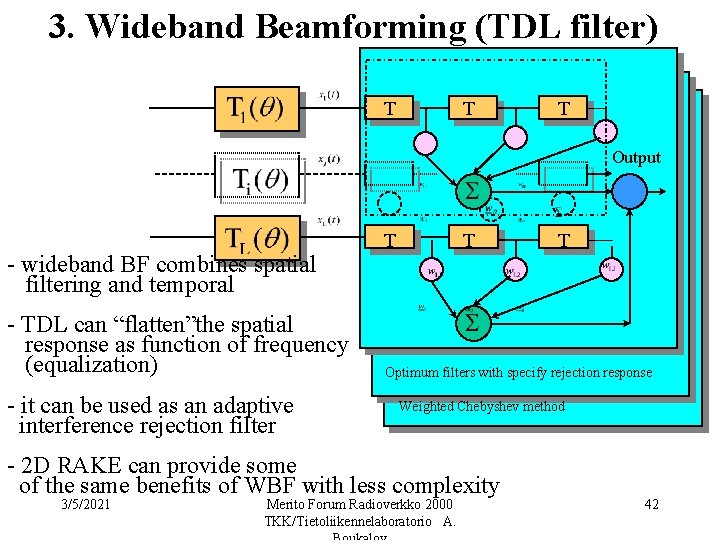
3. Wideband Beamforming (TDL filter) T T T Output - wideband BF combines spatial filtering and temporal - TDL can “flatten”the spatial response as function of frequency (equalization) - it can be used as an adaptive interference rejection filter T T Optimum filters with specify rejection response Weighted Chebyshev method - 2 D RAKE can provide some of the same benefits of WBF with less complexity 3/5/2021 T Merito Forum Radioverkko 2000 TKK/Tietoliikennelaboratorio A. 42
3. CDMA SA Receiver - Path diversity can be achieved with WB Array and RAKE which is WBA with only few taps, and variable matched delays of the received multipath components which followed by diversity comb. - Single-user and multi-user SA receiver demodulate simultaneously K signals. Estimation- subtraction (Spat Proc. + Par. IC). Separable MAI cancellation in space domain. IC for remaining MAI - 2 D RAKE achieve angular and temporal separation - dispersing -> spatial receiver requires only one despreader for each spatial receiver - reverse: spat filter -> despreading - M (branches) despreaders are required 3/5/2021 Merito Forum Radioverkko 2000 TKK/Tietoliikennelaboratorio A. 43
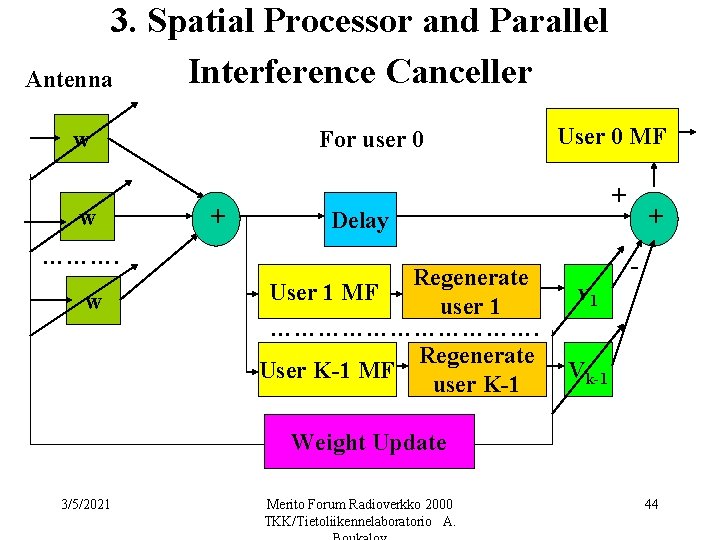
3. Spatial Processor and Parallel Interference Canceller Antenna w w ………. w For user 0 + User 0 MF + Delay Regenerate User 1 MF user 1 ………………. Regenerate User K-1 MF user K-1 + - v 1 Vk-1 Weight Update 3/5/2021 Merito Forum Radioverkko 2000 TKK/Tietoliikennelaboratorio A. 44
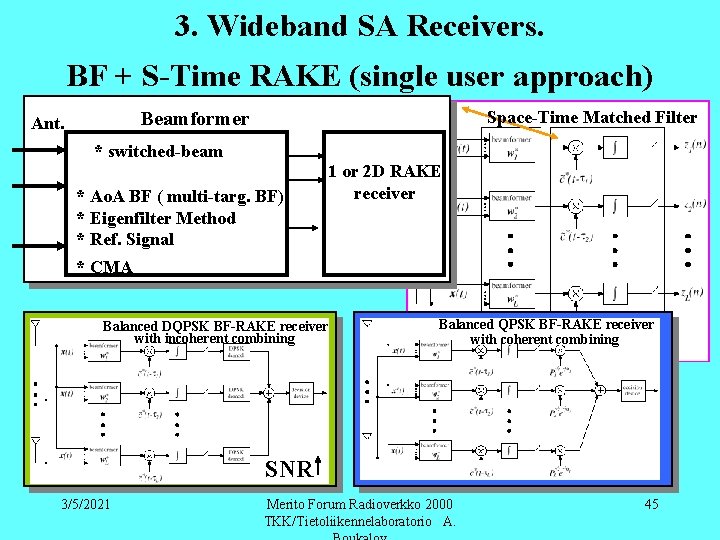
3. Wideband SA Receivers. BF + S-Time RAKE (single user approach) Space-Time Matched Filter Beamformer Ant. * switched-beam * Ao. A BF ( multi-targ. BF) * Eigenfilter Method * Ref. Signal 1 or 2 D RAKE receiver * CMA Balanced DQPSK BF-RAKE receiver with incoherent combining Balanced QPSK BF-RAKE receiver with coherent combining SNR 3/5/2021 Merito Forum Radioverkko 2000 TKK/Tietoliikennelaboratorio A. 45
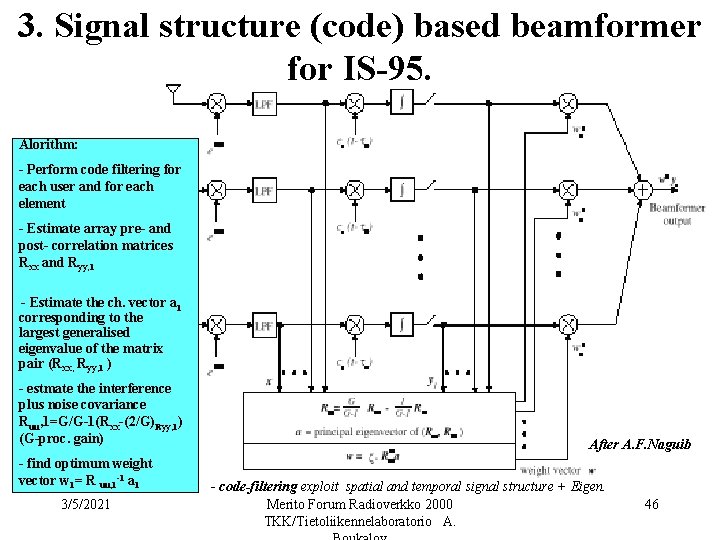
3. Signal structure (code) based beamformer for IS-95. Alorithm: - Perform code filtering for each user and for each element - Estimate array pre- and post- correlation matrices Rxx and Ryy, 1 - Estimate the ch. vector a 1 corresponding to the largest generalised eigenvalue of the matrix pair (Rxx, Ryy, 1 ) - estmate the interference plus noise covariance Ruu, 1=G/G-1(Rxx-(2/G)Ryy, 1) (G-proc. gain) - find optimum weight vector w 1= R uu, 1 -1 a 1 3/5/2021 After A. F. Naguib - code-filtering exploit spatial and temporal signal structure + Eigen. Merito Forum Radioverkko 2000 TKK/Tietoliikennelaboratorio A. 46
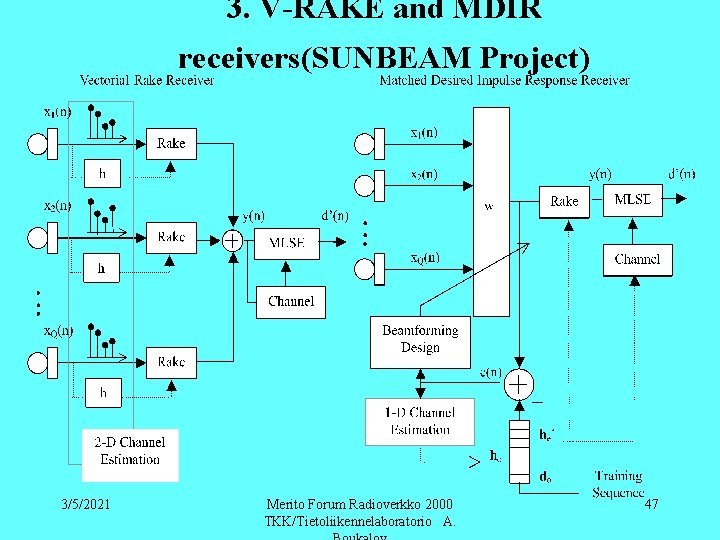
3. V-RAKE and MDIR receivers(SUNBEAM Project) 3/5/2021 Merito Forum Radioverkko 2000 TKK/Tietoliikennelaboratorio A. 47
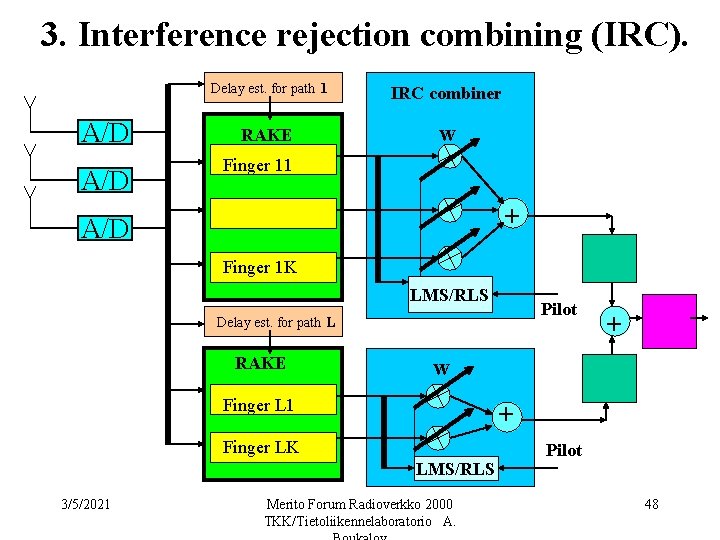
3. Interference rejection combining (IRC). A/D Delay est. for path 1 IRC combiner RAKE w Finger 11 + A/D Finger 1 K LMS/RLS Pilot Delay est. for path L RAKE w Finger L 1 + Finger LK LMS/RLS 3/5/2021 + Merito Forum Radioverkko 2000 TKK/Tietoliikennelaboratorio A. Pilot 48
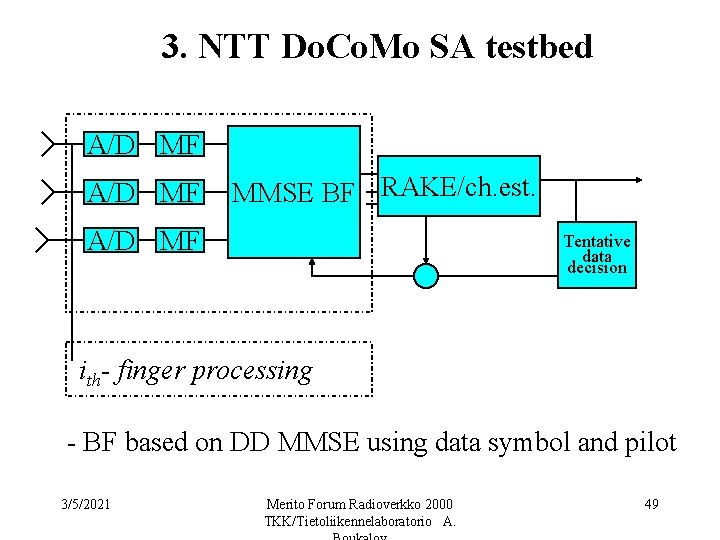
3. NTT Do. Co. Mo SA testbed A/D MF MMSE BF RAKE/ch. est. A/D MF Tentative data decision ith- finger processing - BF based on DD MMSE using data symbol and pilot 3/5/2021 Merito Forum Radioverkko 2000 TKK/Tietoliikennelaboratorio A. 49
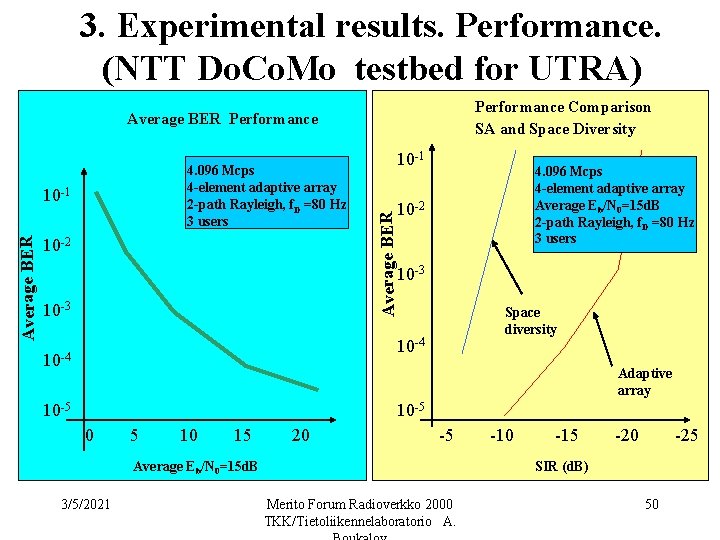
3. Experimental results. Performance. (NTT Do. Co. Mo testbed for UTRA) Performance Comparison SA and Space Diversity Average BER Performance Average BER 10 -1 10 -2 4. 096 Mcps 4 -element adaptive array Average Eb/N 0=15 d. B 2 -path Rayleigh, f. D =80 Hz 3 users 10 -2 Average BER 4. 096 Mcps 4 -element adaptive array 2 -path Rayleigh, f. D =80 Hz 3 users 10 -1 10 -3 Space diversity 10 -4 Adaptive array 10 -5 0 5 10 15 20 -5 Average Eb/N 0=15 d. B 3/5/2021 -10 -15 -20 -25 SIR (d. B) Merito Forum Radioverkko 2000 TKK/Tietoliikennelaboratorio A. 50
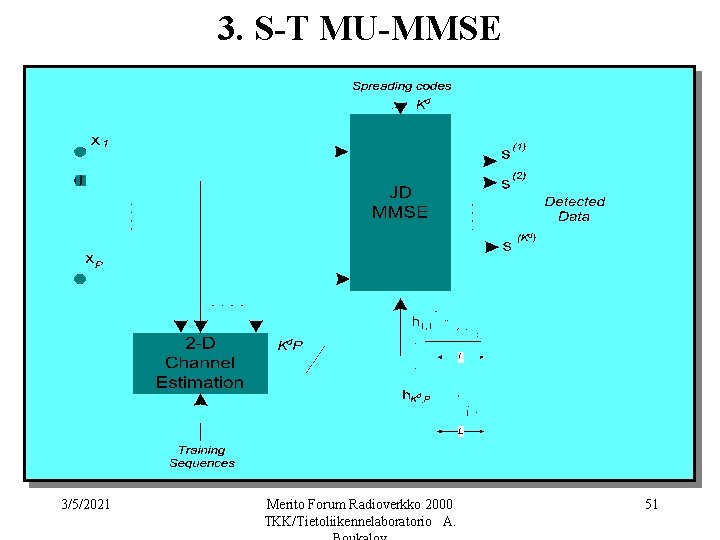
3. S-T MU-MMSE 3/5/2021 Merito Forum Radioverkko 2000 TKK/Tietoliikennelaboratorio A. 51
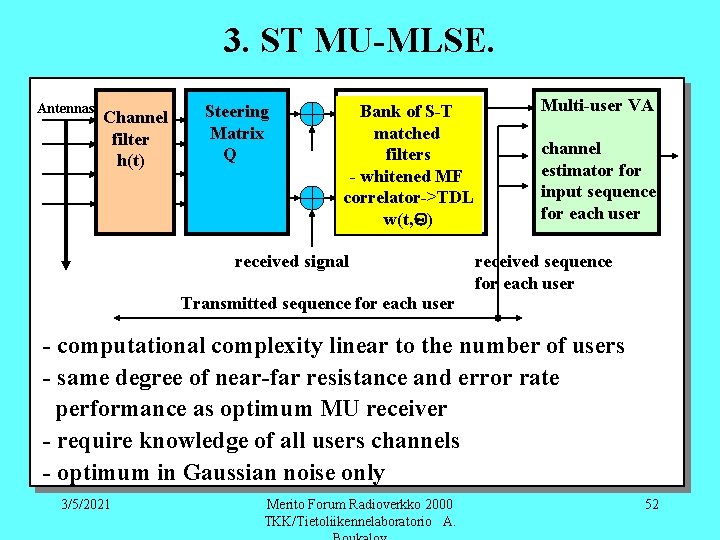
3. ST MU-MLSE. Antennas Channel filter h(t) Steering Matrix Q Bank of S-T matched filters - whitened MF correlator->TDL w(t, ) received signal Multi-user VA channel estimator for input sequence for each user received sequence for each user Transmitted sequence for each user - computational complexity linear to the number of users - same degree of near-far resistance and error rate performance as optimum MU receiver - require knowledge of all users channels - optimum in Gaussian noise only 3/5/2021 Merito Forum Radioverkko 2000 TKK/Tietoliikennelaboratorio A. 52
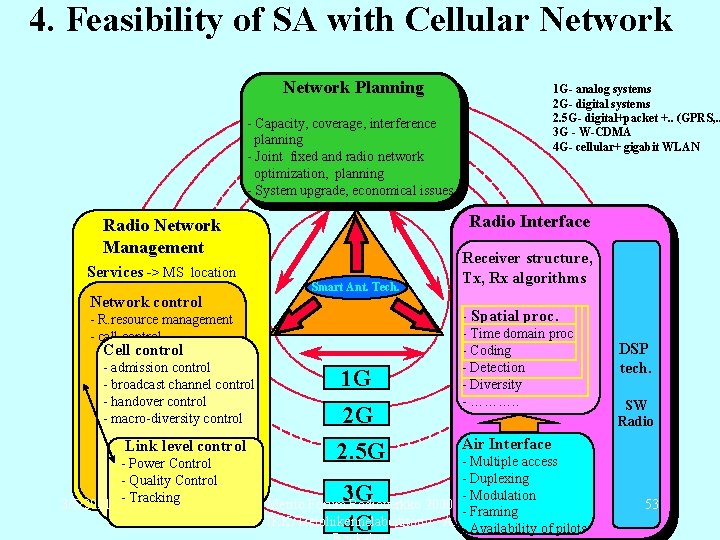
4. Feasibility of SA with Cellular Network Planning 1 G- analog systems 2 G- digital systems 2. 5 G- digital+packet +. . (GPRS, . . 3 G - W-CDMA 4 G- cellular+ gigabit WLAN - Capacity, coverage, interference planning - Joint fixed and radio network optimization, planning - System upgrade, economical issues Radio Interface Radio Network Management Services -> MS location Network control Smart Ant. Tech. - Spatial proc. - R. resource management - call control Cell control - admission control - broadcast channel control - handover control - macro-diversity control Link level control 3/5/2021 - Power Control - Quality Control - Tracking Receiver structure, Tx, Rx algorithms 1 G 2 G 2. 5 G - Time domain proc. - Coding - Detection - Diversity - ………. . SW Radio Air Interface - Multiple access - Duplexing - Modulation Merito Forum Radioverkko 2000 - Framing TKK/Tietoliikennelaboratorio A. - Availability of pilots 3 G 4 G DSP tech. 53
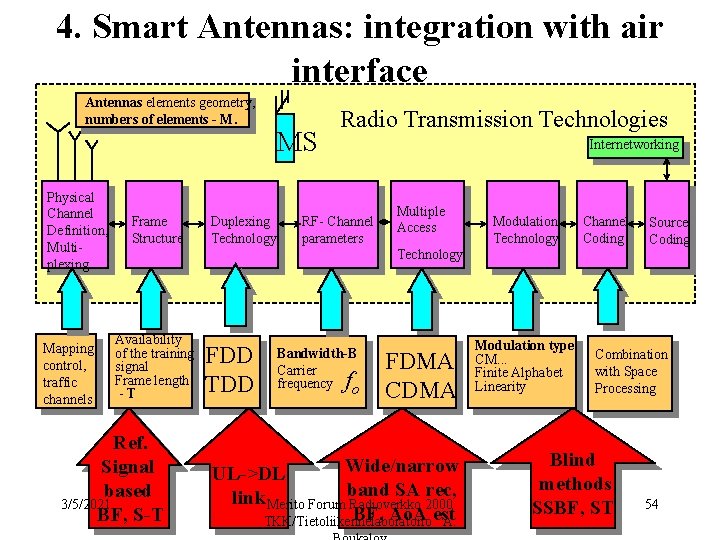
4. Smart Antennas: integration with air interface Antennas elements geometry, numbers of elements - M. Physical Channel Definition, Multiplexing Mapping control, traffic channels Frame Structure MS Duplexing Technology Radio Transmission Technologies Internetworking RF- Channel parameters Multiple Access Modulation Technology Channel Coding Technology Availability of the training signal Frame length -T Ref. Signal based 3/5/2021 BF, S-T FDD TDD Bandwidth-B Carrier frequency o f FDMA CDMA Wide/narrow UL->DL SA rec, link Merito Forum band Radioverkko 2000 BF, Ao. A est TKK/Tietoliikennelaboratorio A. Modulation type CM. . . Finite Alphabet Linearity Source Coding Combination with Space Processing Blind methods SSBF, ST 54
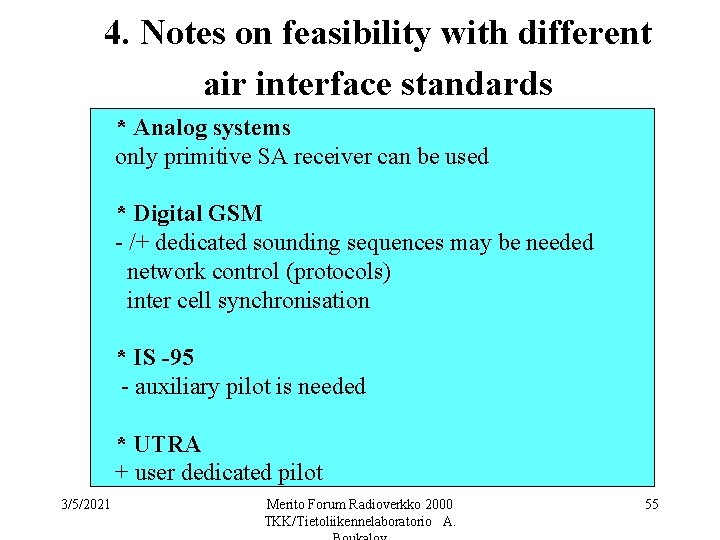
4. Notes on feasibility with different air interface standards * Analog systems only primitive SA receiver can be used * Digital GSM - /+ dedicated sounding sequences may be needed network control (protocols) inter cell synchronisation * IS -95 - auxiliary pilot is needed * UTRA + user dedicated pilot 3/5/2021 Merito Forum Radioverkko 2000 TKK/Tietoliikennelaboratorio A. 55
4. Network Planning with SA - Concepts of HSR, SFIR, SDMA. . in F/TDMA networks - CDMA network planning with SA - Networks upgrade with SA - Simulation tools 3/5/2021 Merito Forum Radioverkko 2000 TKK/Tietoliikennelaboratorio A. 56
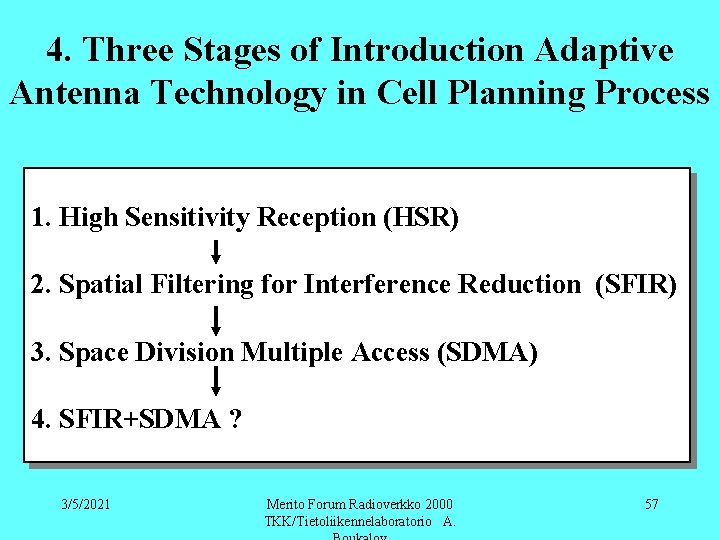
4. Three Stages of Introduction Adaptive Antenna Technology in Cell Planning Process 1. High Sensitivity Reception (HSR) 2. Spatial Filtering for Interference Reduction (SFIR) 3. Space Division Multiple Access (SDMA) 4. SFIR+SDMA ? 3/5/2021 Merito Forum Radioverkko 2000 TKK/Tietoliikennelaboratorio A. 57
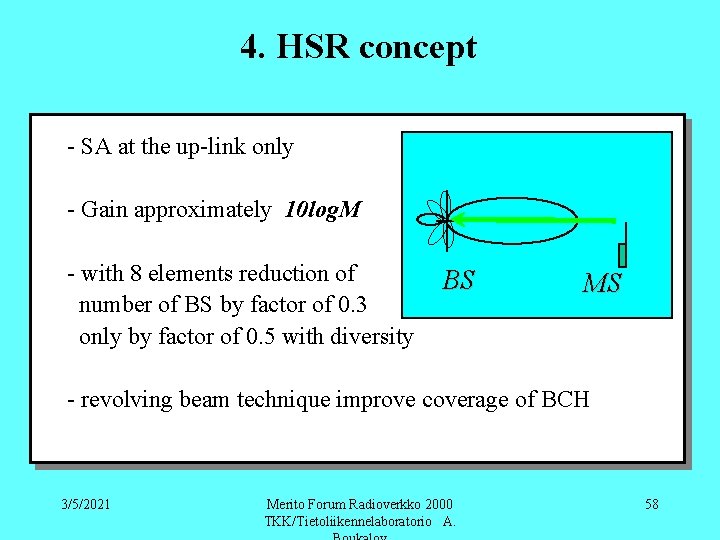
4. HSR concept - SA at the up-link only - Gain approximately 10 log. M - with 8 elements reduction of number of BS by factor of 0. 3 only by factor of 0. 5 with diversity BS MS - revolving beam technique improve coverage of BCH 3/5/2021 Merito Forum Radioverkko 2000 TKK/Tietoliikennelaboratorio A. 58
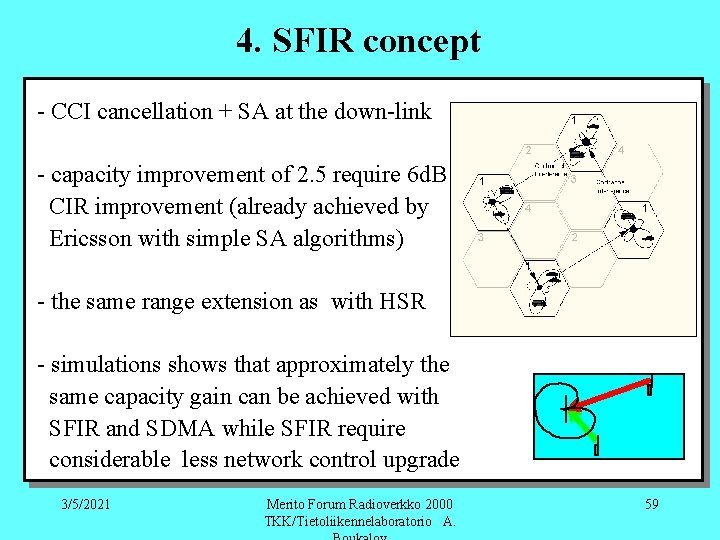
4. SFIR concept - CCI cancellation + SA at the down-link - capacity improvement of 2. 5 require 6 d. B CIR improvement (already achieved by Ericsson with simple SA algorithms) - the same range extension as with HSR - simulations shows that approximately the same capacity gain can be achieved with SFIR and SDMA while SFIR require considerable less network control upgrade 3/5/2021 Merito Forum Radioverkko 2000 TKK/Tietoliikennelaboratorio A. 59
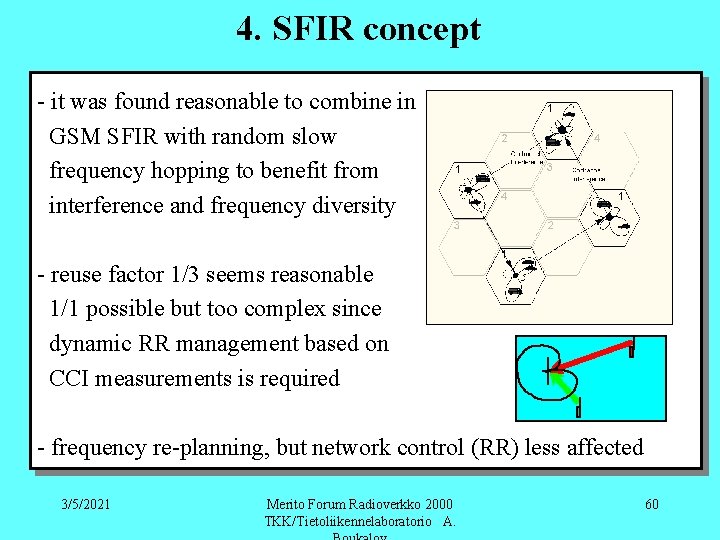
4. SFIR concept - it was found reasonable to combine in GSM SFIR with random slow frequency hopping to benefit from interference and frequency diversity - reuse factor 1/3 seems reasonable 1/1 possible but too complex since dynamic RR management based on CCI measurements is required - frequency re-planning, but network control (RR) less affected 3/5/2021 Merito Forum Radioverkko 2000 TKK/Tietoliikennelaboratorio A. 60
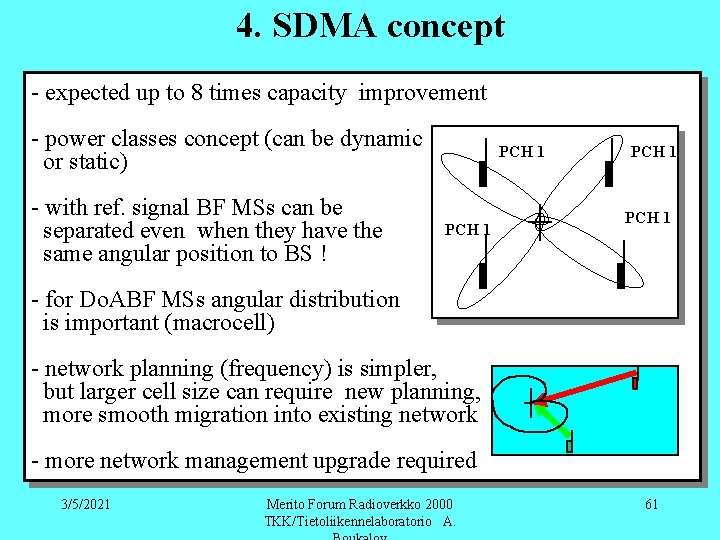
4. SDMA concept - expected up to 8 times capacity improvement - power classes concept (can be dynamic or static) - with ref. signal BF MSs can be separated even when they have the same angular position to BS ! PCH 1 - for Do. ABF MSs angular distribution is important (macrocell) - network planning (frequency) is simpler, but larger cell size can require new planning, more smooth migration into existing network - more network management upgrade required 3/5/2021 Merito Forum Radioverkko 2000 TKK/Tietoliikennelaboratorio A. 61
4. SFIR+SDMA concept - In theory it is possible to combine SFIR and SDMA concepts - Intercell reuse distance and intracell reuse distance of co-channels will increase - Complexity is very high to be implemented in the near future 3/5/2021 Merito Forum Radioverkko 2000 TKK/Tietoliikennelaboratorio A. 62
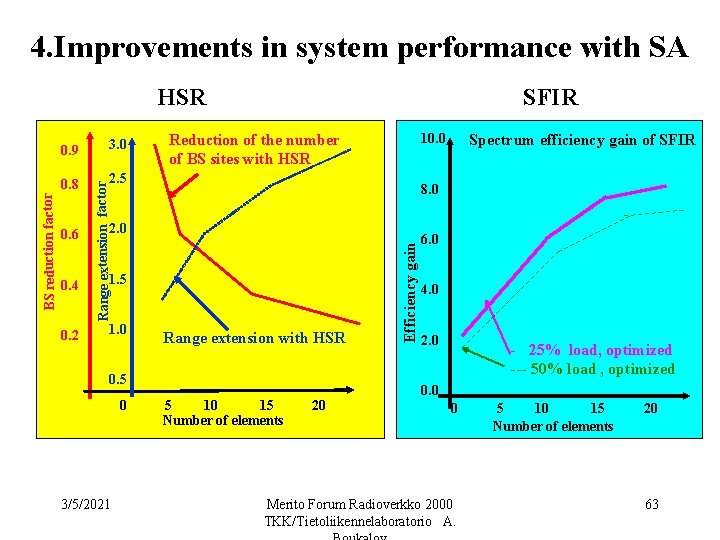
4. Improvements in system performance with SA 0. 9 3. 0 0. 8 2. 5 0. 4 0. 2 10. 0 Reduction of the number of BS sites with HSR 2. 0 1. 5 1. 0 Range extension with HSR 0. 5 0 3/5/2021 Spectrum efficiency gain of SFIR 8. 0 5 10 15 Number of elements 20 Efficiency gain 0. 6 SFIR Range extension factor BS reduction factor HSR 6. 0 4. 0 2. 0 - 25% load, optimized --- 50% load , optimized 0. 0 0 Merito Forum Radioverkko 2000 TKK/Tietoliikennelaboratorio A. 5 10 15 Number of elements 20 63
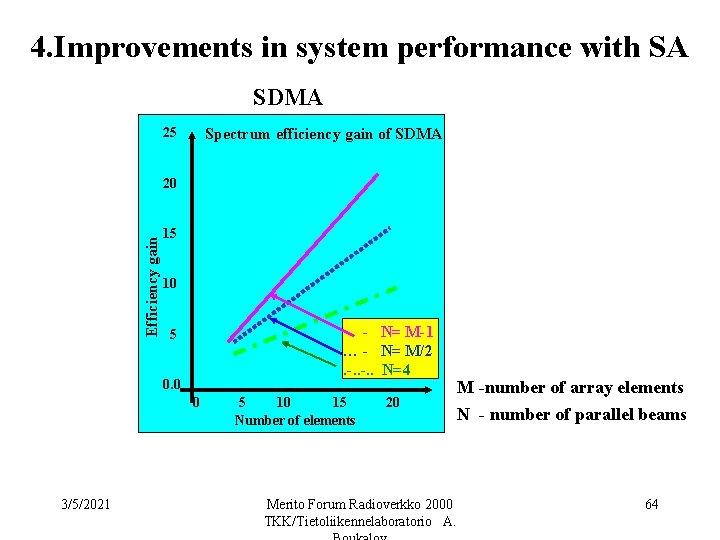
4. Improvements in system performance with SA SDMA 25 Spectrum efficiency gain of SDMA Efficiency gain 20 15 10 - N= M-1 … - N= M/2. -. . N=4 5 0. 0 0 3/5/2021 5 10 15 Number of elements 20 Merito Forum Radioverkko 2000 TKK/Tietoliikennelaboratorio A. M -number of array elements N - number of parallel beams 64
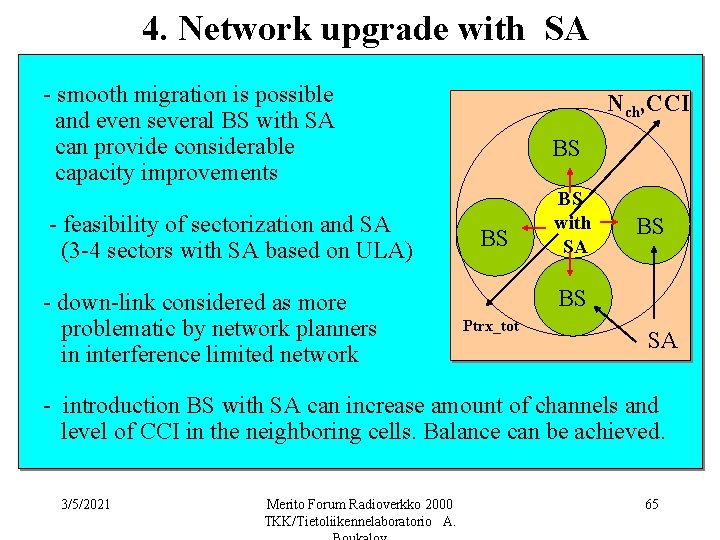
4. Network upgrade with SA - smooth migration is possible and even several BS with SA can provide considerable capacity improvements - feasibility of sectorization and SA (3 -4 sectors with SA based on ULA) - down-link considered as more problematic by network planners in interference limited network Nch, CCI BS BS BS with SA BS BS Ptrx_tot SA - introduction BS with SA can increase amount of channels and level of CCI in the neighboring cells. Balance can be achieved. 3/5/2021 Merito Forum Radioverkko 2000 TKK/Tietoliikennelaboratorio A. 65
4. CDMA network planning with SA - reuse factor 1, only HSR and “SFIR” concept is applicable - in multi- layer ( single carrier ) CDMA network (? ) SA can reduce near-far effect - range will increase - pilot pollution problem can be solved by control it spatial domain - “cells breathing” effect can be mitigated - capacity will increase since less interference at the receiver - SA can be very effective in suppression interference coming from the limited number of high bit rate users - PN planning 3/5/2021 Merito Forum Radioverkko 2000 TKK/Tietoliikennelaboratorio A. 66
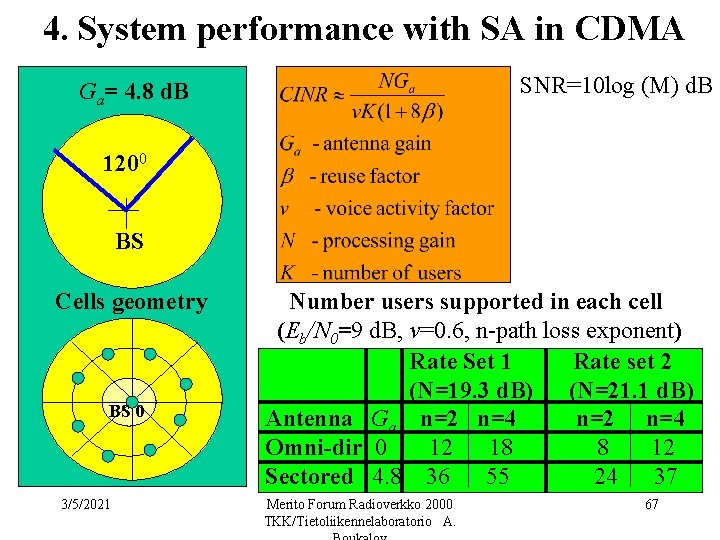
4. System performance with SA in CDMA SNR=10 log (M) d. B Ga= 4. 8 d. B 1200 BS Cells geometry BS 0 3/5/2021 Number users supported in each cell (Eb/N 0=9 d. B, v=0. 6, n-path loss exponent) Rate Set 1 Rate set 2 (N=19. 3 d. B) (N=21. 1 d. B) Antenna Ga n=2 n=4 Omni-dir. 0 12 18 8 12 Sectored 4. 8 36 55 24 37 Merito Forum Radioverkko 2000 TKK/Tietoliikennelaboratorio A. 67
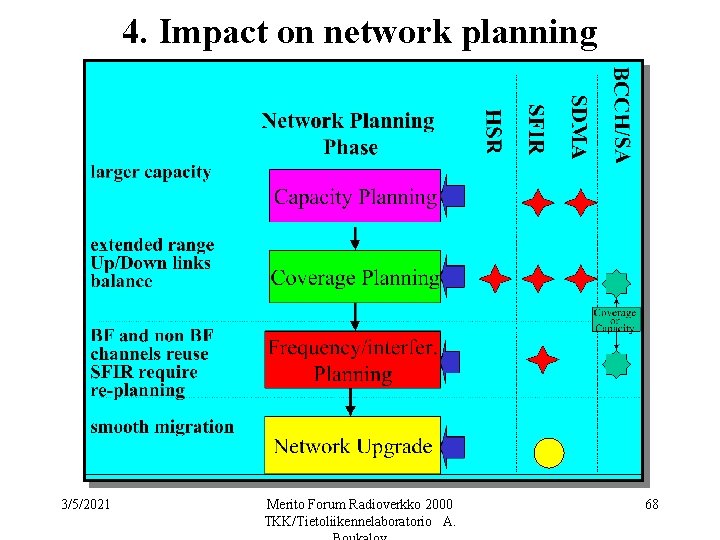
4. Impact on network planning 3/5/2021 Merito Forum Radioverkko 2000 TKK/Tietoliikennelaboratorio A. 68
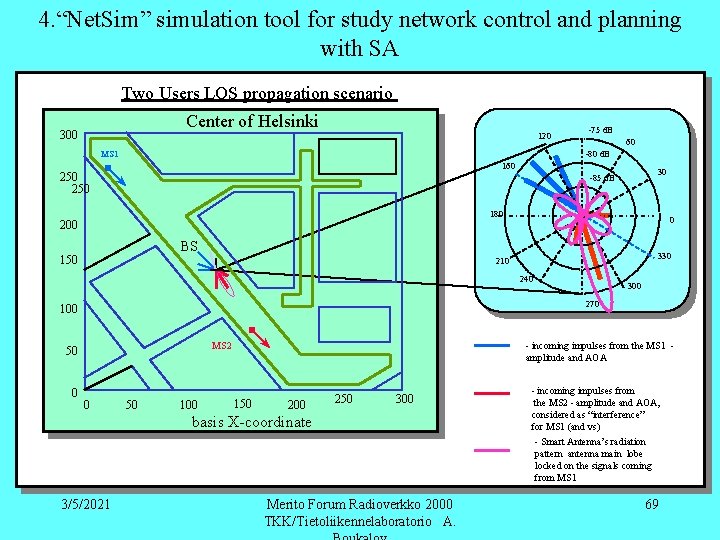
4. “Net. Sim” simulation tool for study network control and planning with SA Two Users LOS propagation scenario Center of Helsinki 300 120 MS 1 -75 d. B 60 -80 d. B 160 250 180 200 0 BS 150 330 210 240 300 270 100 MS 2 50 0 30 -85 d. B 0 50 100 - incoming impulses from the MS 1 amplitude and AOA 150 200 250 300 basis X-coordinate - incoming impulses from the MS 2 - amplitude and AOA, considered as “interference” for MS 1 (and vs) - Smart Antenna’s radiation pattern antenna main lobe locked on the signals coming from MS 1 3/5/2021 Merito Forum Radioverkko 2000 TKK/Tietoliikennelaboratorio A. 69
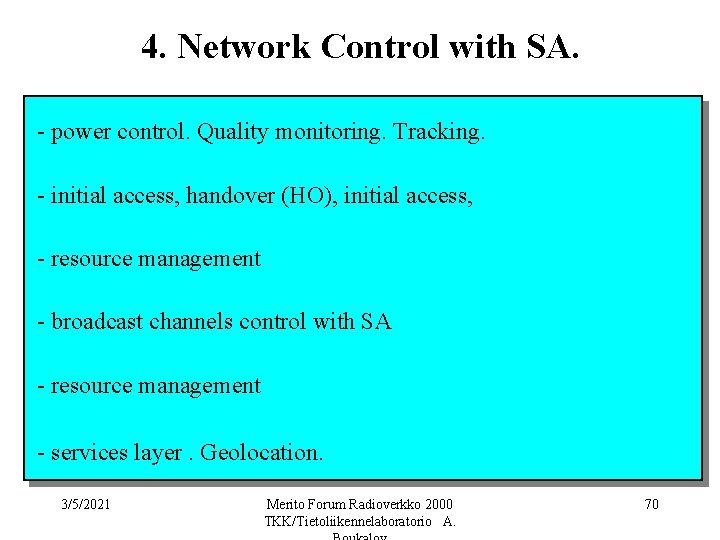
4. Network Control with SA. - power control. Quality monitoring. Tracking. - initial access, handover (HO), initial access, - resource management - broadcast channels control with SA - resource management - services layer. Geolocation. 3/5/2021 Merito Forum Radioverkko 2000 TKK/Tietoliikennelaboratorio A. 70
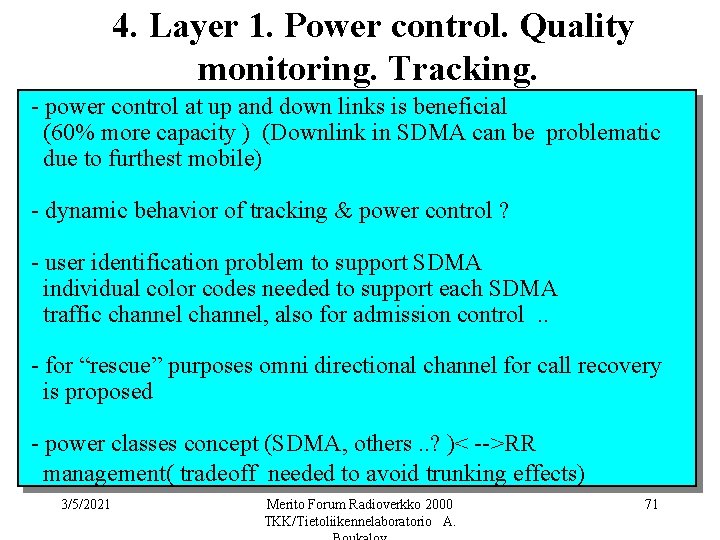
4. Layer 1. Power control. Quality monitoring. Tracking. - power control at up and down links is beneficial (60% more capacity ) (Downlink in SDMA can be problematic due to furthest mobile) - dynamic behavior of tracking & power control ? - user identification problem to support SDMA individual color codes needed to support each SDMA traffic channel, also for admission control. . - for “rescue” purposes omni directional channel for call recovery is proposed - power classes concept (SDMA, others. . ? )< -->RR management( tradeoff needed to avoid trunking effects) 3/5/2021 Merito Forum Radioverkko 2000 TKK/Tietoliikennelaboratorio A. 71
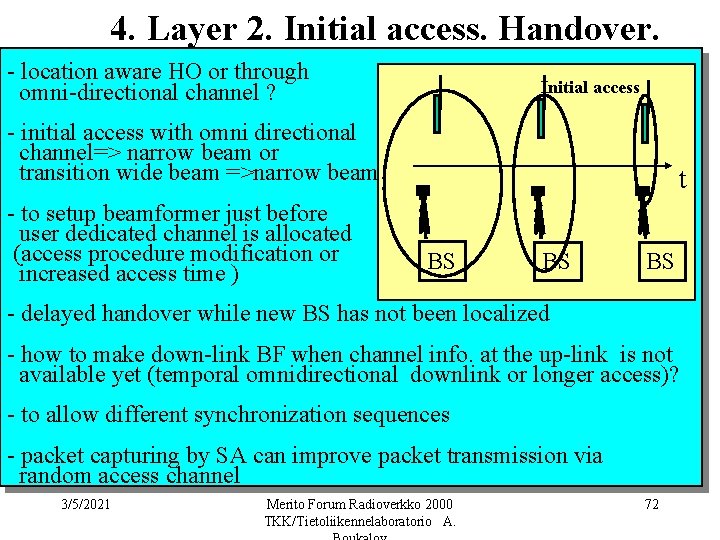
4. Layer 2. Initial access. Handover. - location aware HO or through omni-directional channel ? Initial access - initial access with omni directional channel=> narrow beam or transition wide beam =>narrow beam - to setup beamformer just before user dedicated channel is allocated (access procedure modification or increased access time ) t BS BS BS - delayed handover while new BS has not been localized - how to make down-link BF when channel info. at the up-link is not available yet (temporal omnidirectional downlink or longer access)? - to allow different synchronization sequences - packet capturing by SA can improve packet transmission via random access channel 3/5/2021 Merito Forum Radioverkko 2000 TKK/Tietoliikennelaboratorio A. 72
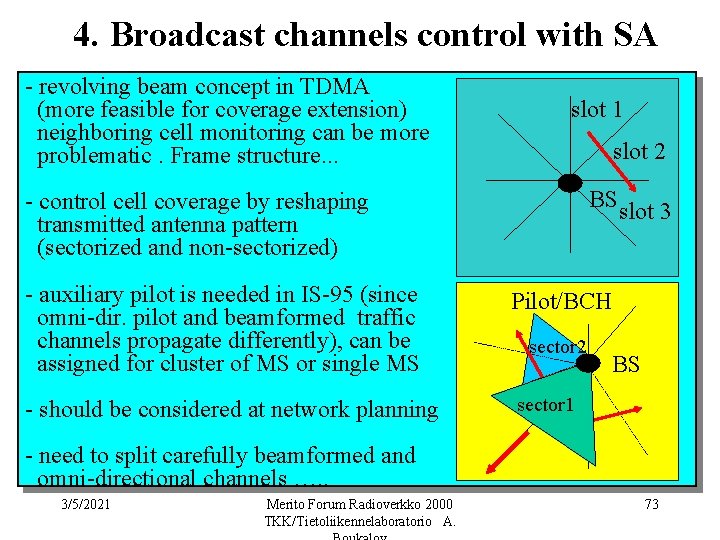
4. Broadcast channels control with SA - revolving beam concept in TDMA (more feasible for coverage extension) neighboring cell monitoring can be more problematic. Frame structure. . . slot 1 slot 2 BSslot 3 - control cell coverage by reshaping transmitted antenna pattern (sectorized and non-sectorized) - auxiliary pilot is needed in IS-95 (since omni-dir. pilot and beamformed traffic channels propagate differently), can be assigned for cluster of MS or single MS - should be considered at network planning Pilot/BCH sector 2 BS sector 1 - need to split carefully beamformed and omni-directional channels …. . 3/5/2021 Merito Forum Radioverkko 2000 TKK/Tietoliikennelaboratorio A. 73
4. Layer 3. Resource management. - new functions: physical channel allocation based on angular information and or link quality monitoring - dynamic channel allocation (DCA) (localization with different precision. . . ? ? needed) => precise localization - centralized DCA or => no DCA with SFIR and interference averaging approach or => subdivision on sectors and create list of forbidden sectors - joint power control , beamforming and BS assignment - centralized or distributed control (bunch concept) ? - smoothing of spatial traffic distribution - more benefit we expect to get (capacity, flexibility)- more RR management should be aware of spatial characteristics 3/5/2021 Merito Forum Radioverkko 2000 TKK/Tietoliikennelaboratorio A. 74
4. Network Control with SA. Higher layers. Geolocation. New service (991, transport control…) Combined DOA measurements and time delay based approach Raytheon introduced commercial available geolocation system (SA option is included) 3/5/2021 Merito Forum Radioverkko 2000 TKK/Tietoliikennelaboratorio A. 75
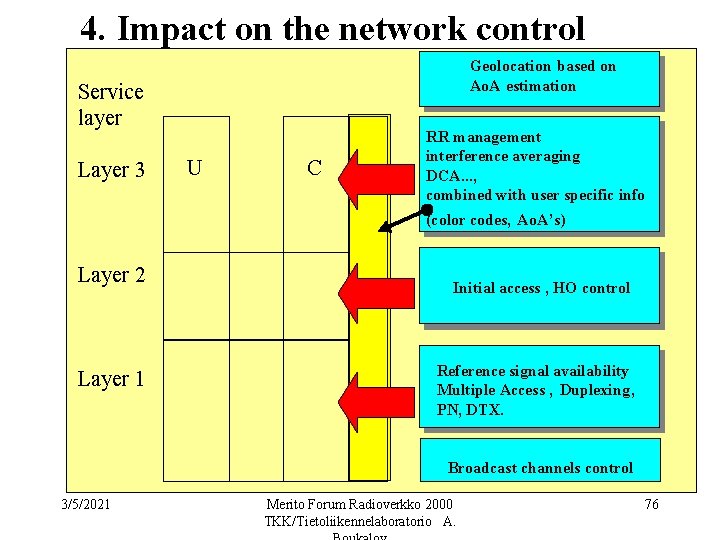
4. Impact on the network control Geolocation based on Ao. A estimation Service layer Layer 3 U C RR management interference averaging DCA. . . , combined with user specific info (color codes, Ao. A’s) Layer 2 Layer 1 Initial access , HO control Reference signal availability Multiple Access , Duplexing, PN, DTX. Broadcast channels control 3/5/2021 Merito Forum Radioverkko 2000 TKK/Tietoliikennelaboratorio A. 76
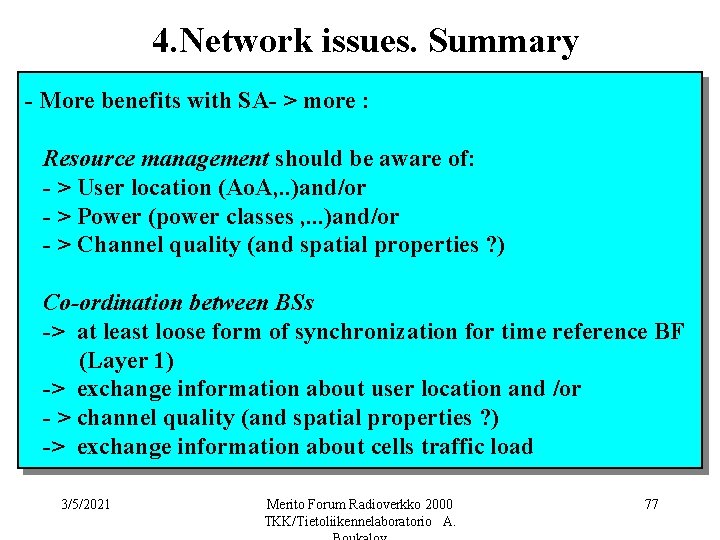
4. Network issues. Summary - More benefits with SA- > more : Resource management should be aware of: - > User location (Ao. A, . . )and/or - > Power (power classes , . . . )and/or - > Channel quality (and spatial properties ? ) Co-ordination between BSs -> at least loose form of synchronization for time reference BF (Layer 1) -> exchange information about user location and /or - > channel quality (and spatial properties ? ) -> exchange information about cells traffic load 3/5/2021 Merito Forum Radioverkko 2000 TKK/Tietoliikennelaboratorio A. 77
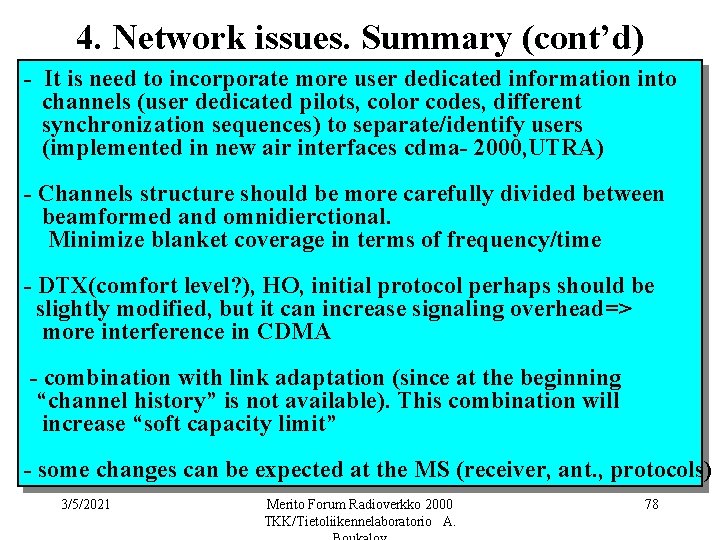
4. Network issues. Summary (cont’d) - It is need to incorporate more user dedicated information into channels (user dedicated pilots, color codes, different synchronization sequences) to separate/identify users (implemented in new air interfaces cdma- 2000, UTRA) - Channels structure should be more carefully divided between beamformed and omnidierctional. Minimize blanket coverage in terms of frequency/time - DTX(comfort level? ), HO, initial protocol perhaps should be slightly modified, but it can increase signaling overhead=> more interference in CDMA - combination with link adaptation (since at the beginning “channel history” is not available). This combination will increase “soft capacity limit” - some changes can be expected at the MS (receiver, ant. , protocols) 3/5/2021 Merito Forum Radioverkko 2000 TKK/Tietoliikennelaboratorio A. 78
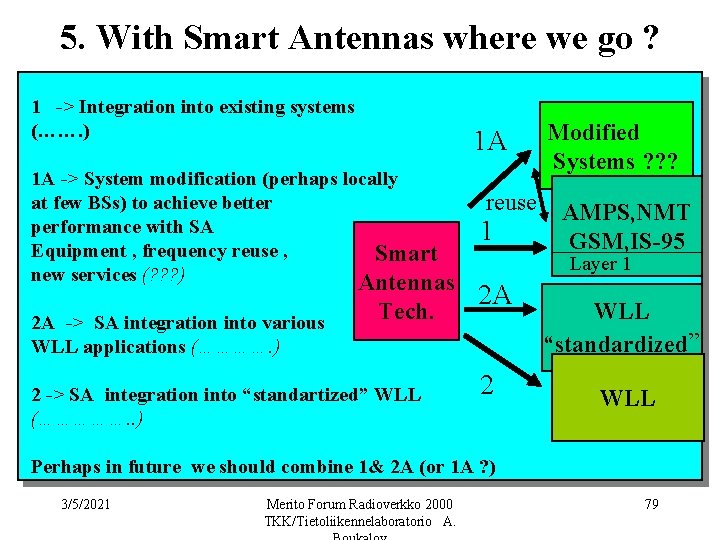
5. With Smart Antennas where we go ? 1 -> Integration into existing systems (……. ) 1 A 1 A -> System modification (perhaps locally at few BSs) to achieve better performance with SA Equipment , frequency reuse , Smart new services (? ? ? ) Antennas 2 A -> SA integration into various WLL applications (…………. ) Tech. 2 -> SA integration into “standartized” WLL (……………. . ) reuse 1 Modified Systems ? ? ? AMPS, NMT GSM, IS-95 Layer 1 2 A 2 WLL “standardized” WLL Perhaps in future we should combine 1& 2 A (or 1 A ? ) 3/5/2021 Merito Forum Radioverkko 2000 TKK/Tietoliikennelaboratorio A. 79
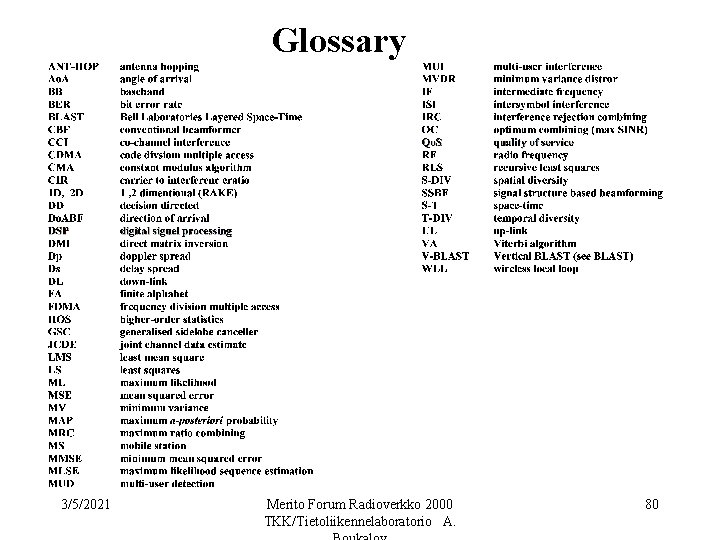
Glossary 3/5/2021 Merito Forum Radioverkko 2000 TKK/Tietoliikennelaboratorio A. 80
Bibliography - J. C. Liberti , T. S. Rappaport ”Smart Antennas for Wireless Communications”, Prentice Hall PTR, 1999. - F. Swarts, Pieter van Rooyen, I. Opperman , M. Lotter “CDMA Techniques for Third Generation Mobile Systems”, Kluwer Academic Publishes, 1999. - L. C. Godara “Antenna Arrays and Mobile Communications”, Part I, II, Proc. of IEEE vol. 85, NO. 8, July , August 1997. - H. Krim, M. Viberg “Two Decades of Array Signal Processing Research”, IEEE Signal Processing Magazine , July 1996. - A. J. Paulraj, B. C. Ng “Space-Time Modems for Wireless Communications”, IEEE Personal Communications, February 1998. - B. D. Van Veen, K. M. Buckley “Beamforming: A Versatile approach to Spatial Filtering”, IEEE ASSP Magasine, April 1998. - P. M. Grant, J. S. Thompson, B. Mulgrew “Adaptive Arrays for narrowband CDMA Base Stations”, Electronics&Communication Eng. , Journal, August 1998 - J. H. Winters ” Smart Antennas for Wireless Systems ”IEEE Personal Communications, February 1998. - R. Kohno, “Spatial and Temporal Communication Theory Using Adaptive Antenna Array”IEEE Personal Communications, February 1998. 3/5/2021 Merito Forum Radioverkko 2000 TKK/Tietoliikennelaboratorio A. 81
- Slides: 81