
SMART ANTENNAS FOR THIRD GENERATION TDMA EDGE Jack
![EQUALIZATION • Delay spread: Delay spread over [(M-1) / 2]T or M-1 delayed signals](https://slidetodoc.com/presentation_image/539773f62a247d0d5b68110d77901818/image-9.jpg "EQUALIZATION • Delay spread: Delay spread over [(M-1) / 2]T or M-1 delayed signals")
![SMART ANTENNA RESEARCH Evolution [Research Issues] • IS-136: • Optimum combining uplink / power](https://slidetodoc.com/presentation_image/539773f62a247d0d5b68110d77901818/image-24.jpg "SMART ANTENNA RESEARCH Evolution [Research Issues] • IS-136: • Optimum combining uplink / power")
- Slides: 24
SMART ANTENNAS FOR THIRD GENERATION TDMA (EDGE) Jack H. Winters AT&T Labs - Research Red Bank, NJ 07701 -7033 jhw@research. att. com March 22, 2000 1
OUTLINE • Smart Antenna Overview • 2 G System Applications • 3 G System Applications: – EDGE – MIMO-EDGE – OFDM-MIMO-EDGE • Conclusions 2
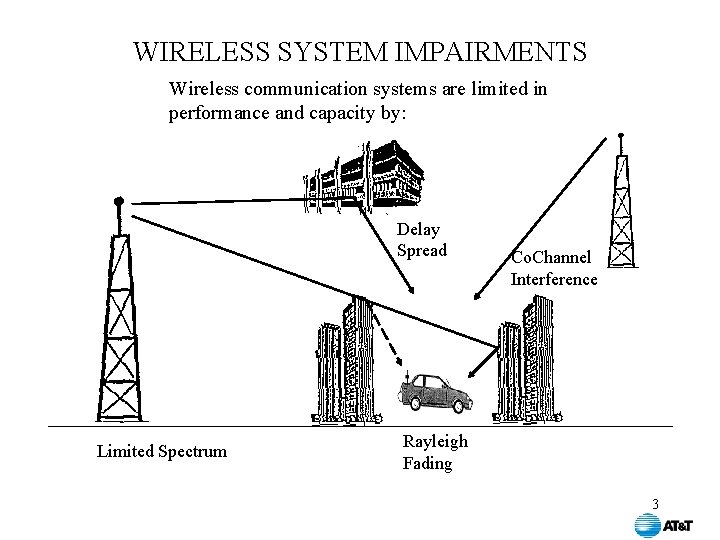
WIRELESS SYSTEM IMPAIRMENTS Wireless communication systems are limited in performance and capacity by: Delay Spread Limited Spectrum Co. Channel Interference Rayleigh Fading 3
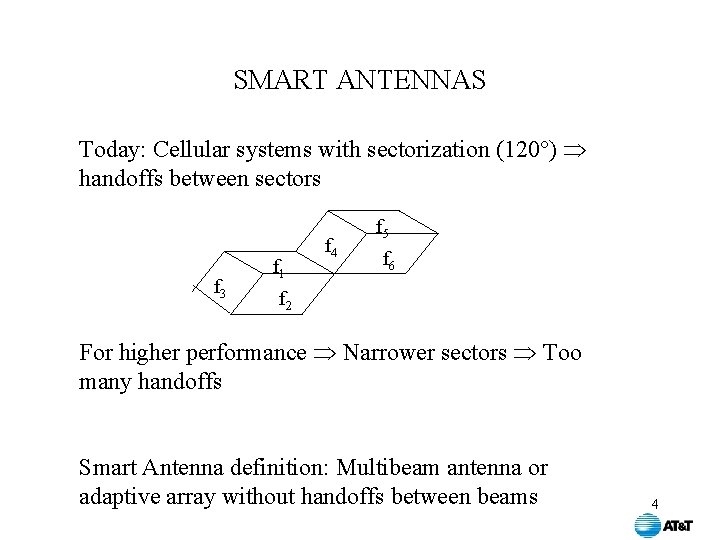
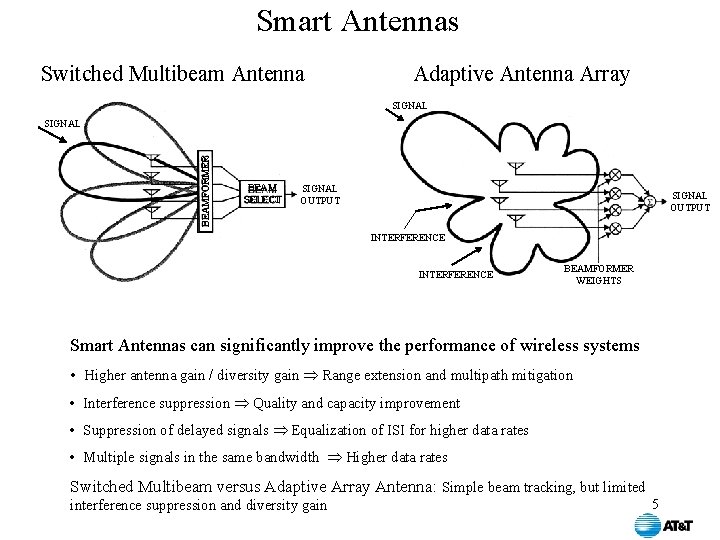
SMART ANTENNAS Today: Cellular systems with sectorization (120°) handoffs between sectors f 3 f 1 f 4 f 5 f 6 f 2 For higher performance Narrower sectors Too many handoffs Smart Antenna definition: Multibeam antenna or adaptive array without handoffs between beams 4
Smart Antennas Switched Multibeam Antenna Adaptive Antenna Array SIGNAL BEAMFORMER SIGNAL BEAM SELECT SIGNAL OUTPUT INTERFERENCE BEAMFORMER WEIGHTS Smart Antennas can significantly improve the performance of wireless systems • Higher antenna gain / diversity gain Range extension and multipath mitigation • Interference suppression Quality and capacity improvement • Suppression of delayed signals Equalization of ISI for higher data rates • Multiple signals in the same bandwidth Higher data rates Switched Multibeam versus Adaptive Array Antenna: Simple beam tracking, but limited interference suppression and diversity gain 5
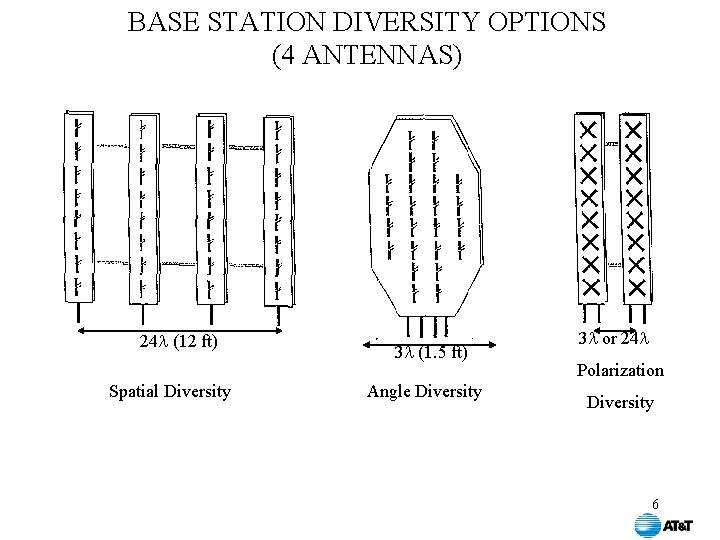
BASE STATION DIVERSITY OPTIONS (4 ANTENNAS) 24 (12 ft) Spatial Diversity 3 (1. 5 ft) Angle Diversity 3 or 24 Polarization Diversity 6
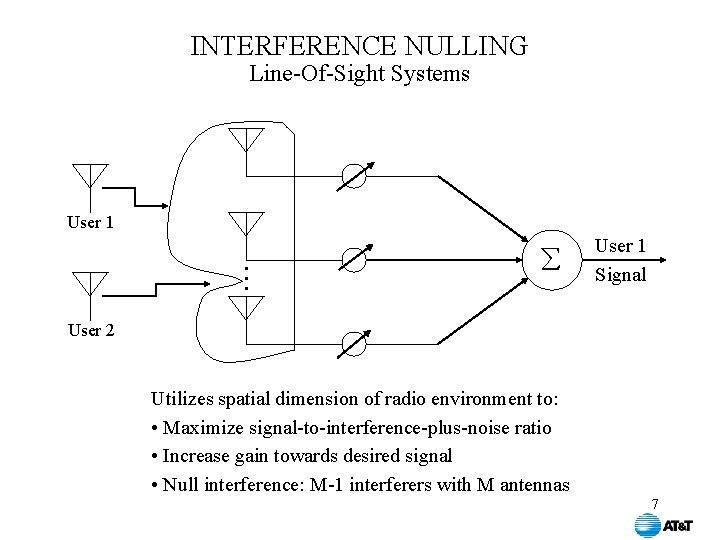
INTERFERENCE NULLING Line-Of-Sight Systems User 1 • • • User 1 Signal User 2 Utilizes spatial dimension of radio environment to: • Maximize signal-to-interference-plus-noise ratio • Increase gain towards desired signal • Null interference: M-1 interferers with M antennas 7
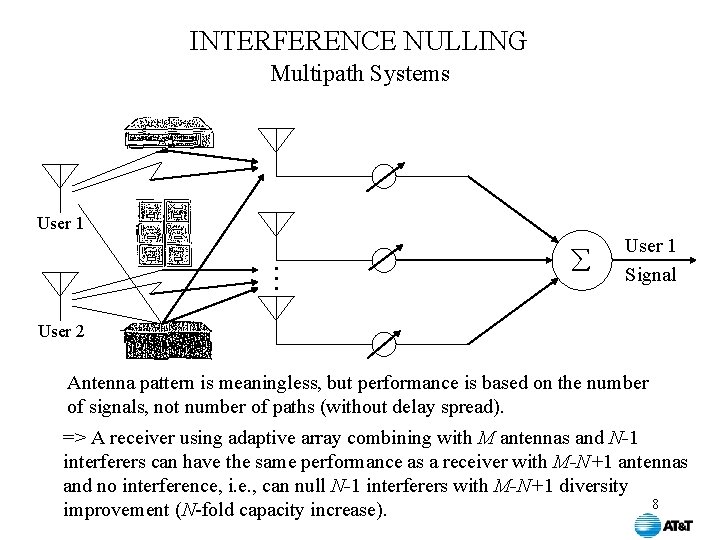
INTERFERENCE NULLING Multipath Systems User 1 • • • User 1 Signal User 2 Antenna pattern is meaningless, but performance is based on the number of signals, not number of paths (without delay spread). => A receiver using adaptive array combining with M antennas and N-1 interferers can have the same performance as a receiver with M-N+1 antennas and no interference, i. e. , can null N-1 interferers with M-N+1 diversity 8 improvement (N-fold capacity increase).
EQUALIZATION • Delay spread: Delay spread over [(M-1) / 2]T or M-1 delayed signals (over any delay) can be eliminated • Typically use temporal processing with spatial processing for equalization: LE MLSE/DFE LE 9
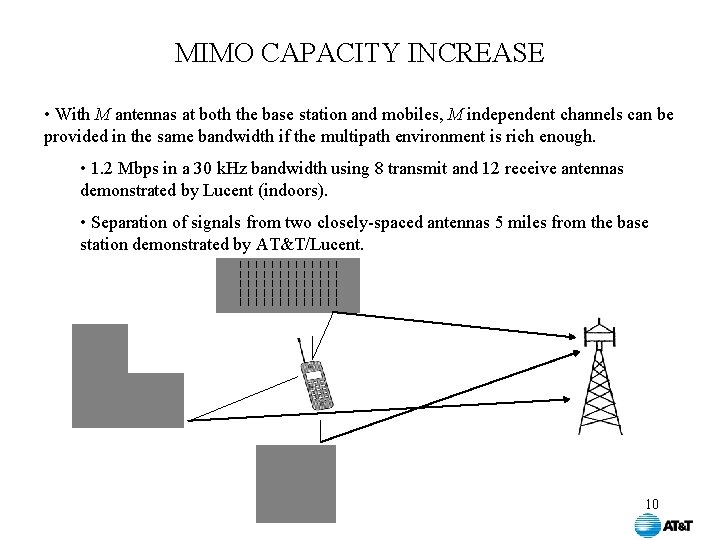
MIMO CAPACITY INCREASE • With M antennas at both the base station and mobiles, M independent channels can be provided in the same bandwidth if the multipath environment is rich enough. • 1. 2 Mbps in a 30 k. Hz bandwidth using 8 transmit and 12 receive antennas demonstrated by Lucent (indoors). • Separation of signals from two closely-spaced antennas 5 miles from the base station demonstrated by AT&T/Lucent. 10
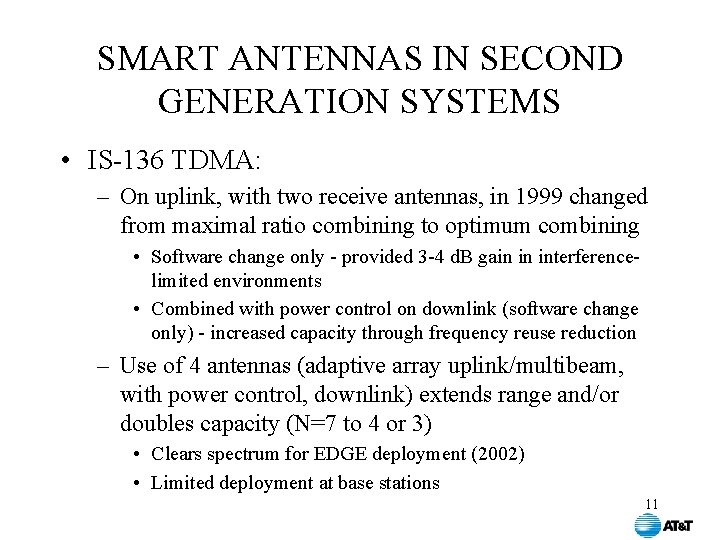
SMART ANTENNAS IN SECOND GENERATION SYSTEMS • IS-136 TDMA: – On uplink, with two receive antennas, in 1999 changed from maximal ratio combining to optimum combining • Software change only - provided 3 -4 d. B gain in interferencelimited environments • Combined with power control on downlink (software change only) - increased capacity through frequency reuse reduction – Use of 4 antennas (adaptive array uplink/multibeam, with power control, downlink) extends range and/or doubles capacity (N=7 to 4 or 3) • Clears spectrum for EDGE deployment (2002) • Limited deployment at base stations 11
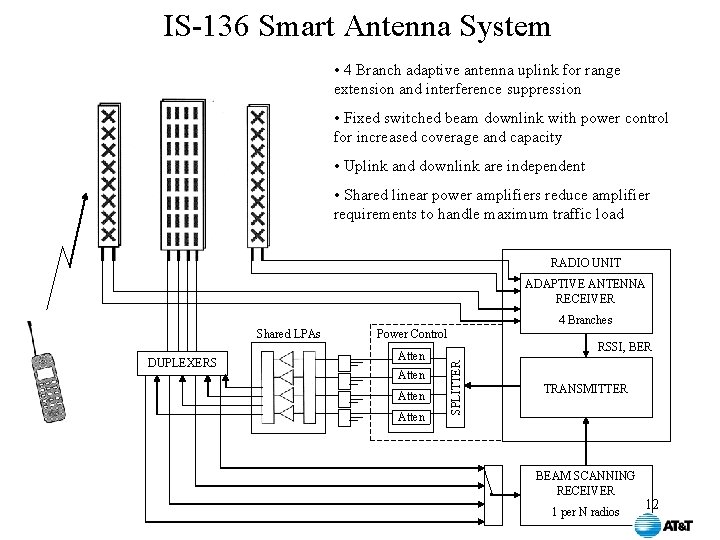
IS-136 Smart Antenna System • 4 Branch adaptive antenna uplink for range extension and interference suppression • Fixed switched beam downlink with power control for increased coverage and capacity • Uplink and downlink are independent • Shared linear power amplifiers reduce amplifier requirements to handle maximum traffic load RADIO UNIT ADAPTIVE ANTENNA RECEIVER 4 Branches DUPLEXERS Power Control Atten RSSI, BER SPLITTER Shared LPAs TRANSMITTER • BEAM SCANNING RECEIVER 1 per N radios 12
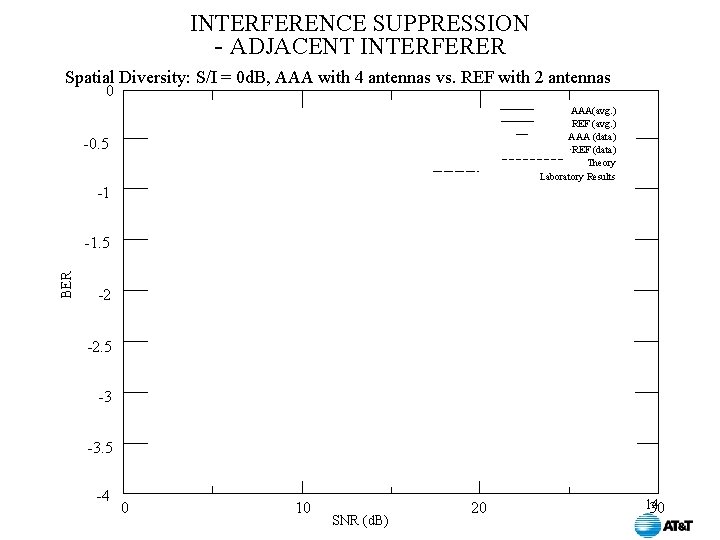
EXPERIMENTAL TESTBED • 1. 9 GHz PCS band, IS-136 • 4 antennas (adaptive array uplink / multibeam downlink) • Baseband processing: 4 ‘C 40 DSP’s • DMI - realtime (symbol-by-symbol) processing with sliding window and symbol synchronization (uplink) • RF channel emulator (independent Rayleigh fading) • Ideal (theoretical) performance at 10 -2 BER (versus 2 antenna system with selection diversity): - 6 d. B gain in noise alone (S/I = ) - 4 d. B gain with S/I = 0 d. B • Experimental Results: - Noise alone (S/I = ): < 0. 5 d. B implementation loss up to 60 mph - S/I = 0 d. B: 1 d. B implementation loss for speeds < 8 mph, close to 10 -2 BER at 13 high S/N at 60 mph
INTERFERENCE SUPPRESSION - ADJACENT INTERFERER Spatial Diversity: S/I = 0 d. B, AAA with 4 antennas vs. REF with 2 antennas 0 AAA(avg. ) REF (avg. ) AAA (data) ·REF (data) Theory Laboratory Results -0. 5 -1 BER -1. 5 -2 -2. 5 -3 -3. 5 -4 0 10 SNR (d. B) 20 14 30
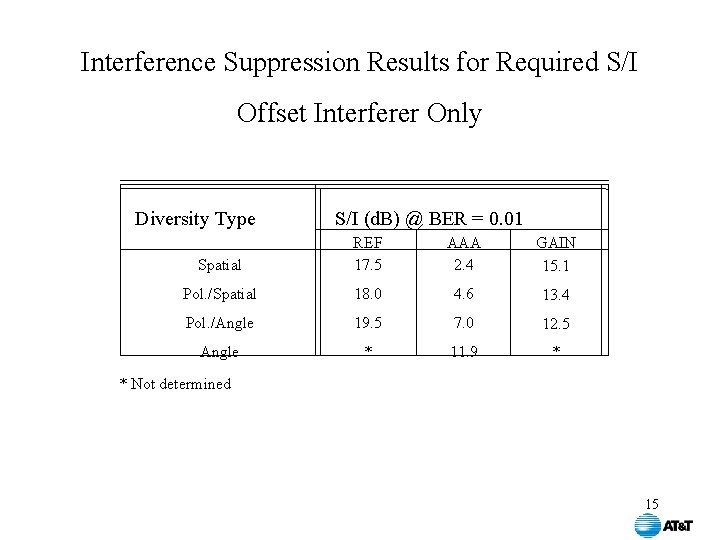
Interference Suppression Results for Required S/I Offset Interferer Only Diversity Type S/I (d. B) @ BER = 0. 01 Spatial REF 17. 5 AAA 2. 4 GAIN 15. 1 Pol. /Spatial 18. 0 4. 6 13. 4 Pol. /Angle 19. 5 7. 0 12. 5 Angle * 11. 9 * * Not determined 15
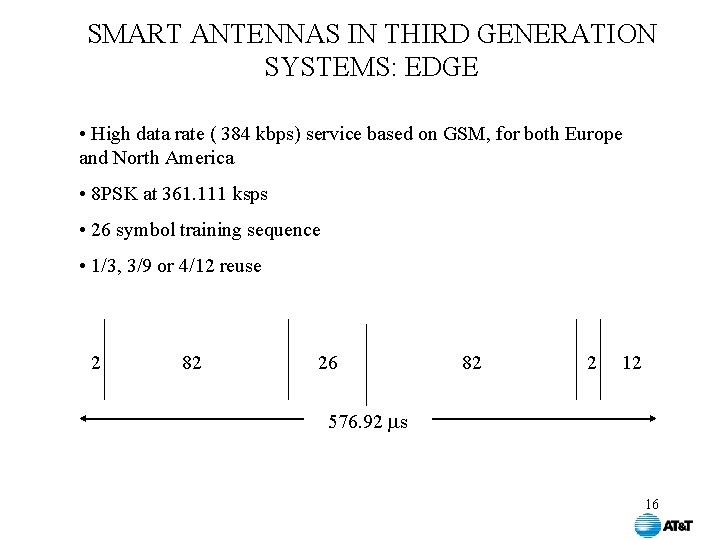
SMART ANTENNAS IN THIRD GENERATION SYSTEMS: EDGE • High data rate ( 384 kbps) service based on GSM, for both Europe and North America • 8 PSK at 361. 111 ksps • 26 symbol training sequence • 1/3, 3/9 or 4/12 reuse 2 82 26 82 2 12 576. 92 s 16
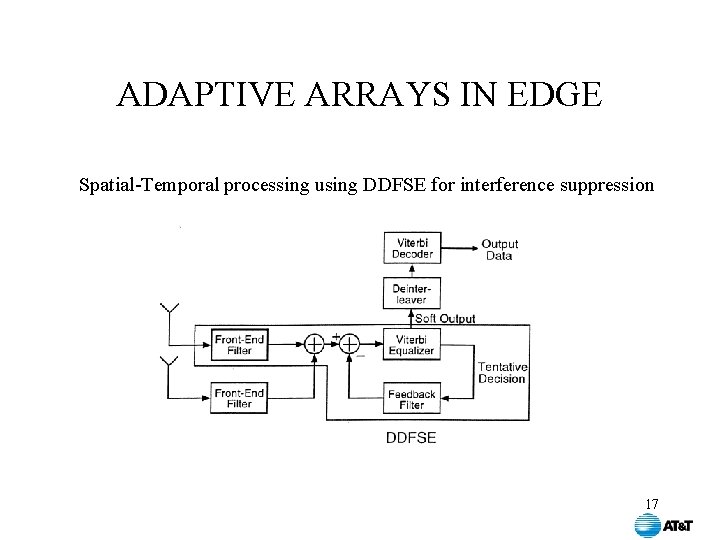
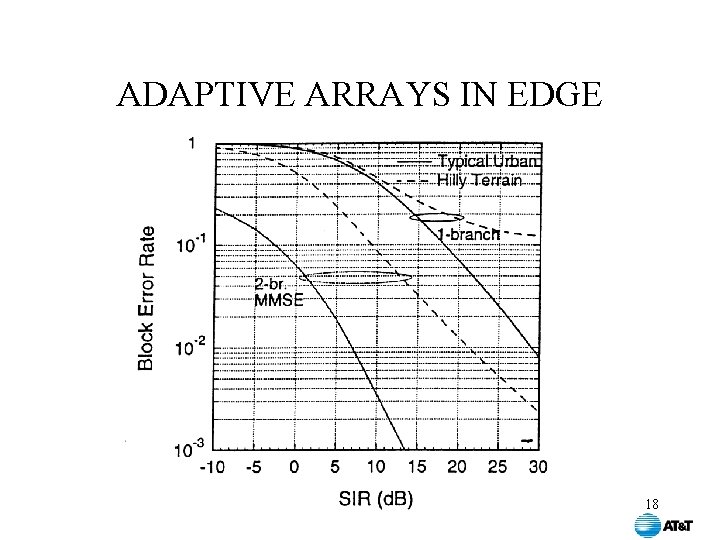
ADAPTIVE ARRAYS IN EDGE Spatial-Temporal processing using DDFSE for interference suppression 17
ADAPTIVE ARRAYS IN EDGE 18
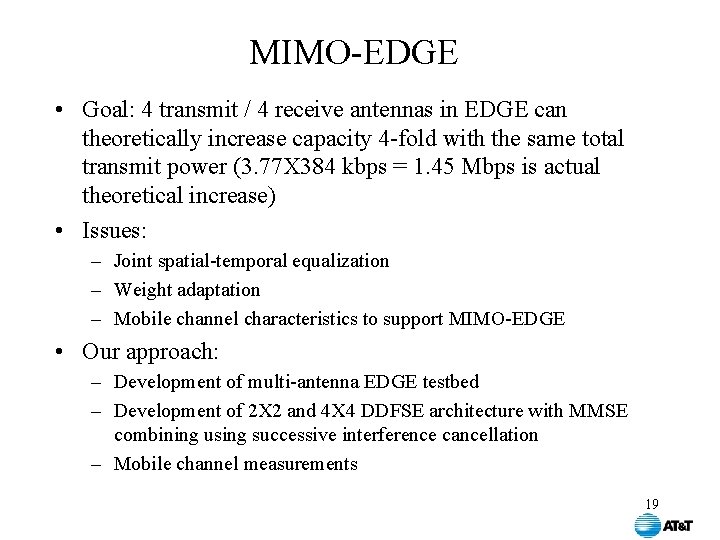
MIMO-EDGE • Goal: 4 transmit / 4 receive antennas in EDGE can theoretically increase capacity 4 -fold with the same total transmit power (3. 77 X 384 kbps = 1. 45 Mbps is actual theoretical increase) • Issues: – Joint spatial-temporal equalization – Weight adaptation – Mobile channel characteristics to support MIMO-EDGE • Our approach: – Development of multi-antenna EDGE testbed – Development of 2 X 2 and 4 X 4 DDFSE architecture with MMSE combining using successive interference cancellation – Mobile channel measurements 19
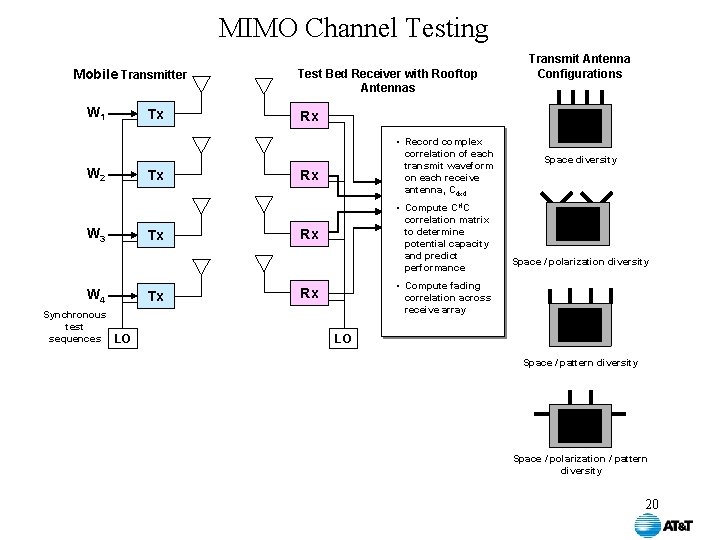
MIMO Channel Testing Mobile Transmitter W 1 Tx W 2 Tx W 3 Tx W 4 Synchronous test sequences Tx LO Test Bed Receiver with Rooftop Antennas Transmit Antenna Configurations Rx • Record complex correlation of each transmit waveform on each receive antenna, C 4 x 4 Rx • Compute CHC correlation matrix to determine potential capacity and predict performance Rx Space diversity Space / polarization diversity • Compute fading correlation across receive array Rx LO Space / pattern diversity Space / polarization / pattern diversity 20
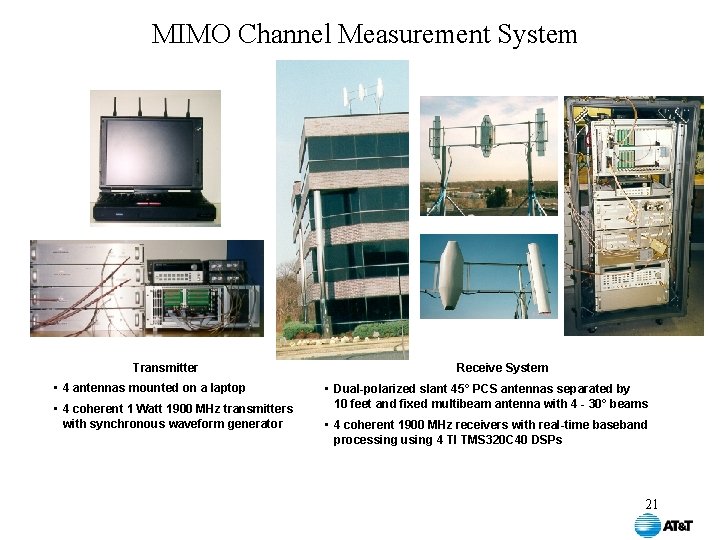
MIMO Channel Measurement System Transmitter • 4 antennas mounted on a laptop • 4 coherent 1 Watt 1900 MHz transmitters with synchronous waveform generator Receive System • Dual-polarized slant 45° PCS antennas separated by 10 feet and fixed multibeam antenna with 4 - 30° beams • 4 coherent 1900 MHz receivers with real-time baseband processing using 4 TI TMS 320 C 40 DSPs 21
EDGE with Wideband OFDM MIMO Downlink • High data rates (>1 Mbps) required on downlink only • OFDM eliminates need for temporal processing => simplified MIMO processing for much higher data rates • With 1. 25 MHz bandwidth, QPSK, OFDMMIMO with 4 antennas at base station and terminal => 10 Mbps downlink 22
SMART ANTENNA RESEARCH Conclusions • Smart antennas can significantly enhance wireless systems: • Extend coverage Higher antenna gain, improved diversity • Increase capacity Interference suppression • Suppression of delayed signals Better equalization of ISI with temporal equalization for higher data rates • Multiple signals in the same bandwidth Higher data rates in EDGE • IS-136: Double capacity on downlink and uplink with 4 antennas/beams (cost effective evolution) • EDGE: Adaptive arrays provide substantial interference suppression (>10 d. B), but dual terminal antennas/power control may be required on downlink. • MIMO EDGE: Up to 1. 5 Mbps with 4 transmit/receive antennas. 23
SMART ANTENNA RESEARCH Evolution [Research Issues] • IS-136: • Optimum combining uplink / power control downlink at all base stations with existing antennas • 4 antenna upgrade (adaptive uplink/multibeam downlink) for N=7 to 4 to clear spectrum for EDGE • EDGE: • S-T processing with IS-136 smart antennas [power control/weight generation/S-T architecture/Vo. IP] • MIMO-EDGE (1. 5 Mbps) [multipath richness] • Wideband OFDM-MIMO downlink (10 Mbps) [weight generation] 24