
SMART ANTENAS Presentation by Mr Sahil Tarfe Mr
SMART ANTENAS Presentation by Mr. Sahil Tarfe Mr. Siddhesh Sonawdekar
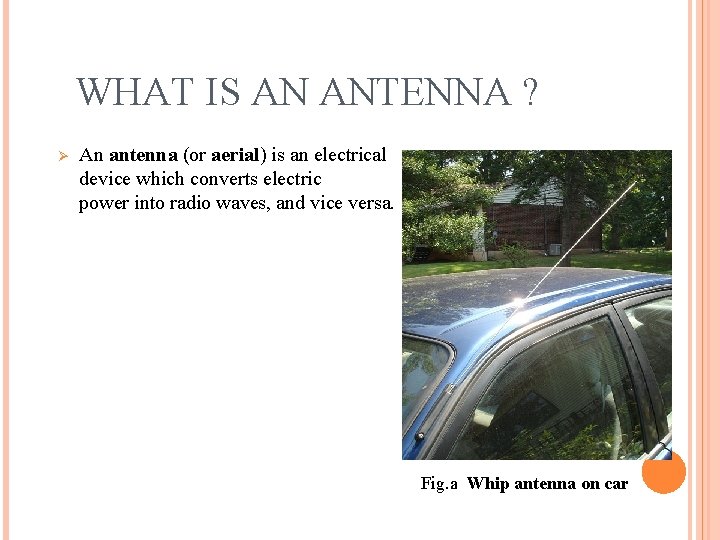
WHAT IS AN ANTENNA ? Ø An antenna (or aerial) is an electrical device which converts electric power into radio waves, and vice versa. Fig. a Whip antenna on car
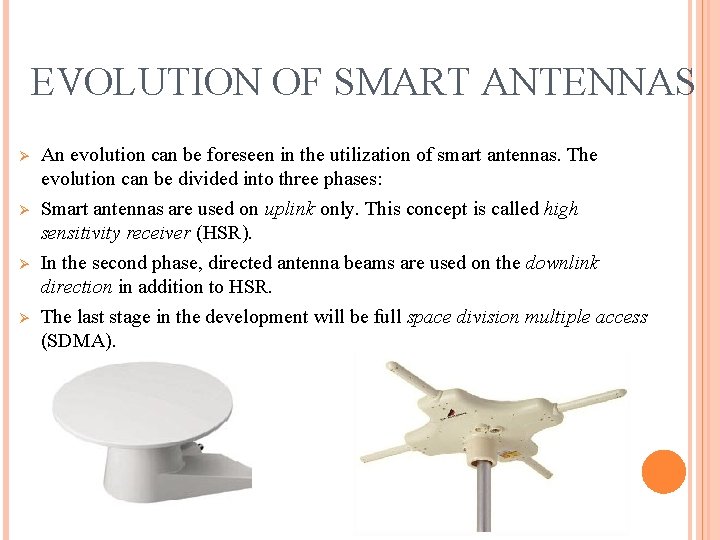
EVOLUTION OF SMART ANTENNAS Ø Ø An evolution can be foreseen in the utilization of smart antennas. The evolution can be divided into three phases: Smart antennas are used on uplink only. This concept is called high sensitivity receiver (HSR). In the second phase, directed antenna beams are used on the downlink direction in addition to HSR. The last stage in the development will be full space division multiple access (SDMA).
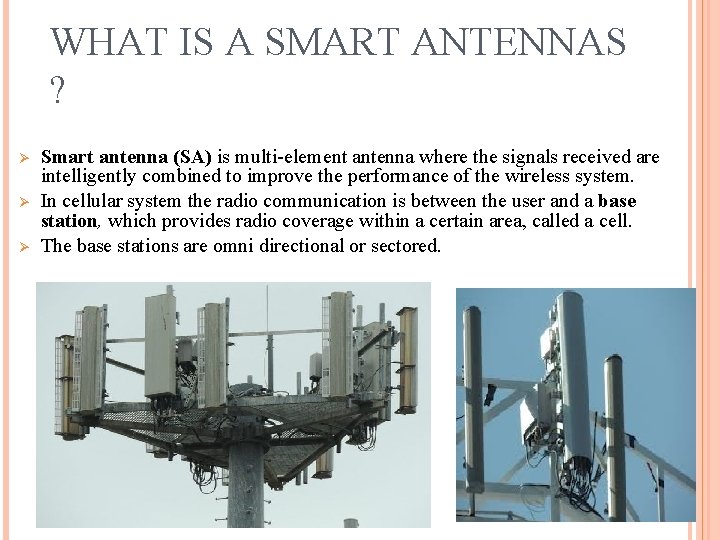
WHAT IS A SMART ANTENNAS ? Ø Ø Ø Smart antenna (SA) is multi-element antenna where the signals received are intelligently combined to improve the performance of the wireless system. In cellular system the radio communication is between the user and a base station, which provides radio coverage within a certain area, called a cell. The base stations are omni directional or sectored.

DIFFERENCE BETWEEN SMART ANTENNAS AND NORMAL ANTENNAS Top View Antenna Array Antenna Omnidirectional Sectorized
BRIEF IDEA ABOUT SMART ANTENNAS Ø Ø Ø Smart antenna is digital wireless communication antenna system that takes advantage of diversity effect at the source (transmitter), the destination (receiver), or both. Diversity effect involves the transmission andreception of multiple radio frequency (RF) waves to increase data speed and reduce error rate. A smart antenna system combines an antenna array with a digital signalprocessing capability to transmit and receive in an adaptive, spatially sensitive manner. Control unit can be called the smart antenna’s intelligence. It is realized using a digital signal processor (DSP). Based on this definition of smart antenna, is“levels of Intelligence”.
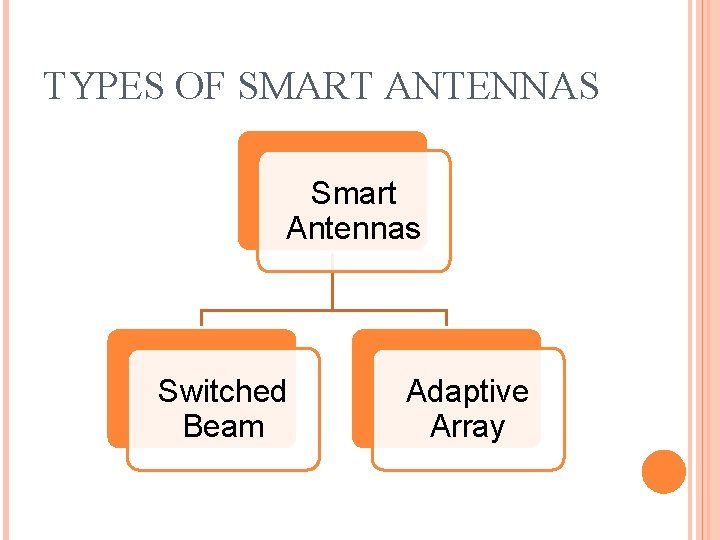
TYPES OF SMART ANTENNAS Smart Antennas Switched Beam Adaptive Array

SWITCHED BEAM ANTENNAS

ADAPTIVE ARRAY ANTENNAS
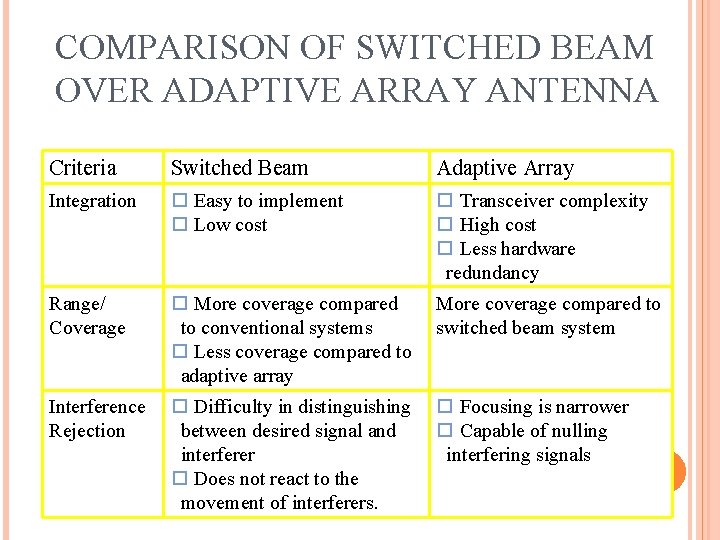
COMPARISON OF SWITCHED BEAM OVER ADAPTIVE ARRAY ANTENNA Criteria Switched Beam Adaptive Array Integration o Easy to implement o Low cost o Transceiver complexity o High cost o Less hardware redundancy Range/ Coverage o More coverage compared to conventional systems o Less coverage compared to adaptive array More coverage compared to switched beam system Interference o Difficulty in distinguishing Rejection between desired signal and interferer o Does not react to the movement of interferers. o Focusing is narrower o Capable of nulling interfering signals
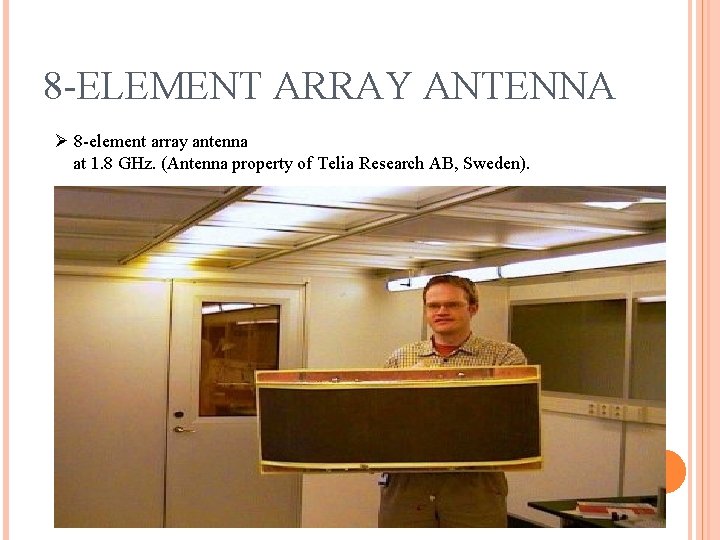
8 -ELEMENT ARRAY ANTENNA Ø 8 -element array antenna at 1. 8 GHz. (Antenna property of Telia Research AB, Sweden).
ADVANTAGES Ø Large increase in Capacity. Increased in range. Potential to introduce new services. More security. Ø Reduced Multipath propagation. Ø Ø Ø
DISADVANTAGES Ø Ø The new technology used with smart antennas is more complicated than that used in a traditional one and if a problem occurs it could be more difficult to find the problem. This antennas are relatively expensive to install.
APPLICATIONS Ø Ø Ø Wireless local loops. Cellular systems for wide angular spread. TDMA systems

DRAWBACKS AND COST FACTORS Ø Transceiver Complexity Ø Resource Management Ø Physical Size
CONCLUSION Ø Ø Can provide increased performance to wireless network. A smart antenna is a digital wireless communications antenna system that takes advantage of diversity effect at the source (transmitter), the destination (receiver), or both.

Thank You For Your Kind Attention….
- Slides: 17