
Smart and Technical Textiles The future of fibres
Smart and Technical Textiles The future of fibres & fabrics
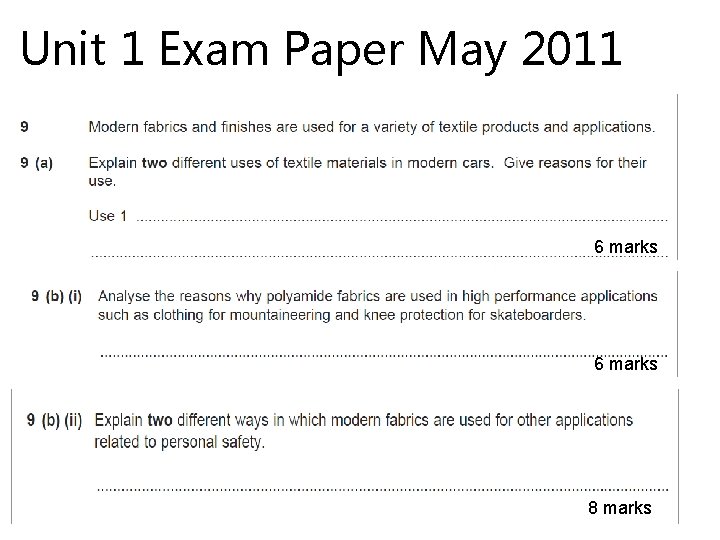
Unit 1 Exam Paper May 2011 6 marks 8 marks
Learning Objectives • To understand the terms: – Smart Textiles – Technical Textiles – Interactive Textiles. • To be able to give examples of the above. • To GENERATE ideas for a textile product that uses this technology • To answer the exam question
Smart and Modern Textiles This is a minefield of confusion and inaccurate information. You need to be able to differentiate between textile materials which are smart, and those which are technical/modern. A smart material is defined as one which is able to react to external stimulus / changes in the environment without human intervention.
Smart Materials include ones that: • monitor body functions and administer medicines/give warnings; • maintain a personal micro-climate, eg Stomatex, Outlast; • can provide buoyancy and support, eg bodysuits for medical/physiotherapy support ; • have chromatic properties and change colour in response to specific situations; • have shape memory, eg Corpo Nove shirt which adjusts to differing temperatures; • are self-cleaning, eg nano-technology fabrics triggered by sunlight; • use biomimetics that imitate nature, eg Fastskin, Stomatex; • can generate solar power when exposed to sunlight; • can sense and track movement, eg Sens. Floor Smart carpets.
Technical and Modern Materials include the following examples: Gore-Tex • Kevlar & Nomex • Phosphorescent textiles • Reflective textiles using glass beads • Fabrics that wick moisture away from the body, eg Coolmax • Microencapsulated fibres, eg those which release scents • Fabrics which protect against bacteria, eg Purista, Chitopoly • Fabrics with electronics, eg GPS systems, • Geotextiles • Materials using Nano-technology • Microfibres
Technical Textiles • Technical textiles are fibres & fabrics which have been developed for their performance, and functional properties. • They are often made of microfibres (synthetic fibres up to 60 times finer than human hair) • Technical Textiles are all around us. http: //www. fibertex. com/en-GB/businessareas/Geotextiles/Functions/Pages/default. aspx Uses Building Industry Agricultural Industry Medical Industry Transport Industry Armed Forces Police Performance Sportswear
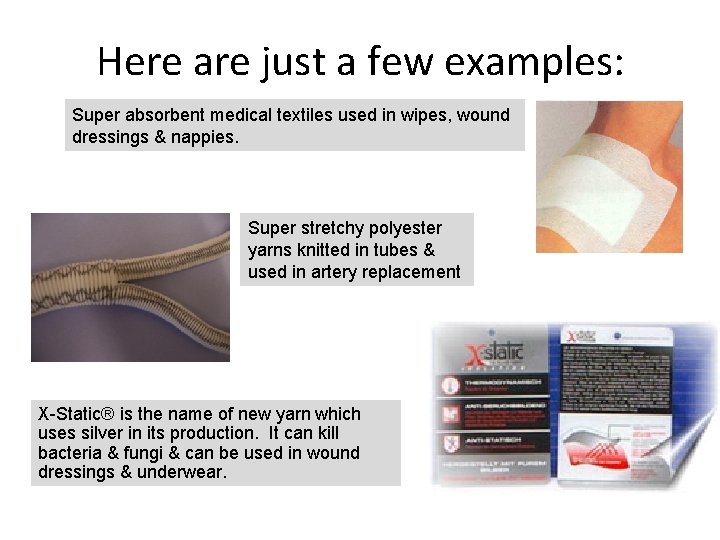
Here are just a few examples: Super absorbent medical textiles used in wipes, wound dressings & nappies. Super stretchy polyester yarns knitted in tubes & used in artery replacement X-Static® is the name of new yarn which uses silver in its production. It can kill bacteria & fungi & can be used in wound dressings & underwear.
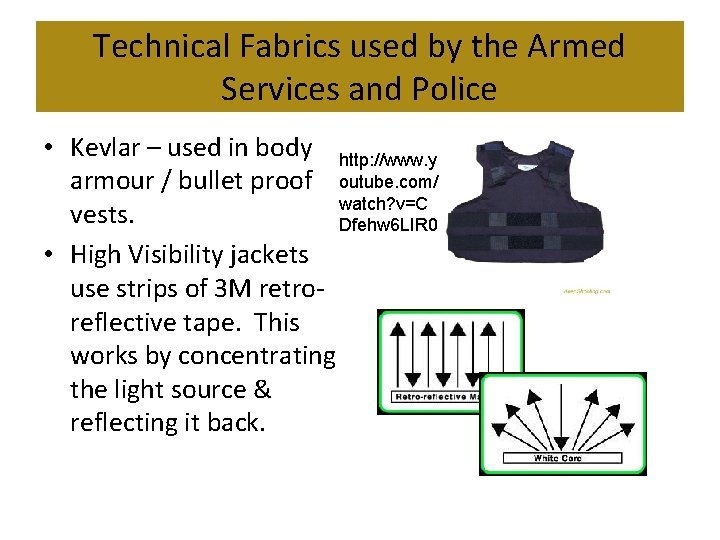
Technical Fabrics used by the Armed Services and Police • Kevlar – used in body http: //www. y armour / bullet proof outube. com/ watch? v=C vests. Dfehw 6 LIR 0 • High Visibility jackets use strips of 3 M retroreflective tape. This works by concentrating the light source & reflecting it back.
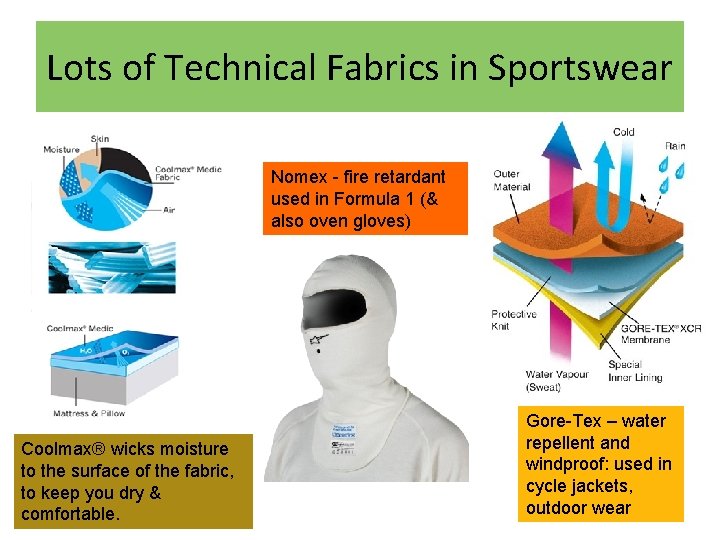
Lots of Technical Fabrics in Sportswear Nomex - fire retardant used in Formula 1 (& also oven gloves) Coolmax® wicks moisture to the surface of the fabric, to keep you dry & comfortable. Gore-Tex – water repellent and windproof: used in cycle jackets, outdoor wear
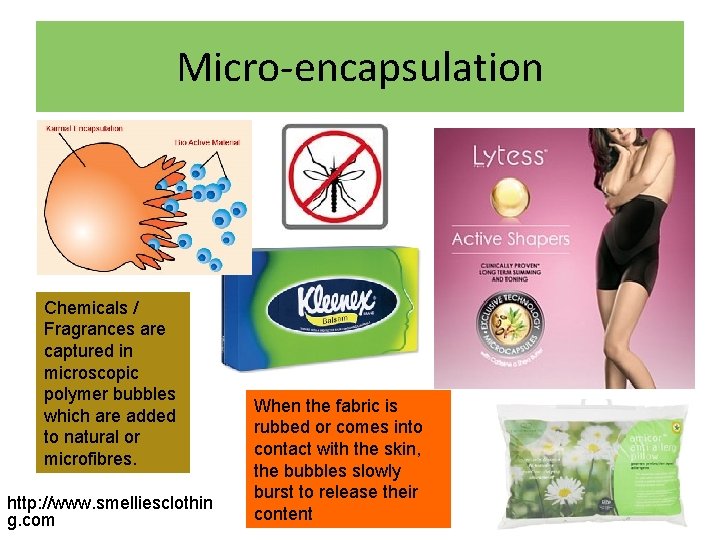
Micro-encapsulation Chemicals / Fragrances are captured in microscopic polymer bubbles which are added to natural or microfibres. http: //www. smelliesclothin g. com When the fabric is rubbed or comes into contact with the skin, the bubbles slowly burst to release their content
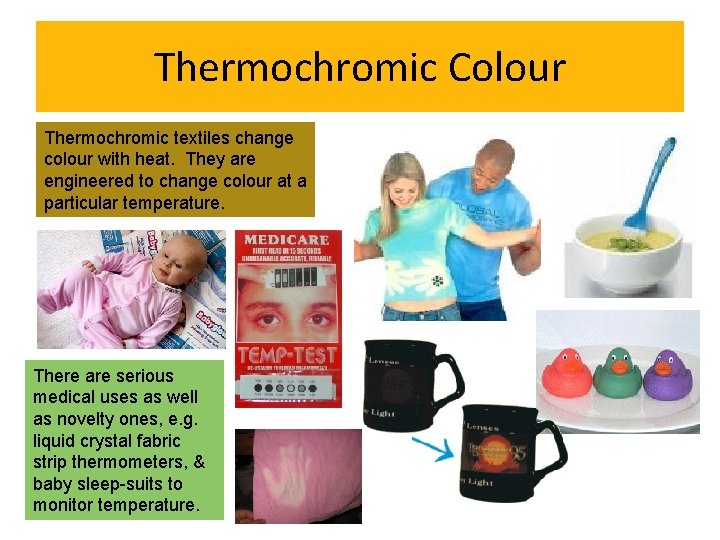
Thermochromic Colour Thermochromic textiles change colour with heat. They are engineered to change colour at a particular temperature. There are serious medical uses as well as novelty ones, e. g. liquid crystal fabric strip thermometers, & baby sleep-suits to monitor temperature.
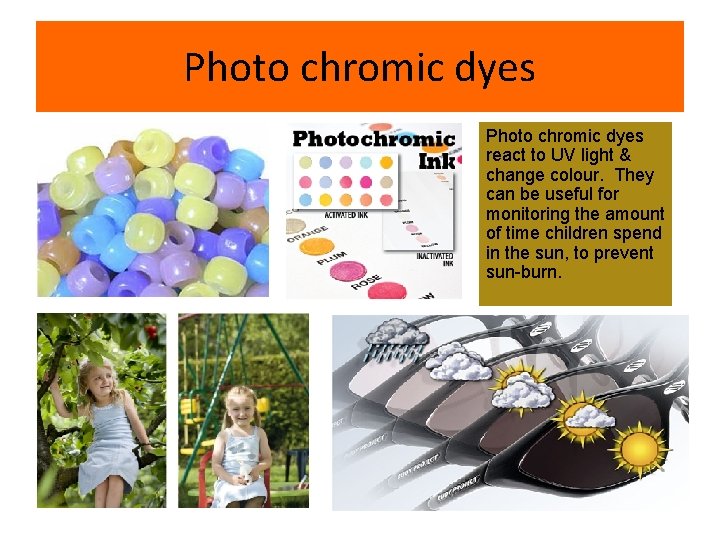
Photo chromic dyes react to UV light & change colour. They can be useful for monitoring the amount of time children spend in the sun, to prevent sun-burn.
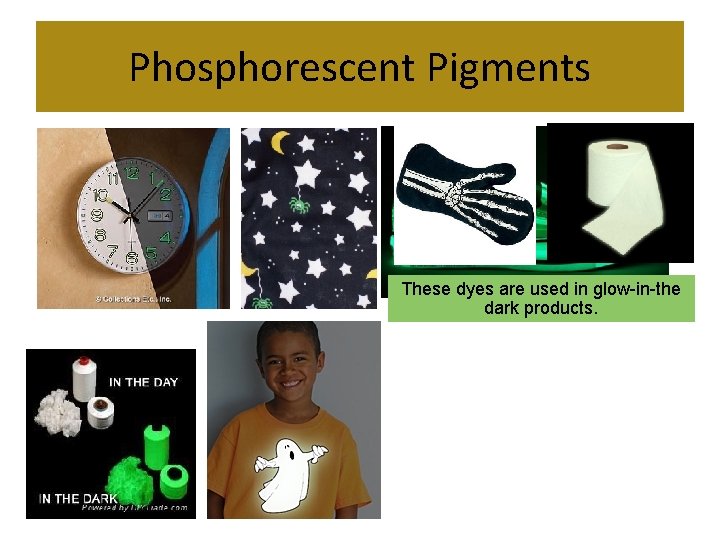
Phosphorescent Pigments These dyes are used in glow-in-the dark products.
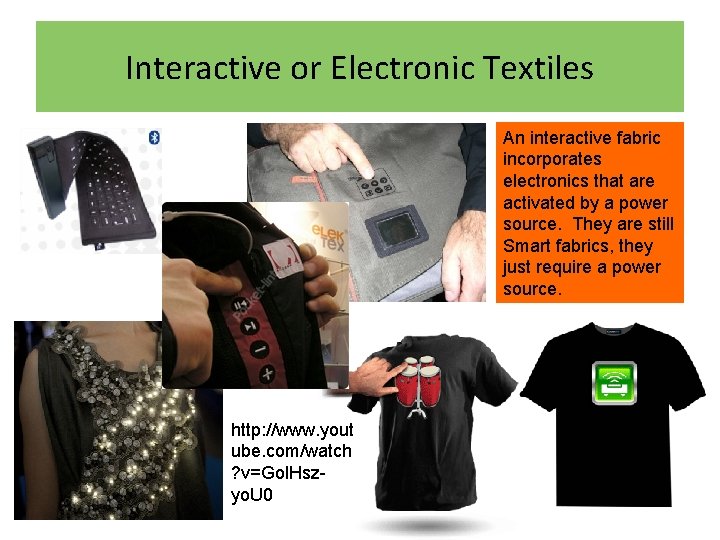
Interactive or Electronic Textiles An interactive fabric incorporates electronics that are activated by a power source. They are still Smart fabrics, they just require a power source. http: //www. yout ube. com/watch ? v=Gol. Hszyo. U 0
Some more Electronic Fabrics Graphic Equilizer T-shirt playing to Lady Ga. Ga http: //www. youtube. com/watch? v=u. Gv 6 Bw 34 Pt. U Electronic fashion on the catwalk – by Diana Eng http: //www. youtube. com/watch? v=Bkd. Jv 5 OCXio&feature=related The climate dress http: //www. youtube. com/watch? v=bg. Va. Uq. SK 3 IQ Shape changing couture http: //www. youtube. com/watch? v=nn. Ck. JCyjix. U&feature=related http: //www. crunchwear. com/cute-circuit-galaxy-led-dress
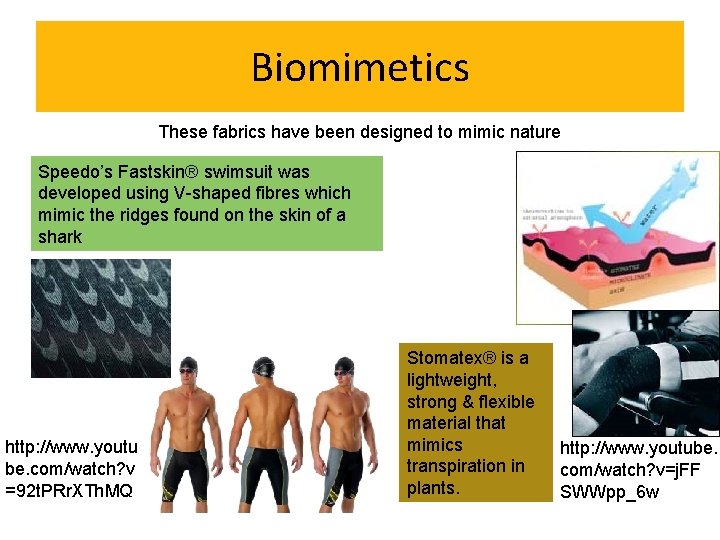
Biomimetics These fabrics have been designed to mimic nature Speedo’s Fastskin® swimsuit was developed using V-shaped fibres which mimic the ridges found on the skin of a shark http: //www. youtu be. com/watch? v =92 t. PRr. XTh. MQ Stomatex® is a lightweight, strong & flexible material that mimics transpiration in plants. http: //www. youtube. com/watch? v=j. FF SWWpp_6 w
Smart Textiles Smart textiles can sense, react & adapt to the conditions around them. For example, they can react to: • Hot or cold temperature Uses Novelty clothing • Light Protective clothing • Pressure Safety equipment • Moisture Medical textiles • Time Some smart materials meet a real need & have been developed for specific functions. Others are more of a novelty design feature. Military uses Anti-allergen products Baby products
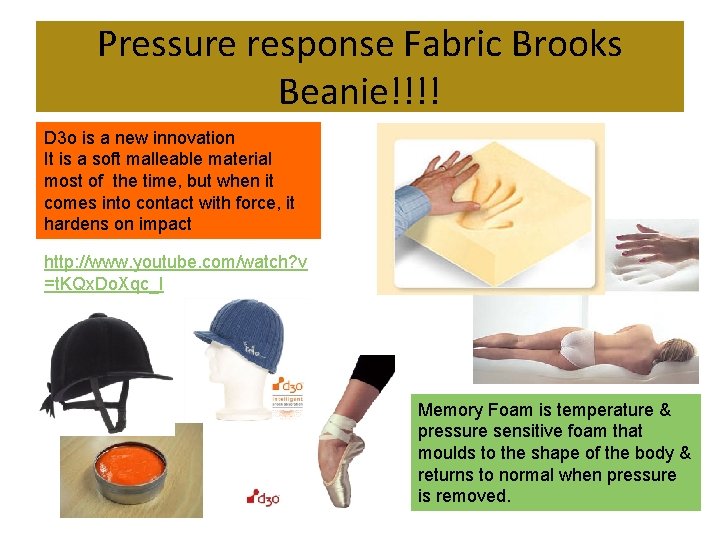
Pressure response Fabric Brooks Beanie!!!! D 3 o is a new innovation It is a soft malleable material most of the time, but when it comes into contact with force, it hardens on impact http: //www. youtube. com/watch? v =t. KQx. Do. Xqc_I Memory Foam is temperature & pressure sensitive foam that moulds to the shape of the body & returns to normal when pressure is removed.
- Slides: 19