
SMAP Radiometer RFI Study Status Review January 6
- Slides: 31
SMAP Radiometer RFI Study Status Review January 6 th 2009 SMAP RFI Review Telecon 1
Overview • RFI in the SMAP L-band Radiometer is a major concern, being examined by the SMAP radiometer team – (J. Piepmeier, NASA GSFC, study lead) • Goal of this telecon: Peer review of analysis process and datasets • is analysis reasonable forecasting SMAP RFI environment? • anything missing? • is the methodology reasonable? • Desired outcome: – Feedback from participants during telecon or via email within 24 hours – Progress toward consensus on any recommendations for SMAP • Invited Participants: – SMAP SDT (Njoku, O’Neill, Jackson, Johnson, Moghaddam, Tsang, Entekhabi, Mc. Donald) – Instrument team (Piepmeier, Hudson, Medeiros, Spencer) – SMAP RFI WG (Gasiewski, Camps, Laymon, Ruf, Le. Vine, De. Roo, Li, Yueh, Dinardo, Skou)
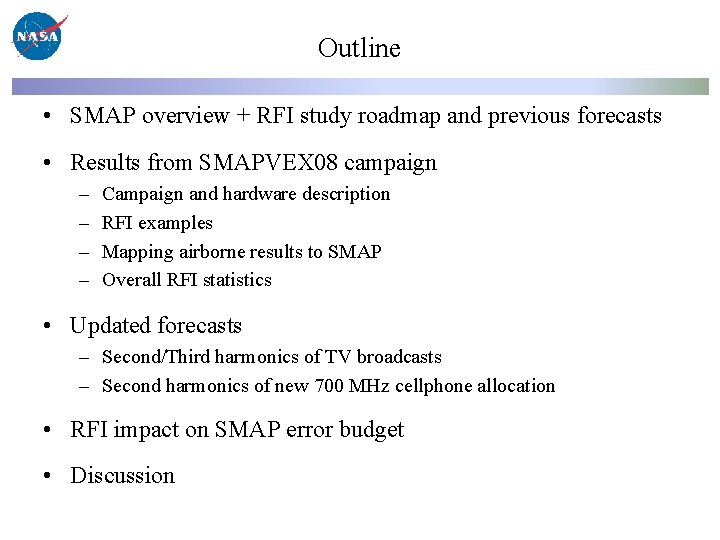
Outline • SMAP overview + RFI study roadmap and previous forecasts • Results from SMAPVEX 08 campaign – – Campaign and hardware description RFI examples Mapping airborne results to SMAP Overall RFI statistics • Updated forecasts – Second/Third harmonics of TV broadcasts – Second harmonics of new 700 MHz cellphone allocation • RFI impact on SMAP error budget • Discussion
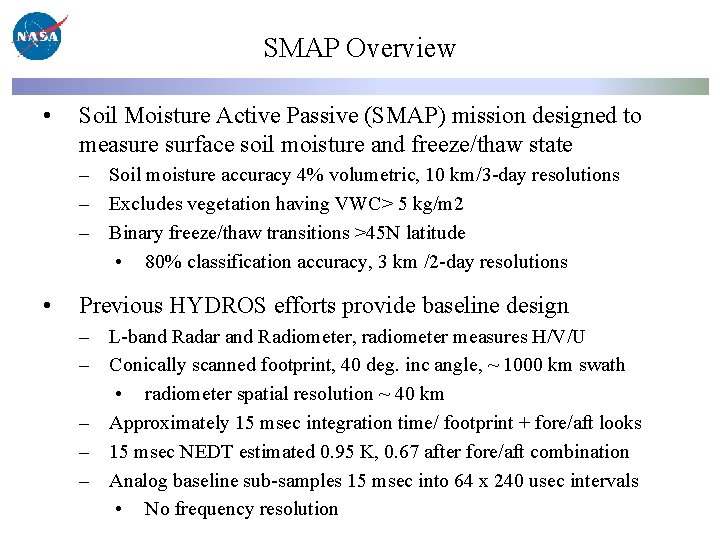
SMAP Overview • Soil Moisture Active Passive (SMAP) mission designed to measure surface soil moisture and freeze/thaw state – Soil moisture accuracy 4% volumetric, 10 km/3 -day resolutions – Excludes vegetation having VWC> 5 kg/m 2 – Binary freeze/thaw transitions >45 N latitude • 80% classification accuracy, 3 km /2 -day resolutions • Previous HYDROS efforts provide baseline design – L-band Radar and Radiometer, radiometer measures H/V/U – Conically scanned footprint, 40 deg. inc angle, ~ 1000 km swath • radiometer spatial resolution ~ 40 km – Approximately 15 msec integration time/ footprint + fore/aft looks – 15 msec NEDT estimated 0. 95 K, 0. 67 after fore/aft combination – Analog baseline sub-samples 15 msec into 64 x 240 usec intervals • No frequency resolution
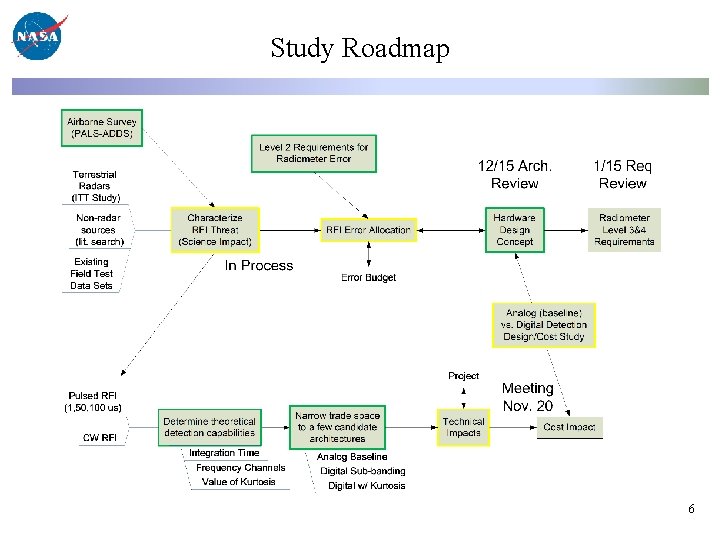
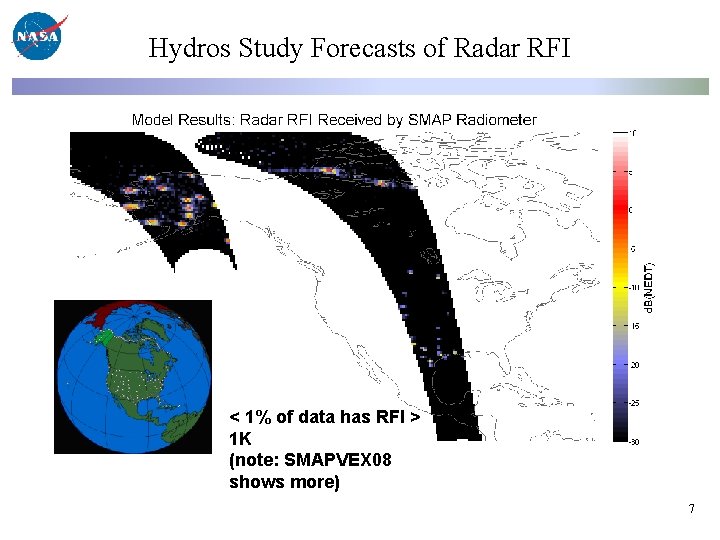
Study roadmap and previous forecasts • An RFI study roadmap has been developed for SMAP • Study goals: – Characterize RFI threat using forecasts and measured datasets • SMAPVEX 08 provides an important dataset – Model RFI detection/mitigation performance of possible hardware modifications – Final outcome: recommendations for radiometer design • An RFI forecast study was performed previously for HYDROS – Investigated impact of US radar systems on HYDROS – Impact of “tails” of radar emissions into SMAP bandwidth/filter sidebands • Similar analyses also performed for SMOS
Study Roadmap 6
Hydros Study Forecasts of Radar RFI < 1% of data has RFI > 1 K (note: SMAPVEX 08 shows more) 7
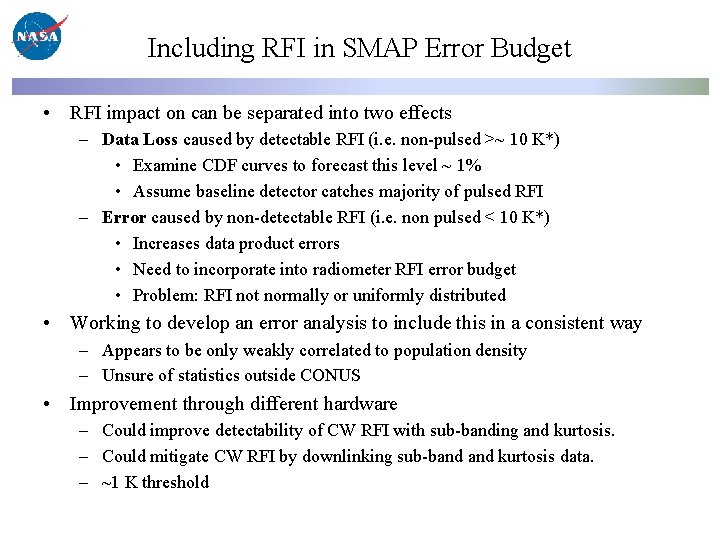
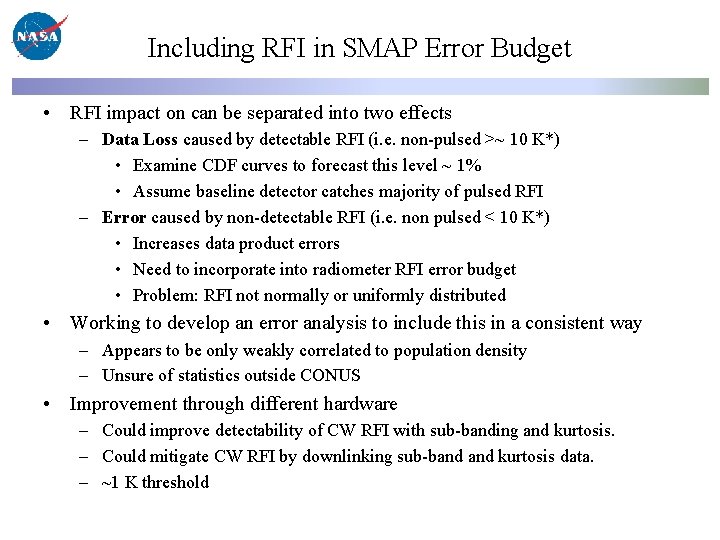
Including RFI in SMAP Error Budget • RFI impact on can be separated into two effects – Data Loss caused by detectable RFI (i. e. non-pulsed >~ 10 K*) • Examine CDF curves to forecast this level ~ 1% • Assume baseline detector catches majority of pulsed RFI – Error caused by non-detectable RFI (i. e. non pulsed < 10 K*) • Increases data product errors • Need to incorporate into radiometer RFI error budget • Problem: RFI not normally or uniformly distributed • Working to develop an error analysis to include this in a consistent way – Appears to be only weakly correlated to population density – Unsure of statistics outside CONUS • Improvement through different hardware – Could improve detectability of CW RFI with sub-banding and kurtosis. – Could mitigate CW RFI by downlinking sub-band kurtosis data. – ~1 K threshold
Airborne RFI Information • Numerous airborne and ground-based L-band campaigns have reported RFI – PALS/ESTAR/Co. SMOS/ other ground based systems – Usually (except Co. SMOS) unable to mitigate or detect low-level RFI – Mostly anecdotal evidence, detailed statistics not compiled • Several groups developing improved RFI detection/mitigation methods in recent years • Three RFI detecting/mitigating systems combined with JPL PALS in SMAPVEX 08 campaign to provide enhanced dataset – Sept 20 -Oct 19 th, 2008, ~ 92 flight hours – ~20 deg. beamwidth, 40 deg. inc angle, Twin Otter aircraft – NASA P-3 also deployed with an RFI detecting radiometer from MSFC
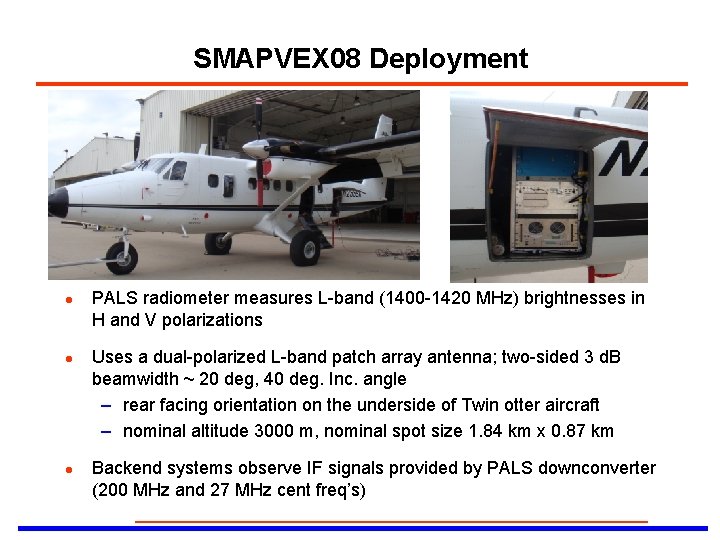
SMAPVEX 08 Deployment l l l PALS radiometer measures L-band (1400 -1420 MHz) brightnesses in H and V polarizations Uses a dual-polarized L-band patch array antenna; two-sided 3 d. B beamwidth ~ 20 deg, 40 deg. Inc. angle – rear facing orientation on the underside of Twin otter aircraft – nominal altitude 3000 m, nominal spot size 1. 84 km x 0. 87 km Backend systems observe IF signals provided by PALS downconverter (200 MHz and 27 MHz cent freq’s)
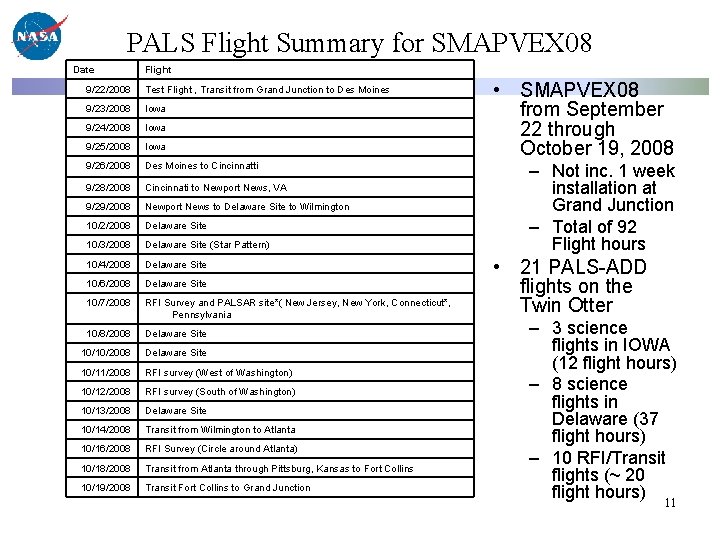
PALS Flight Summary for SMAPVEX 08 Date Flight 9/22/2008 Test Flight , Transit from Grand Junction to Des Moines 9/23/2008 Iowa 9/24/2008 Iowa 9/25/2008 Iowa 9/26/2008 Des Moines to Cincinnatti 9/28/2008 Cincinnati to Newport News, VA 9/29/2008 Newport News to Delaware Site to Wilmington 10/2/2008 Delaware Site 10/3/2008 Delaware Site (Star Pattern) 10/4/2008 Delaware Site 10/6/2008 Delaware Site 10/7/2008 RFI Survey and PALSAR site*( New Jersey, New York, Connecticut*, Pennsylvania 10/8/2008 Delaware Site 10/10/2008 Delaware Site 10/11/2008 RFI survey (West of Washington) 10/12/2008 RFI survey (South of Washington) 10/13/2008 Delaware Site 10/14/2008 Transit from Wilmington to Atlanta 10/16/2008 RFI Survey (Circle around Atlanta) 10/18/2008 Transit from Atlanta through Pittsburg, Kansas to Fort Collins 10/19/2008 Transit Fort Collins to Grand Junction • SMAPVEX 08 from September 22 through October 19, 2008 – Not inc. 1 week installation at Grand Junction – Total of 92 Flight hours • 21 PALS-ADD flights on the Twin Otter – 3 science flights in IOWA (12 flight hours) – 8 science flights in Delaware (37 flight hours) – 10 RFI/Transit flights (~ 20 flight hours) 11
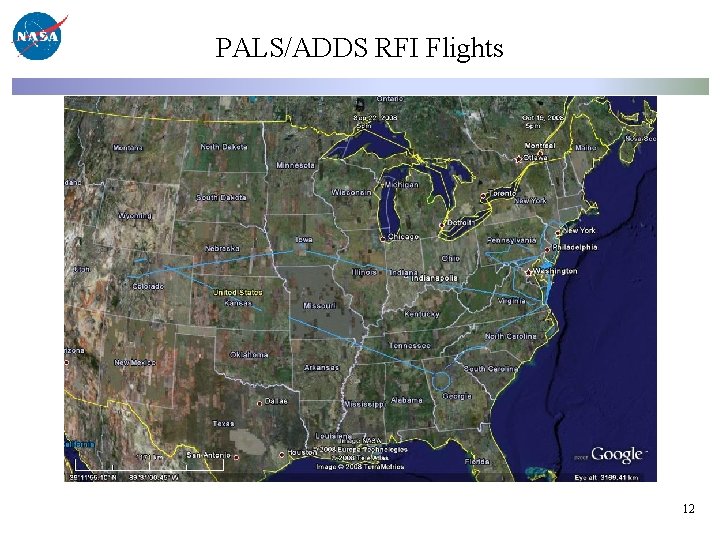
PALS/ADDS RFI Flights 12
RFI Detection and Mitigation in SMAPVEX 08 • Three algorithm types: pulse, cross-frequency, kurtosis – Pulse for pulsed sources, cross-freq for narrowband, kurtosis tests for normality – ~ 20 -30 seconds for PALS to traverse one footprint • PALS: capable of pulse detection at ~ a few msec time scale • GSFC ADD: pulse detection at 2 usec time resolution – Also has a “pseudo-kurtosis” capability but not yet processed – No frequency resolution • U. Mich ADD: kurtosis or pulse detection >= 4 msec res – Has 8 x 2. 29 MHz sub-bands, only fullband results presented here • OSU LISR: Records 350 usec x 0. 1 MHz spectrograms – Pulse detection at 350 usec time resolution – Cross-frequency detection at 0. 1 MHz spectral resolution • Selected RFI examples (among a huge number) follow (initial results) – Other spatial/polarization detection tests remain to be studied
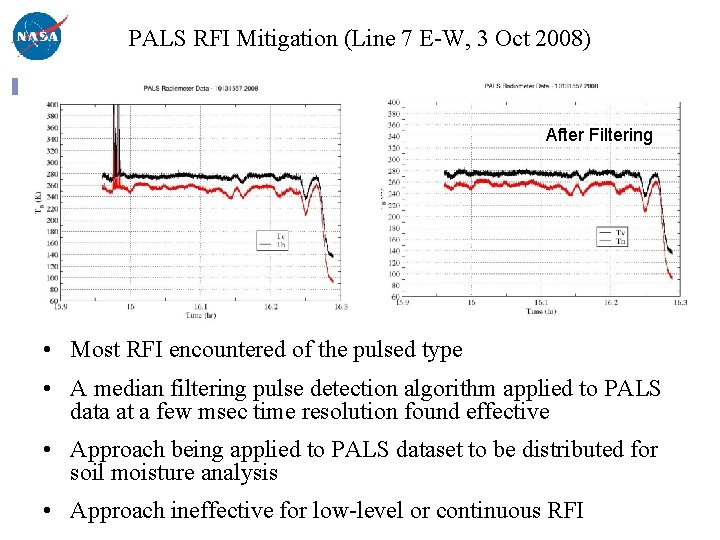
PALS RFI Mitigation (Line 7 E-W, 3 Oct 2008) After Filtering • Most RFI encountered of the pulsed type • A median filtering pulse detection algorithm applied to PALS data at a few msec time resolution found effective • Approach being applied to PALS dataset to be distributed for soil moisture analysis • Approach ineffective for low-level or continuous RFI
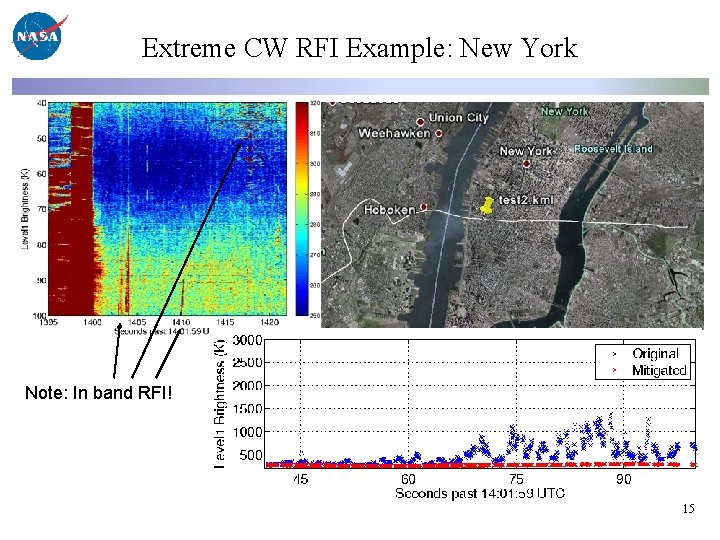
Extreme CW RFI Example: New York Note: In band RFI! 15
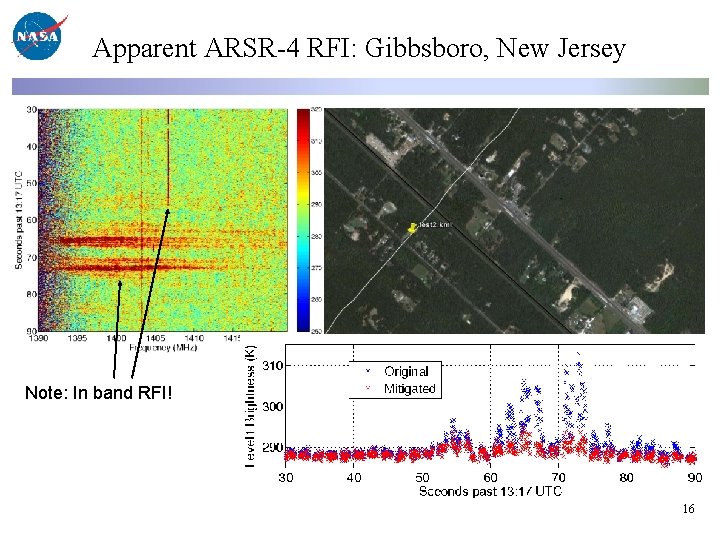
Apparent ARSR-4 RFI: Gibbsboro, New Jersey Note: In band RFI! 16
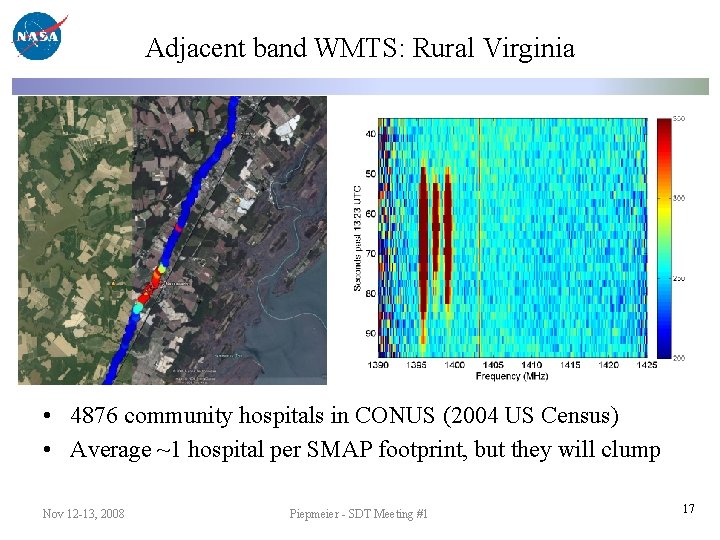
Adjacent band WMTS: Rural Virginia • 4876 community hospitals in CONUS (2004 US Census) • Average ~1 hospital per SMAP footprint, but they will clump Nov 12 -13, 2008 Piepmeier - SDT Meeting #1 17
Mapping Airborne Observations to SMAP • Scaling airborne results to SMAP requires consideration of – Larger range to SMAP – Larger antenna gain of SMAP – Larger footprint of SMAP • A Friis formula analysis shows that problem reduces to the EIRP per footprint area for either system (density of interferers equation) – See document mappingtosmap. pdf • SMAP forecasting reduces to averaging airborne detected RFI levels over scales comparable to SMAP footprint • Airborne tracks mostly linear, so compiling a SMAP footprint area would involve disjoint linear regions – Averaging over linear scales comparable to SMAP footprint diameter preferred? – Statistics compiled for multiple time scales to examine averaging effects
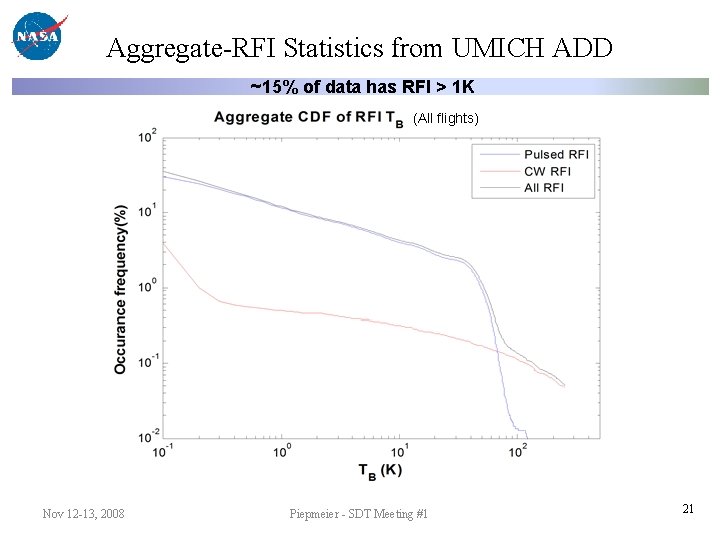
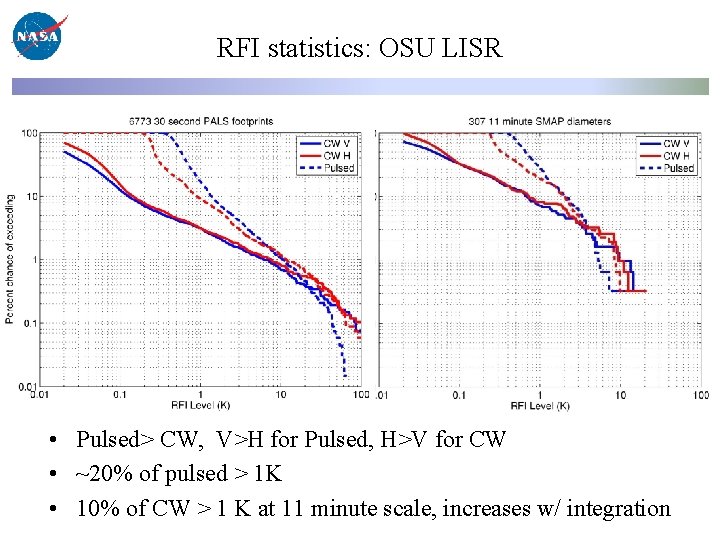
Campaign Statistics • Detected RFI levels using campaign dataset compiled for each RFI backend – GSFC: pulsed detection, H pol – UM ADD: kurtosis/pulsed detection, H and V pols – OSU LISR: pulsed, cross-freq detection, H and V pols • Time scales: 2 usec/4 msec/350 usec, then averaged to larger spatial scales – 30 seconds ~ 1 PALS footprint; 11 minutes ~ 1 SMAP footprint diameter – Entire flight ~ 1 SMAP footprint area • Some pixels (esp. in soil moisture study regions) observed multiple times – Improving processing to remove this effect • Also possible to examine “residual” RFI levels following various detection/mitigation approaches: subject for future discussions • Looking for basic consistency among multiple systems, then RFI info – Some RFI may still be undetected, some level of false alarms – Expected false alarm rate not coordinated here
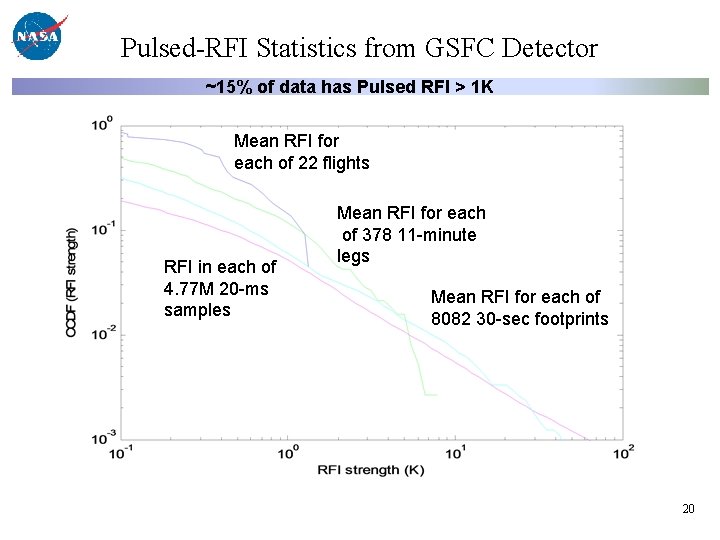
Pulsed-RFI Statistics from GSFC Detector ~15% of data has Pulsed RFI > 1 K Mean RFI for each of 22 flights RFI in each of 4. 77 M 20 -ms samples Mean RFI for each of 378 11 -minute legs Mean RFI for each of 8082 30 -sec footprints 20
Aggregate-RFI Statistics from UMICH ADD ~15% of data has RFI > 1 K (All flights) Nov 12 -13, 2008 Piepmeier - SDT Meeting #1 21
RFI statistics: OSU LISR • Pulsed> CW, V>H for Pulsed, H>V for CW • ~20% of pulsed > 1 K • 10% of CW > 1 K at 11 minute scale, increases w/ integration
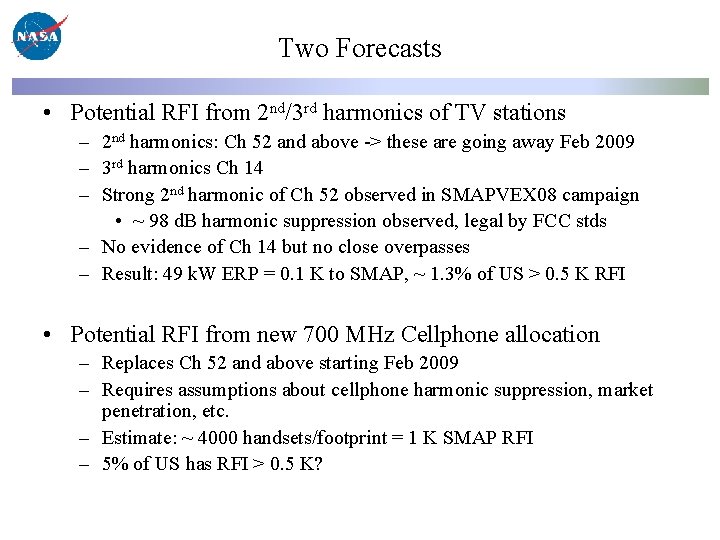
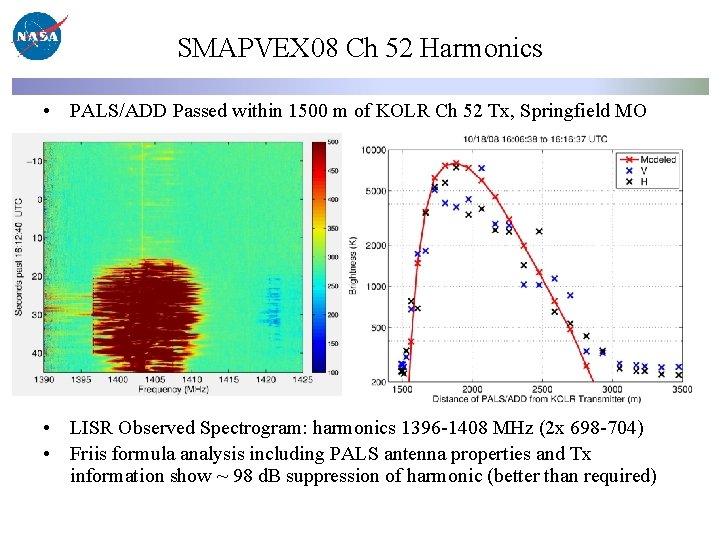
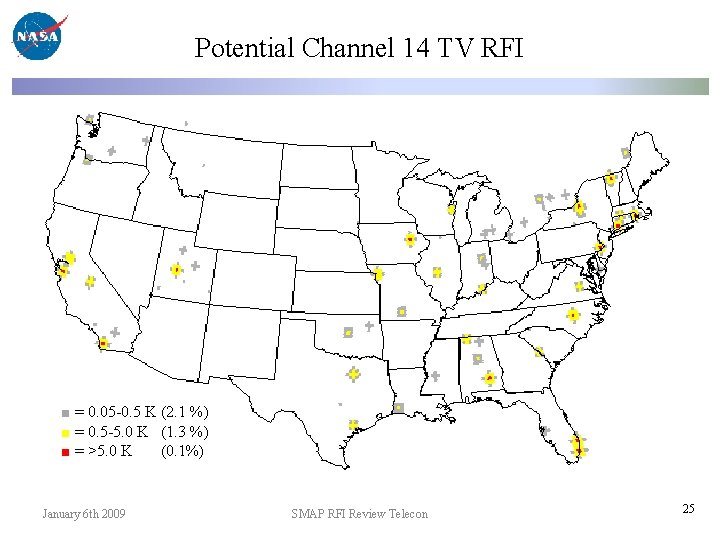
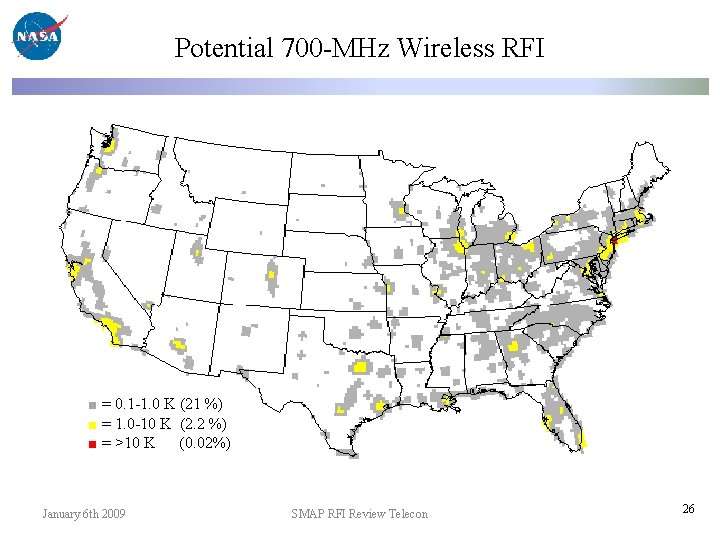
Two Forecasts • Potential RFI from 2 nd/3 rd harmonics of TV stations – 2 nd harmonics: Ch 52 and above -> these are going away Feb 2009 – 3 rd harmonics Ch 14 – Strong 2 nd harmonic of Ch 52 observed in SMAPVEX 08 campaign • ~ 98 d. B harmonic suppression observed, legal by FCC stds – No evidence of Ch 14 but no close overpasses – Result: 49 k. W ERP = 0. 1 K to SMAP, ~ 1. 3% of US > 0. 5 K RFI • Potential RFI from new 700 MHz Cellphone allocation – Replaces Ch 52 and above starting Feb 2009 – Requires assumptions about cellphone harmonic suppression, market penetration, etc. – Estimate: ~ 4000 handsets/footprint = 1 K SMAP RFI – 5% of US has RFI > 0. 5 K?
SMAPVEX 08 Ch 52 Harmonics • PALS/ADD Passed within 1500 m of KOLR Ch 52 Tx, Springfield MO • LISR Observed Spectrogram: harmonics 1396 -1408 MHz (2 x 698 -704) • Friis formula analysis including PALS antenna properties and Tx information show ~ 98 d. B suppression of harmonic (better than required)
Potential Channel 14 TV RFI ■ = 0. 05 -0. 5 K (2. 1 %) ■ = 0. 5 -5. 0 K (1. 3 %) ■ = >5. 0 K (0. 1%) January 6 th 2009 SMAP RFI Review Telecon 25
Potential 700 -MHz Wireless RFI ■ = 0. 1 -1. 0 K (21 %) ■ = 1. 0 -10 K (2. 2 %) ■ = >10 K (0. 02%) January 6 th 2009 SMAP RFI Review Telecon 26
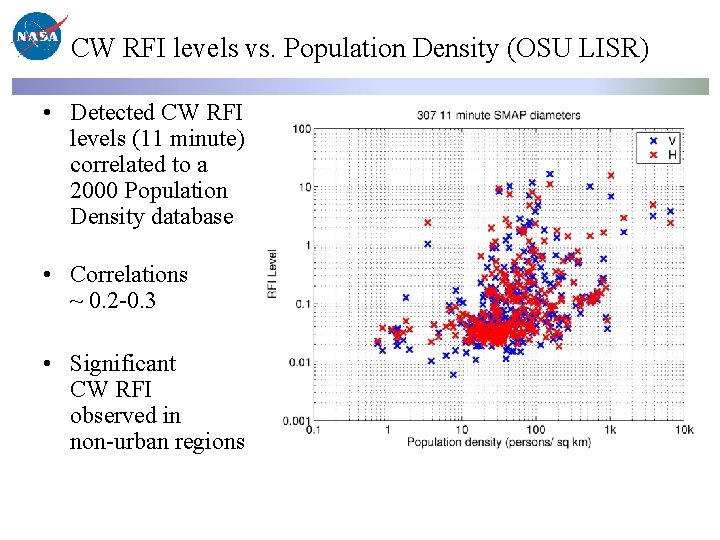
CW RFI levels vs. Population Density (OSU LISR) • Detected CW RFI levels (11 minute) correlated to a 2000 Population Density database • Correlations ~ 0. 2 -0. 3 • Significant CW RFI observed in non-urban regions
Summary and Discussion • SMAPVEX 08 campaign results show: – A large percent of observations contain negligible RFI – Pulsed RFI occurs frequently, baseline algorithm can handle much of this – CW RFI occurs less frequently, but up to 10% of SMAP footprint diameters estimated to have RFI >= 1 K – Additional analysis of these datasets still in progress • Measured data show that harmonic emissions are real, potential RFI from new 700 MHz cell phones a concern • Technical/program impact assessment of alternate hardware strategies against these sources in progress 28
Including RFI in SMAP Error Budget • RFI impact on can be separated into two effects – Data Loss caused by detectable RFI (i. e. non-pulsed >~ 10 K*) • Examine CDF curves to forecast this level ~ 1% • Assume baseline detector catches majority of pulsed RFI – Error caused by non-detectable RFI (i. e. non pulsed < 10 K*) • Increases data product errors • Need to incorporate into radiometer RFI error budget • Problem: RFI not normally or uniformly distributed • Working to develop an error analysis to include this in a consistent way – Appears to be only weakly correlated to population density – Unsure of statistics outside CONUS • Improvement through different hardware – Could improve detectability of CW RFI with sub-banding and kurtosis. – Could mitigate CW RFI by downlinking sub-band kurtosis data. – ~1 K threshold
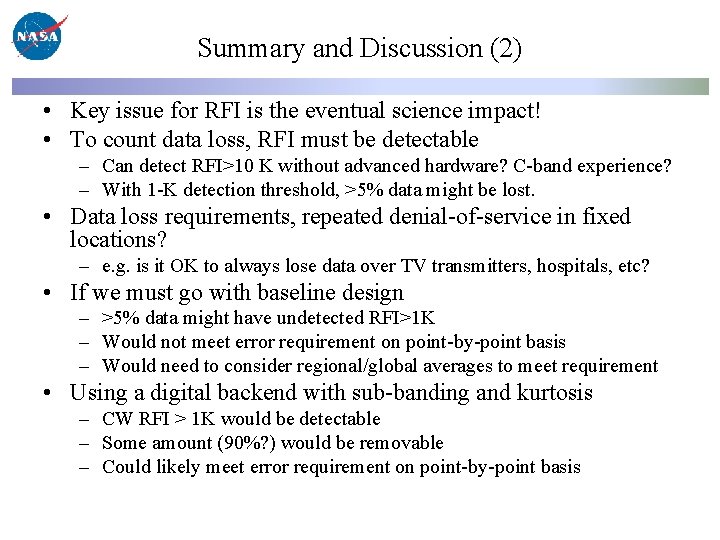
Summary and Discussion (2) • Key issue for RFI is the eventual science impact! • To count data loss, RFI must be detectable – Can detect RFI>10 K without advanced hardware? C-band experience? – With 1 -K detection threshold, >5% data might be lost. • Data loss requirements, repeated denial-of-service in fixed locations? – e. g. is it OK to always lose data over TV transmitters, hospitals, etc? • If we must go with baseline design – >5% data might have undetected RFI>1 K – Would not meet error requirement on point-by-point basis – Would need to consider regional/global averages to meet requirement • Using a digital backend with sub-banding and kurtosis – CW RFI > 1 K would be detectable – Some amount (90%? ) would be removable – Could likely meet error requirement on point-by-point basis
Recap • Goal of this telecon: Peer review of analysis process and datasets • is analysis reasonable forecasting SMAP RFI environment? • anything missing? • is the methodology reasonable? • Desired outcome: – Feedback from participants during telecon or via email within 24 hours – Progress toward consensus on any recommendations for SMAP • Now is the time to act! If SDT feels we won’t meet science needs with baseline design (i. e. , must live with CW RFI), please speak up now. January 6 th 2009 SMAP RFI Review Telecon 31