
Smallpox Vaccine Overview Types of Vaccine Administration Contraindications
- Slides: 96
Smallpox Vaccine Overview Types of Vaccine Administration Contraindications Adverse Reactions
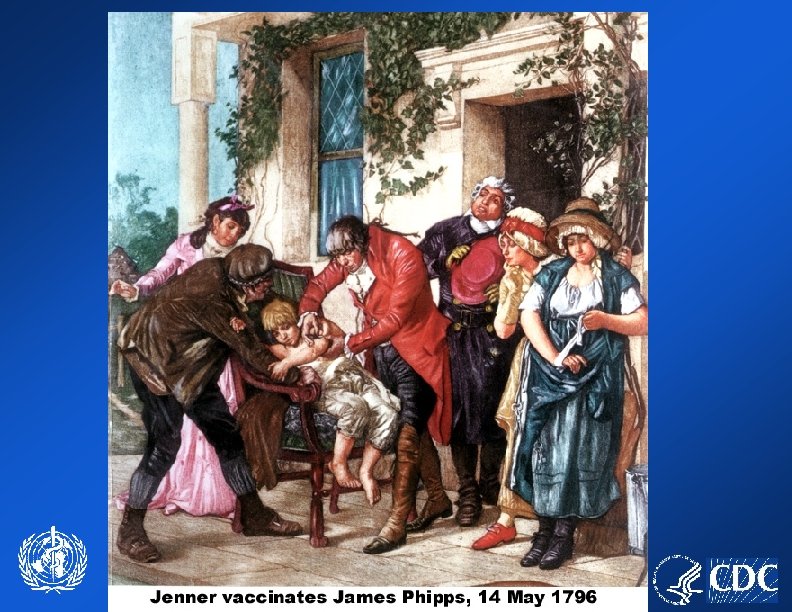
Smallpox Vaccine History • Original material used by Jenner was probably cowpox. • Cowpox to vaccinia in 19 th Century.
Vaccinia Virus • Origin of vaccinia virus unknown. • Genetically distinct from cowpox and variola. • May be a virus now extinct in nature.
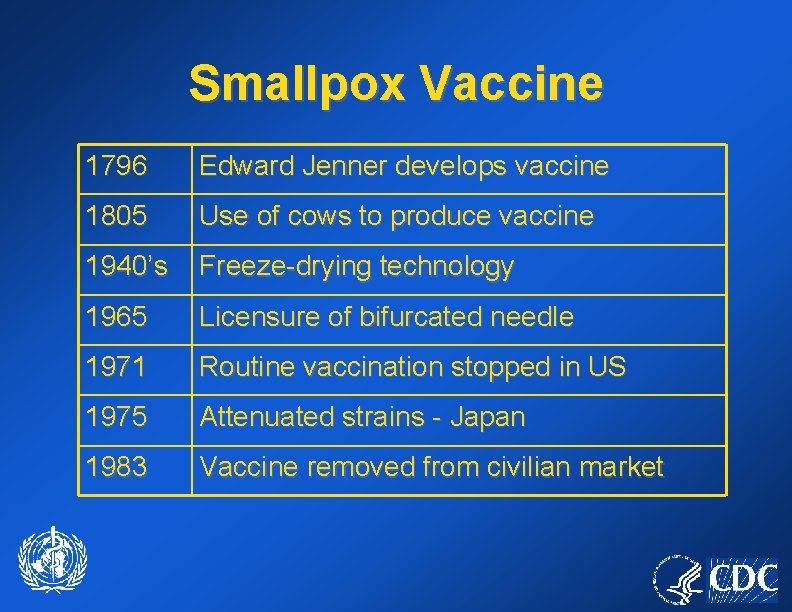
Smallpox Vaccine 1796 Edward Jenner develops vaccine 1805 Use of cows to produce vaccine 1940’s Freeze-drying technology 1965 Licensure of bifurcated needle 1971 Routine vaccination stopped in US 1975 Attenuated strains - Japan 1983 Vaccine removed from civilian market
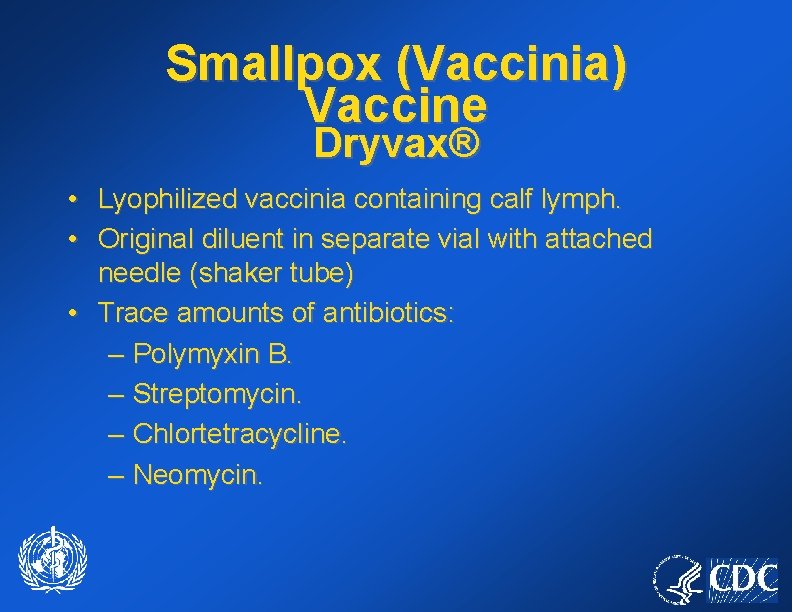
Smallpox (Vaccinia) Vaccine Dryvax® • Lyophilized vaccinia containing calf lymph. • Original diluent in separate vial with attached needle (shaker tube) • Trace amounts of antibiotics: – Polymyxin B. – Streptomycin. – Chlortetracycline. – Neomycin.
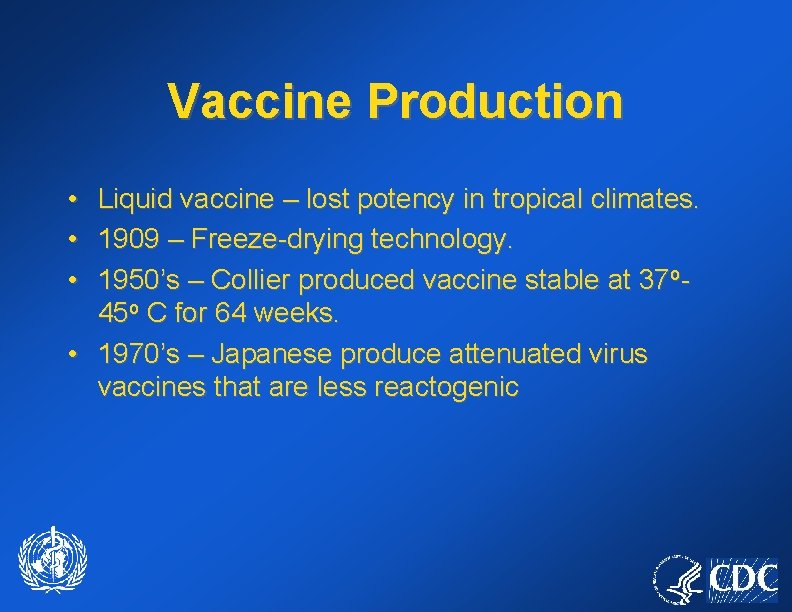
Vaccine Production • • • Liquid vaccine – lost potency in tropical climates. 1909 – Freeze-drying technology. 1950’s – Collier produced vaccine stable at 37 o 45 o C for 64 weeks. • 1970’s – Japanese produce attenuated virus vaccines that are less reactogenic
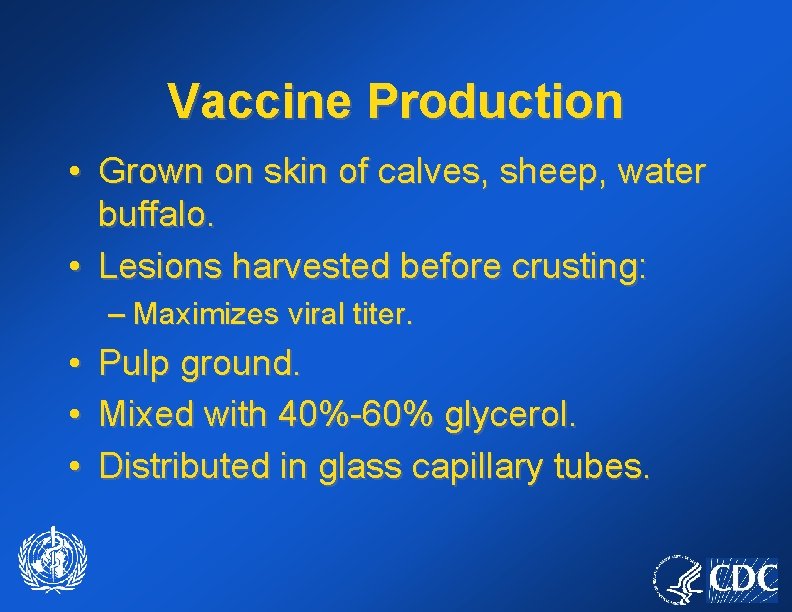
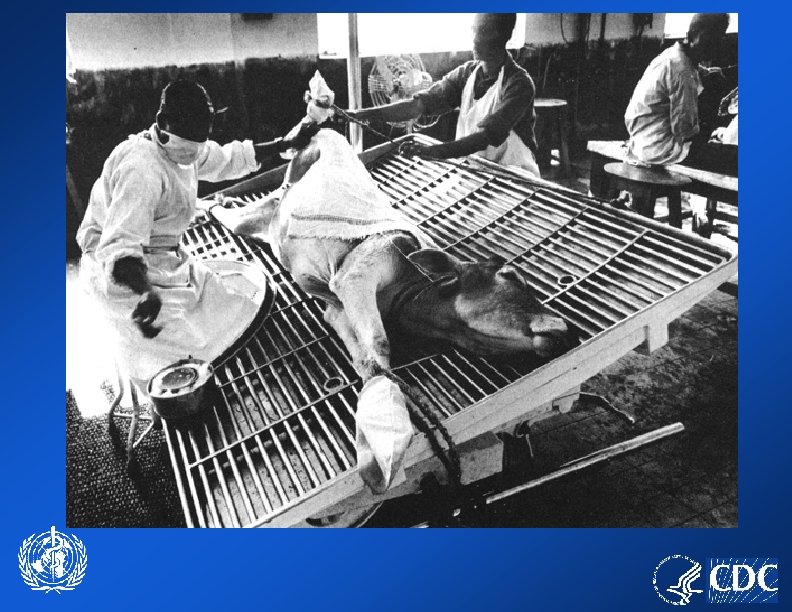
Vaccine Production • Grown on skin of calves, sheep, water buffalo. • Lesions harvested before crusting: – Maximizes viral titer. • Pulp ground. • Mixed with 40%-60% glycerol. • Distributed in glass capillary tubes.
Dryvax® Vaccine Storage and Handling (Check Manufacturer’s Instructions) • Stable indefinitely at – 20°C. • Unreconstituted – Stable >1 year at room temperature. • Reconstituted – Stable 3 months* at refrigerator temperature. * Recent FDA
Dryvax Smallpox (Vaccinia) Vaccine Administration Schedule Occupational Schedule: • 1 Successful Dose >18 years of age. Revaccination: • 10 Years - nonhighly-attenuated vaccinia and recombinants. • 3 Years – highly attenuated orthopoxviruses.
Smallpox (Vaccinia) Vaccine Administration Schedule – Non. Emergency Schedule: • 1 Successful Dose >18 years of age. Revaccination: • Unknown.
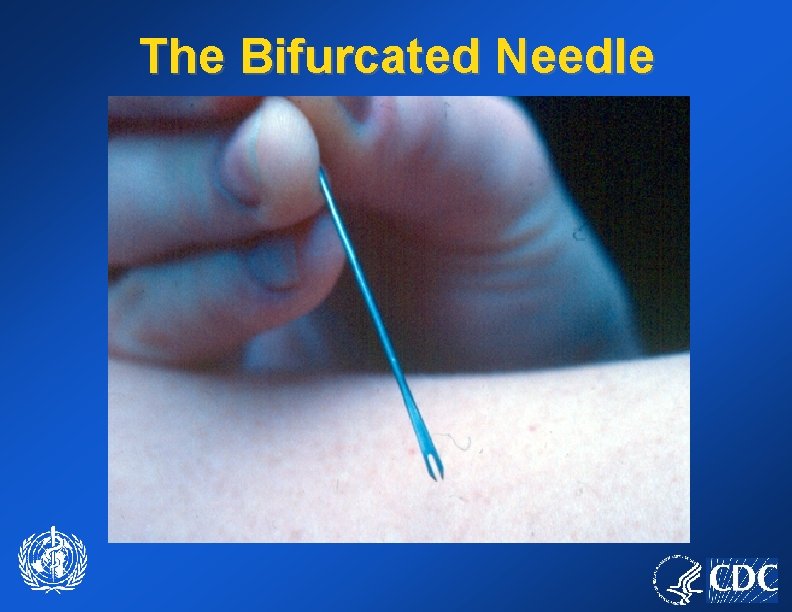
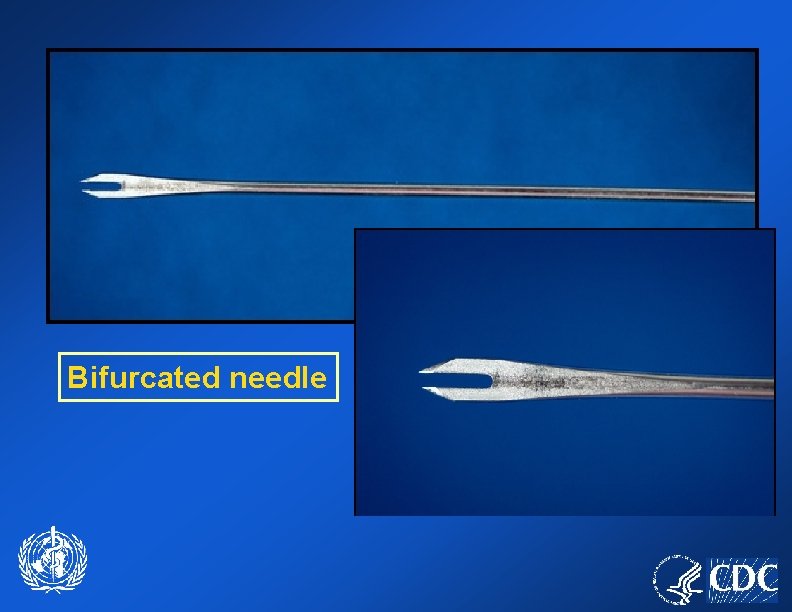
Vaccine Administration • • • Surgical needle. Vaccinostyle. Rotary lancet. Jet injector. Bifurcated needle*. *Only administration technique currently in use.
The Bifurcated Needle
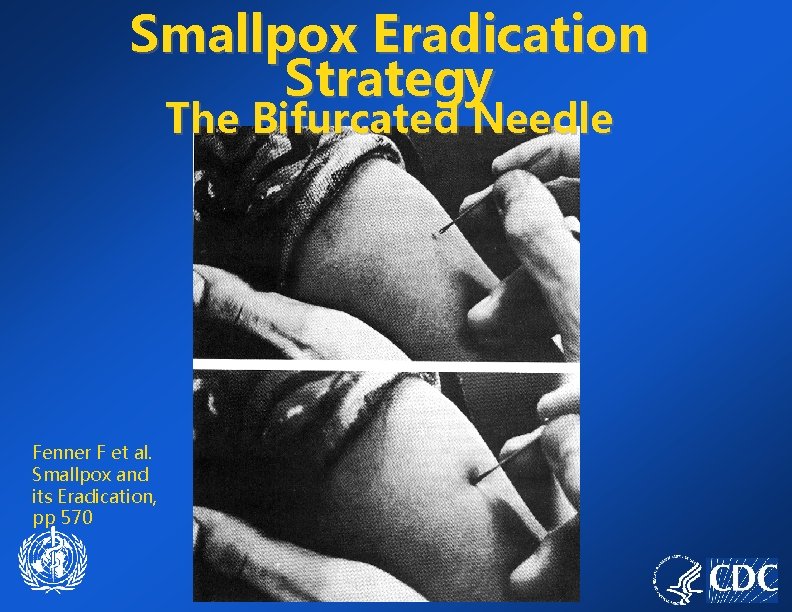
Smallpox Eradication Strategy The Bifurcated Needle Fenner F et al. Smallpox and its Eradication, pp 570
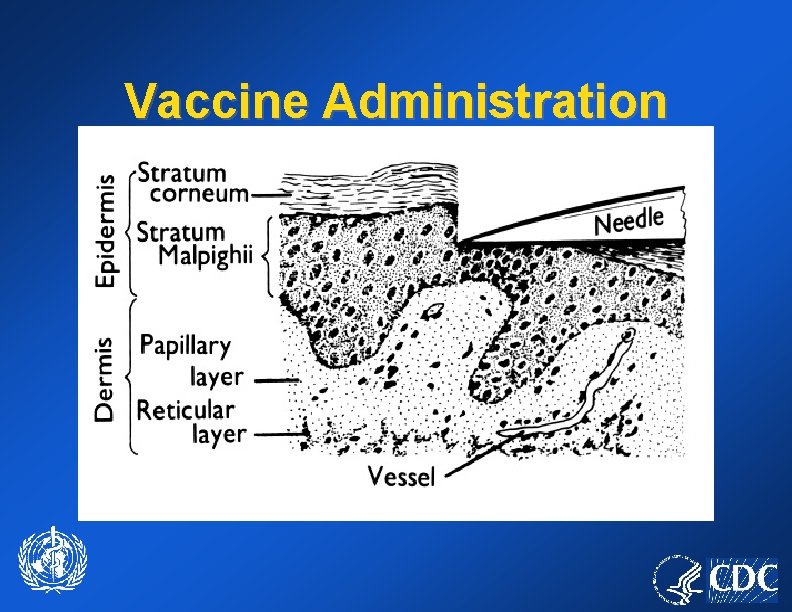
Vaccine Administration
New Smallpox Vaccines, 2003 • Live vaccinia virus produced using cell culture technology. • Distributed as a freeze-dried powder. • Do not contain antibiotics. • Diluent contains glycerin and phenol.
Contraindications and Screening
Smallpox Vaccine • Vaccine contains live vaccinia virus. • Vaccine virus can be transmitted to household and other close contacts. • Candidates for vaccination must be carefully screened for contraindications. • Certain medical conditions in the person's household contacts must also be considered as contraindications for vaccination.
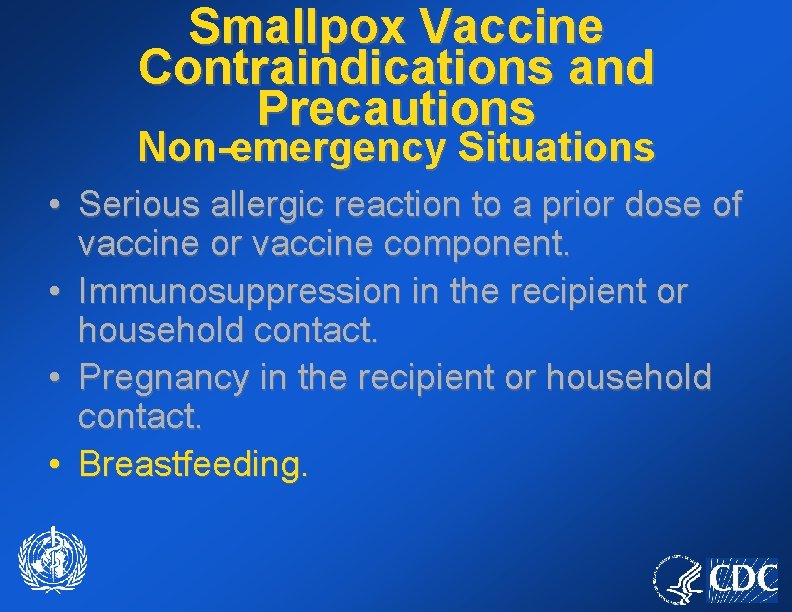
Smallpox Vaccine Contraindications and Precautions Non-emergency Situations • Serious allergic reaction to a prior dose of vaccine or vaccine component.
Smallpox Vaccine Components • Dryvax: – polymyxin B. – streptomycin. – tetracycline. – neomycin. – phenol. • New vaccines do not contain antibiotics.
Smallpox Vaccine Contraindications and Precautions Non-emergency Situations • Serious allergic reaction to a prior dose of vaccine or vaccine component. • Immunosuppression in the recipient or household contact.
Causes of Immunosuppression Diseases • • • Leukemia. Lymphoma. Generalized malignancy. Solid organ or stem cell transplantation. Humoral or cellular immunity disorders. HIV infection.
Causes of Immunosuppression Therapies • • Alkylating agents. Antimetabolites. Radiation. High dose corticosteroid therapy: – >2 mg/kg/day, OR – >20 mg/day for >14 days.
Screening for HIV Infection • Mandatory HIV testing not recommended, but: – Recommended for persons who have history of risk factor and do not know status. – Should be readily available for anyone concerned who wishes testing.
Smallpox Vaccine Contraindications and Precautions Non-emergency Situations • Serious allergic reaction to a prior dose of vaccine or vaccine component. • Immunosuppression in the recipient or household contact. • Pregnancy in the recipient or household contact.
Screening for Pregnancy • In pre-event setting, should NOT be given to: – pregnant women. – women trying to become pregnant. • Educate women of child-bearing age about fetal vaccinia. • Advise avoidance of pregnancy for 4 weeks following vaccination.
Screening for Pregnancy • If concerned, administer home test for pregnancy. • Establish pregnancy registry for women inadvertently vaccinated.
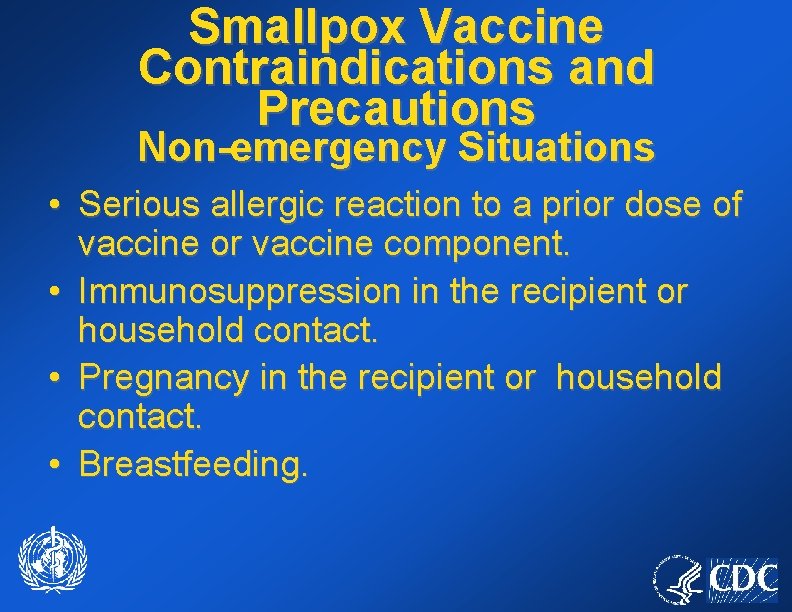
Smallpox Vaccine Contraindications and Precautions Non-emergency Situations • Serious allergic reaction to a prior dose of vaccine or vaccine component. • Immunosuppression in the recipient or household contact. • Pregnancy in the recipient or household contact. • Breastfeeding.
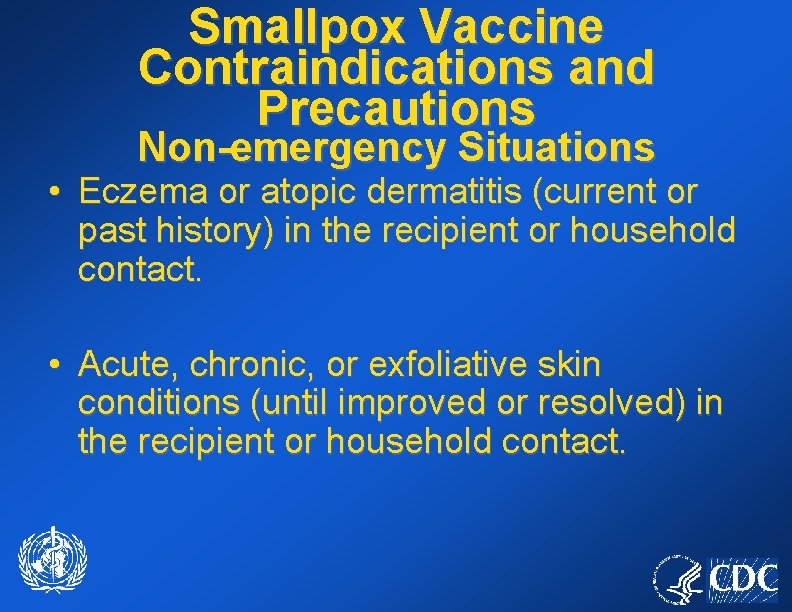
Smallpox Vaccine Contraindications and Precautions Non-emergency Situations • Eczema or atopic dermatitis (current or past history) in the recipient or household contact. • Acute, chronic, or exfoliative skin conditions (until improved or resolved) in the recipient or household contact.
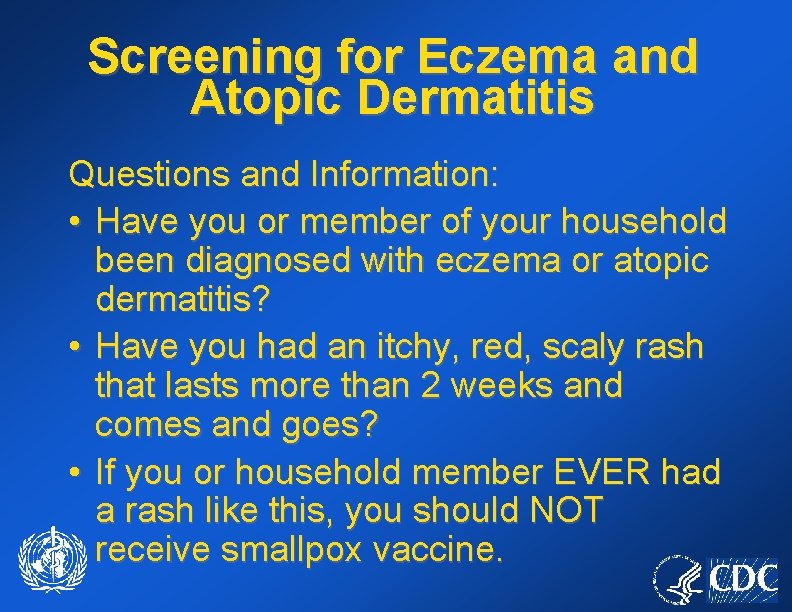
Screening for Eczema and Atopic Dermatitis Questions and Information: • Have you or member of your household been diagnosed with eczema or atopic dermatitis? • Have you had an itchy, red, scaly rash that lasts more than 2 weeks and comes and goes? • If you or household member EVER had a rash like this, you should NOT receive smallpox vaccine.
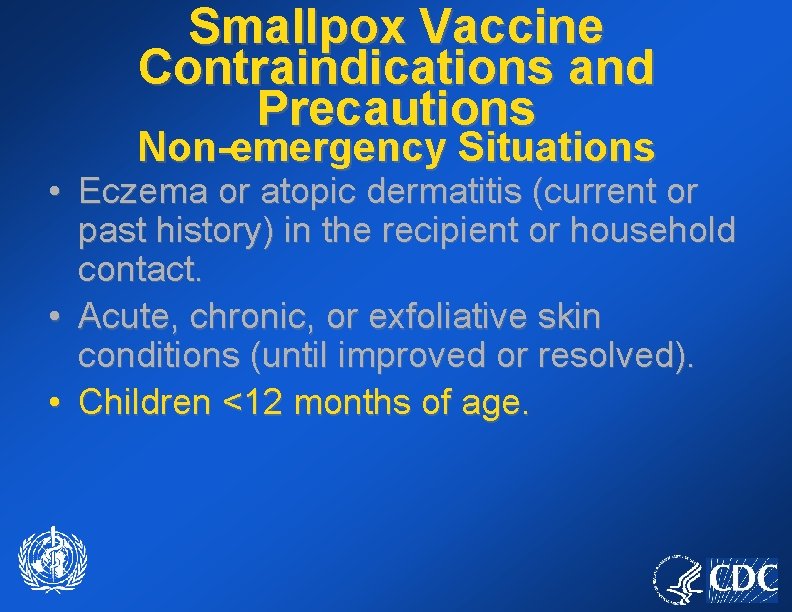
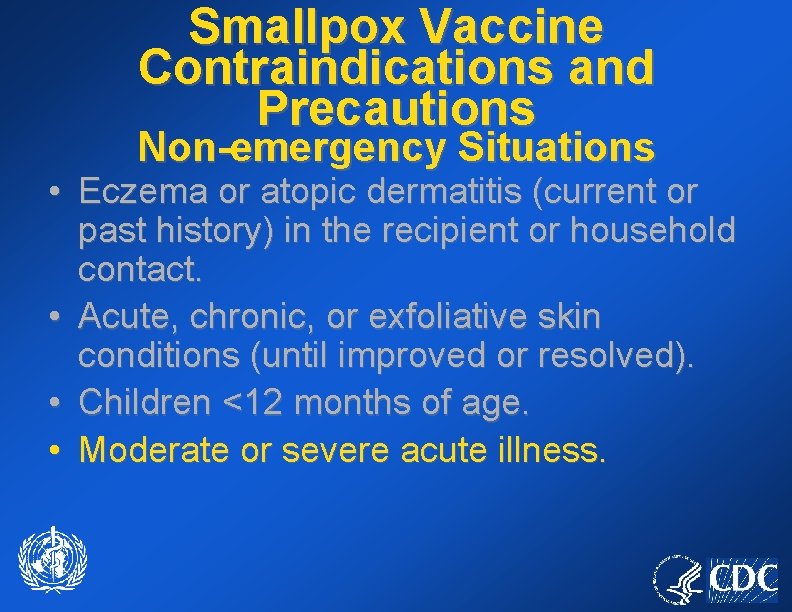
Smallpox Vaccine Contraindications and Precautions Non-emergency Situations • Eczema or atopic dermatitis (current or past history) in the recipient or household contact. • Acute, chronic, or exfoliative skin conditions (until improved or resolved). • Children <12 months of age.
Smallpox Vaccine Contraindications and Precautions Non-emergency Situations • Eczema or atopic dermatitis (current or past history) in the recipient or household contact. • Acute, chronic, or exfoliative skin conditions (until improved or resolved). • Children <12 months of age. • Moderate or severe acute illness.
Smallpox Vaccine Contraindications and Precautions Non-emergency Situations • Serious allergic reaction to a prior dose of vaccine or vaccine component. • Immunosuppression in the recipient or household contact. • Pregnancy in the recipient or household contact. • Breastfeeding.
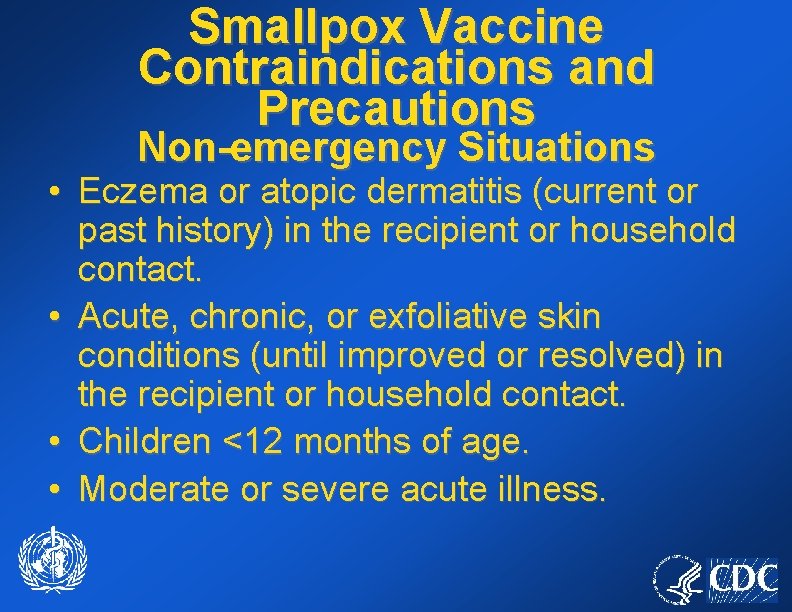
Smallpox Vaccine Contraindications and Precautions Non-emergency Situations • Eczema or atopic dermatitis (current or past history) in the recipient or household contact. • Acute, chronic, or exfoliative skin conditions (until improved or resolved) in the recipient or household contact. • Children <12 months of age. • Moderate or severe acute illness.
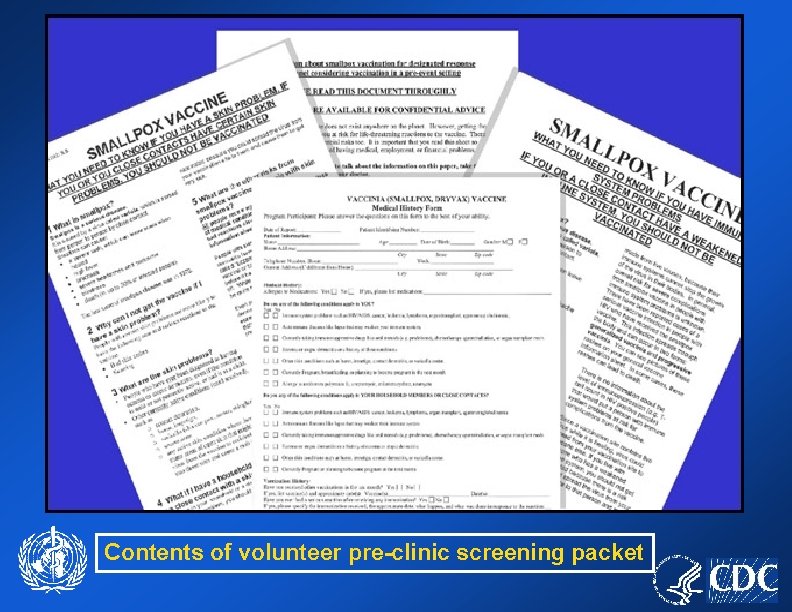
Contents of volunteer pre-clinic screening packet
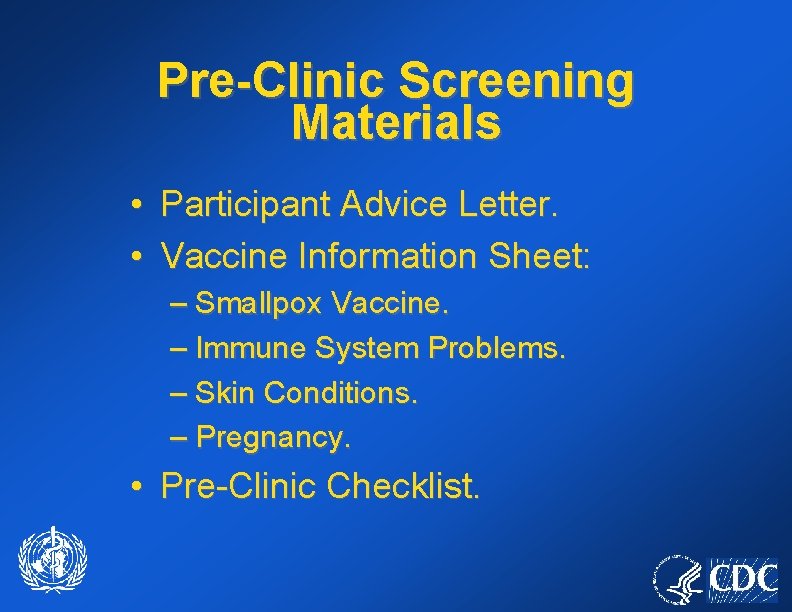
Pre-Clinic Screening Materials • • Participant Advice Letter. Vaccine Information Sheet: – Smallpox Vaccine. – Immune System Problems. – Skin Conditions. – Pregnancy. • Pre-Clinic Checklist.
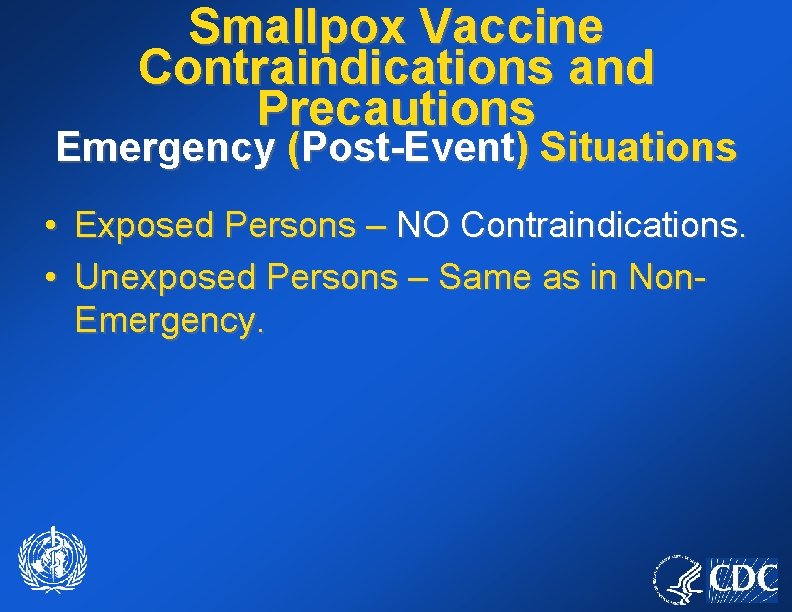
Smallpox Vaccine Contraindications and Precautions Emergency (Post-Event) Situations • Exposed Persons – NO Contraindications. • Unexposed Persons – Same as in Non. Emergency.
World Health Organization Issues
Watch Vaccine Administration Video
Vaccine Administration Technique Review
Smallpox Vaccine Reconstitution • Diluent and instructions for reconstitution will be supplied with vaccine. • Vaccine may be used for 30 days following reconstitution.
Smallpox Vaccine Administration • Use of gloves is recommended. • Persons administering smallpox vaccine should be vaccinated. • Healthcare workers with a contraindication to vaccination should not handle or administer the vaccine.
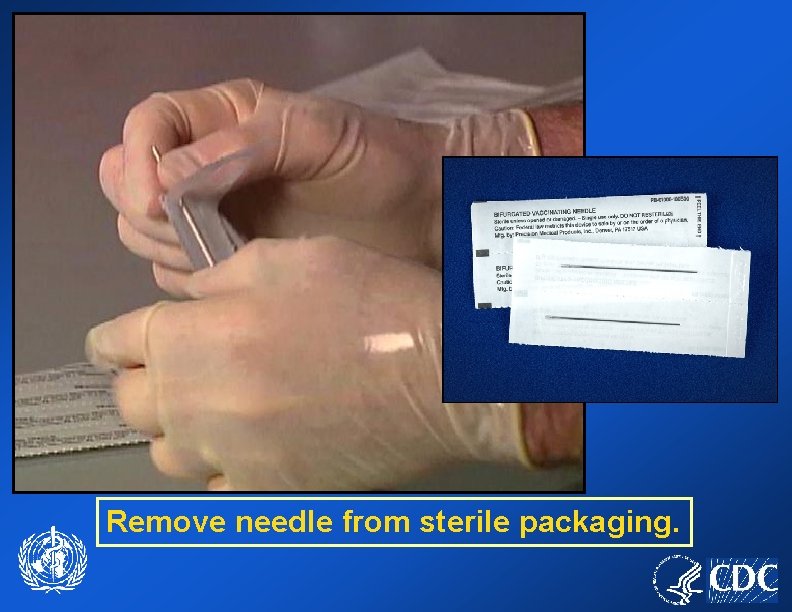
Bifurcated needle
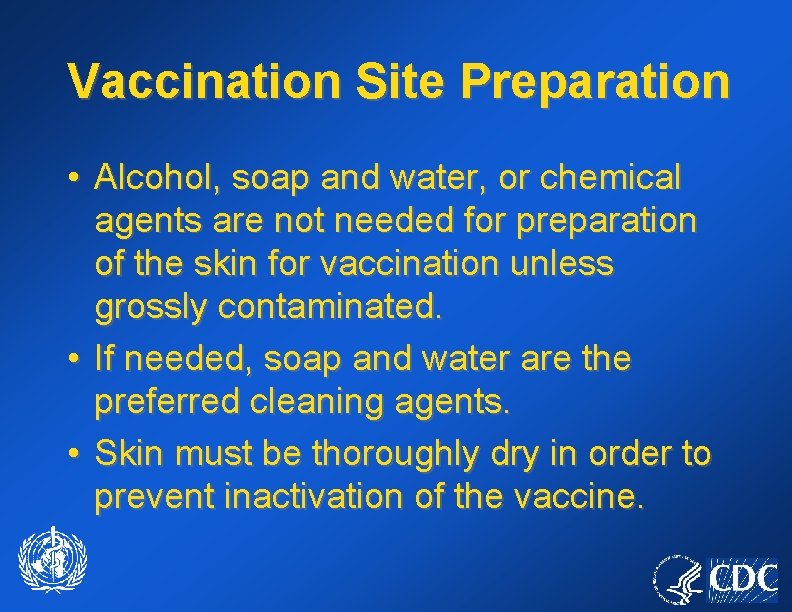
Vaccination Site Preparation • Alcohol, soap and water, or chemical agents are not needed for preparation of the skin for vaccination unless grossly contaminated. • If needed, soap and water are the preferred cleaning agents. • Skin must be thoroughly dry in order to prevent inactivation of the vaccine.
Remove needle from sterile packaging.
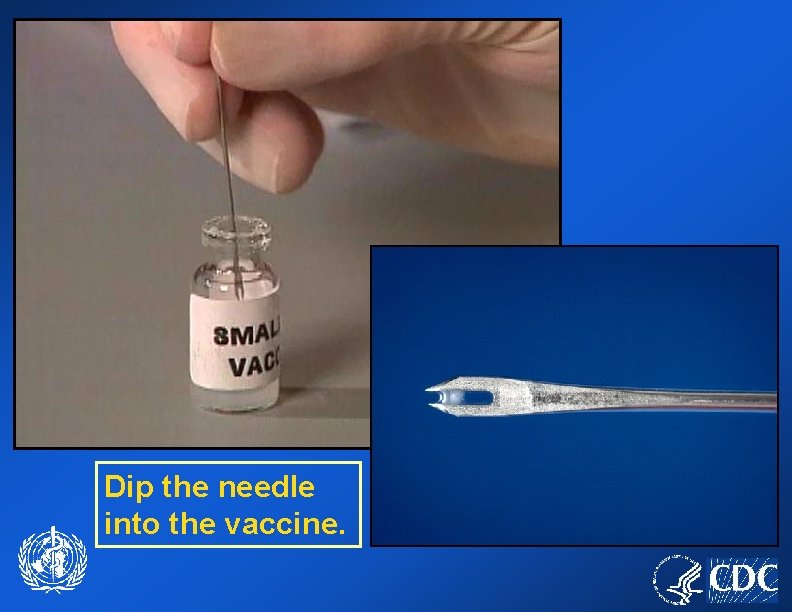
Dip the needle into the vaccine.
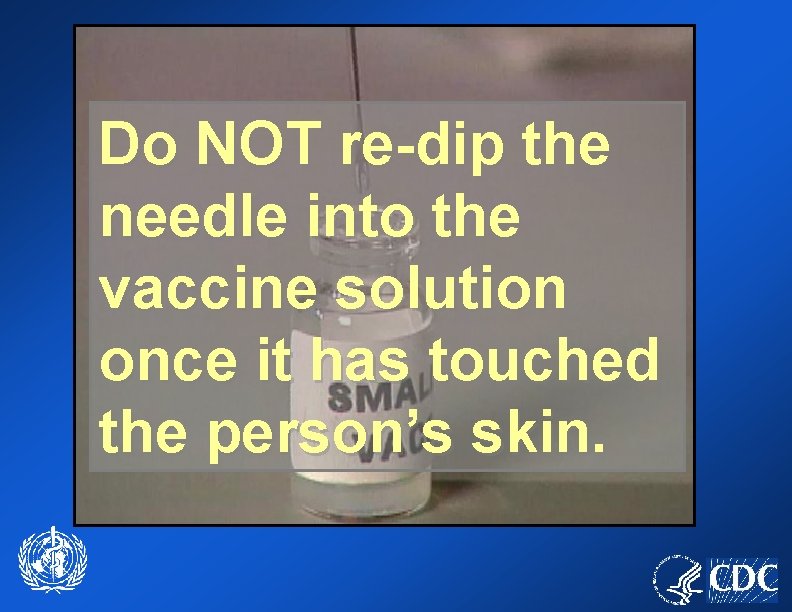
Do NOT re-dip the needle into the vaccine solution once it has touched the person’s skin.
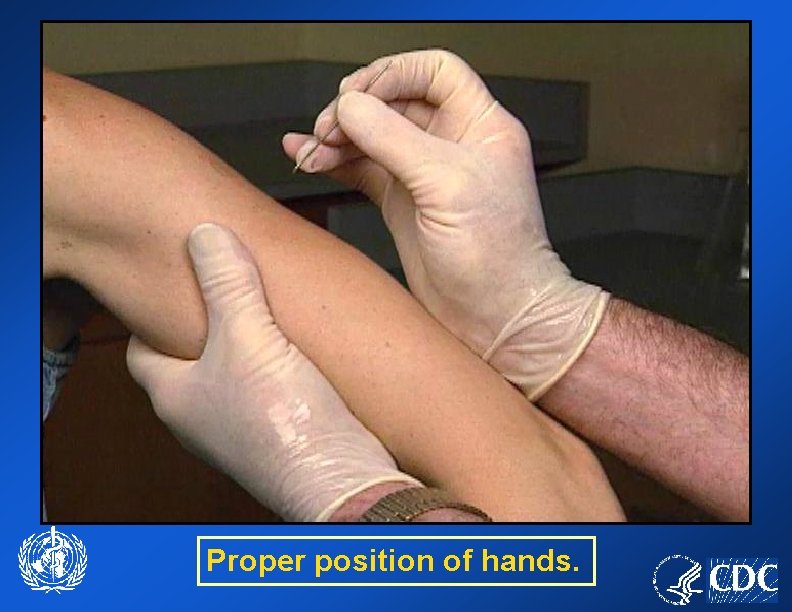
Proper position of hands.
Smallpox Vaccine Administration • Prior to administration of smallpox vaccine, please refer to the package insert for number of bifurcated needle punctures to administer.
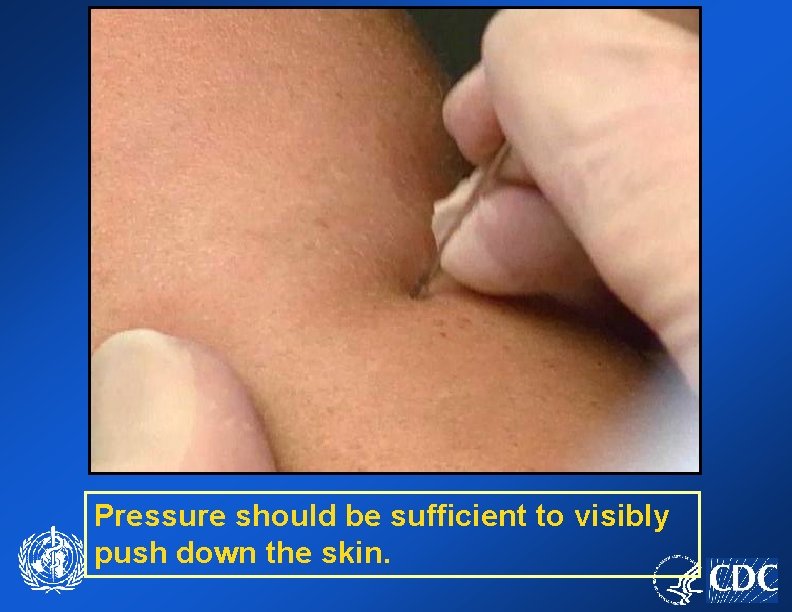
Smallpox Vaccine Administration • • Apply strokes perpendicular to the skin. Prick the skin in about 3 seconds within an area of 5 millimeters. • Apply sufficient pressure to visibly push down the skin.
Pressure should be sufficient to visibly push down the skin.
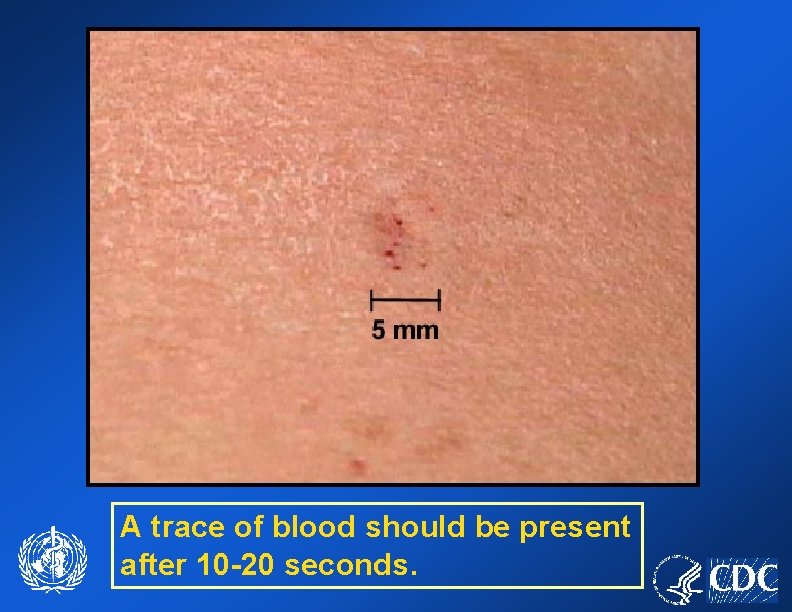
A trace of blood should be present after 10 -20 seconds.
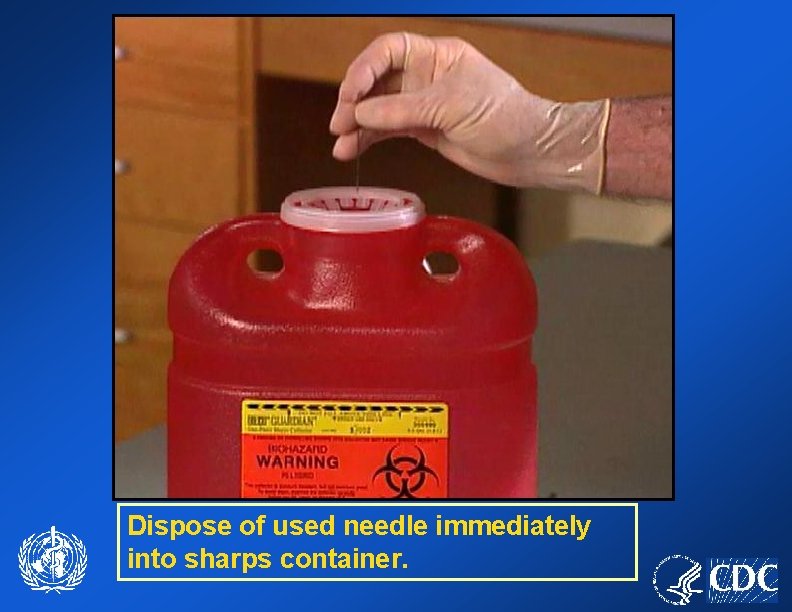
Dispose of used needle immediately into sharps container.
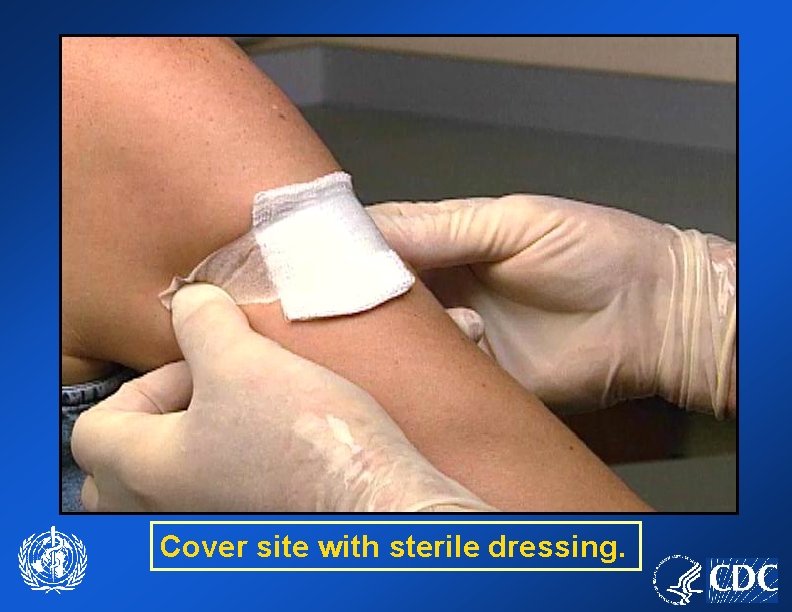
Cover site with sterile dressing.
Smallpox Vaccine Administration • Vaccinia virus may be cultured from the site of a primary vaccination from 2 -3 days after vaccination until the scab separates. • Care must be taken to prevent spread of the virus to other parts of the body or other persons. • Hands must be washed after every contact with the vaccination site or any materials (clothing, dressing, etc. ) that has come into contact with the vaccination site.
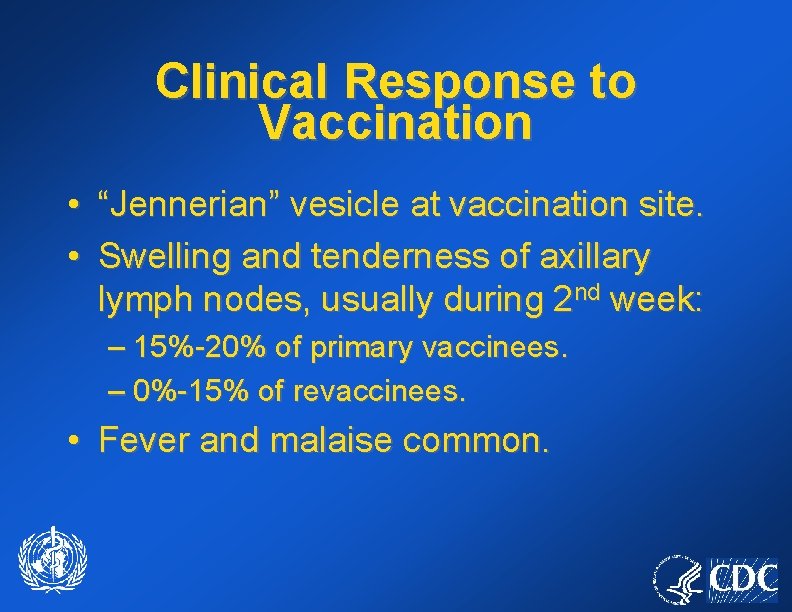
Clinical Response to Vaccination • • “Jennerian” vesicle at vaccination site. Swelling and tenderness of axillary lymph nodes, usually during 2 nd week: – 15%-20% of primary vaccinees. – 0%-15% of revaccinees. • Fever and malaise common.
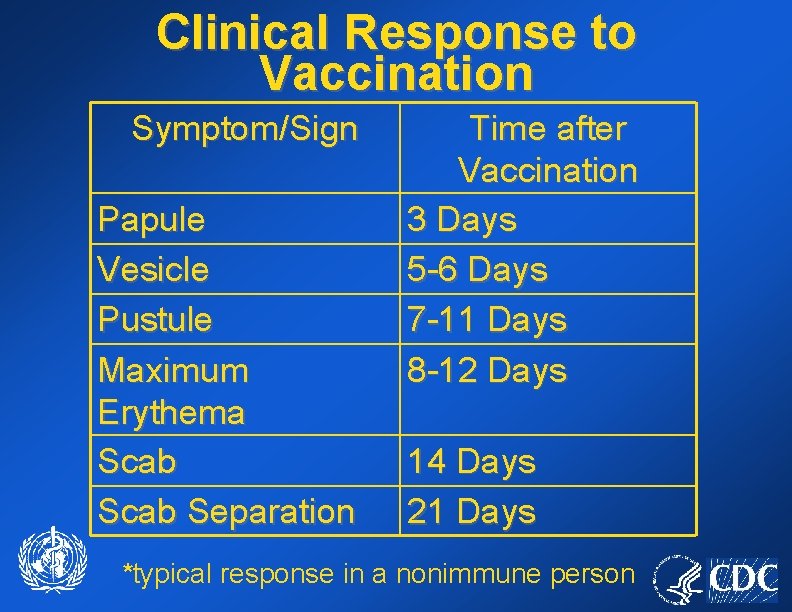
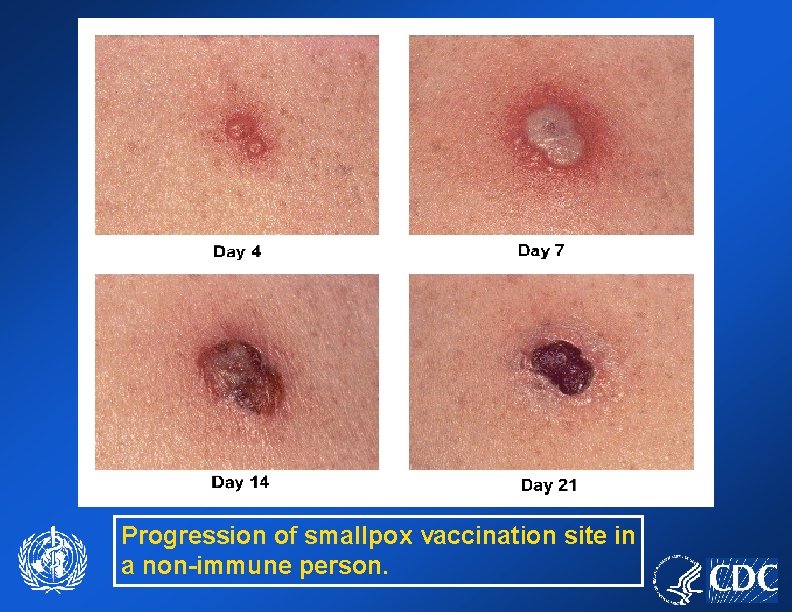
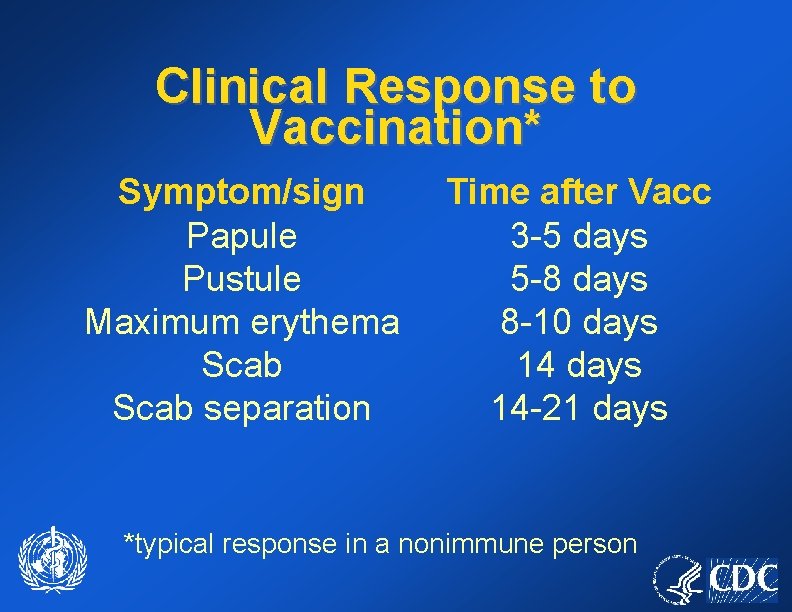
Clinical Response to Vaccination Symptom/Sign Papule Vesicle Pustule Maximum Erythema Scab Separation Time after Vaccination 3 Days 5 -6 Days 7 -11 Days 8 -12 Days 14 Days 21 Days *typical response in a nonimmune person
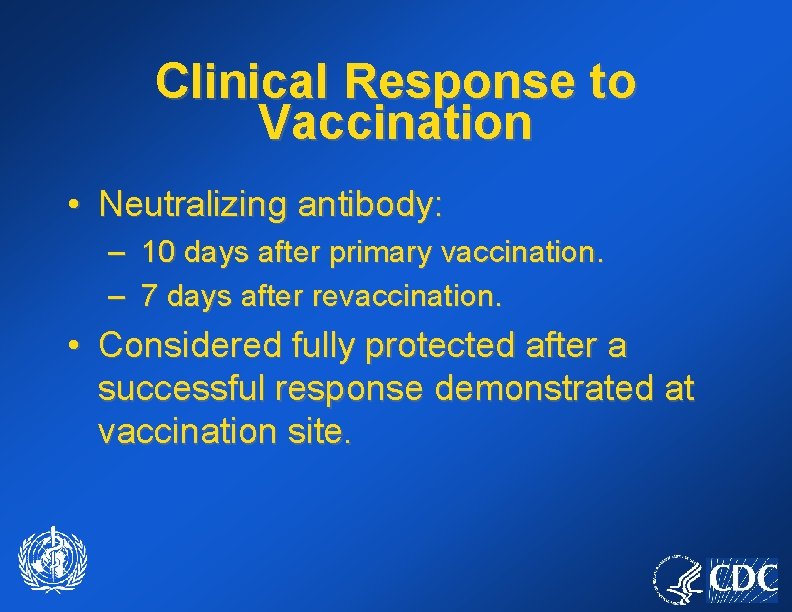
Clinical Response to Vaccination • Neutralizing antibody: – 10 days after primary vaccination. – 7 days after revaccination. • Considered fully protected after a successful response demonstrated at vaccination site.
Clinical Response to Vaccination • Major (primary) reaction: – Indicates viral replication has occurred and vaccination was successful. • Equivocal reaction: – Indicates immune suppression of viral replication or allergic reaction without production of immunity. – Poor vaccination technique. – Inactive vaccine.
Major Reaction 6 -8 Days After Vaccination • Primary vaccination: – Vesicular or pustular lesion. – Area of definite palpable induration surrounding a central crust or ulcer. • Revaccination: – Less pronounced and more rapid progression. – Pustular lesion or induration surrounding a central crust or ulcer.
Equivocal Reaction • All responses* other than major reactions. • Caused by immunity, insufficiently potent vaccine, vaccination technique failure. • Vaccination should be repeated with another vial, if possible. *Includes accelerated, modified, vaccinoid, immediate, early, or immune reactions.
Vaccine Efficacy • Clinical efficacy estimated in household contact studies. • 91%-97% reduction in cases among contacts with vaccination scar. • Studies did not consider time since vaccination or potency of vaccine.
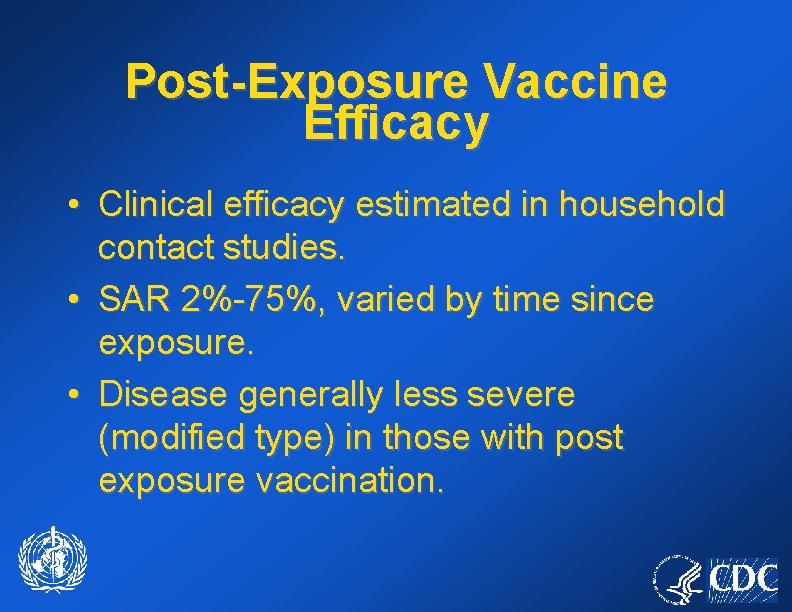
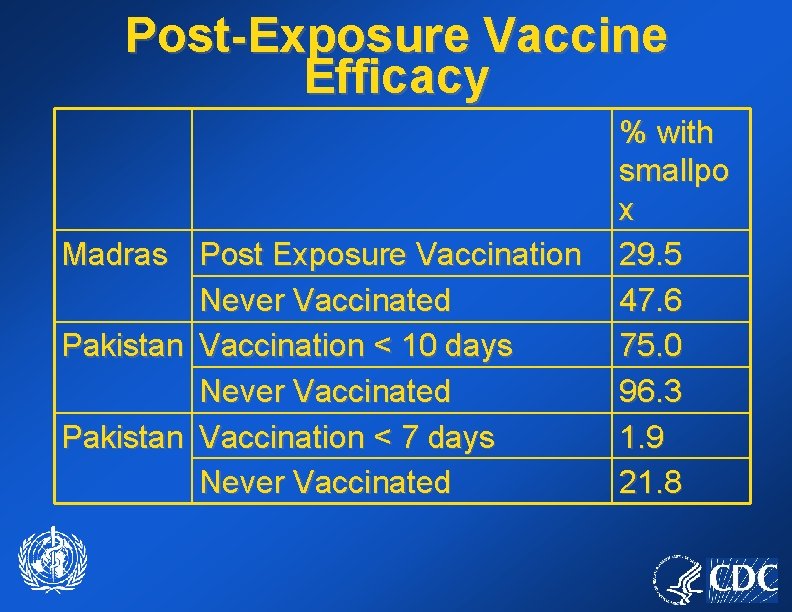
Post-Exposure Vaccine Efficacy • Clinical efficacy estimated in household contact studies. • SAR 2%-75%, varied by time since exposure. • Disease generally less severe (modified type) in those with post exposure vaccination.
Post-Exposure Vaccine Efficacy Madras Post Exposure Vaccination Never Vaccinated Pakistan Vaccination < 10 days Never Vaccinated Pakistan Vaccination < 7 days Never Vaccinated % with smallpo x 29. 5 47. 6 75. 0 96. 3 1. 9 21. 8
Adverse Events following Smallpox Vaccination
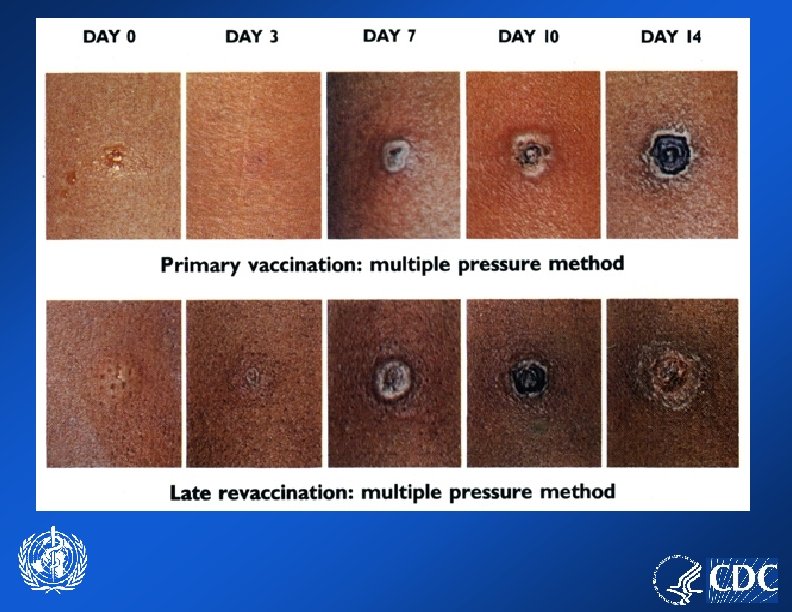
Progression of smallpox vaccination site in a non-immune person.
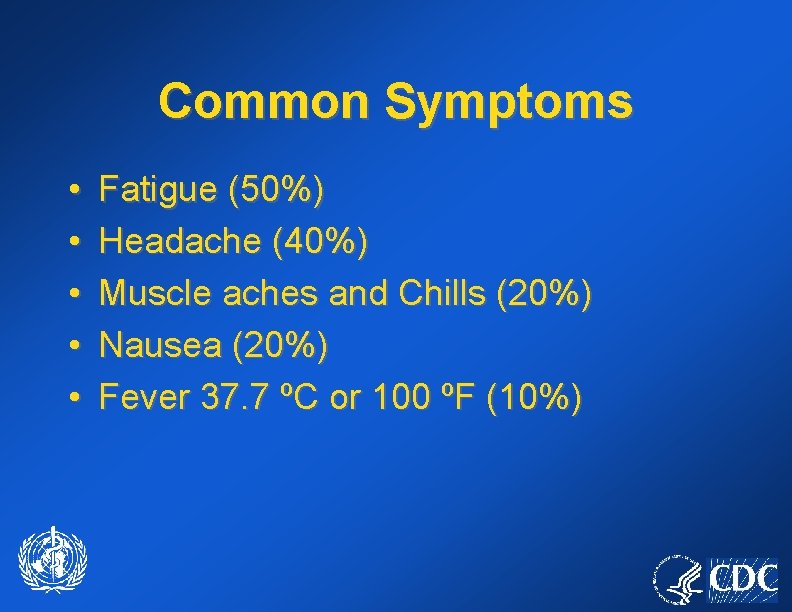
Common Symptoms • • • Fatigue (50%) Headache (40%) Muscle aches and Chills (20%) Nausea (20%) Fever 37. 7 ºC or 100 ºF (10%)
Clinical Response to Vaccination* Symptom/sign Papule Pustule Maximum erythema Scab separation Time after Vacc 3 -5 days 5 -8 days 8 -10 days 14 -21 days *typical response in a nonimmune person
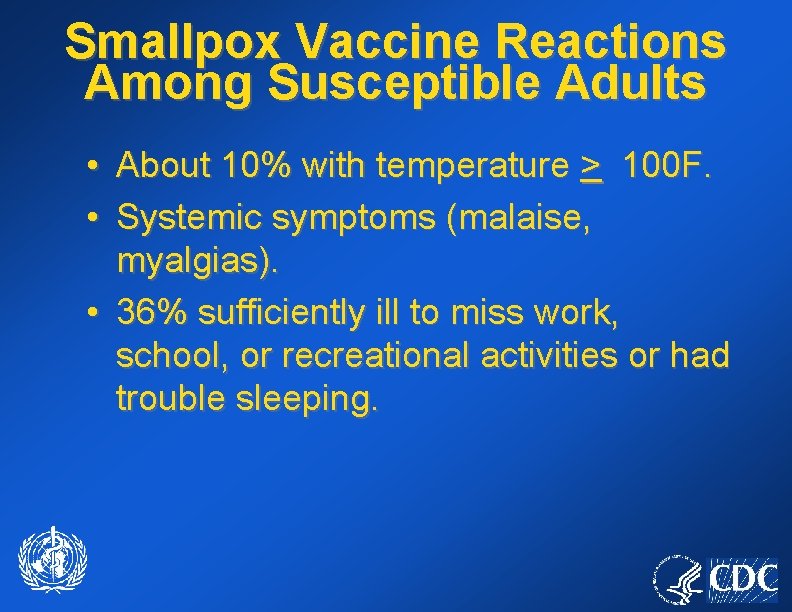
Smallpox Vaccine Reactions Among Susceptible Adults • About 10% with temperature > 100 F. • Systemic symptoms (malaise, myalgias). • 36% sufficiently ill to miss work, school, or recreational activities or had trouble sleeping.
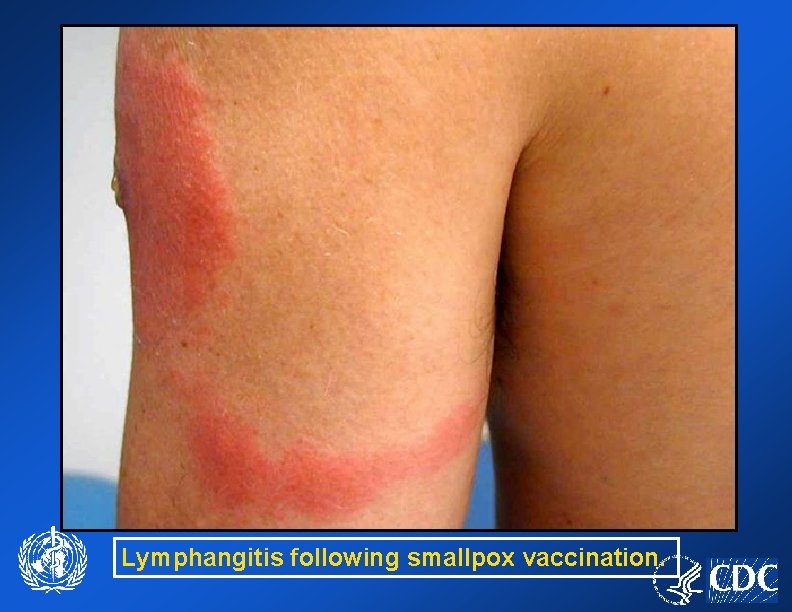
Lymphangitis following smallpox vaccination.
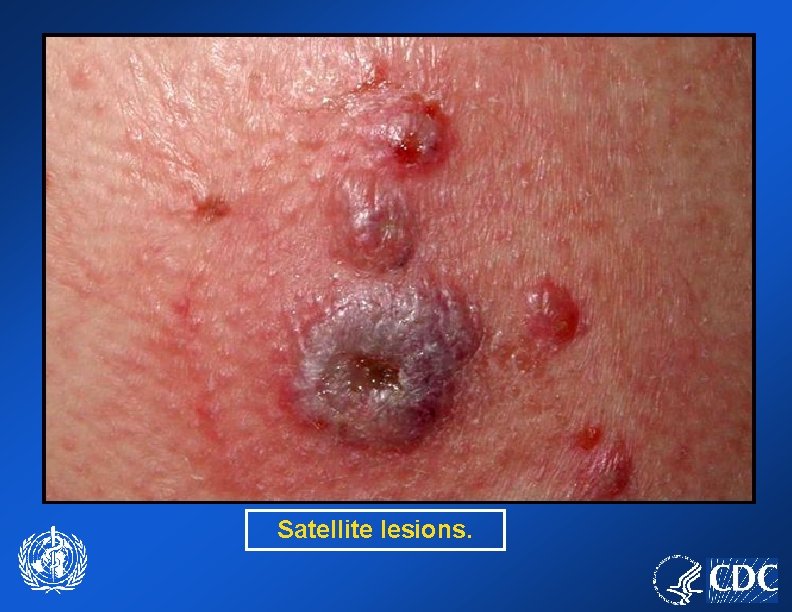
Satellite lesions.
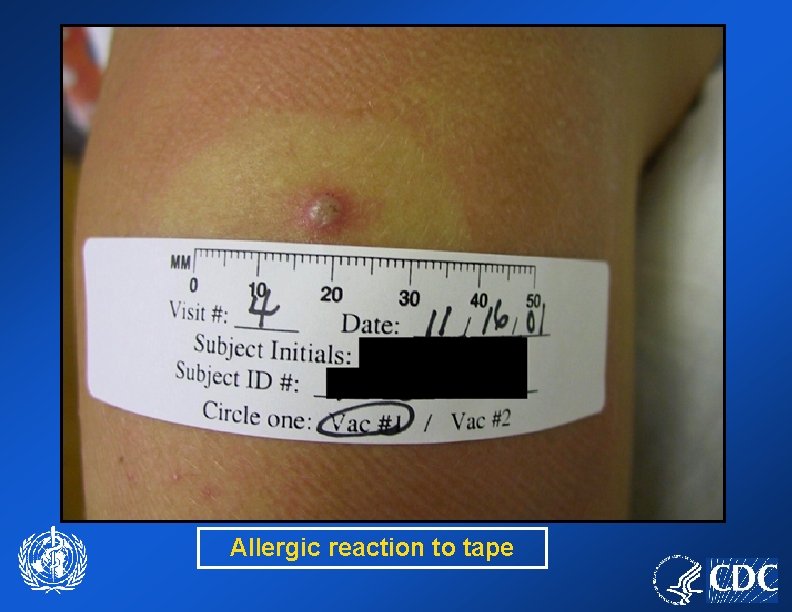
Allergic reaction to tape
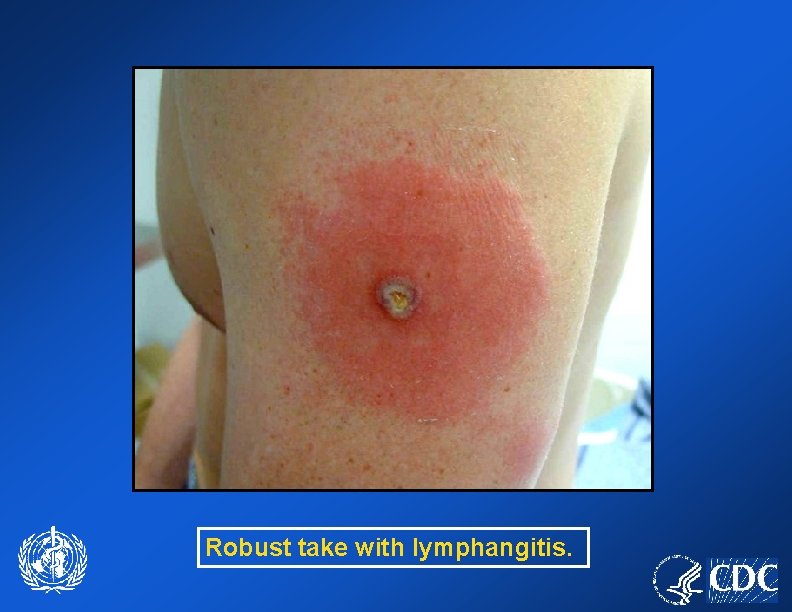
Robust take with lymphangitis.
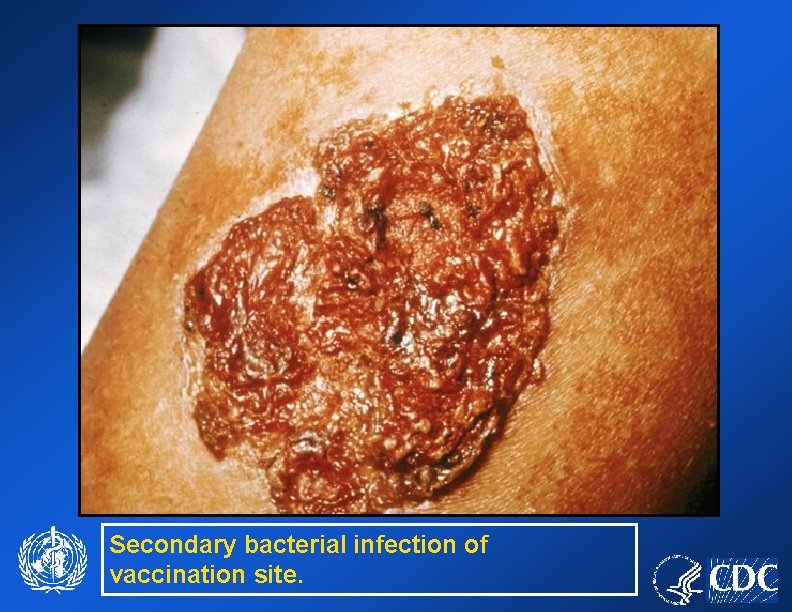
Secondary bacterial infection of vaccination site.
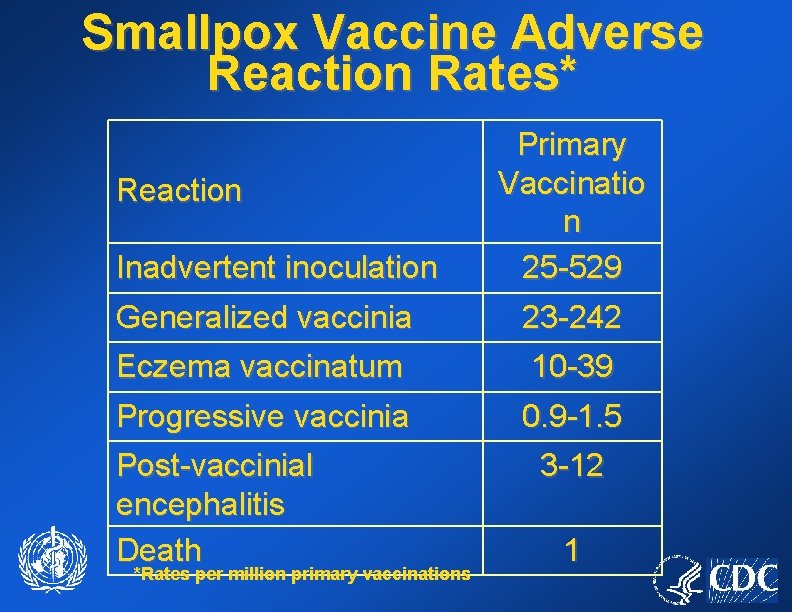
Smallpox Vaccine Adverse Reaction Rates* Reaction Inadvertent inoculation Primary Vaccinatio n 25 -529 Generalized vaccinia 23 -242 Eczema vaccinatum 10 -39 Progressive vaccinia 0. 9 -1. 5 Post-vaccinial encephalitis Death *Rates per million primary vaccinations 3 -12 1
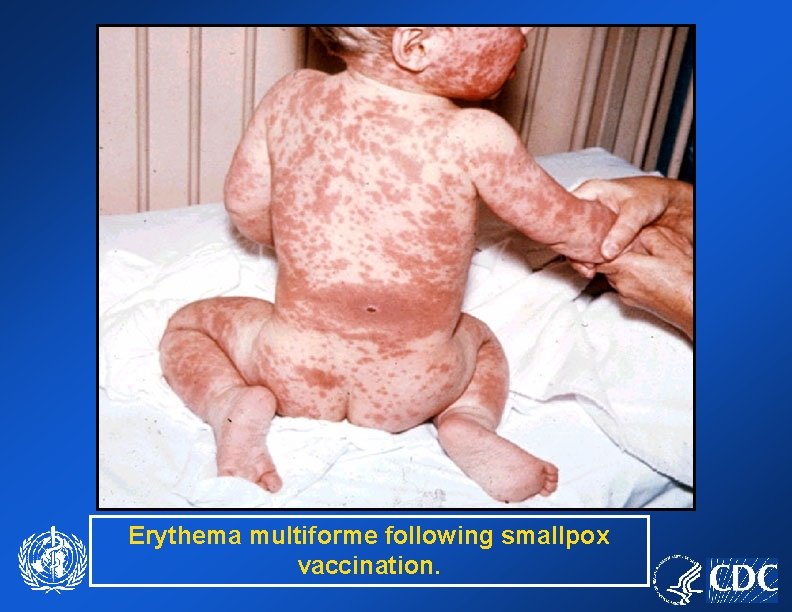
Erythema multiforme following smallpox vaccination.
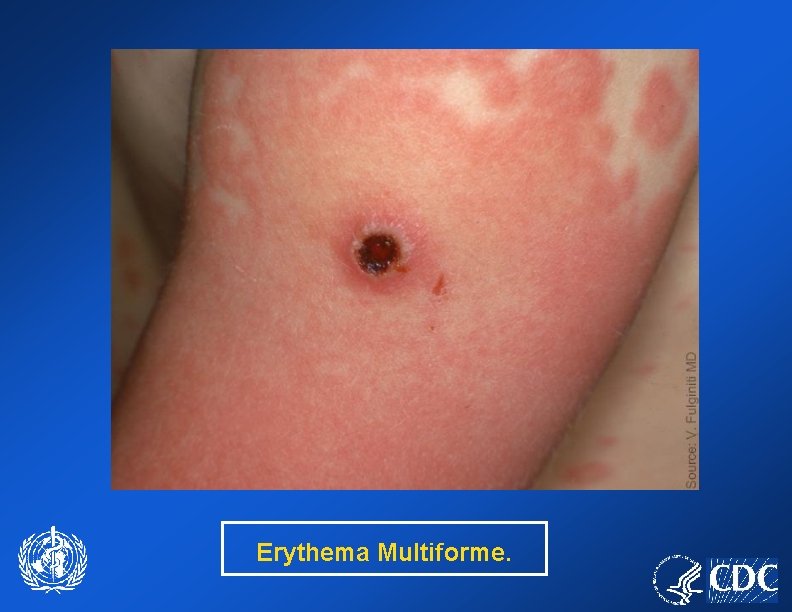
Erythema Multiforme.
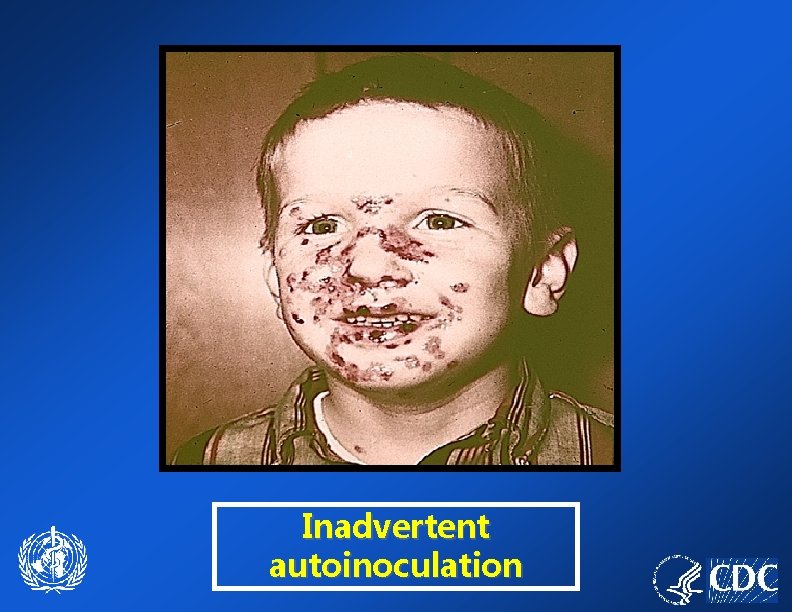
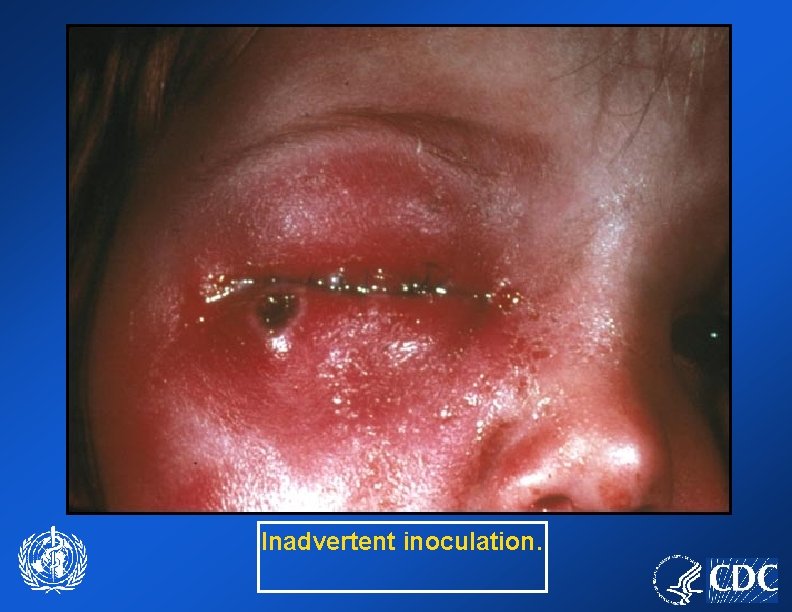
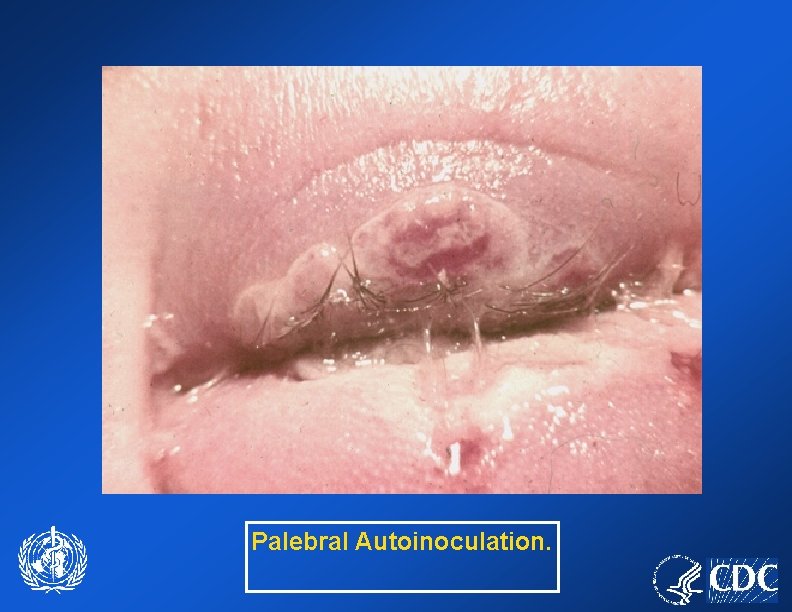
Inadvertent Autoinoculation • Transfer of vaccinia virus to sites other than the intended vaccination site • Commonly on mucocutaneous borders (eye, mouth, rectum) • Lesions heal spontaneously without specific treatment • Highest risk in children 1 -4 years • Vaccinia Immune Globulin (VIG) may be useful
Inadvertent autoinoculation
Inadvertent inoculation.
Palebral Autoinoculation.
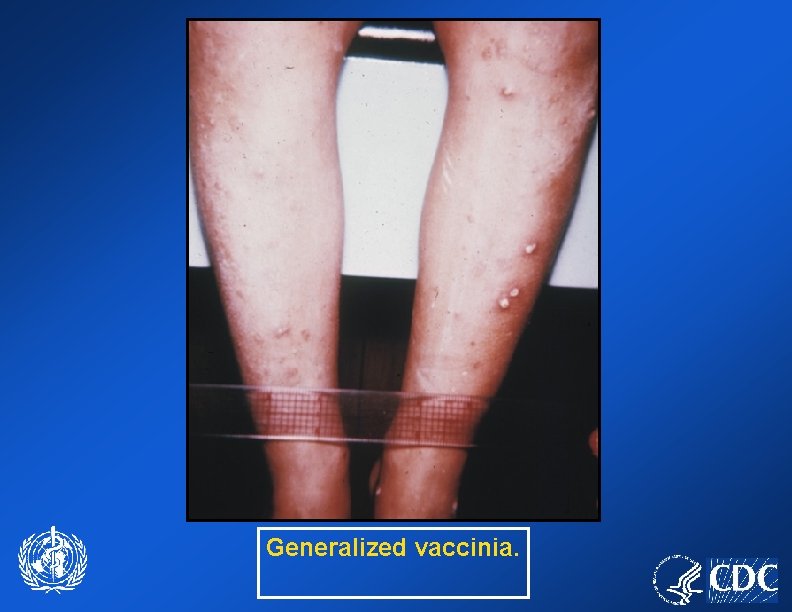
Generalized Vaccinia • Generalized vesicular skin lesions occurring in the absence of eczema or other preexisting skin diseases • Believed to result from a viremia with implantations in the skin • Fever and systemic signs vary widely but are generally mild • VIG may attenuate severity if given early in course of illness
Generalized vaccinia.
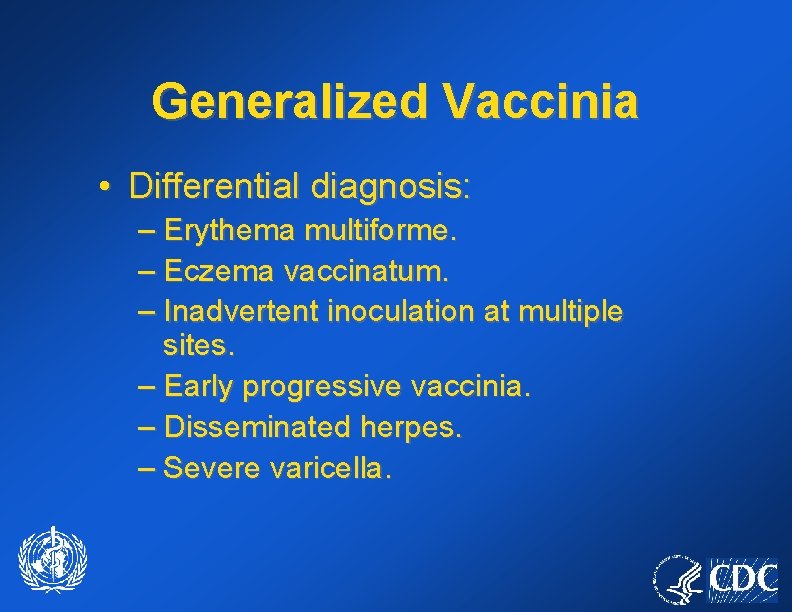
Generalized Vaccinia • Differential diagnosis: – Erythema multiforme. – Eczema vaccinatum. – Inadvertent inoculation at multiple sites. – Early progressive vaccinia. – Disseminated herpes. – Severe varicella.
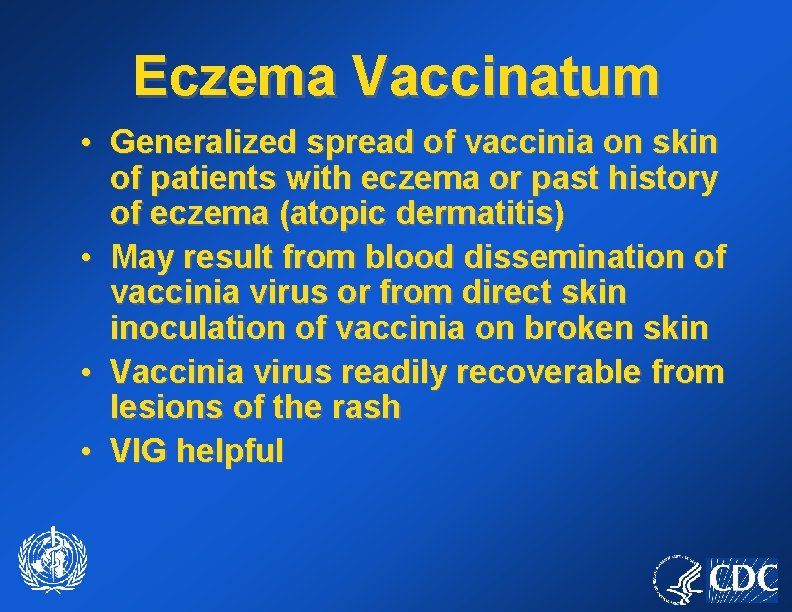
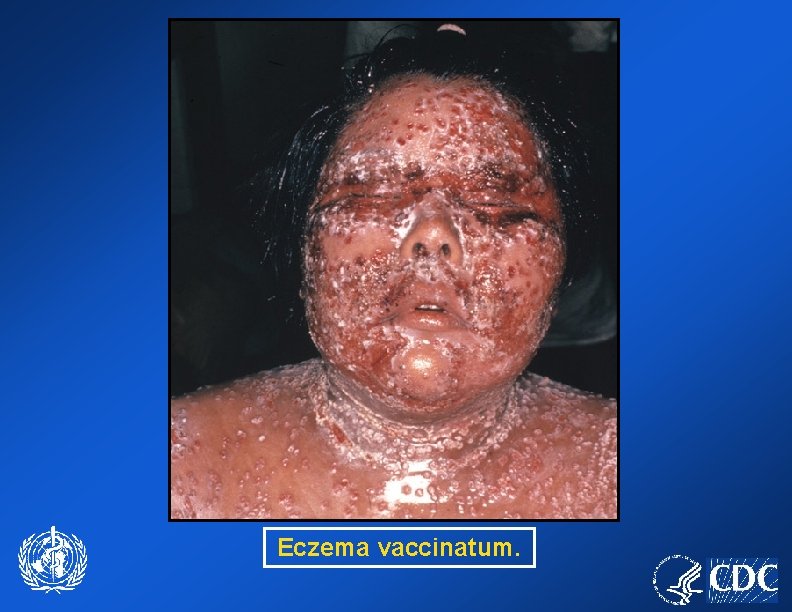
Eczema Vaccinatum • Generalized spread of vaccinia on skin of patients with eczema or past history of eczema (atopic dermatitis) • May result from blood dissemination of vaccinia virus or from direct skin inoculation of vaccinia on broken skin • Vaccinia virus readily recoverable from lesions of the rash • VIG helpful
Eczema vaccinatum.
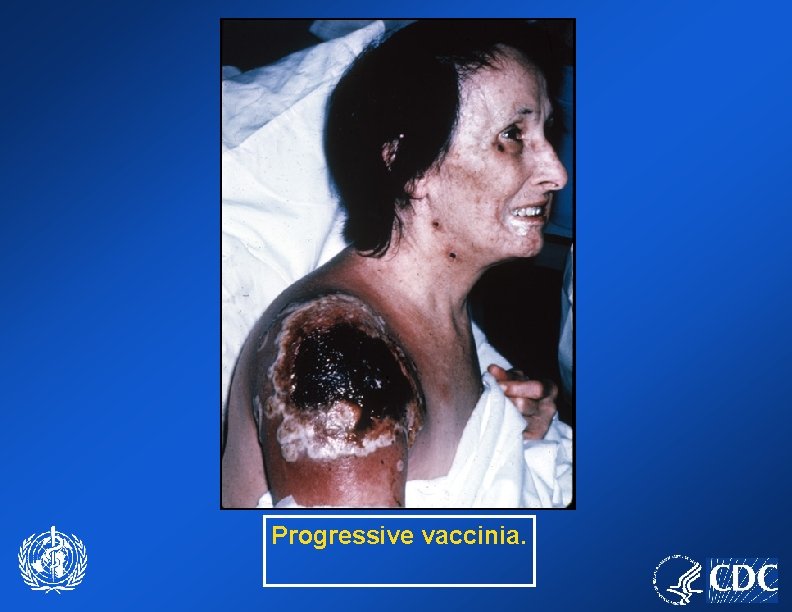
Progressive Vaccinia • Also known as vaccinia necrosum and vaccinia gangrenosa • Occurs only in patients with impaired immunologic function • Characterized by spreading necrosis at site of vaccination, with or without metastatic necrotic lesions elsewhere on the body • Painless, progressive, +/- systemic illness • VIG is used to treat
Progressive vaccinia.
Post-vaccinial Encephalitis • • Diagnosis of exclusion. Other infectious or toxic causes of encephalitis should be ruled out. • Pathophysiology not well understood. • CSF may have increased opening pressure, lymphocytosis, elevated protein.
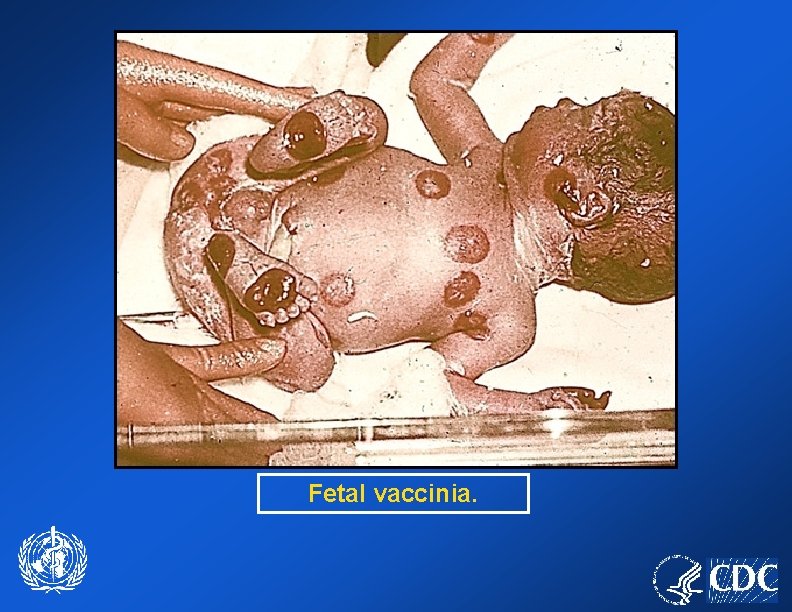
Fetal Vaccinia • 47 fetal vaccinia cases reported in world literature (as of 1970) • Most result from primary vaccination of mother early in pregnancy • May results in stillbirth or death of infant soon after delivery • VIG may benefit live born infant
Fetal vaccinia.
Vaccinia Immune Globulin • Antibodies limit viral replication • Cangene® intravenous – First-line therapy – Under IND – Available only through CDC • Administer as soon as possible after onset – Inadvertent inoculation (severe, or underlying illness) – Generalized vaccinia (severe, or underlying illness) – Eczema vaccinatum – Progressive vaccinia – Consider for severe ocular complications
Vistide®, cidofovir • Antiviral therapy • FDA approved for CMV retinitis in AIDS patients • Second-line treatment – Not tested in humans against vaccinia – Nephrotoxic (probenecid, hydration) – Carcinogenic • Investigational New Drug (IND)
Certain images supplied by: Dr. John Leedom Dr. J. Michael Lane Dr. Vincent Fulginiti World Health Organization University of Rochester National Institutes of Health Logical Images, Inc.