
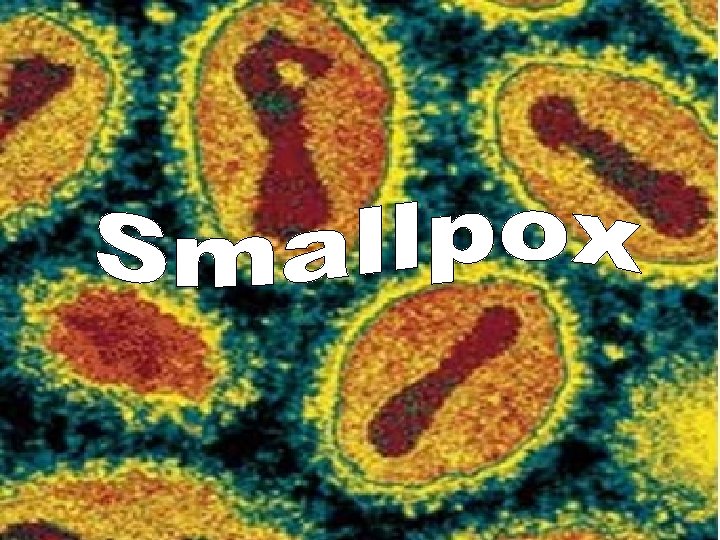
Smallpox is a serious contagious and sometimes fatal
- Slides: 11
• Smallpox is a serious, contagious and sometimes fatal infectious disease. • Caused by the variola virus that emerged in humans thousands of years ago. • 2 clinical forms: – Variola major • Severe and most common form of smallpox. – Variola minor • Less common presentation of the disease and much less severe
• Except for in laboratories, smallpox has been eliminated. • However there is concern that the variola virus may be used as a bioterrorism agent.
• Direct and prolonged face-to-face contact is generally necessary to spread smallpox. • However, it can also be spread through direct contact with infected bodily fluids or contaminated objects (like clothing or towels). • Rarely is the smallpox virus spread through the air. – However it has happened when the disease has been released in enclosed spaces such as buildings or trains. – The disease is killed by the sun and heat.
• Humans are the only natural hosts of variola and the disease is not known to be spread by insects or animals.
• After exposure, the infected person feels fine and is not contagious. • After 7 -17 days, symptoms begin with a high fever (101°-104°), head and body aches, and sometimes vomiting. • A rash follows that starts on the tongue and mouth and spreads to the skin. The rash usually covers the body within 24 hours.
• The rash progresses to raised bumps and then round, firm pus-filled blisters that crust, scab, and fall off after about 3 weeks, leaving a pitted scar.
• There is no proven treatment for smallpox. • Scientists are currently researching new treatments. • One of the best ways to prevent smallpox is through vaccination. When given before exposure, the vaccine can completely prevent the contraction of smallpox. • Once a patient has a rash, the vaccine will not offer any protection. • The vaccine is not currently available to the public, however in the event of a smallpox emergency there is enough stock to vaccinate every citizen in the U. S.
• The majority of patients with smallpox recover. • Regarding variola major, death occurs in 30% of cases. • Regarding variola minor, death occurs in less than 1% of cases. • Many survivors have permanent scars over large areas of their body, especially on their face. • Some survivors are left blind.
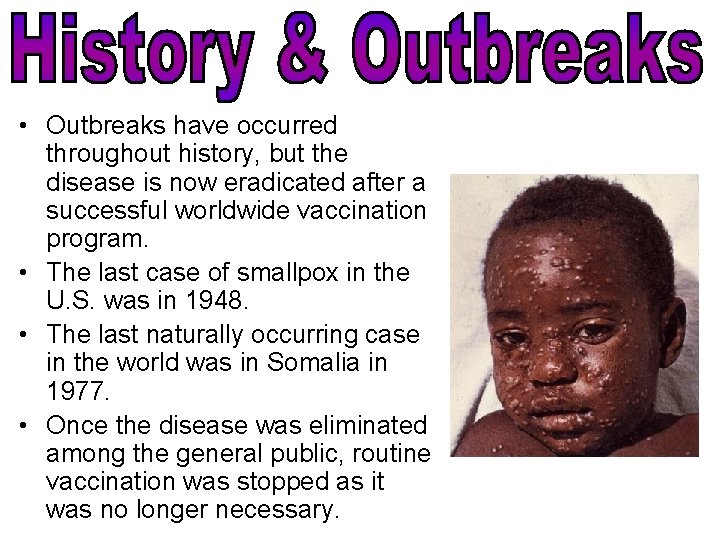
• Outbreaks have occurred throughout history, but the disease is now eradicated after a successful worldwide vaccination program. • The last case of smallpox in the U. S. was in 1948. • The last naturally occurring case in the world was in Somalia in 1977. • Once the disease was eliminated among the general public, routine vaccination was stopped as it was no longer necessary.
• Centers for Disease Control and Prevention Home Page – http: //www. cdc. gov/ • National Institute of Allergy and Infectious Diseases – http: //www. niaid. nih. gov/ • World Health Organization WWW Home Page – http: //www. who. ch/