
Smallo notation Smallomega Notation SmallLittle o notation Little
- Slides: 10
Small-o notation Small-omega Notation
Small/Little o notation �Little o notation is used to describe an upper bound that cannot be tight. In other words, loose upper bound of f(n). Let f(n) and g(n) are the functions that map positive real number �Big-O means “is of the same order as”. The corresponding little-o means “is ultimately smaller than”: f (n) = o(1) means that f (n)/c ! 0 for any constant c. Re- cursively, g(n) = o(f (n)) means g(n)/f (n) = o(1), or g(n)/f (n)
Big O notation �Big O notation is a mathematical notation that describes the limiting behavior of a function when the argument tends towards a particular value or infinity. �The letter O is used because the growth rate of a function is also referred to as the order of the function. A description of a function in terms of big O notation usually only provides an upper bound on the growth rate of the function. �Associated with big O notation are several related notations, using the symbols o, Ω, ω, and Θ, to describe other kinds of bounds on asymptotic growth rates.
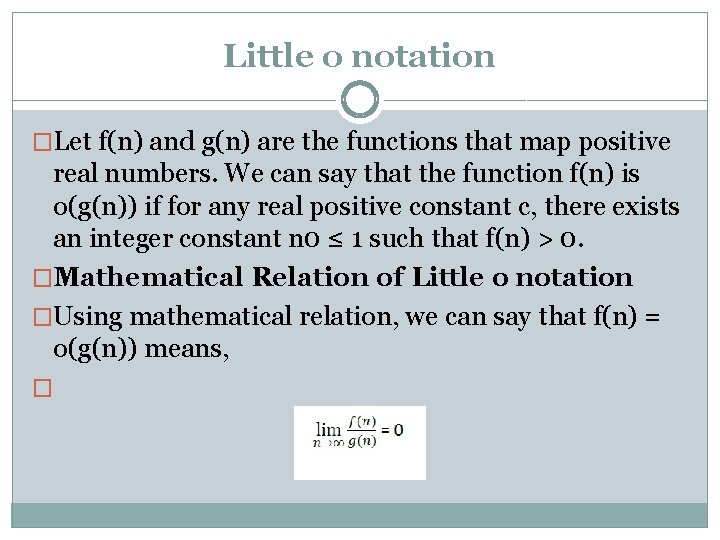
Little o notation �Let f(n) and g(n) are the functions that map positive real numbers. We can say that the function f(n) is o(g(n)) if for any real positive constant c, there exists an integer constant n 0 ≤ 1 such that f(n) > 0. �Mathematical Relation of Little o notation �Using mathematical relation, we can say that f(n) = o(g(n)) means, �
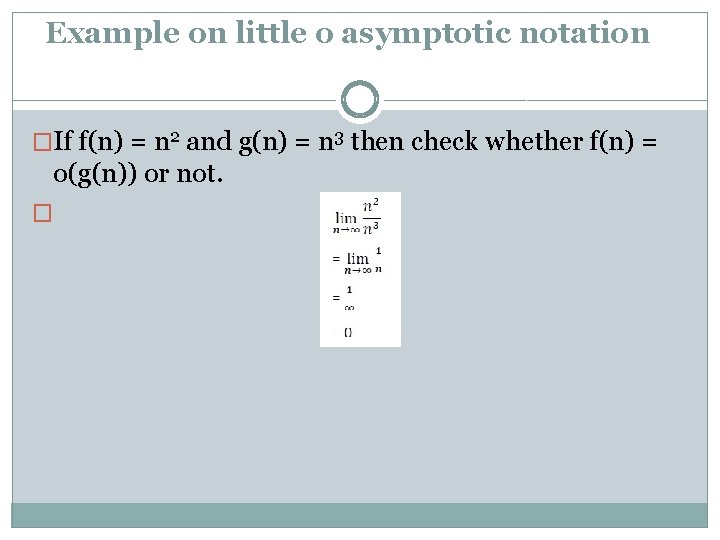
Example on little o asymptotic notation �If f(n) = n 2 and g(n) = n 3 then check whether f(n) = o(g(n)) or not. �
Small-omega Notation �Small-omega, commonly written as ω, is an Asymptotic Notation to denote the lower bound (that is not asymptotically tight) on the growth rate of runtime of an algorithm. f(n) is ω(g(n)), if for all real constants c (c > 0) and n 0 (n 0 > 0), f(n) is > c g(n) for every input size n (n > n 0).
Small-omega Notation �Definition : Let f(n) and g(n) be functions that map positive integers to positive real numbers. We say that f(n) is ω(g(n)) (or f(n) ∈ ω(g(n))) if for any real constant c > 0, there exists an integer constant n 0 ≥ 1 such that f(n) > c * g(n) ≥ 0 for every integer n ≥ n 0. �f(n) has a higher growth rate than g(n) so main difference between Big Omega (Ω) and little omega (ω) lies in their definitions. In the case of Big Omega f(n)=Ω(g(n)) and the bound is 0<=cg(n)<=f(n), but in case of little omega, it is true for 0<=c*g(n)<f(n).
Relationship �The relationship between Big Omega (Ω) and Little Omega (ω) is similar to that of Big-Ο and Little o except that now we are looking at the lower bounds. Little Omega (ω) is a rough estimate of the order of the growth whereas Big Omega (Ω) may represent exact order of growth. We use ω notation to denote a lower bound that is not asymptotically tight. �And, f(n) ∈ ω(g(n)) if and only if g(n) ∈ ο((f(n)).
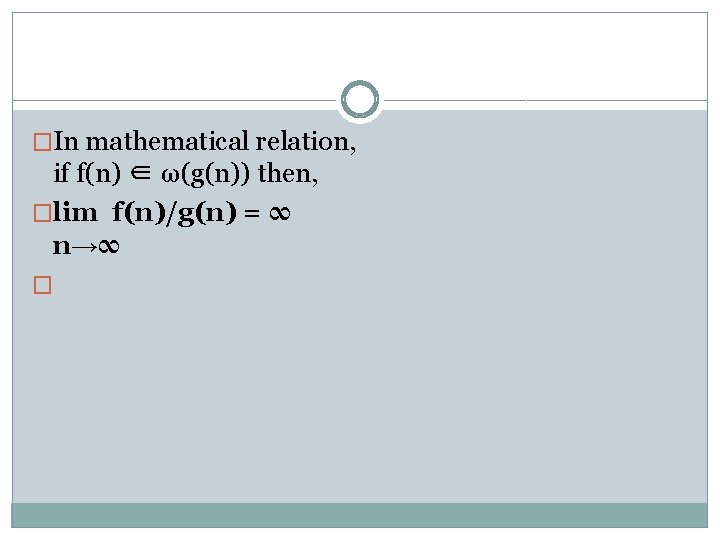
�In mathematical relation, if f(n) ∈ ω(g(n)) then, �lim f(n)/g(n) = ∞ n→∞ �
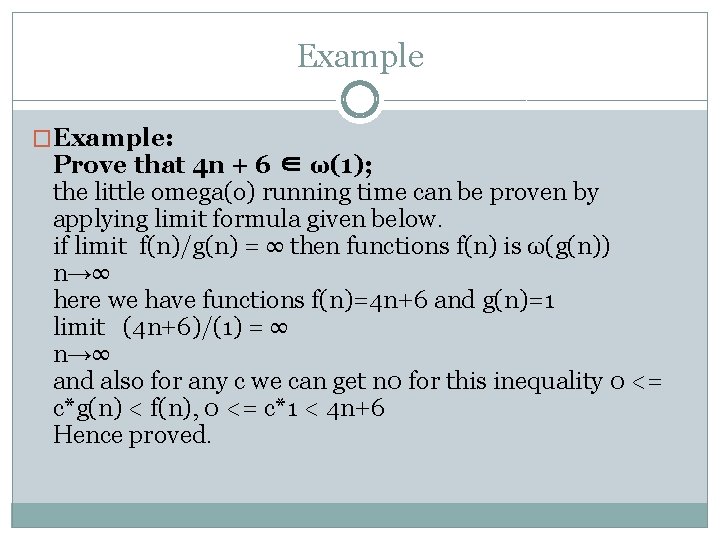
Example �Example: Prove that 4 n + 6 ∈ ω(1); the little omega(ο) running time can be proven by applying limit formula given below. if limit f(n)/g(n) = ∞ then functions f(n) is ω(g(n)) n→∞ here we have functions f(n)=4 n+6 and g(n)=1 limit (4 n+6)/(1) = ∞ n→∞ and also for any c we can get n 0 for this inequality 0 <= c*g(n) < f(n), 0 <= c*1 < 4 n+6 Hence proved.