
SmallAngle Neutron Scattering in Materials Science P Strunz
- Slides: 28
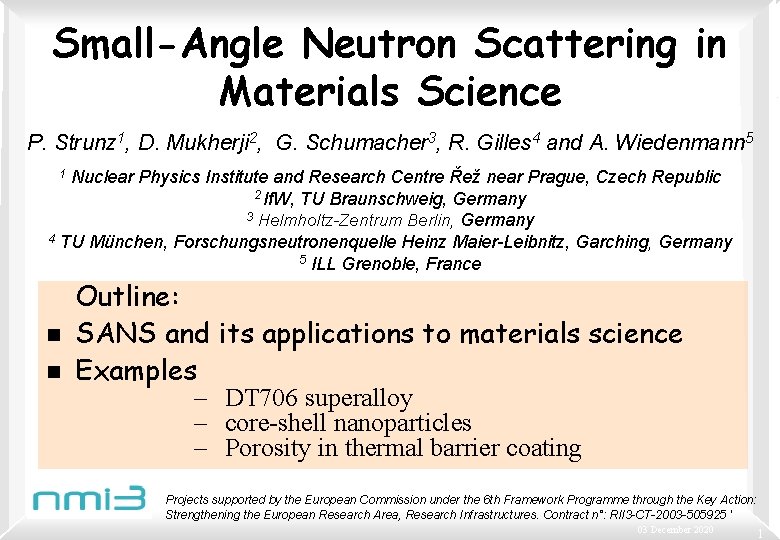
Small-Angle Neutron Scattering in Materials Science P. Strunz 1, D. Mukherji 2, G. Schumacher 3, R. Gilles 4 and A. Wiedenmann 5 Nuclear Physics Institute and Research Centre Řež near Prague, Czech Republic 2 If. W, TU Braunschweig, Germany 3 Helmholtz-Zentrum Berlin, Germany 4 TU München, Forschungsneutronenquelle Heinz Maier-Leibnitz, Garching, Germany 5 ILL Grenoble, France 1 n n Outline: SANS and its applications to materials science Examples – DT 706 superalloy – core-shell nanoparticles – Porosity in thermal barrier coating Projects supported by the European Commission under the 6 th Framework Programme through the Key Action: Strengthening the European Research Area, Research Infrastructures. Contract n°: RII 3 -CT-2003 -505925 ' 03 December 2020 1
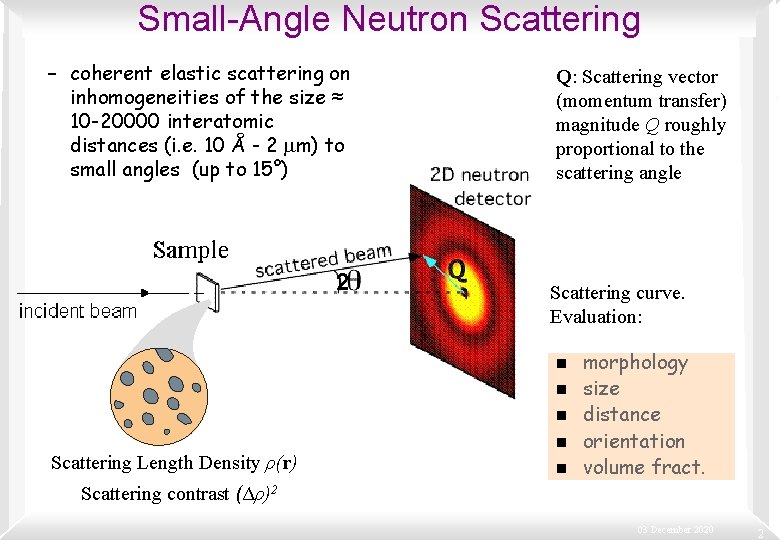
Small-Angle Neutron Scattering – coherent elastic scattering on inhomogeneities of the size ≈ 10 -20000 interatomic distances (i. e. 10 Å - 2 mm) to small angles (up to 15°) 2 Q: Scattering vector (momentum transfer) magnitude Q roughly proportional to the scattering angle Scattering curve. Evaluation: n n n Scattering Length Density ρ(r) n n morphology size distance orientation volume fract. Scattering contrast (Δρ)2 03 December 2020 2
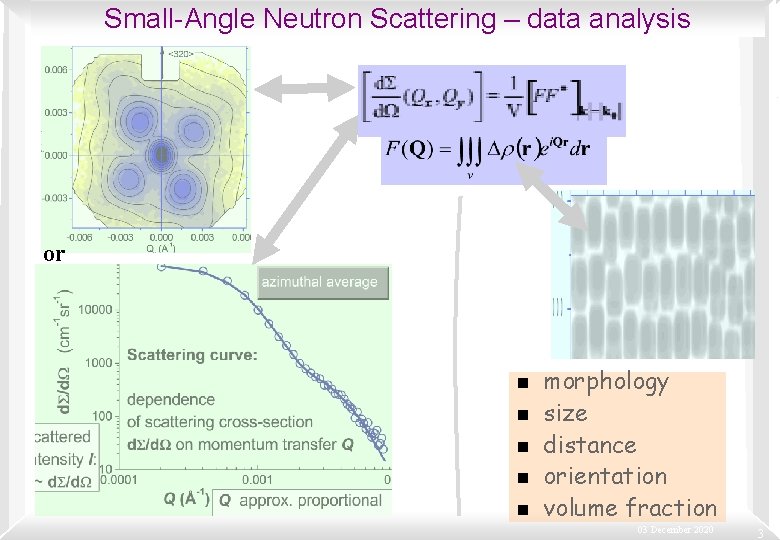
Small-Angle Neutron Scattering – data analysis or n n n morphology size distance orientation volume fraction 03 December 2020 3
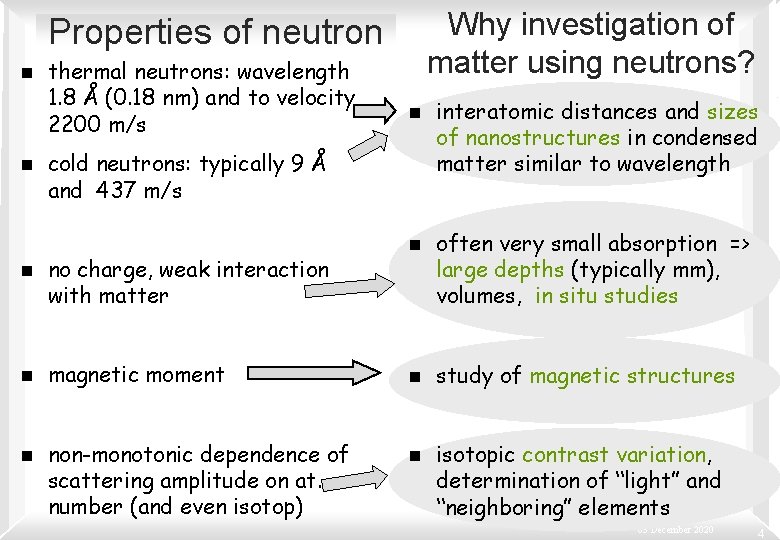
Why investigation of matter using neutrons? Properties of neutron n n thermal neutrons: wavelength 1. 8 Å (0. 18 nm) and to velocity 2200 m/s n cold neutrons: typically 9 Å and 437 m/s no charge, weak interaction with matter magnetic moment non-monotonic dependence of scattering amplitude on at. number (and even isotop) n n n interatomic distances and sizes of nanostructures in condensed matter similar to wavelength often very small absorption => large depths (typically mm), volumes, in situ studies study of magnetic structures isotopic contrast variation, determination of “light” and “neighboring” elements 03 December 2020 4
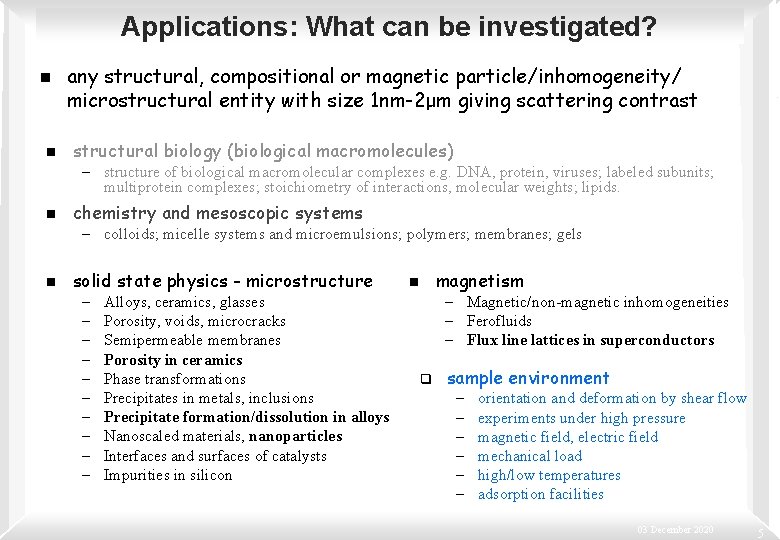
Applications: What can be investigated? n n any structural, compositional or magnetic particle/inhomogeneity/ microstructural entity with size 1 nm-2μm giving scattering contrast structural biology (biological macromolecules) – structure of biological macromolecular complexes e. g. DNA, protein, viruses; labeled subunits; multiprotein complexes; stoichiometry of interactions, molecular weights; lipids. n chemistry and mesoscopic systems – colloids; micelle systems and microemulsions; polymers; membranes; gels n solid state physics - microstructure – – – – – Alloys, ceramics, glasses Porosity, voids, microcracks Semipermeable membranes Porosity in ceramics Phase transformations Precipitates in metals, inclusions Precipitate formation/dissolution in alloys Nanoscaled materials, nanoparticles Interfaces and surfaces of catalysts Impurities in silicon magnetism n – Magnetic/non-magnetic inhomogeneities – Ferofluids – Flux line lattices in superconductors q sample environment – – – orientation and deformation by shear flow experiments under high pressure magnetic field, electric field mechanical load high/low temperatures adsorption facilities 03 December 2020 5
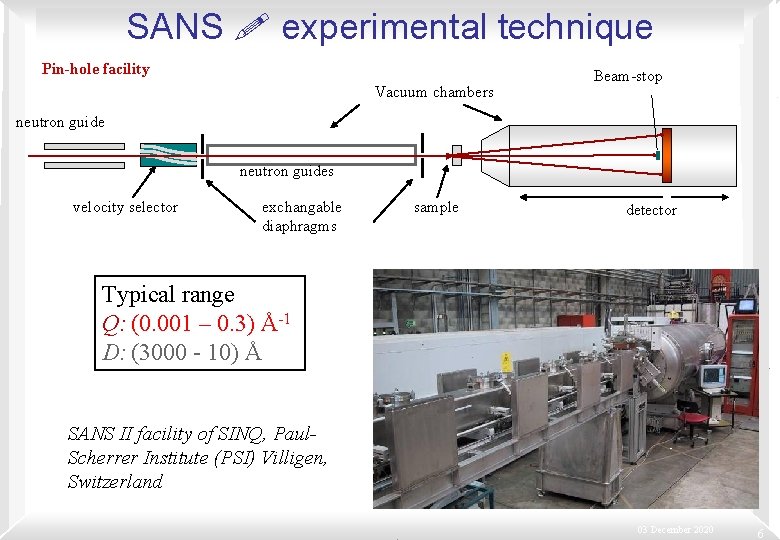
SANS experimental technique Pin-hole facility Vacuum chambers Beam-stop neutron guides velocity selector exchangable diaphragms sample detector Typical range Q: (0. 001 – 0. 3) Å-1 D: (3000 - 10) Å SANS II facility of SINQ, Paul. Scherrer Institute (PSI) Villigen, Switzerland 03 December 2020 6
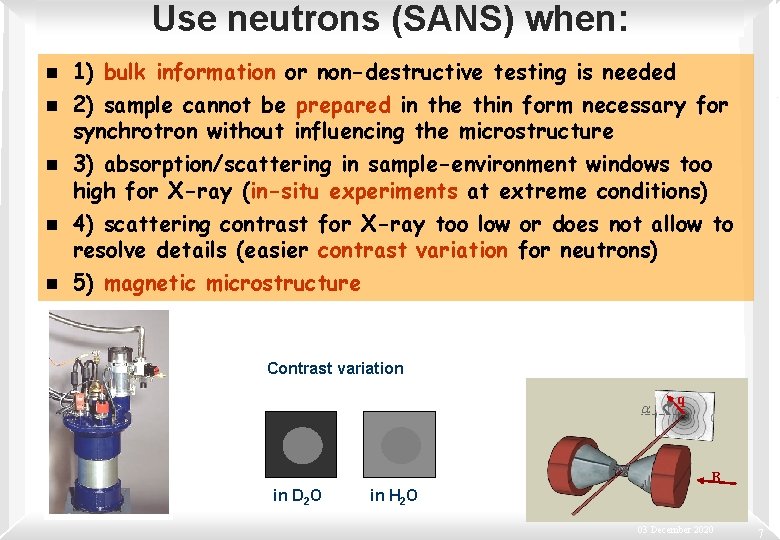
Use neutrons (SANS) when: n n n 1) bulk information or non-destructive testing is needed 2) sample cannot be prepared in the thin form necessary for synchrotron without influencing the microstructure 3) absorption/scattering in sample-environment windows too high for X-ray (in-situ experiments at extreme conditions) 4) scattering contrast for X-ray too low or does not allow to resolve details (easier contrast variation for neutrons) 5) magnetic microstructure Contrast variation a q B in D 2 O in H 2 O 03 December 2020 7
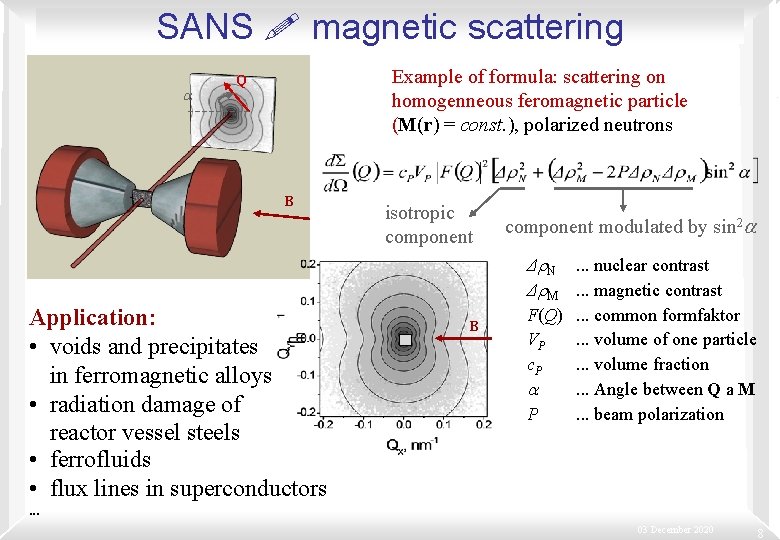
SANS magnetic scattering a Example of formula: scattering on homogenneous feromagnetic particle (M(r) = const. ), polarized neutrons Q B Application: • voids and precipitates in ferromagnetic alloys • radiation damage of reactor vessel steels • ferrofluids • flux lines in superconductors isotropic component B component modulated by sin 2 a Δr. N Δr. M F(Q) VP c. P a P . . . nuclear contrast. . . magnetic contrast. . . common formfaktor. . . volume of one particle. . . volume fraction. . . Angle between Q a M. . . beam polarization . . . 03 December 2020 8
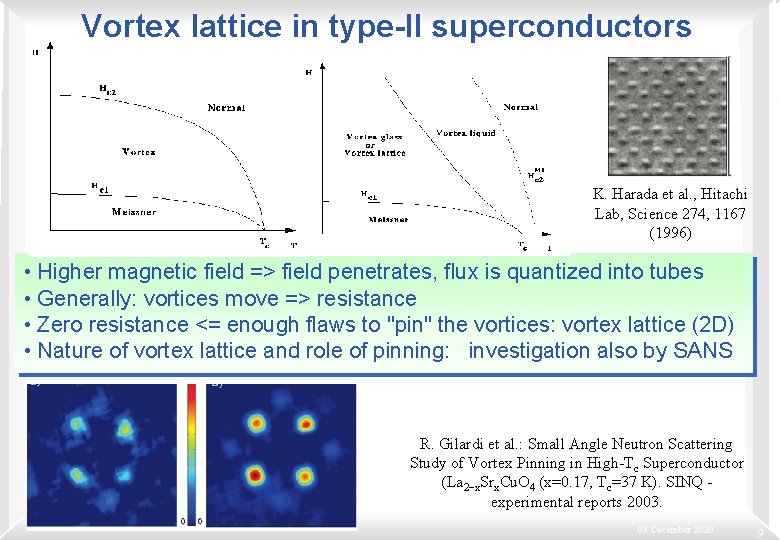
Vortex lattice in type-II superconductors K. Harada et al. , Hitachi Lab, Science 274, 1167 (1996) • Higher magnetic field => field penetrates, flux is quantized into tubes • Generally: vortices move => resistance • Zero resistance <= enough flaws to "pin" the vortices: vortex lattice (2 D) • Nature of vortex lattice and role of pinning: investigation also by SANS R. Gilardi et al. : Small Angle Neutron Scattering Study of Vortex Pinning in High-Tc Superconductor (La 2−x. Srx. Cu. O 4 (x=0. 17, Tc=37 K). SINQ experimental reports 2003. 03 December 2020 9
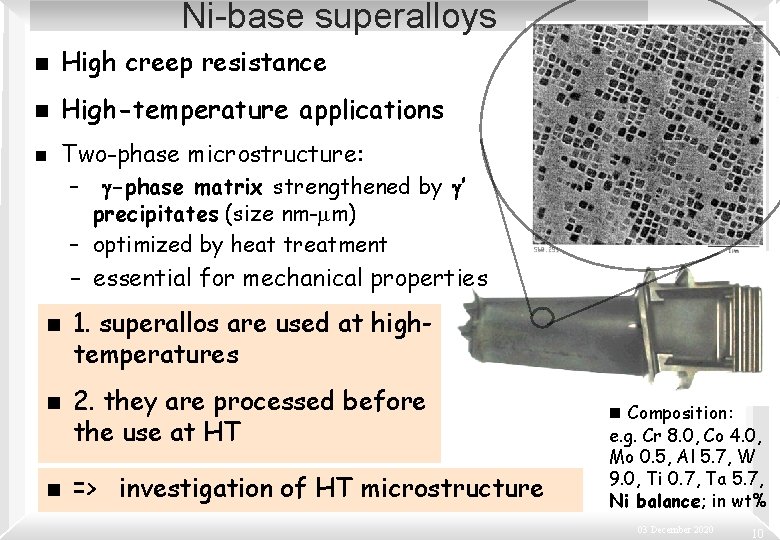
Ni-base superalloys n High creep resistance n High-temperature applications n Two-phase microstructure: – g-phase matrix strengthened by g’ precipitates (size nm-mm) – optimized by heat treatment – essential for mechanical properties n n n 1. superallos are used at hightemperatures 2. they are processed before the use at HT => investigation of HT microstructure n Composition: e. g. Cr 8. 0, Co 4. 0, Mo 0. 5, Al 5. 7, W 9. 0, Ti 0. 7, Ta 5. 7, Ni balance; in wt% 03 December 2020 10
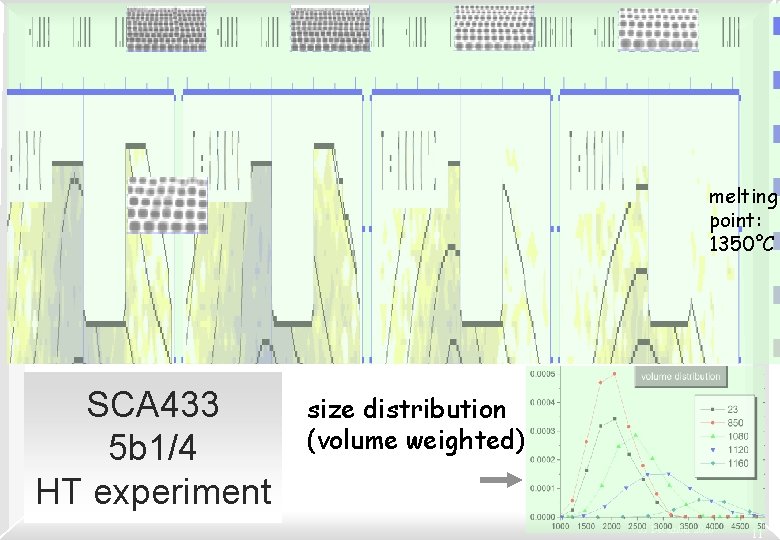
melting point: 1350°C SCA 433 5 b 1/4 HT experiment size distribution (volume weighted) 03 December 2020 11
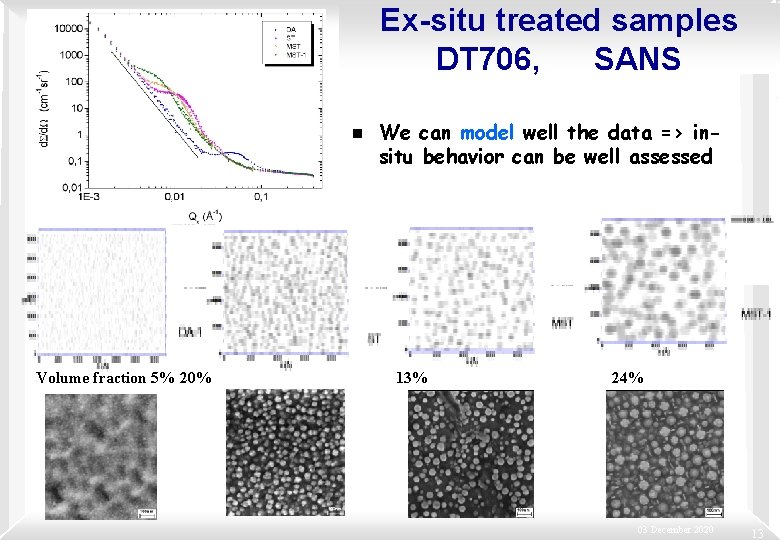
In-situ SANS investigation of hightemperature precipitate morphology in polycrystalline Ni-base superalloy DT 706 D. Mukherji, D. Del Genovese, P. Strunz, R. Gilles, A. Wiedenmann and J. Rösler J. Phys. : Condens. Matter 20 (2008), 104220 (9 pp) new development of Ni-base superalloys: - improving their microstructural stability - preserving their good mechanical properties => Need to know the microstructure during heat treatment => the use of (in-situ) SANS 03 December 2020 12
Ex-situ treated samples DT 706, SANS n Volume fraction 5% 20% We can model well the data => insitu behavior can be well assessed 13% 24% 03 December 2020 13
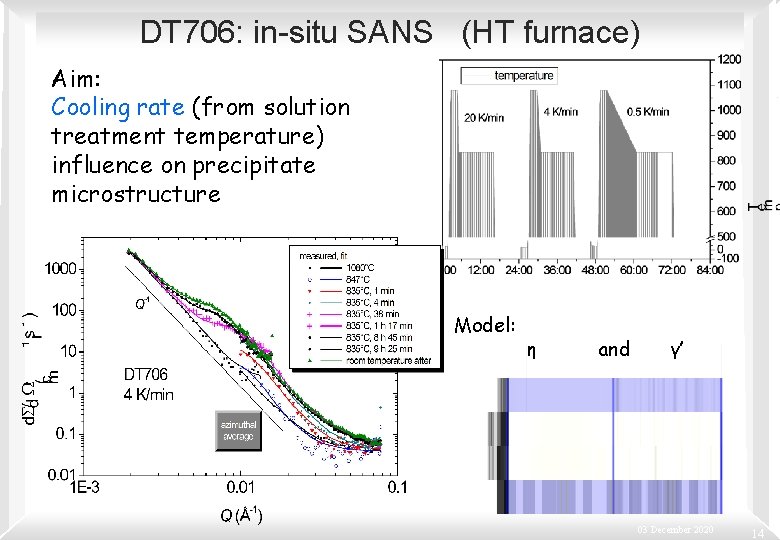
DT 706: in-situ SANS (HT furnace) Aim: Cooling rate (from solution treatment temperature) influence on precipitate microstructure Model: η and γ’ 03 December 2020 14
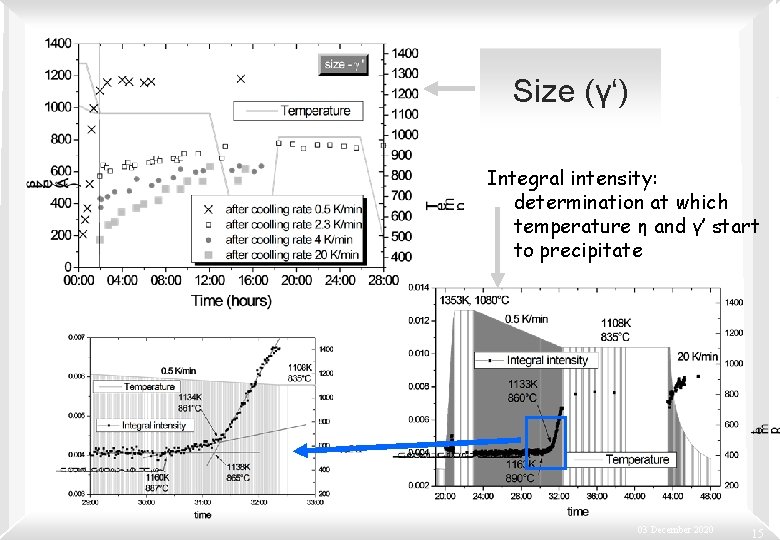
Size (γ‘) Integral intensity: determination at which temperature η and γ’ start to precipitate 03 December 2020 15
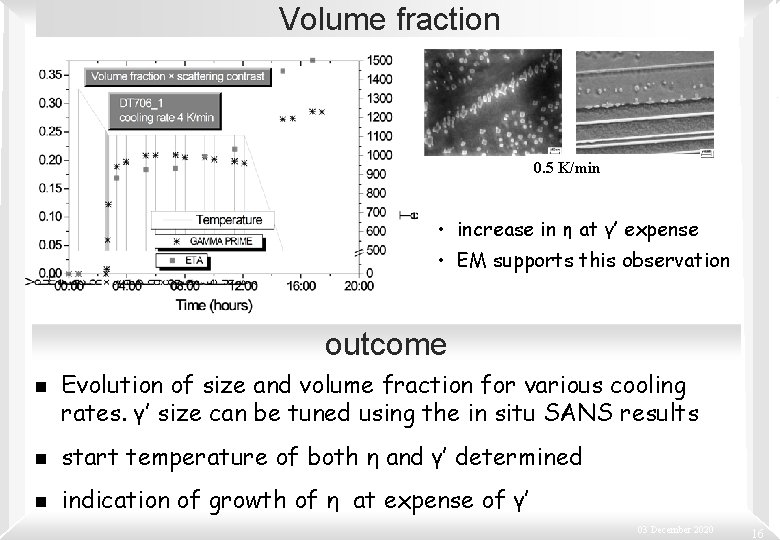
Volume fraction 0. 5 K/min • increase in η at γ’ expense • EM supports this observation outcome n Evolution of size and volume fraction for various cooling rates. γ’ size can be tuned using the in situ SANS results n start temperature of both η and γ’ determined n indication of growth of η at expense of γ’ 03 December 2020 16
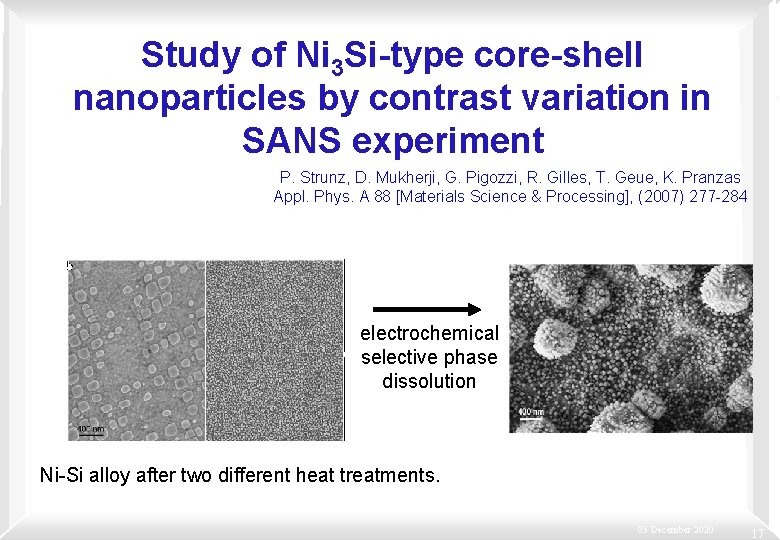
Study of Ni 3 Si-type core-shell nanoparticles by contrast variation in SANS experiment P. Strunz, D. Mukherji, G. Pigozzi, R. Gilles, T. Geue, K. Pranzas Appl. Phys. A 88 [Materials Science & Processing], (2007) 277 -284 electrochemical selective phase dissolution Ni-Si alloy after two different heat treatments. 03 December 2020 17
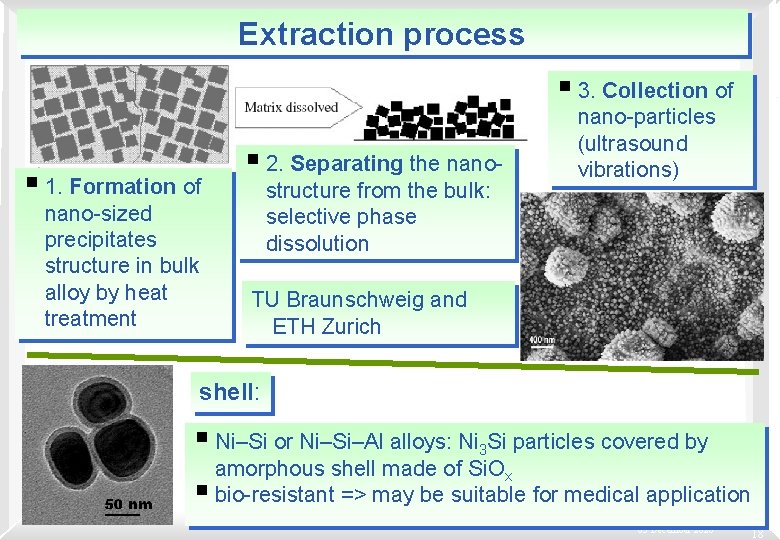
Extraction process § 3. Collection of § 1. Formation of nano-sized precipitates structure in bulk alloy by heat treatment § 2. Separating the nanostructure from the bulk: selective phase dissolution nano-particles (ultrasound vibrations) TU Braunschweig and ETH Zurich shell: § Ni–Si or Ni–Si–Al alloys: Ni 3 Si particles covered by amorphous shell made of Si. Ox § bio-resistant => may be suitable for medical application 03 December 2020 18
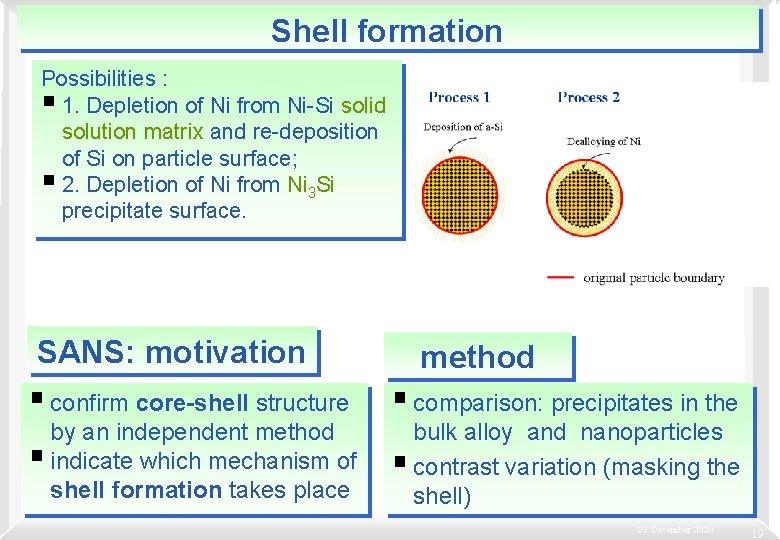
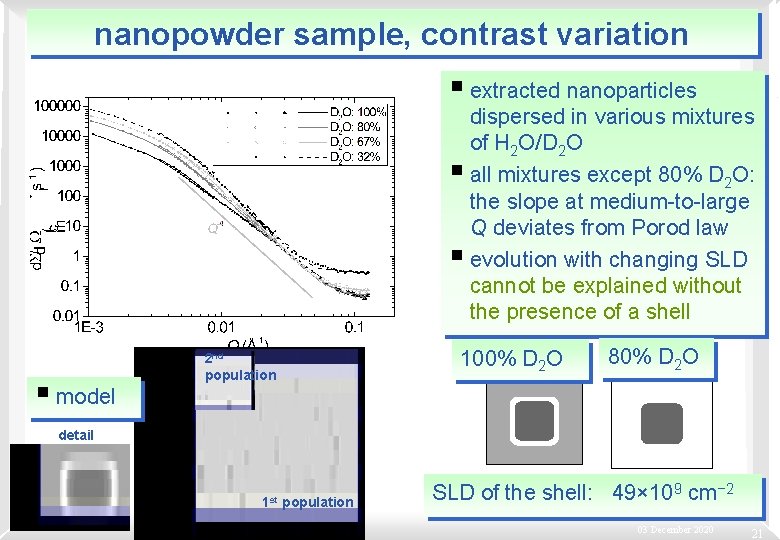
Shell formation Possibilities : § 1. Depletion of Ni from Ni-Si solid solution matrix and re-deposition of Si on particle surface; § 2. Depletion of Ni from Ni 3 Si precipitate surface. SANS: motivation § confirm core-shell structure by an independent method § indicate which mechanism of shell formation takes place method § comparison: precipitates in the bulk alloy and nanoparticles § contrast variation (masking the shell) 03 December 2020 19
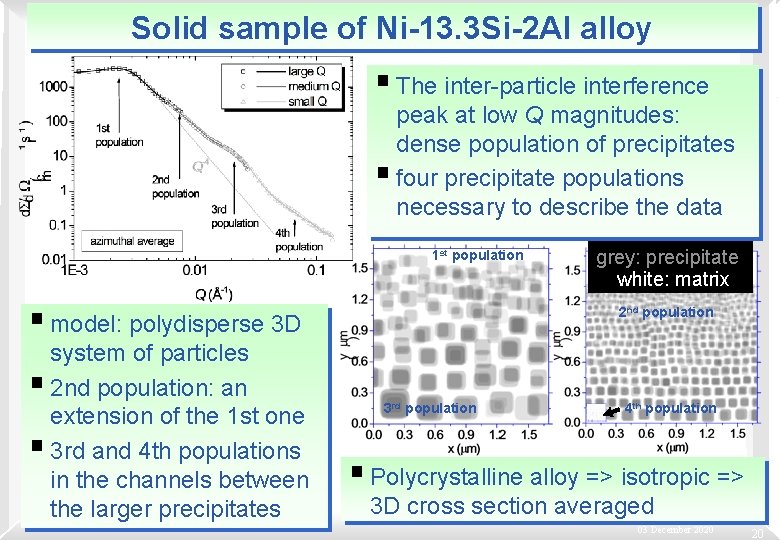
Solid sample of Ni-13. 3 Si-2 Al alloy § The inter-particle interference peak at low Q magnitudes: dense population of precipitates § four precipitate populations necessary to describe the data 1 st population § model: polydisperse 3 D system of particles § 2 nd population: an extension of the 1 st one § 3 rd and 4 th populations in the channels between the larger precipitates grey: precipitate white: matrix 2 nd population 3 rd population 4 th population § Polycrystalline alloy => isotropic => 3 D cross section averaged 03 December 2020 20
nanopowder sample, contrast variation § extracted nanoparticles dispersed in various mixtures of H 2 O/D 2 O § all mixtures except 80% D 2 O: the slope at medium-to-large Q deviates from Porod law § evolution with changing SLD cannot be explained without the presence of a shell § model 2 nd population 100% D 2 O 80% D 2 O detail 1 st population SLD of the shell: 49× 109 cm− 2 03 December 2020 21
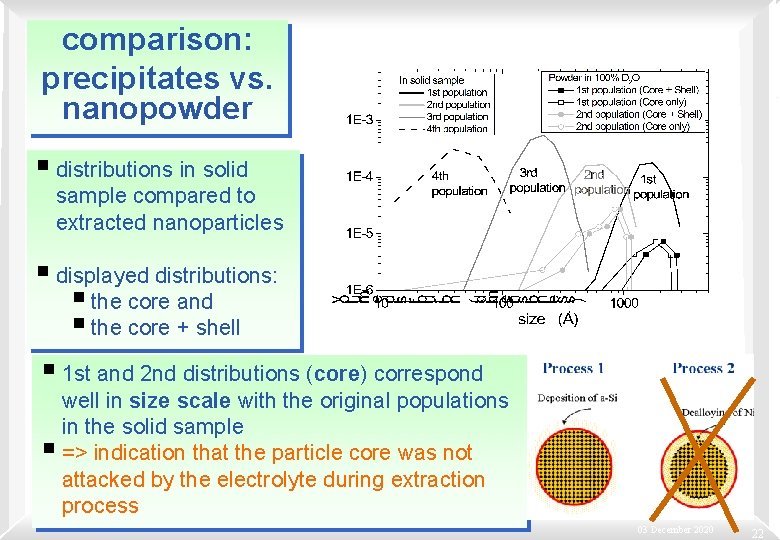
comparison: precipitates vs. nanopowder § distributions in solid sample compared to extracted nanoparticles § displayed distributions: § the core and § the core + shell § 1 st and 2 nd distributions (core) correspond well in size scale with the original populations in the solid sample § => indication that the particle core was not attacked by the electrolyte during extraction process 03 December 2020 22
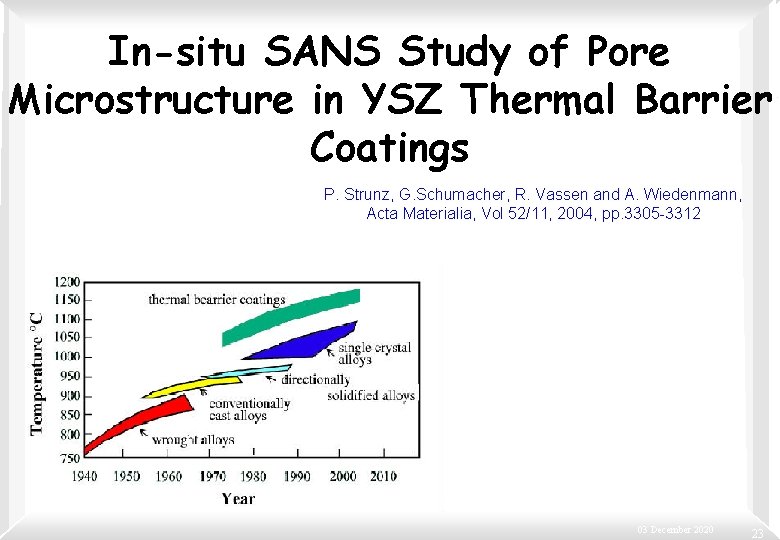
In-situ SANS Study of Pore Microstructure in YSZ Thermal Barrier Coatings P. Strunz, G. Schumacher, R. Vassen and A. Wiedenmann, Acta Materialia, Vol 52/11, 2004, pp. 3305 -3312 03 December 2020 23
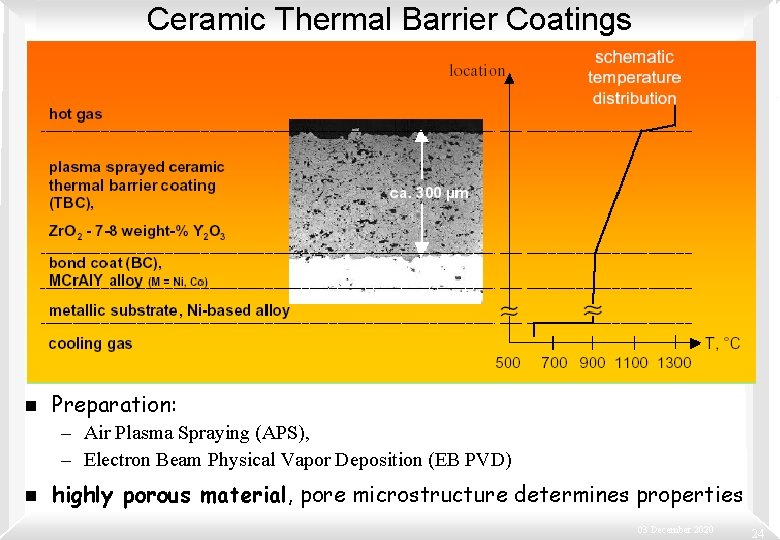
Ceramic Thermal Barrier Coatings n Preparation: – Air Plasma Spraying (APS), – Electron Beam Physical Vapor Deposition (EB PVD) n highly porous material, pore microstructure determines properties 03 December 2020 24
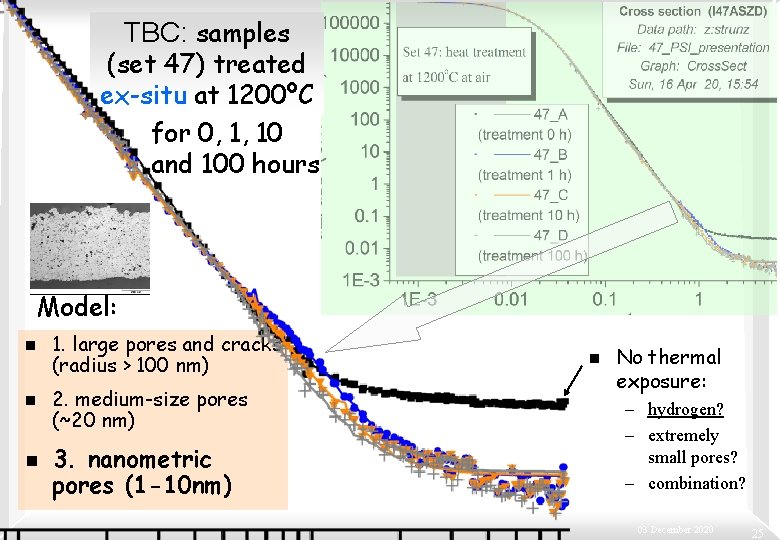
TBC: samples (set 47) treated ex-situ at 1200ºC for 0, 1, 10 and 100 hours Model: n n n 1. large pores and cracks (radius > 100 nm) 2. medium-size pores (~20 nm) 3. nanometric pores (1 -10 nm) n No thermal exposure: – hydrogen? – extremely small pores? – combination? 03 December 2020 25
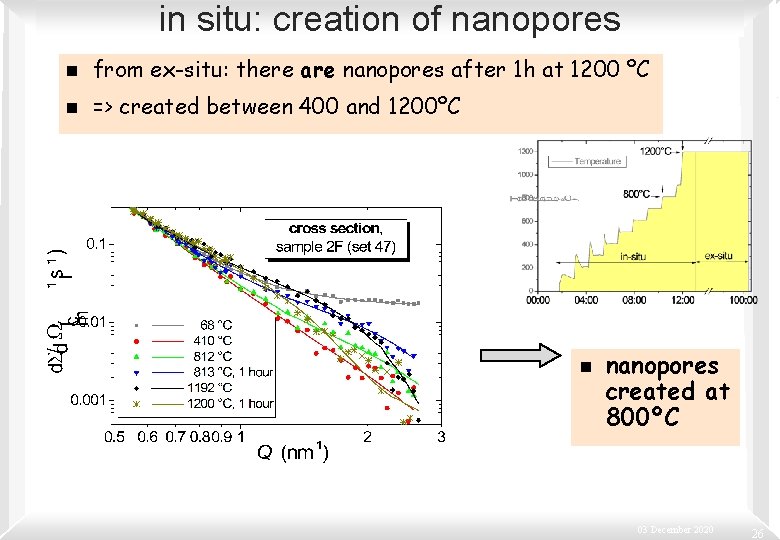
in situ: creation of nanopores n from ex-situ: there are nanopores after 1 h at 1200 ºC n => created between 400 and 1200ºC n nanopores created at 800ºC 03 December 2020 26
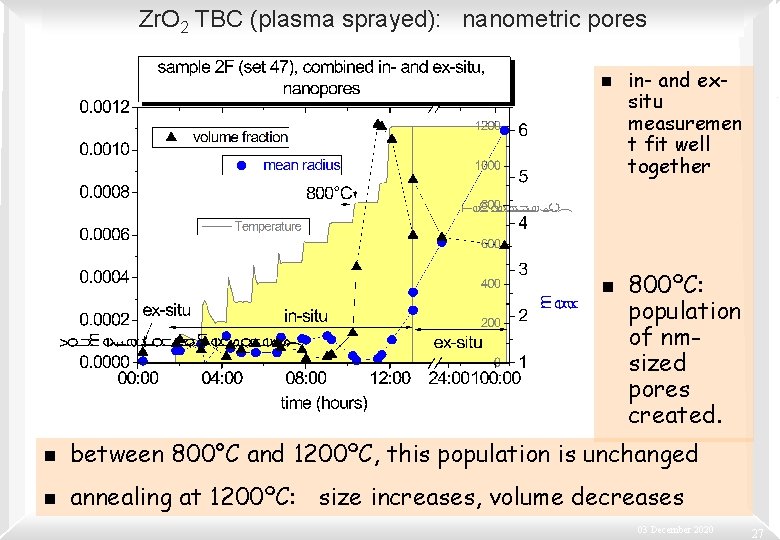
Zr. O 2 TBC (plasma sprayed): nanometric pores n n in- and exsitu measuremen t fit well together 800ºC: population of nmsized pores created. n between 800°C and 1200ºC, this population is unchanged n annealing at 1200ºC: size increases, volume decreases 03 December 2020 27
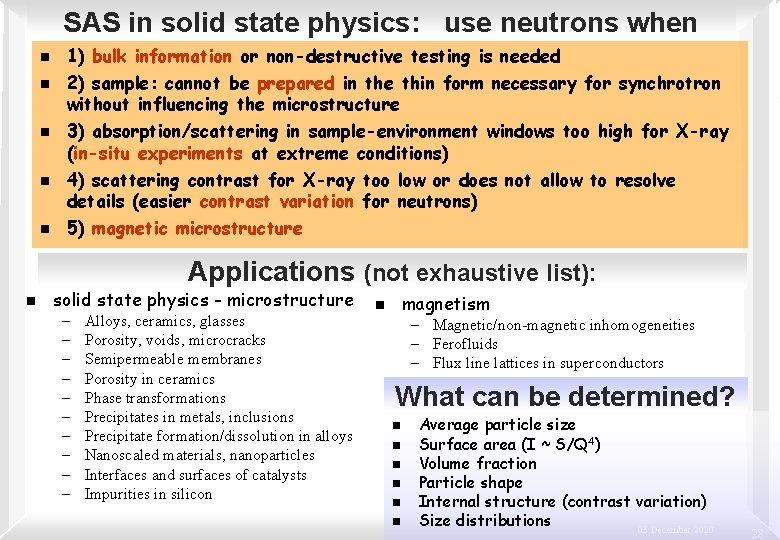
SAS in solid state physics: use neutrons when n n 1) bulk information or non-destructive testing is needed 2) sample: cannot be prepared in the thin form necessary for synchrotron without influencing the microstructure 3) absorption/scattering in sample-environment windows too high for X-ray (in-situ experiments at extreme conditions) 4) scattering contrast for X-ray too low or does not allow to resolve details (easier contrast variation for neutrons) 5) magnetic microstructure Applications (not exhaustive list): n solid state physics - microstructure – – – – – Alloys, ceramics, glasses Porosity, voids, microcracks Semipermeable membranes Porosity in ceramics Phase transformations Precipitates in metals, inclusions Precipitate formation/dissolution in alloys Nanoscaled materials, nanoparticles Interfaces and surfaces of catalysts Impurities in silicon magnetism n – Magnetic/non-magnetic inhomogeneities – Ferofluids – Flux line lattices in superconductors What can be determined? n n n Average particle size Surface area (I ~ S/Q 4) Volume fraction Particle shape Internal structure (contrast variation) Size distributions 03 December 2020 28