
Small Engines Engine Operations Chapter 3 Building a
Small Engines Engine Operations Chapter 3
Building a Simple Engine n Fuel
Building a Simple Engine n Chemical to Mechanical Energy
Building a Simple Engine n Valves
Building a Simple Engine n Ignition
4 -Stroke Cycle Engines n n Has four distinct piston strokes. Completes 5 events in the four strokes. • Intake • Compression • Ignition • Power • Exhaust
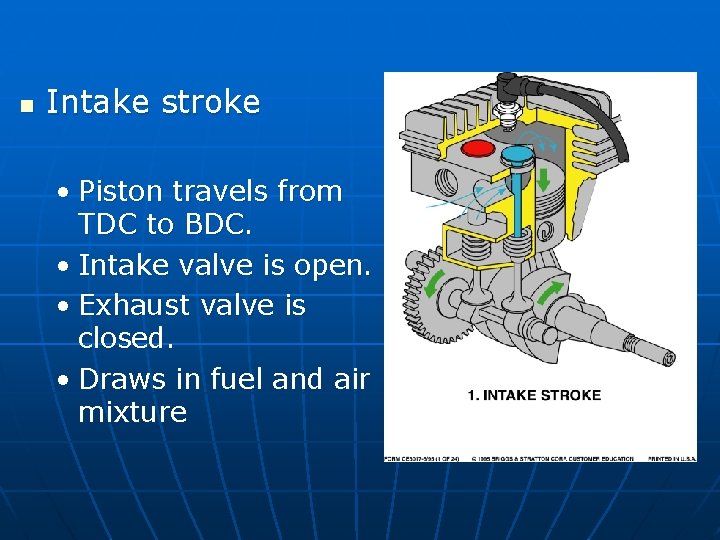
n Intake stroke • Piston travels from TDC to BDC. • Intake valve is open. • Exhaust valve is closed. • Draws in fuel and air mixture

n Compression stroke • Piston travels from BDC to TDC. • Intake valve is closed. • Exhaust valve is closed. • Compresses fuel and air mixture.
n Ignition • When the compressed air/fuel mixture is ignited by the spark plug. • Combustion is the rapid chemical reaction that releases energy in the form of heat.
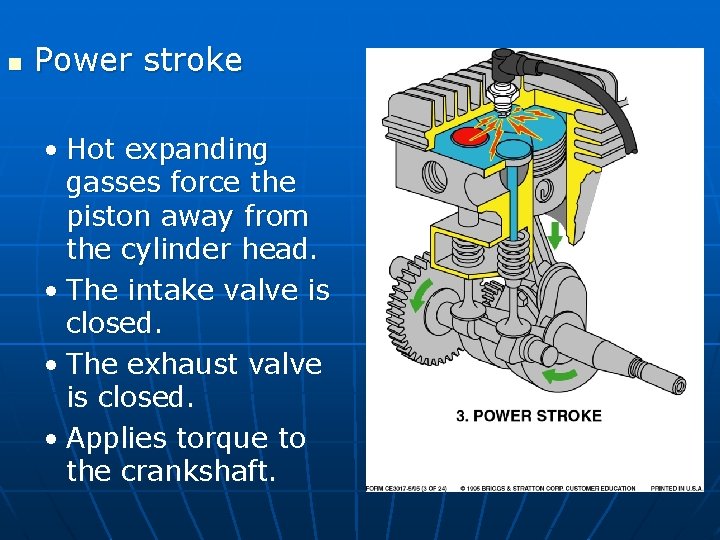
n Power stroke • Hot expanding gasses force the piston away from the cylinder head. • The intake valve is closed. • The exhaust valve is closed. • Applies torque to the crankshaft.
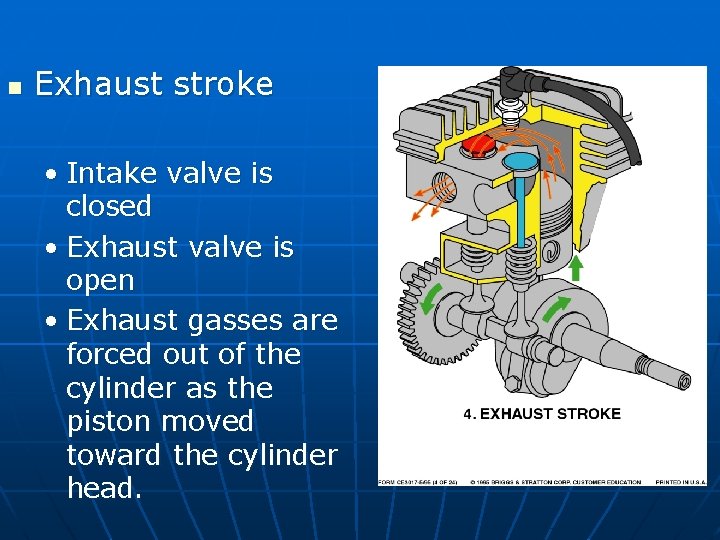
n Exhaust stroke • Intake valve is closed • Exhaust valve is open • Exhaust gasses are forced out of the cylinder as the piston moved toward the cylinder head.

n n n Engine Block – the main structure of an engine which supports internal and external components. Cylinder Bore – the hole in the engine that aligns the piston. Cylinder Head – Caps off the cylinder.
n n n Head gasket – Seals between the block and the head. Made of graphite and soft metal. Piston – slides in the cylinder. Stroke – the linear distance the piston travels in the cylinder.

§TDC – top dead center §BDC – bottom dead center §Displacement – the volume a piston displaces when it travels from BDC to TDC.
n n Cooling fins – integral thin cast strip designed to provide more surface area for cooling. Crankcase – the part of the engine that houses the crankshaft. May also be used as the oil reservoir.
n n Sump – the removable part that serves as the oil reservoir and provides access to internal parts. Crankcase cover – provides access to internal parts and supports crankshaft
n n Atmospheric pressure at sea level – 14. 7 psi. Crankcase breather – relieves crankcase pressure created by piston.

n n OHV – over head valve. Valves and related components located in the head. L-head – valves and related components located in the block.
n Crankshaft – converts reciprocating motion to rotary motion. • Magneto journal – on the flywheel side. • Crankpin – Center journal for the rod. • PTO journal – on the PTO end. • Throw – center of the crankshaft to the center of the crankpin journal. • Counterweights – balances the piston.
n Crankgear – the gear on the end of the crankshaft that drives other parts of the engine. n Piston head – top of the piston n Skirt – aligns piston in cylinder
n n Piston pin – or wrist pin that connects the piston to the rod Piston pin bore – Hole through the piston that holds piston pin
n n Ring groove – recessed area around the piston that holds the rings. Ring lands – two parallel surfaces of the ring groove that serve as a sealing surface for the piston rings.
n n Piston rings – made of cast iron, expandable split ring used to seal against cylinder walls. Compression ring – top ring that seals the compression chamber.
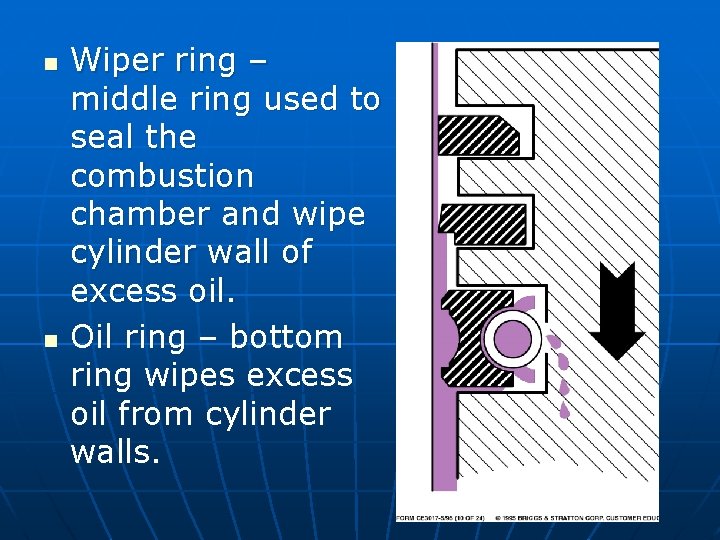
n n Wiper ring – middle ring used to seal the combustion chamber and wipe cylinder wall of excess oil. Oil ring – bottom ring wipes excess oil from cylinder walls.
n Connecting rod – transfers motion from the piston to the crankshaft. • Small end connects piston to rod with the piston or wrist pin. • Large end connects to the crankpin with a removable rod cap.
n n Bearing – used to reduce friction and maintain clearance between stationary and rotating engine parts. Friction bearing – fixed, non-moving, bearing surface.
n n n Antifriction bearing – contains moving elements to provide lowfriction and support. Radial load – applied perpendicular to the shaft. Axial load – applied parallel to the shaft.
Valving Systems n n n Controls the flow of gasses in and out of the combustion chamber. Three main purposes: 1. Allow fuel/air mixture into the cylinder. 2. Seal the combustion chamber during compression and combustion. 3. Remove exhaust gasses form the cylinder.
n n n Flywheel – cast iron, aluminum, or zinc disk mounted on the end of the crankshaft to provide inertia. Inertia – keeps the crankshaft turning between power strokes. Cooling fins – fins on the crankshaft provide movement of air across cooling fins on the block.
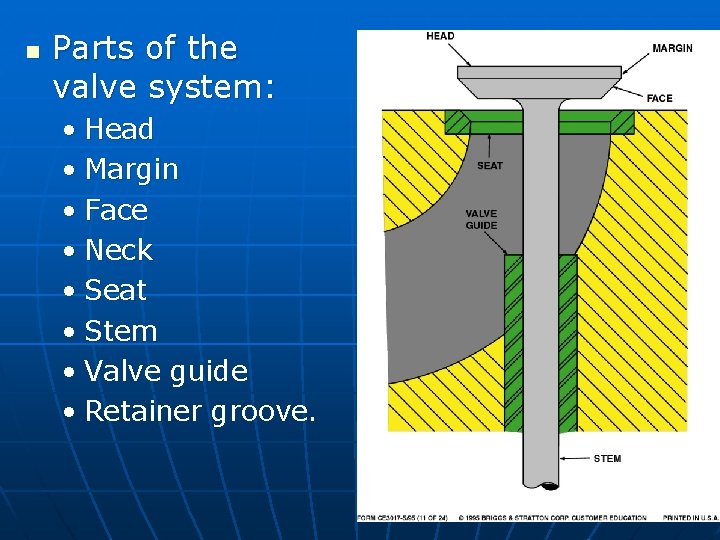
n Parts of the valve system: • Head • Margin • Face • Neck • Seat • Stem • Valve guide • Retainer groove.

n n Valve Rotator – used to rotate the valve each time it opens to provide even wear. Valve Spring Retainers: • Pin • Collar • Keyhole or retainer
n n Valves must withstand 30000 F during combustion and 12000 F continuous. Contact between the valve face and the valve seat provides a seal and allows transfer of heat to cool. Valves are made of Austenitic steel, a heat resistant alloy. Valves open 30 times a second at operating speed.
n n n Valve overlap – the period during engine operation where both valves are open at the same time. Occurs near TDC between the exhaust and intake strokes. Duration is between 10 and 20 degrees of rotation.
n n Low pressure allows fuel/air mixture to fill cylinder to maximum capacity. Provides increase power at high speeds.
n n n The camshaft is timed to the crankshaft by gears. The camshaft rotates at ½ the speed of the crankshaft. Cam lobes change rotary motion into linear motion.
n n n Lobes push up on the tappets. Tappets push on the valve stem to open the valve. In an OHV engine, tappets pushrods, which push rocker arms, which open valves.
2 – Stroke Cycle Engines n n n Five events completed in two strokes. One rotation of the crankshaft completes the two strokes. Twice as much power in the same number of crankshaft rotations as a 4 -stroke cycle engine
Advantages n n Valve system requires fewer moving parts. Much lighter. • Chain saws • Weed Eaters • Leaf Blowers • Ice Augers
n n Ignition and Power begin when the piston is at TDC. The crankcase is filled with a new charge of fuel/air mixture. Piston travels toward BDC. Exhaust port is uncovered letting out the exhaust.
n n n Exhaust and Intake events occur as the piston moves toward BDC. The intake port is opened and the new fuel/air charge is routed to the cylinder. Piston head shape moves fresh fuel/air mixture to top of cylinder so it does not go out the exhaust port.

2 -Cycle Valve Systems n n n Reed Valve – Made from thin spring material that opens and closes with pressure changes. Three port system – uses pressure differences. Rotary valve – a rotating disk with a section removed attached to the crankshaft.
- Slides: 41