
Small Business Innovation Research RadiationHard CMOS APS Circuits
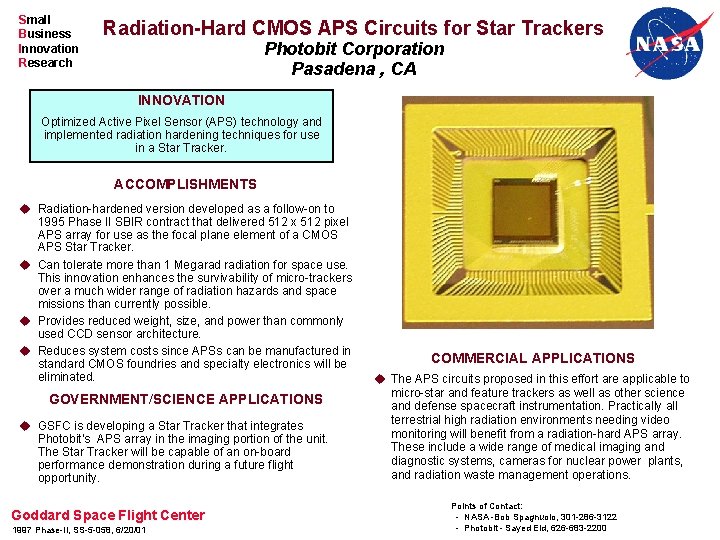
Small Business Innovation Research Radiation-Hard CMOS APS Circuits for Star Trackers Photobit Corporation Pasadena , CA INNOVATION Optimized Active Pixel Sensor (APS) technology and implemented radiation hardening techniques for use in a Star Tracker. ACCOMPLISHMENTS u Radiation-hardened version developed as a follow-on to 1995 Phase II SBIR contract that delivered 512 x 512 pixel APS array for use as the focal plane element of a CMOS APS Star Tracker. u Can tolerate more than 1 Megarad radiation for space use. This innovation enhances the survivability of micro-trackers over a much wider range of radiation hazards and space missions than currently possible. u Provides reduced weight, size, and power than commonly used CCD sensor architecture. u Reduces system costs since APSs can be manufactured in standard CMOS foundries and specialty electronics will be eliminated. GOVERNMENT/SCIENCE APPLICATIONS u GSFC is developing a Star Tracker that integrates Photobit’s APS array in the imaging portion of the unit. The Star Tracker will be capable of an on-board performance demonstration during a future flight opportunity. Goddard Space Flight Center 1997 Phase-II, SS-5 -058, 6/20/01 Graphic COMMERCIAL APPLICATIONS u The APS circuits proposed in this effort are applicable to micro-star and feature trackers as well as other science and defense spacecraft instrumentation. Practically all terrestrial high radiation environments needing video monitoring will benefit from a radiation-hard APS array. These include a wide range of medical imaging and diagnostic systems, cameras for nuclear power plants, and radiation waste management operations. Points of Contact: - NASA -Bob Spagnuolo, 301 -286 -3122 - Photobit - Sayed Eid, 626 -683 -2200
- Slides: 1