
Small Business Innovation Research FiberReinforced Ceramic Matrix Composites
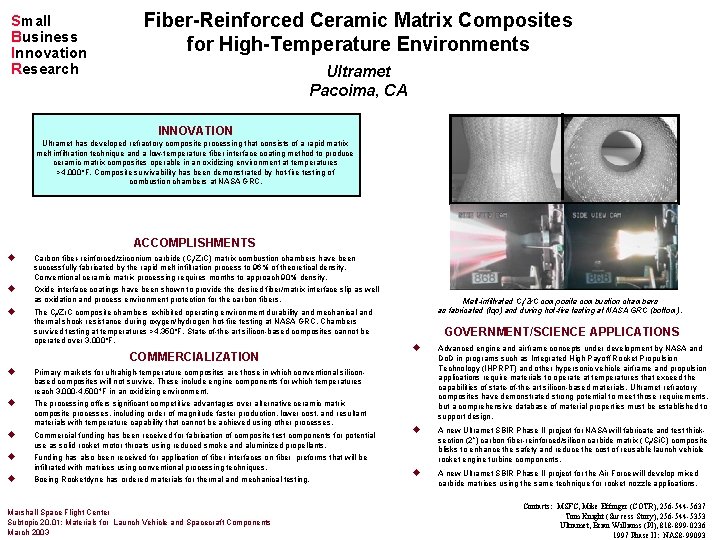
Small Business Innovation Research Fiber-Reinforced Ceramic Matrix Composites for High-Temperature Environments Ultramet Pacoima, CA INNOVATION Ultramet has developed refractory composite processing that consists of a rapid matrix melt infiltration technique and a low-temperature fiber interface coating method to produce ceramic matrix composites operable in an oxidizing environment at temperatures >4, 000°F. Composite survivability has been demonstrated by hot-fire testing of combustion chambers at NASA GRC. ACCOMPLISHMENTS u Carbon fiber-reinforced/zirconium carbide (Cf/Zr. C) matrix combustion chambers have been successfully fabricated by the rapid melt infiltration process to 96% of theoretical density. Conventional ceramic matrix processing requires months to approach 90% density. u Oxide interface coatings have been shown to provide the desired fiber/matrix interface slip as well as oxidation and process environment protection for the carbon fibers. u The Cf/Zr. C composite chambers exhibited operating environment durability and mechanical and thermal shock resistance during oxygen/hydrogen hot-fire testing at NASA GRC. Chambers survived testing at temperatures >4, 350°F. State-of-the-art silicon-based composites cannot be operated over 3, 000°F. COMMERCIALIZATION u Primary markets for ultrahigh-temperature composites are those in which conventional siliconbased composites will not survive. These include engine components for which temperatures reach 3, 000 -4, 500°F in an oxidizing environment. u The processing offers significant competitive advantages over alternative ceramic matrix composite processes, including order of magnitude faster production, lower cost, and resultant materials with temperature capability that cannot be achieved using other processes. u Commercial funding has been received for fabrication of composite test components for potential use as solid rocket motor throats using reduced smoke and aluminized propellants. u Funding has also been received for application of fiber interfaces on fiber preforms that will be infiltrated with matrices using conventional processing techniques. u Boeing Rocketdyne has ordered materials for thermal and mechanical testing. Marshall Space Flight Center Subtopic 20. 01: Materials for Launch Vehicle and Spacecraft Components March 2003 Melt-infiltrated Cf/Zr. C composite combustion chambers as fabricated (top) and during hot-fire testing at NASA GRC (bottom). GOVERNMENT/SCIENCE APPLICATIONS u Advanced engine and airframe concepts under development by NASA and Do. D in programs such as Integrated High Payoff Rocket Propulsion Technology (IHPRPT) and other hypersonic vehicle airframe and propulsion applications require materials to operate at temperatures that exceed the capabilities of state-of-the-art silicon-based materials. Ultramet refractory composites have demonstrated strong potential to meet those requirements, but a comprehensive database of material properties must be established to support design. u A new Ultramet SBIR Phase II project for NASA will fabricate and test thicksection (2”) carbon fiber-reinforced/silicon carbide matrix ( Cf/Si. C) composite blisks to enhance the safety and reduce the cost of reusable launch vehicle rocket engine turbine components. u A new Ultramet SBIR Phase II project for the Air Force will develop mixed carbide matrices using the same technique for rocket nozzle applications. Contacts: MSFC, Mike Effinger (COTR), 256 -544 -5637 Tom Knight (Success Story), 256 -544 -5353 Ultramet, Brian Williams (PI), 818 -899 -0236 1997 Phase II: NAS 8 -99093
- Slides: 1