
SLTD 04 Clinical Linguistics and Phonetics Phonological SystemNatural
![Allophonic (phonetic) variation Allophones – variant pronunciations of the same phoneme, eg [ ]](https://slidetodoc.com/presentation_image_h/1042e1d164342412bbf3b1bc2ae1786b/image-5.jpg "Allophonic (phonetic) variation Allophones – variant pronunciations of the same phoneme, eg [ ]")
![Allophonic (phonetic) variation Clear [l] and dark [ ] leaf [lif], sleeve [sliv], pillow](https://slidetodoc.com/presentation_image_h/1042e1d164342412bbf3b1bc2ae1786b/image-7.jpg "Allophonic (phonetic) variation Clear [l] and dark [ ] leaf [lif], sleeve [sliv], pillow")
![Note correct use of brackets! Orthographic Phonemic Phonetic (broad/narrow) <peach> /pitʃ/ [pitʃ], [phitʃ] <felt>](https://slidetodoc.com/presentation_image_h/1042e1d164342412bbf3b1bc2ae1786b/image-8.jpg "Note correct use of brackets! Orthographic Phonemic Phonetic (broad/narrow) <peach> /pitʃ/ [pitʃ], [phitʃ] <felt>")
![Orthographic gloss Adult target / / Child’s realisation [ ] cake geese bag king](https://slidetodoc.com/presentation_image_h/1042e1d164342412bbf3b1bc2ae1786b/image-14.jpg "Orthographic gloss Adult target / / Child’s realisation [ ] cake geese bag king")
![Orthographic gloss Adult target / / Child’s realisation [ ] cake geese bag king](https://slidetodoc.com/presentation_image_h/1042e1d164342412bbf3b1bc2ae1786b/image-16.jpg "Orthographic gloss Adult target / / Child’s realisation [ ] cake geese bag king")
![Orthographic Adult target gloss / / Child’s realisation [ ] cake geese bag king](https://slidetodoc.com/presentation_image_h/1042e1d164342412bbf3b1bc2ae1786b/image-18.jpg "Orthographic Adult target gloss / / Child’s realisation [ ] cake geese bag king")






![Natural Phonological Processes • May interact, eg /s n/ [d n] /s n/ [g](https://slidetodoc.com/presentation_image_h/1042e1d164342412bbf3b1bc2ae1786b/image-54.jpg "Natural Phonological Processes • May interact, eg /s n/ [d n] /s n/ [g")
- Slides: 58
SLTD 04 Clinical Linguistics and Phonetics Phonological System/Natural phonological processes Dr Sally Bates 26 September 2019
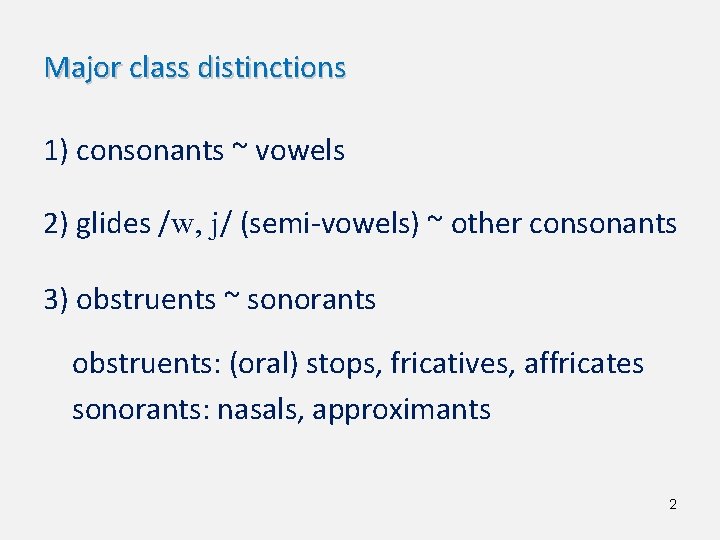
Major class distinctions 1) consonants ~ vowels 2) glides /w, j/ (semi-vowels) ~ other consonants 3) obstruents ~ sonorants obstruents: (oral) stops, fricatives, affricates sonorants: nasals, approximants 2
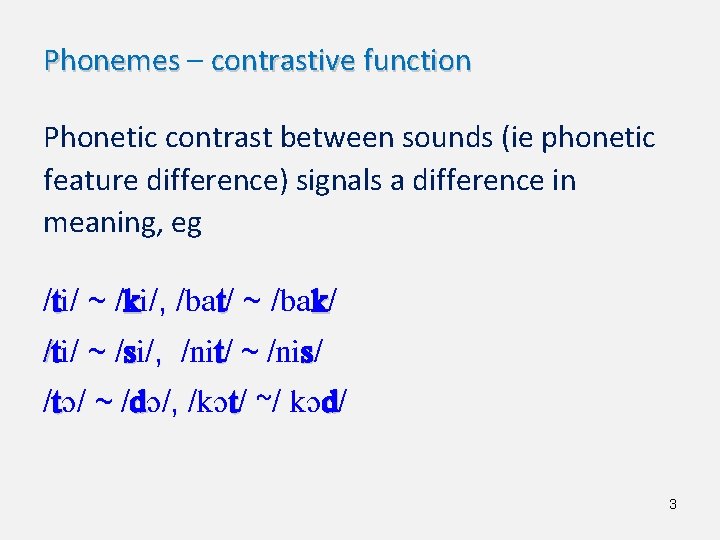
Phonemes – contrastive function Phonetic contrast between sounds (ie phonetic feature difference) signals a difference in meaning, eg /ti/ ~ /ki/, /bat/ ~ /bak/ /ti/ ~ /si/, /nit/ ~ /nis/ /t. O/ ~ /d. O/, /k. Ot/ ~/ k. Od/ 3
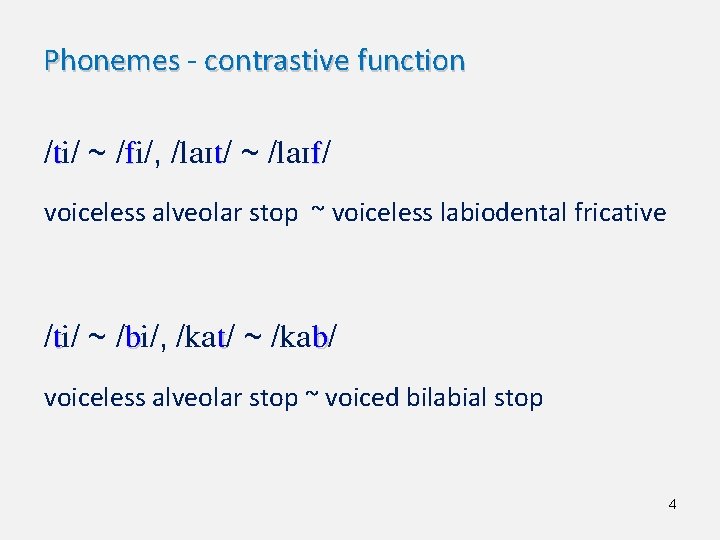
Phonemes - contrastive function /ti/ ~ /fi/, /la. It/ ~ /la. If/ voiceless alveolar stop ~ voiceless labiodental fricative /ti/ ~ /bi/, /kat/ ~ /kab/ voiceless alveolar stop ~ voiced bilabial stop 4
Allophonic (phonetic) variation Allophones – variant pronunciations of the same phoneme, eg [ ] is an allophone of /t/ butter [b t ] or butter [b ] Hyper-hypo continuum (stylistic variation) careful /slow [and] [l. Ast na. It] casual/fast speech [ǝnd n d ǝn n] [l. As na. It] 5
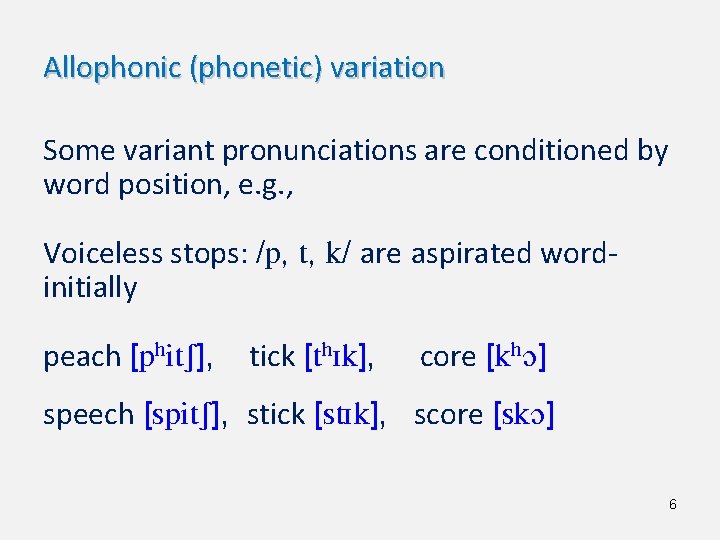
Allophonic (phonetic) variation Some variant pronunciations are conditioned by word position, e. g. , Voiceless stops: /p, t, k/ are aspirated wordinitially peach [p it. S], tick [t Ik], core [k O] speech [spit. S], stick [st. Ik], score [sk. O] 6
Allophonic (phonetic) variation Clear [l] and dark [ ] leaf [lif], sleeve [sliv], pillow [p. IləU] feel [fi ], felt [f. E t], builder [b. I də] 7
Note correct use of brackets! Orthographic Phonemic Phonetic (broad/narrow) <peach> /pitʃ/ [pitʃ], [phitʃ] <felt> /fɛlt/ [fɛlt], [fɛ t [ ] Broad phonetic (sequence of phonemes) Narrow phonetic (allophonic detail) Always use square brackets [ ] for live transcription 8
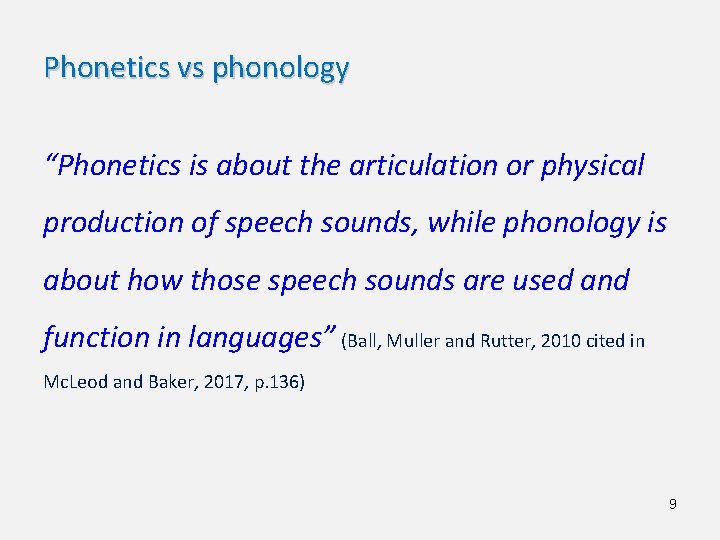
Phonetics vs phonology “Phonetics is about the articulation or physical production of speech sounds, while phonology is about how those speech sounds are used and function in languages” (Ball, Muller and Rutter, 2010 cited in Mc. Leod and Baker, 2017, p. 136) 9
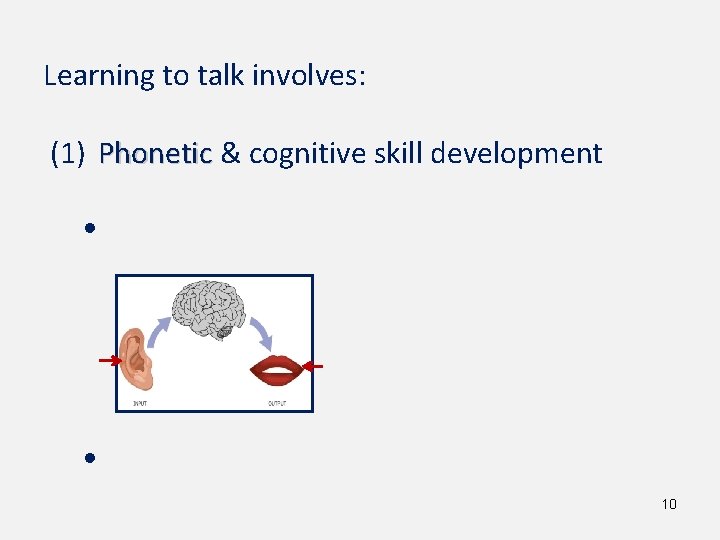
Learning to talk involves: (1) Phonetic & cognitive skill development • • 10
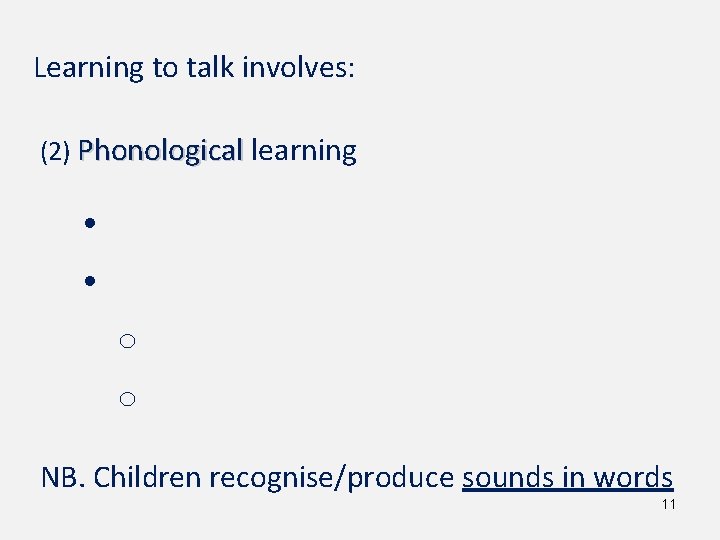
Learning to talk involves: (2) Phonological learning • • o o NB. Children recognise/produce sounds in words 11
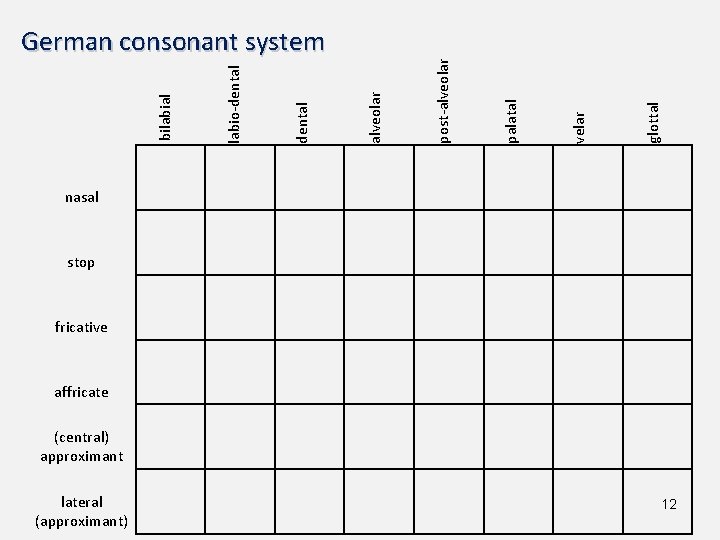
glottal velar palatal post-alveolar dental labio-dental bilabial German consonant system nasal stop fricative affricate (central) approximant lateral (approximant) 12
Exercise Set A (2; 6 yrs) 1) Give the phonemic (SBS) transcription for each of the words listed in column 1 NB. SBS = Southern British Standard accent system 13
Orthographic gloss Adult target / / Child’s realisation [ ] cake geese bag king kangaroo NB! /i/ or /i /, /u/ or /u / Long vowels with or without length marks either is acceptable 14
2) You will hear a number of immature pronunciations based on the child’s attempts at producing these words. Phonetically transcribe these in column 3. 15
Orthographic gloss Adult target / / Child’s realisation [ ] cake geese bag king kangaroo NB! /i/ ~ /i /, /u/ ~ /u / Long vowels with or without length marks either is acceptable 16
3) Using your phoneme grid for reference, identify the speech ‘error’ pattern/s and describe what is happening in phonetic terms. 17
Orthographic Adult target gloss / / Child’s realisation [ ] cake geese bag king kangaroo 18
Pattern 19
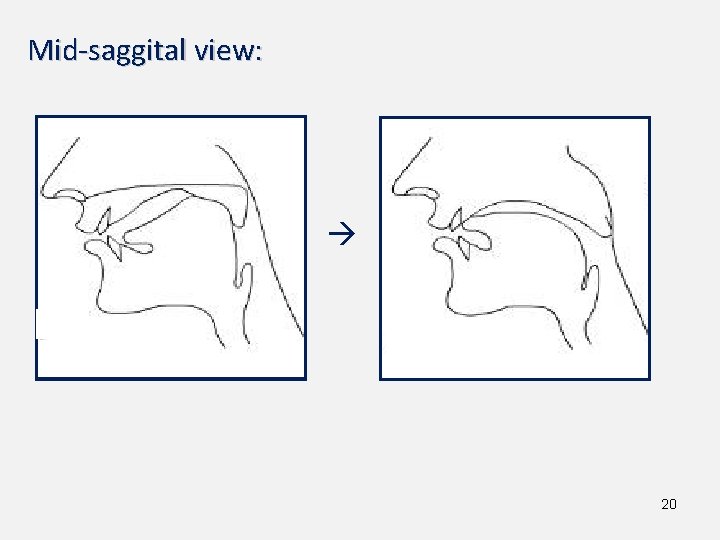
Mid-saggital view: 20
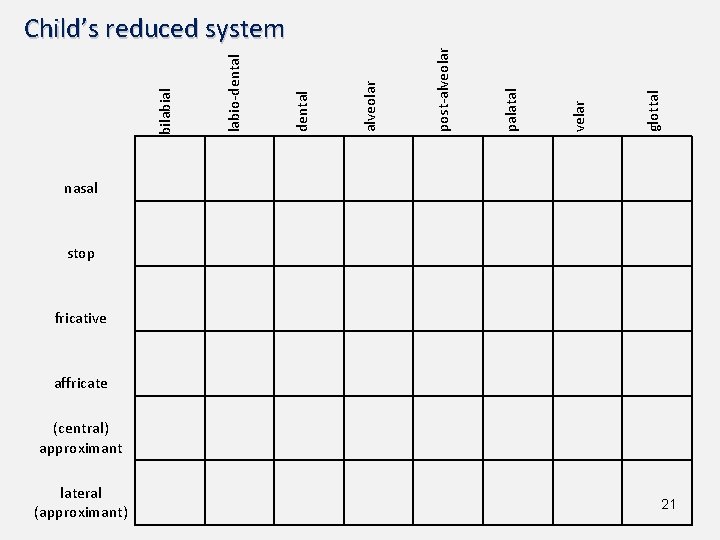
glottal velar palatal post-alveolar dental labio-dental bilabial Child’s reduced system nasal stop fricative affricate (central) approximant lateral (approximant) 21
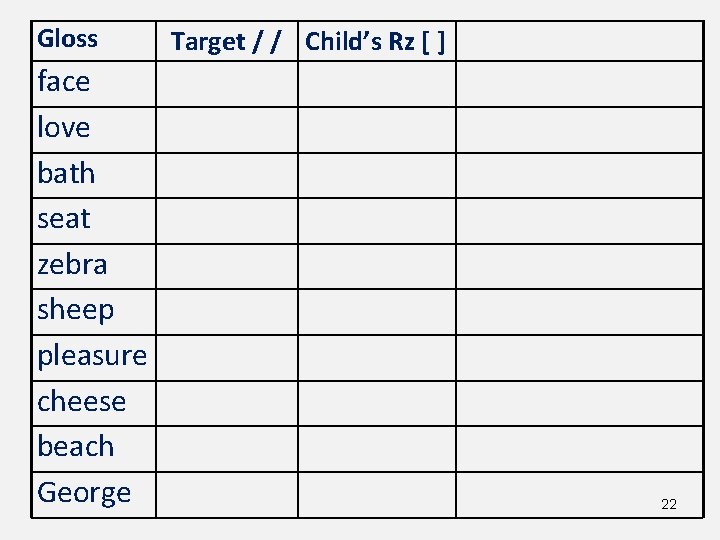
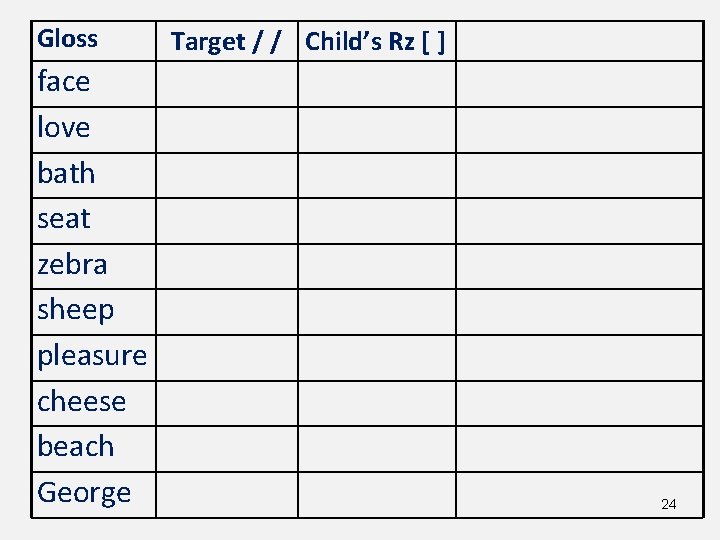
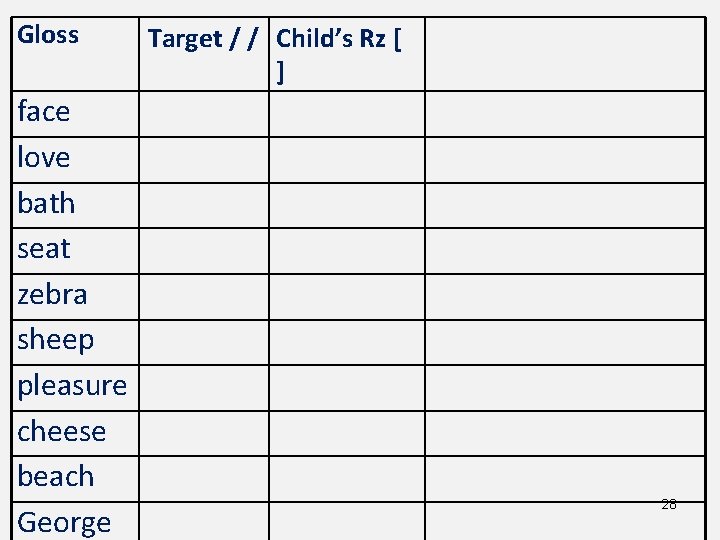
Gloss face love bath seat zebra sheep pleasure cheese beach George Target / / Child’s Rz [ ] 22
Exercise Set B (3; 0 yrs) 1) Give the phonemic (SBS) transcription for each of the words listed in column 1. 23
Gloss face love bath seat zebra sheep pleasure cheese beach George Target / / Child’s Rz [ ] 24
2) Phonetically transcribe the child’s realisations in column 3. 25
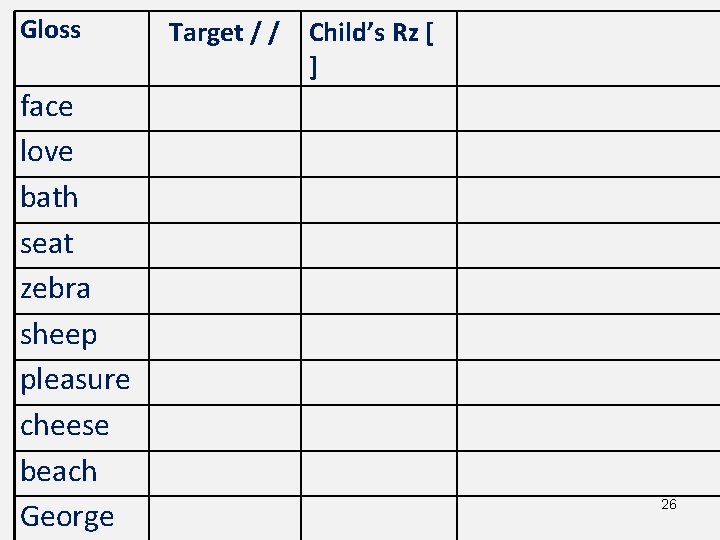
Gloss face love bath seat zebra sheep pleasure cheese beach George Target / / Child’s Rz [ ] 26
3) Using your phoneme grid for reference, identify the speech ‘error’ pattern/s and describe what is happening in phonetic terms. 27
Gloss face love bath seat zebra sheep pleasure cheese beach George Target / / Child’s Rz [ ] 28
Pattern 29
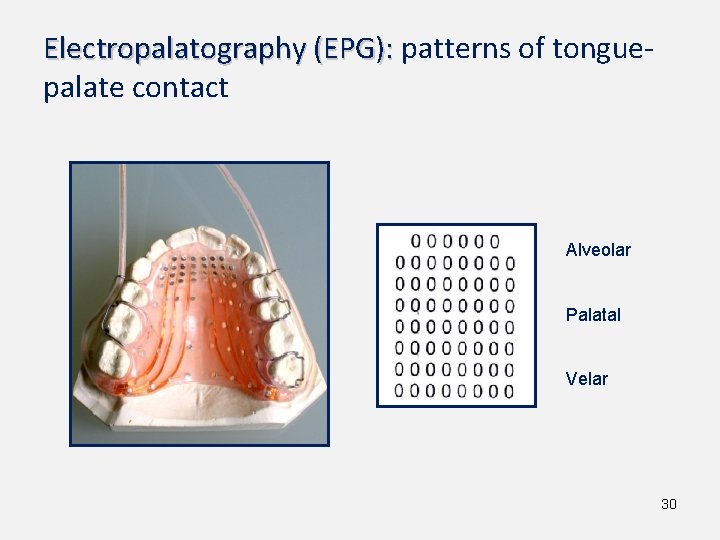
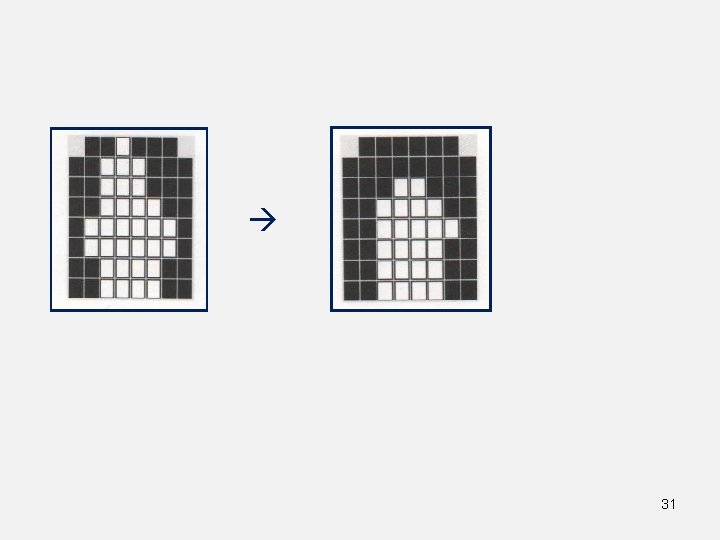
Electropalatography (EPG): patterns of tonguepalate contact Alveolar Palatal Velar 30
31
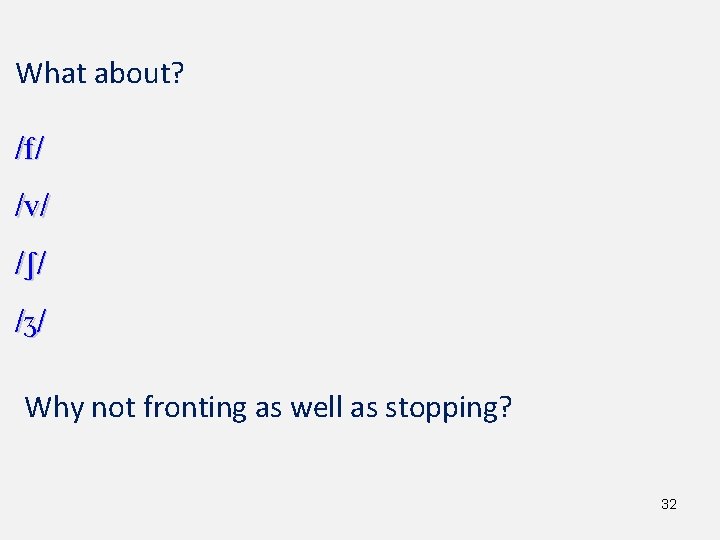
What about? /f/ /v/ /S/ / Z/ Why not fronting as well as stopping? 32
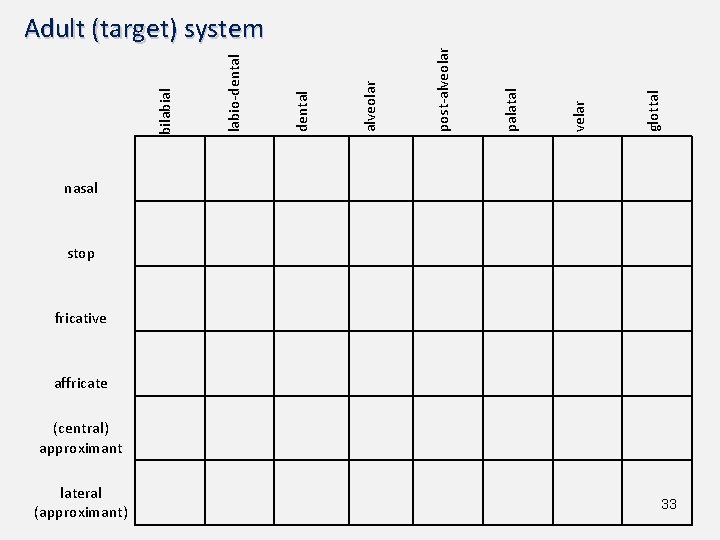
glottal velar palatal post-alveolar dental labio-dental bilabial Adult (target) system nasal stop fricative affricate (central) approximant lateral (approximant) 33
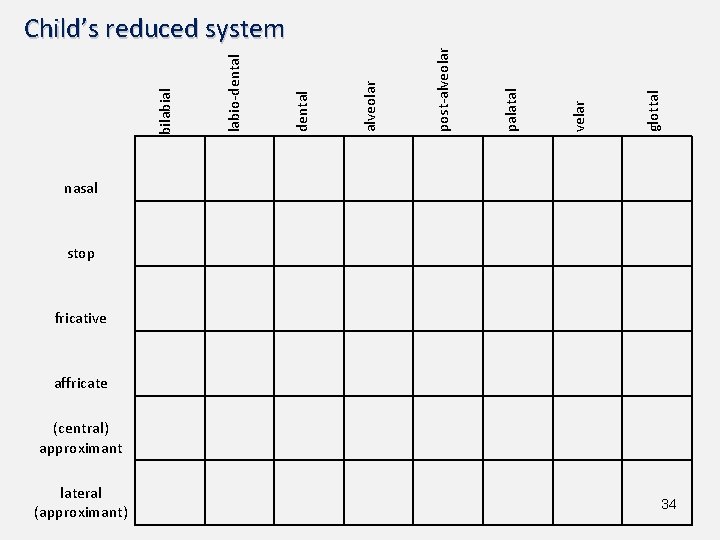
glottal velar palatal post-alveolar dental labio-dental bilabial Child’s reduced system nasal stop fricative affricate (central) approximant lateral (approximant) 34
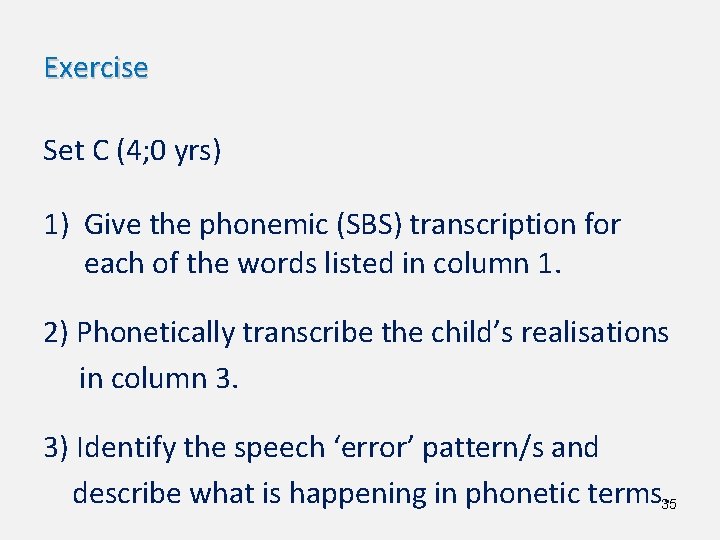
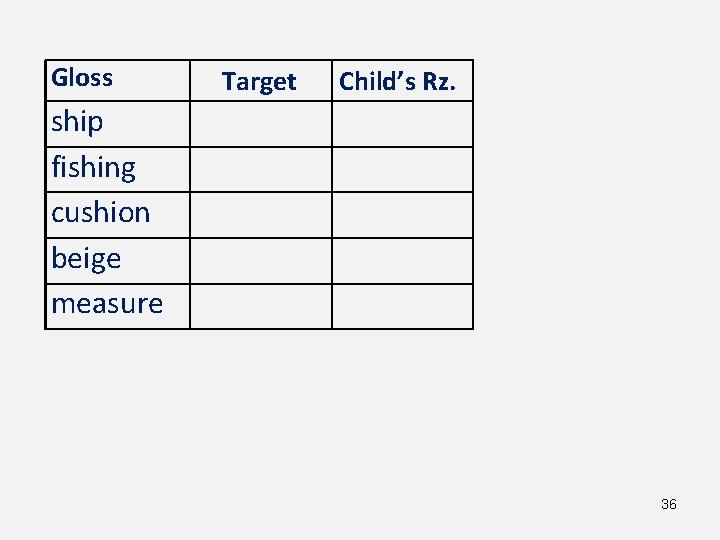
Exercise Set C (4; 0 yrs) 1) Give the phonemic (SBS) transcription for each of the words listed in column 1. 2) Phonetically transcribe the child’s realisations in column 3. 3) Identify the speech ‘error’ pattern/s and describe what is happening in phonetic terms. 35
Gloss Target Child’s Rz. ship fishing cushion beige measure 36
Exercise Set D (2; 6 yrs) 1) Give the phonemic (SBS) transcription for each of the words listed in column 1. 2) Phonetically transcribe the child’s realisations in column 3. 3) Identify the speech ‘error’ pattern/s and describe what is happening in phonetic terms. 37
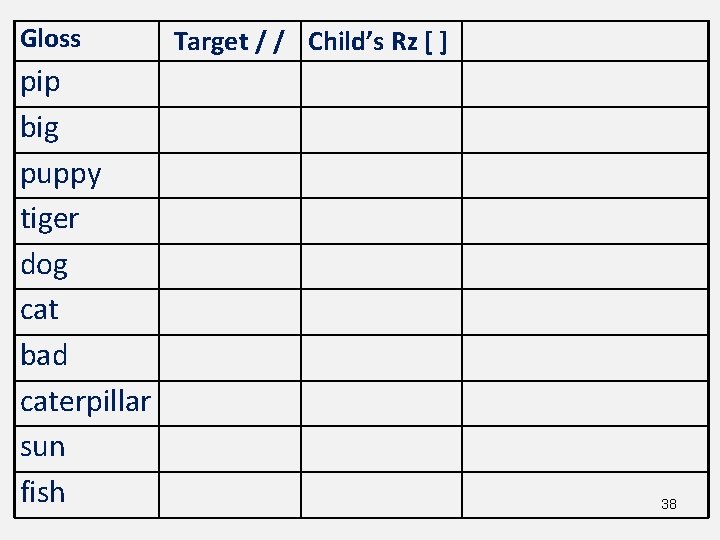
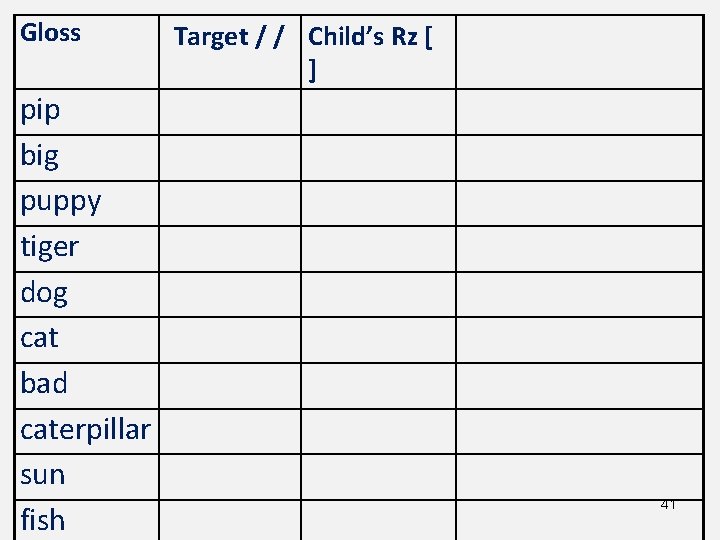
Gloss pip big puppy tiger dog cat bad caterpillar sun fish Target / / Child’s Rz [ ] 38
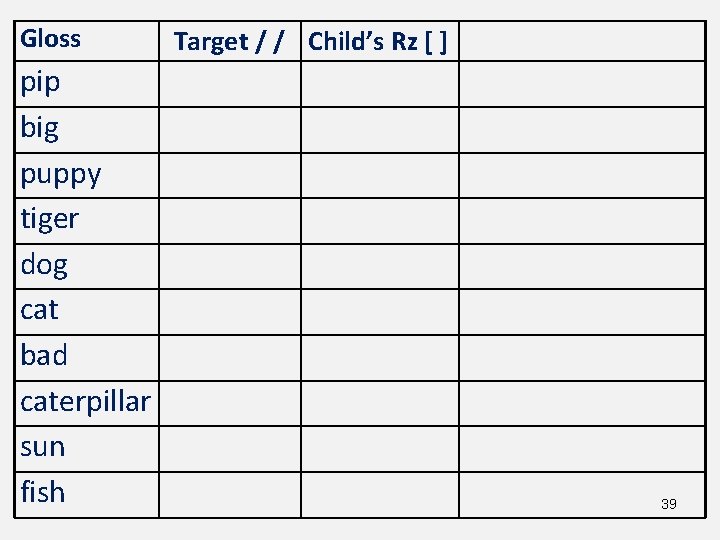
Gloss pip big puppy tiger dog cat bad caterpillar sun fish Target / / Child’s Rz [ ] 39
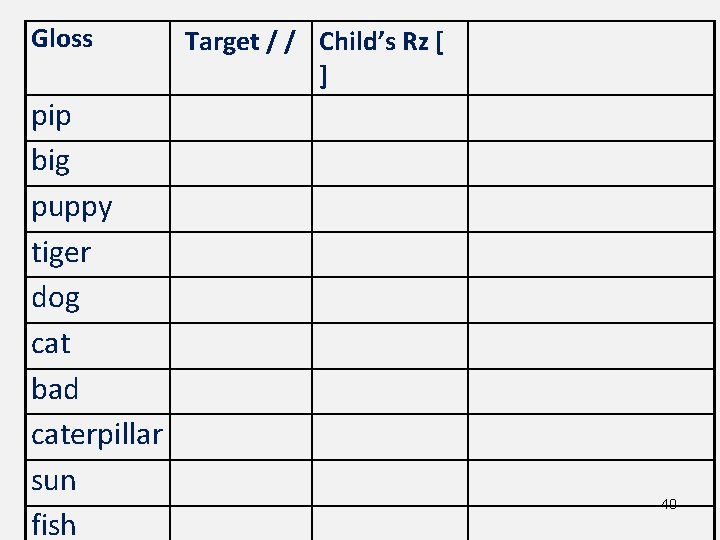
Gloss pip big puppy tiger dog cat bad caterpillar sun fish Target / / Child’s Rz [ ] 40
Gloss pip big puppy tiger dog cat bad caterpillar sun fish Target / / Child’s Rz [ ] 41
Patterns 42
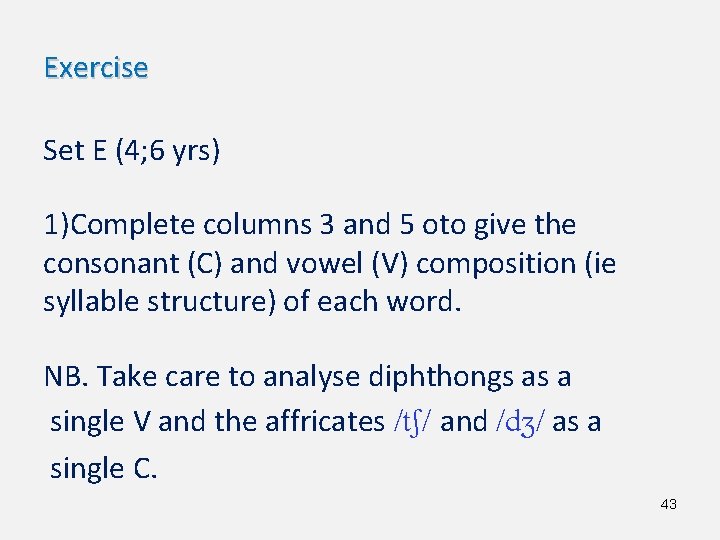
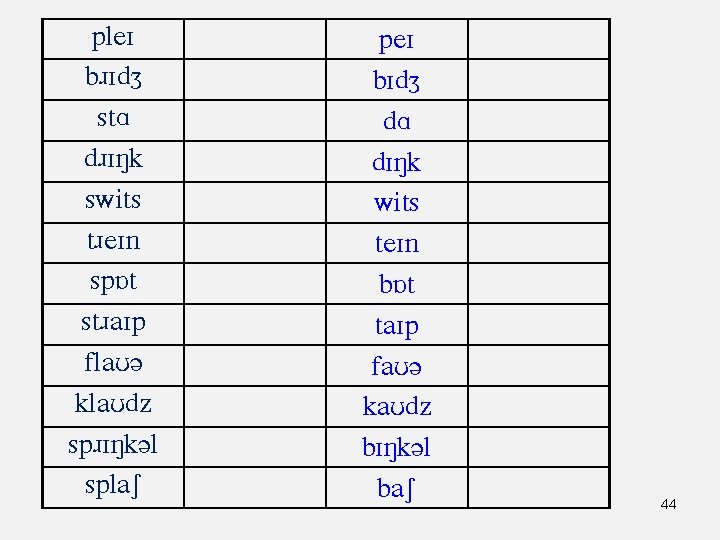
Exercise Set E (4; 6 yrs) 1)Complete columns 3 and 5 oto give the consonant (C) and vowel (V) composition (ie syllable structure) of each word. NB. Take care to analyse diphthongs as a single V and the affricates /tʃ/ and /dʒ/ as a single C. 43
ple. I b Id. Z st. A d INk swits t e. In sp t st a. Ip fla. U kla. Udz sp INk l spla. S pe. I b. Id. Z d. A d. INk wits te. In b t ta. Ip fa. U ka. Udz b. INk l ba. S 44
2) How do these patterns differ from the previous patterns? Do they affect the segmental or structural composition of the target word? 45
Pattern 46
/s/ clusters 47
Obstruent + liquid clusters 48
/s/ + obstruent + liquid clusters 49
Exercise Set F (3; 0 yrs) 1) How so Child A and Child B differ in their treatment of the velar plosives /k, g/? 2) How might you explain Child C’s variable treatment of velar plosives, ie can you find a pattern? 50
Pattern 51
Natural Phonological Processes • Are a characteristic feature of the speech of young typically developing children • Segmental processes reflect difficulty contrasting sounds along 3 key phonetic dimensions: voicing, place, manner o typically affect groups of sounds, ie natural classes 52
Natural Phonological Processes • Structural processes reflect difficulty achieving the full range of syllable structures or ‘word shapes’ o final consonants (CVC), clusters (CCVC), weak syllables in multi-syllabic words 53
Natural Phonological Processes • May interact, eg /s n/ [d n] /s n/ [g n] • May be conditioned by word position or phonetic context, ie application is not necessarily 100% 54
Natural Phonological Processes • May persist in the speech of some children beyond the typical age of suppression = phonological delay = reduced system of sound contrasts 55
For next week Complete: • Phonological Process Table (see LS) Mc. Leod and Baker (2017) Chapter 5, pp. 135 -139, 145 -146, 151 -159 • Linguistic profiling exercise (see LS) 56
Phonetics revision (see LS) • e-learning resource • formative quiz Knight, R. (2012) Phonetics: A Coursebook. Cambridge University Press Mc. Leod, S. & Baker, E. (2017) Children’s Speech: Evidence –Based Approach to Intervention and Management. Chapter 4 57
Further Useful Reading Flahive, L. K. and Hodson, B. W. (2014) Speech Sound Disorders: An Overview of Acquisition, Assessment, and Treatment. In N. C. Capone Singleton and B. B. Shulman, (Eds) Language Development: Foundations, Processes and Clinical Applications. Jones Bartlett Learning Stoel-Gammon, C. and Vogel Sosa, A. (2009) Phonological Development. In E. Hoff and M. Shatz (Eds) Blackwell Handbook of Language Development (pp. 238 -257). Wiley-Blackwell. 58