
SLSA Advanced Resuscitation PUAEME 003 B Administer Oxygen
SLSA Advanced Resuscitation PUAEME 003 B Administer Oxygen In An Emergency Situation Chapter 23 – Advanced Resuscitation and Oxygen Administration © Surf Life Saving Australia – Version 1 SLSA Advanced Resuscitation / PUAEME 003 B Administer Oxygen in an Emergency Situation 23. 1
UNIT 23 – ADVANCED RESUSCITATION AND OXYGEN ADMINISTRATION © Surf Life Saving Australia – Version 1 SLSA Advanced Resuscitation / PUAEME 003 B Administer Oxygen in an Emergency Situation 23. 2
Advanced Resuscitation Why Use Oxygen? (pg 162) The Components Of Oxygen Resuscitation Equipment (pg 162) Administering Oxygen Therapy (pg 164) Setting Up Oxygen Resuscitation Equipment (pg 165) Equipment Maintenance (pg 166) Administering Suction* (pg 167) Automatic Oxygen-Powered Resuscitator* (pg 167) Oropharyngeal Airways (pg 168) *These 2 sections are NOT part of the SLSA Advanced Resuscitation Certificate. They can be trained and utilised by qualified personnel ONLY Page numbers refer to the SLSA First Aid & Emergency Care Manual © Surf Life Saving Australia – Version 1 SLSA Advanced Resuscitation / PUAEME 003 B Administer Oxygen in an Emergency Situation 23. 3
Prerequisites • A candidate must be a minimum age of 15 years old on the date of final assessment, AND • Hold the PUAEME 001 A ‘Provide Emergency Care’ Competency, found in the SLSA 32 nd Edition Training Manual: – Unit 3 – Anatomy and Physiology – Unit 4 – Basic First Aid – Unit 5 – First Aid – Unit 6 –Resuscitation – Unit 7 – Basic Oxygen • Also from SLSA FAEC Manual – Chapter 8 – Respiratory Emergencies © Surf Life Saving Australia – Version 1 SLSA Advanced Resuscitation / PUAEME 003 B Administer Oxygen in an Emergency Situation 23. 4
Why use Oxygen? Patients likely to benefit from oxygen include those with the following conditions: • Unconsciousness • Shock • Blood loss • Chest pain • Shortness of breath, including asthma • Circulatory distress • Severe pain • Injuries • After resuscitation • Absent breathing © Surf Life Saving Australia – Version 1 SLSA Advanced Resuscitation / PUAEME 003 B Administer Oxygen in an Emergency Situation 23. 5

Oxygen Safety precautions when using oxygen: • Never use oxygen near an open flame • Never use oxygen near cigarettes • Never use grease or oil with oxygen equipment • Oxygen promotes combustion • Do not tamper with oxygen equipment • Store in a cool place • Store oxygen bottles lying flat, or securely fastened if upright • Use only medical oxygen • Do not use when delivering a shock via a defibrillator © Surf Life Saving Australia – Version 1 SLSA Advanced Resuscitation / PUAEME 003 B Administer Oxygen in an Emergency Situation 23. 6

Components of Oxygen Resuscitation Equipment • • • Protective case Medical oxygen cylinder Cylinder cradle Cylinder yoke Sealing washer Locating pins Thumb screw Cylinder key wheel External cylinder connection Contents gauge © Surf Life Saving Australia – Version 1 SLSA Advanced Resuscitation / PUAEME 003 B Administer Oxygen in an Emergency Situation 23. 7

Components of Oxygen Resuscitation Equipment • • • Regulator OP airways Airbag Oxygen reservoir bag Tubing Control valves Anaesthetic masks Therapy masks Chalk Gloves Pens, pencils & paper © Surf Life Saving Australia – Version 1 Other equipment (optional): • Automatic oxygenpowered resuscitator • Suction SLSA Advanced Resuscitation / PUAEME 003 B Administer Oxygen in an Emergency Situation 23. 8
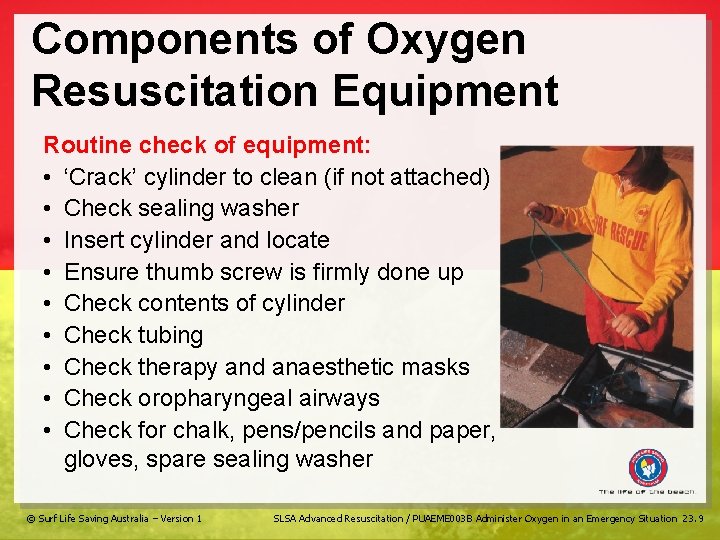
Components of Oxygen Resuscitation Equipment Routine check of equipment: • ‘Crack’ cylinder to clean (if not attached) • Check sealing washer • Insert cylinder and locate • Ensure thumb screw is firmly done up • Check contents of cylinder • Check tubing • Check therapy and anaesthetic masks • Check oropharyngeal airways • Check for chalk, pens/pencils and paper, gloves, spare sealing washer © Surf Life Saving Australia – Version 1 SLSA Advanced Resuscitation / PUAEME 003 B Administer Oxygen in an Emergency Situation 23. 9

Components of Oxygen Resuscitation Equipment Routine check of equipment (cont’d): • Check flow of oxygen • Check there is no odour from oxygen • Check operation of oxygen nipples • Check airbag (5 checks) • Close cylinder valve and drain oxygen from system • Check additional equipment (eg Suction, etc) The SLSA Oxygen Equipment Policy is located on SLSA website at www. slsa. com. au © Surf Life Saving Australia – Version 1 SLSA Advanced Resuscitation / PUAEME 003 B Administer Oxygen in an Emergency Situation 23. 10
Components of Oxygen Resuscitation Equipment Checking Suction (optional): • Remove large suction tubing and hold near open end • Turn suction lever fully on • Test for suction • Turn lever off • Remove catheter and fit to large tubing • Turn suction lever fully on • Test for suction again • Turn lever off • Return to case in original position © Surf Life Saving Australia – Version 1 SLSA Advanced Resuscitation / PUAEME 003 B Administer Oxygen in an Emergency Situation 23. 11

Components of Oxygen Resuscitation Equipment Automatic oxygen-powered resuscitator (optional): • As per oxygen equipment plus: – Block off powerhead/ demand valve outlet with 1 hand trigger the device – Check for valve release – Check for blockages © Surf Life Saving Australia – Version 1 SLSA Advanced Resuscitation / PUAEME 003 B Administer Oxygen in an Emergency Situation 23. 12

Administering Oxygen Therapy • Check oxygen before each use • Place unit in appropriate position to operate • Connect therapy mask to tubing and turn on oxygen • Place mask on patient’s face – Adjust accordingly • Reassure the patient If a conscious patient does not want to use the mask, they can hold the mask in front of their face, or remove the tubing from it and direct the oxygen flow around the mouth and nose © Surf Life Saving Australia – Version 1 SLSA Advanced Resuscitation / PUAEME 003 B Administer Oxygen in an Emergency Situation 23. 13
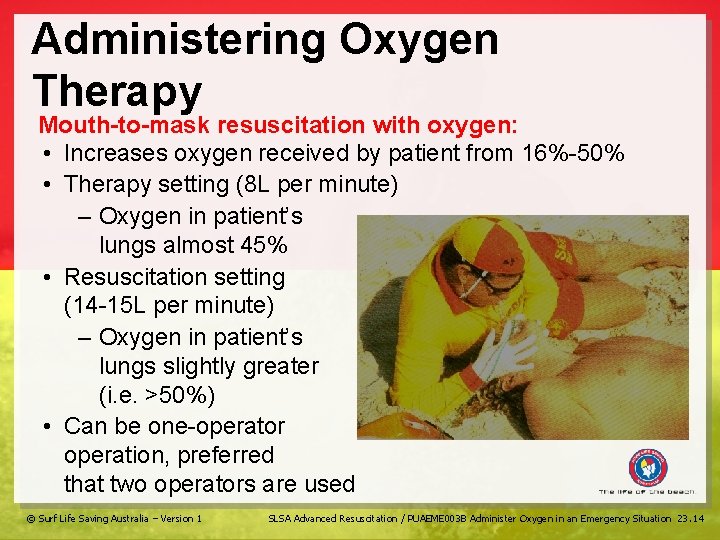
Administering Oxygen Therapy Mouth-to-mask resuscitation with oxygen: • Increases oxygen received by patient from 16%-50% • Therapy setting (8 L per minute) – Oxygen in patient’s lungs almost 45% • Resuscitation setting (14 -15 L per minute) – Oxygen in patient’s lungs slightly greater (i. e. >50%) • Can be one-operator operation, preferred that two operators are used © Surf Life Saving Australia – Version 1 SLSA Advanced Resuscitation / PUAEME 003 B Administer Oxygen in an Emergency Situation 23. 14

Administering Oxygen Therapy Airbag checks: • Check airbags by blocking patient valve • Check function of disc membrane on patient valve • Check overflow of membrane of reservoir valve – (Laerdal bag only) • Check air-intake membrane (rear valve of airbag) – (Laerdal bag only) © Surf Life Saving Australia – Version 1 SLSA Advanced Resuscitation / PUAEME 003 B Administer Oxygen in an Emergency Situation 23. 15

Administering Oxygen Therapy Airbag oxygen resuscitator: • Will supply the patient with up to 95% oxygen with flow rate of 14 -15 L per minute • Possible for mouth-tomask resuscitation with oxygen using therapy tubing whilst oxygen unit is being set up © Surf Life Saving Australia – Version 1 SLSA Advanced Resuscitation / PUAEME 003 B Administer Oxygen in an Emergency Situation 23. 16

Setting Up Oxygen Resuscitation Equipment • Inform others of who you are and your qualifications • Set up and place unit in appropriate position to operate • Anaesthetic mask to Airway operator – If not already being used • Quickly check: – Operation of patient valve – Valve to oxygen reservoir bag – Connection to oxygen supply • Turn on oxygen to 14 -15 L per minute to allow inflation of airbag reservoir © Surf Life Saving Australia – Version 1 SLSA Advanced Resuscitation / PUAEME 003 B Administer Oxygen in an Emergency Situation 23. 17

Setting Up Oxygen Resuscitation Equipment Procedure: • Inform other operators airbag is ready • Attach patient valve with no change to Rescue Breathing rate • Airbag oxygen resuscitator compressed with 2 hands (for adult) using gentle squeezing motion • Squeeze airbag until chest rises – Bag released and allowed to refill The rise and fall of the patient’s chest should be watched at all times during this procedure by both Airway and oxygen airbag operators © Surf Life Saving Australia – Version 1 SLSA Advanced Resuscitation / PUAEME 003 B Administer Oxygen in an Emergency Situation 23. 18
Setting Up Oxygen Resuscitation Equipment Procedure (cont’d): • Remove oxygen equipment if not operating properly and continue with Rescue Breathing • Recommended that 3 operators be present for operation during CPR • Paediatric airbag (if available) should be used for children – Compressed with 1 hand • Airbag resuscitators are not designed for infants, and therefore should NOT be used on infants • Can use airbag without oxygen bottle – Remove reservoir bag © Surf Life Saving Australia – Version 1 SLSA Advanced Resuscitation / PUAEME 003 B Administer Oxygen in an Emergency Situation 23. 19
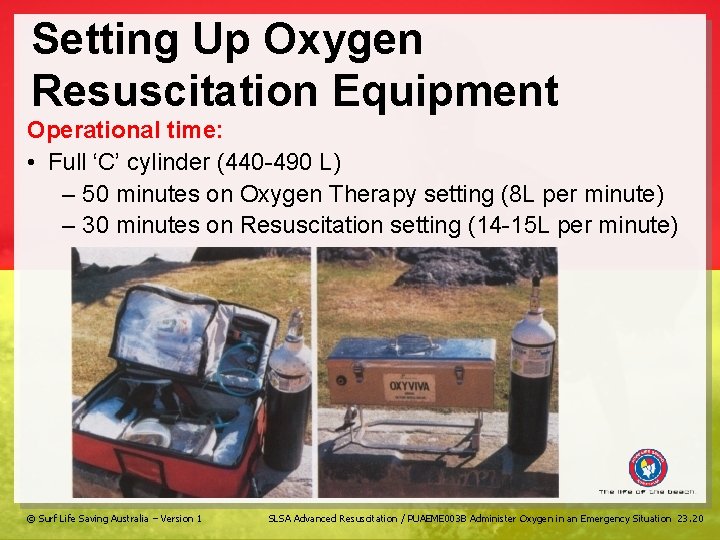
Setting Up Oxygen Resuscitation Equipment Operational time: • Full ‘C’ cylinder (440 -490 L) – 50 minutes on Oxygen Therapy setting (8 L per minute) – 30 minutes on Resuscitation setting (14 -15 L per minute) © Surf Life Saving Australia – Version 1 SLSA Advanced Resuscitation / PUAEME 003 B Administer Oxygen in an Emergency Situation 23. 20
Equipment Maintenance General care: • Machine kept clean and free of sand/foreign materials • Checked: – After every teaching session – Before use each day • Removed from service immediately if default found • Serviced at least every 12 months © Surf Life Saving Australia – Version 1 SLSA Advanced Resuscitation / PUAEME 003 B Administer Oxygen in an Emergency Situation 23. 21
Equipment Maintenance Care after use: • Used oxygen therapy masks sent to hospital or disposed of • Tube • Anaesthetic masks • Patient valve Washed in warm soapy water for • Rear valve 2 minutes, then rinsed in fresh running water • Airbag • Reservoir valve • Oxygen reservoir © Surf Life Saving Australia – Version 1 SLSA Advanced Resuscitation / PUAEME 003 B Administer Oxygen in an Emergency Situation 23. 22
Equipment Maintenance Care after use (cont’d): • Contaminated parts: – Soaked in 70% alcoholic chlorhexidine or hypochlorite solution – For at least 2 minutes – Rinsed and dried • Operate all parts before storage to ensure they are operational After every use, the resuscitator should be disassembled, cleaned, disinfected, reassembled and tested in an orderly sequence © Surf Life Saving Australia – Version 1 SLSA Advanced Resuscitation / PUAEME 003 B Administer Oxygen in an Emergency Situation 23. 23
Equipment Maintenance Storage: • In a cool place • Spare oxygen bottles kept near equipment • Away from busy areas, sand, dust • Away from oil and grease DO NOT: • Store in enclosed space • Allow smoking or near naked flame • Leave pressure in system Empty cylinders should be filled without delay: • Half-full or less can be used for training © Surf Life Saving Australia – Version 1 SLSA Advanced Resuscitation / PUAEME 003 B Administer Oxygen in an Emergency Situation 23. 24
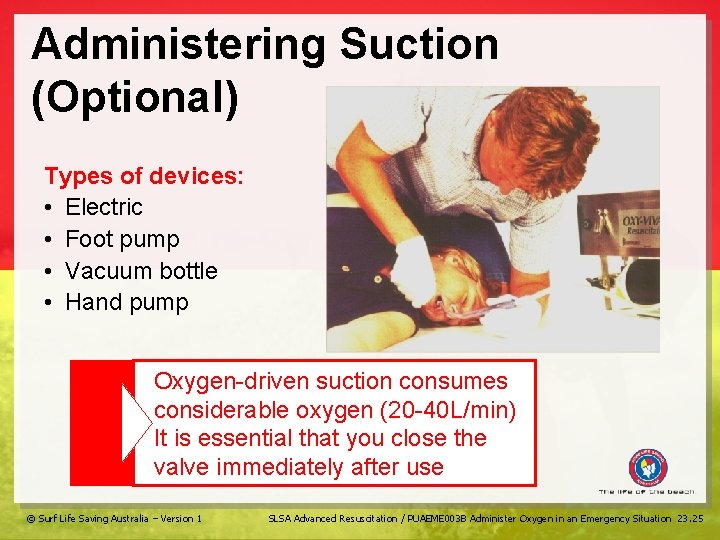
Administering Suction (Optional) Types of devices: • Electric • Foot pump • Vacuum bottle • Hand pump Oxygen-driven suction consumes considerable oxygen (20 -40 L/min) It is essential that you close the valve immediately after use © Surf Life Saving Australia – Version 1 SLSA Advanced Resuscitation / PUAEME 003 B Administer Oxygen in an Emergency Situation 23. 25
Administering Suction (Optional) Procedures: • Suction ONLY used in: – unconscious patient, or Where they can’t cough or swallow – Semiconscious patient Wearing gloves: • Attach suction catheter to suction tubing • Measure appropriate distance • Lubricate the catheter • Can repeat several times but no longer than 15 seconds – Prevents hypoxia developing • Check area between teeth and cheek, and under tongue © Surf Life Saving Australia – Version 1 SLSA Advanced Resuscitation / PUAEME 003 B Administer Oxygen in an Emergency Situation 23. 26
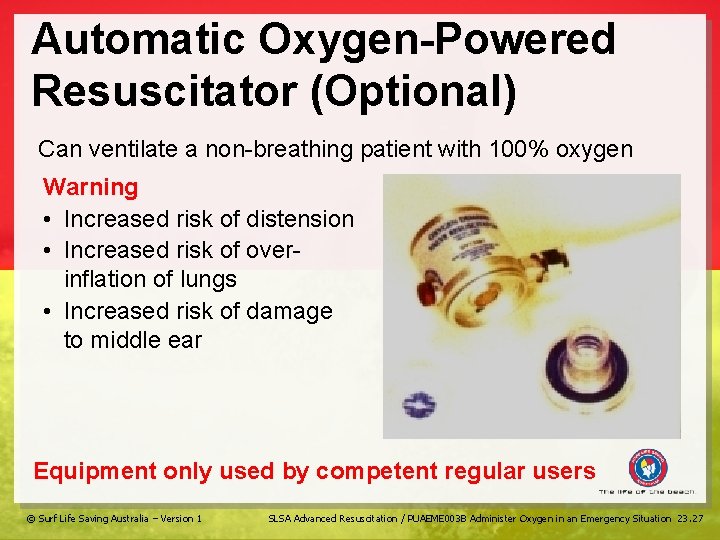
Automatic Oxygen-Powered Resuscitator (Optional) Can ventilate a non-breathing patient with 100% oxygen Warning • Increased risk of distension • Increased risk of overinflation of lungs • Increased risk of damage to middle ear Equipment only used by competent regular users © Surf Life Saving Australia – Version 1 SLSA Advanced Resuscitation / PUAEME 003 B Administer Oxygen in an Emergency Situation 23. 27
Automatic Oxygen-Powered Resuscitator (Optional) Procedure: • Oxygen supply ON • Control lever ON (if necessary) • Adjust tidal flow and/or frequency (if necessary) • Clear airway • Open airway using head tilt/jaw support • Insert oropharyngeal airway (if qualified) © Surf Life Saving Australia – Version 1 SLSA Advanced Resuscitation / PUAEME 003 B Administer Oxygen in an Emergency Situation 23. 28
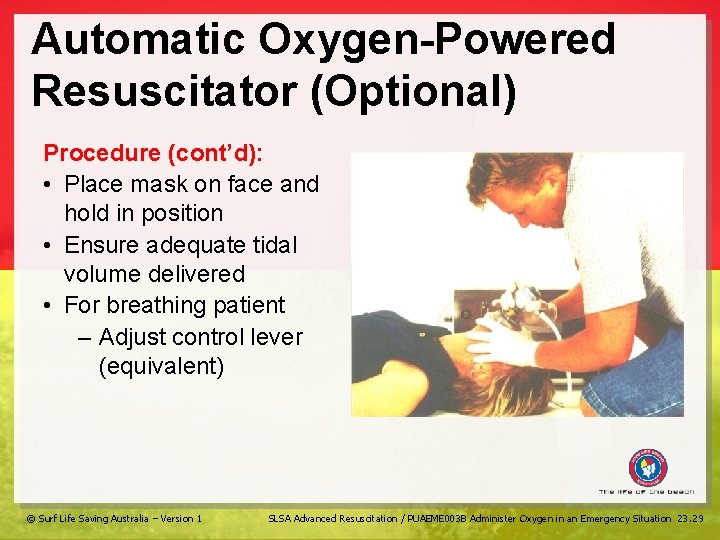
Automatic Oxygen-Powered Resuscitator (Optional) Procedure (cont’d): • Place mask on face and hold in position • Ensure adequate tidal volume delivered • For breathing patient – Adjust control lever (equivalent) © Surf Life Saving Australia – Version 1 SLSA Advanced Resuscitation / PUAEME 003 B Administer Oxygen in an Emergency Situation 23. 29
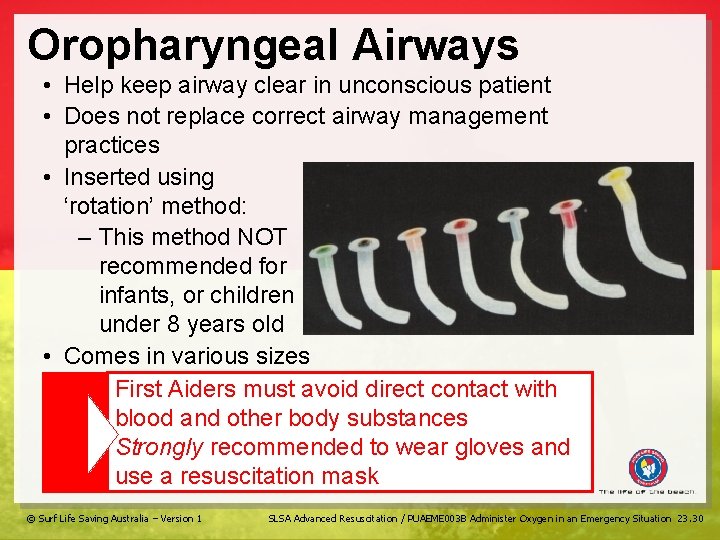
Oropharyngeal Airways • Help keep airway clear in unconscious patient • Does not replace correct airway management practices • Inserted using ‘rotation’ method: – This method NOT recommended for infants, or children under 8 years old • Comes in various sizes First Aiders must avoid direct contact with blood and other body substances Strongly recommended to wear gloves and use a resuscitation mask © Surf Life Saving Australia – Version 1 SLSA Advanced Resuscitation / PUAEME 003 B Administer Oxygen in an Emergency Situation 23. 30
Oropharyngeal Airways Care of OP airways: • Stored in a sterile state • Easily accessible in: – First aid kit – Oxygen unit – First aid rooms • Should be checked for deformities • If used for training purposes: – Mark with ‘Training Use Only’ – Washed after use in warm soapy water for 2 minutes minimum • OP airway appropriately disposed of after use on patient © Surf Life Saving Australia – Version 1 SLSA Advanced Resuscitation / PUAEME 003 B Administer Oxygen in an Emergency Situation 23. 31
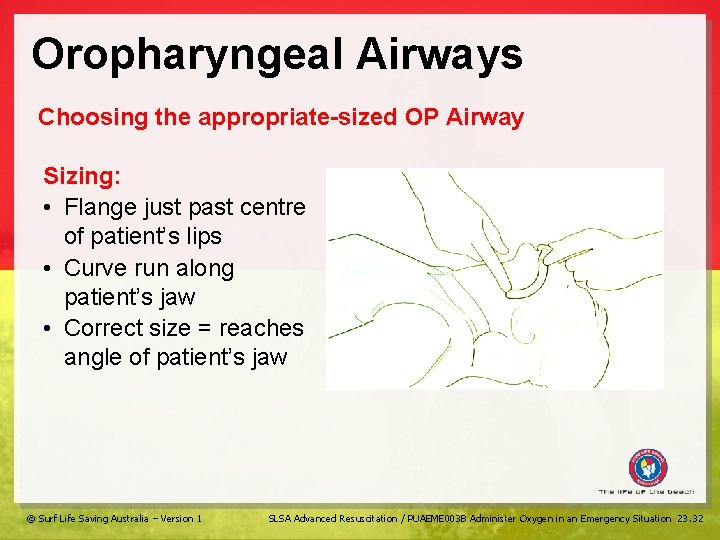
Oropharyngeal Airways Choosing the appropriate-sized OP Airway Sizing: • Flange just past centre of patient’s lips • Curve run along patient’s jaw • Correct size = reaches angle of patient’s jaw © Surf Life Saving Australia – Version 1 SLSA Advanced Resuscitation / PUAEME 003 B Administer Oxygen in an Emergency Situation 23. 32
Oropharyngeal Airways When to insert an OP airway: • Use is optional • <15 seconds to size and insert • Inserted into: – Unconscious patient in lateral position after airway cleared, or – During Rescue Breathing/CPR while patient on their back after stopping Rescue Breathing/CPR briefly The OP airway should NOT be inserted during delivery of chest compressions © Surf Life Saving Australia – Version 1 SLSA Advanced Resuscitation / PUAEME 003 B Administer Oxygen in an Emergency Situation 23. 33
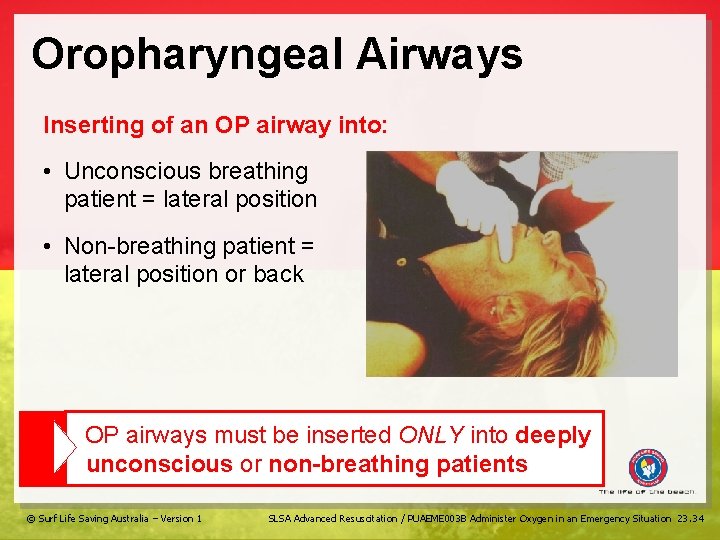
Oropharyngeal Airways Inserting of an OP airway into: • Unconscious breathing patient = lateral position • Non-breathing patient = lateral position or back OP airways must be inserted ONLY into deeply unconscious or non-breathing patients © Surf Life Saving Australia – Version 1 SLSA Advanced Resuscitation / PUAEME 003 B Administer Oxygen in an Emergency Situation 23. 34
Oropharyngeal Airways Inserting an OP airway: • Open patient’s airway • Ensure clear airway • Choose appropriate sized airway • Lubricate airway • Insert OP airway using ‘rotation’ method • Should slip easily into place Precautions when inserting an OP Airway • Ensure lower lip is not pinched • Ensure OP airway does not push tongue backwards and block airway • Ensure adequate head tilt before inserting OP airway • Don’t force the OP airway © Surf Life Saving Australia – Version 1 SLSA Advanced Resuscitation / PUAEME 003 B Administer Oxygen in an Emergency Situation 23. 35
Oropharyngeal Airways Removing the OP airway: • Remove immediately if signs of rejection of OP airway Remove by: • Sliding it out following its natural curve Do not attempt to rotate airway on removal IMPORTANT OP airways should not be used: • If patient is conscious or semiconscious • If correct size airway is not available • If there is a large amount of vomit © Surf Life Saving Australia – Version 1 SLSA Advanced Resuscitation / PUAEME 003 B Administer Oxygen in an Emergency Situation 23. 36

Thank You © Surf Life Saving Australia – Version 1 SLSA Advanced Resuscitation / PUAEME 003 B Administer Oxygen in an Emergency Situation 23. 37
- Slides: 37