
Slow Moving Capital Mark Mitchell CNH Partners Lasse
- Slides: 19
Slow Moving Capital Mark Mitchell CNH Partners Lasse Heje Pedersen NYU, NBER, and CEPR Todd Pulvino CNH Partners
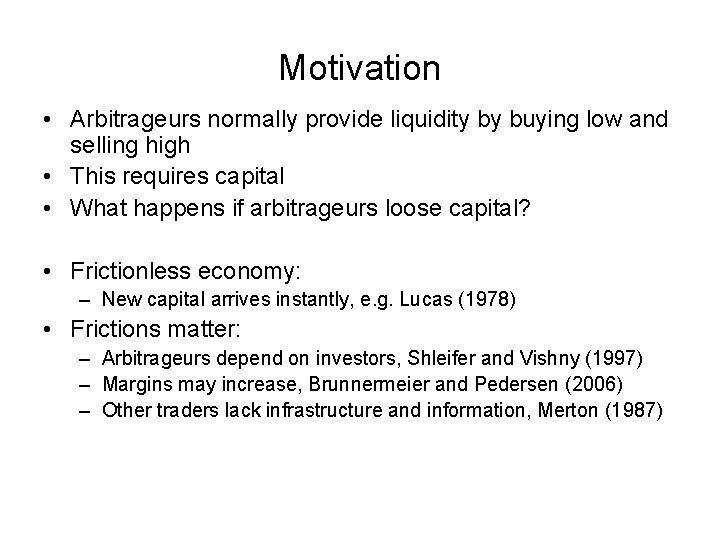
Motivation • Arbitrageurs normally provide liquidity by buying low and selling high • This requires capital • What happens if arbitrageurs loose capital? • Frictionless economy: – New capital arrives instantly, e. g. Lucas (1978) • Frictions matter: – Arbitrageurs depend on investors, Shleifer and Vishny (1997) – Margins may increase, Brunnermeier and Pedersen (2006) – Other traders lack infrastructure and information, Merton (1987)
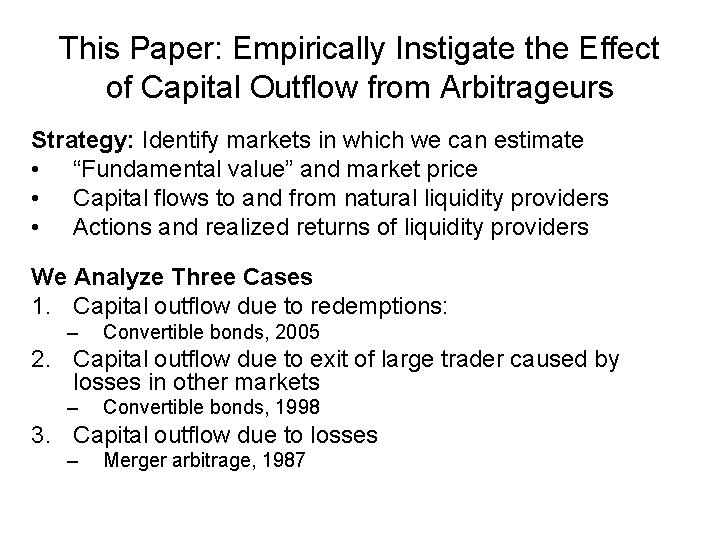
This Paper: Empirically Instigate the Effect of Capital Outflow from Arbitrageurs Strategy: Identify markets in which we can estimate • “Fundamental value” and market price • Capital flows to and from natural liquidity providers • Actions and realized returns of liquidity providers We Analyze Three Cases 1. Capital outflow due to redemptions: – Convertible bonds, 2005 2. Capital outflow due to exit of large trader caused by losses in other markets – Convertible bonds, 1998 3. Capital outflow due to losses – Merger arbitrage, 1987
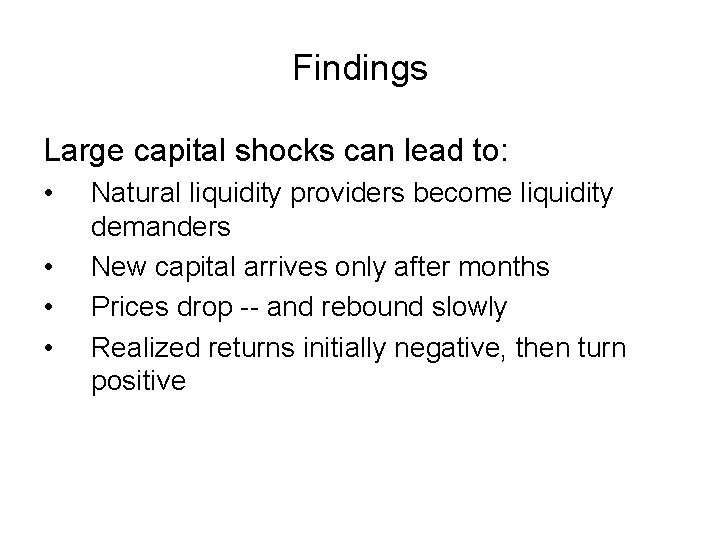
Findings Large capital shocks can lead to: • • Natural liquidity providers become liquidity demanders New capital arrives only after months Prices drop -- and rebound slowly Realized returns initially negative, then turn positive
Convertible Bonds • Convertible bond: – Corporate bond + call option (+ more) • Theoretical value can be inferred from – Issuer stock price – Stock price volatility – Option-implied volatility – Risk-free interest rates – Credit spreads
Convertible Bond Arbitrage • Buy convertible bond if it trades at a discount • Short the issuers stock • Potentially: – Short risk-free bonds – Short non-convertible bonds (or buy CDS) – Short stock options
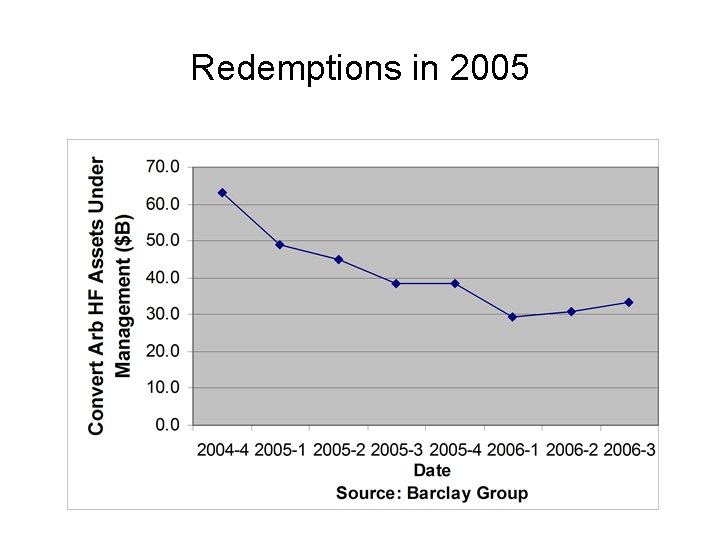
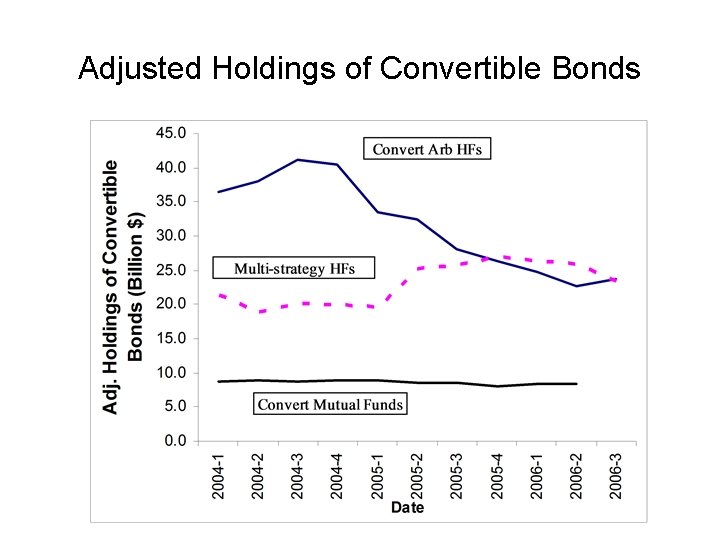
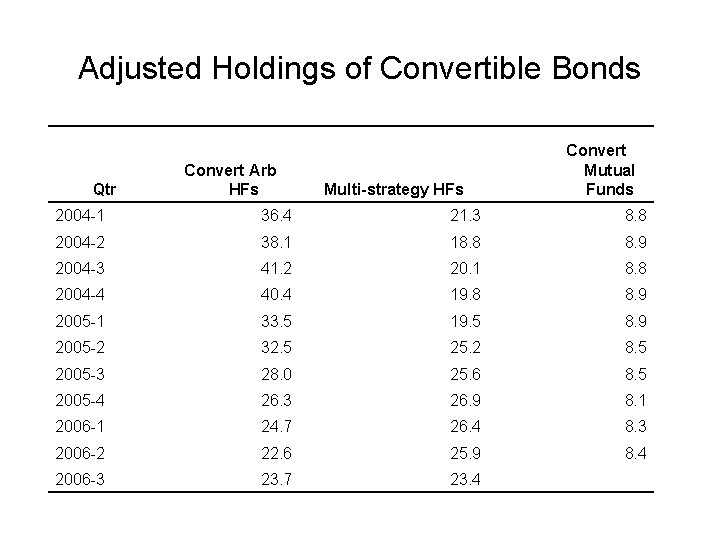
Analysis 1: Convertible Bond Arbitrage Capital Outflows in 2005 • Natural liquidity providers: Convertible Bond Arbitrage Hedge Funds (HFs) • Capital outflows in 2005: – 2005 Q 1: 20% capital redeemed – 2005 Q 1 – 2006 Q 1: assets fell by half • Convert Arb HFs sold convertible bonds
Redemptions in 2005
Adjusted Holdings of Convertible Bonds
Adjusted Holdings of Convertible Bonds Qtr Convert Arb HFs Multi-strategy HFs Convert Mutual Funds 2004 -1 36. 4 21. 3 8. 8 2004 -2 38. 1 18. 8 8. 9 2004 -3 41. 2 20. 1 8. 8 2004 -4 40. 4 19. 8 8. 9 2005 -1 33. 5 19. 5 8. 9 2005 -2 32. 5 25. 2 8. 5 2005 -3 28. 0 25. 6 8. 5 2005 -4 26. 3 26. 9 8. 1 2006 -1 24. 7 26. 4 8. 3 2006 -2 22. 6 25. 9 8. 4 2006 -3 23. 7 23. 4
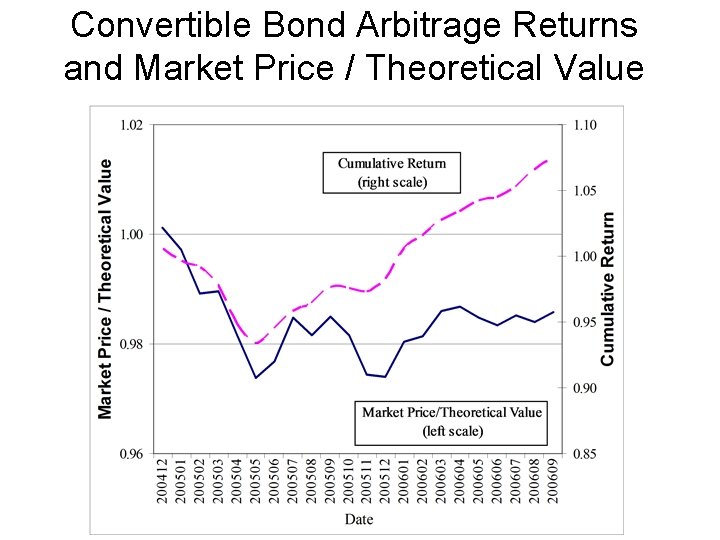
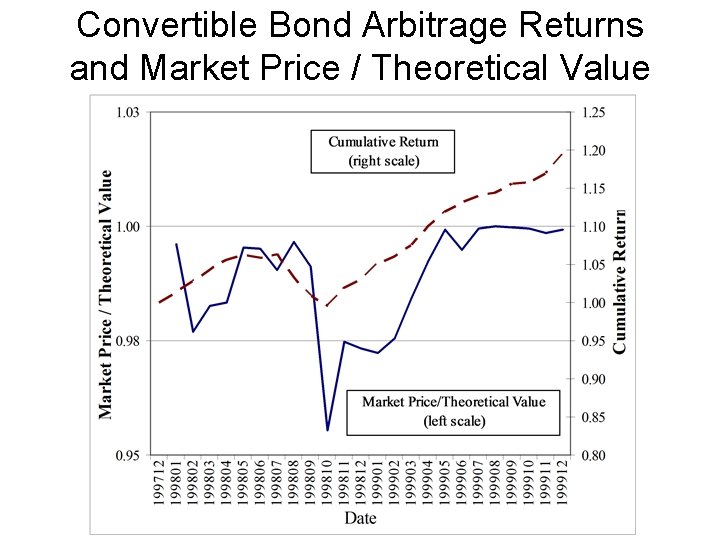
Convertible Bond Arbitrage Returns and Market Price / Theoretical Value
Interpretation • Prices drop and rebound • Price-to-fundamentals lowest around redemption notices (45 days before end of June and end of December) • Returns negative, then positive • Response by other traders: – Multi-strategy hedge funds – Mutual funds
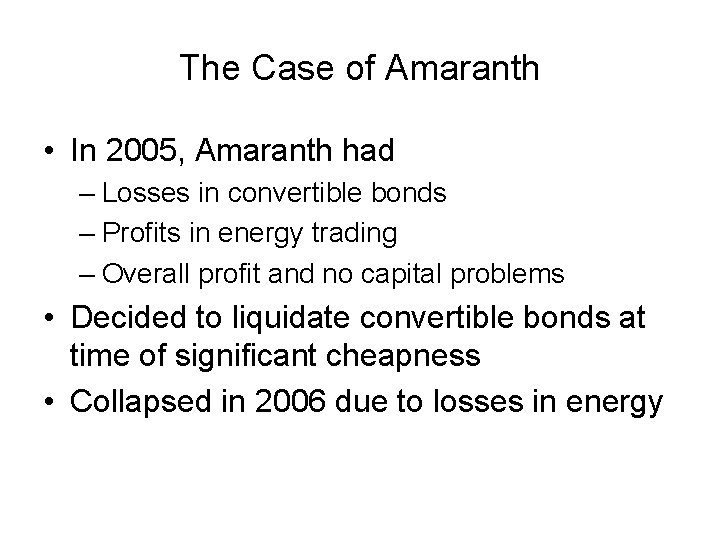
The Case of Amaranth • In 2005, Amaranth had – Losses in convertible bonds – Profits in energy trading – Overall profit and no capital problems • Decided to liquidate convertible bonds at time of significant cheapness • Collapsed in 2006 due to losses in energy
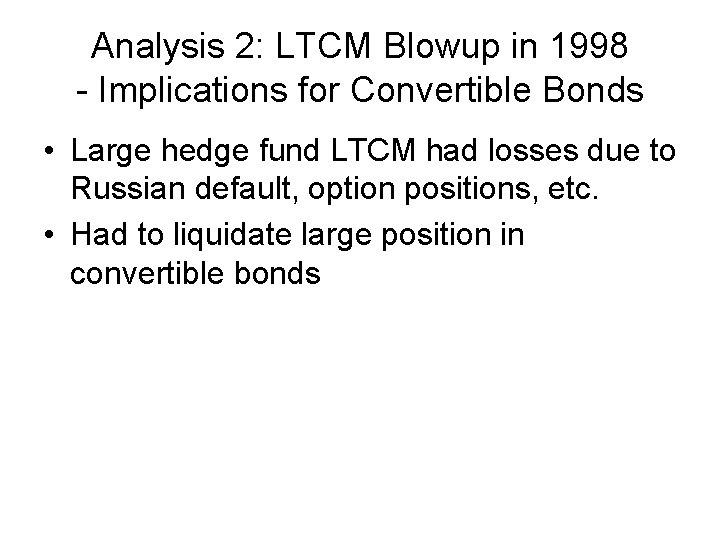
Analysis 2: LTCM Blowup in 1998 - Implications for Convertible Bonds • Large hedge fund LTCM had losses due to Russian default, option positions, etc. • Had to liquidate large position in convertible bonds
Convertible Bond Arbitrage Returns and Market Price / Theoretical Value
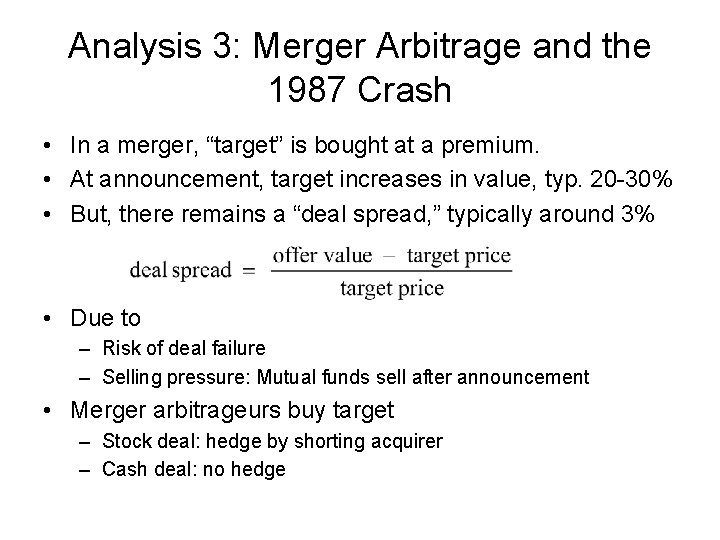
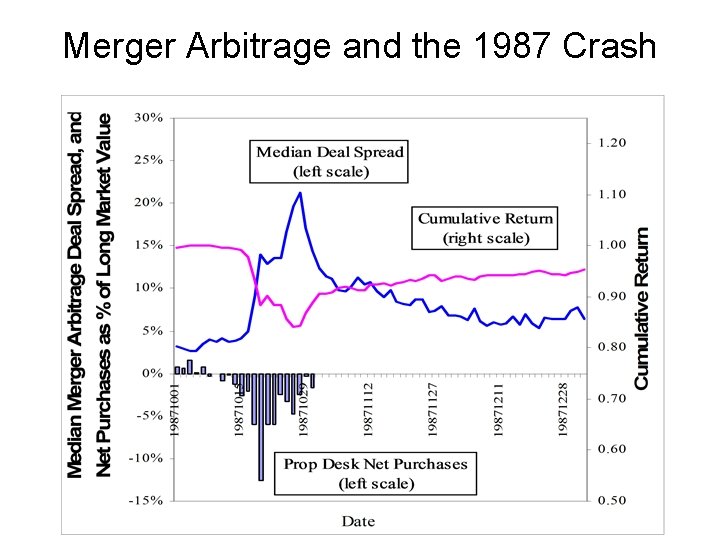
Analysis 3: Merger Arbitrage and the 1987 Crash • In a merger, “target” is bought at a premium. • At announcement, target increases in value, typ. 20 -30% • But, there remains a “deal spread, ” typically around 3% • Due to – Risk of deal failure – Selling pressure: Mutual funds sell after announcement • Merger arbitrageurs buy target – Stock deal: hedge by shorting acquirer – Cash deal: no hedge
Merger Arbitrage and the 1987 Crash
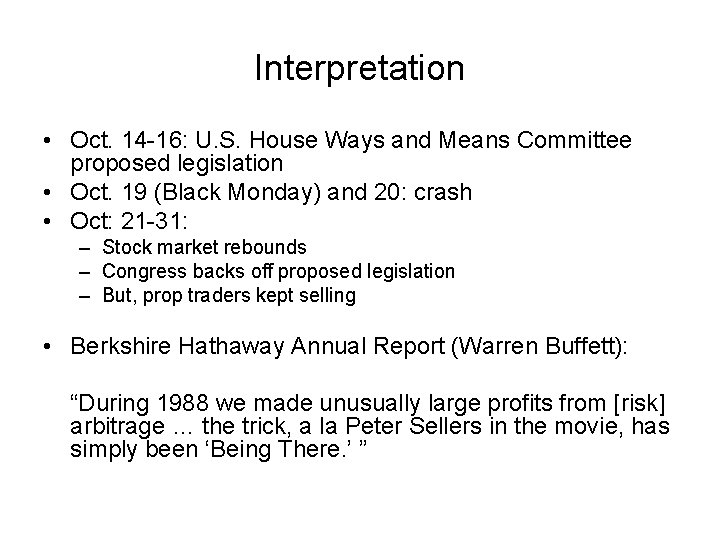
Interpretation • Oct. 14 -16: U. S. House Ways and Means Committee proposed legislation • Oct. 19 (Black Monday) and 20: crash • Oct: 21 -31: – Stock market rebounds – Congress backs off proposed legislation – But, prop traders kept selling • Berkshire Hathaway Annual Report (Warren Buffett): “During 1988 we made unusually large profits from [risk] arbitrage … the trick, a la Peter Sellers in the movie, has simply been ‘Being There. ’ ”
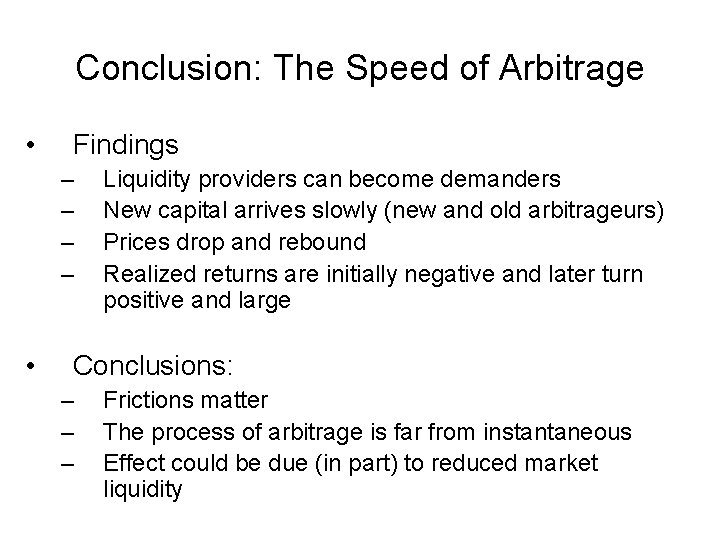
Conclusion: The Speed of Arbitrage • Findings – – • Liquidity providers can become demanders New capital arrives slowly (new and old arbitrageurs) Prices drop and rebound Realized returns are initially negative and later turn positive and large Conclusions: – – – Frictions matter The process of arbitrage is far from instantaneous Effect could be due (in part) to reduced market liquidity