
Slow Extraction for the Mu 2 e Experiment
- Slides: 17
Slow Extraction for the Mu 2 e Experiment at Fermilab Vladimir Nagaslaev, FNAL Slow Extraction Workshop, Darmstadt 1 June, 2016
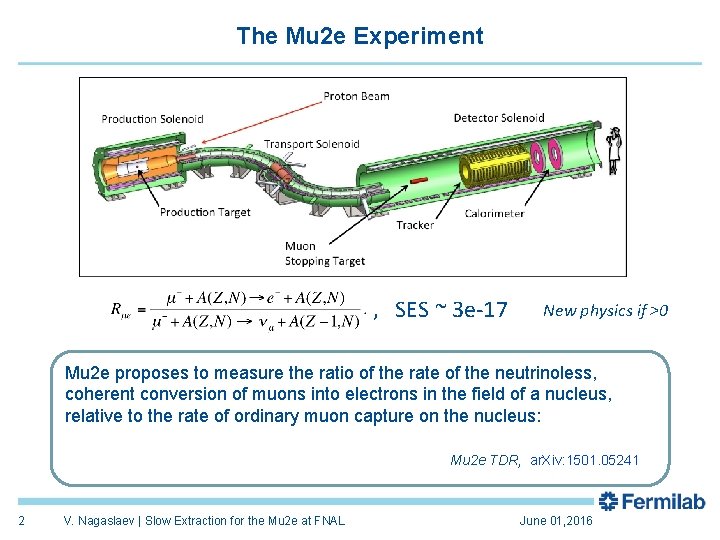
The Mu 2 e Experiment , SES ~ 3 e-17 New physics if >0 Mu 2 e proposes to measure the ratio of the rate of the neutrinoless, coherent conversion of muons into electrons in the field of a nucleus, relative to the rate of ordinary muon capture on the nucleus: Mu 2 e TDR, ar. Xiv: 1501. 05241 2 V. Nagaslaev | Slow Extraction for the Mu 2 e at FNAL June 01, 2016
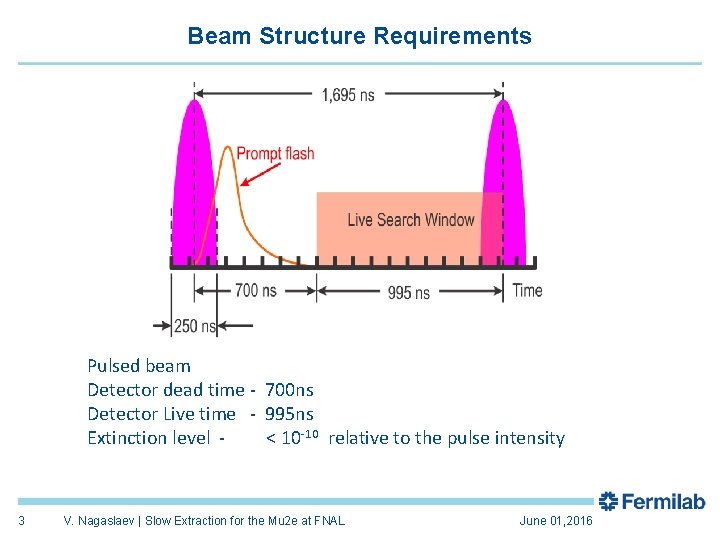
Beam Structure Requirements Pulsed beam Detector dead time - 700 ns Detector Live time - 995 ns Extinction level < 10 -10 relative to the pulse intensity 3 V. Nagaslaev | Slow Extraction for the Mu 2 e at FNAL June 01, 2016
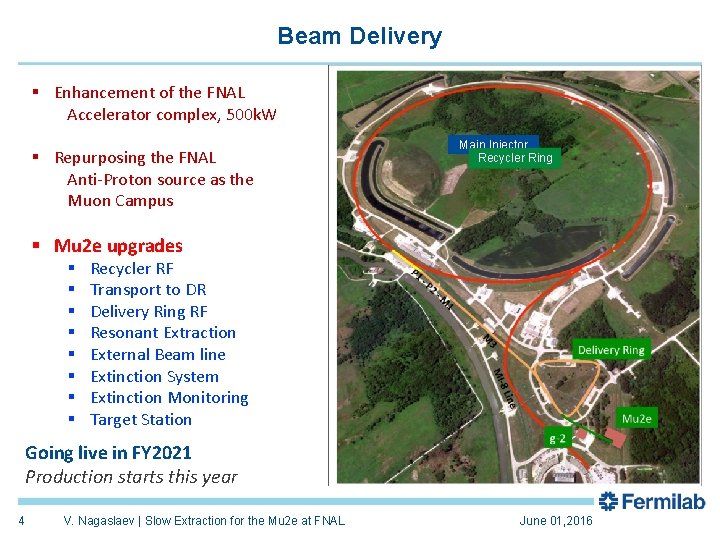
Beam Delivery § Enhancement of the FNAL Accelerator complex, 500 k. W § Repurposing the FNAL Anti-Proton source as the Muon Campus Main Injector Recycler Ring § Mu 2 e upgrades § § § § Recycler RF Transport to DR Delivery Ring RF Resonant Extraction External Beam line Extinction System Extinction Monitoring Target Station Going live in FY 2021 Production starts this year 4 V. Nagaslaev | Slow Extraction for the Mu 2 e at FNAL June 01, 2016
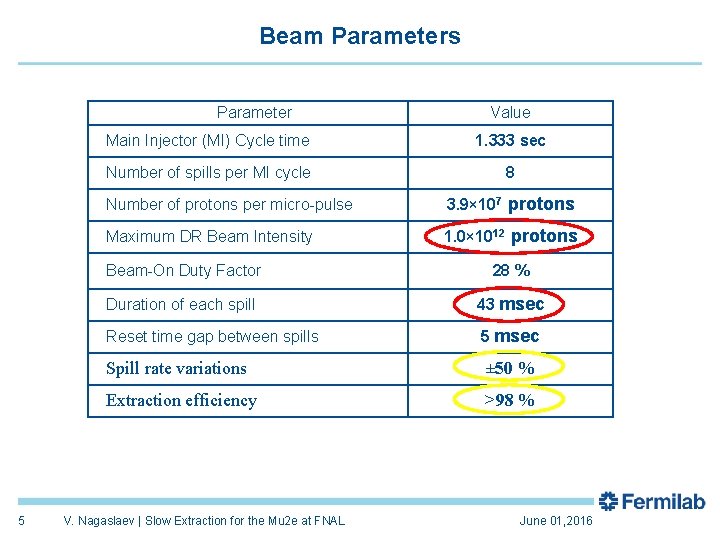
Beam Parameters Parameter 5 Value Main Injector (MI) Cycle time 1. 333 sec Number of spills per MI cycle 8 Number of protons per micro-pulse 3. 9× 10⁷ protons Maximum DR Beam Intensity 1. 0× 1012 protons Beam-On Duty Factor 28 % Duration of each spill 43 msec Reset time gap between spills 5 msec Spill rate variations ± 50 % Extraction efficiency >98 % V. Nagaslaev | Slow Extraction for the Mu 2 e at FNAL June 01, 2016
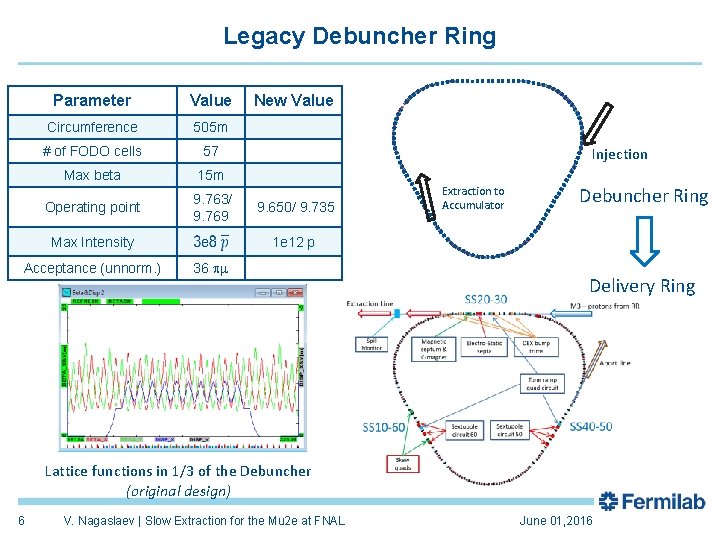
Legacy Debuncher Ring Parameter Value Circumference 505 m # of FODO cells 57 Max beta 15 m Operating point 9. 763/ 9. 769 Max Intensity Acceptance (unnorm. ) New Value Injection 9. 650/ 9. 735 Extraction to Accumulator Debuncher Ring 1 e 12 p 36 pm Delivery Ring Lattice functions in 1/3 of the Debuncher (original design) 6 V. Nagaslaev | Slow Extraction for the Mu 2 e at FNAL June 01, 2016
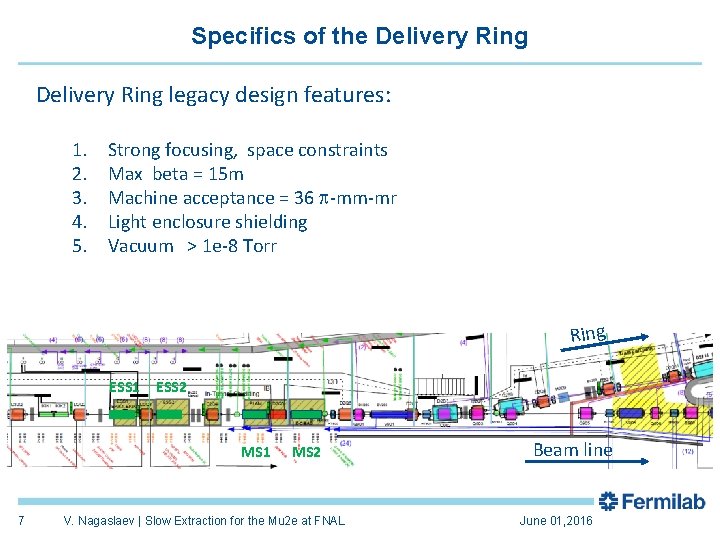
Specifics of the Delivery Ring legacy design features: 1. 2. 3. 4. 5. Strong focusing, space constraints Max beta = 15 m Machine acceptance = 36 p-mm-mr Light enclosure shielding Vacuum > 1 e-8 Torr Ring ESS 1 ESS 2 MS 1 7 MS 2 V. Nagaslaev | Slow Extraction for the Mu 2 e at FNAL Beam line June 01, 2016
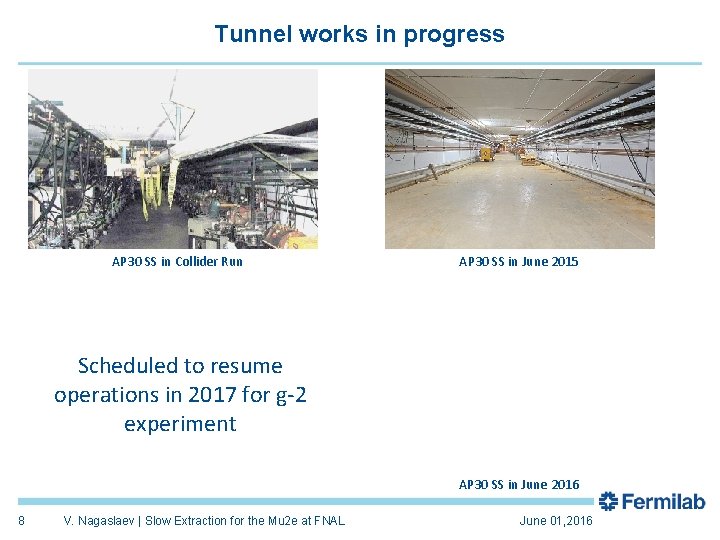
Tunnel works in progress AP 30 SS in Collider Run AP 30 SS in June 2015 Scheduled to resume operations in 2017 for g-2 experiment AP 30 SS in June 2016 8 V. Nagaslaev | Slow Extraction for the Mu 2 e at FNAL June 01, 2016
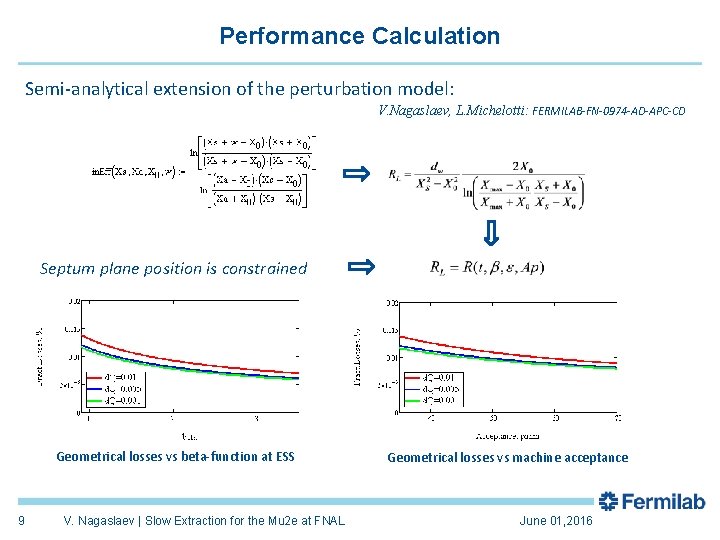
Performance Calculation Semi-analytical extension of the perturbation model: V. Nagaslaev, L. Michelotti: FERMILAB-FN-0974 -AD-APC-CD Septum plane position is constrained Geometrical losses vs beta-function at ESS 9 V. Nagaslaev | Slow Extraction for the Mu 2 e at FNAL Geometrical losses vs machine acceptance June 01, 2016
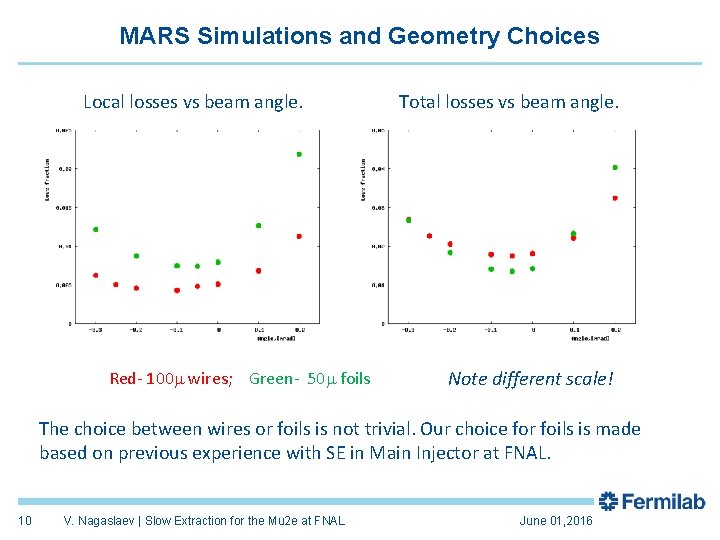
MARS Simulations and Geometry Choices Local losses vs beam angle. Red- 100 m wires; Green- 50 m foils Total losses vs beam angle. Note different scale! The choice between wires or foils is not trivial. Our choice for foils is made based on previous experience with SE in Main Injector at FNAL. 10 V. Nagaslaev | Slow Extraction for the Mu 2 e at FNAL June 01, 2016
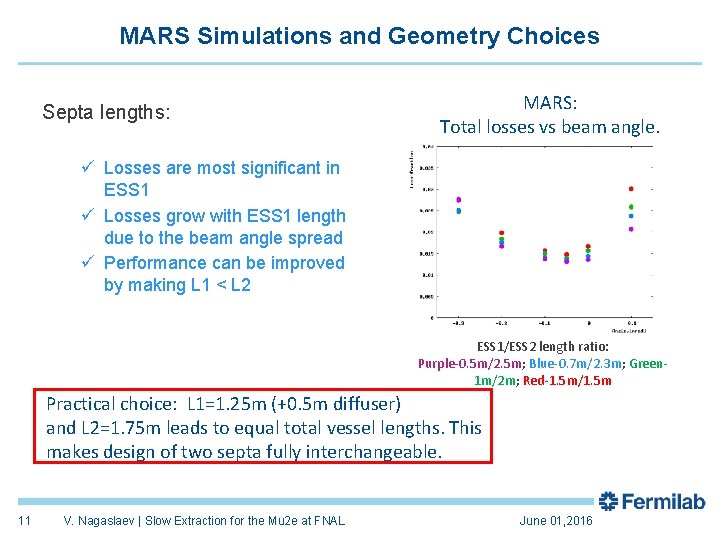
MARS Simulations and Geometry Choices Septa lengths: MARS: Total losses vs beam angle. ü Losses are most significant in ESS 1 ü Losses grow with ESS 1 length due to the beam angle spread ü Performance can be improved by making L 1 < L 2 ESS 1/ESS 2 length ratio: Purple-0. 5 m/2. 5 m; Blue-0. 7 m/2. 3 m; Green 1 m/2 m; Red-1. 5 m/1. 5 m Practical choice: L 1=1. 25 m (+0. 5 m diffuser) and L 2=1. 75 m leads to equal total vessel lengths. This makes design of two septa fully interchangeable. 11 V. Nagaslaev | Slow Extraction for the Mu 2 e at FNAL June 01, 2016
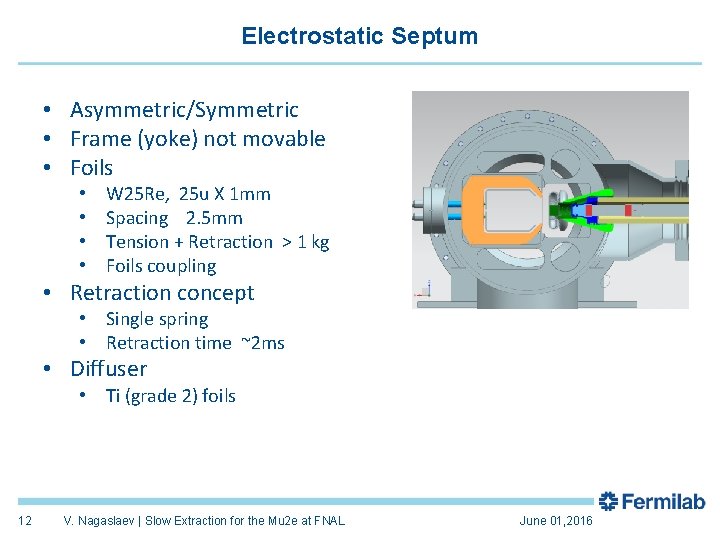
Electrostatic Septum • Asymmetric/Symmetric • Frame (yoke) not movable • Foils • • W 25 Re, 25 u X 1 mm Spacing 2. 5 mm Tension + Retraction > 1 kg Foils coupling • Retraction concept • Single spring • Retraction time ~2 ms • Diffuser • Ti (grade 2) foils 12 V. Nagaslaev | Slow Extraction for the Mu 2 e at FNAL June 01, 2016
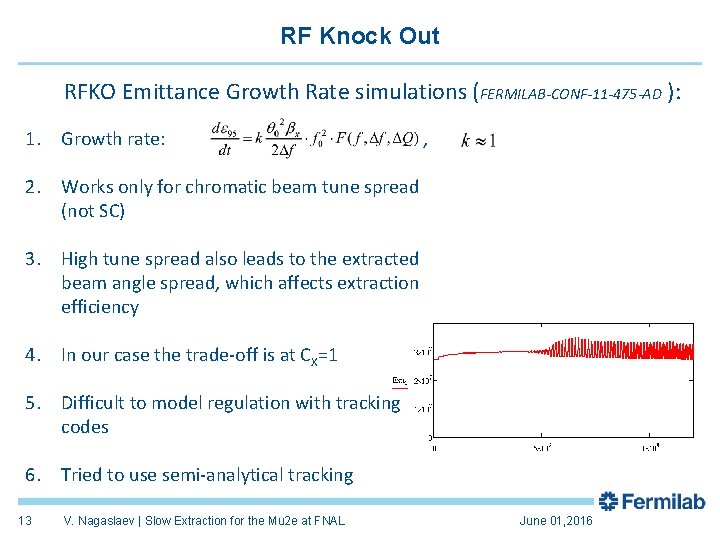
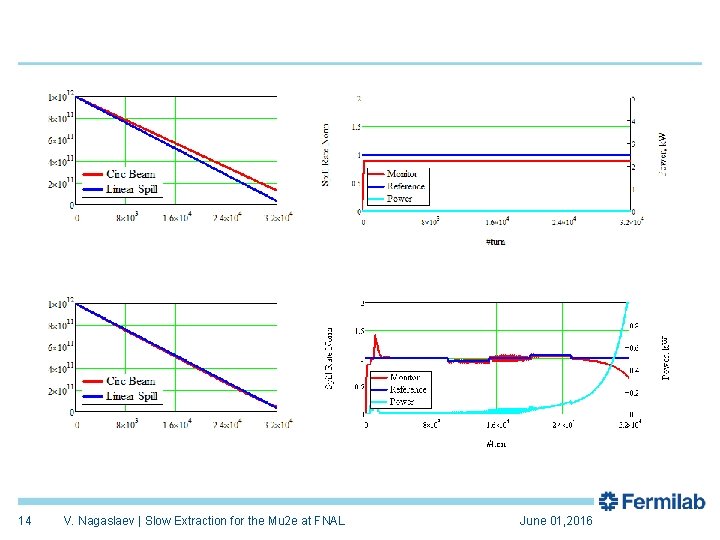
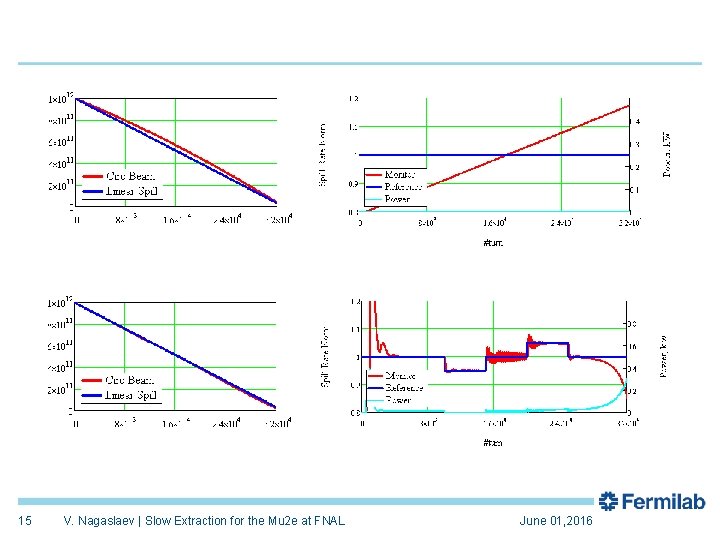
RF Knock Out RFKO Emittance Growth Rate simulations (FERMILAB-CONF-11 -475 -AD ): 1. Growth rate: , 2. Works only for chromatic beam tune spread (not SC) 3. High tune spread also leads to the extracted beam angle spread, which affects extraction efficiency 4. In our case the trade-off is at CX=1 5. Difficult to model regulation with tracking codes 6. Tried to use semi-analytical tracking 13 V. Nagaslaev | Slow Extraction for the Mu 2 e at FNAL June 01, 2016
14 V. Nagaslaev | Slow Extraction for the Mu 2 e at FNAL June 01, 2016
15 V. Nagaslaev | Slow Extraction for the Mu 2 e at FNAL June 01, 2016
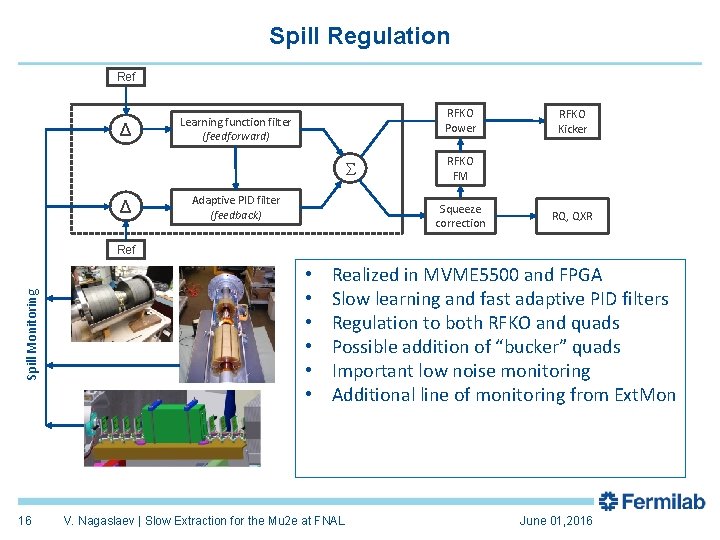
Spill Regulation Ref Δ RFKO Power Learning function filter (feedforward) Δ Adaptive PID filter (feedback) RFKO Kicker RFKO FM Squeeze correction RQ, QXR Spill Monitoring Ref 16 • • • Realized in MVME 5500 and FPGA Slow learning and fast adaptive PID filters Regulation to both RFKO and quads Possible addition of “bucker” quads Important low noise monitoring Additional line of monitoring from Ext. Mon V. Nagaslaev | Slow Extraction for the Mu 2 e at FNAL June 01, 2016
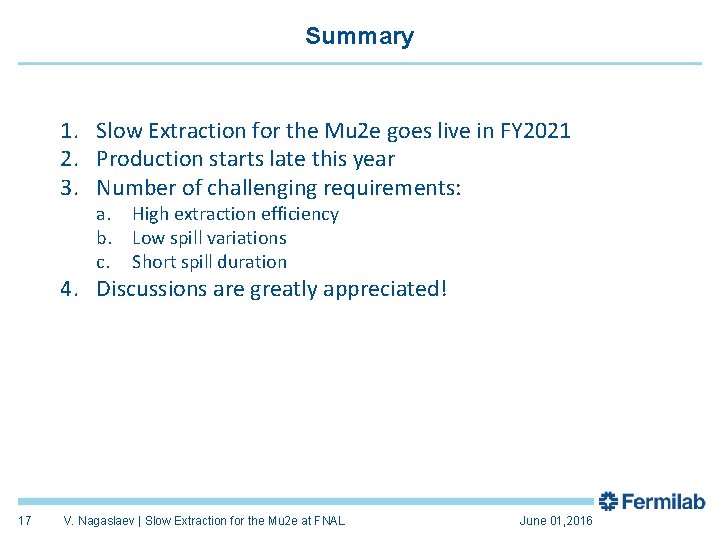
Summary 1. Slow Extraction for the Mu 2 e goes live in FY 2021 2. Production starts late this year 3. Number of challenging requirements: a. High extraction efficiency b. Low spill variations c. Short spill duration 4. Discussions are greatly appreciated! 17 V. Nagaslaev | Slow Extraction for the Mu 2 e at FNAL June 01, 2016