
Slow Energy Relaxation in Complex Systems Francesco Piazza

- Slides: 29
Slow Energy Relaxation in Complex Systems Francesco Piazza Laboratore de Biophysique Statistique EPF-Lausanne, Switzerland
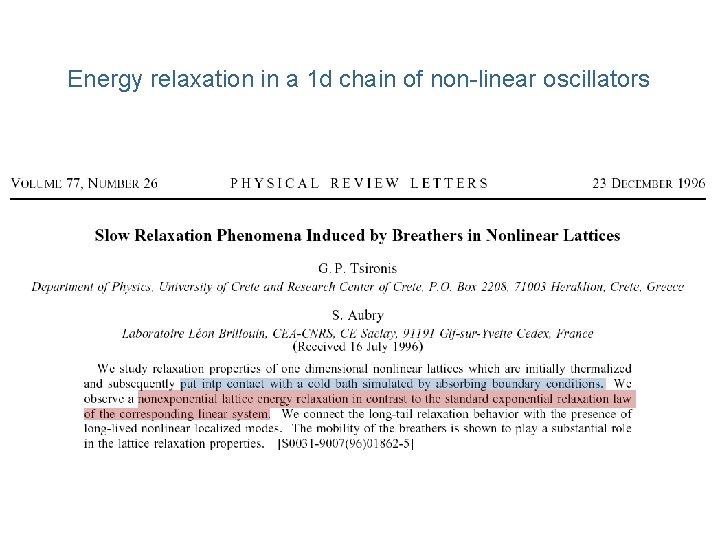
Energy relaxation in a 1 d chain of non-linear oscillators
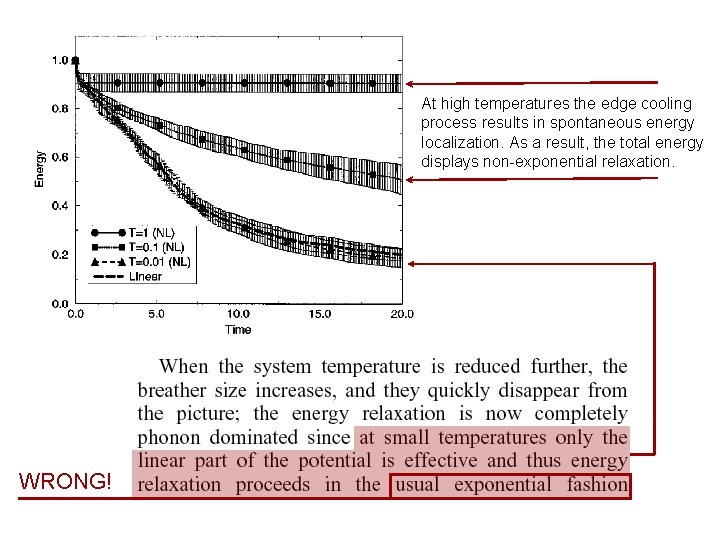
At high temperatures the edge cooling process results in spontaneous energy localization. As a result, the total energy displays non-exponential relaxation. WRONG!
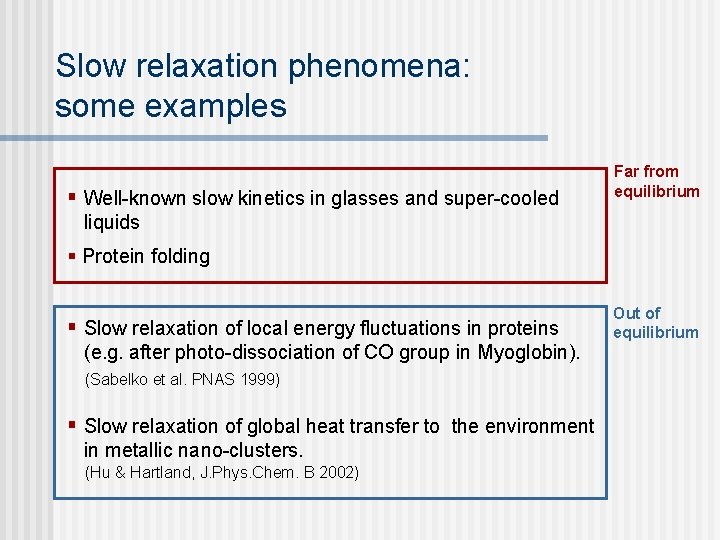
Slow relaxation phenomena: some examples § Well-known slow kinetics in glasses and super-cooled Far from equilibrium liquids § Protein folding § Slow relaxation of local energy fluctuations in proteins (e. g. after photo-dissociation of CO group in Myoglobin). (Sabelko et al. PNAS 1999) § Slow relaxation of global heat transfer to the environment in metallic nano-clusters. (Hu & Hartland, J. Phys. Chem. B 2002) Out of equilibrium
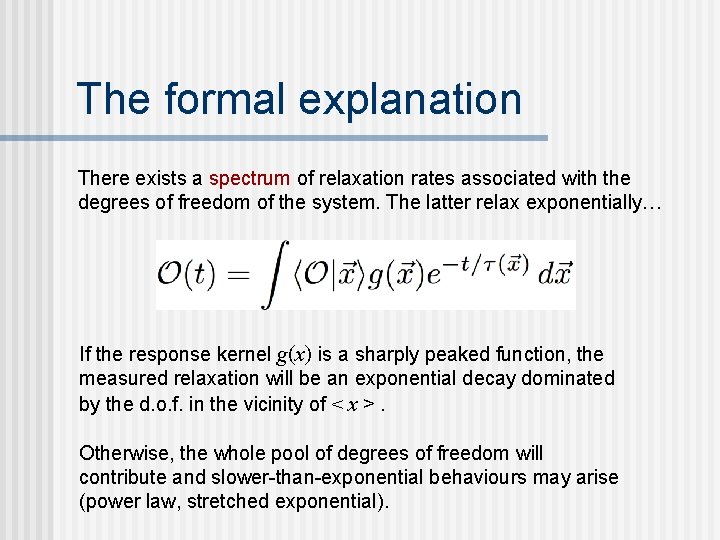
The formal explanation There exists a spectrum of relaxation rates associated with the degrees of freedom of the system. The latter relax exponentially… If the response kernel g(x) is a sharply peaked function, the measured relaxation will be an exponential decay dominated by the d. o. f. in the vicinity of < x >. Otherwise, the whole pool of degrees of freedom will contribute and slower-than-exponential behaviours may arise (power law, stretched exponential).
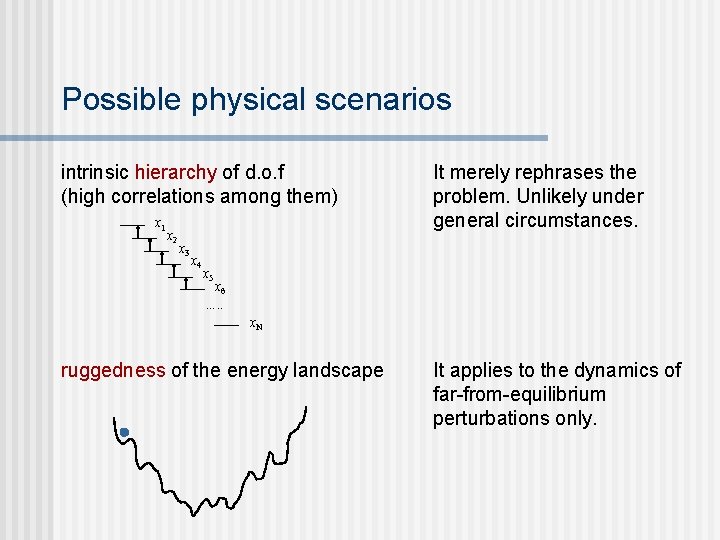
Possible physical scenarios intrinsic hierarchy of d. o. f (high correlations among them) x 1 x 2 x 3 x 4 It merely rephrases the problem. Unlikely under general circumstances. x 5 x 6 …. . x. N ruggedness of the energy landscape It applies to the dynamics of far-from-equilibrium perturbations only.
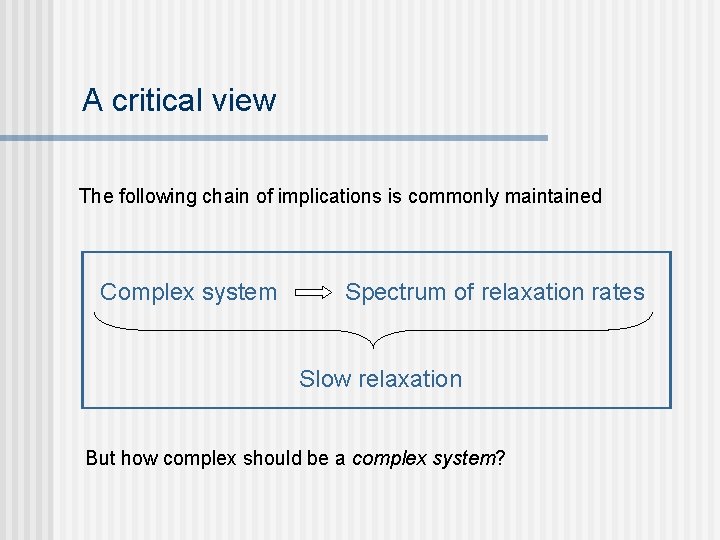
A critical view The following chain of implications is commonly maintained Complex system Spectrum of relaxation rates Slow relaxation But how complex should be a complex system?
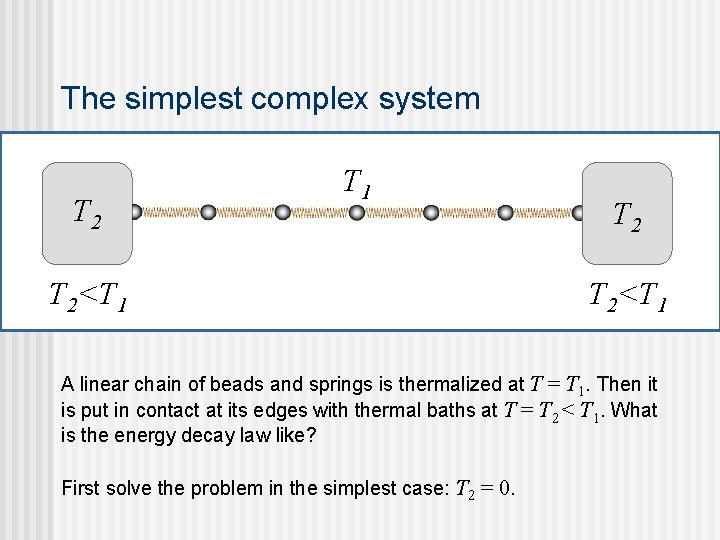
The simplest complex system T 2 T 1 T 2<T 1 A linear chain of beads and springs is thermalized at T = T 1. Then it is put in contact at its edges with thermal baths at T = T 2 < T 1. What is the energy decay law like? First solve the problem in the simplest case: T 2 = 0.
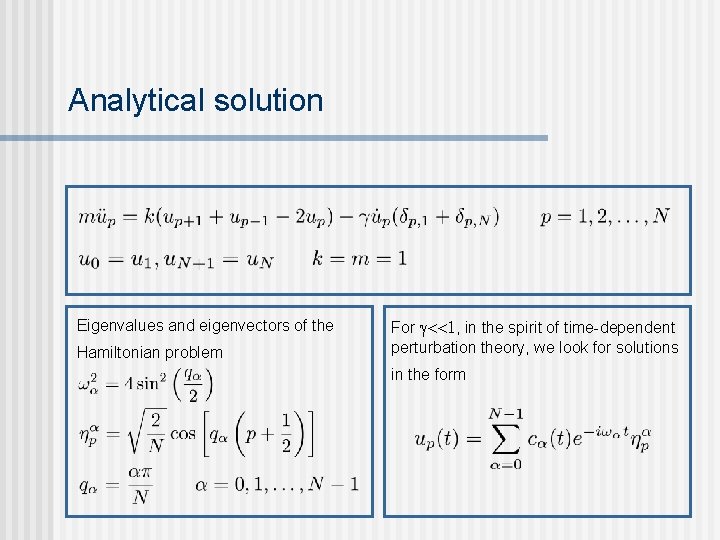
Analytical solution Eigenvalues and eigenvectors of the Hamiltonian problem For , in the spirit of time-dependent perturbation theory, we look for solutions in the form
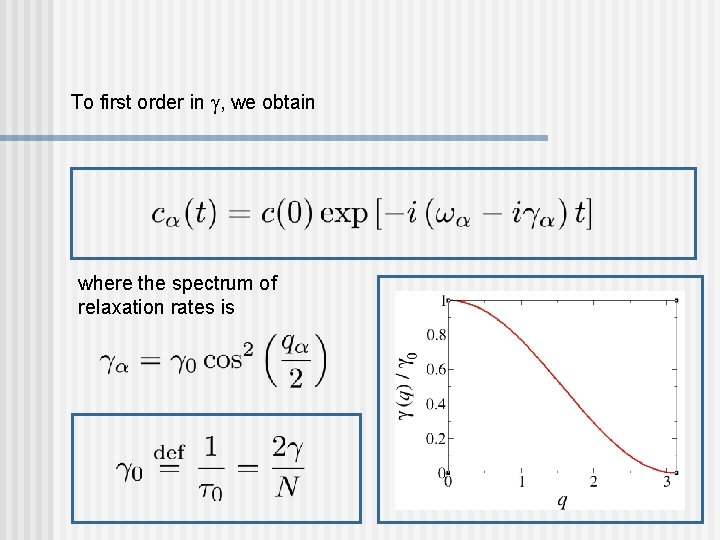
To first order in , we obtain where the spectrum of relaxation rates is
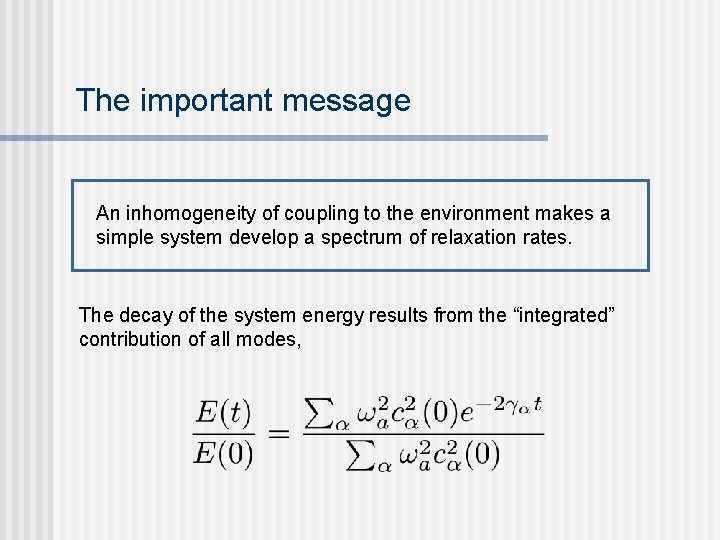
The important message An inhomogeneity of coupling to the environment makes a simple system develop a spectrum of relaxation rates. The decay of the system energy results from the “integrated” contribution of all modes,
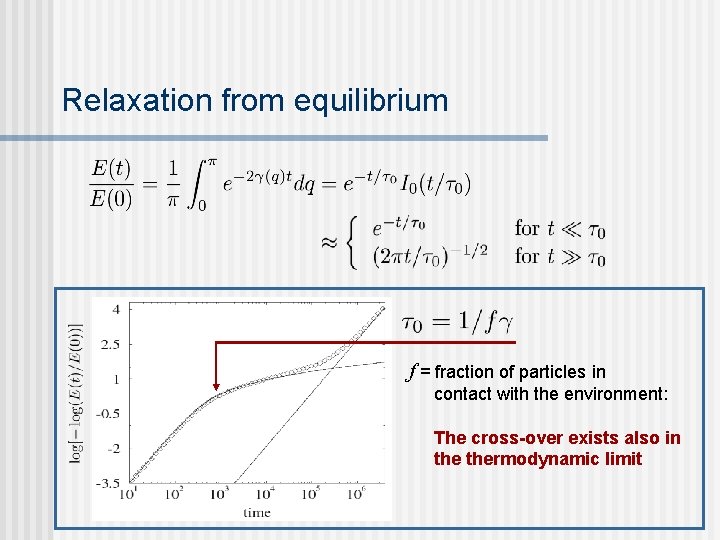
Relaxation from equilibrium f = fraction of particles in contact with the environment: The cross-over exists also in thermodynamic limit
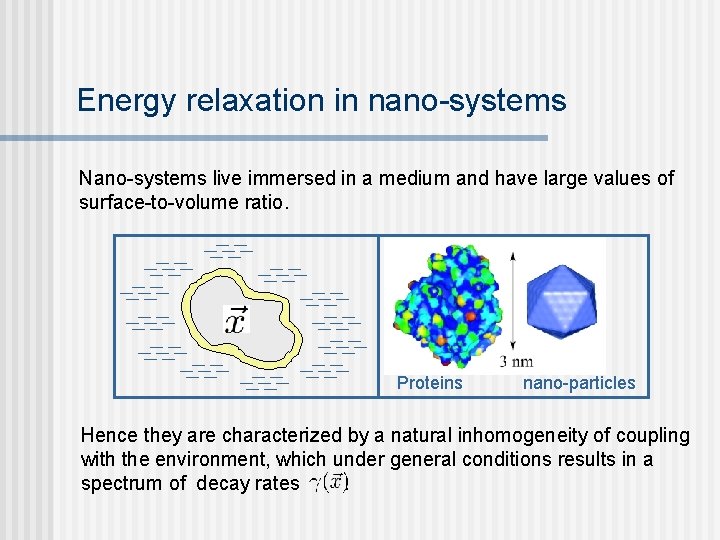
Energy relaxation in nano-systems Nano-systems live immersed in a medium and have large values of surface-to-volume ratio. Proteins nano-particles Hence they are characterized by a natural inhomogeneity of coupling with the environment, which under general conditions results in a spectrum of decay rates.
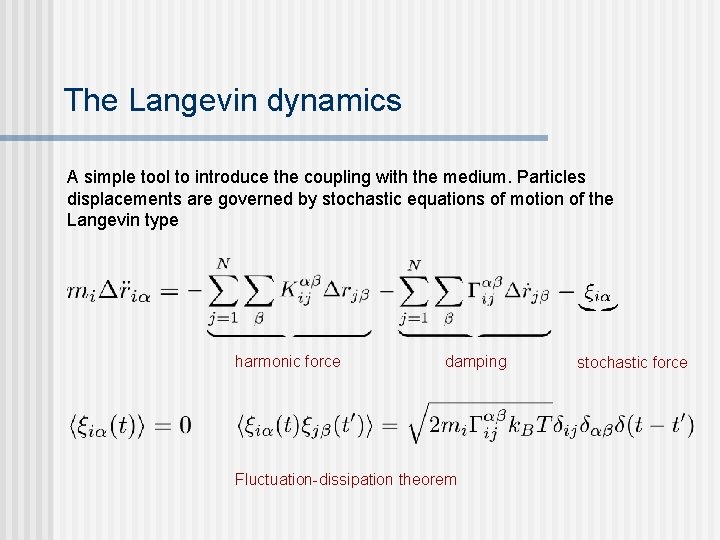
The problem We want to study the relaxation of the system from a temperature T 1 to a lower temperature T 2 The individual units (residues, atoms) are assigned a “local” surface fraction f (bulk and surface) We describe the stochastic dynamics à la Langevin. The damping constants are taken to be proportional to f The amplitudes of the fluctuating forces are set accordingly, in accordance to the FD theorem.
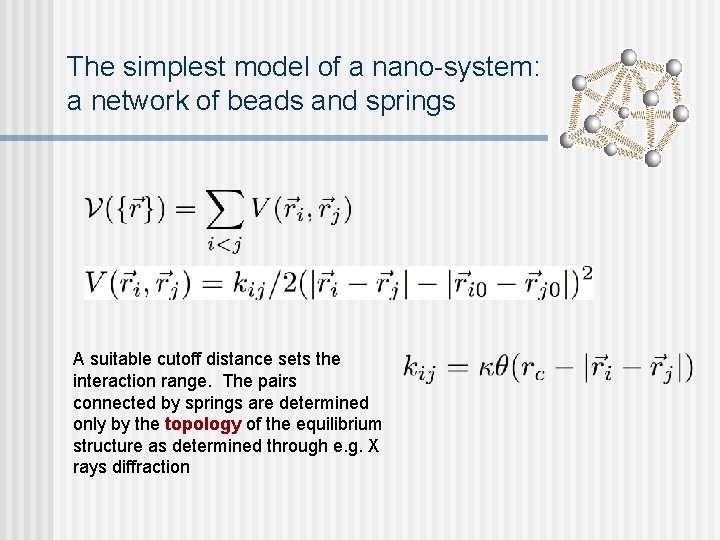
The simplest model of a nano-system: a network of beads and springs A suitable cutoff distance sets the interaction range. The pairs connected by springs are determined only by the topology of the equilibrium structure as determined through e. g. X rays diffraction
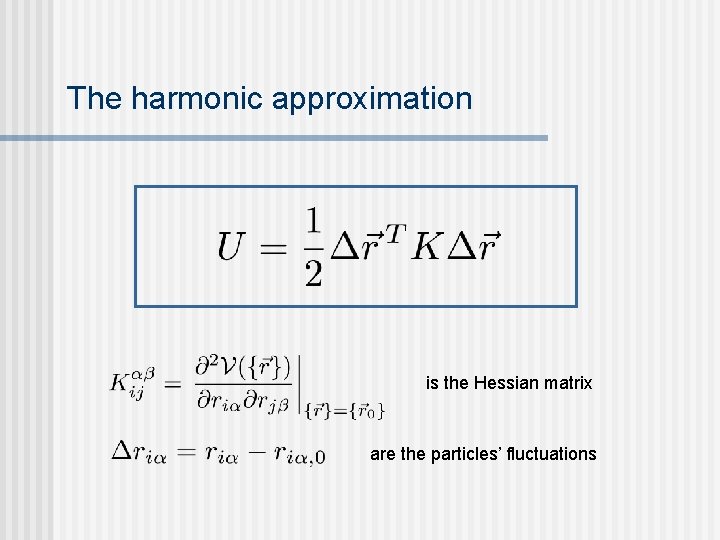
The harmonic approximation is the Hessian matrix are the particles’ fluctuations
The Langevin dynamics A simple tool to introduce the coupling with the medium. Particles displacements are governed by stochastic equations of motion of the Langevin type harmonic force damping Fluctuation-dissipation theorem stochastic force
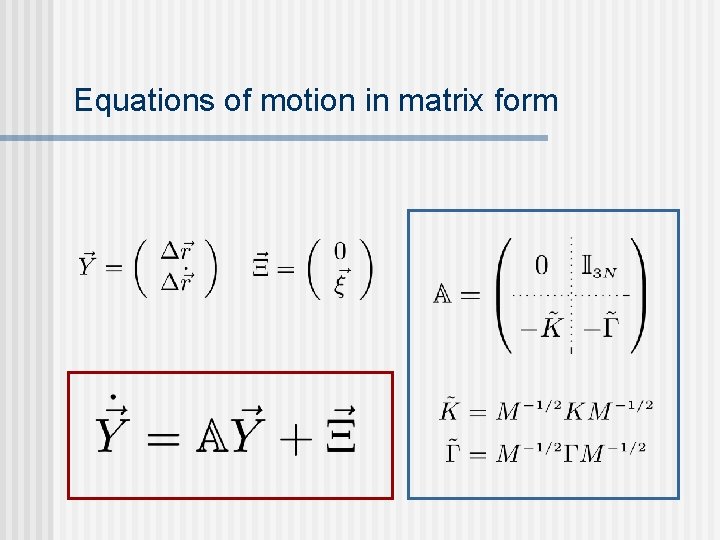
Equations of motion in matrix form
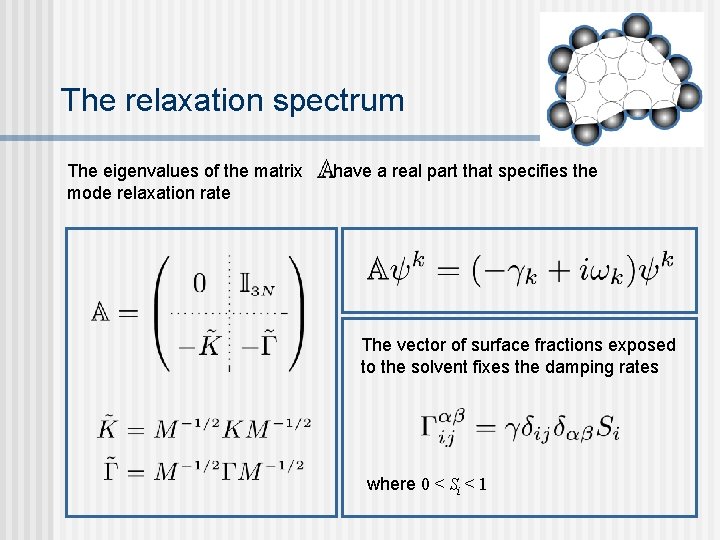
The relaxation spectrum The eigenvalues of the matrix mode relaxation rate have a real part that specifies the The vector of surface fractions exposed to the solvent fixes the damping rates where 0 < Si < 1
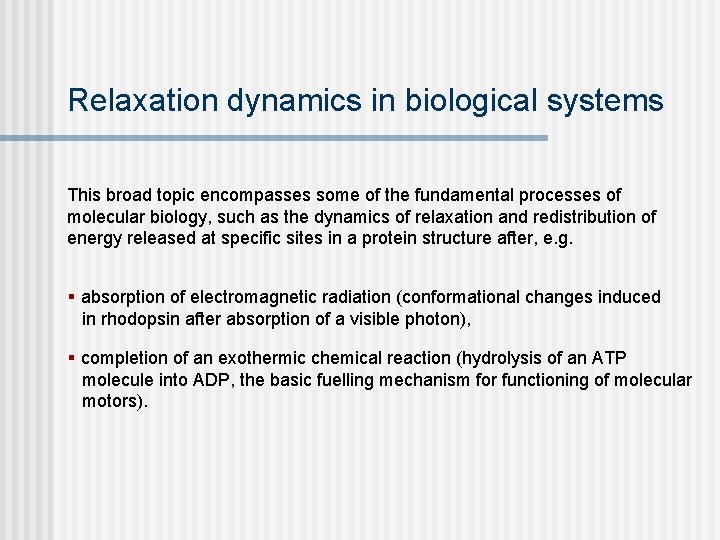
Relaxation dynamics in biological systems This broad topic encompasses some of the fundamental processes of molecular biology, such as the dynamics of relaxation and redistribution of energy released at specific sites in a protein structure after, e. g. § absorption of electromagnetic radiation (conformational changes induced in rhodopsin after absorption of a visible photon), § completion of an exothermic chemical reaction (hydrolysis of an ATP molecule into ADP, the basic fuelling mechanism for functioning of molecular motors).
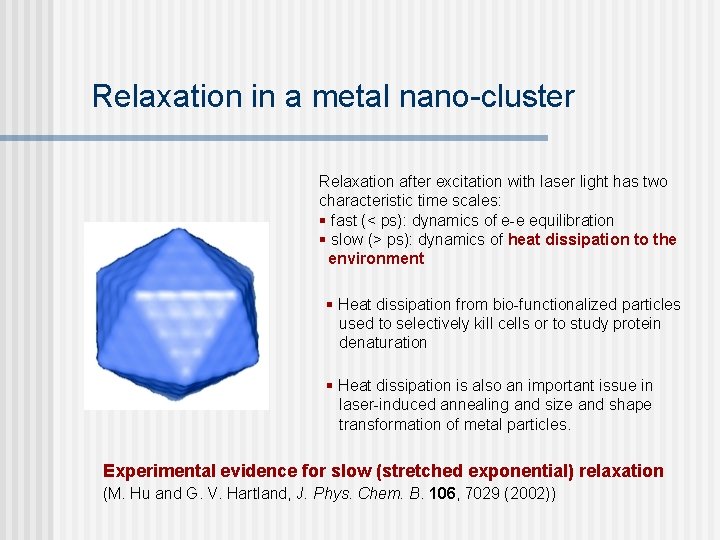
Relaxation in a metal nano-cluster Relaxation after excitation with laser light has two characteristic time scales: § fast (< ps): dynamics of e-e equilibration § slow (> ps): dynamics of heat dissipation to the environment § Heat dissipation from bio-functionalized particles used to selectively kill cells or to study protein denaturation § Heat dissipation is also an important issue in laser-induced annealing and size and shape transformation of metal particles. Experimental evidence for slow (stretched exponential) relaxation (M. Hu and G. V. Hartland, J. Phys. Chem. B. 106, 7029 (2002))
The Fokker Planck formalism Such phenomena of relaxation dynamics and related ones can be studied analytically by solving the Fokker -Planck equation associated with the Langevin elastic network model of the system.
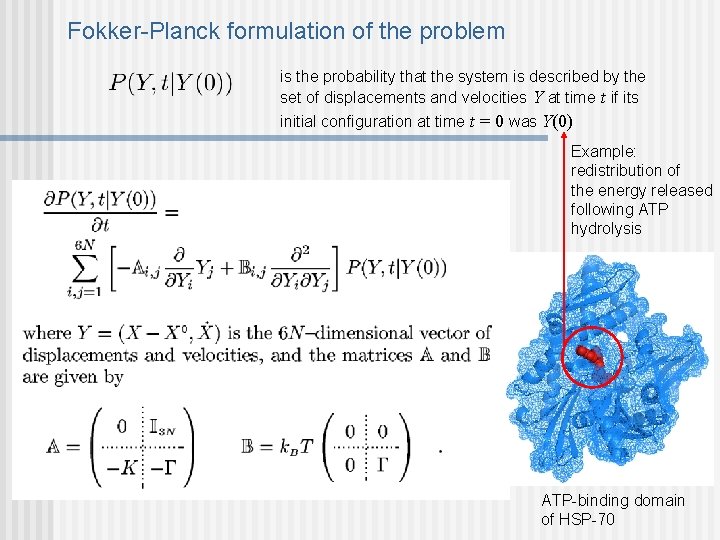
Fokker-Planck formulation of the problem is the probability that the system is described by the set of displacements and velocities Y at time t if its initial configuration at time t = 0 was Y(0) Example: redistribution of the energy released following ATP hydrolysis ATP-binding domain of HSP-70
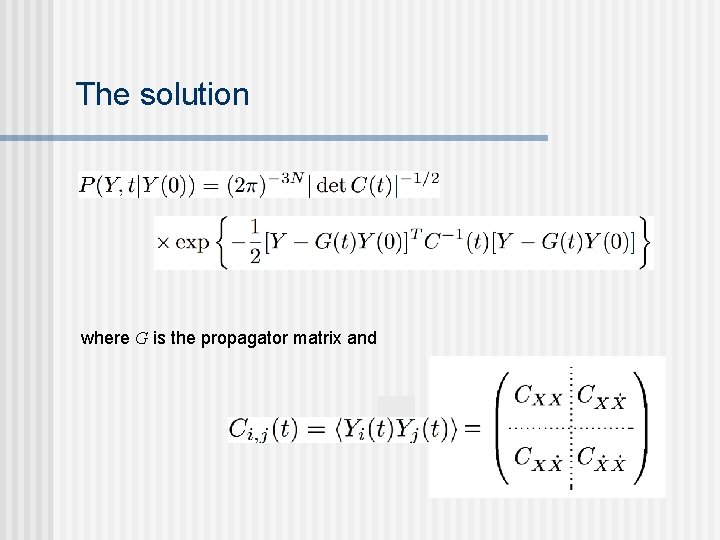
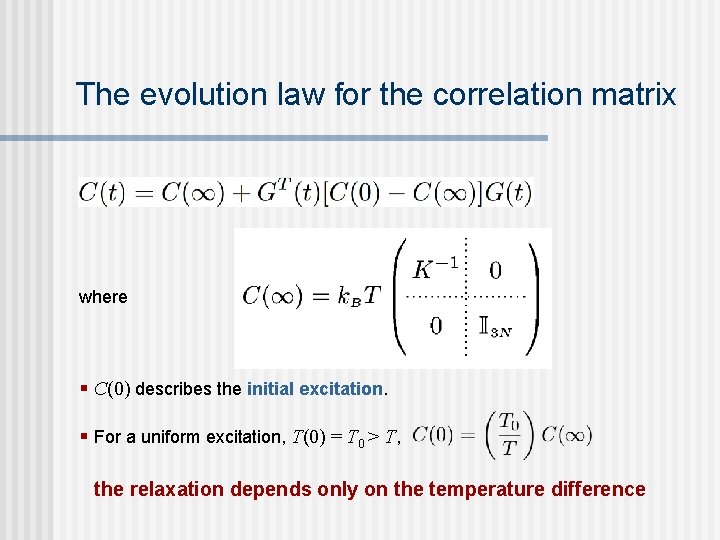
The solution where G is the propagator matrix and
The evolution law for the correlation matrix where § C(0) describes the initial excitation. § For a uniform excitation, T(0) = T 0 > T, the relaxation depends only on the temperature difference
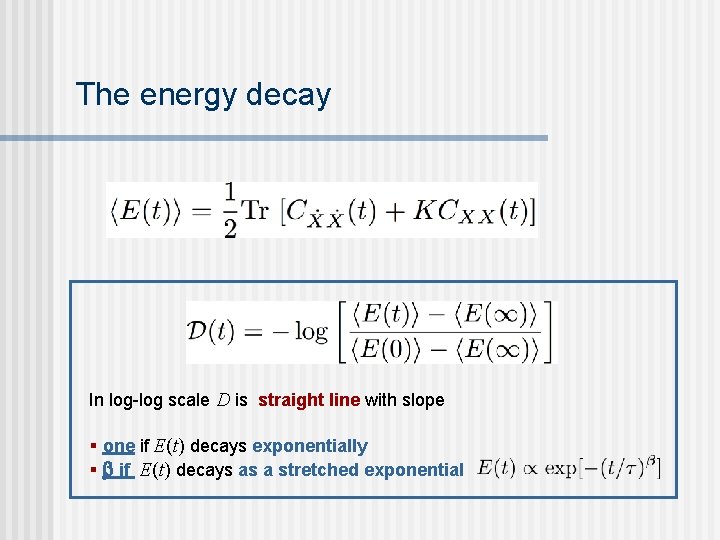
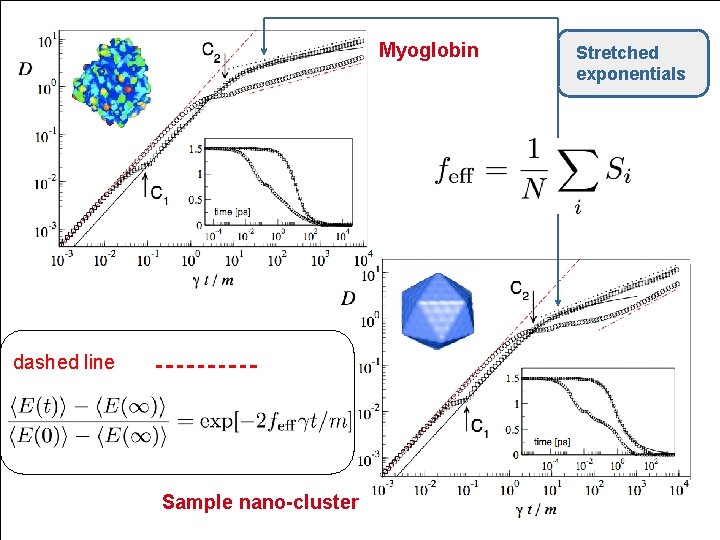
The energy decay In log-log scale D is straight line with slope § one if E(t) decays exponentially § if E(t) decays as a stretched exponential
Myoglobin dashed line Sample nano-cluster Stretched exponentials
Conclusions § A simple extended harmonc system naturally develops a spectrum of relaxation rates when interacting with the environment through its surface § The response to an energy excitation is a superposition of many exponentially decaying channels: the result is a rich, non-exponential behaviour. 1. 2. § a first portion of the accumulated energy decays exponentially with a rate constant characteristic of the fastest d. o. f. Then the decay crosses over to an “integrated” non-exponential regime, which is the full super-position of all relaxing d. o. f. The cross-over should be observable in nano-systems and is also predicted to be observable in thermodynamic limit. The integrated decay is a power law of the type E d/2 in dimension d for ordered structures with nearest-neighbour interactions. It is well approximated by a stretched exponential law in more complex or disordered structures.
Co-workers n n Roberto Livi, Università di Firenze, IT Stefano Lepri, ISC-CNR, IT Paolo De Los Rios, EPFL, Lausanne, CH Yves-Henri Sanejouand, ENS, Lyon, FR http: //marie. epfl. ch/fpiazza/