
Slow Electron Velocitymap Imaging of Negative Ions Applications

- Slides: 34
Slow Electron Velocity-map Imaging of Negative Ions: Applications to Spectroscopy and Dynamics Columbus June 2012
Spectroscopy and dynamics of free radicals, transition states, clusters • Reactive free radicals play key role in combustion, planetary atmospheres, interstellar chemistry – Map out electronic and vibrational structure, with special focus on vibronic coupling • Spectroscopy of potential energy surfaces for chemical reactions – Pre-reactive van der waals complexes – Transition state spectroscopy • Clusters: evolution of properties of matter with size – Semiconductor clusters, metal oxides, water clusters, He droplets • How do we do this? Anion photoelectron spectroscopy (PES) and its variants – Anion slow electron velocity-map imaging (SEVI), a high resolution version of PES – Combine with ion trapping and cooling to maximize resolution
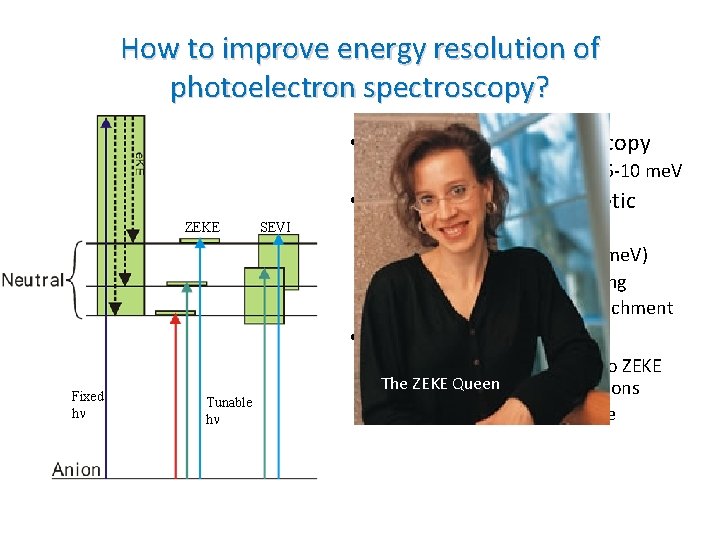
How to improve energy resolution of photoelectron spectroscopy? • Photoelectron spectroscopy – Very general, limited to 5 -10 me. V ZEKE SEVI • ZEKE (zero electron kinetic energy) spectroscopy – High resolution (0. 1 -0. 2 me. V) – Experimentally challenging – restricted to s-wave detachment • SEVI Fixed h Tunable h – Resolution comparable to ZEKE Thewithout ZEKE Queen expt’l complications – Versatile structural probe
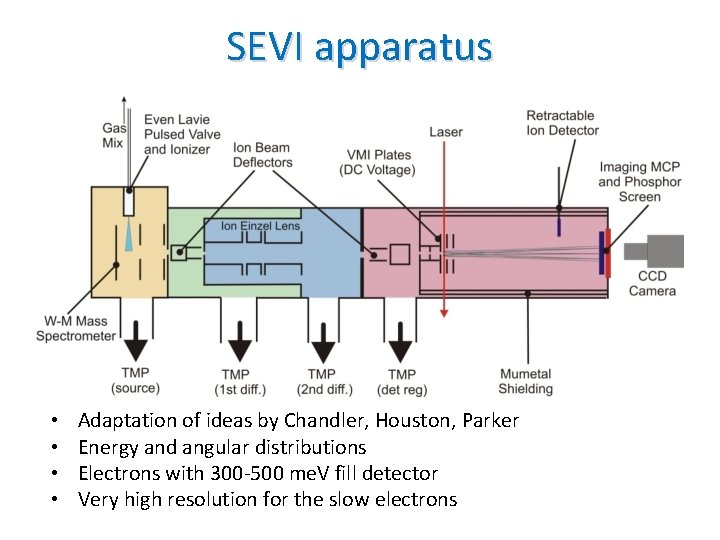
SEVI apparatus • • Adaptation of ideas by Chandler, Houston, Parker Energy and angular distributions Electrons with 300 -500 me. V fill detector Very high resolution for the slow electrons
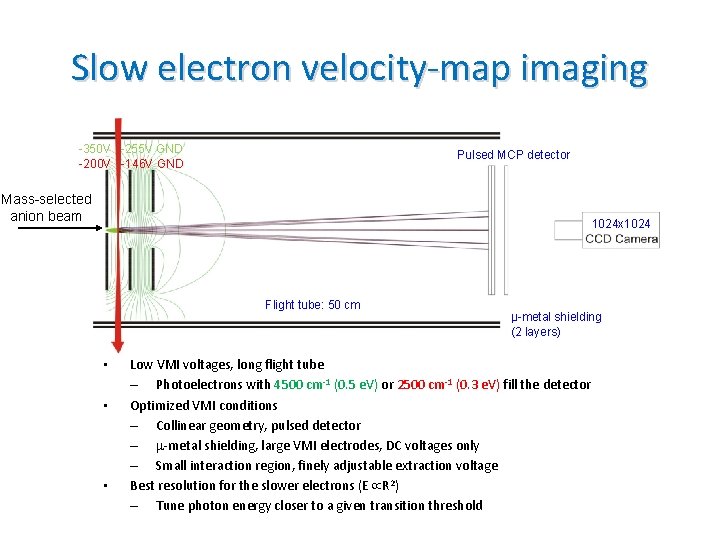
Slow electron velocity-map imaging -350 V -255 V GND -200 V -146 V GND Pulsed MCP detector Mass-selected anion beam 1024 x 1024 Flight tube: 50 cm • • • μ-metal shielding (2 layers) Low VMI voltages, long flight tube – Photoelectrons with 4500 cm-1 (0. 5 e. V) or 2500 cm-1 (0. 3 e. V) fill the detector Optimized VMI conditions – Collinear geometry, pulsed detector – -metal shielding, large VMI electrodes, DC voltages only – Small interaction region, finely adjustable extraction voltage Best resolution for the slower electrons (E R 2) – Tune photon energy closer to a given transition threshold
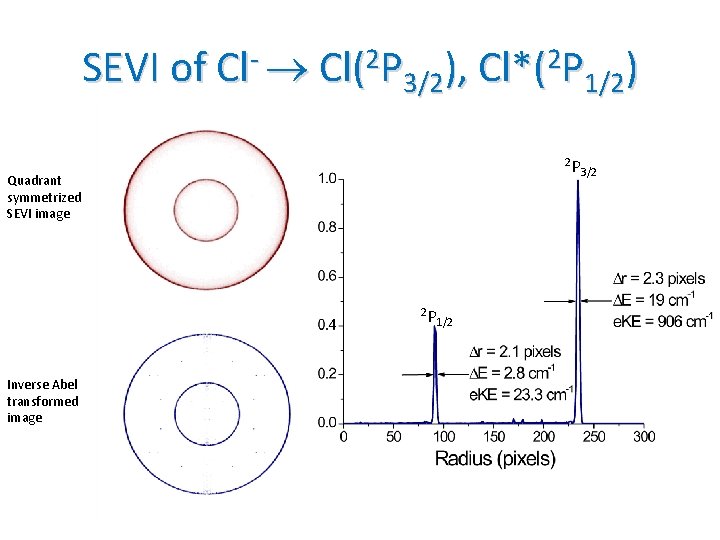
SEVI of Cl- Cl(2 P 3/2), Cl*(2 P 1/2) Quadrant symmetrized SEVI image 2 P Cl* Cl 2 P Inverse Abel transformed image 1/2 3/2
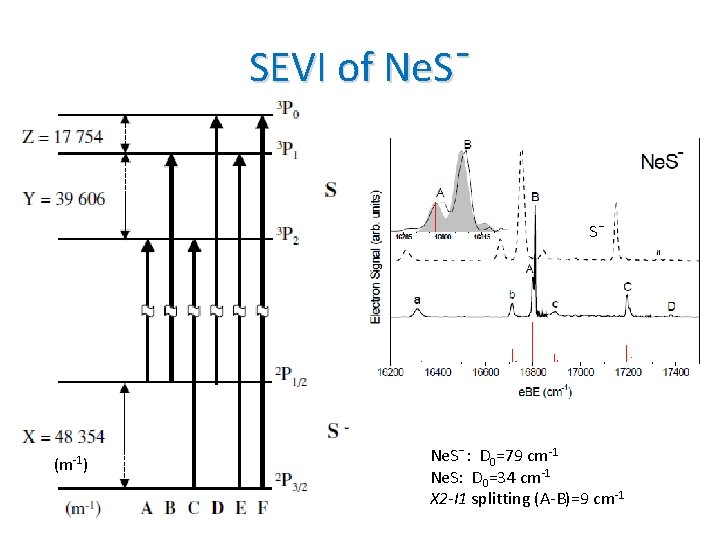
SEVI of Ne. Sˉ Sˉ (m-1) Ne. Sˉ: D 0=79 cm-1 Ne. S: D 0=34 cm-1 X 2 -I 1 splitting (A-B)=9 cm-1
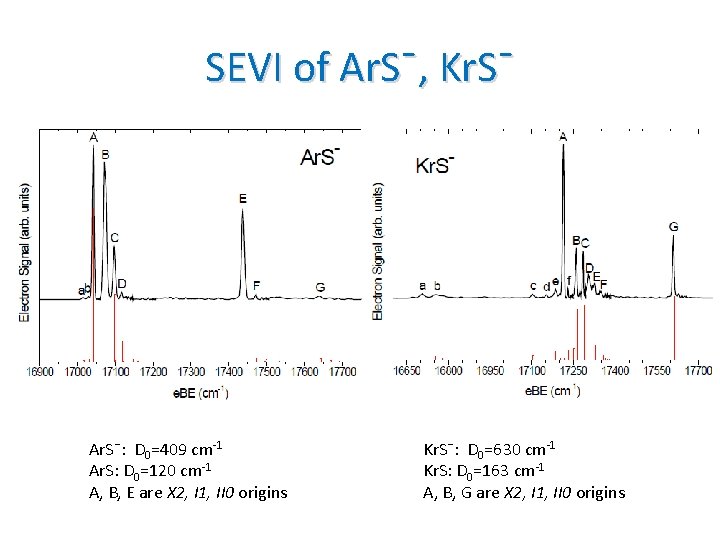
SEVI of Ar. Sˉ, Kr. Sˉ Ar. Sˉ: D 0=409 cm-1 Ar. S: D 0=120 cm-1 A, B, E are X 2, I 1, II 0 origins Kr. Sˉ: D 0=630 cm-1 Kr. S: D 0=163 cm-1 A, B, G are X 2, I 1, II 0 origins
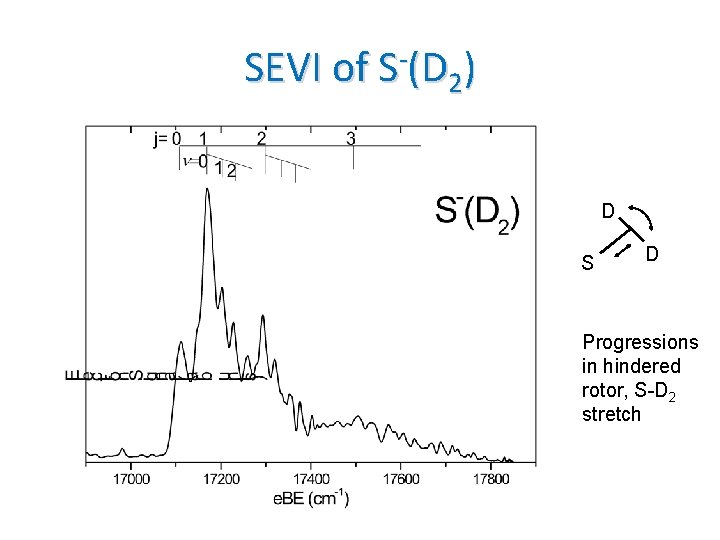
SEVI of S-(D 2) D S D Progressions in hindered rotor, S-D 2 stretch
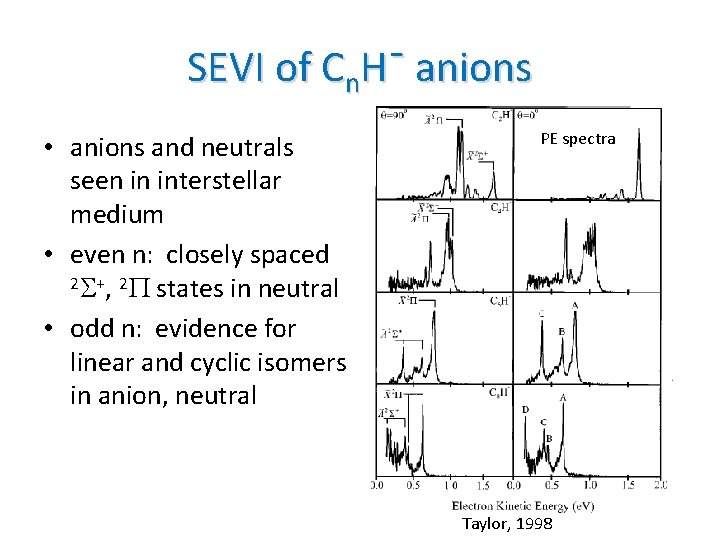
SEVI of Cn. Hˉ anions • anions and neutrals seen in interstellar medium • even n: closely spaced 2 +, 2 states in neutral • odd n: evidence for linear and cyclic isomers in anion, neutral PE spectra Taylor, 1998
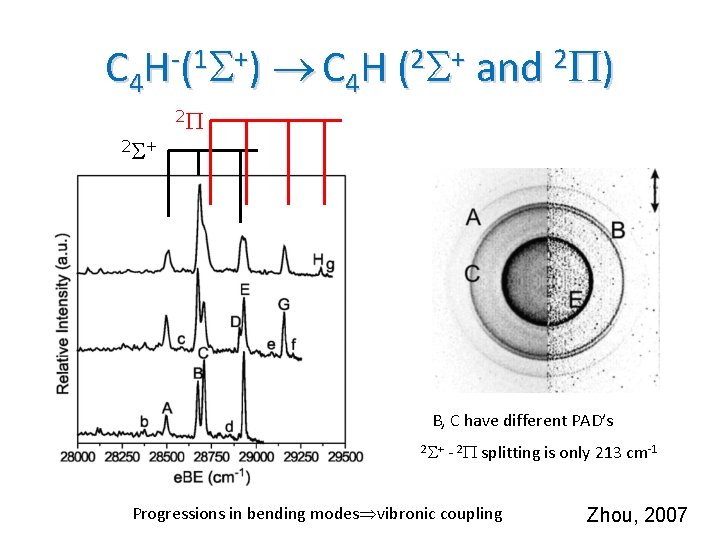
C 4 H-(1 +) C 4 H (2 + and 2 ) 2 2 + Zhou, 2007 B, C have different PAD’s 2 + - 2 splitting is only 213 cm-1 Progressions in bending modes vibronic coupling Zhou, 2007
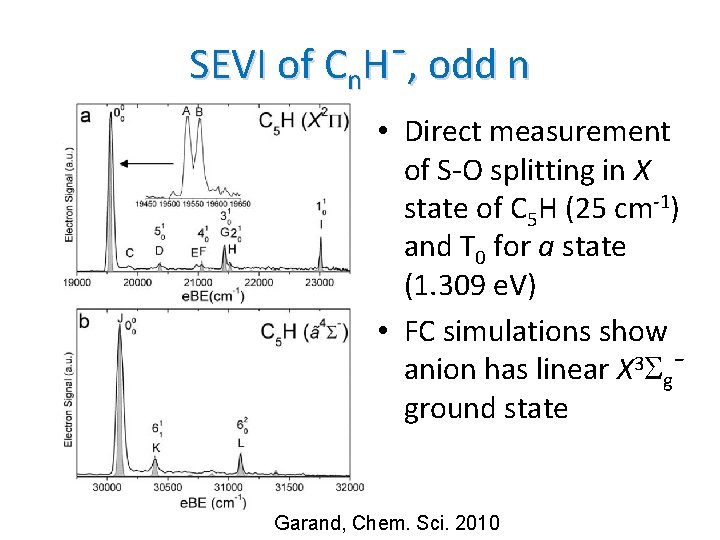
SEVI of Cn. Hˉ, odd n • Direct measurement of S-O splitting in X state of C 5 H (25 cm-1) and T 0 for a state (1. 309 e. V) • FC simulations show anion has linear X 3 gˉ ground state Garand, Chem. Sci. 2010
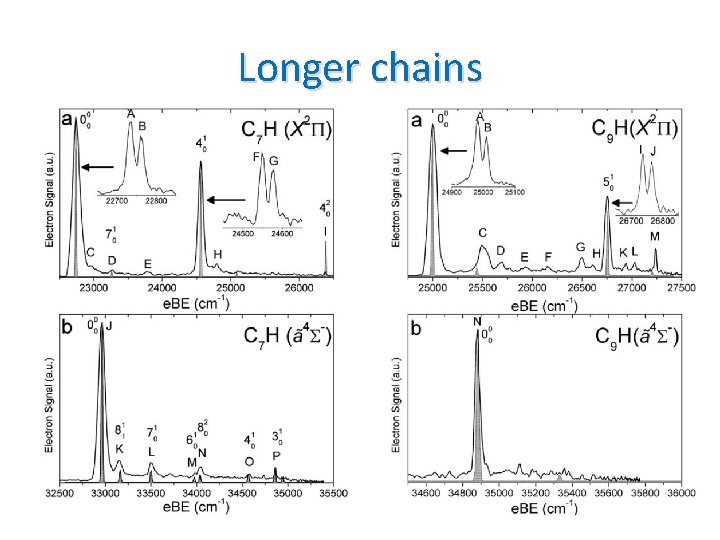
Longer chains
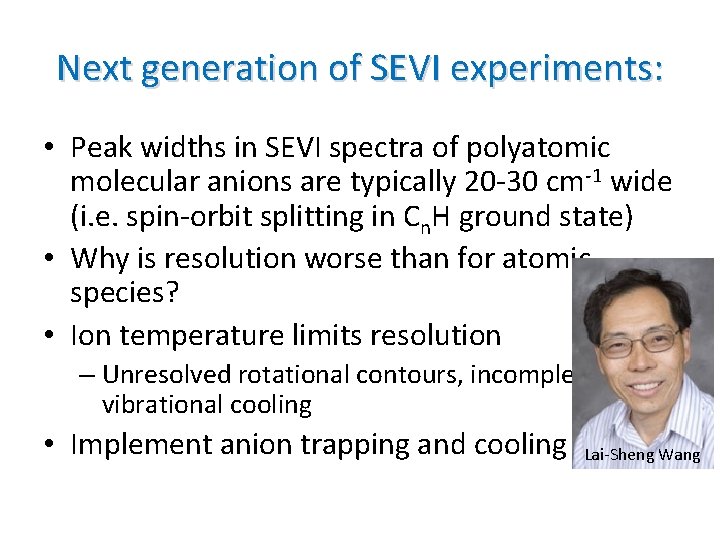
Next generation of SEVI experiments: • Peak widths in SEVI spectra of polyatomic molecular anions are typically 20 -30 cm-1 wide (i. e. spin-orbit splitting in Cn. H ground state) • Why is resolution worse than for atomic species? • Ion temperature limits resolution – Unresolved rotational contours, incomplete vibrational cooling • Implement anion trapping and cooling Lai-Sheng Wang
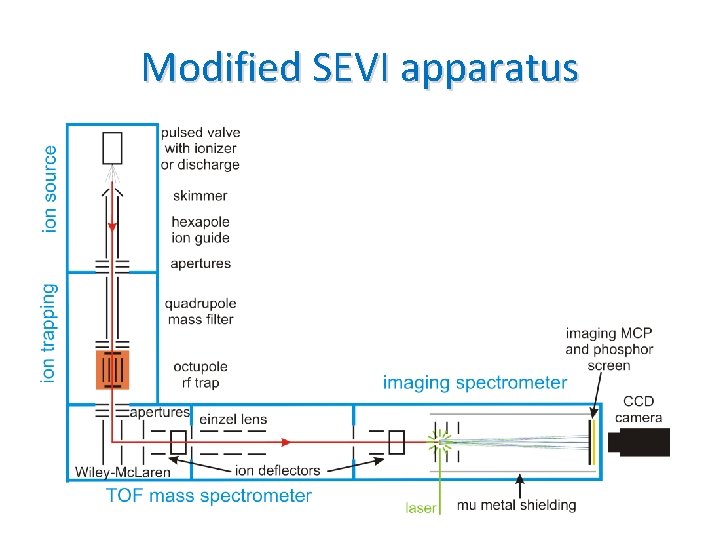
Modified SEVI apparatus
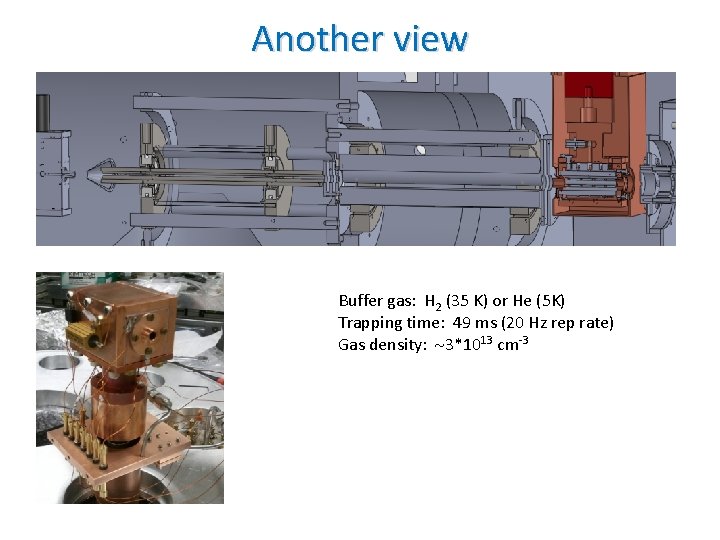
Another view Buffer gas: H 2 (35 K) or He (5 K) Trapping time: 49 ms (20 Hz rep rate) Gas density: 3*1013 cm-3
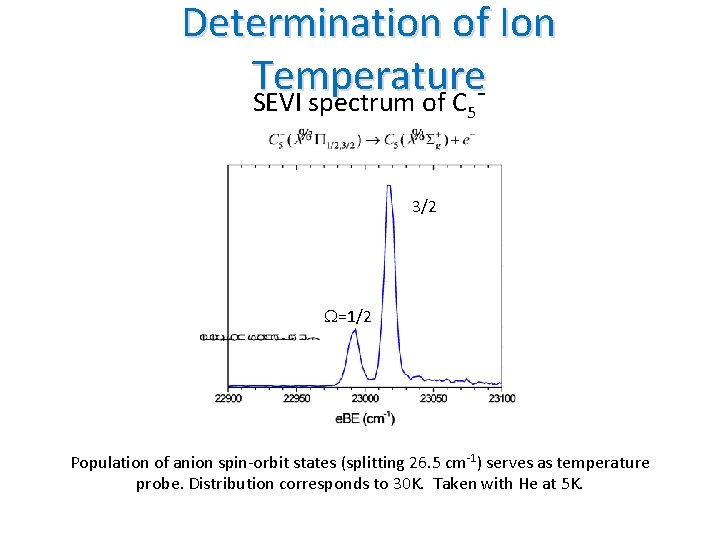
Determination of Ion Temperature SEVI spectrum of C ˉ 5 3/2 =1/2 Population of anion spin-orbit states (splitting 26. 5 cm-1) serves as temperature probe. Distribution corresponds to 30 K. Taken with He at 5 K.
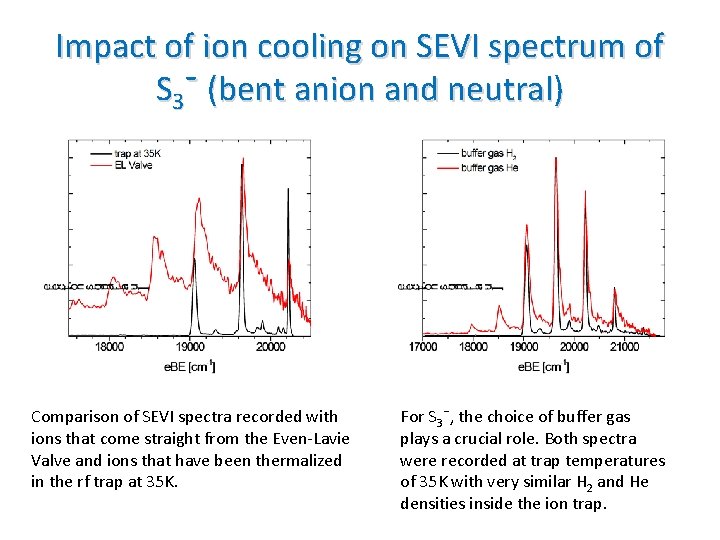
Impact of ion cooling on SEVI spectrum of S 3ˉ (bent anion and neutral) Comparison of SEVI spectra recorded with ions that come straight from the Even-Lavie Valve and ions that have been thermalized in the rf trap at 35 K. For S 3ˉ, the choice of buffer gas plays a crucial role. Both spectra were recorded at trap temperatures of 35 K with very similar H 2 and He densities inside the ion trap.
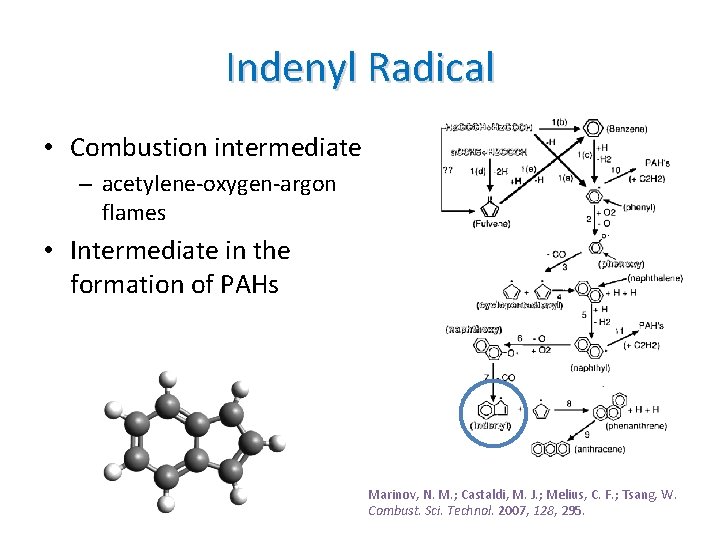
Indenyl Radical • Combustion intermediate – acetylene-oxygen-argon flames • Intermediate in the formation of PAHs Marinov, N. M. ; Castaldi, M. J. ; Melius, C. F. ; Tsang, W. Combust. Sci. Technol. 2007, 128, 295.
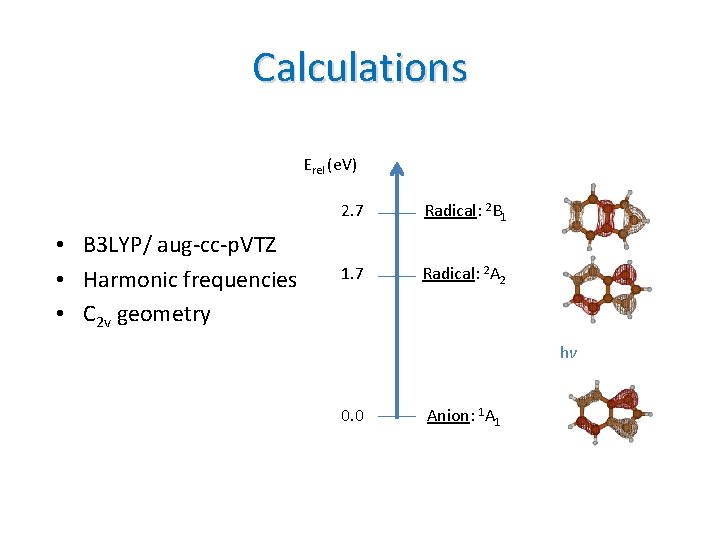
Calculations Erel (e. V) • B 3 LYP/ aug-cc-p. VTZ • Harmonic frequencies • C 2 v geometry 2. 7 Radical: 2 B 1 1. 7 Radical: 2 A 2 hv 0. 0 Anion: 1 A 1
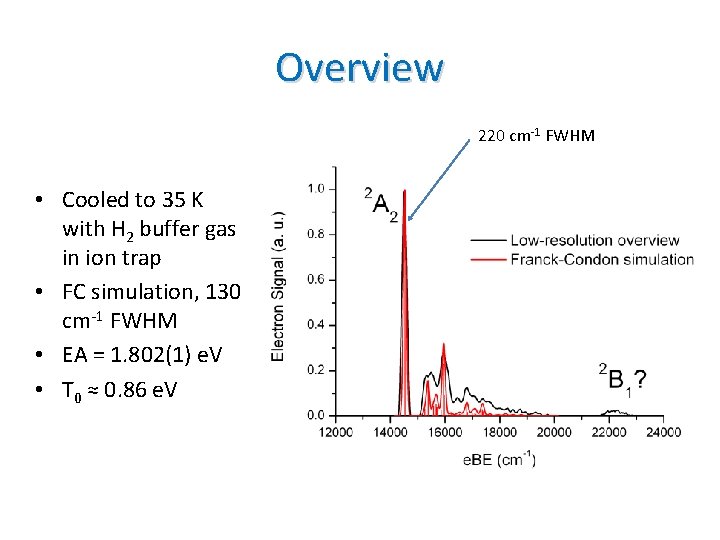
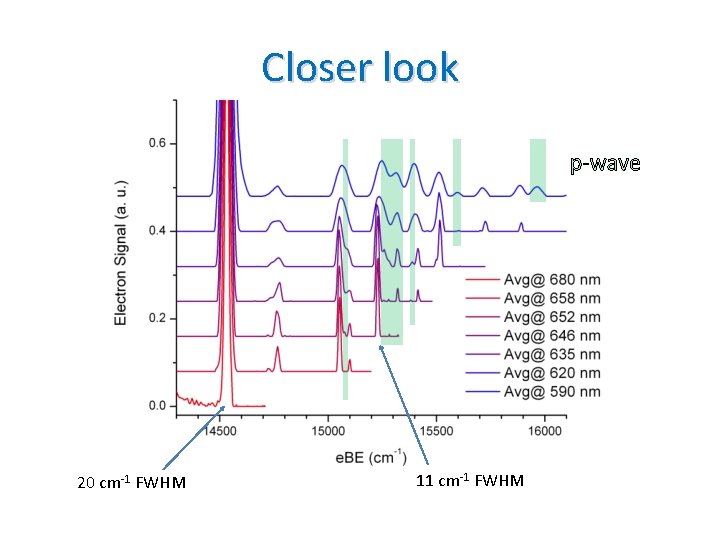
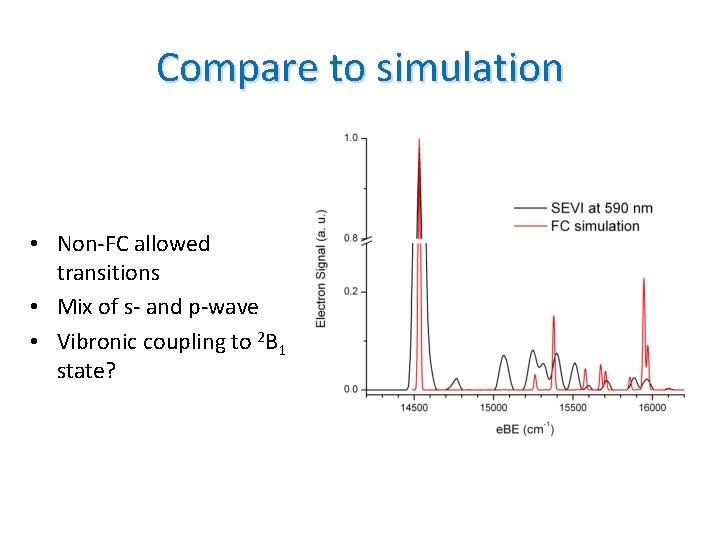
Overview 220 cm-1 FWHM • Cooled to 35 K with H 2 buffer gas in ion trap • FC simulation, 130 cm-1 FWHM • EA = 1. 802(1) e. V • T 0 ≈ 0. 86 e. V
Closer look p-wave 20 cm-1 FWHM 11 cm-1 FWHM
Compare to simulation • Non-FC allowed transitions • Mix of s- and p-wave • Vibronic coupling to 2 B 1 state?
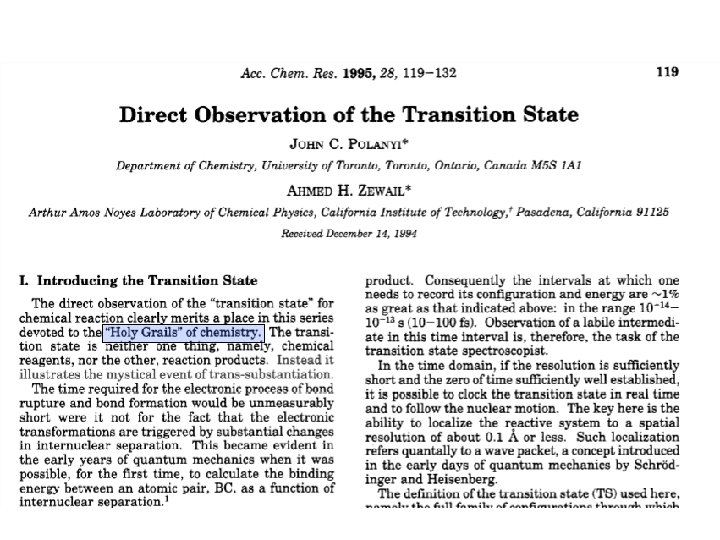
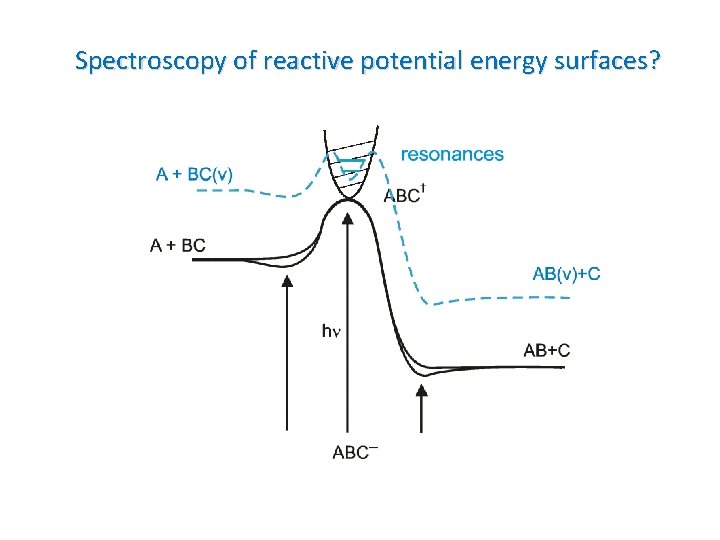
Spectroscopy of reactive potential energy surfaces?
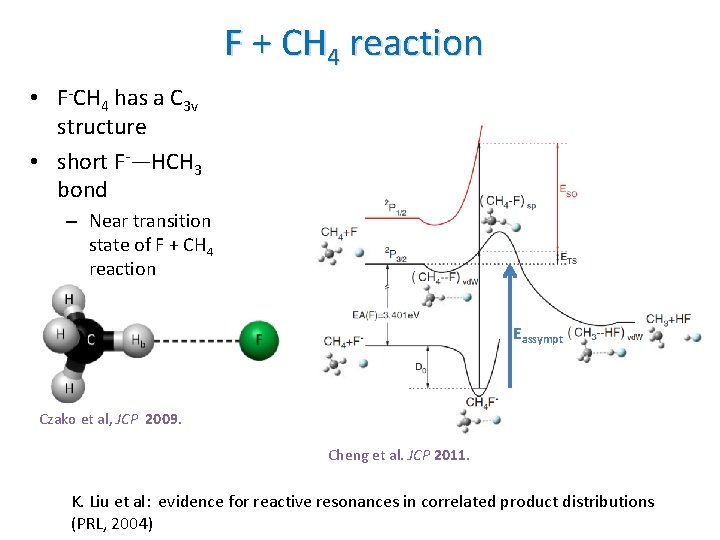
F + CH 4 reaction • F-CH 4 has a C 3 v structure • short F-—HCH 3 bond – Near transition state of F + CH 4 reaction Eassympt Czako et al, JCP 2009. Cheng et al. JCP 2011. K. Liu et al: evidence for reactive resonances in correlated product distributions (PRL, 2004)
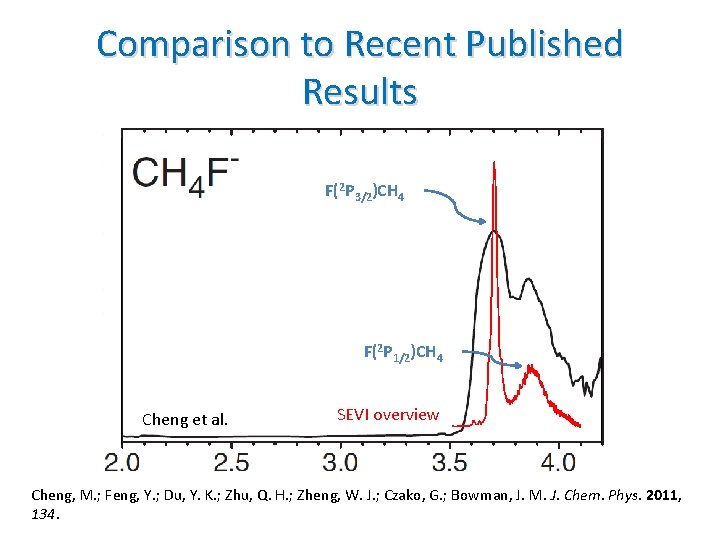
Comparison to Recent Published Results F(2 P 3/2)CH 4 F(2 P 1/2)CH 4 Cheng et al. SEVI overview Cheng, M. ; Feng, Y. ; Du, Y. K. ; Zhu, Q. H. ; Zheng, W. J. ; Czako, G. ; Bowman, J. M. J. Chem. Phys. 2011, 134.
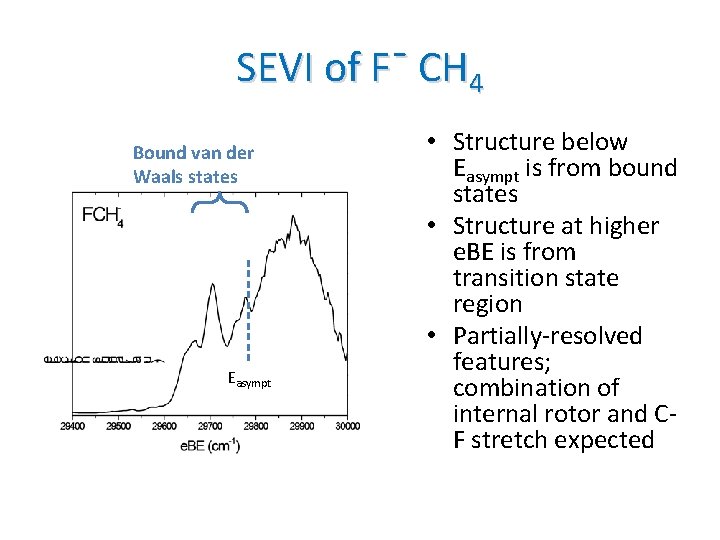
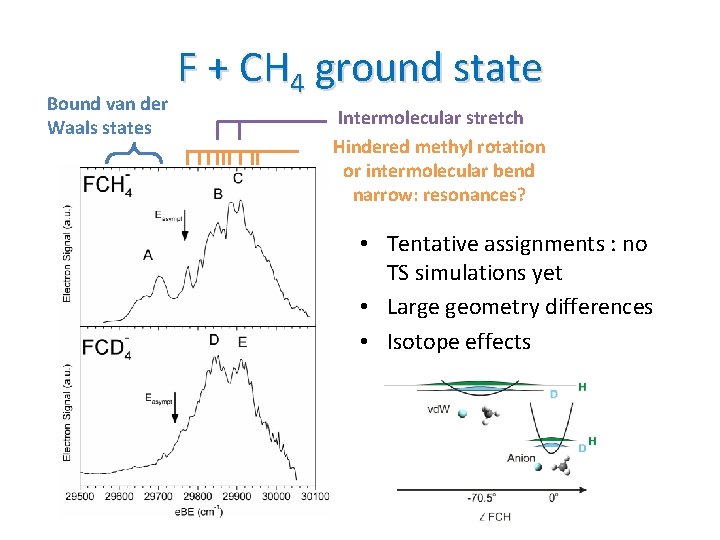
SEVI of Fˉ CH 4 Bound van der Waals states Easympt • Structure below Easympt is from bound states • Structure at higher e. BE is from transition state region • Partially-resolved features; combination of internal rotor and CF stretch expected
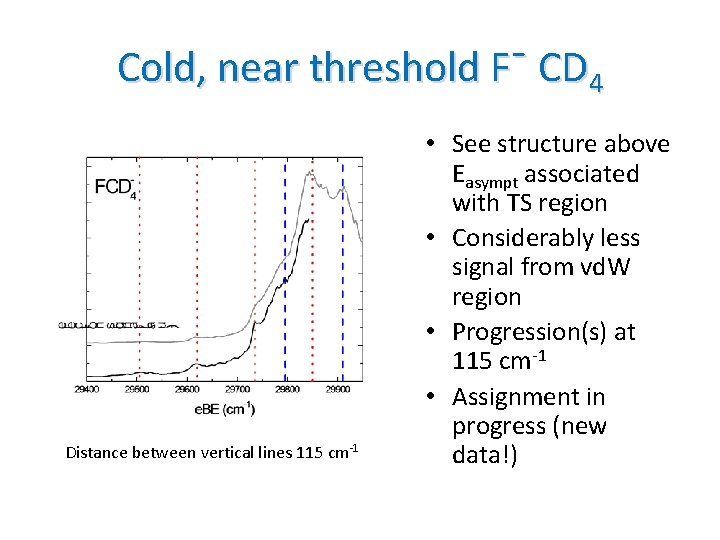
Cold, near threshold Fˉ CD 4 Distance between vertical lines 115 cm-1 • See structure above Easympt associated with TS region • Considerably less signal from vd. W region • Progression(s) at 115 cm-1 • Assignment in progress (new data!)
Summary • SEVI offers “next generation” of anion photodetachment experiments – First technique that systematically improves resolution of anion PES without sacrificing (much) generality • Where are we headed? – Cold ions via trapping/cooling – Bare and complexed metal/semiconductor clusters – Pre-reactive complexes and transition states (in progress) – Theory needed to simulate TS spectra, vibronic coupling
Many thanks: Etienne Garand Jongjin Kim Andreas Osterwalder Tara Yacovitch Matt Nee Jia Zhou $$$ AFOSR Christian Hock
… and the rest of the group!
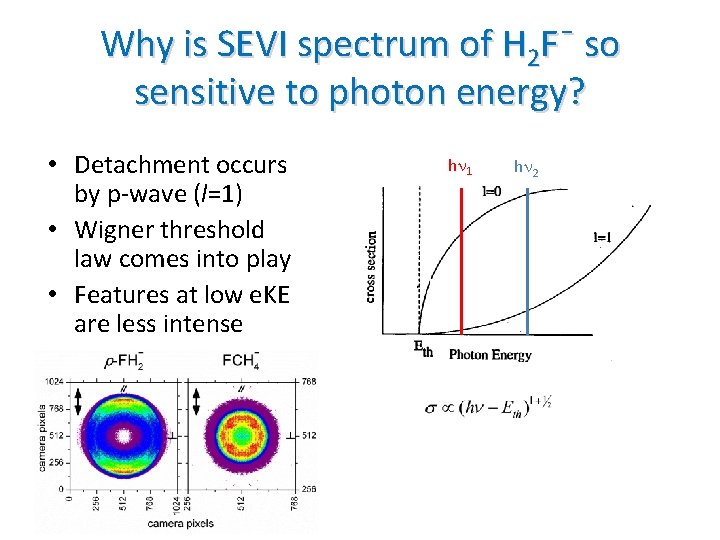
Why is SEVI spectrum of H 2 Fˉ so sensitive to photon energy? • Detachment occurs by p-wave (l=1) • Wigner threshold law comes into play • Features at low e. KE are less intense h 1 h 2
Bound van der Waals states F + CH 4 ground state Intermolecular stretch Hindered methyl rotation or intermolecular bend narrow: resonances? • Tentative assignments : no TS simulations yet • Large geometry differences • Isotope effects