
SLLA Test Prep Session 2 November 2008 Dr
SLLA Test Prep Session #2 November 2008 Dr. Tamerin Capellino
Test Prep Day #2 Overview Introductions n Review- Pop Quiz n Master Scheduling n More Test Taking Tips n Practice Questions n
Reminders Next Test Date: January 10 th n Score Report Mailing Date: February 12 th n Registration Deadline: December 13 th n Next Prep Session: December 10 th n
Pop Quiz 1. 2. 3. 4. 5. 6. SLLA stands for? The SLLA is a ___ hrs long written test. The SLLA is based on what standards? You have ___ minutes per question when taking the Evaluation of Actions I section of the test. You have ___ minutes per question when taking the Evaluation of Actions II section of the test. The case studies are ____ long each.
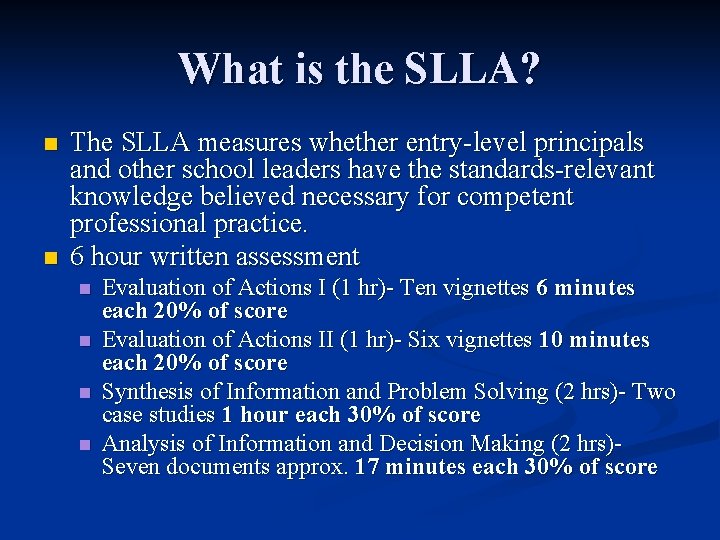
What is the SLLA? n n The SLLA measures whether entry-level principals and other school leaders have the standards-relevant knowledge believed necessary for competent professional practice. 6 hour written assessment n n Evaluation of Actions I (1 hr)- Ten vignettes 6 minutes each 20% of score Evaluation of Actions II (1 hr)- Six vignettes 10 minutes each 20% of score Synthesis of Information and Problem Solving (2 hrs)- Two case studies 1 hour each 30% of score Analysis of Information and Decision Making (2 hrs)Seven documents approx. 17 minutes each 30% of score
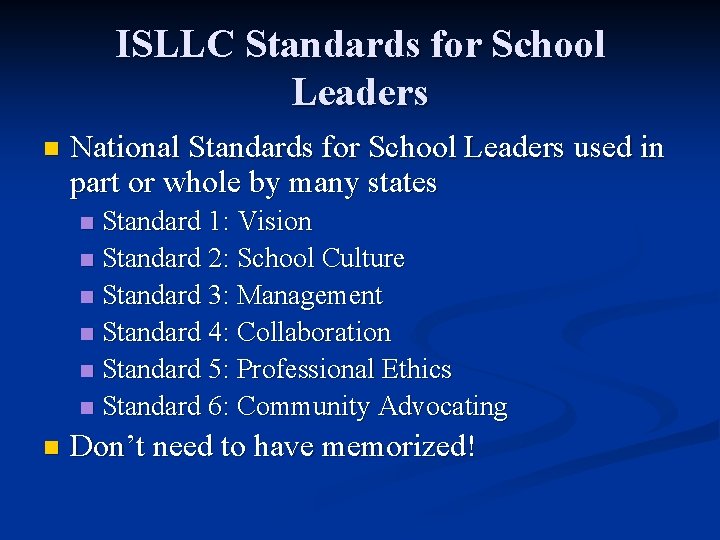
ISLLC Standards for School Leaders n National Standards for School Leaders used in part or whole by many states Standard 1: Vision n Standard 2: School Culture n Standard 3: Management n Standard 4: Collaboration n Standard 5: Professional Ethics n Standard 6: Community Advocating n n Don’t need to have memorized!
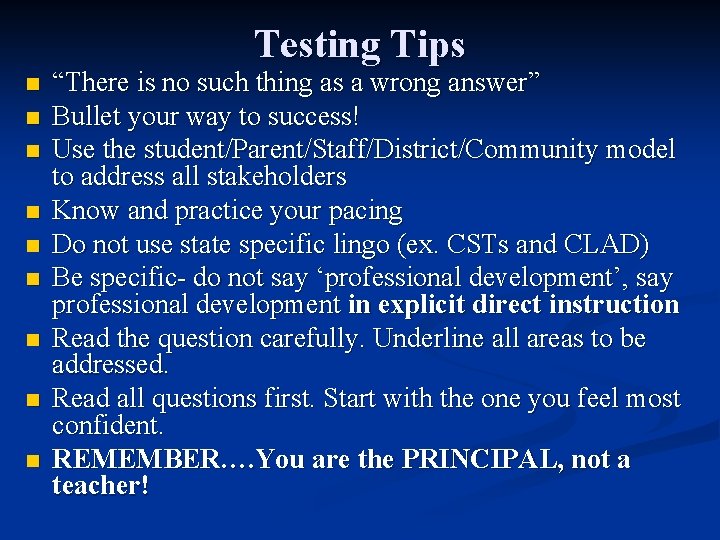
Testing Tips n n n n n “There is no such thing as a wrong answer” Bullet your way to success! Use the student/Parent/Staff/District/Community model to address all stakeholders Know and practice your pacing Do not use state specific lingo (ex. CSTs and CLAD) Be specific- do not say ‘professional development’, say professional development in explicit direct instruction Read the question carefully. Underline all areas to be addressed. Read all questions first. Start with the one you feel most confident. REMEMBER…. You are the PRINCIPAL, not a teacher!
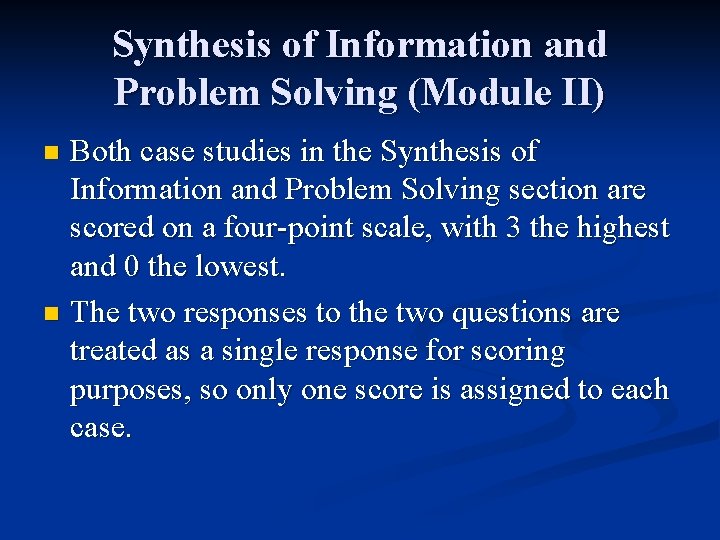
Synthesis of Information and Problem Solving (Module II) Both case studies in the Synthesis of Information and Problem Solving section are scored on a four-point scale, with 3 the highest and 0 the lowest. n The two responses to the two questions are treated as a single response for scoring purposes, so only one score is assigned to each case. n

Synthesis of Information and Problem Solving Scenario You are the newly assigned principal of James Madison School, an elementary school with an excellent reputation in the area, enriched programs in all grades, and high level of parent participation. The district has embarked on a major initiative in cooperative learning. By and large, the school has experienced rapid growth as a result of extensive real estate development in the area. One change evident in the past five years is that a much smaller proportion of the student population now participates in lessons, classes, sports activities, and other educational and personal opportunities outside the scope of the school.
Synthesis of Information and Problem Solving Scenario (cont) n School Improvement Goals: To improve implementation of cooperative learning in all classrooms n To improve achievement levels of all students in basic skills in the core areas: reading, writing, and mathematics n
Synthesis of Information and Problem Solving Scenario (cont) n Questions: 1. 2. Based on your understanding of learning and teaching and larger educational issues, identify and describe the broader challenges faced by the school. Evaluate the given school improvement plan in terms of its strengths and weaknesses. Describe the actions the principal should take to implement the plan and elicit community support.

Scoring Rubric Well developed analysis and synthesis of all documents n Describe challenges faced by the school n Evaluation of Improvement Plan (strengths and weaknesses) n Multiple ways to elicit community support n Multiple actions principal should take n
Analysis of Information and Decision Making (Module III) The seven exercises in the Analysis of Information and Decision Making section are scored on a three-point scale, with 2 the highest possible score and 0 the lowest. The responses to the two questions are associated with each document are treated as a single response for scoring purposes. n Approx. 17 minutes per response n
Analysis of Information and Decision Making n The types of documents used in this module may include: Assessment data n School improvement plans n Budget information n Schedules n Staff allocations n Curriculum information n
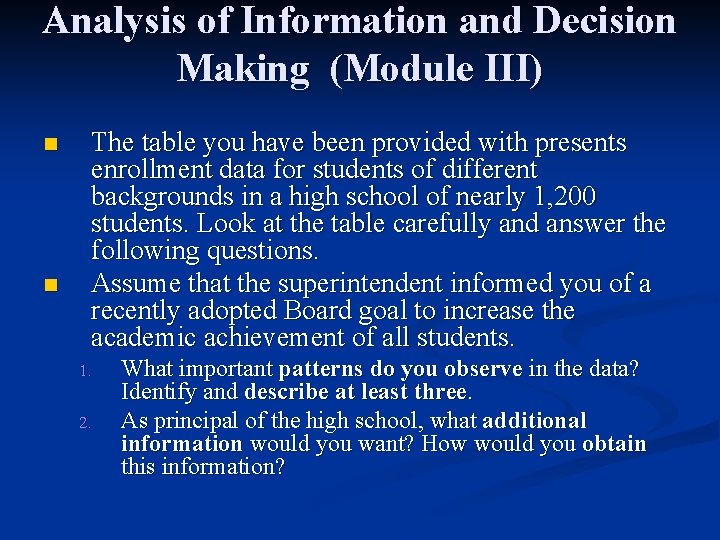
Analysis of Information and Decision Making (Module III) n n The table you have been provided with presents enrollment data for students of different backgrounds in a high school of nearly 1, 200 students. Look at the table carefully and answer the following questions. Assume that the superintendent informed you of a recently adopted Board goal to increase the academic achievement of all students. 1. 2. What important patterns do you observe in the data? Identify and describe at least three. As principal of the high school, what additional information would you want? How would you obtain this information?

Scoring Rubric n In order to achieve a score of 2, the response specifically cites the three important patterns observed (Asian Population and AP course enrollment, males in AP classes, Black population and basic math, etc. ) and thoroughly addresses the additional information needed such as: n n n Grades Standardized test score information % of students entering 4 year universities How students are placed. Explains how the information would be obtained.

Questions? ? ?

Next Meeting n n n Date: December 10 th, 2008 Time: 3: 30 -5: 30 pm Agenda: n n More practice questions Key content knowledge Last minute advice Other? ?
- Slides: 18