
Slippy Maps Visualizing maps on the web What
Slippy Maps Visualizing maps on the web
What is a Map? �A map is a drawing that is the representation, on a certain scale, of a terrain.

The classic "Big (Composite) Map" �Have a very big file size for the "real-estate" you get in the game world. �Have limits with texture sizes. �Not be very flexible; you won't really be able to re-use whole screens as different parts of the world. �Be easier to program with. �Won't require a 'Tile Editor' to compose.

"Tiled Map“ �Have a much smaller file size for a much larger world. �Be a bit more fiddly to program (but it's not massively complex). �Require you to edit / load tile configurations (maps) in the game from your own file format. �Make large scrolling levels work much better. �Have much more flexibility - one tile set could make dozens of levels.
Requesting for a Map �The map will be generated with a proper level of detail, depending on the following parameters: �latitude and �longitude for the center of map �the zoom level – corresponding on how much space to be represented on a usually preset content size. The level of detail is then deducted, depending on how much information can be represented with the above constraints.
Map Services Providers �Free: Open. Street. Map �Commercial: Google (Tele Atlas) Tom
Open. Street. Map �Open. Street. Map (OSM) is a collaborative project to create a free editable map of the world – www. openstreetmap. org. �The data comes from: �Portable GPS devices, �aerial photography, �from other free sources, �or simply from local knowledge.
Open. Street. Map �Open. Street. Map was inspired by sites such as Wikipedia — the map display features a prominent 'Edit' tab and a full revision history is maintained. Registered users can upload GPS track logs and edit the vector data using the given editing tools.
Open. Street. Map – Map Production �The initial map data was all built from scratch by volunteers performing ground surveys using a GPS unit and a notebook or a voice recorder. Then the data was then entered into the Open. Street. Map database. �In the present the availability of aerial photography and other data sources has greatly increased the work speed the data is collected more accurately. �Ground surveys are performed by volunteers. The data is entered into the database using one of several purpose-built map editors.
Slippy Map �The Slippy Map is the main Open. Street. Map web based display for browsing OSM data. �AJAX component : Java. Script runs in the browser, which dynamically requests tiles from the server in the background without reloading the whole HTML page. This provides a smooth slippy zoomy map browsing experience.
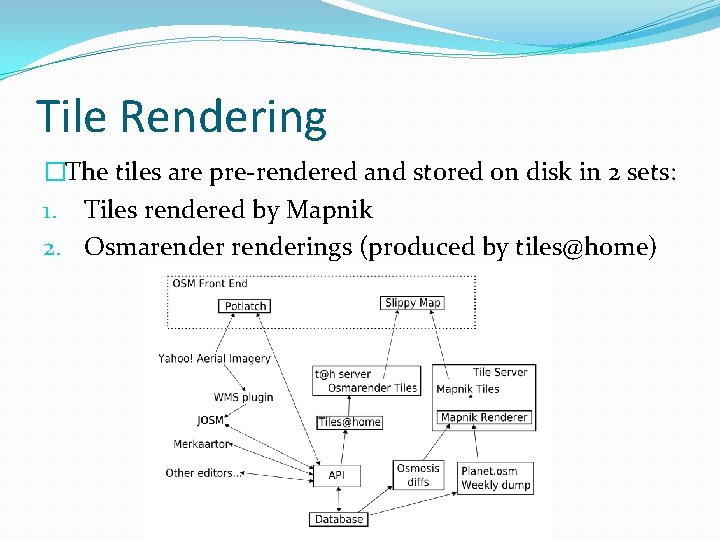
Tile Rendering �The tiles are pre-rendered and stored on disk in 2 sets: 1. Tiles rendered by Mapnik 2. Osmarenderings (produced by tiles@home)
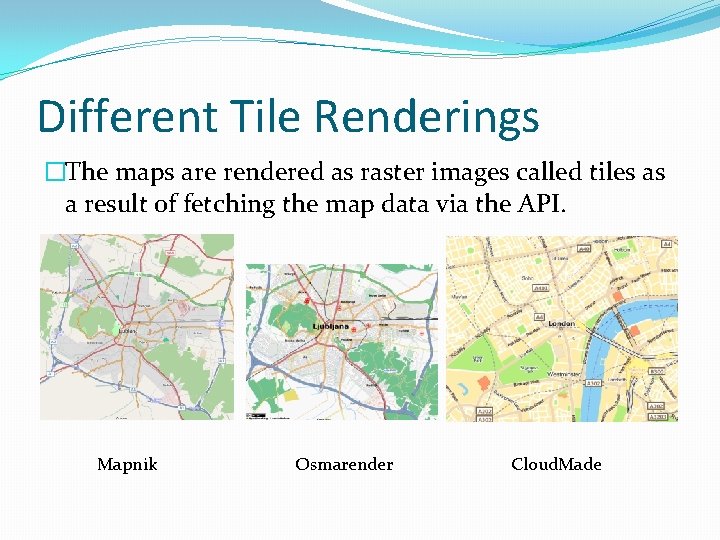
Different Tile Renderings �The maps are rendered as raster images called tiles as a result of fetching the map data via the API. Mapnik Osmarender Cloud. Made
Mapnik Tile Rendering �Mapnik tiles are currently generated on tile. openstreetmap. org. �The Mapnik database is updated with hourly diffs so that most data changes should get rendered within an hour. �Mapnik rendering runs as an apache module called mod tile developed especially for high performance needs.
Mapnik Renderer Rules �Every tile has a timestamp for when it was rendered and a dirty flag signifying that it is ready to be re-rendered. �Whenever looking at a tile, it is checked if it is older than seven days. � If it is older than seven days then it is marked dirty (and thus rendered). �A background rendering process generates a list of all dirty tiles and then proceeds to render them all. � Once it has finished it queries the list of dirty tiles again. �Tiles are rendered on a interest/attention-first basis. �Marking a tile dirty does not mark all sub tiles as dirty.
Libraries for Displaying the Tiles �Open. Layers and Google. Maps �Open. Layers can combine maps from different sources (Google Maps background, WMS overlays, vector data from KML or GML files or WFS etc) �You can style Open. Layers much more than possible with Google Maps �Open. Layers is open source, so debugging is possible �If maps with high precision are requested, the best choice is using Open. Layers with a suitable map server backend rather than Google Maps to get a better map projection (Google Maps uses the Mercator projection, so it cannot show areas around the poles)
- Slides: 15