
Slip Trip and Fall Prevention for Public Entities
Slip, Trip, and Fall Prevention for Public Entities
National Statistics General Industry • #3 leading cause of fatal injury on the job • Over 12, 000 deaths occur each year • 23% more deaths in 1999 than 1989 • Approximately 300, 000 non fatal slip/trip/falls occur on the job each year • Representing 19% of all disabling injuries
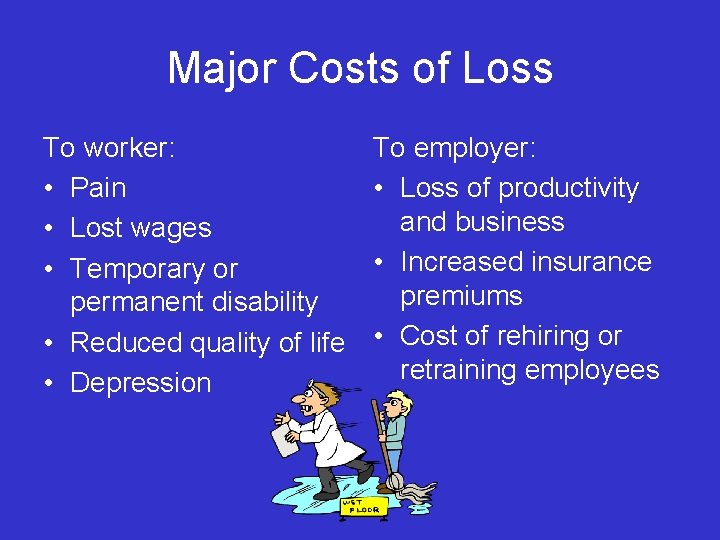
Major Costs of Loss To worker: • Pain • Lost wages • Temporary or permanent disability • Reduced quality of life • Depression To employer: • Loss of productivity and business • Increased insurance premiums • Cost of rehiring or retraining employees
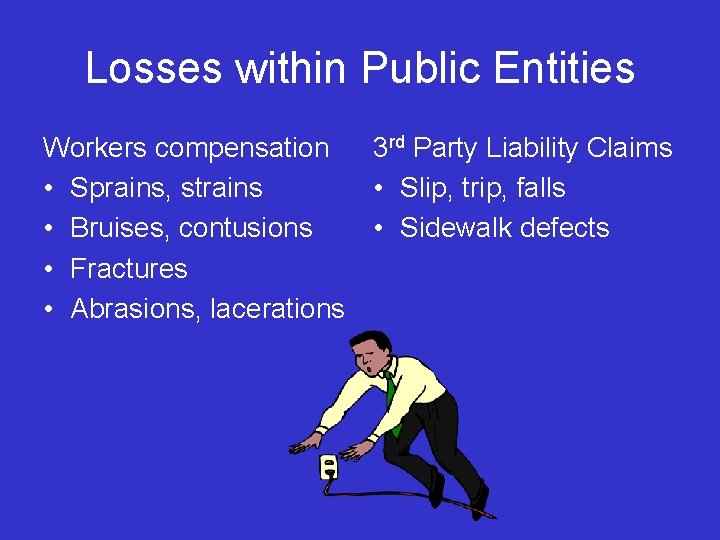
Losses within Public Entities Workers compensation 3 rd Party Liability Claims • Sprains, strains • Slip, trip, falls • Bruises, contusions • Sidewalk defects • Fractures • Abrasions, lacerations
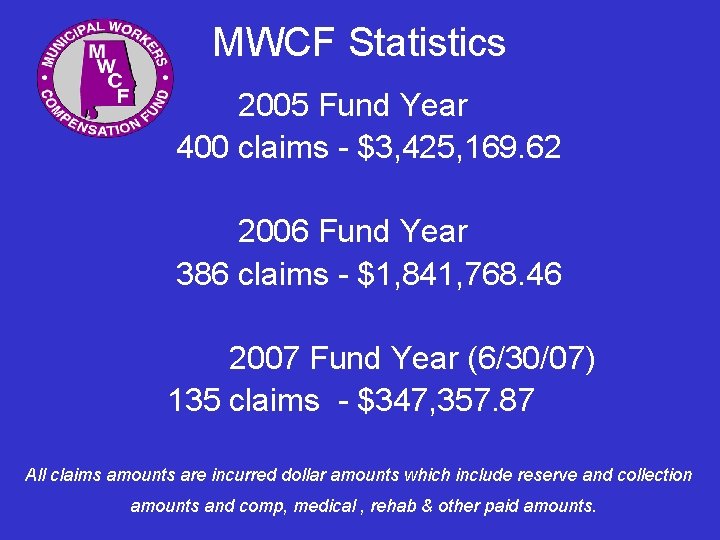
MWCF Statistics 2005 Fund Year 400 claims - $3, 425, 169. 62 2006 Fund Year 386 claims - $1, 841, 768. 46 2007 Fund Year (6/30/07) 135 claims - $347, 357. 87 All claims amounts are incurred dollar amounts which include reserve and collection amounts and comp, medical , rehab & other paid amounts.
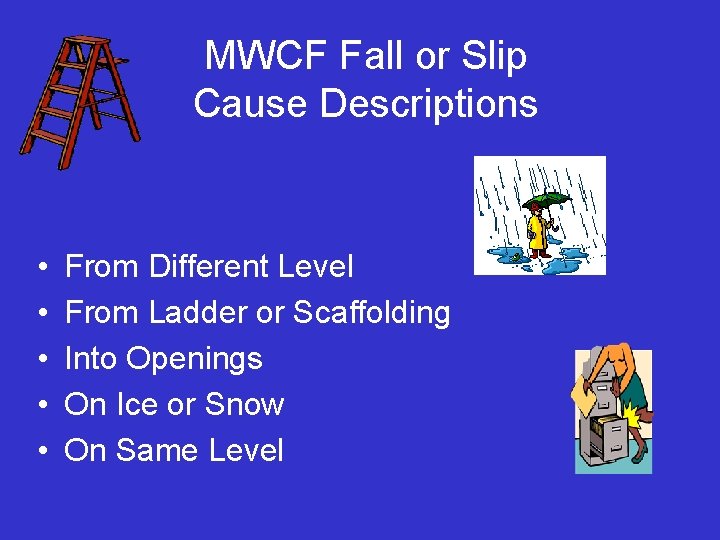
MWCF Fall or Slip Cause Descriptions • • • From Different Level From Ladder or Scaffolding Into Openings On Ice or Snow On Same Level
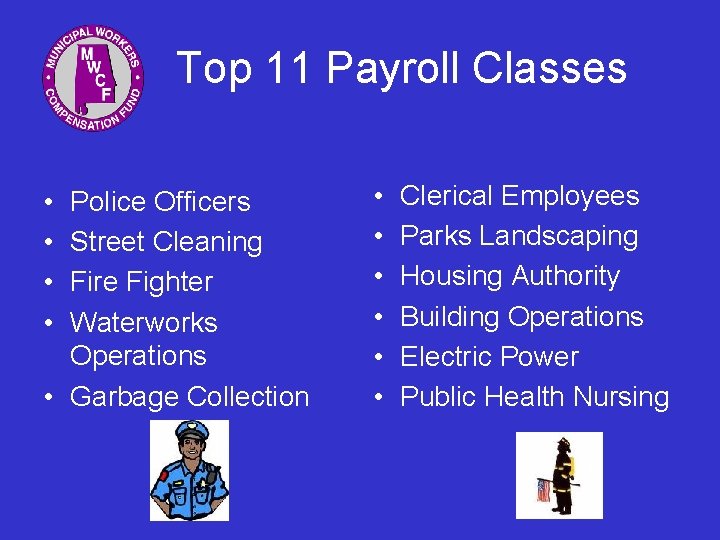
Top 11 Payroll Classes • • Police Officers Street Cleaning Fire Fighter Waterworks Operations • Garbage Collection • • • Clerical Employees Parks Landscaping Housing Authority Building Operations Electric Power Public Health Nursing
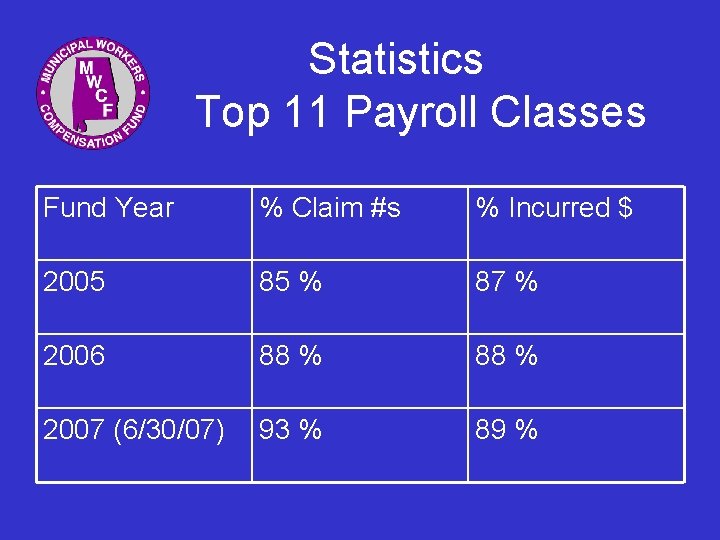
Statistics Top 11 Payroll Classes Fund Year % Claim #s % Incurred $ 2005 85 % 87 % 2006 88 % 2007 (6/30/07) 93 % 89 %
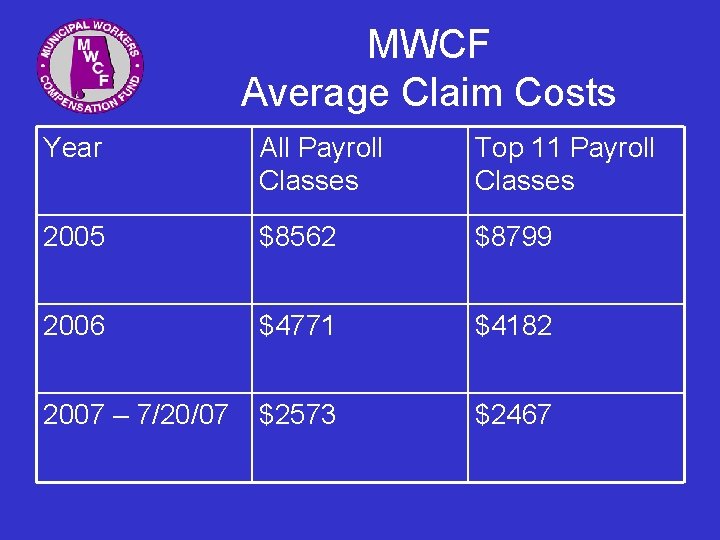
MWCF Average Claim Costs Year All Payroll Classes Top 11 Payroll Classes 2005 $8562 $8799 2006 $4771 $4182 2007 – 7/20/07 $2573 $2467
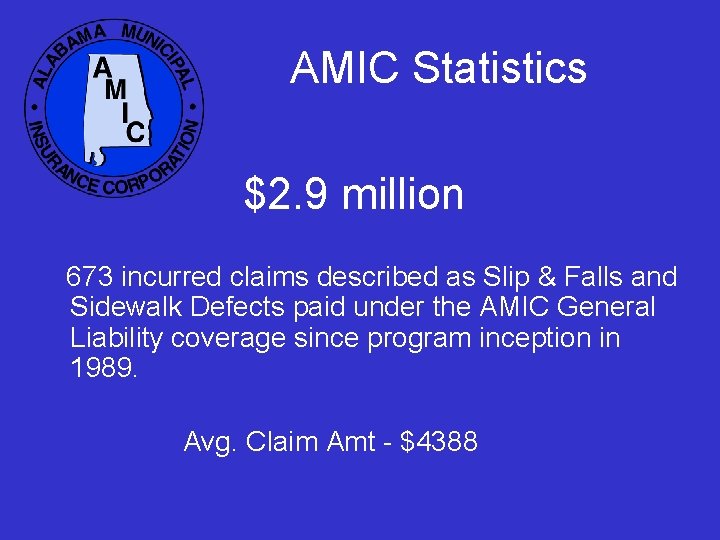
AMIC Statistics $2. 9 million 673 incurred claims described as Slip & Falls and Sidewalk Defects paid under the AMIC General Liability coverage since program inception in 1989. Avg. Claim Amt - $4388
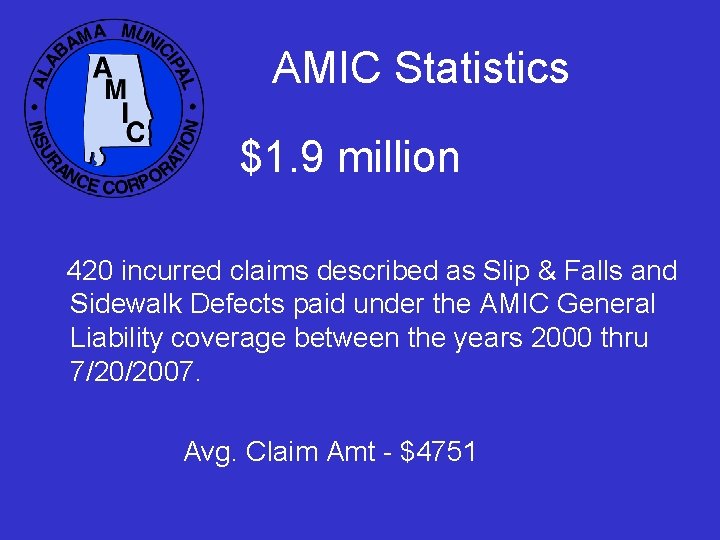
AMIC Statistics $1. 9 million 420 incurred claims described as Slip & Falls and Sidewalk Defects paid under the AMIC General Liability coverage between the years 2000 thru 7/20/2007. Avg. Claim Amt - $4751
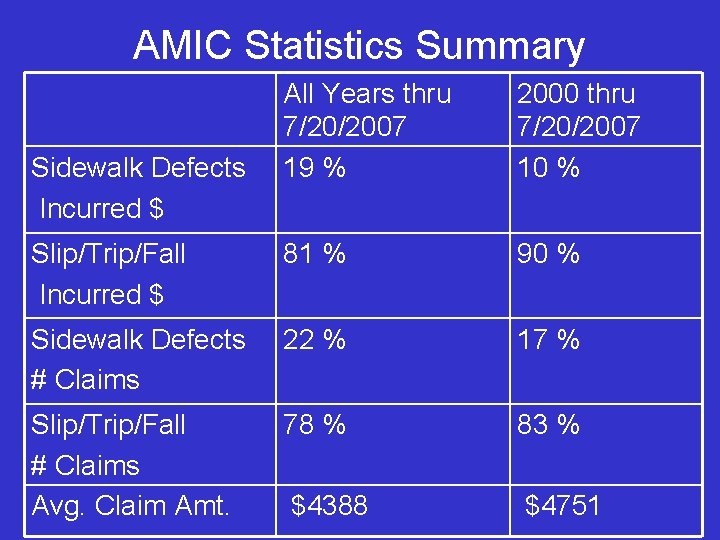
AMIC Statistics Summary All Years thru 7/20/2007 19 % 2000 thru 7/20/2007 10 % Slip/Trip/Fall Incurred $ 81 % 90 % Sidewalk Defects # Claims 22 % 17 % Slip/Trip/Fall # Claims Avg. Claim Amt. 78 % 83 % $4388 $4751 Sidewalk Defects Incurred $
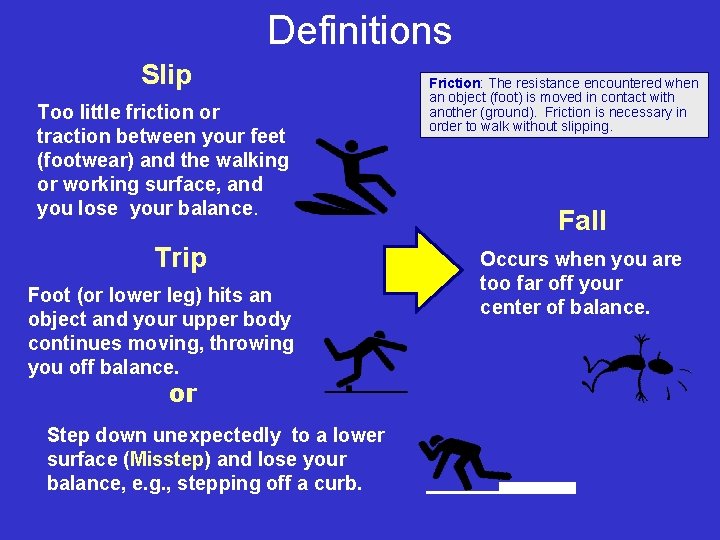
Definitions Slip Too little friction or traction between your feet (footwear) and the walking or working surface, and you lose your balance. Trip Foot (or lower leg) hits an object and your upper body continues moving, throwing you off balance. or Step down unexpectedly to a lower surface (Misstep) and lose your balance, e. g. , stepping off a curb. Friction: The resistance encountered when an object (foot) is moved in contact with another (ground). Friction is necessary in order to walk without slipping. Fall Occurs when you are too far off your center of balance.
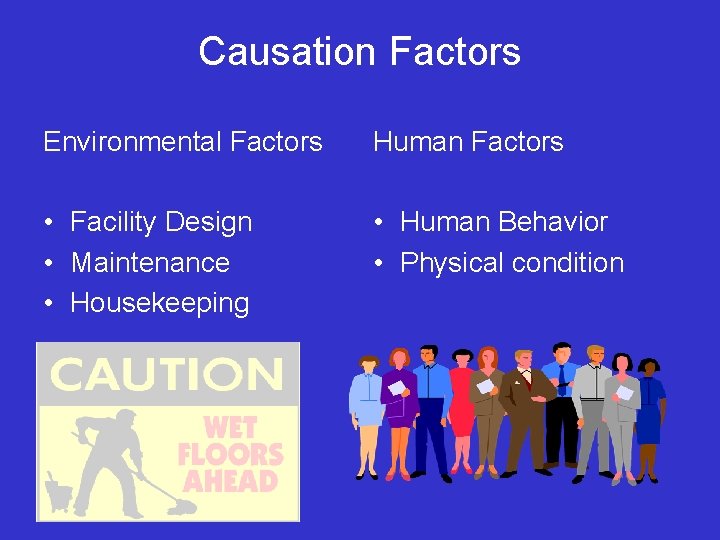
Causation Factors Environmental Factors Human Factors • Facility Design • Maintenance • Housekeeping • Human Behavior • Physical condition
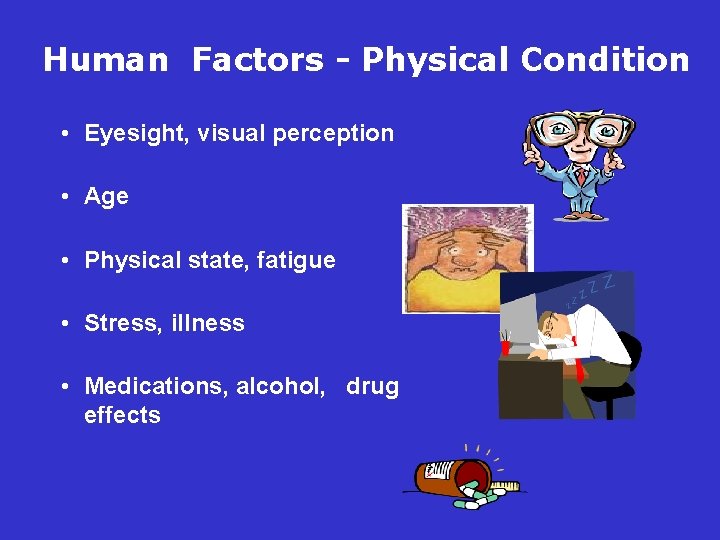
Human Factors - Physical Condition • Eyesight, visual perception • Age • Physical state, fatigue • Stress, illness • Medications, alcohol, drug effects
Age & Medical Related Factors • Reduced Visual Ability – lighting, objects on floor, warning or informational signs • Declines in Musculoskeletal or Nervous System – poor balance or unsteady gait, level walk areas, handrails • Illness, Seizures, Medications – contributes to fatigue or drowsiness
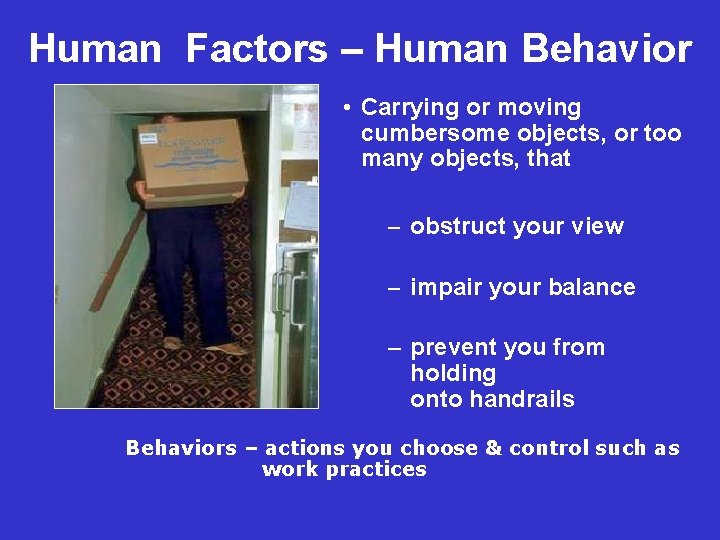
Human Factors – Human Behavior • Carrying or moving cumbersome objects, or too many objects, that – obstruct your view – impair your balance – prevent you from holding onto handrails Behaviors – actions you choose & control such as work practices
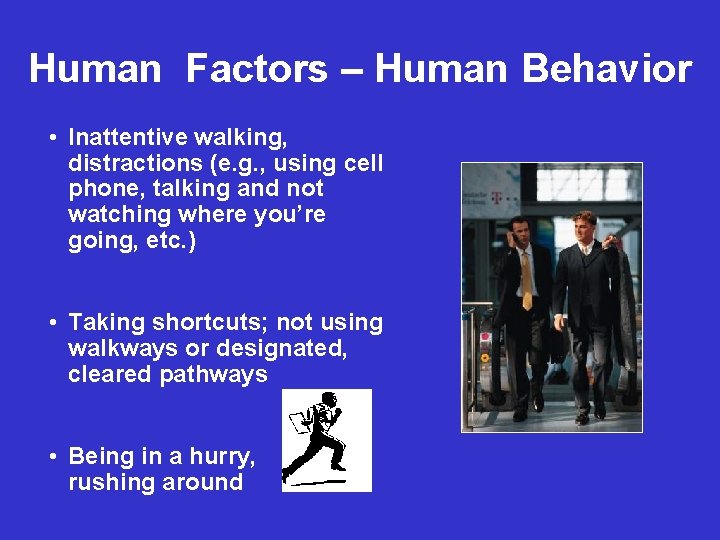
Human Factors – Human Behavior • Inattentive walking, distractions (e. g. , using cell phone, talking and not watching where you’re going, etc. ) • Taking shortcuts; not using walkways or designated, cleared pathways • Being in a hurry, rushing around
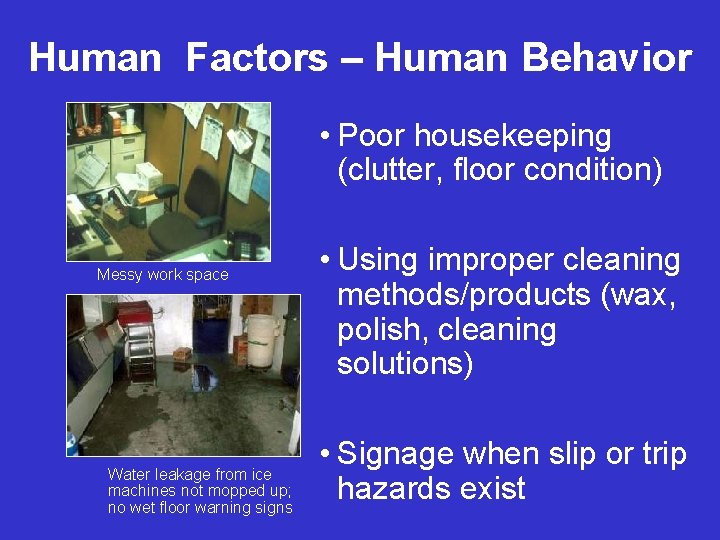
Human Factors – Human Behavior • Poor housekeeping (clutter, floor condition) Messy work space Water leakage from ice machines not mopped up; no wet floor warning signs • Using improper cleaning methods/products (wax, polish, cleaning solutions) • Signage when slip or trip hazards exist
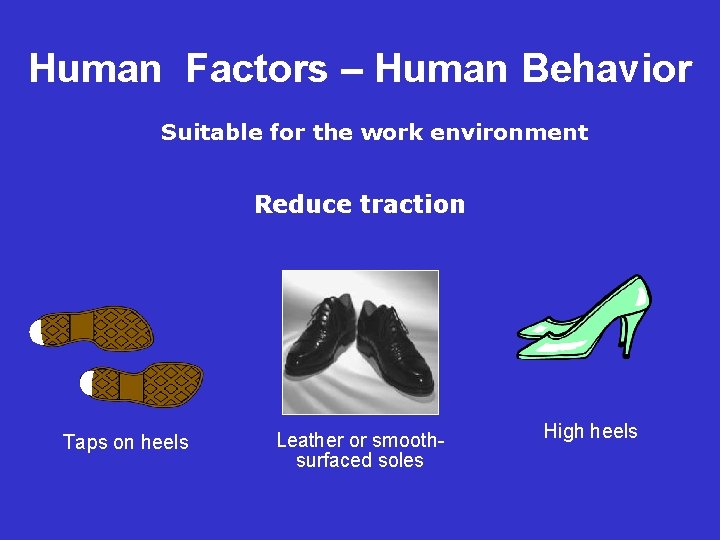
Human Factors – Human Behavior Suitable for the work environment Reduce traction Taps on heels Leather or smoothsurfaced soles High heels
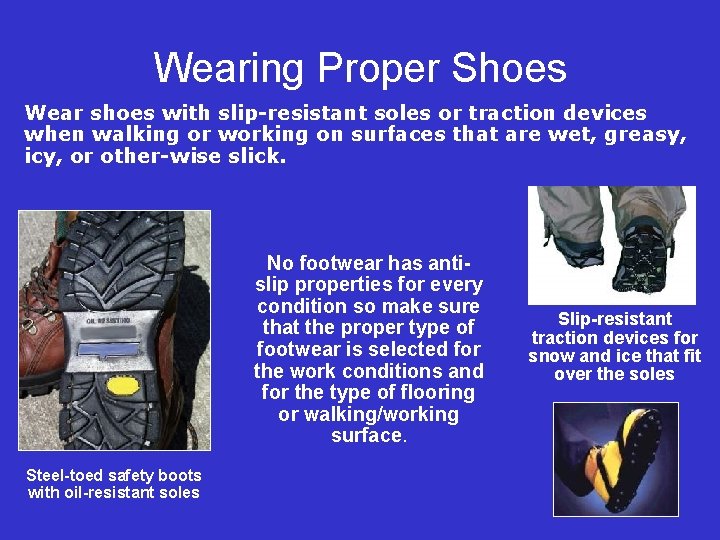
Wearing Proper Shoes Wear shoes with slip-resistant soles or traction devices when walking or working on surfaces that are wet, greasy, icy, or other-wise slick. No footwear has antislip properties for every condition so make sure that the proper type of footwear is selected for the work conditions and for the type of flooring or walking/working surface. Steel-toed safety boots with oil-resistant soles Slip-resistant traction devices for snow and ice that fit over the soles
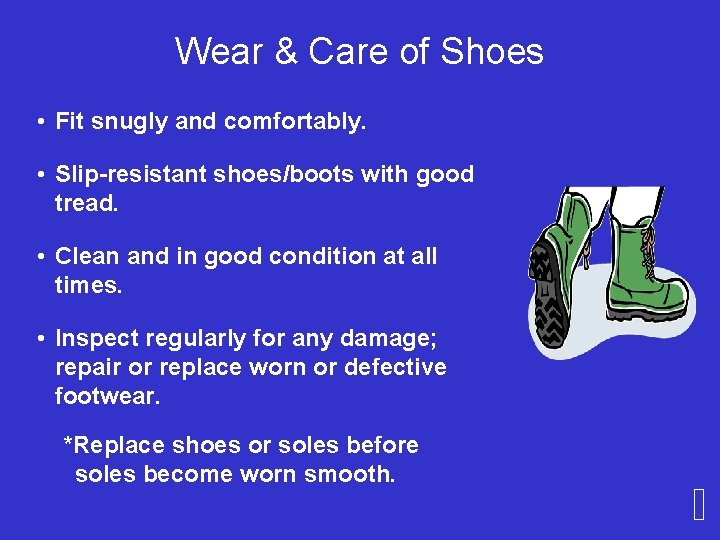
Wear & Care of Shoes • Fit snugly and comfortably. • Slip-resistant shoes/boots with good tread. • Clean and in good condition at all times. • Inspect regularly for any damage; repair or replace worn or defective footwear. *Replace shoes or soles before soles become worn smooth.
Human Factors – Human Behavior Safe Walking Practices • Attentiveness to surroundings, obstructions, and walking surfaces • Watch for changes in elevations • Walk don’t run • Use handrails/dollies/elevators • Report slip/trip/fall hazards
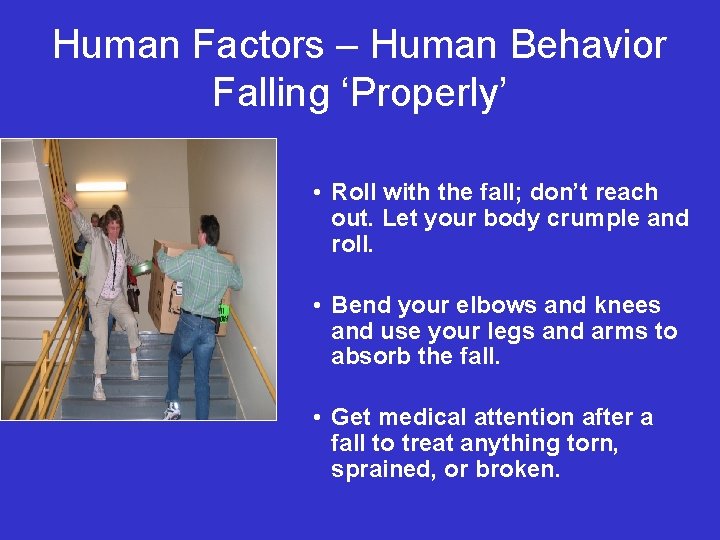
Human Factors – Human Behavior Falling ‘Properly’ • Roll with the fall; don’t reach out. Let your body crumple and roll. • Bend your elbows and knees and use your legs and arms to absorb the fall. • Get medical attention after a fall to treat anything torn, sprained, or broken.
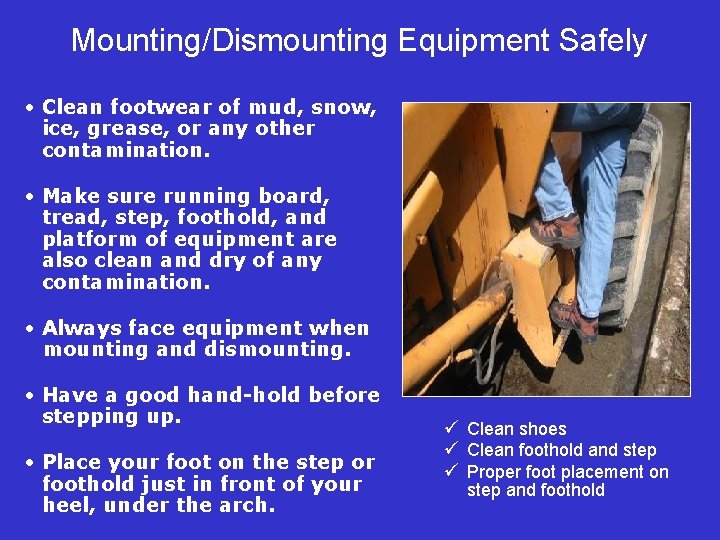
Mounting/Dismounting Equipment Safely • Clean footwear of mud, snow, ice, grease, or any other contamination. • Make sure running board, tread, step, foothold, and platform of equipment are also clean and dry of any contamination. • Always face equipment when mounting and dismounting. • Have a good hand-hold before stepping up. • Place your foot on the step or foothold just in front of your heel, under the arch. ü Clean shoes ü Clean foothold and step ü Proper foot placement on step and foothold
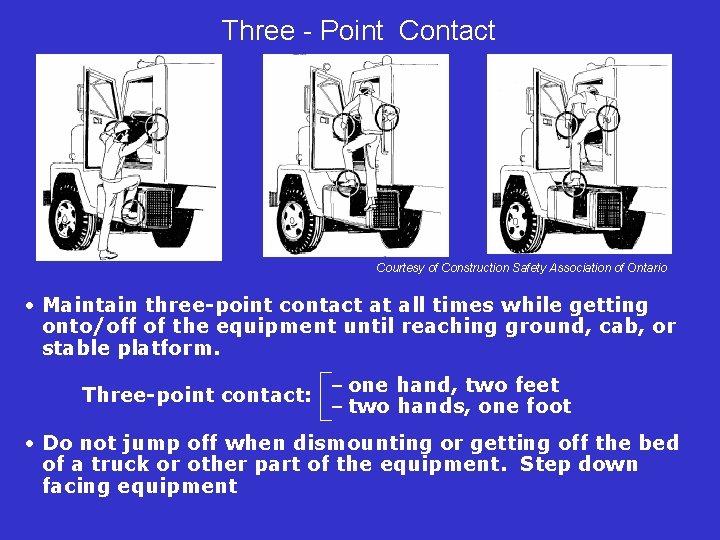
Three - Point Contact Courtesy of Construction Safety Association of Ontario • Maintain three-point contact at all times while getting onto/off of the equipment until reaching ground, cab, or stable platform. Three-point contact: – one hand, two feet – two hands, one foot • Do not jump off when dismounting or getting off the bed of a truck or other part of the equipment. Step down facing equipment
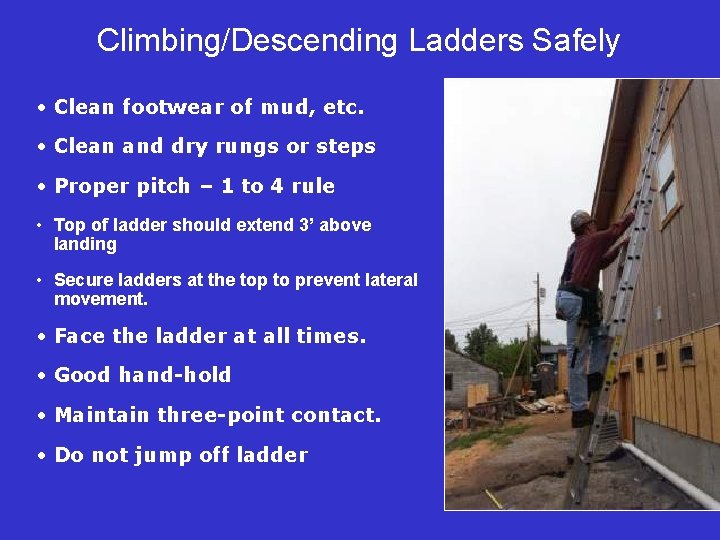
Climbing/Descending Ladders Safely • Clean footwear of mud, etc. • Clean and dry rungs or steps • Proper pitch – 1 to 4 rule • Top of ladder should extend 3’ above landing • Secure ladders at the top to prevent lateral movement. • Face the ladder at all times. • Good hand-hold • Maintain three-point contact. • Do not jump off ladder
Environmental Factors Facility Design • Building codes • Life Safety codes • ADA Accessibility guidelines
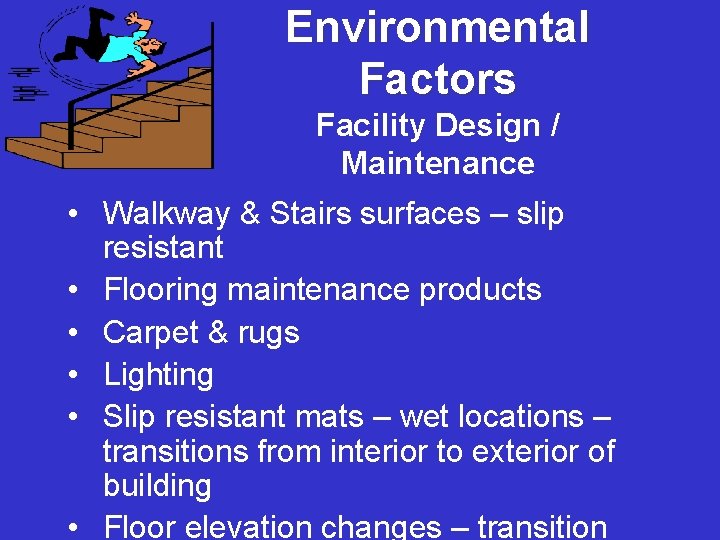
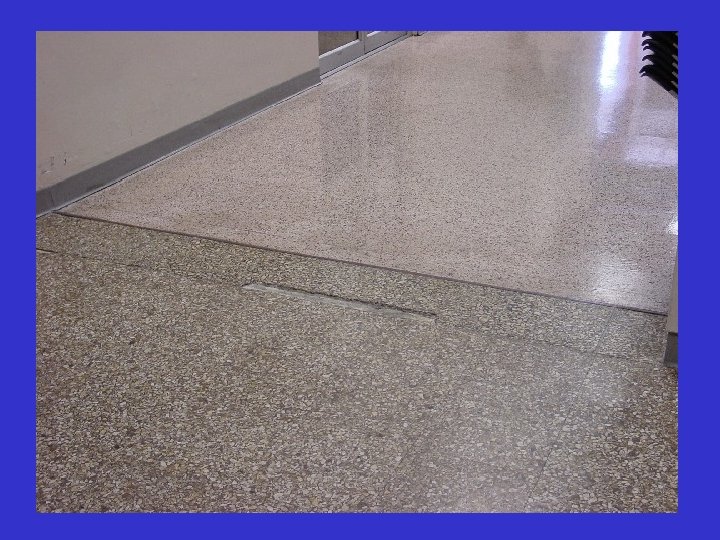
Environmental Factors Facility Design / Maintenance • Walkway & Stairs surfaces – slip resistant • Flooring maintenance products • Carpet & rugs • Lighting • Slip resistant mats – wet locations – transitions from interior to exterior of building • Floor elevation changes – transition
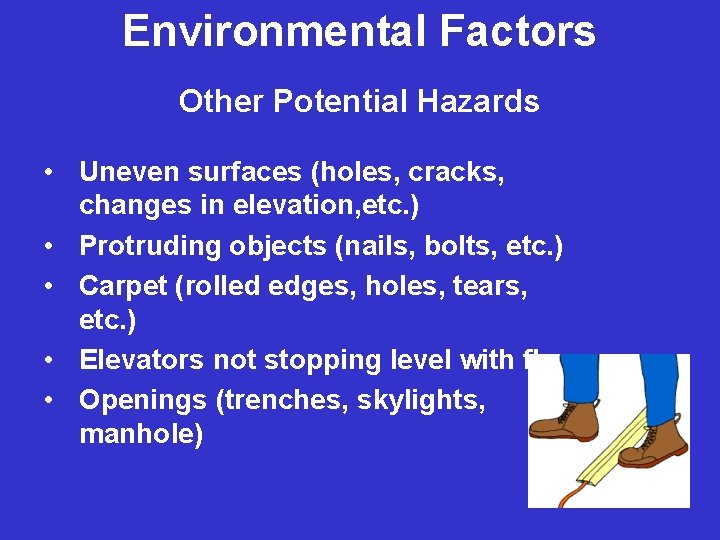
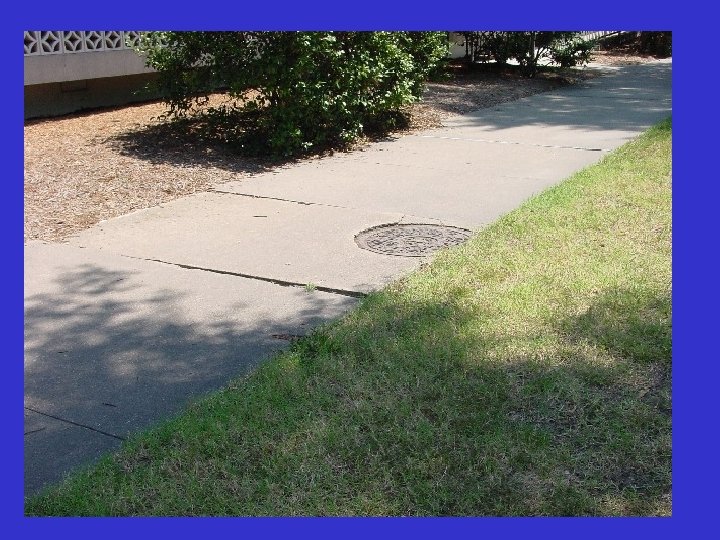
Environmental Factors Other Potential Hazards • Uneven surfaces (holes, cracks, changes in elevation, etc. ) • Protruding objects (nails, bolts, etc. ) • Carpet (rolled edges, holes, tears, etc. ) • Elevators not stopping level with floor • Openings (trenches, skylights, manhole)
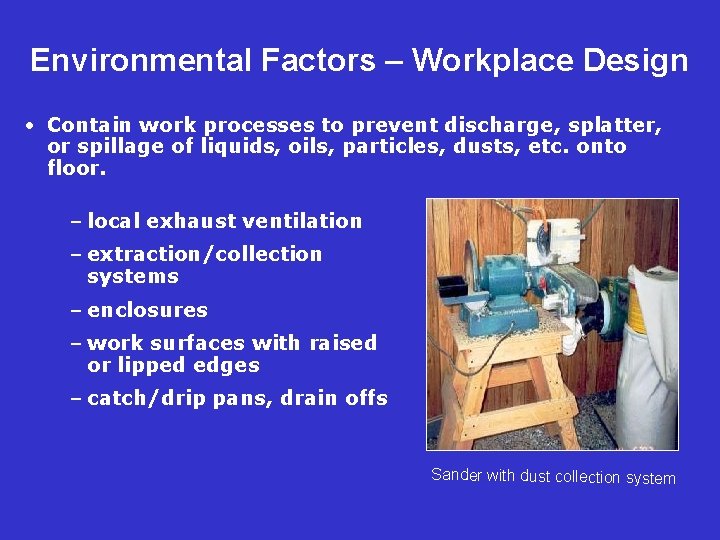
Environmental Factors – Workplace Design • Contain work processes to prevent discharge, splatter, or spillage of liquids, oils, particles, dusts, etc. onto floor. – local exhaust ventilation – extraction/collection systems – enclosures – work surfaces with raised or lipped edges – catch/drip pans, drain offs Sander with dust collection system
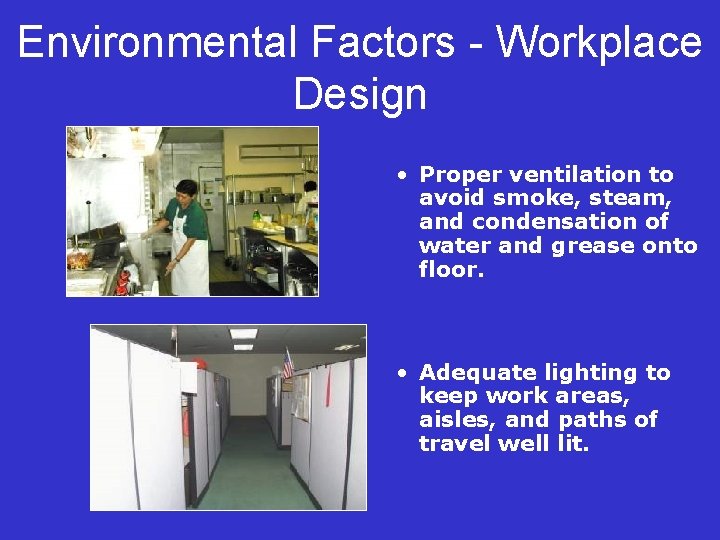
Environmental Factors - Workplace Design • Proper ventilation to avoid smoke, steam, and condensation of water and grease onto floor. • Adequate lighting to keep work areas, aisles, and paths of travel well lit.
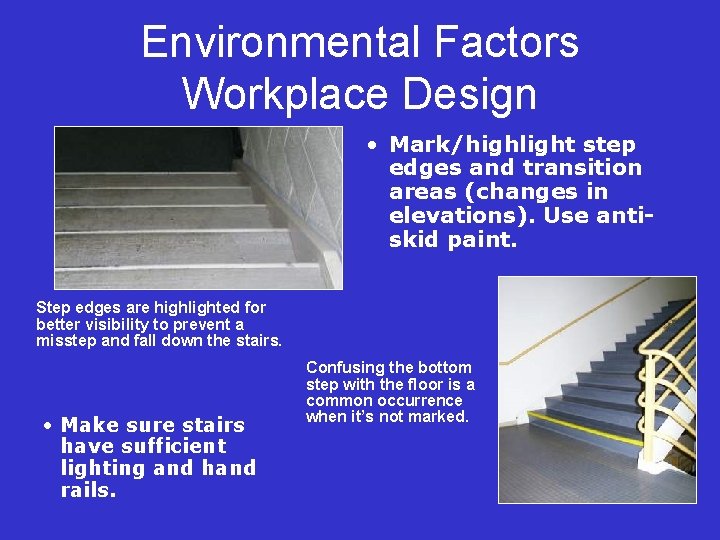
Environmental Factors Workplace Design • Mark/highlight step edges and transition areas (changes in elevations). Use antiskid paint. Step edges are highlighted for better visibility to prevent a misstep and fall down the stairs. • Make sure stairs have sufficient lighting and hand rails. Confusing the bottom step with the floor is a common occurrence when it’s not marked.
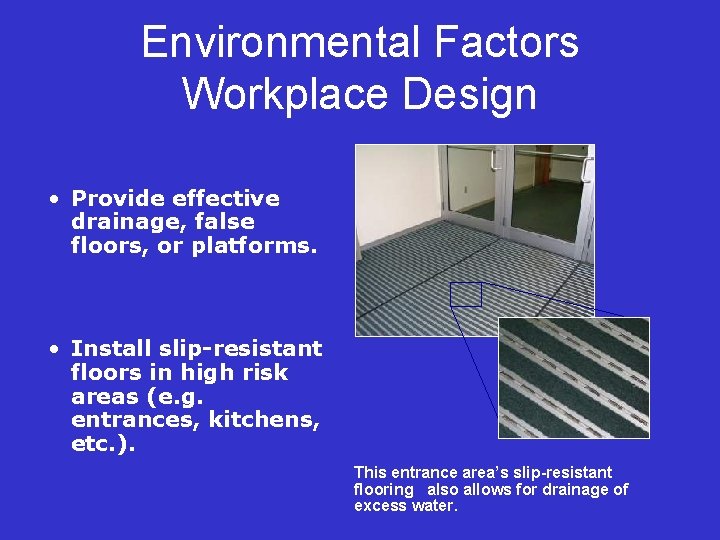
Environmental Factors Workplace Design • Provide effective drainage, false floors, or platforms. • Install slip-resistant floors in high risk areas (e. g. entrances, kitchens, etc. ). This entrance area’s slip-resistant flooring also allows for drainage of excess water.
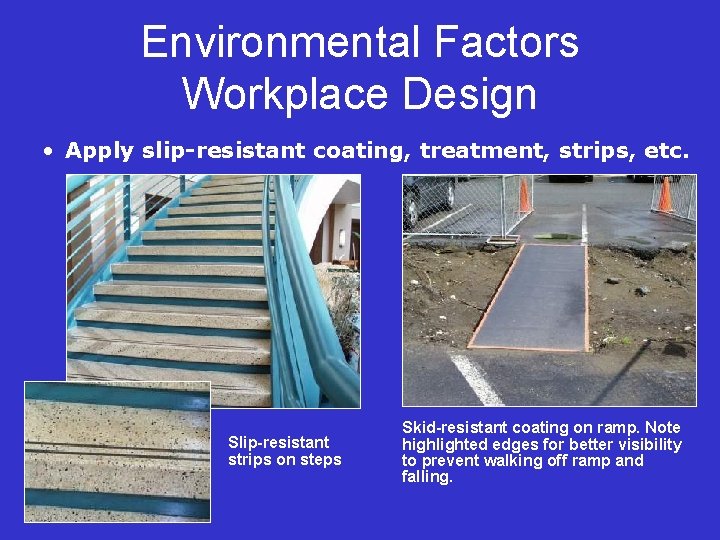
Environmental Factors Workplace Design • Apply slip-resistant coating, treatment, strips, etc. Slip-resistant strips on steps Skid-resistant coating on ramp. Note highlighted edges for better visibility to prevent walking off ramp and falling.
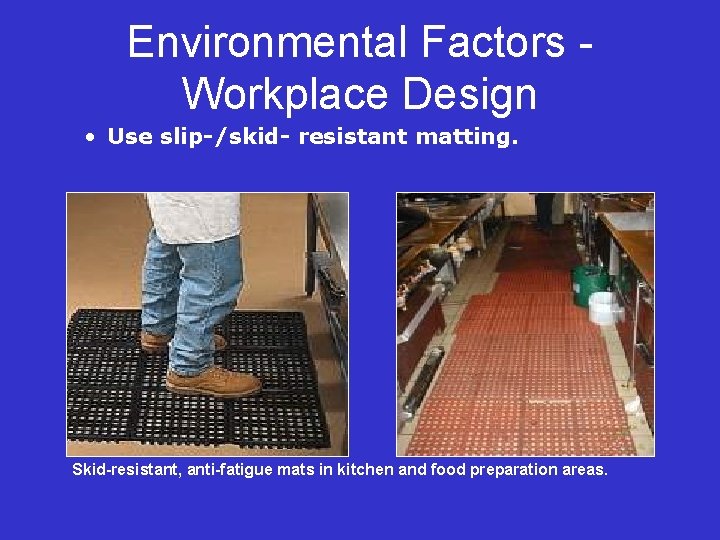
Environmental Factors Workplace Design • Use slip-/skid- resistant matting. Skid-resistant, anti-fatigue mats in kitchen and food preparation areas.
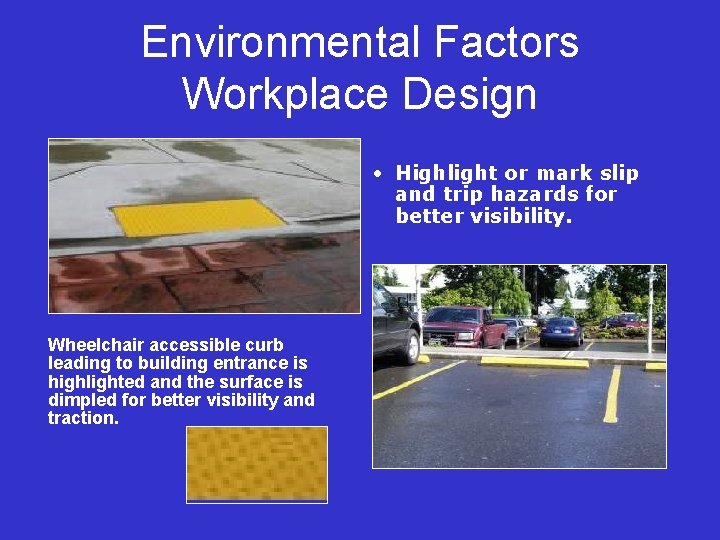
Environmental Factors Workplace Design • Highlight or mark slip and trip hazards for better visibility. Wheelchair accessible curb leading to building entrance is highlighted and the surface is dimpled for better visibility and traction.
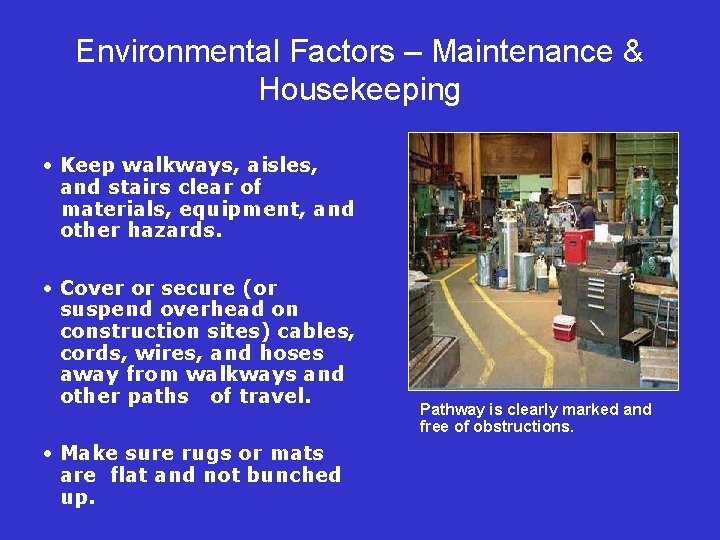
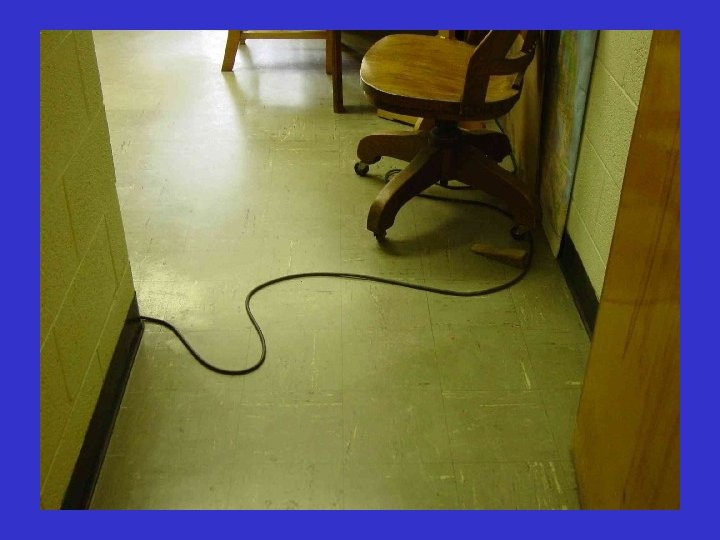
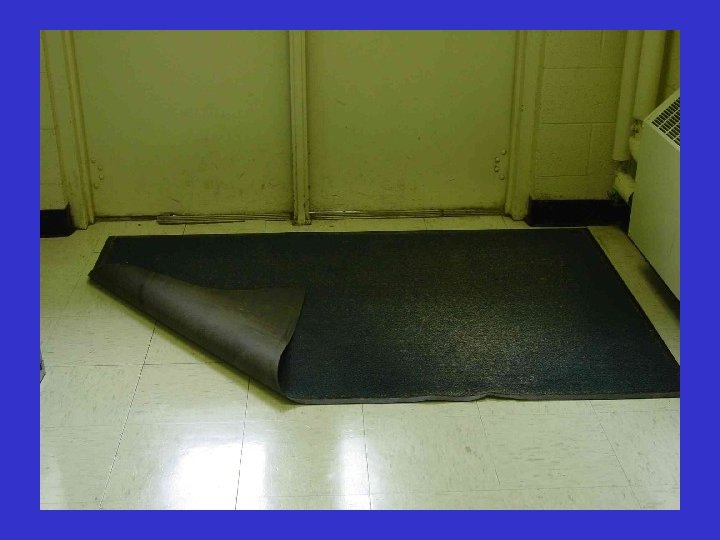
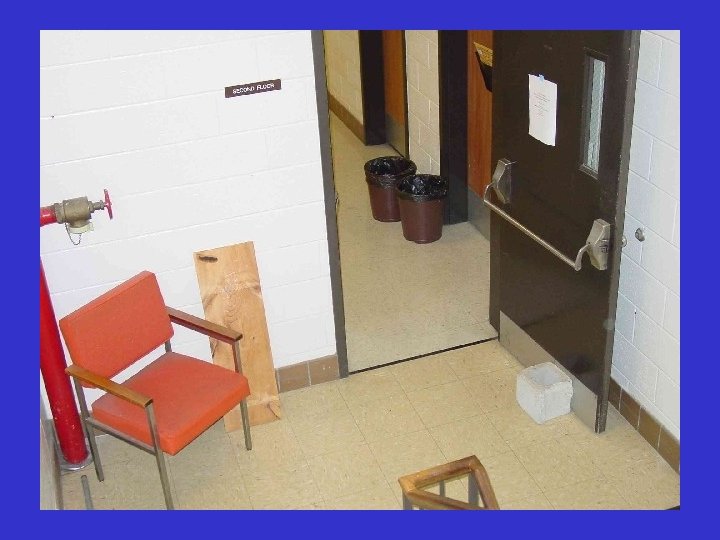
Environmental Factors – Maintenance & Housekeeping • Keep walkways, aisles, and stairs clear of materials, equipment, and other hazards. • Cover or secure (or suspend overhead on construction sites) cables, cords, wires, and hoses away from walkways and other paths of travel. • Make sure rugs or mats are flat and not bunched up. Pathway is clearly marked and free of obstructions.
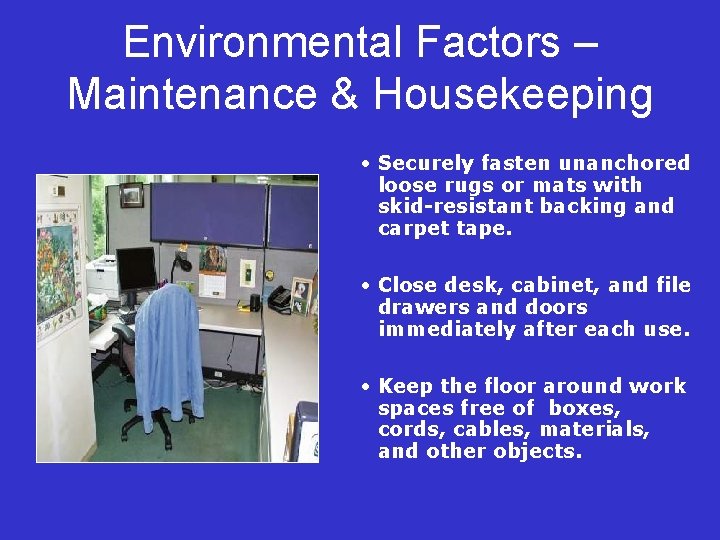
Environmental Factors – Maintenance & Housekeeping • Securely fasten unanchored loose rugs or mats with skid-resistant backing and carpet tape. • Close desk, cabinet, and file drawers and doors immediately after each use. • Keep the floor around work spaces free of boxes, cords, cables, materials, and other objects.
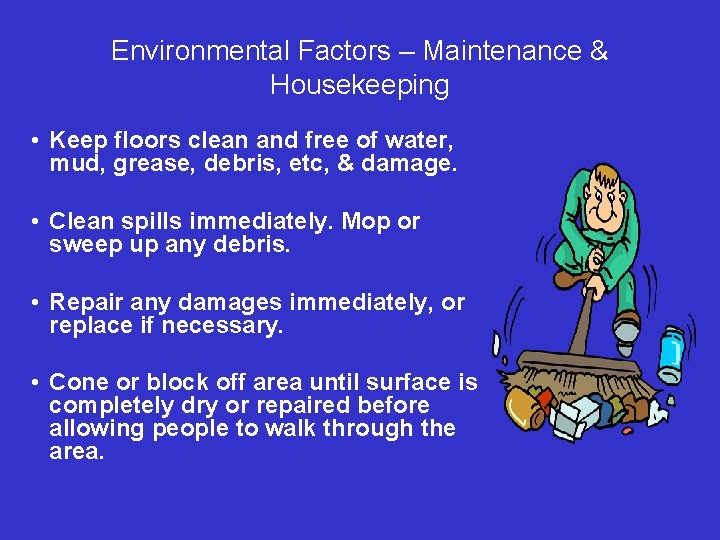
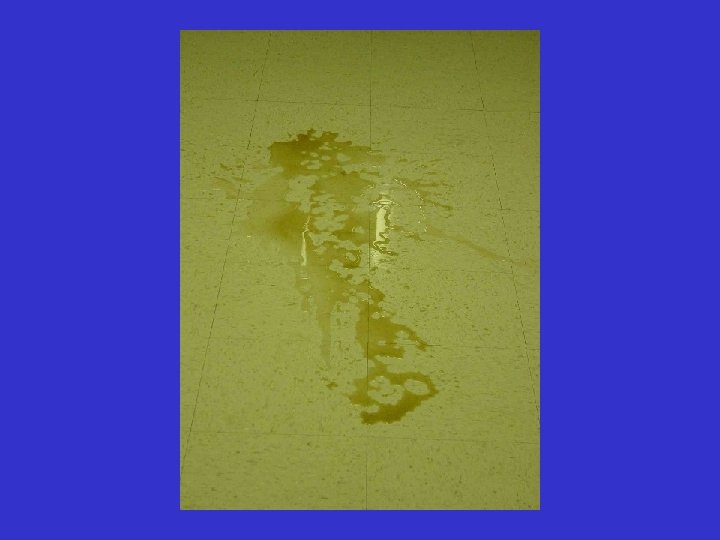
Environmental Factors – Maintenance & Housekeeping • Keep floors clean and free of water, mud, grease, debris, etc, & damage. • Clean spills immediately. Mop or sweep up any debris. • Repair any damages immediately, or replace if necessary. • Cone or block off area until surface is completely dry or repaired before allowing people to walk through the area.
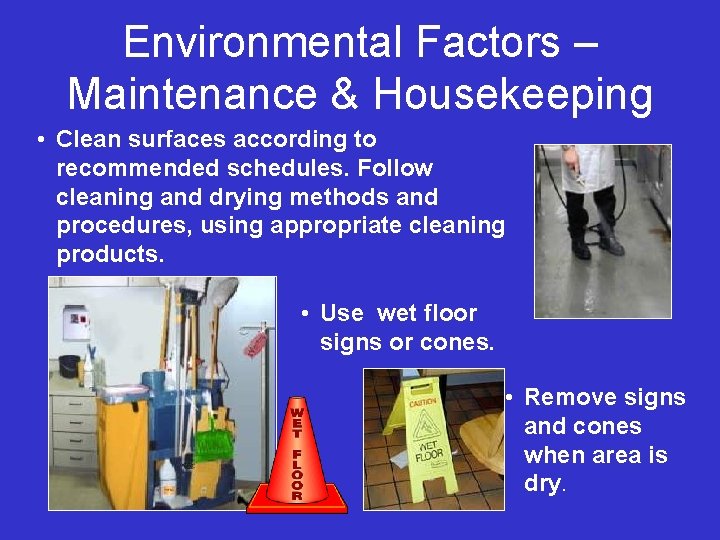
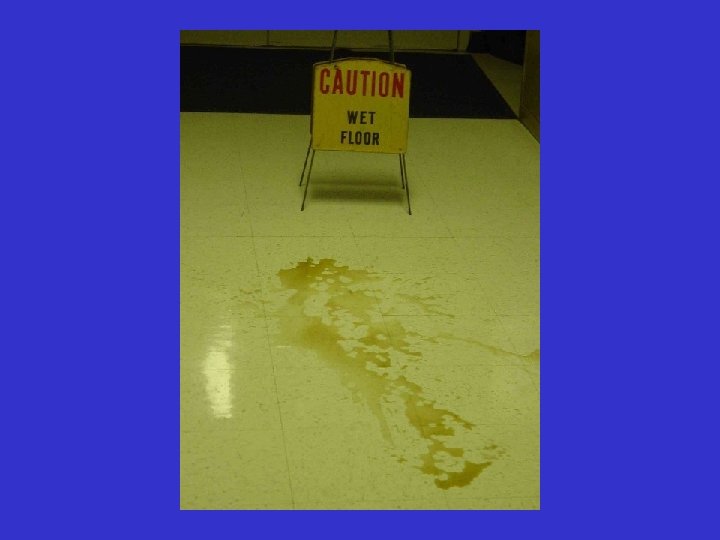
Environmental Factors – Maintenance & Housekeeping • Clean surfaces according to recommended schedules. Follow cleaning and drying methods and procedures, using appropriate cleaning products. • Use wet floor signs or cones. • Remove signs and cones when area is dry.
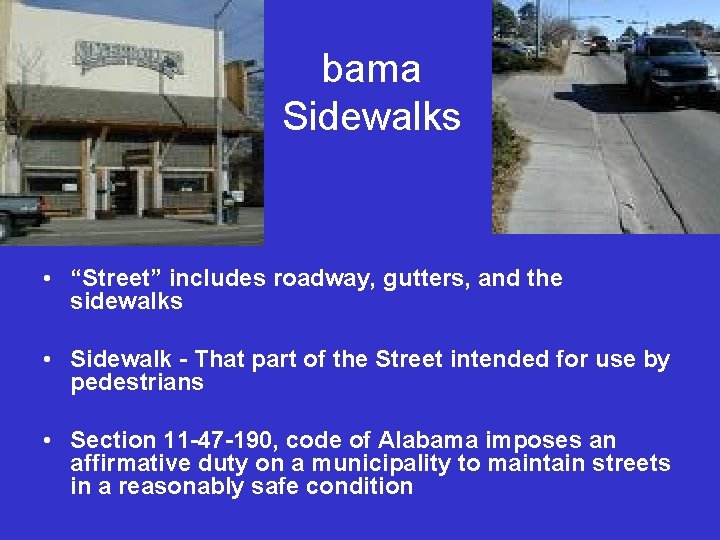
Ala bama Sidewalks • “Street” includes roadway, gutters, and the sidewalks • Sidewalk - That part of the Street intended for use by pedestrians • Section 11 -47 -190, code of Alabama imposes an affirmative duty on a municipality to maintain streets in a reasonably safe condition
Liability of Municipalities • City of Florence V. Stack, 155 So. 2 d 324 (1963) Duty and obligation to exercise ordinary and reasonable care to keep its streets and sidewalks in a reasonably safe condition for travel
Responsibility & Accountability • Remedy such defects upon receiving notice • Law infers defects ought to have been discovered and remedied within such length of time and under such conditions and circumstances • Safe for ordinary travel day or night
General Duty of Municipalities • Duty to keep sidewalks in proper repair and safe condition • Duty to keep public sidewalks open for travel & free from unnecessary obstructions
Immunity • Governmental immunity does not defeat a negligence claim for maintenance of public sidewalks or walkways
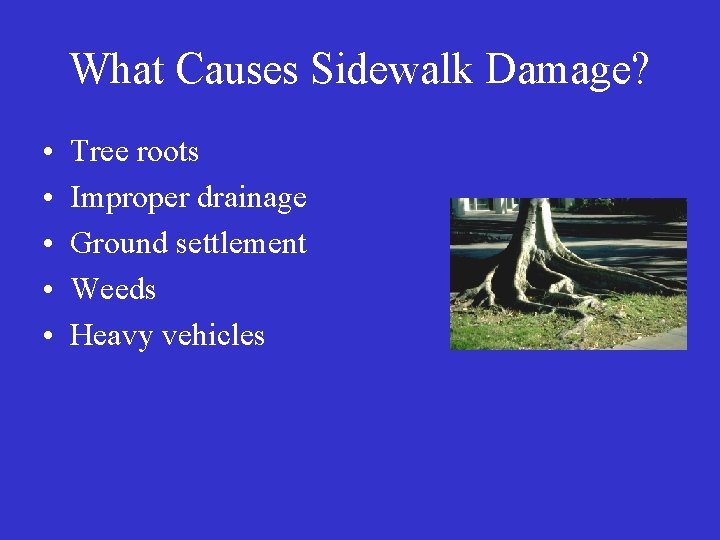
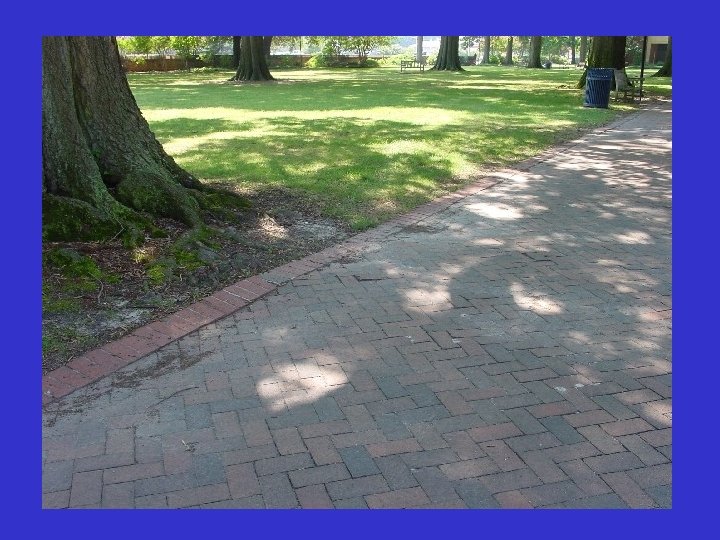
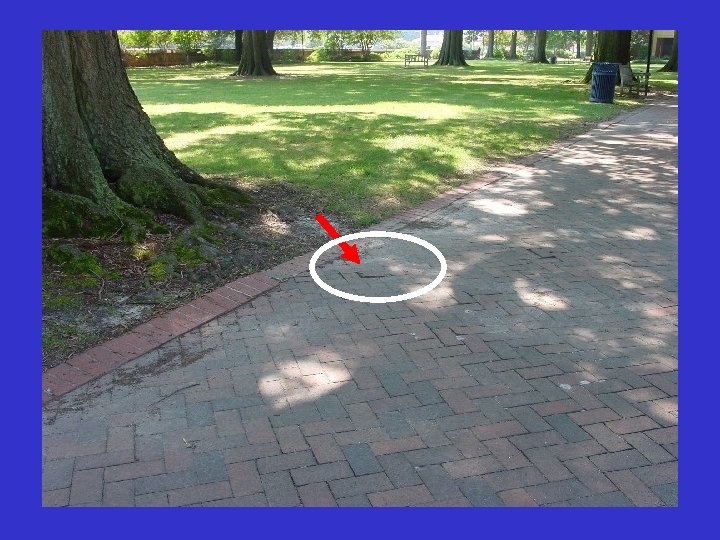
What Causes Sidewalk Damage? • • • Tree roots Improper drainage Ground settlement Weeds Heavy vehicles
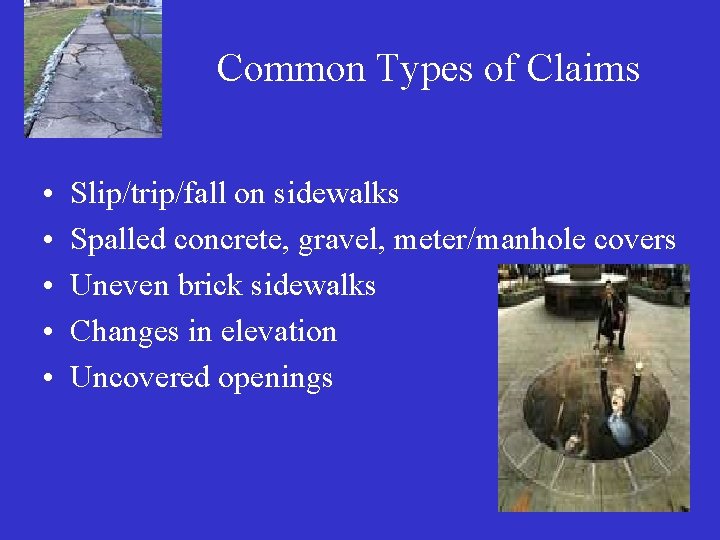
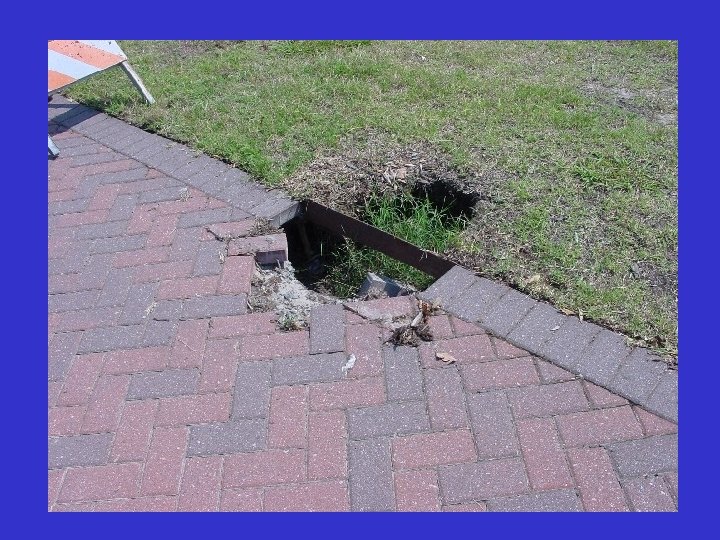
Common Types of Claims • • • Slip/trip/fall on sidewalks Spalled concrete, gravel, meter/manhole covers Uneven brick sidewalks Changes in elevation Uncovered openings
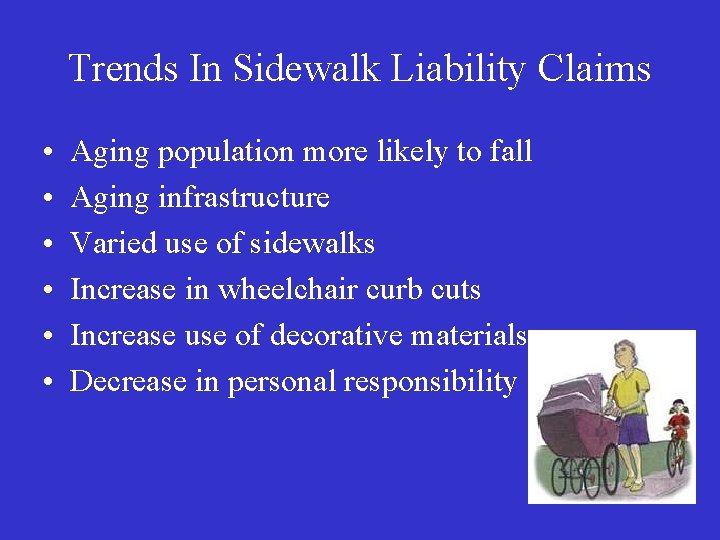
Trends In Sidewalk Liability Claims • • • Aging population more likely to fall Aging infrastructure Varied use of sidewalks Increase in wheelchair curb cuts Increase use of decorative materials Decrease in personal responsibility
Risk Management Tools • Planned Inspection Program • Sidewalk Liability Improvement Program
Planned Inspection Program • Recognition, evaluation, and control of slip, trip, fall exposures to employees and the public • Housekeeping • Maintenance • Involvement of all departments
Planned Departmental Inspections WHY ? • Safety and health of employees • Safety and health of the public • Legal and moral obligation
COM N HAZARDS • Housekeeping and Sanitation • Tools and Equipment • Material Handling and Storage • Motorized vehicles • Personal and Protective Equipment • Fire Protection • Walking & Working Surfaces • Exits
DOCUMENTATION • Development of checklists • Safety Hazard Reports • Employee Report of Hazard • Evidence of the program
Sidewalk Liability Improvement Program • Comprehensive Written Policy • Sidewalk Repair Ordinance – Define financial responsibilities of homeowners and companies • Identify Defective Conditions – Initial Survey & Follow up Inspections • Corrective Action – Prioritize Replacement and repair • Funding approval
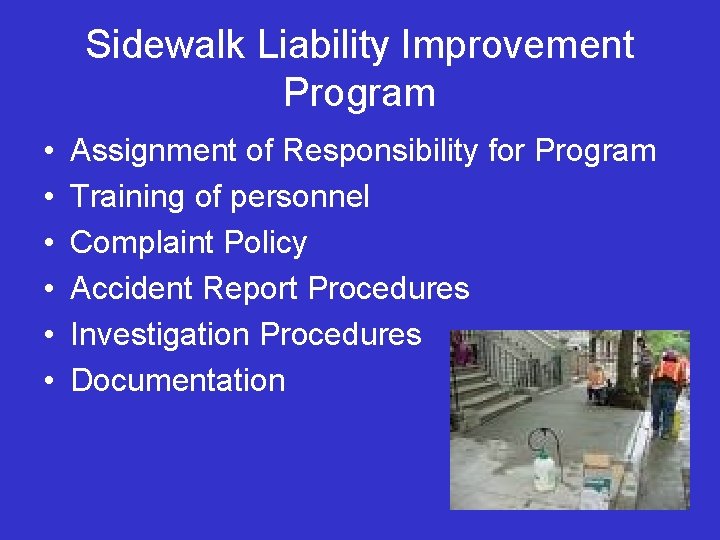
Sidewalk Liability Improvement Program • • • Assignment of Responsibility for Program Training of personnel Complaint Policy Accident Report Procedures Investigation Procedures Documentation
Documentation • Must be kept – Computer system – Handwritten log • Be consistent • Need to be able to show you met the reasonable standard of care • Signed and dated when work performed • Indicate what area of municipality inspected/repaired and what was done • Allows you to perform problem solving analysis
Citizens’ Complaints • Develop a written complaint policy • Indicate who & when complaint was made • Determine if repairs are needed • What was the response Procedure to be followed after complaint • Inspect problem • Decide if under entity’s criteria the identified area would need repairs • Warning device and barriers necessary to protect the public • Take photographs - document
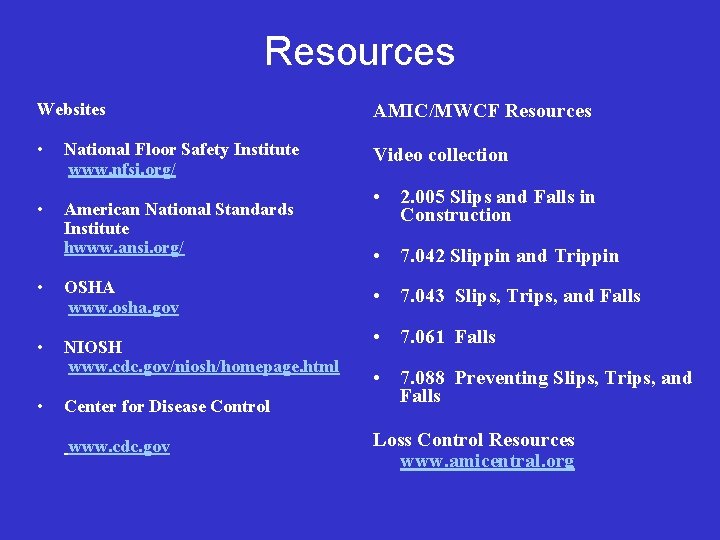
Resources Websites AMIC/MWCF Resources • National Floor Safety Institute www. nfsi. org/ Video collection • American National Standards Institute hwww. ansi. org/ • OSHA www. osha. gov • NIOSH www. cdc. gov/niosh/homepage. html • Center for Disease Control www. cdc. gov • 2. 005 Slips and Falls in Construction • 7. 042 Slippin and Trippin • 7. 043 Slips, Trips, and Falls • 7. 061 Falls • 7. 088 Preventing Slips, Trips, and Falls Loss Control Resources www. amicentral. org
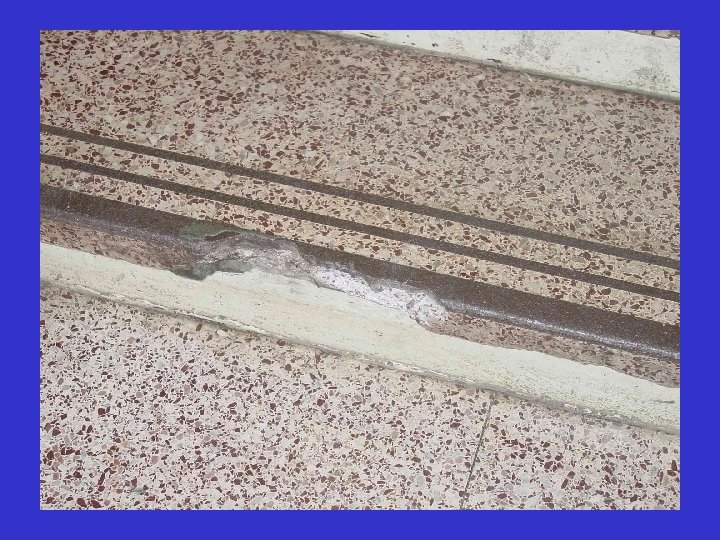
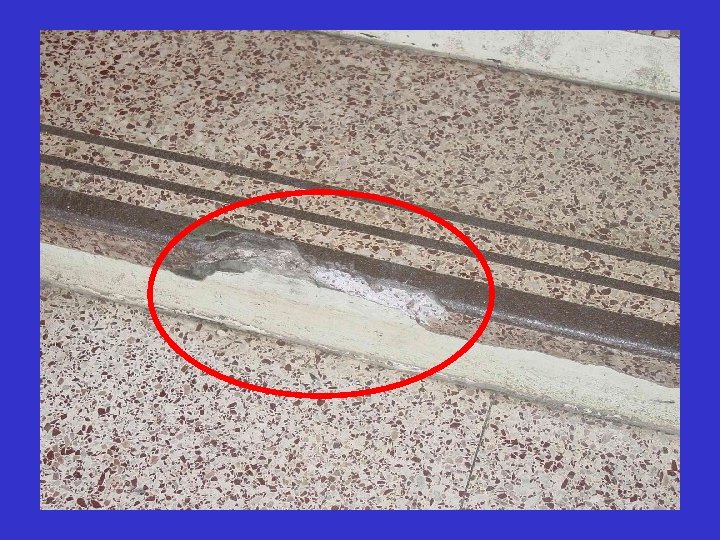
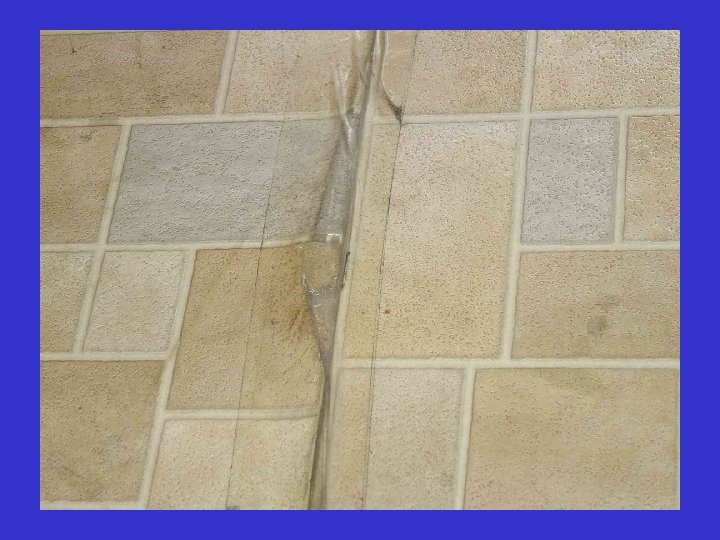
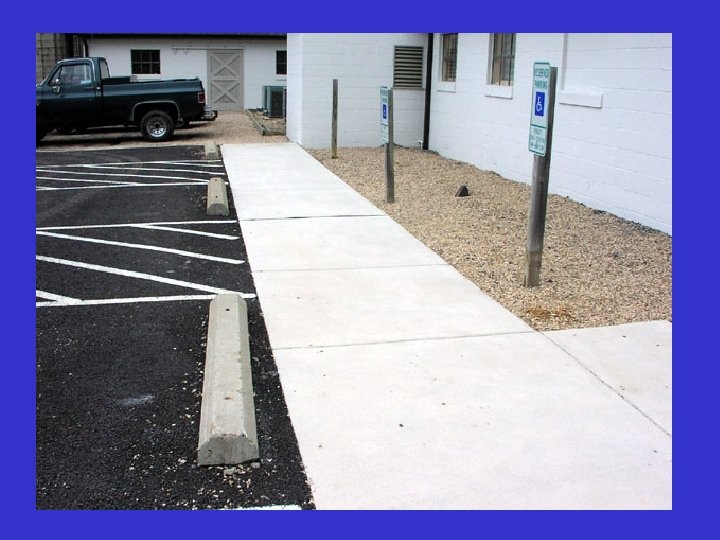
Can you identify what is wrong in the following pictures?
- Slides: 74