
SLIDING SHIELDS AROUND THE BEAM PIPE KLAUS SINRAM

SLIDING SHIELDS AROUND THE BEAM PIPE KLAUS SINRAM SEOUL, FEB. 17, 2009
> In order to have unlimited access to the experimental hall during machine operation the beam has to be shielded over the full width of the hall. With a selfshielding detector sitting in the interaction point one has to shield the regions between the detector and the walls of the underground hall on both sides of the detector. As an alternative to the so called PACMAN-concept a shielding solution consisting of a fixed and a movable part is proposed. The fixed part consists of vertical walls built from a concrete block system, the roof is made from concrete beams ( commissioning of the linear collider anyway needs a removable shielding of the beamline throughout the experimental hall which could be made from the same concrete block system ). The movable part is a concrete arch which slides over the fixed part to allow an opening of the detector endcap. > The inner volume ( width and height ) enclosed by the shielding can be adjusted in such a way that one has easy access to the coldbox of the final focus magnet QD 0 and to the beamline itself. Klaus Sinram | Seoul Workshop | 17. 02. 2009 | Page 2
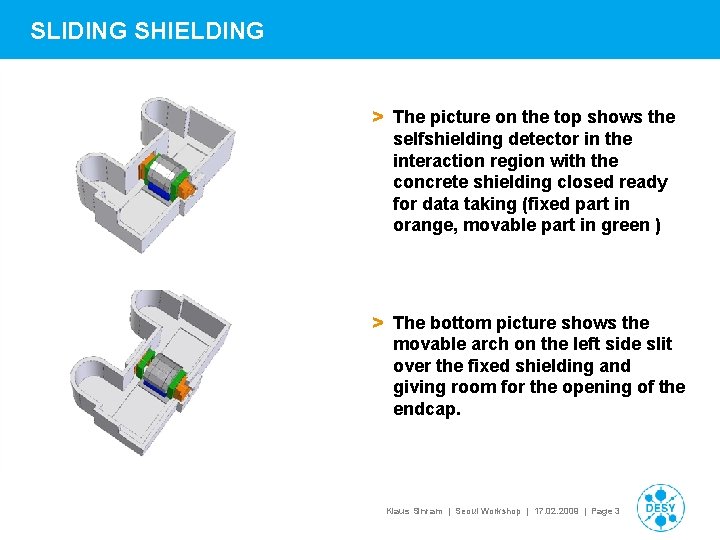
SLIDING SHIELDING > The picture on the top shows the selfshielding detector in the interaction region with the concrete shielding closed ready for data taking (fixed part in orange, movable part in green ) > The bottom picture shows the movable arch on the left side slit over the fixed shielding and giving room for the opening of the endcap. Klaus Sinram | Seoul Workshop | 17. 02. 2009 | Page 3
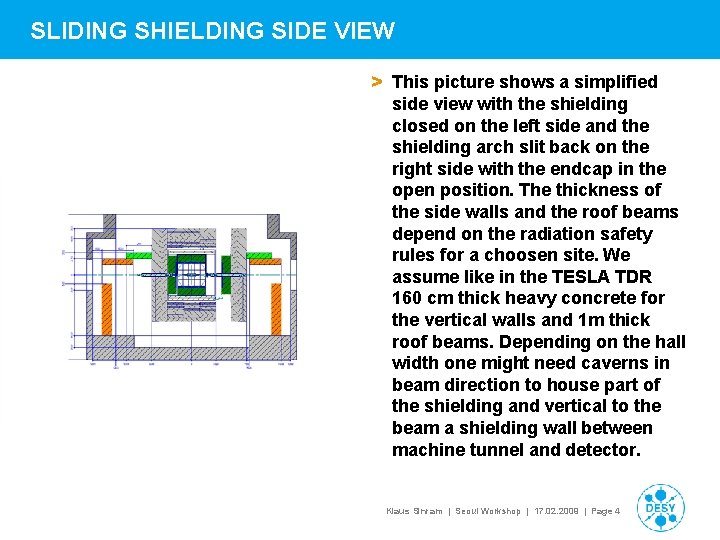
SLIDING SHIELDING SIDE VIEW > This picture shows a simplified side view with the shielding closed on the left side and the shielding arch slit back on the right side with the endcap in the open position. The thickness of the side walls and the roof beams depend on the radiation safety rules for a choosen site. We assume like in the TESLA TDR 160 cm thick heavy concrete for the vertical walls and 1 m thick roof beams. Depending on the hall width one might need caverns in beam direction to house part of the shielding and vertical to the beam a shielding wall between machine tunnel and detector. Klaus Sinram | Seoul Workshop | 17. 02. 2009 | Page 4
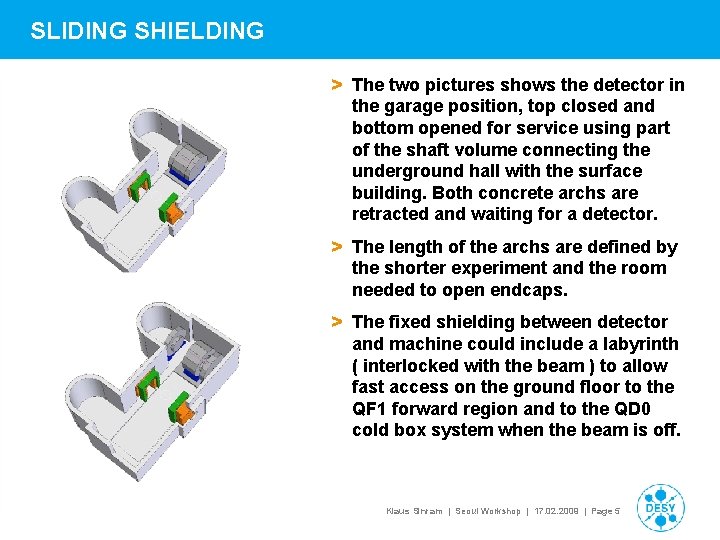
SLIDING SHIELDING > The two pictures shows the detector in the garage position, top closed and bottom opened for service using part of the shaft volume connecting the underground hall with the surface building. Both concrete archs are retracted and waiting for a detector. > The length of the archs are defined by the shorter experiment and the room needed to open endcaps. > The fixed shielding between detector and machine could include a labyrinth ( interlocked with the beam ) to allow fast access on the ground floor to the QF 1 forward region and to the QD 0 cold box system when the beam is off. Klaus Sinram | Seoul Workshop | 17. 02. 2009 | Page 5
SLIDING SHIELDING > Conclusions: > Shielding system with movable archs allows fast opening of the endcaps > Uses the same concrete block system necessary to shield the beam during machine commissioning and consequently could be part of this shielding from the very beginning of collider operation. > Allows easy access to the final focus magnet region > Can be tailored to fit the needs of two different detectors > Can in principle include an entrance into the tunnel ( like HERA ) for safety reasons and even for machine component transportation Klaus Sinram | Seoul Workshop | 17. 02. 2009 | Page 6
- Slides: 6