
Sliding Filament Mechanism T Rick Objectives 1 Describe
Sliding Filament Mechanism T. Rick
Objectives 1. Describe the sliding filament mechanism of muscle contraction. 2. Describe some of the body’s muscle impairments.
The Sliding Filament Mechanism A nerve impulse causes depolarization of a muscle fiber, and this electrical change enables the myosin filaments to pull the actin filaments toward the center of the sarcomere, making the sarcomere shorter.
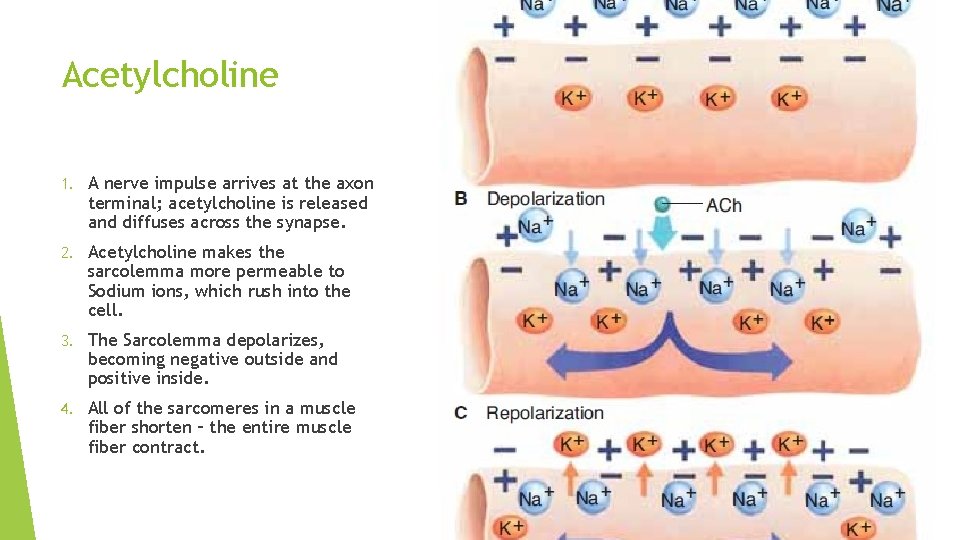
Acetylcholine 1. A nerve impulse arrives at the axon terminal; acetylcholine is released and diffuses across the synapse. 2. Acetylcholine makes the sarcolemma more permeable to Sodium ions, which rush into the cell. 3. The Sarcolemma depolarizes, becoming negative outside and positive inside. 4. All of the sarcomeres in a muscle fiber shorten – the entire muscle fiber contract.
Depolarization 1. Depolarization stimulates the release of Calcium ions from the sarcoplasmic reticulum. Calcium ions bond to the troponintropomyosin complex. Which shift away from the actin filaments. 2. Myosin splits ATP to release its energy; bridges on the myosin attach to the actin filaments and pull them toward the center of the sarcomere, thus making the sarcomere shorter.

Repolarization The Sarcolemma repolarizes: Potassium ions leave the cell, restoring a positive charge outside and a negative charge inside. The pumps return Sodium ions outside and Potassium ions inside.
Cholinesterase in the sarcolemma inactivates acetylcholine. Subsequent nerve impulses will prolong contraction (more acetylcholine is released). When there are no further impulses, the muscle fiber will relax and return to its original state.
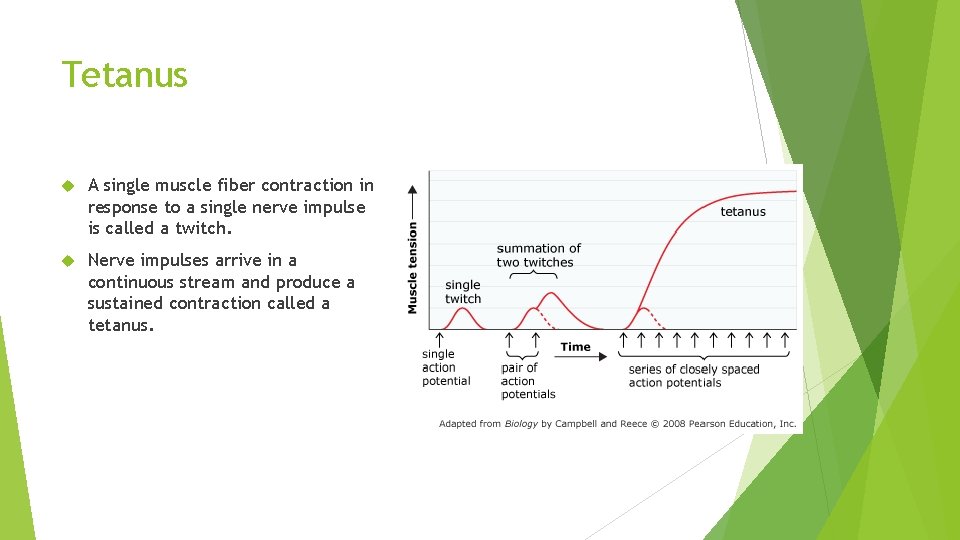
Tetanus A single muscle fiber contraction in response to a single nerve impulse is called a twitch. Nerve impulses arrive in a continuous stream and produce a sustained contraction called a tetanus.
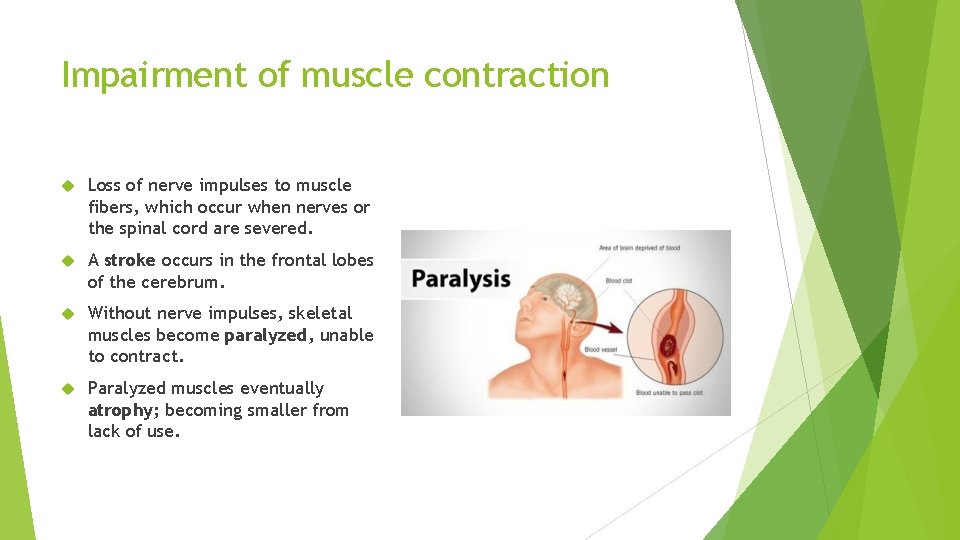
Impairment of muscle contraction Loss of nerve impulses to muscle fibers, which occur when nerves or the spinal cord are severed. A stroke occurs in the frontal lobes of the cerebrum. Without nerve impulses, skeletal muscles become paralyzed, unable to contract. Paralyzed muscles eventually atrophy; becoming smaller from lack of use.
- Slides: 9