
Slides presented at the 2012 Cog Sci Conference
- Slides: 35
Slides presented at the 2012 Cog Sci Conference, 1 August 2012. A Risk Driven Approach to Experimental Design and Practice Frank E. Ritter and Jonathan H. Morgan (slides) The College of IST Penn State and Jong W. Kim and Richard Carlson (book) Psychology, U. of Central Florida, and Psychology, Penn State Supported by ONR, Contracts N 00014 -11 -1 -0275, N 00014 -10 -1 -0401, & W 911 QY-07 -01 -0004 1 12/1/2020
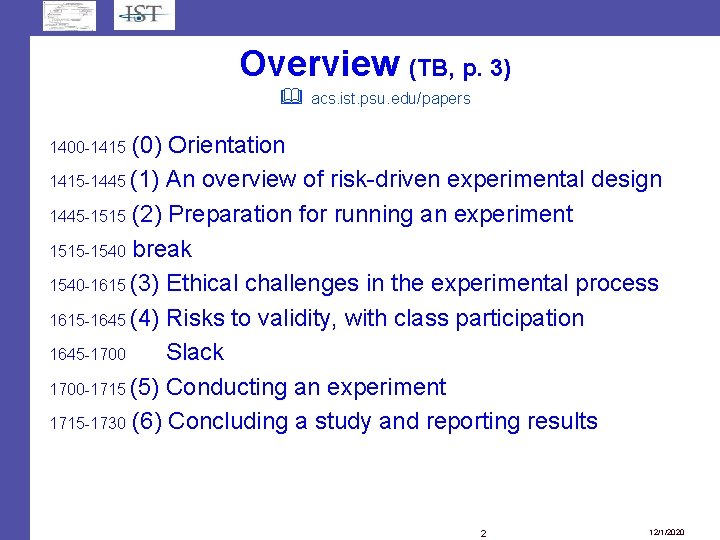
Overview (TB, p. 3) acs. ist. psu. edu/papers (0) Orientation 1415 -1445 (1) An overview of risk-driven experimental design 1445 -1515 (2) Preparation for running an experiment 1515 -1540 break 1540 -1615 (3) Ethical challenges in the experimental process 1615 -1645 (4) Risks to validity, with class participation 1645 -1700 Slack 1700 -1715 (5) Conducting an experiment 1715 -1730 (6) Concluding a study and reporting results 1400 -1415 2 12/1/2020
What to get out of this Tutorial 1) Some feeling for how to run a study Cognitive science may be modeling + data So, to use data you have to know how it was gathered Modeling is slow, so data publication helps modelers If you are a computer scientist, you won’t have taste in this area => Help you develop a green thumb Not how to design a study, but related 2) Some tools to help you set up a study 3) Materials Draft book on this topic (please let me know if you use it for a class) Handout Example problems 4) A break at ~1515 pm (local) 5) A greater appreciation for mistakes to avoid and a theory of how to avoid them 3 12/1/2020
Who are you? 1) Name, organization, background, number of studies, what you want to get from this 2) Please form into pairs for later exercise 4 12/1/2020
Ch 1. Overview Some Terms used A study, varying an Independent variable (IV, e. g. , amount of practice), to the see the effect on a dependent variable (DV) Worth reading a methods book(s) Subjects (Ss) or Participants (Ps), Users, learners, students, Experimenters (Es) See APA manual and also Roediger (2006) for arguments for S and P and U/L/S Example studies Multi-lingual fonts Partially sighted and blind users HRI 5 12/1/2020
Experimental Process Overview, linear (TB, p. 11) An iterative, and often overlapping process 6 12/1/2020
Experimental Process Overview Risk Driven, more spiral (TB, p. 4) 7 12/1/2020
Summary: Lessons so Far More steps than I thought Iterative and risk-driven (if you pay attention) A process but not a set process Studies will overlap each other and inspire each other It is useful to have the RAs/Es pay attention Ss suddenly ‘get it’ Ss don’t get some aspect Ss comments Ss ‘cheat’ somehow 8 12/1/2020
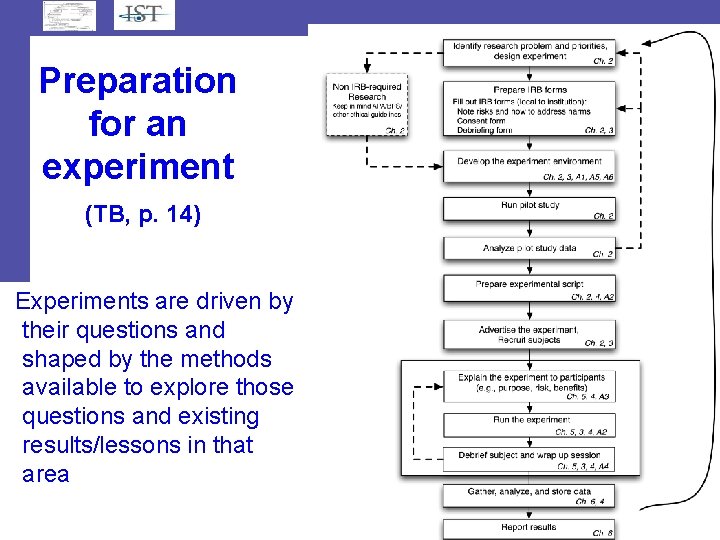
Preparation for an experiment (TB, p. 14) Experiments are driven by their questions and shaped by the methods available to explore those questions and existing results/lessons in that area 9 12/1/2020
What studies need IRB? In the US if not publishing no IRB (but, be careful), includes class projects If only authors are Ss, no IRB If only published / publicly available data, no IRB but IRB has to ok this (!) Else, IRB Blood, sexual history, etc. are high-risk, => full IRB Outside US Depends, UK used to do IRB only on high-risk studies Can you tell me? In all cases, worth having someone check your work 10 12/1/2020
IRB Forms Used to check your work May be worth being clear and concise Also check with example forms for language Draft for the PI 11 12/1/2020
Summary: Piloting Write out method Used to check your work Use a script, Step 1, start program, Step 2 “Welcome to…” Start local, e. g. , YOU, and then officemate, and then move further and further away Mount a scratch monkey Check your apparatus and data gathering and use of data Consider/reconsider, number of Ss to run Previous studies Power analyses (Cohen for Ss; Ritter et al. for models) Why not prefer large effects? 12 12/1/2020
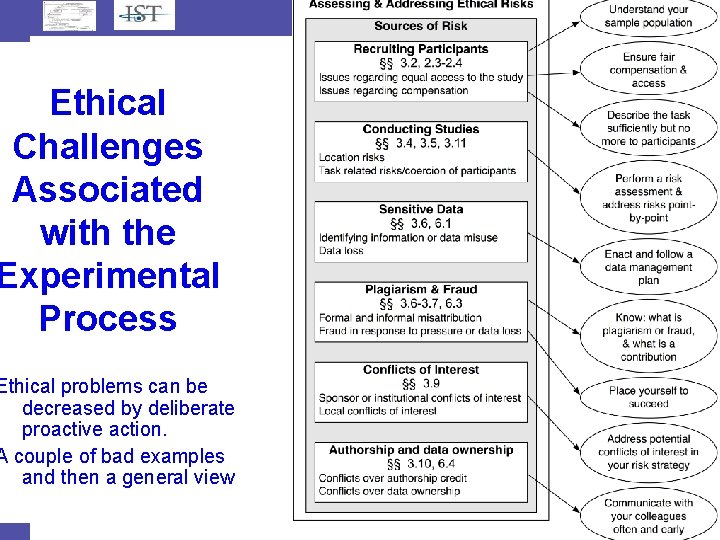
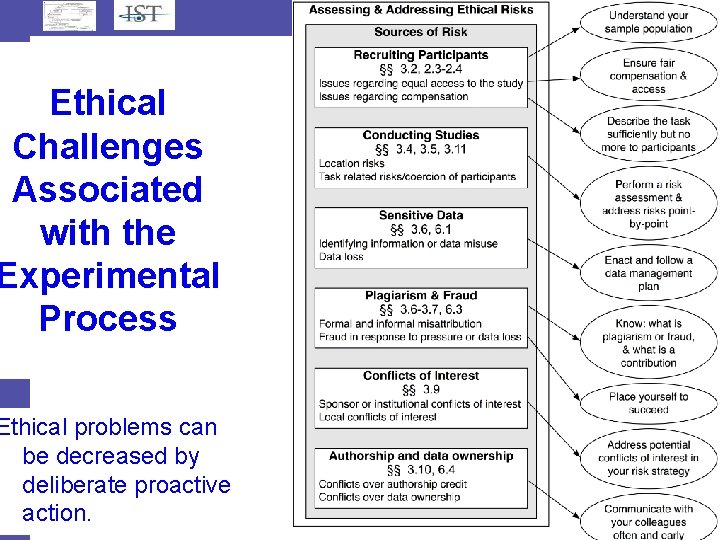
Ethical Challenges Associated with the Experimental Process Ethical problems can be decreased by deliberate proactive action. A couple of bad examples and then a general view 13 12/1/2020
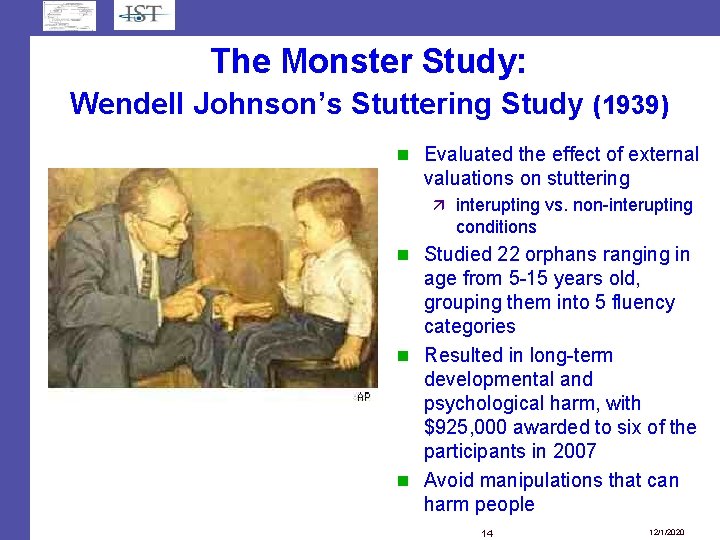
The Monster Study: Wendell Johnson’s Stuttering Study (1939) Evaluated the effect of external valuations on stuttering interupting vs. non-interupting conditions Studied 22 orphans ranging in age from 5 -15 years old, grouping them into 5 fluency categories Resulted in long-term developmental and psychological harm, with $925, 000 awarded to six of the participants in 2007 Avoid manipulations that can harm people 14 12/1/2020
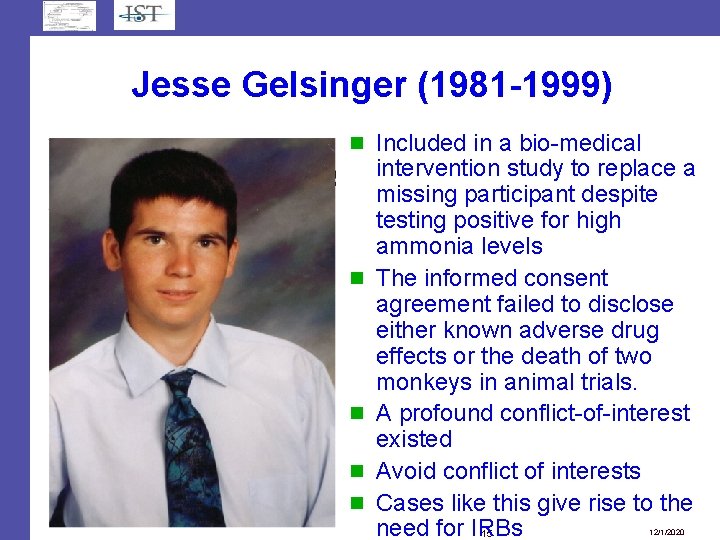
Jesse Gelsinger (1981 -1999) Included in a bio-medical intervention study to replace a missing participant despite testing positive for high ammonia levels The informed consent agreement failed to disclose either known adverse drug effects or the death of two monkeys in animal trials. A profound conflict-of-interest existed Avoid conflict of interests Cases like this give rise to the need for IRBs 15 12/1/2020
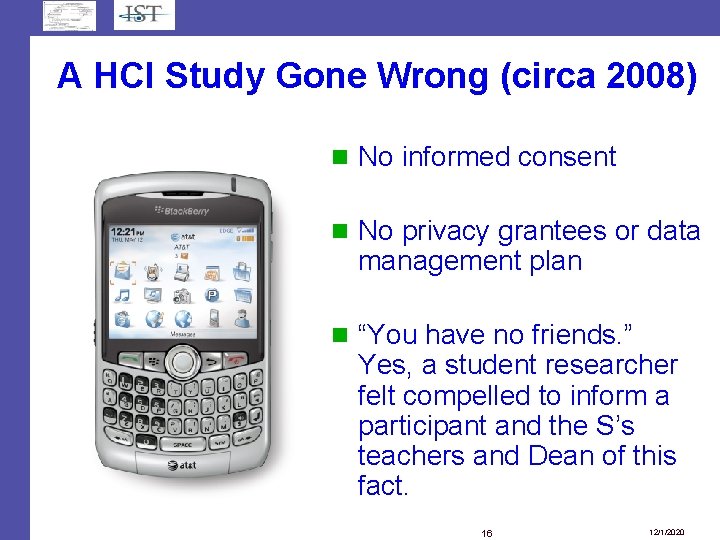
A HCI Study Gone Wrong (circa 2008) No informed consent No privacy grantees or data management plan “You have no friends. ” Yes, a student researcher felt compelled to inform a participant and the S’s teachers and Dean of this fact. 16 12/1/2020
Ethical Challenges Associated with the Experimental Process Ethical problems can be decreased by deliberate proactive action. 17 12/1/2020
Summary: How to avoid ethical problems Recruit fairly Look out for your Ss Anonymise data at the beginning of each session by using subject IDs, not names Have a plan for surprising data (e. g. , high BP) Communicate early and relatively often about publication plans and data ownership Some argue that you have an obligation to use the data you gather 18 12/1/2020
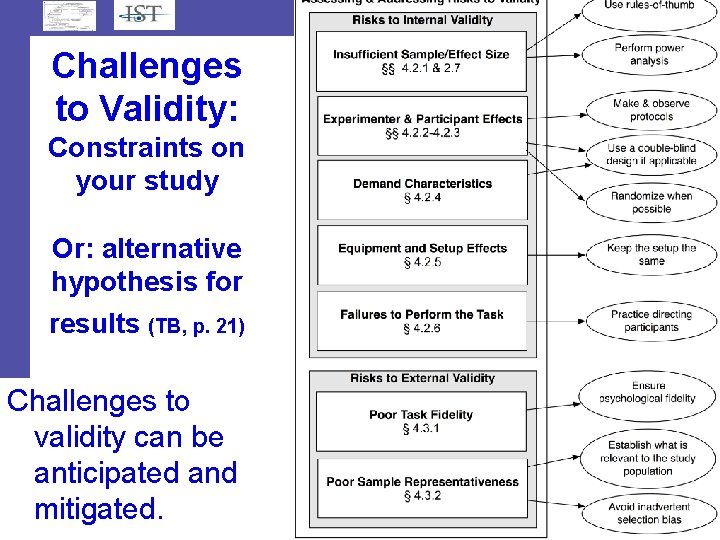
Challenges to Validity: Constraints on your study Or: alternative hypothesis for results (TB, p. 21) Challenges to validity can be anticipated and mitigated. 19 12/1/2020
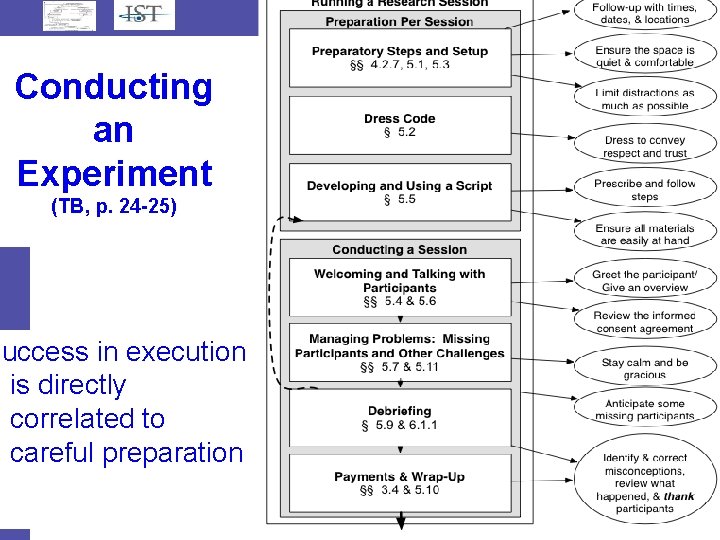
Conducting an Experiment (TB, p. 24 -25) Success in execution is directly correlated to careful preparation 20 12/1/2020
Summary: Running a session Use of piloting means no surprises (except for the data!) Script keeps treatment the same, it includes session set up Keep eyes open while running for further insights Anonymise data as soon as possible 21 12/1/2020
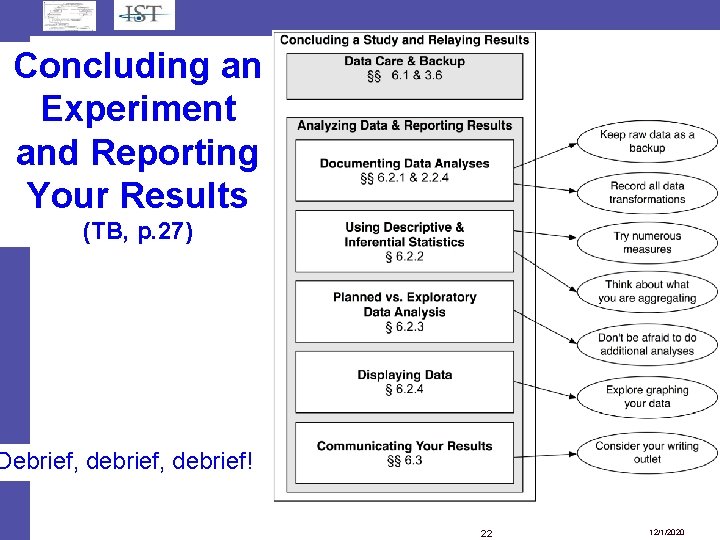
Concluding an Experiment and Reporting Your Results (TB, p. 27) Debrief, debrief! 22 12/1/2020
Summary: Concluding an Experiment and Reporting Your Results Concluding a session Finish with the subject (thank, debrief, check paperwork) Check the data was collected and saved Comment on the data if anomolies Data care, security and privacy Anonymizing removes nearly all ills Back up data (daily, weekly) Data analysis Not how, but note how (document and keep track of) Know your data if you are the RA that analyses Save the analyses, time is not important, space is not important, the insights and results are important Aside: we prefer regression Aside: we prefer individual analyse 23 12/1/2020
Ch 6. 5 Communicating your results Start with a target in mind (if you can) Work to larger publications (workshop, conf, journal, book) Rewrite, rewrite (the book is draft 49 [mar 12], now 53) 24 12/1/2020
Exercise: setting up space [iff time] (a) Describe your space with your partner for your next study (b) Does it match the description pp. 32 -33? (c) How could you improve it? (d) Should you improve it? 25 12/1/2020
Ch. 7 Afterward Appropriate behavior with subjects Insights Repeatability Reportability 26 12/1/2020
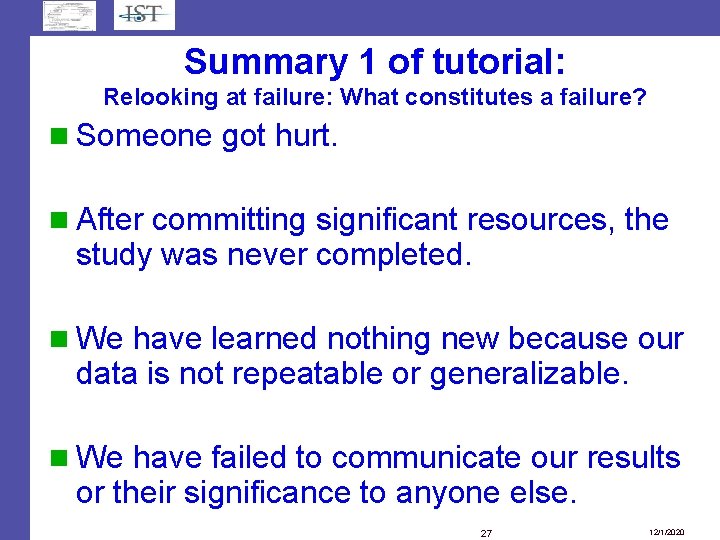
Summary 1 of tutorial: Relooking at failure: What constitutes a failure? Someone got hurt. After committing significant resources, the study was never completed. We have learned nothing new because our data is not repeatable or generalizable. We have failed to communicate our results or their significance to anyone else. 27 12/1/2020
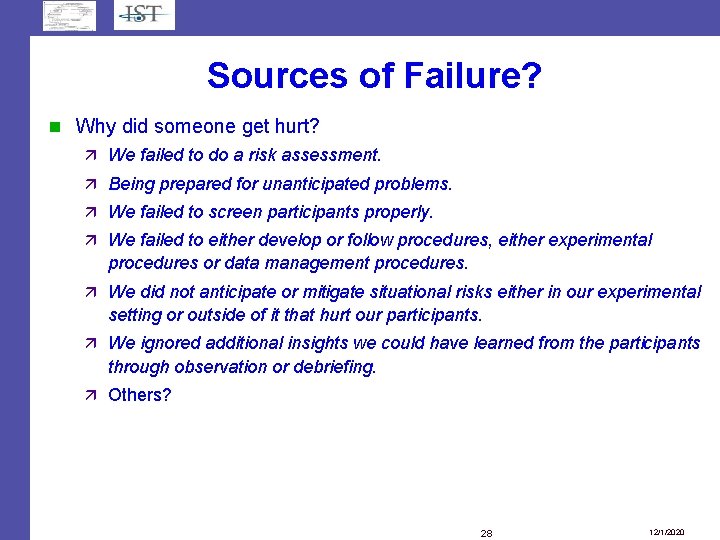
Sources of Failure? Why did someone get hurt? We failed to do a risk assessment. Being prepared for unanticipated problems. We failed to screen participants properly. We failed to either develop or follow procedures, either experimental procedures or data management procedures. We did not anticipate or mitigate situational risks either in our experimental setting or outside of it that hurt our participants. We ignored additional insights we could have learned from the participants through observation or debriefing. Others? 28 12/1/2020
Sources of Failure? Why we were unable to complete the study? We were overly ambitious, perhaps because we failed to fit the research question or methods to the problem at hand. We ran out of time. We ran out of resources or lacked them in the first place. We lacked the people, either participants or staff, or trained staff. (experiments appear to have less risk than modeling) 29 12/1/2020
Sources of Failure? Why we were unable to reproduce our results or generalize them? We failed to use the same experimental procedures or test under the same conditions for each S. We failed to achieve an adequate sample size or sufficient degree of representativeness in our sample. Our task fidelity was poor. We failed to construct an experimental task that was analogous with respect to its key points. 30 12/1/2020
Sources of Failure? Why have we been unable to report our results or communicate their significance? We failed to properly catalog or backup our data. We failed to write as we went. We no longer remember some of the critical early details. We made poor data analysis or display choices. We failed to identify a venue early, or understand who we should consider our audience. 31 12/1/2020
How do we avoid failure? We recognize that running a study is an incremental risk- driven process, similar in some respects to spiral development (Boehm & Hansen, 2001; Pew & Mavor, 2007). To be successful, we need to: Formulate a research question that meets our research goals Have a theory of transfer effects that minimizes risks associated with confounding variables, and enables us to conserve time and resources. Pilot studies and study components Be candid in our risk assessments and be willing to adapt and refine. 32 12/1/2020
Summary 2 of Tutorial There are steps to running a study separate from design and analysis These are practical, hands-on, implicit knowledge They are informed by previous studies To be successful, we need to: Formulate a research question that meets our research goals Pilot studies and study components Be candid in our risk assessments and be willing to adapt and refine Be aware of alternative hypotheses, and avoid what we can and control what we cannot avoid Plan for reporting results early 33 12/1/2020
If you will teach this…. Full book available shortly from Sage Slides available as ppt or pdf Workbook available as pdf 34 12/1/2020
References acs. ist. psu. edu/papers Boehm, B. , & Hansen, W. (2001). The Spiral Model as a tool for evolutionary acquisition. Crosstalk: The Journal � of Defense Software Engineering, 14(5), 4 -11. Cohen, J. (1992). A power primer. Psychological Bulletin, 112, 155 -159. Delaney, P. F. , Reder, L. M. , Staszewski, J. J. , & Ritter, F. E. (1998). The strategy specific nature of improvement: The power law applies by strategy within task. Psychological Science, 9(1), 1 -8. Kim, J. W. , Koubek, R. J. , & Ritter, F. E. (2007). Investigation of procedural skills degradation from different modalities. In Proceedings of the 8 th International Conference on Cognitive Modeling, 255 -260. Taylor & Francis/Psychology Press: Oxford, UK. Pew, R. W. , & Mavor, A. S. (Eds. ). (2007). Human-system integration in the system development process: A new look. Washington, DC: National Academy Press. http: //books. nap. edu/catalog. php? record_id=11893, checked March 2012. Reder, L. M. , & Ritter, F. E. (1992). What determines initial feeling of knowing? Familiarity with question terms, not the answer. Journal of Experimental Psychology : Learning, Memory & Cognition, 18(3), 435 -451. Ritter, F. E. , Kim, J. W. , Morgan, J. H. , & Carlson, R. A. (in press, 2012). How to run experiments: A practical guide to research with human participants. Currently 150 pages. Thousand Oaks, CA: Sage. Ritter, F. E. , Schoelles, M. J. , Quigley, K. S. , & Klein, L. C. (2011). Determining the number of model runs: Treating cognitive models as theories by not sampling their behavior. In L. Rothrock & S. Narayanan (Eds. ), Human-in-the-loop simulations: Methods and practice (pp. 97 -116). London: Springer-Verlag. Winston, A. S. (1990). Robert Sessions Woodworth and the "Columbia Bible": How the psychological experiment was redefined. The American Journal of Psychology, 103(3), 391 -401. 35 12/1/2020