
Slides for Chapter 6 Operating System support From
- Slides: 17
Slides for Chapter 6: Operating System support From Coulouris, Dollimore and Kindberg Distributed Systems: Concepts and Design Edition 4, © Pearson Education 2005
Figure 6. 1 System layers Instructor’s Guide for Coulouris, Dollimore and Kindberg Distributed Systems: Concepts and Design Edn. 4 © Pearson Education 2005
Figure 6. 2 Core OS functionality Instructor’s Guide for Coulouris, Dollimore and Kindberg Distributed Systems: Concepts and Design Edn. 4 © Pearson Education 2005
Figure 6. 3 Address space Instructor’s Guide for Coulouris, Dollimore and Kindberg Distributed Systems: Concepts and Design Edn. 4 © Pearson Education 2005
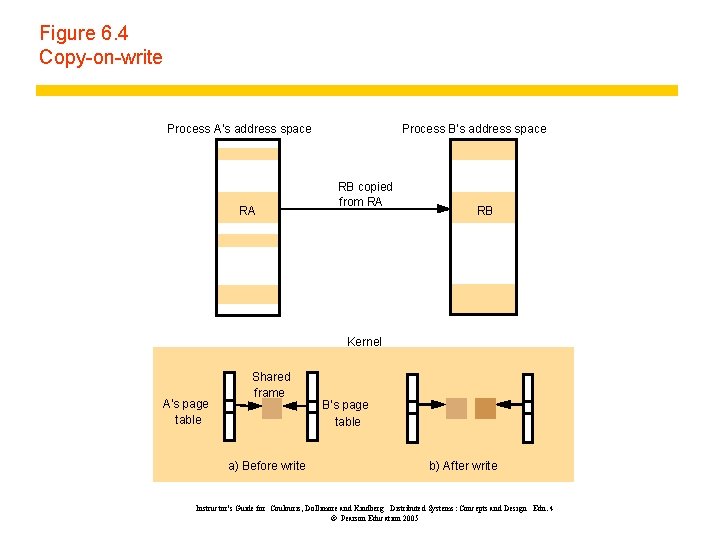
Figure 6. 4 Copy-on-write Process A’s address space RA Process B’s address space RB copied from RA RB Kernel A's page table Shared frame a) Before write B's page table b) After write Instructor’s Guide for Coulouris, Dollimore and Kindberg Distributed Systems: Concepts and Design Edn. 4 © Pearson Education 2005
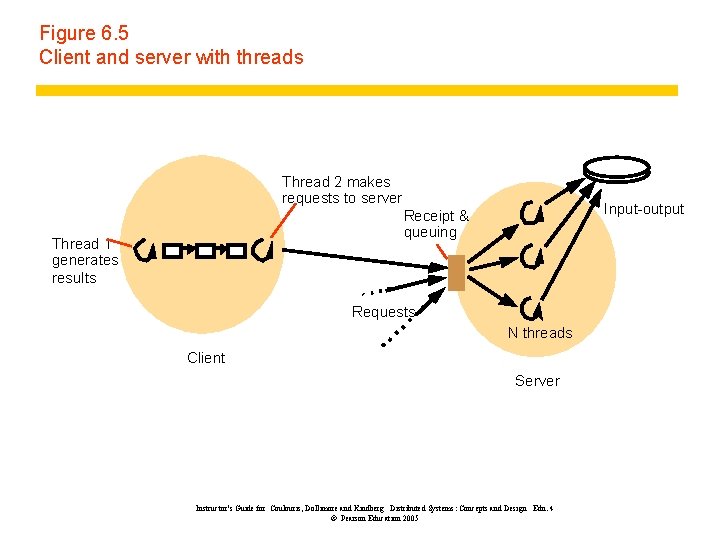
Figure 6. 5 Client and server with threads Thread 2 makes requests to server Thread 1 generates results Input-output Receipt & queuing T 1 Requests N threads Client Server Instructor’s Guide for Coulouris, Dollimore and Kindberg Distributed Systems: Concepts and Design Edn. 4 © Pearson Education 2005
Figure 6. 6 Alternative server threading architectures (see also Figure 6. 5) Instructor’s Guide for Coulouris, Dollimore and Kindberg Distributed Systems: Concepts and Design Edn. 4 © Pearson Education 2005
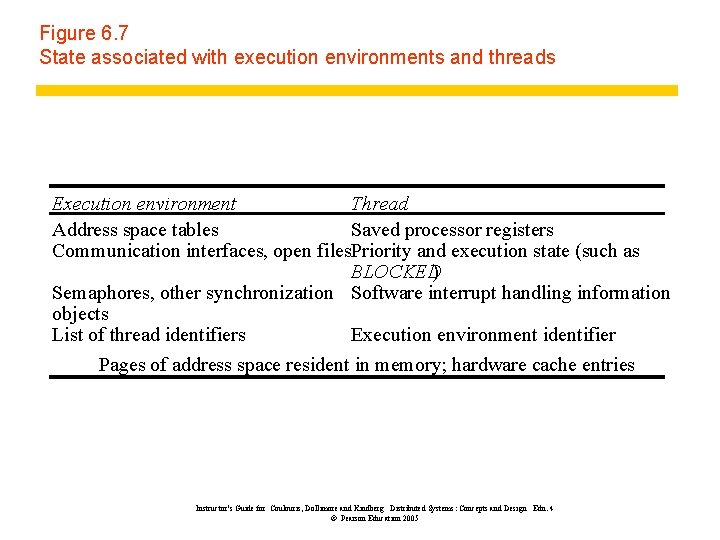
Figure 6. 7 State associated with execution environments and threads Execution environment Thread Address space tables Saved processor registers Communication interfaces, open files. Priority and execution state (such as BLOCKED) Semaphores, other synchronization Software interrupt handling information objects List of thread identifiers Execution environment identifier Pages of address space resident in memory; hardware cache entries Instructor’s Guide for Coulouris, Dollimore and Kindberg Distributed Systems: Concepts and Design Edn. 4 © Pearson Education 2005
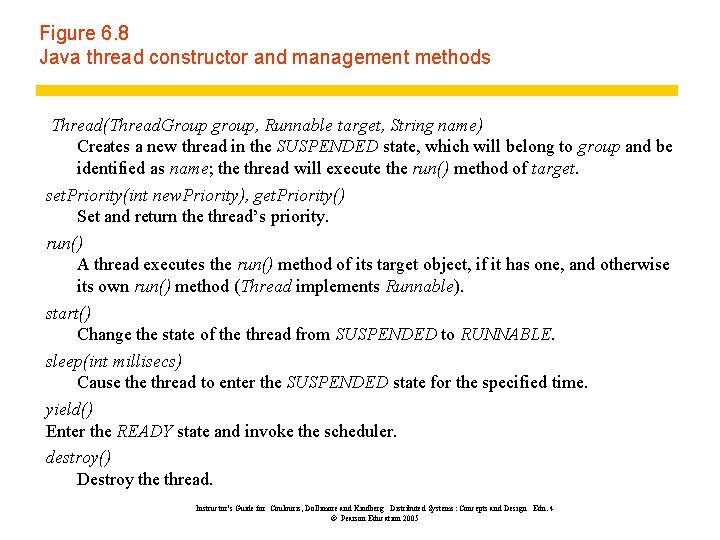
Figure 6. 8 Java thread constructor and management methods Thread(Thread. Group group, Runnable target, String name) Creates a new thread in the SUSPENDED state, which will belong to group and be identified as name; the thread will execute the run() method of target. set. Priority(int new. Priority), get. Priority() Set and return the thread’s priority. run() A thread executes the run() method of its target object, if it has one, and otherwise its own run() method (Thread implements Runnable). start() Change the state of the thread from SUSPENDED to RUNNABLE. sleep(int millisecs) Cause thread to enter the SUSPENDED state for the specified time. yield() Enter the READY state and invoke the scheduler. destroy() Destroy the thread. Instructor’s Guide for Coulouris, Dollimore and Kindberg Distributed Systems: Concepts and Design Edn. 4 © Pearson Education 2005
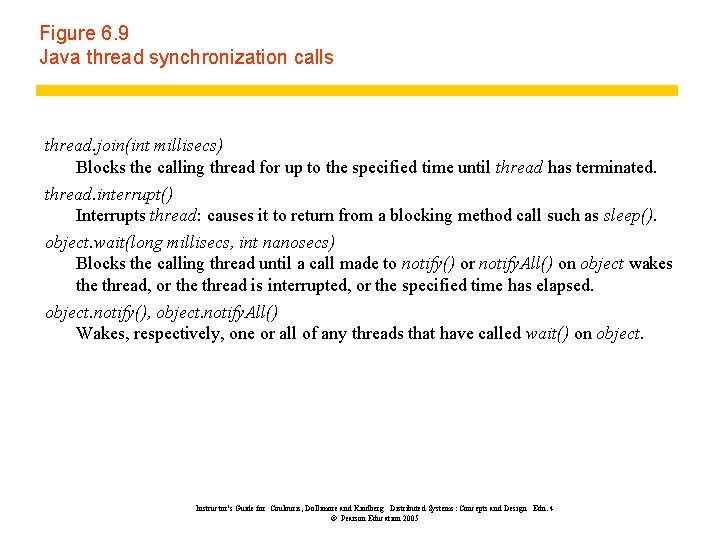
Figure 6. 9 Java thread synchronization calls thread. join(int millisecs) Blocks the calling thread for up to the specified time until thread has terminated. thread. interrupt() Interrupts thread: causes it to return from a blocking method call such as sleep(). object. wait(long millisecs, int nanosecs) Blocks the calling thread until a call made to notify() or notify. All() on object wakes the thread, or the thread is interrupted, or the specified time has elapsed. object. notify(), object. notify. All() Wakes, respectively, one or all of any threads that have called wait() on object. Instructor’s Guide for Coulouris, Dollimore and Kindberg Distributed Systems: Concepts and Design Edn. 4 © Pearson Education 2005
Figure 6. 10 Scheduler activations Instructor’s Guide for Coulouris, Dollimore and Kindberg Distributed Systems: Concepts and Design Edn. 4 © Pearson Education 2005
Figure 6. 11 Invocations between address spaces Instructor’s Guide for Coulouris, Dollimore and Kindberg Distributed Systems: Concepts and Design Edn. 4 © Pearson Education 2005
Figure 6. 12 RPC delay against parameter size Instructor’s Guide for Coulouris, Dollimore and Kindberg Distributed Systems: Concepts and Design Edn. 4 © Pearson Education 2005
Figure 6. 13 A lightweight remote procedure call Instructor’s Guide for Coulouris, Dollimore and Kindberg Distributed Systems: Concepts and Design Edn. 4 © Pearson Education 2005
Figure 6. 14 Times for serialized and concurrent invocations Instructor’s Guide for Coulouris, Dollimore and Kindberg Distributed Systems: Concepts and Design Edn. 4 © Pearson Education 2005
Figure 6. 15 Monolithic kernel and microkernel Instructor’s Guide for Coulouris, Dollimore and Kindberg Distributed Systems: Concepts and Design Edn. 4 © Pearson Education 2005
Figure 6. 16 The role of the microkernel Instructor’s Guide for Coulouris, Dollimore and Kindberg Distributed Systems: Concepts and Design Edn. 4 © Pearson Education 2005