
Slides for Chapter 14 Time and Global States
Slides for Chapter 14: Time and Global States From Coulouris, Dollimore, Kindberg and Blair Distributed Systems: Concepts and Design Edition 5, © Addison-Wesley 2012
![Introduction [14. 1] • We need to reason about time of events • No](http://slidetodoc.com/presentation_image_h2/ebfa06db0012cb2cfe3dd4312bc4f00d/image-2.jpg "Introduction [14. 1] • We need to reason about time of events • No")
Introduction [14. 1] • We need to reason about time of events • No perfect global clock • Lots of work on clock synchronization, we are skipping (14. 3) 2
![Clocks, events, and process states [14. 2] • Refine the model in Chapter 2](http://slidetodoc.com/presentation_image_h2/ebfa06db0012cb2cfe3dd4312bc4f00d/image-3.jpg "Clocks, events, and process states [14. 2] • Refine the model in Chapter 2")
Clocks, events, and process states [14. 2] • Refine the model in Chapter 2 proprocess interactions • Consider DS a set P of N processes, pi for i=1, …, N • Process pi has a state si that (usually) changes over time • Process pi takes a series of actions, from 3 choices • Message send • Message receive • Operation to transform its state • Event≡occurrence of a single action that a process caries out as it executes • Totally ordered (locally) on a given host, • History(pi) ≡ hi ≡<ei 0, ei 1 , ei 2 , …> #series of events • Note: skipping rest of 14. 2 … on clocks etc and also 14. 3 3
![Logical time and logical clocks [14. 4] • (Going to teach through the VR](http://slidetodoc.com/presentation_image_h2/ebfa06db0012cb2cfe3dd4312bc4f00d/image-4.jpg "Logical time and logical clocks [14. 4] • (Going to teach through the VR")
Logical time and logical clocks [14. 4] • (Going to teach through the VR 01 slide set for most of this, then go through the examples here to reinforce) • Also for vector clocks separate example slides 4
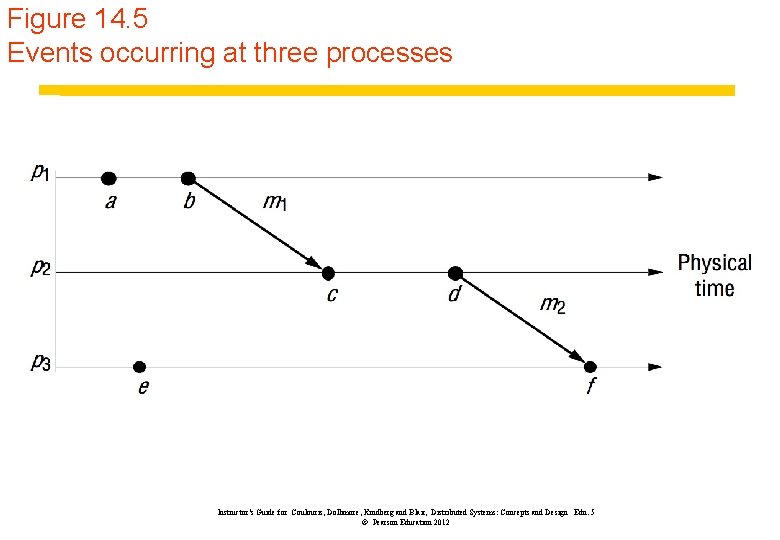
Figure 14. 5 Events occurring at three processes Instructor’s Guide for Coulouris, Dollimore, Kindberg and Blair, Distributed Systems: Concepts and Design Edn. 5 © Pearson Education 2012

Figure 14. 6 Lamport timestamps for the events shown in Figure 14. 5 Instructor’s Guide for Coulouris, Dollimore, Kindberg and Blair, Distributed Systems: Concepts and Design Edn. 5 © Pearson Education 2012
Vector clocks • Limitation of Lamport clocks: if L(e) < L(e’) we can’t conculde that e e’ • Solution: make the LC scalar a vector • Vi[i]≡number of events that pi has timestamped • Vi[j] (for i≠j) ≡ #events at pj that may have affected pi and that pi knows about. • (Now see slides from the Birman book) 7
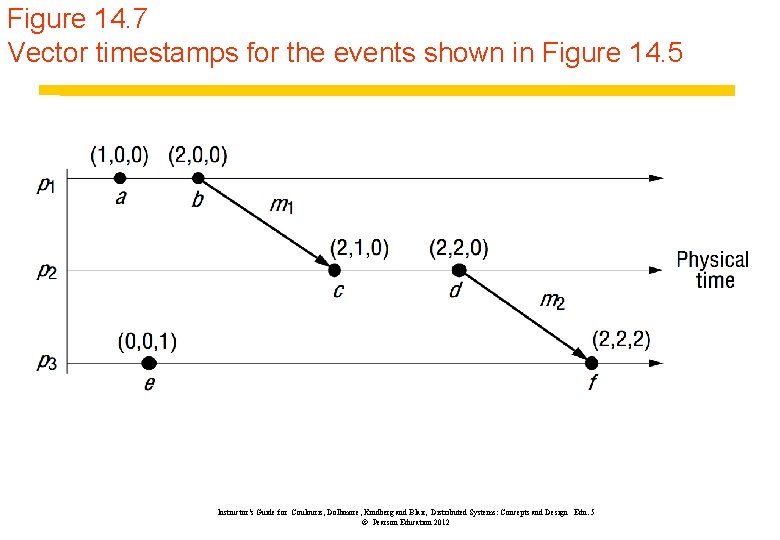
Figure 14. 7 Vector timestamps for the events shown in Figure 14. 5 Instructor’s Guide for Coulouris, Dollimore, Kindberg and Blair, Distributed Systems: Concepts and Design Edn. 5 © Pearson Education 2012
![Global states [14. 5] • (See the VR 01 slides for best intro to](http://slidetodoc.com/presentation_image_h2/ebfa06db0012cb2cfe3dd4312bc4f00d/image-9.jpg "Global states [14. 5] • (See the VR 01 slides for best intro to")
Global states [14. 5] • (See the VR 01 slides for best intro to this) 9
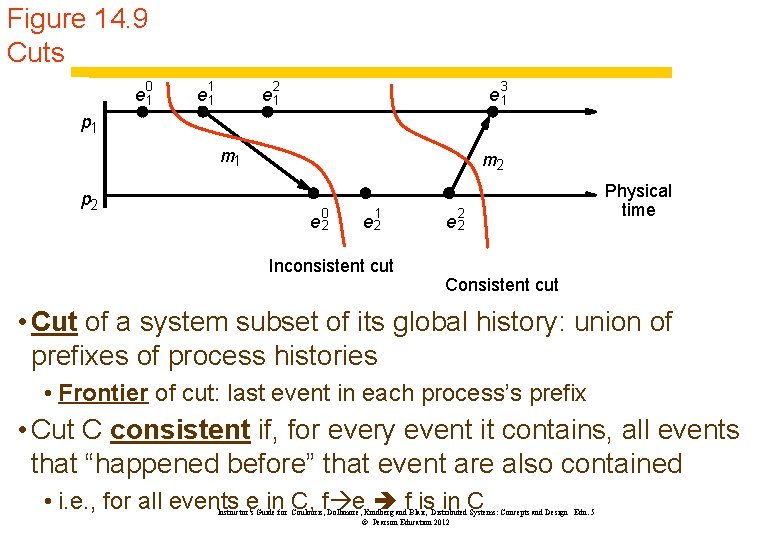
Figure 14. 9 Cuts 0 e 1 1 2 e 1 3 e 1 p 1 m 1 p 2 m 2 0 e 2 1 e 2 Inconsistent cut 2 e 2 Physical time Consistent cut • Cut of a system subset of its global history: union of prefixes of process histories • Frontier of cut: last event in each process’s prefix • Cut C consistent if, for every event it contains, all events that “happened before” that event are also contained • i. e. , for all events e in C, f e f is in C Instructor’s Guide for Coulouris, Dollimore, Kindberg and Blair, Distributed Systems: Concepts and Design Edn. 5 © Pearson Education 2012
Consistent cuts • Recall system goes through S 0 S 1 S 2. . • One different event at one process in Si Si+1 • Global state then union of process states after a cut • Run: a total ordering of all events in a global history that’s consistent with each local history’s ordering • Not all runs pass through consistent global states • Linearization (AKA consistent run): ordering of events in global history consistent with happened-before relationship on the history • All linearizations pass only through consistent global states • Reachability: state S’ is reachable from state S if there is a linearization that passes through S and then S’. 11
![Global state predicates, stability, safety, and liveness [14. 5. 2] • Evaluate a global](http://slidetodoc.com/presentation_image_h2/ebfa06db0012cb2cfe3dd4312bc4f00d/image-12.jpg "Global state predicates, stability, safety, and liveness [14. 5. 2] • Evaluate a global")
Global state predicates, stability, safety, and liveness [14. 5. 2] • Evaluate a global state predicate to detect deadlock, etc • Function mapping from global states to {True, False} • Stable property: once predicate true, stays true (opp. : transitory) • I. e. , true from all states reachable from the present state • Safety property (e. g. , α): nothing “bad” ever happens • E. g. , never have deadlock • i. e. , for all states reachable from initial state, α is False (never True) • Liveness property (e. g. , β): something good eventually happens • E. g. , distributed algorithm eventually terminates • I. e. , Liveness w. r. t. β: for any linearization L starting in state S 0, β evaluates to True for some state SL reachable from S 0. 12
![Snapshot algorithm • By Chandy and Lamport [1985]: determine global states • Goal: record](http://slidetodoc.com/presentation_image_h2/ebfa06db0012cb2cfe3dd4312bc4f00d/image-13.jpg "Snapshot algorithm • By Chandy and Lamport [1985]: determine global states • Goal: record")
Snapshot algorithm • By Chandy and Lamport [1985]: determine global states • Goal: record a set of process AND channel states such that it is consistent (not strongly consistent) for a set of processes pi (i=1, 2, … N) • Assumptions • Neither channels nor processes fail • Channels are uni-directional and FIFO ordered • Graph of processes and channels strongly connected (path between any 2 processes) • Any process may initiate the snapshot at any time • Processes don’t need to freeze/lock: continue normal operations 13
Snapshot algorithm (cont. ) • Main ideas • Terms: incoming channels and outgoing channels for pi • Each process records its state, and for each incoming channel, set of messages sent to it • For each channel, process records channel state: messages that arrived after its last recorded state and before sender recorded state • I. e, . Record state at different times but account for messages transmitted but not yet received (these are part of the channel state) • Use distinguished marker messages • Tell receiver to save state • Way to determine which messages go in channel state • To initiate the algorithm, process acts like it received a marker message 14
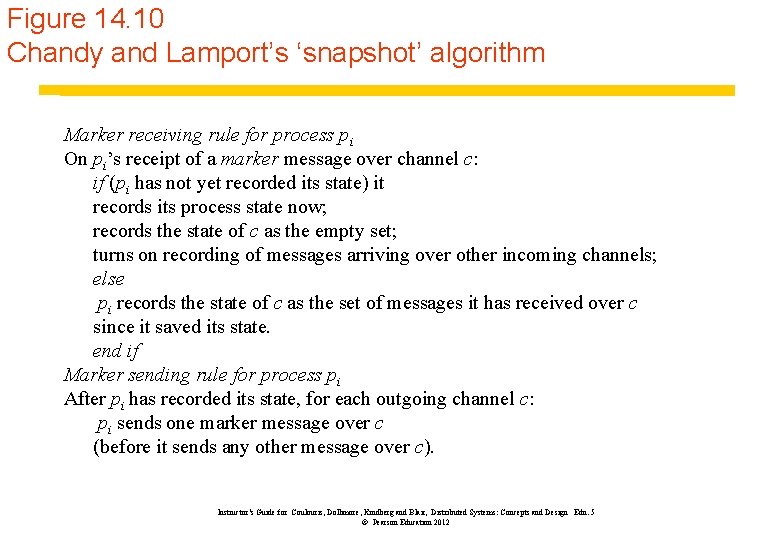
Figure 14. 10 Chandy and Lamport’s ‘snapshot’ algorithm Marker receiving rule for process pi On pi’s receipt of a marker message over channel c: if (pi has not yet recorded its state) it records its process state now; records the state of c as the empty set; turns on recording of messages arriving over other incoming channels; else pi records the state of c as the set of messages it has received over c since it saved its state. end if Marker sending rule for process pi After pi has recorded its state, for each outgoing channel c: pi sends one marker message over c (before it sends any other message over c). Instructor’s Guide for Coulouris, Dollimore, Kindberg and Blair, Distributed Systems: Concepts and Design Edn. 5 © Pearson Education 2012
Example of snapshot algorithm • Two processes, trade in widgets, over two unidirectional channels • Process p 1 sends orders for widgets to p 2 with its payment ($10/widget) • Process p 2 sends widget along other channel 16
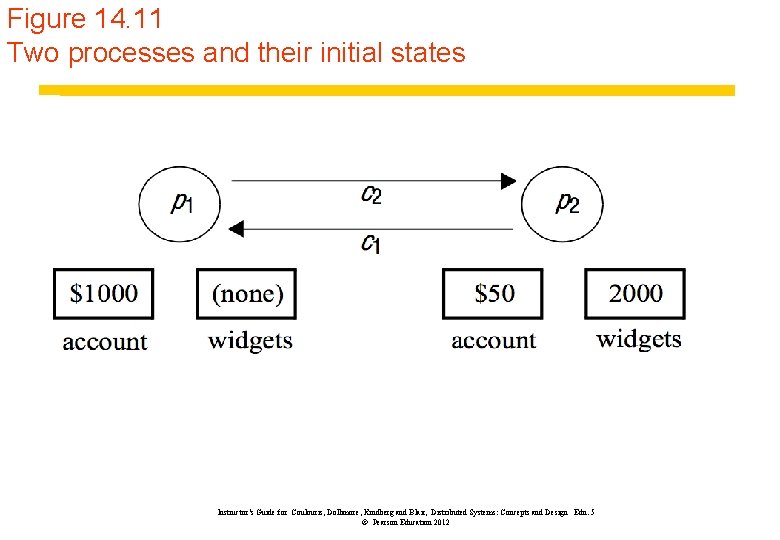
Figure 14. 11 Two processes and their initial states Instructor’s Guide for Coulouris, Dollimore, Kindberg and Blair, Distributed Systems: Concepts and Design Edn. 5 © Pearson Education 2012
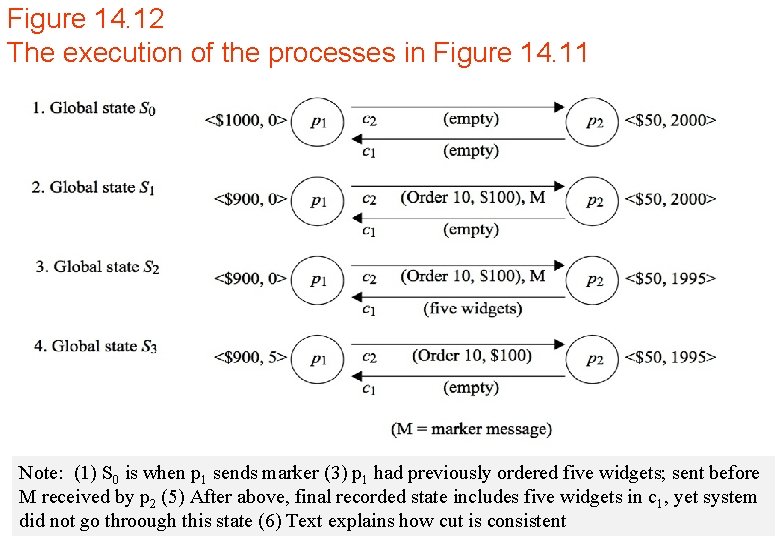
Figure 14. 12 The execution of the processes in Figure 14. 11 Note: (1) S 0 is when p 1 sends marker (3) p 1 had previously ordered five widgets; sent before M received by p 2 (5) After above, final recorded state includes five widgets in c 1, yet system did not go throough this state (6) Text explains how cut is consistent Instructor’s Guide for Coulouris, Dollimore, Kindberg and Blair, Distributed Systems: Concepts and Design Edn. 5 © Pearson Education 2012
![Distributed debugging [14. 6] • Problem: recording system’s global state to make useful statements](http://slidetodoc.com/presentation_image_h2/ebfa06db0012cb2cfe3dd4312bc4f00d/image-19.jpg "Distributed debugging [14. 6] • Problem: recording system’s global state to make useful statements")
Distributed debugging [14. 6] • Problem: recording system’s global state to make useful statements about whether a transitory state occurred in an actual execution • Capture trace info and do post hoc analysis • Chandy and Lamport’s [1985] snapshot algorithm earlier used to collect states • Send to monitor process (considered outside the system) • Algorithm by Marzullo and Neiger [1991] 19
Distributed debugging (cont. ) • Goal: determine cases where global state predicate φ • Was definitely True at some point in the execution • Was possibly True at some point in the execution • “Definitely” applies to actual execution, not run extrapolated from it • Basically, we want to know if a transitory state actually occurred in an actual execution • Why not worry if a stable state did? • Can consider all linearizations H of the observed events • Possibly φ : exists a consistent global state S through which a linearization of H passes such that φ(S) is True • Definitely φ: for all linearizations L of H, exists a consistent global state S through which L passes such that φ(S) is True 20
![Collecting the state [14. 6. 1] • Procs pi send in initial state, then](http://slidetodoc.com/presentation_image_h2/ebfa06db0012cb2cfe3dd4312bc4f00d/image-21.jpg "Collecting the state [14. 6. 1] • Procs pi send in initial state, then")
Collecting the state [14. 6. 1] • Procs pi send in initial state, then periodically later ones • Does not interfere with execution, only delays a bit (!!) • Only need to send updates when change in variable used in φ • Monitor proc records state msgs from each pi in queue Qi 21
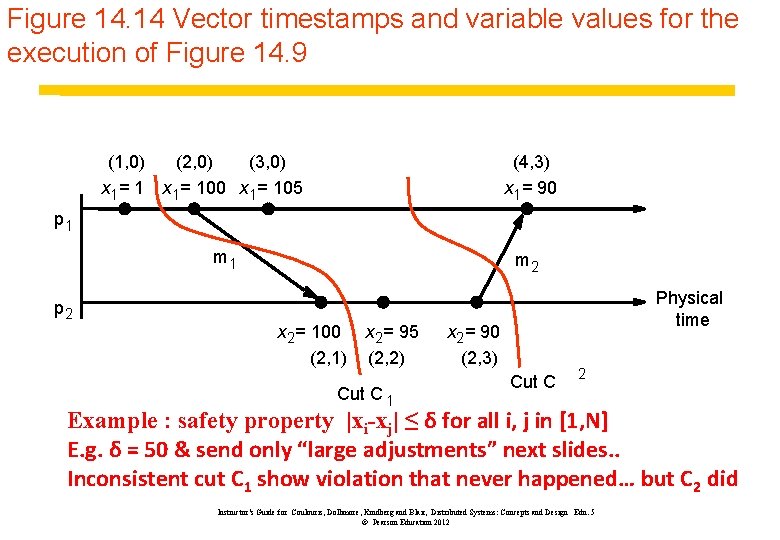
Figure 14. 14 Vector timestamps and variable values for the execution of Figure 14. 9 (1, 0) (2, 0) (3, 0) x 1= 100 x 1= 105 (4, 3) x 1= 90 p 1 m 1 p 2 m 2 x 2= 100 (2, 1) x 2= 95 (2, 2) Cut C 1 Physical time x 2= 90 (2, 3) Cut C 2 Example : safety property |xi-xj| ≤ δ for all i, j in [1, N] E. g. δ = 50 & send only “large adjustments” next slides. . Inconsistent cut C 1 show violation that never happened… but C 2 did Instructor’s Guide for Coulouris, Dollimore, Kindberg and Blair, Distributed Systems: Concepts and Design Edn. 5 © Pearson Education 2012
![Observing consistent global states [14. 6. 2] • Recall a cut C consistent if,](http://slidetodoc.com/presentation_image_h2/ebfa06db0012cb2cfe3dd4312bc4f00d/image-23.jpg "Observing consistent global states [14. 6. 2] • Recall a cut C consistent if,")
Observing consistent global states [14. 6. 2] • Recall a cut C consistent if, for every event it contains, all events that “happened before” that event are also contained • i. e. , ∀ events e ∈ C, f e implies that f ∈C • Fig 14. 14 & only send when adjustments “large enough” • Upon receipt, process updates its value to that of sender • To know of cut is consistent, processes also send vector clocks with (changed) state 23
Observing consistent global states (cont. ) • Let • S={s 1, s 2, … , s. N} be a global state at monitor, from the state msgs • V(si) vector timestamp of state si received from process pi • Then S is a consistent global state iff V(si)[i] ≥ V(sj)[i] for i, j in [1, N] • I. e. , # of pi’s events known at pj when it sent sj is no more than then number of events that had occurred at pi when it sent si. • I. e. , if one proc’s state depends on another (by happened-to), then global state also encompasses state upon which it depends • How to represent? Lattices (2 slides away) • Condition depicted next… 24
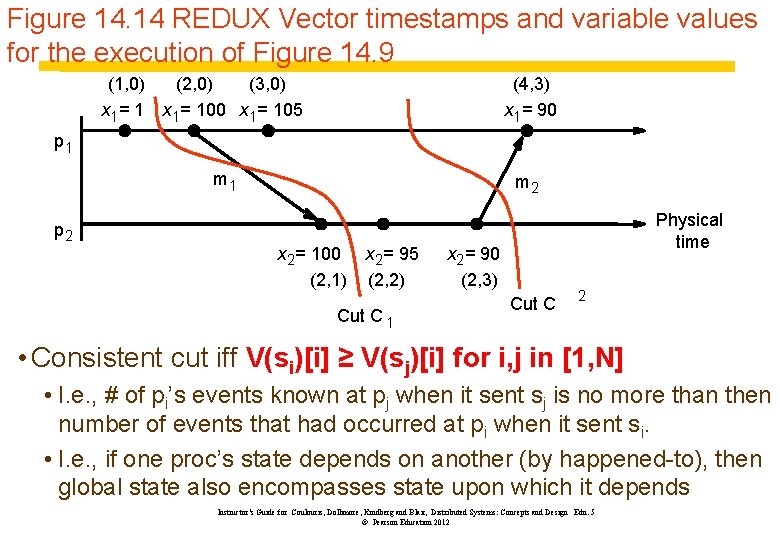
Figure 14. 14 REDUX Vector timestamps and variable values for the execution of Figure 14. 9 (1, 0) (2, 0) (3, 0) x 1= 100 x 1= 105 (4, 3) x 1= 90 p 1 m 1 p 2 m 2 x 2= 100 (2, 1) x 2= 95 (2, 2) Cut C 1 Physical time x 2= 90 (2, 3) Cut C 2 • Consistent cut iff V(si)[i] ≥ V(sj)[i] for i, j in [1, N] • I. e. , # of pi’s events known at pj when it sent sj is no more than then number of events that had occurred at pi when it sent si. • I. e. , if one proc’s state depends on another (by happened-to), then global state also encompasses state upon which it depends Instructor’s Guide for Coulouris, Dollimore, Kindberg and Blair, Distributed Systems: Concepts and Design Edn. 5 © Pearson Education 2012
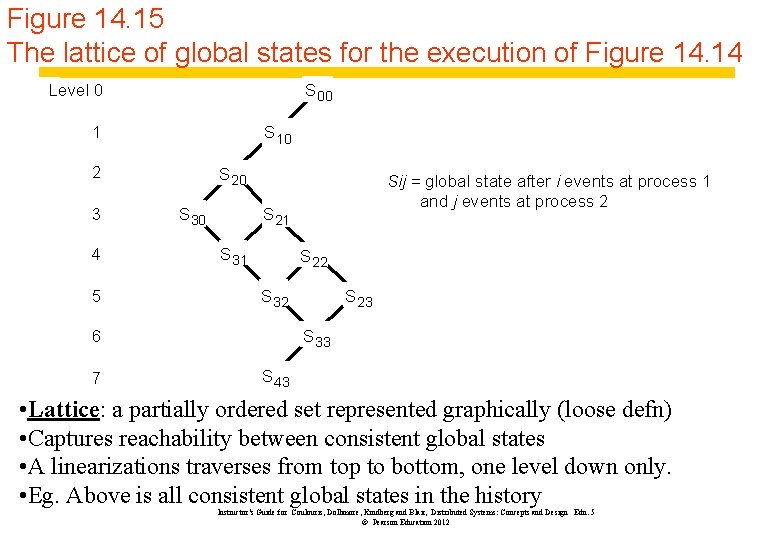
Figure 14. 15 The lattice of global states for the execution of Figure 14. 14 Level 0 S 00 1 S 10 2 3 4 5 S 20 S 30 S 21 S 31 S 22 S 32 6 7 Sij = global state after i events at process 1 and j events at process 2 S 23 S 33 S 43 • Lattice: a partially ordered set represented graphically (loose defn) • Captures reachability between consistent global states • A linearizations traverses from top to bottom, one level down only. • Eg. Above is all consistent global states in the history Instructor’s Guide for Coulouris, Dollimore, Kindberg and Blair, Distributed Systems: Concepts and Design Edn. 5 © Pearson Education 2012
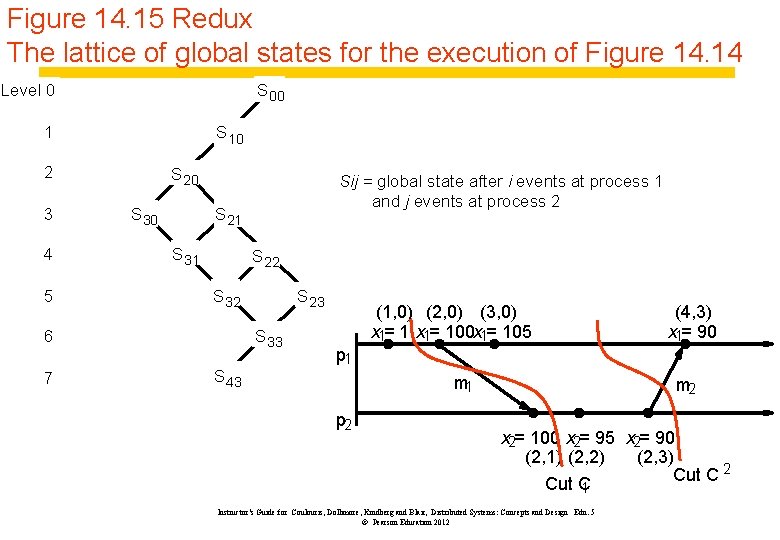
Figure 14. 15 Redux The lattice of global states for the execution of Figure 14. 14 Level 0 S 00 1 S 10 2 3 4 5 S 20 S 30 S 21 S 31 S 22 S 32 6 7 Sij = global state after i events at process 1 and j events at process 2 S 23 S 33 S 43 p 1 (1, 0) (2, 0) (3, 0) x 1= 100 x 1= 105 m 1 p 2 (4, 3) x 1= 90 m 2 x 2= 100 x 2= 95 x 2= 90 (2, 1) (2, 2) (2, 3) 2 Cut C 1 Instructor’s Guide for Coulouris, Dollimore, Kindberg and Blair, Distributed Systems: Concepts and Design Edn. 5 © Pearson Education 2012
Evaluating with the lattice • Lattice shows us all linearizations corresponding to a history • Evaluating possibly φ • Start at initial stage & step through all consistent states • Evaluate φ at each stage, stop when it evaluates to True • Evaluating definitely φ • Try to find a set of states through which all linearizations must pass • Then check if the set’s states all evaluate φ to True; done if find • E. g. , φ(S 30) and φ(S 21) both true, and one or other must be passed through for all executions 28
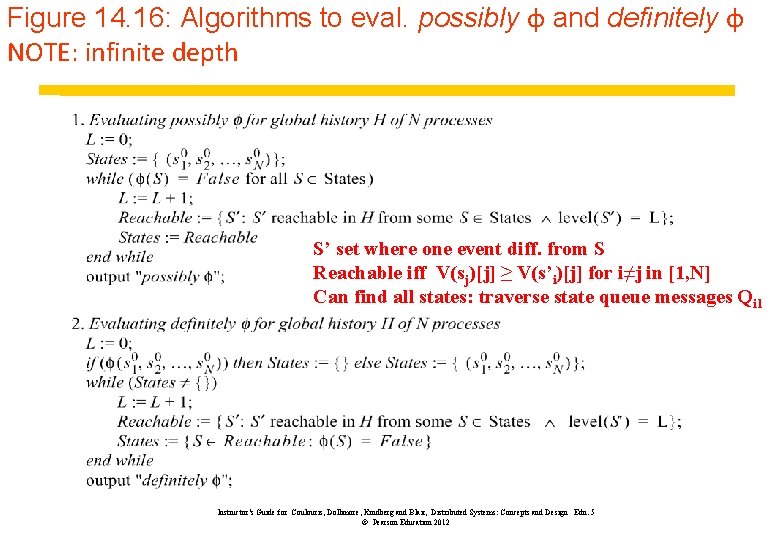
Figure 14. 16: Algorithms to eval. possibly φ and definitely φ NOTE: infinite depth S’ set where one event diff. from S Reachable iff V(sj)[j] ≥ V(s’i)[j] for i≠j in [1, N] Can find all states: traverse state queue messages Qi 1 Instructor’s Guide for Coulouris, Dollimore, Kindberg and Blair, Distributed Systems: Concepts and Design Edn. 5 © Pearson Education 2012
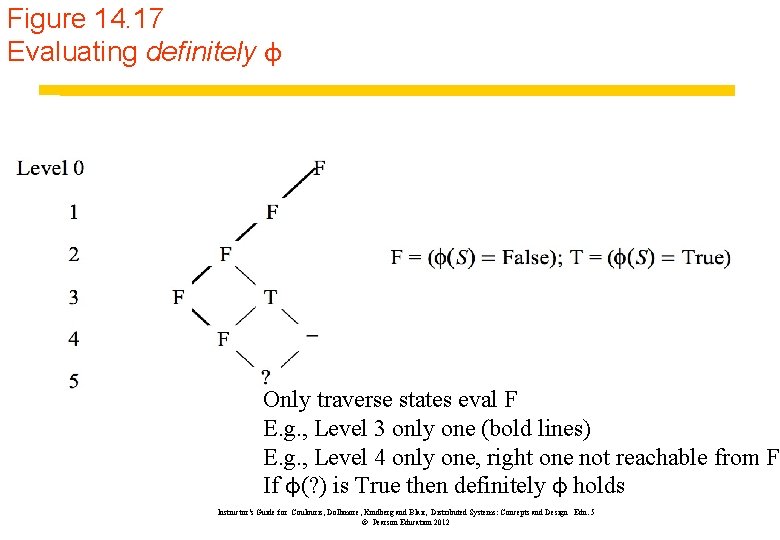
Figure 14. 17 Evaluating definitely φ Only traverse states eval F E. g. , Level 3 only one (bold lines) E. g. , Level 4 only one, right one not reachable from F If φ(? ) is True then definitely φ holds Instructor’s Guide for Coulouris, Dollimore, Kindberg and Blair, Distributed Systems: Concepts and Design Edn. 5 © Pearson Education 2012
- Slides: 30