
Slides Available http bit ly1 a IC 3
Slides Available: http: //bit. ly/1 a. IC 3 S Constructing an Anonymous Dataset From the Personal Digital Photo Libraries of Mac App Store Users JCDL 2013 Jesse P. Gozali, Min-Yen Kan, Hari Sundaram National University of Singapore, Arizona State University 1
Slides Available: http: //bit. ly/1 a. IC 3 S COLLECTING PERSONAL DATA FOR RESEARCH • Research on personal digital photo libraries need access to real data. • The personal nature, especially since photos are involved, makes accessing large datasets difficult, yet alone creating a publicly available one. • Past research that requires such data have resorted to photos from the researchers themselves or soliciting volunteers with monetary remuneration. 2
Slides Available: http: //bit. ly/1 a. IC 3 S CROWDSOURCING? How can we reach out to a large number of potential volunteers? Crowd-sourcing platforms (e. g. Amazon Mechanical Turk) are useful for gathering human judgements, as long as precautions are taken (qualification task, verification questions, fake data filtering) However: • Annotations on the data must be done by photo owners, not third-party evaluators due to the semantic gap between the photos and the event they represent. • Motivation is monetary; MTurk participants may not be target users. 3
Slides Available: http: //bit. ly/1 a. IC 3 S APP STORES A solution: Application Stores • Widely used for mobile applications (e. g. Android Marketplace, Apple’s App Store), but also for desktop applications (Valve’s Steam, Apple’s Mac App Store, Microsoft’s Windows Store). • Large user base with high download rates. • Helps application developers to manage the purchase, distribution, updating, and publicity of their applications. 4
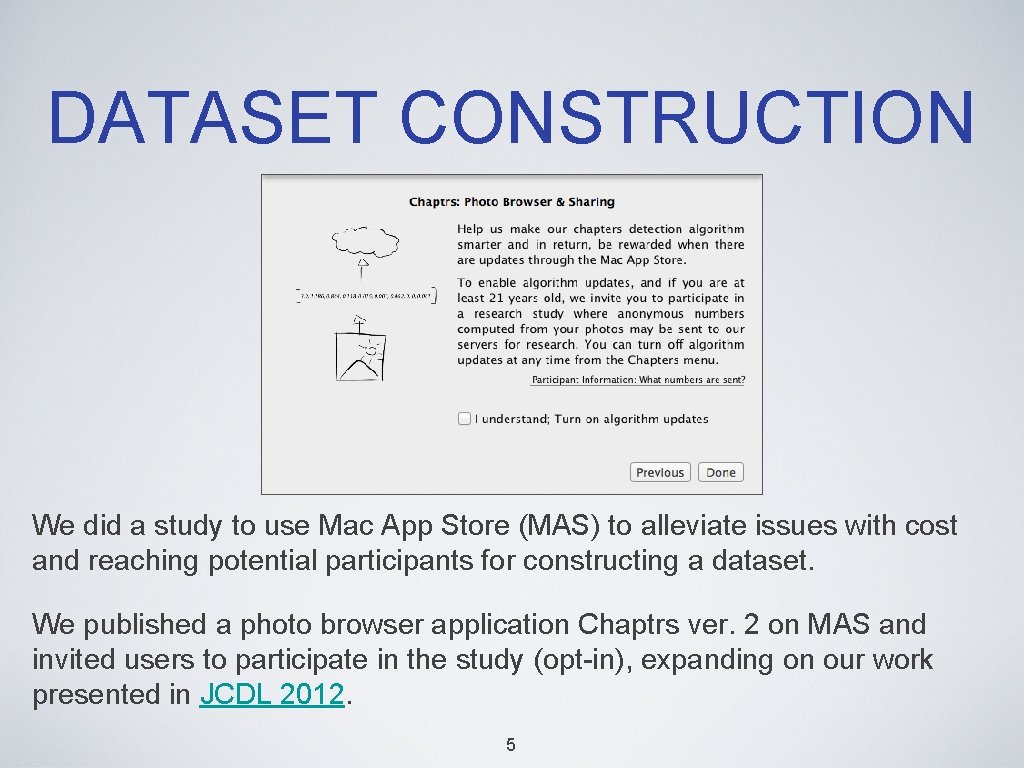
DATASET CONSTRUCTION We did a study to use Mac App Store (MAS) to alleviate issues with cost and reaching potential participants for constructing a dataset. We published a photo browser application Chaptrs ver. 2 on MAS and invited users to participate in the study (opt-in), expanding on our work presented in JCDL 2012. 5
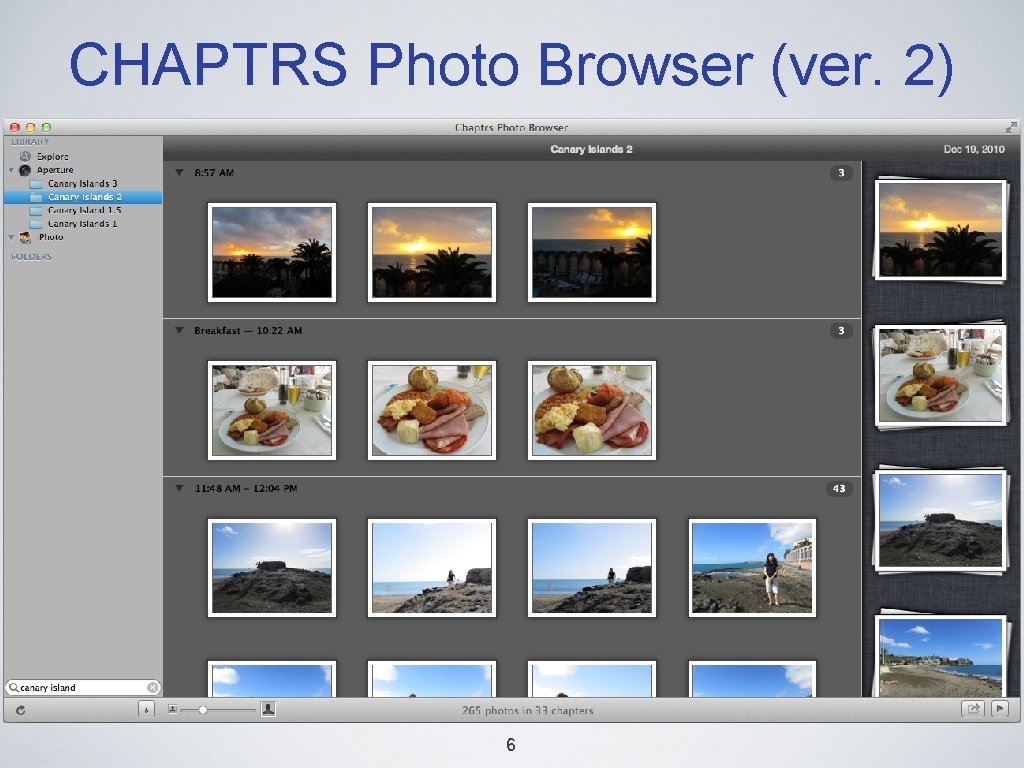
CHAPTRS Photo Browser (ver. 2) 6
CONS IN USING MAS • Application needs to have a “useful purpose” for the user. Its main purpose cannot be for collecting data; for us, the main purpose is a chapter-based photo browser. • A necessary overhead just like qualification tasks and verification questions in MTurk. • Application needs to undergo a review process; usually 1 -2 weeks, but will be longer if complications arise (resubmission, appeals to review board). 7
PROS IN USING MAS • Cost doesn’t scale with number of participants or amount of data collected. Cost only attributed to the 99 USD / year fee. • Cost is lower than reported by previous work with MTurk • • If we consider the 20, 778 photo sets (473, 772 photos) we collected in 60 days, cost is 0. 0002 USD per photo • If we consider the 60 photo sets (8, 107 photos) with chapter boundary annotations, cost is 0. 012 USD per annotation Visibility is high: total number of downloads in 60 days of study is 2, 549 (42 per day) 8
CHAPTRS DATASET • The dataset we constructed has anonymous photo features, corresponding to those used in our event photo stream segmentation algorithm: time gap, aperture diameter, log light (scene brightness), 8 -bin color histogram. • 20, 778 photo sets (473, 772 photos), including 60 photo sets (8, 107 photos) with author-annotated chapter boundary annotations. • The dataset can be expanded to include other anonymous photo features. • Released as a publicly available dataset to further research in http: //bit. ly/113 ZQs. Y personal digital photo libraries. http: //wing. comp. nus. edu. sg/~jeprab/chaptrs_dataset/ 9
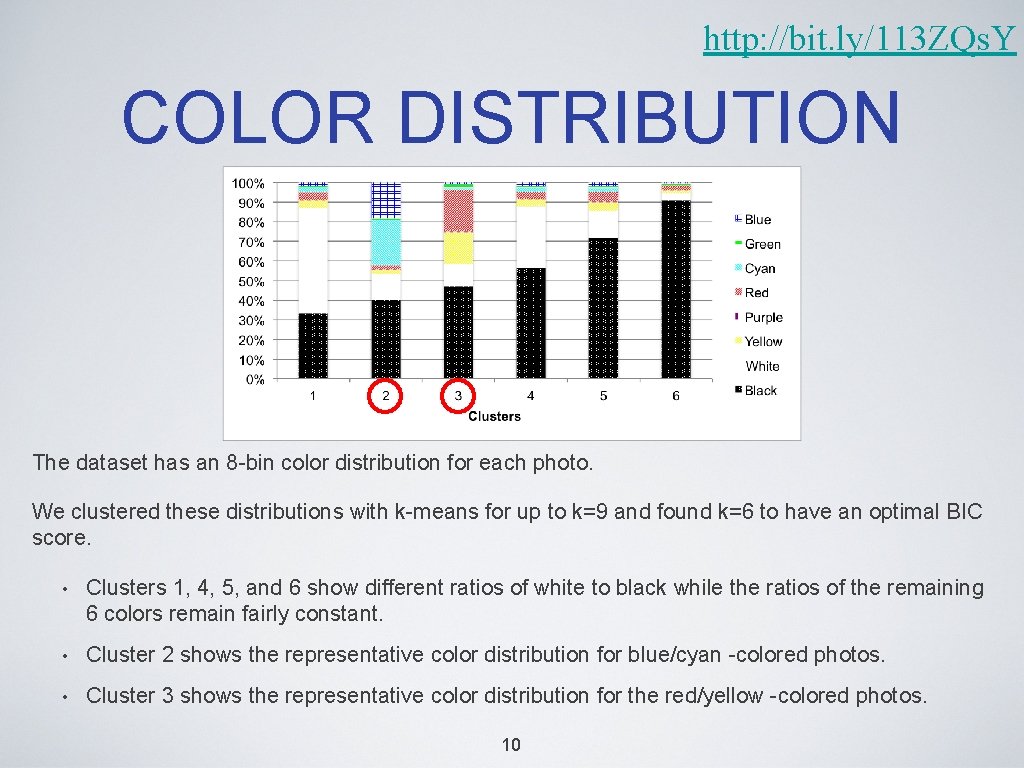
http: //bit. ly/113 ZQs. Y COLOR DISTRIBUTION The dataset has an 8 -bin color distribution for each photo. We clustered these distributions with k-means for up to k=9 and found k=6 to have an optimal BIC score. • Clusters 1, 4, 5, and 6 show different ratios of white to black while the ratios of the remaining 6 colors remain fairly constant. • Cluster 2 shows the representative color distribution for blue/cyan -colored photos. • Cluster 3 shows the representative color distribution for the red/yellow -colored photos. 10
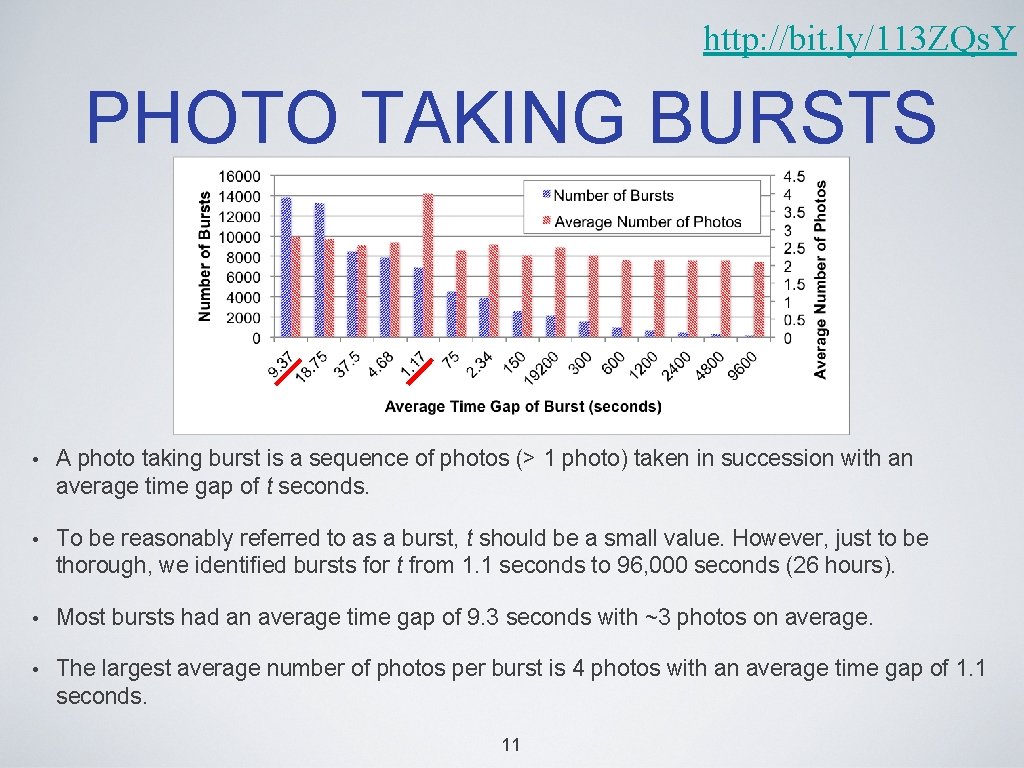
http: //bit. ly/113 ZQs. Y PHOTO TAKING BURSTS • A photo taking burst is a sequence of photos (> 1 photo) taken in succession with an average time gap of t seconds. • To be reasonably referred to as a burst, t should be a small value. However, just to be thorough, we identified bursts for t from 1. 1 seconds to 96, 000 seconds (26 hours). • Most bursts had an average time gap of 9. 3 seconds with ~3 photos on average. • The largest average number of photos per burst is 4 photos with an average time gap of 1. 1 seconds. 11
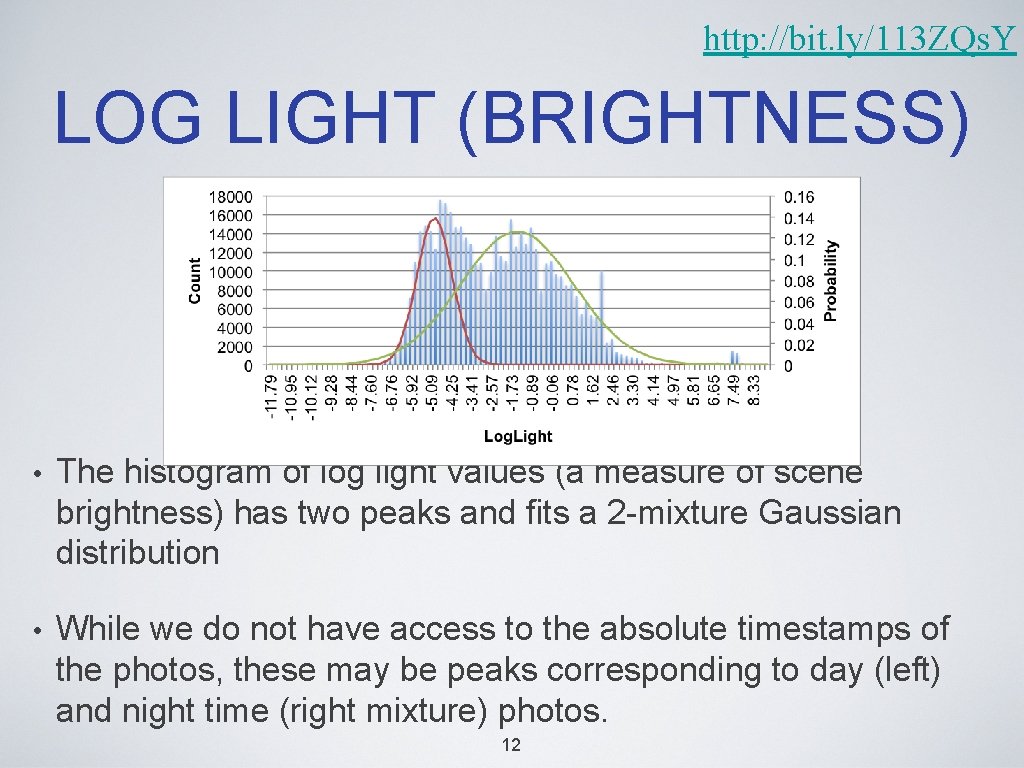
http: //bit. ly/113 ZQs. Y LOG LIGHT (BRIGHTNESS) • The histogram of log light values (a measure of scene brightness) has two peaks and fits a 2 -mixture Gaussian distribution • While we do not have access to the absolute timestamps of the photos, these may be peaks corresponding to day (left) and night time (right mixture) photos. 12
Dataset Available: http: //bit. ly/113 ZQs. Y CONCLUSION • First study on chapter-based photo organization • Unsupervised method for event photo stream segmentation, embedded into. . . • Released a freely-available chapter-based photo browser • Released publicly available dataset for photo organization research • Outlined data collection method to reach personal digital photo libraries using the Mac App Store (MAS) as a distribution platform and released the dataset to the research community 13
- Slides: 13