
Slide Set Seven B Parole Evidence Rule Last
Slide Set Seven B: Parole Evidence Rule
Last Time: What We Spoke About: • Consideration Part One: Definitions / General Principals / Exceptions • Legality Part Two: Definitions / General Principals • Public Policy Part Three: Definitions / Public Welfare Agreements / Violations • Class Case – Allegheny College v. National Chautauqua County Bank Consideration as a Condition of Contract
Tonight: We Will Speak About: Contract Rules and Interpretation • Statute of Frauds Part One: Definitions / Oral and Written Contracts / Non Compliance • Parole Evidence Rule Part Two: Definitions / Exclusion / Non Application • Rules of Construction Part Three: Definitions / Intent / Four Corners / Terms / Conduct • Class Case – Bethlehem Steel v. Turner Construction Company Contracts Viewed from their Four Corners
Contract Rules and Interpretation Generally - Definitions 4
Contract Rules and Interpretation Definition - Contract Black’s Law Dictionary defines the term “Contract” as: “An agreement between two or more parties creating obligations that are enforceable or otherwise recognizable at law. ” 5
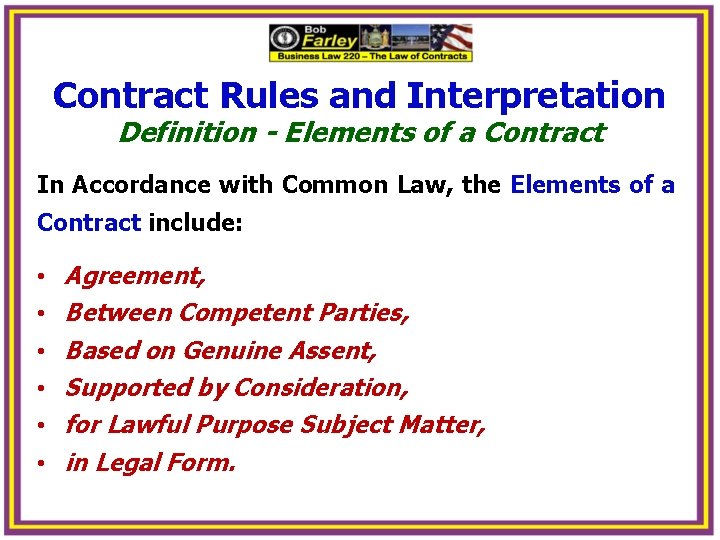
Contract Rules and Interpretation Definition - Elements of a Contract In Accordance with Common Law, the Elements of a Contract include: • Agreement, • Between Competent Parties, • Based on Genuine Assent, • Supported by Consideration, • for Lawful Purpose Subject Matter, • in Legal Form.
Contract Rules and Interpretation Generally – Oral and Written Contracts 7
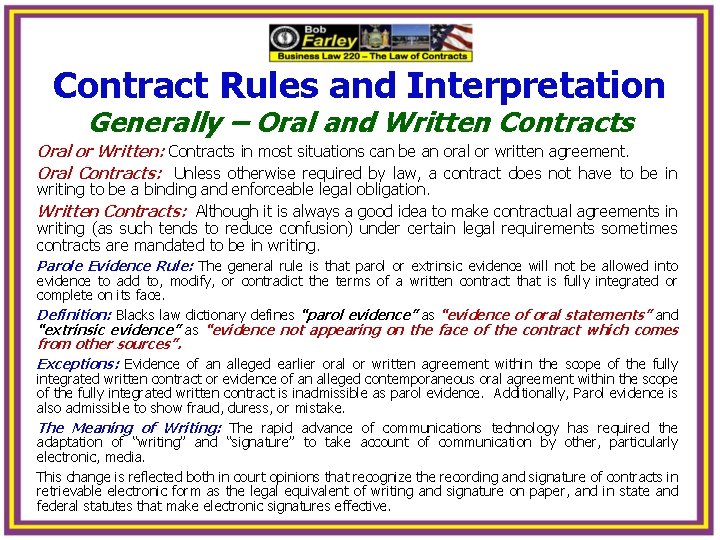
Contract Rules and Interpretation Generally – Oral and Written Contracts Oral or Written: Contracts in most situations can be an oral or written agreement. Oral Contracts: Unless otherwise required by law, a contract does not have to be in writing to be a binding and enforceable legal obligation. Written Contracts: Although it is always a good idea to make contractual agreements in writing (as such tends to reduce confusion) under certain legal requirements sometimes contracts are mandated to be in writing. Parole Evidence Rule: The general rule is that parol or extrinsic evidence will not be allowed into evidence to add to, modify, or contradict the terms of a written contract that is fully integrated or complete on its face. Definition: Blacks law dictionary defines “parol evidence” as “evidence of oral statements” and “extrinsic evidence” as “evidence not appearing on the face of the contract which comes from other sources”. Exceptions: Evidence of an alleged earlier oral or written agreement within the scope of the fully integrated written contract or evidence of an alleged contemporaneous oral agreement within the scope of the fully integrated written contract is inadmissible as parol evidence. Additionally, Parol evidence is also admissible to show fraud, duress, or mistake. The Meaning of Writing: The rapid advance of communications technology has required the adaptation of “writing” and “signature” to take account of communication by other, particularly electronic, media. This change is reflected both in court opinions that recognize the recording and signature of contracts in retrievable electronic form as the legal equivalent of writing and signature on paper, and in state and federal statutes that make electronic signatures effective.
Contract Rules and Interpretation Generally – The Parole Evidence Rule 9
Contract Rules and Interpretation Parole Evidence Rule - Generally Meaning of Parole Evidence Rule: The Parole Evidence Rule denies the admissibility of oral evidence (verbal testimony) or extrinsic evidence (any evidence outside the terms of the contract) when an agreement has been duly recorded in written form. History of the Parole Evidence Rule: Roman Law: The foundations of the Parole Evidence Rule emanated from Roman law, which held that anything of an inferior evidentiary basis could not overcome superior evidence, and that a written document is superior to oral testimony. British Common Law: With the requirement of a written record for specified types of contracts entered the common law of England in 1677, through a statutory enactment by the British Parliament the “Act for Prevention of Fraud and Perjuries, ” the modern parallel concept of the Parol Evidence Rule was born, with the development of the common law concept that “the writing within the contract constitutes the best evidence of the intent of the parties”. New York Law: The Parol Evidence Rule is a function of case law doctrine. Court of Appeals: The Court of Appeals has held that when parties enter into a contract, each assumes that the language in their agreement accurately memorializes their understandings and intentions, and when a dispute arises, the intent of the parties is best expressed by the language they chose to put into their writing. See Kass v. Kass, 91 N. Y. 2 d 554, 566 (1998). Textual Analysis of Written Contracts: New York is a textual jurisdiction (where the courts look to the agreement itself to determine the meaning of the agreement), and whethere is ambiguity “is determined by looking within the four corners of the document, not to outside sources. As a result, New York courts will examine the parties’ intentions as set forth in the agreement, and seek to afford the language an interpretation that is sensible, practical, fair, and reasonable.
Contract Rules and Interpretation Parol Evidence Rule – Basic Rule and Application Parole Evidence Rule – Basic Meaning: The Parole Evidence Rule simply holds that no oral or extrinsic evidence (evidence outside the provisions of the written contract) shall be considered when determining the meaning of the contract itself. When the Parole Evidence Rule Comes into Play: The Parol Evidence Rule applies when an agreement is recorded, whether in writing on paper or in an electronic record, and one of the parties attempts to offer outside evidence to prove a term that is not contained in the recorded contract, or to explain or expand on a term of such contract. Contract Ambiguity: When the parties have a dispute over the meaning of their contract, the courts in New York first ask if the contract contains any ambiguity. A contract is not ambiguous if, on its face, it is definite and precise and reasonably susceptible to only one meaning. The “parties cannot create ambiguity from whole cloth where none exists, and provisions are not ambiguous merely because the parties interpret them differently. Ambiguity is a Question of Law: Whether or not a writing is ambiguous is a question of law to be resolved by the courts. Claims of Ambiguity and Parol Evidence: Under the Parol Evidence Rule, extrinsic and parol evidence is not admissible to create an ambiguity in a written agreement which is complete and clear and unambiguous upon its face. This means that a contractual provision that is clear on its face must be enforced according to the plain meaning of its terms, and courts may not add or excise terms, nor distort the meaning of those used and thereby make a new contract for the parties under the guise of interpreting the writing. Sophisticated, Arms Length Transactions: The Parole Evidence Rule is especially applicable where the parties are commercially sophisticated and contractually astute. This is especially so in commercial contracts negotiated at arm’s length by sophisticated, counseled business people.
Contract Rules and Interpretation Parol Evidence Rule – Rationale Parole Evidence Rule – Basic Statement and Rationale: The Parole Evidence Rule holds that no oral or extrinsic evidence (evidence outside the provisions of the written contract) shall be considered when determining the meaning of the contract itself. The Written Contract Represents the Final Expression of the Parties: The Parole Evidence Rule is based on the principle that when the parties record their agreement in writing, they intend the written record to be the final expression of their agreement. Accordingly, under the Parol Evidence Rule, no oral or extrinsic evidence may be admitted to supplement, explain, or contradict the written contract. The Written Contract Supersedes All Previous Discussions and Agreements: When parties reduce the contract to writing, and sign the same, the courts hold that they intended such to supersede anything that might have been proposed, discussed, or agreed to prior to execution of the writing but not ultimately recorded in it. This is why the Parole Evidence Rule requires that the court should not hear evidence of any terms that were allegedly agreed to but are not reflected in the writing, as such evidence is suspect, unreliable, and irrelevant, and is more likely to mislead and confuse than to inform. Purpose and Premise of the Parole Evidence Rule: The primary purpose of the parol evidence rule is to control the court’s decision making and to shield it from evidence that is suspect and unreliable. This Rule also promotes efficiency in the conduct of litigation, by excluding such suspect evidence at the outset thereby saving the time that would otherwise be wasted in presenting such less reliable evidence. Lastly, the Rule also promotes transactional efficiency, because due to its existence, contracting parties are more likely to make an effort to record their agreement more fully and accurately.
Contract Rules and Interpretation Parole Evidence Rule – Exceptions 13
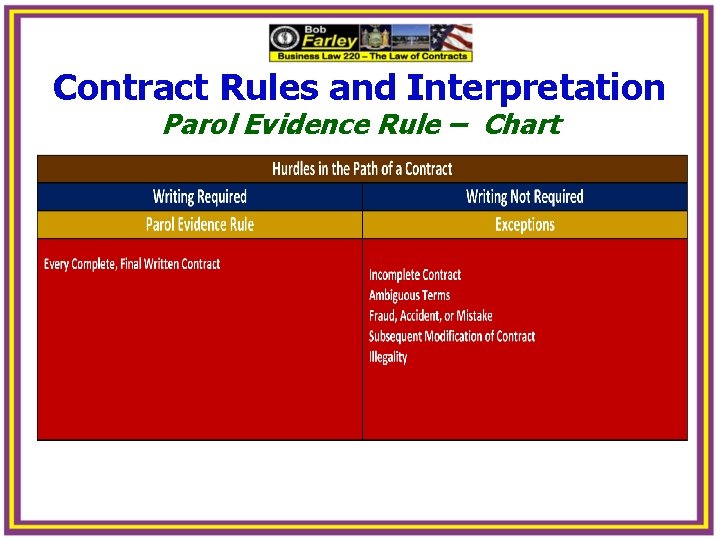
Contract Rules and Interpretation Parole Evidence Rule – Exceptions: The Parol Evidence Rule will not apply in certain very limited cases. The most common of these are as follows: Ambiguity: If a written contract is ambiguous or clearly has term which can have two or more different meanings, then parol evidence may generally be admitted by the court to clarify the meaning. Cannot Violate or Be Determined From the Plain Meaning of the Contract: The party asserting the ambiguity must prove that such ambiguous term cannot be determined from a plain reading of the contract. In such cases, courts have admitted oral (testimonial) or extrinsic (evidence outside of the contract) evidence to clarify the ambiguity or demonstrate that the term used in a contract has a special trade meaning, or a colloquial meaning (a meaning in the particular locality that differs from the common meaning of that word). Fraud, Duress, Mistake or Illegality: Under certain circumstances involving fraud, duress, mistake, or illegality, parol evidence may also sometimes be admitted: Omitted Provision: When a contract, apparently complete on its face, is alleged to have omitted a material provision that should have been included, oral or extrinsic evidence may be admitted to show that the missing provision was omitted as the result of fraud, duress, or mistake. Such evidence must further show what that missing provision stated. Fraud, Duress, Mistake or Illegality in the Making of the Contract: Parol evidence is further admissible to show that a provision of the written contract was a mutual mistake even though the written provision is unambiguous. Additionally, when one party claims to have been fraudulently induced by the other to enter into a contract, the Parol Evidence Rule also does not bar proof that there was fraud. Also, if the subject matter of the contract contains term which are illegal parol evidence can also be admitted. Contract Modification: The Parol Evidence Rule prohibits only the contradiction of a complete written contract. It does not prohibit proof that the contract is incomplete or was subsequently, thereafter modified or terminated.
Contract Rules and Interpretation Parol Evidence Rule – Chart
Class 07 B - Thank you for Coming • For next time – Review Assignments as follows on the Webpage: • Lecture Slides • Selected Readings • Cases and Exercises • We are a hot bench. • Questions?
- Slides: 16