
Slide Set Eight Intellectual Property Patents Trademarks and
- Slides: 27
Slide Set Eight: Intellectual Property Patents, Trademarks and Copyrights 1
Last Class – We Spoke About: • Personal Property: A Continuation of Rights, Ownership, Possession and Transfers: - Gifts Intervivos and Gifts Causa Mortis - Requires: Intent, Delivery and Acceptance - Liens - General Liens and Special Liens - Can only be given by owner of the property - Bailments and Special Interests. - DAPPER: Delivery, Agreement, Personal property, for a Purpose, Entered into for the benefit of one or both parties, and ended with Redelivery - Level of Care – Dependent upon whose benefit the bailment is for. 2
Tonight’s Class: • We will discuss Intellectual Property Concepts - Patents - Trademarks and - Copyrights; and 3
Intellectual Property • Not all property is tangible This is why we need to think of property in terms of “rights” not “things”. • This concept becomes especially important for intellectual property. 4
Intellectual Property Rights in Ideas: Although common law was reluctant to invest property rights in an “idea”, modern society and law have evolved property rights to include certain unique intellectual designs, processes or works. Federal Law Governs: Although most property law is state law, virtually all intellectual property law is based upon federal statutes. 5
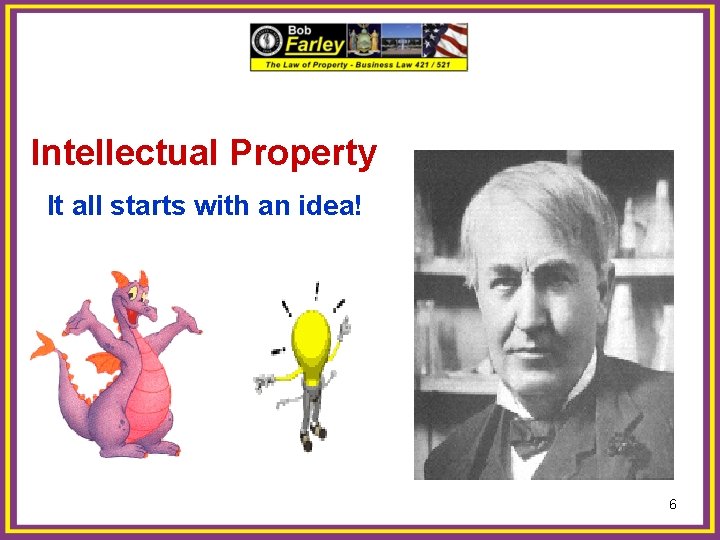
Intellectual Property It all starts with an idea! 6
Intellectual Property Defined: Any product of human intellect that is intangible but has value in the marketplace. It is called “intellectual” property because it is the product of human imagination, creativity, and inventiveness. Why It is Important: Traditionally, businesses have thought of their physical assets, such as land, buildings, and equipment as the most important. Increasingly, however, a company’s intellectual assets are the most important. Protecting intellectual property, promotes creativity, invention and provides incentive and rewards for hard work. 7
Intellectual Property Rights in Ideas: Although common law was reluctant to invest property rights in an “idea”, modern society and law have evolved property rights to include certain unique intellectual designs, processes or works. Federal Law Governs: Although most property law is state law, virtually all intellectual property law is based upon federal statutes. 8
Intellectual Property Three Types of Intellectual Property: Patents – Ideas for Products or Processes Trademarks – Logos, Identifications or Distinctions Copyrights – Written or Performed Works 9
Intellectual Property Part One: Copyrights Enforceable Rights in Writings, Art or Expression 10
Intellectual Property Copyrights – Rights in Writings, Art or Expression Defined as “Original works of authorship fixed in any tangible medium of expression”. Key Elements 1. Originality (Uniqueness) 2. Work of Authorship ● Literary, ● Music, ● Dramatic, ● Graphic or Architectural, or ● Movies or Audio Production *Software is viewed as literary 3. Fixation (Any physical rendering) 11
Intellectual Property Copyrights Collection of Rights – Including the right to: • • Prevent Reproduction Create derivative works Distribute Copies Perform, display or transmit the Work Publicly Duration of Rights: • • • If created after 1978 - Life of the author plus 70 years (No renewal) If created before 1978 – 28 years plus a renewal for 47 years (75 years) Work for Hire Exception – 95 years from publication or 120 from creation whichever is less. 12
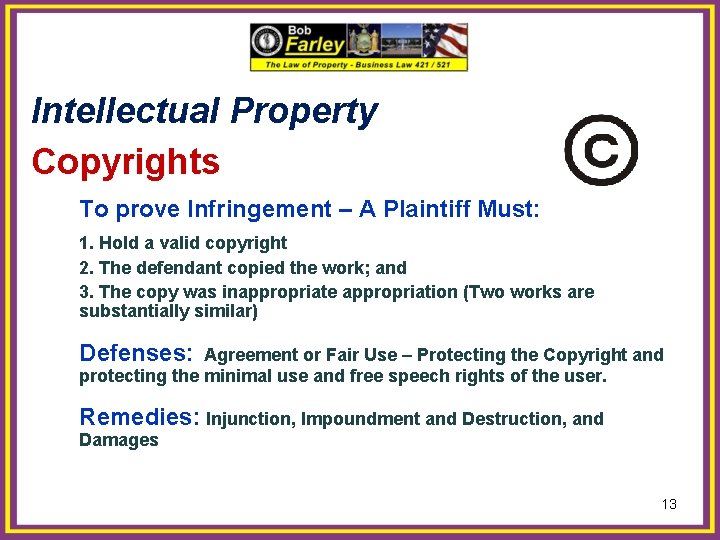
Intellectual Property Copyrights To prove Infringement – A Plaintiff Must: 1. Hold a valid copyright 2. The defendant copied the work; and 3. The copy was inappropriate appropriation (Two works are substantially similar) Defenses: Agreement or Fair Use – Protecting the Copyright and protecting the minimal use and free speech rights of the user. Remedies: Injunction, Impoundment and Destruction, and Damages 13
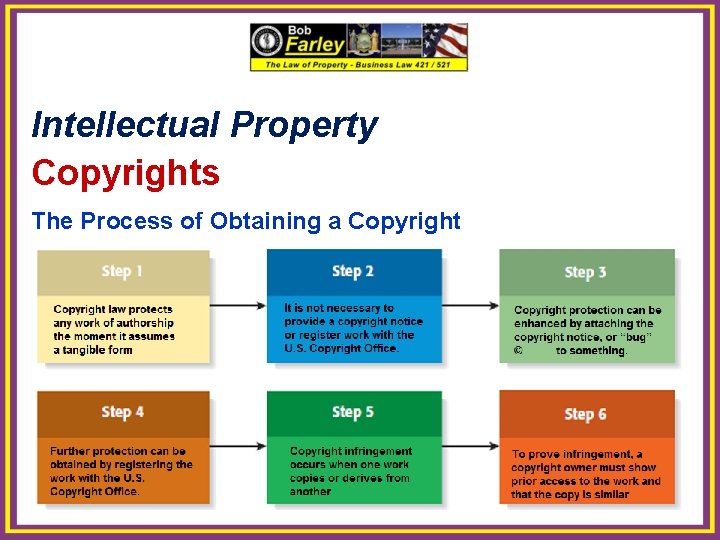
Intellectual Property Copyrights The Process of Obtaining a Copyright 14
Intellectual Property Part Two: Patents Enforceable Rights in any new or useful process, machine, manufacture, composition of matter, or improvement. 15
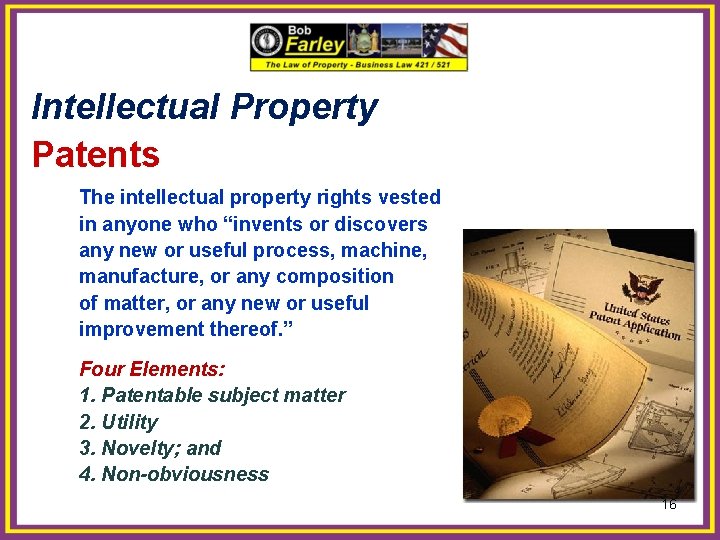
Intellectual Property Patents The intellectual property rights vested in anyone who “invents or discovers any new or useful process, machine, manufacture, or any composition of matter, or any new or useful improvement thereof. ” Four Elements: 1. Patentable subject matter 2. Utility 3. Novelty; and 4. Non-obviousness 16
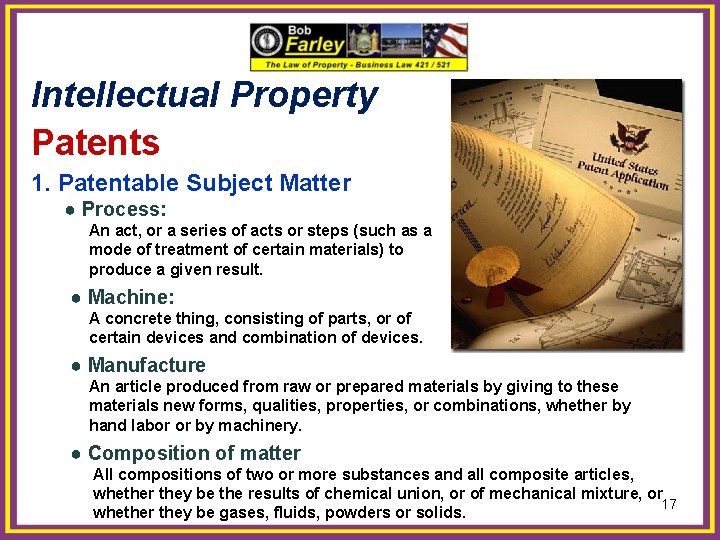
Intellectual Property Patents 1. Patentable Subject Matter ● Process: An act, or a series of acts or steps (such as a mode of treatment of certain materials) to produce a given result. ● Machine: A concrete thing, consisting of parts, or of certain devices and combination of devices. ● Manufacture An article produced from raw or prepared materials by giving to these materials new forms, qualities, properties, or combinations, whether by hand labor or by machinery. ● Composition of matter All compositions of two or more substances and all composite articles, whether they be the results of chemical union, or of mechanical mixture, or 17 whether they be gases, fluids, powders or solids.
Intellectual Property Patents 2. Utility The Invention must be useful and provide actual benefit 3. Novelty The Invention must new, novel and unique. 4. Non-obviousness The Invention must not be obvious to a person of ordinary skill in the subject area. 18
Intellectual Property Patents 1. Collection of Rights - The Right to prevent others from making, using or selling the invention. - A patent is federal right with no rights directly transferable outside the US. - Must file the patent in every nation in which they wish to protect. 2. Duration of Rights - 20 years from the date the patent is filed - Nonrenewable and require a maintenance fee to the PTO. 19
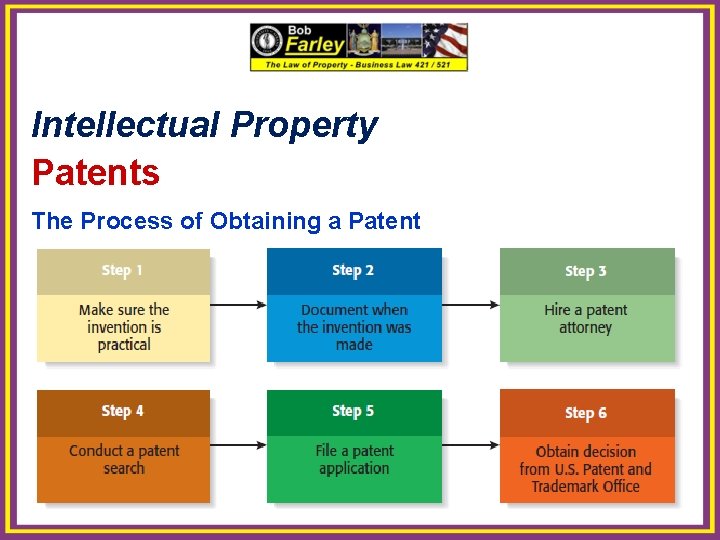
Intellectual Property Patents The Process of Obtaining a Patent 20
Intellectual Property Part Three: Trademarks Enforceable Rights in any word, name, symbol or devise. 21
Intellectual Property Trademarks A trademark is any “word, name, symbol or devise used by a person to identify and distinguish their goods from those sold by others” Requirements: • Distinctiveness • Non-functionality • First use in trade Duration – Good for 10 years with infinite renewals 22
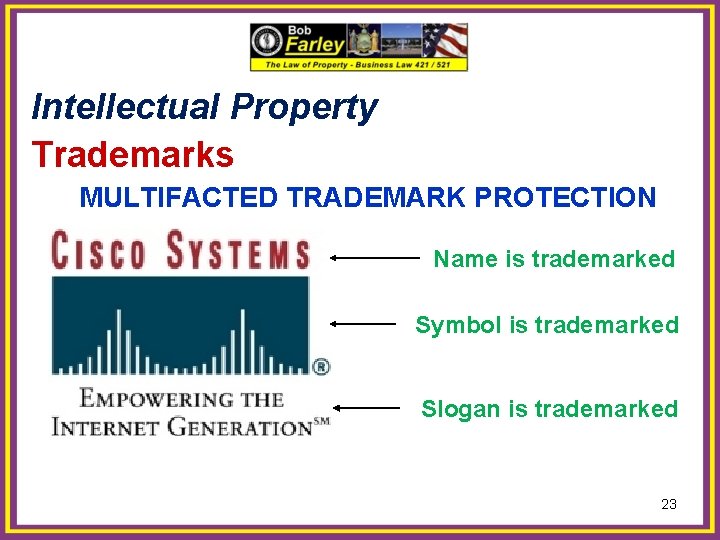
Intellectual Property Trademarks MULTIFACTED TRADEMARK PROTECTION Name is trademarked Symbol is trademarked Slogan is trademarked 23
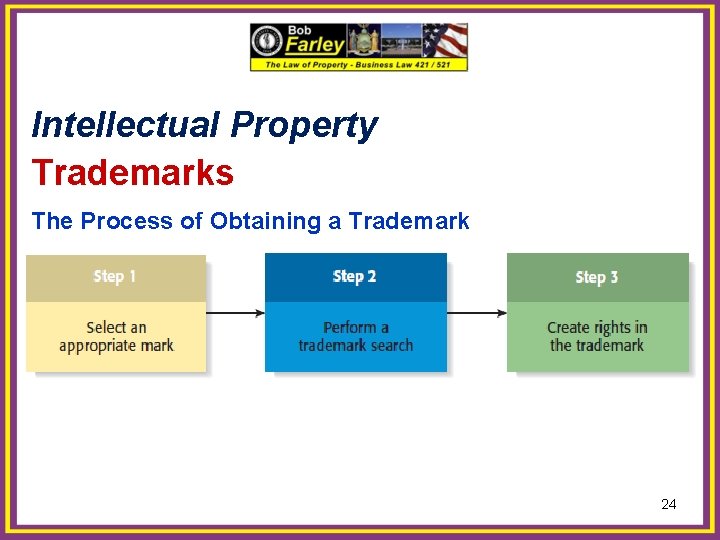
Intellectual Property Trademarks The Process of Obtaining a Trademark 24
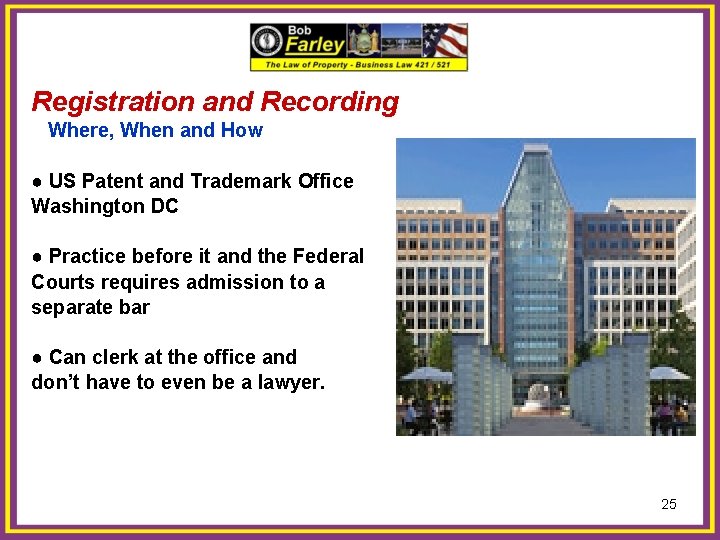
Registration and Recording Where, When and How ● US Patent and Trademark Office Washington DC ● Practice before it and the Federal Courts requires admission to a separate bar ● Can clerk at the office and don’t have to even be a lawyer. 25
Modern Trends The World of Intellectual Property Concerns over China – Reverse Engineering Especially big issues with items uniquely Intellectual – music, software, processes Big players General Electric Disney Motion Picture Companies 26
• Bonus Questions of the Day For next time – Read Assignments on the Website • Questions? ? ? 27