
Slide Set Eight B Corporate Governance Board Powers
Slide Set Eight B: Corporate Governance – Board Powers

Last Time We Spoke About: Securities Regulation • State Regulation Part One: Generally / Jurisdiction / Blue Sky Laws / The Martin Act • Federal Regulation Part Two: Generally / Jurisdiction / Federal Regulatory Statutes • Industry Self Regulation Part Three: Generally / Definitions / Effectiveness • Class Case – SEC v. W. J. Howey Company The Scope of Federal Regulation

Tonight We Will Speak About: Corporate Governance – Boards of Directors • Board Members Part One: Definitions / Roles / Obligations and Duties / Liabilities • Board Member Powers Part Two: Generally / Chairman / Board Members / Committees • Corporate Personhood Part Three: Generally / Fiduciary Responsibilities / Personhood Interests • Class Case – Citizen United v. FEC The Constitutional Rights of Corporations
Part One: Corporate Governance Chair of the Board of Directors – Powers
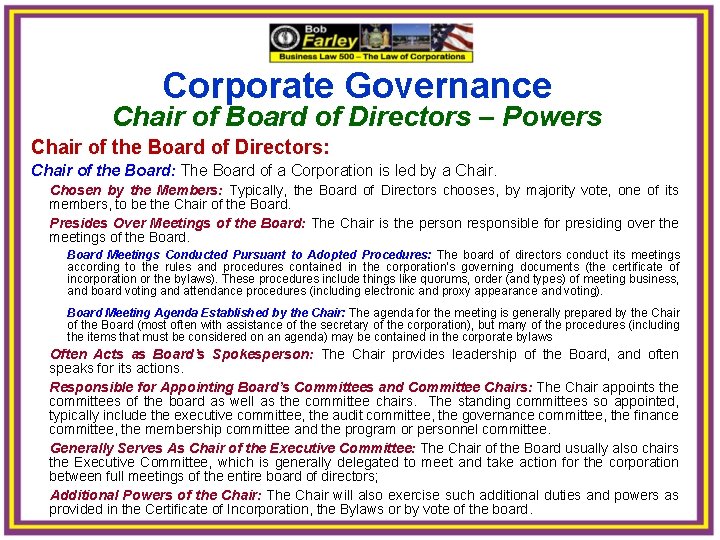
Corporate Governance Chair of Board of Directors – Powers Chair of the Board of Directors: Chair of the Board: The Board of a Corporation is led by a Chair. Chosen by the Members: Typically, the Board of Directors chooses, by majority vote, one of its members, to be the Chair of the Board. Presides Over Meetings of the Board: The Chair is the person responsible for presiding over the meetings of the Board Meetings Conducted Pursuant to Adopted Procedures: The board of directors conduct its meetings according to the rules and procedures contained in the corporation’s governing documents (the certificate of incorporation or the bylaws). These procedures include things like quorums, order (and types) of meeting business, and board voting and attendance procedures (including electronic and proxy appearance and voting). Board Meeting Agenda Established by the Chair: The agenda for the meeting is generally prepared by the Chair of the Board (most often with assistance of the secretary of the corporation), but many of the procedures (including the items that must be considered on an agenda) may be contained in the corporate bylaws Often Acts as Board’s Spokesperson: The Chair provides leadership of the Board, and often speaks for its actions. Responsible for Appointing Board’s Committees and Committee Chairs: The Chair appoints the committees of the board as well as the committee chairs. The standing committees so appointed, typically include the executive committee, the audit committee, the governance committee, the finance committee, the membership committee and the program or personnel committee. Generally Serves As Chair of the Executive Committee: The Chair of the Board usually also chairs the Executive Committee, which is generally delegated to meet and take action for the corporation between full meetings of the entire board of directors; Additional Powers of the Chair: The Chair will also exercise such additional duties and powers as provided in the Certificate of Incorporation, the Bylaws or by vote of the board.

Part Two: Corporate Governance The Board of Directors – What Do they Do?
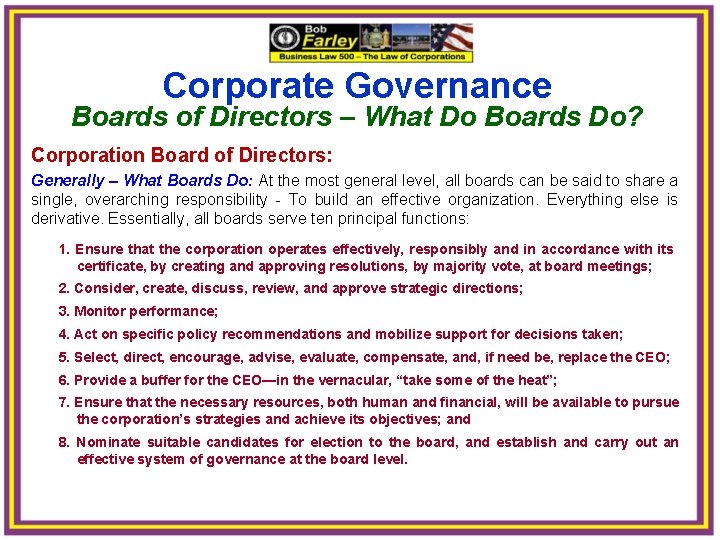
Corporate Governance Boards of Directors – What Do Boards Do? Corporation Board of Directors: Generally – What Boards Do: At the most general level, all boards can be said to share a single, overarching responsibility - To build an effective organization. Everything else is derivative. Essentially, all boards serve ten principal functions: 1. Ensure that the corporation operates effectively, responsibly and in accordance with its certificate, by creating and approving resolutions, by majority vote, at board meetings; 2. Consider, create, discuss, review, and approve strategic directions; 3. Monitor performance; 4. Act on specific policy recommendations and mobilize support for decisions taken; 5. Select, direct, encourage, advise, evaluate, compensate, and, if need be, replace the CEO; 6. Provide a buffer for the CEO—in the vernacular, “take some of the heat”; 7. Ensure that the necessary resources, both human and financial, will be available to pursue the corporation’s strategies and achieve its objectives; and 8. Nominate suitable candidates for election to the board, and establish and carry out an effective system of governance at the board level.

Corporate Governance Boards of Directors – What Do They Do Corporation Board of Directors: Obligations and Duties: A Corporation’s Board of Directors have the following obligations and duties: • • • • Establish Ongoing Goals, Missions and Policies of the Corporation; Hire and Oversee the Corporate Officers; Delegate Duties to Officers, so as to Advance Corporate Policy and Goals; Perform Corporate Planning and Strategy Development for Corporate Advancement; Provide General Management of the Corporate Business, Policy, and Resources; Determine and Monitor the Organization's Products, Services and Programs; Enhance the Corporation's Public Image (so as to improve share value); Assess the Performance of the Corporation and the Board Itself; Avoid Conflicts of Interests and Keep Their Fiduciary Duty to Shareholders; Provide Continuity of the Corporation; Account to Shareholders for the operation and Conduct of Corporate Business; Approving Policy Initiatives and Directives of the Corporation; Approving SEC Filings and Annual Reports; Acting on Mergers, Acquisitions and Dissolutions; Approving Annual Budgets and Ensuring the Availability of Financial Resources; and Establishing Compensation and Benefits for Officers and Employees.

Part Three: Corporate Governance Boards of Directors – Powers

Corporate Governance Boards of Directors – Defined Role Corporation Board of Directors: Defined Powers and Role: Pursuant to Article 7 of the Business Corporation Law, establishes the powers and role of a Corporations Board of Directors as follows: Operates By Means of Resolutions: The principal power of a corporation’s board of directors is to operate as the Corporation’s governing body, by considering, debating and enacting resolutions, at board meetings, to establish the policies and directive of the Corporation. Meets Regularly to Govern the Corporation: The Members of a corporation’s board of directors are the elected representatives of the shareholders, and as such, they meet regularly to govern the corporation by means of the passing of resolutions. Provide Oversight for, and Make Policy of, the Corporation: The members of a corporation’s board of directors provide general oversight and make policy of the corporation (similar to that of political system’s republican, representative government) so as to serve as the governance power of the corporation. All policy decisions are thus under the dominion and control of the board of directors, and are effectuated by means of a majority vote on resolutions. Board Meetings: The board of directors conduct its meetings according to the rules and procedures contained in the corporation’s governing documents (the certificate of incorporation or the bylaws). The agenda for the meeting is generally prepared by the Chair of the Board (most often with assistance of the secretary of the corporation), but many of the procedures (including the items that must be considered on an agenda) may be contained in the corporate bylaws. These procedures include things like quorums, order (and types) of meeting business, and board voting and attendance procedures (including electronic and proxy appearance and voting). Vote of the Board: Resolutions of the board of directors are enacted by a majority vote. The Chair of the Board is the person responsible for presiding over the meetings of the board of directors, and announces the votes of the board and the passage of resolutions. Each board member is entitled to cast one vote.

Part Four: Corporate Governance Boards of Directors – Committees
Corporate Governance Boards of Directors – Role Corporation Board of Directors: Committees: The members of the board of directors are often asked to serve on committees. Standing Committees and Ad Hoc Committees: Committees can be standing committees, used on a regular and continuing basis by the board and set forth in the certificate of incorporation or the corporate bylaws, or they can be ad hoc committees, created on a singular basis by vote of the board. Chairs and Members: Each committee will have a chair and members, usually all appointed by the chair of the entire board of directors. Committee chairs and members usually have an expertise in the subject matter of the committee. Purpose of the Committee: The purpose of the Committees is to advise the full board of directors, and make recommendations on issues within the Committee’s oversight. Committees will issue and vote on reports and recommendations, prior to advising and reporting to the full board. Standing committees often include: • The Executive Committee: Usually chaired by the chair of the entire board, which is generally delegated to • • • meet and take action for the corporation between full meetings of the entire board of directors; Audit Committee: This committee is tasked with selecting the outside auditor of the corporation, meets with the auditor to receive the audit report and management letter, reports to the full board of directors on the annual audit and the management letter, and often is charged with auditing the expenses of the board and the chief executive officer; The Governance Committee: This committee is charged with the care and feeding of the board itself, and its responsibilities generally include board recruitment, orientation, board and director self-assessment, continuing education, and board management; Finance Committee: Sometimes called a Budget Committee or a Budget and Finance Committee, this committee oversees staff’s preparation of the corporation’s annual budget and the performance of the corporation in meeting its budgeted revenues and expenses; Membership Committee: This committee is most often tasked with developing criteria for membership, credentialing members, overseeing elections, or developing and delivering programs for members; and Program or Personnel Committee: This committee also sometimes known as the planning committee, often considers programs and development plans of the corporation, personnel issues and policies, and future corporate goals and policies.

End of Class Eight B • For next time – Review Assignments as follows on the Webpage: • Lecture Slides • Selected Readings • Cases and Exercises • We are a hot bench. • Questions?
- Slides: 13