
Slide Set 05 C Introduction to Business Organizations
Slide Set 05 C: Introduction to Business Organizations Franchises
Last Time We Spoke About: • The Law of Business Organizations Part One: Principles of Business Organization The Nature of Business Organizations • The Nature of Agency Part Two: Definitions /Elements of Agency /Examples of Agency Contracts Between Agents and Principals The Purpose of Agency / Creating the Agency Relationship Termination of Agencies and Duties and Liabilities • Agency and Employment Part Three: Definitions / Employment Law / Collective Bargaining Equal Opportunity / Civil and Human Rights • Class Case – Maurillo v. Park Slope U-Haul Recognition of Contractual Elements
Tonight – We Will Speak About: • The Forms of Business Organizations Part One: The Different Types of Business Organizations Sole Proprietorships / Definitions / Formation / Operations Advantages / Disadvantages / Doing Business As / Termination • Partnerships Part Two: Nature of Partnerships / Definitions / Formation Partnership Property / Relations Between Partners and Third Parties Dissolution / Termination of Partnerships • Franchises Part Three: Definitions / Characteristics / Examples • Class Case – Congel v. Malfitano Applying the Law of Partnerships
The Nature of Franchises • • Definitions Formation Operations Advantages Disadvantages Doing Business As Termination / Dissolution
Forms of Business Organizations Franchise - Definition Anderson’s Business Law, defines a “Franchise” as: “A method of doing business, not a form of business organization. A franchise can be operated as a sole proprietorship, a partnership, a limited liability company, or a corporation. The franchise agreement is a contract that sets forth the rights and obligations of the parties. Contract law governs questions that arise under the franchise agreement. ” The Federal Trade Commission (FTC) defines a franchise under federal law, to be a commercial business arrangement that satisfies three definitional elements, where the franchisor must: (1) Promise to provide a trademark or other commercial symbol; (2) Promise to exercise significant control or provide significant assistance in the operation of the business; and (3) Require a minimum payment of at least $540 during the first six months of operations. ”
Forms of Business Organizations Franchise - Meaning What is a Franchise: A Franchise is: • a contractual agreement, • whereby the owner of a trademark, trade name, or copyright, • licenses others to use the trademark or copyright to sell goods or services, • in a uniform, consistent manner, or • with a similar process or product line. Liability of Franchises • A franchisor is not liable to third persons dealing with its franchisees. • Liability of the franchisor may, however, be imposed on the ground of the apparent authority of the franchisee or the contract control by the franchisor. • Liability of the franchisor may also arise in cases of product liability.
Forms of Business Organizations Famous Franchises: • Some Famous Franchises include: Ø Fast Food Restaurants, such as Mc. Donalds, Wendy’s, KFC, and Subway, ect Ø Car Dealerships such as Ford, Chevrolet, Toyota, Volkswagen, and Dodge, ect Ø Hotels, such as Hampton Inn, Comfort Inn, Hilton, Fairfield Inn and Motel 6, ect Ø Gasoline Dealers, such as Mobil, Speedway SUNOCO, Gulf, and Chevron, ect Ø Fitness Centers, such as Planet Fitness, Gold’s Gym, and Curves, ect 7
Forms of Business Organizations Franchises – Special Issues: • Special Issues for Franchises: Ø Special Protections under Federal and State Laws. v Automobile Dealer’s Day in Court Act. v Petroleum Marketing Practices Act. v Zone Pricing Acts for Gasoline v These statutes provide covered franchisees with protection from bad-faith terminations and unfair trade practices Ø Disclosure Issues, and Ø Vicarious Liability Claims Against Franchisors.
Forms of Business Organizations Franchises – General Principles: • Franchises are licensing agreements under intellectual property laws that allow businesses to operate in a standardized, uniform manner. • These businesses are individually and privately owned, but conform to the uniform standards due to the franchise agreement. • Such agreements allows for standardization of products and processes so as to build brand uniformity and satisfy customer expectation. • Famous franchises include businesses such as Subway, Mc. Donalds, and Exxon-Mobil Gas Stations • Franchises do not include big companies like GE, Walmart, Microsoft or wholly owned private companies like Price Chopper, Koch Industries and Dell Computers.
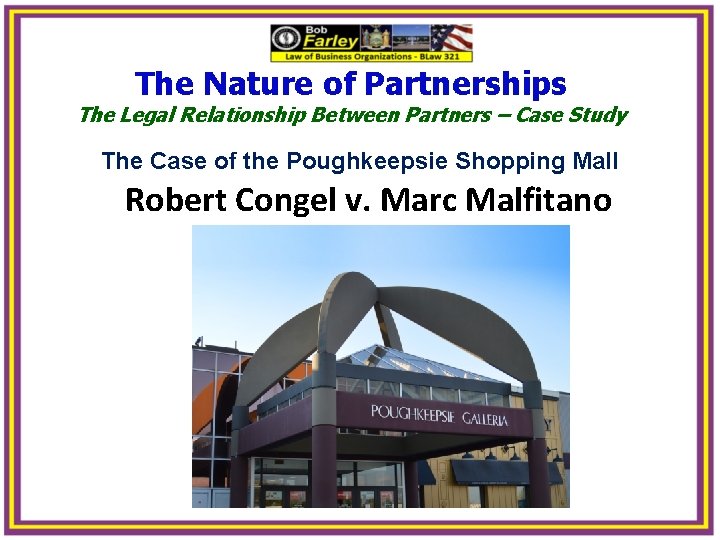
The Nature of Partnerships The Legal Relationship Between Partners – Case Study The Case of the Poughkeepsie Shopping Mall Robert Congel v. Marc Malfitano
Thank you for Your Attention • For next time – Review Assignments as follows on the Webpage: • Lectures, Slides and Cases • Selected Readings • Weekly Information Sheets • We are a hot bench. • Questions?
- Slides: 11