
Slide 9 1 Chapter 2 Culture and Corporate

- Slides: 16
Slide 9. 1 Chapter 2 Culture and Corporate Strategy Browaeys & Price, Understanding Cross-Cultural Management, 2 nd Edition © Pearson Education Limited 2011
Slide 9. 2 This chapter focuses on • Cultural view of strategy – the relationship between culture and strategy – the way national culture influences a company’s strategy. • Strategic alliances and business cultures – the question of culture in merger and acquisition strategies and for all kinds of co-operation. Browaeys & Price, Understanding Cross-Cultural Management, 2 nd Edition © Pearson Education Limited 2011
Slide 9. 3 Strategy and Corporate Culture • The relationship between company culture and strategy: – Is strategy a product of culture? – Is culture a product of strategy? • The definition of culture from Schneider & Barsoux (2003) could also be used as a definition of strategy: – a solution to the problems of external adaptation and internal integration. Browaeys & Price, Understanding Cross-Cultural Management, 2 nd Edition © Pearson Education Limited 2011
Slide 9. 4 Cultural Models of Strategy Strategic management: (Schneider and Barsoux, 2003): Two main types according to their behaviours, values and assumptions: • Controlling model – quantitative and objective information about the environment of the company. • Adapting model – qualitative and subjective information from personal sources and colleagues. Browaeys & Price, Understanding Cross-Cultural Management, 2 nd Edition © Pearson Education Limited 2011
Slide 9. 5 Cultural Factors of Strategy In what way is the formulation of strategy affected by cultural differences? (Fatehi, 1996): • Relationship with the environment – Mental framework of two types of persons: • ‘engineering-oriented’ • ‘symbiotic-oriented’. • Relationship among people – Interpersonal relationships within a company: • Differences among employees towards a company’s strategy (between US and Japan). Browaeys & Price, Understanding Cross-Cultural Management, 2 nd Edition © Pearson Education Limited 2011
Slide 9. 6 National Culture and Strategy In what way can national culture affect strategy? • Leadership and decision-making – the choice of strategy – the way it is realized. • Impact of national structure on strategy – sector of products and services. • Multinational and its local subsidiaries – culture differences in foreign markets. Browaeys & Price, Understanding Cross-Cultural Management, 2 nd Edition © Pearson Education Limited 2011
Slide 9. 7 Multinational Strategic Decisions • Implementation of the corporate strategy (Bartlett et al. , 2003): • Importance of the country manager because he/she: – defends the company’s market decisions – satisfies the demands of the local subsidiary – assumes the role of ‘cultural interpreter’: • gives information about the national situation • understands the corporate goals and values. Browaeys & Price, Understanding Cross-Cultural Management, 2 nd Edition © Pearson Education Limited 2011
Slide 9. 8 International Managers and Strategy • Global assignments can be very important strategically for the company. • The international manager has to – gain insight into the attitudes of those involved in a cross-cultural situation – modify his/her management strategy. • This means: – not having the same strategy whatever the circumstances – applying skills in one context to another. Browaeys & Price, Understanding Cross-Cultural Management, 2 nd Edition © Pearson Education Limited 2011
Slide 9. 9 Developing Strategies for the Global Market • • • Advantages of strategic alliances Area where the most serious cultural problems may arise -> merger or takeover Merger process has three levels: – strategic, organizational, human On the strategic level, four merger strategies: – assimilation, deculturalization, separation, integration Compatibility between cultures from: – two national companies – companies from different countries. Browaeys & Price, Understanding Cross-Cultural Management, 2 nd Edition © Pearson Education Limited 2011
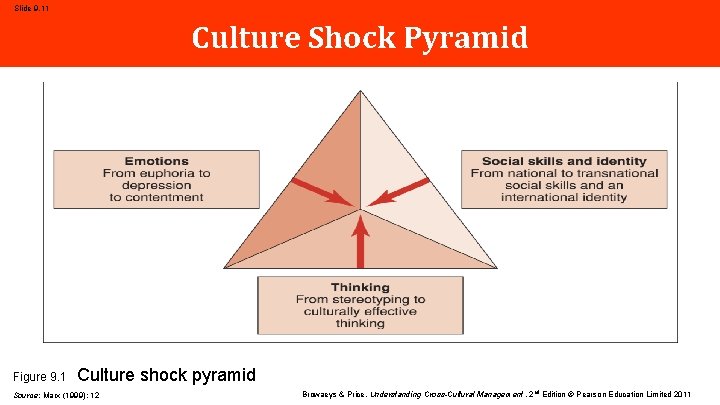
Slide 9. 10 Culture Shock • Culture shock refers to unpleasant experiences with other cultures. • International managers experience culture shock at three levels: – Emotions – Thinking – Social skills and identity. • Culture shock phase is an integral part of the adaptation phase (Marx, 1999). • The Marx’s model (1999) is adapted from an anthropologist (Oberg, 1960). See the next slide. Browaeys & Price, Understanding Cross-Cultural Management, 2 nd Edition © Pearson Education Limited 2011
Slide 9. 11 Culture Shock Pyramid Figure 9. 1 Culture shock pyramid Source: Marx (1999): 12 Browaeys & Price, Understanding Cross-Cultural Management, 2 nd Edition © Pearson Education Limited 2011
Slide 9. 12 International Company Strategy • Kinds of co-operation: from mergers and takeovers to joint ventures, alliances and partnerships • A merger of two companies – presupposes a change of ‘culture’ in the new organization • From different countries: – increasing complexity of exchanges of interaction between cultures – rising other organizational problems due to inevitable change of culture(s) involved. Browaeys & Price, Understanding Cross-Cultural Management, 2 nd Edition © Pearson Education Limited 2011
Slide 9. 13 Strategic or Cultural Issue? • Mergers and acquisitions: • What are the reasons compelling companies to seek an alliance? – purely economic (according to the protagonists). • What role does the cultural element play? – cultural factors come to the fore when M&As do not meet strategic expectations. • However, culture may not be explicitly referred to. See example on the next slide. Browaeys & Price, Understanding Cross-Cultural Management, 2 nd Edition © Pearson Education Limited 2011
Slide 9. 14 Corus (British–Dutch Steel Company) “The board of directors of the British–Dutch steel company Corus has to offer, at short notice, positions to Dutch directors. This was stated by the Russian steel baron Alisher Usmavov (a shareholder in Corus, who has a 12% interest in the company) in an interview with the Dutch financial newspaper FD. ” Browaeys & Price, Understanding Cross-Cultural Management, 2 nd Edition © Pearson Education Limited 2011
Slide 9. 15 Mergers and Takeovers Across Borders • Cultural element in companies is to be found everywhere (Thévenet, 1999) • Attention to culture is all the greater when a company is operating across borders • Cultural problems are not solely to do with differences in national culture (Sony/Philips alliance) • The differences in the local cultures are often underestimated: – in many cases, there are cultural confrontations that provoke resistance to any changes. Browaeys & Price, Understanding Cross-Cultural Management, 2 nd Edition © Pearson Education Limited 2011
Slide 9. 16 Conclusion to Chapter 2 • • • National culture influences a company’s strategy. Organizational culture is a part of the strategy. The process of strategy development lies at the same levels as in culture. Not only does the organizational culture change but also the company’s strategy. Difficulties with all kinds of co-operation on the cultural front, particularly in cross-border M&As. Browaeys & Price, Understanding Cross-Cultural Management, 2 nd Edition © Pearson Education Limited 2011