
Slide 8 1 Research and Development Paul Trott


- Slides: 43
Slide 8. 1 Research and Development Paul Trott, Innovation Management and New Product Development, 4 th Edition, © Pearson Education Limited 2008
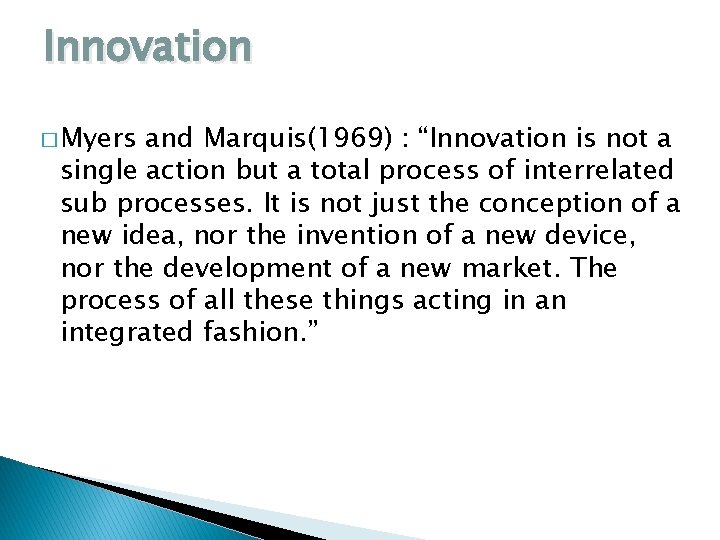
Innovation � Myers and Marquis(1969) : “Innovation is not a single action but a total process of interrelated sub processes. It is not just the conception of a new idea, nor the invention of a new device, nor the development of a new market. The process of all these things acting in an integrated fashion. ”
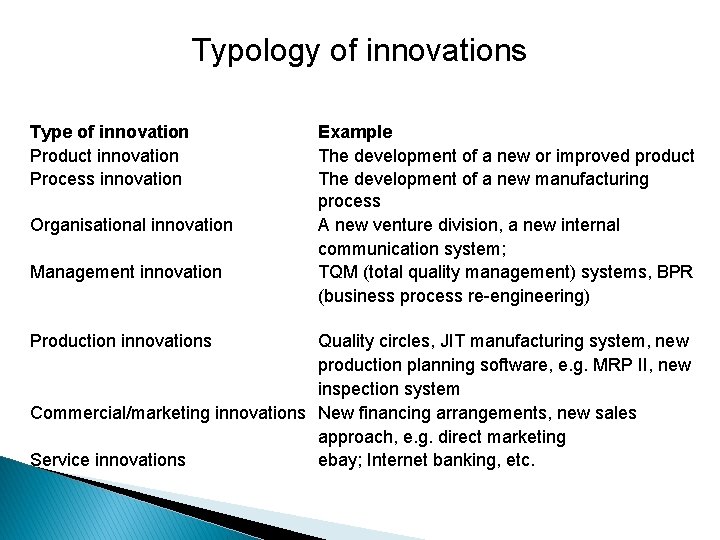
Typology of innovations Type of innovation Product innovation Process innovation Organisational innovation Management innovation Production innovations Example The development of a new or improved product The development of a new manufacturing process A new venture division, a new internal communication system; TQM (total quality management) systems, BPR (business process re-engineering) Quality circles, JIT manufacturing system, new production planning software, e. g. MRP II, new inspection system Commercial/marketing innovations New financing arrangements, new sales approach, e. g. direct marketing Service innovations ebay; Internet banking, etc.
Slide 8. 6 What is R&D? “R&D is the purposeful and systematic use of scientific knowledge to improve man’s lot even though some of its manifestations do not meet with universal approval. ” (Twiss, 1992) “To develop new knowledge and apply scientific or engineering knowledge to connect the knowledge in one field to that in others. ” (Roussel et al. , 1991) Paul Trott, Innovation Management and New Product Development, 4 th Edition, © Pearson Education Limited 2008
Slide 8. 8 R&D in Business Competition has made R&D important Consumers trends, needs, demands No guarantees that higher spending on R&D will lead to: Higher profits greater market share more creativity better products and services Paul Trott, Innovation Management and New Product Development, 4 th Edition, © Pearson Education Limited 2008
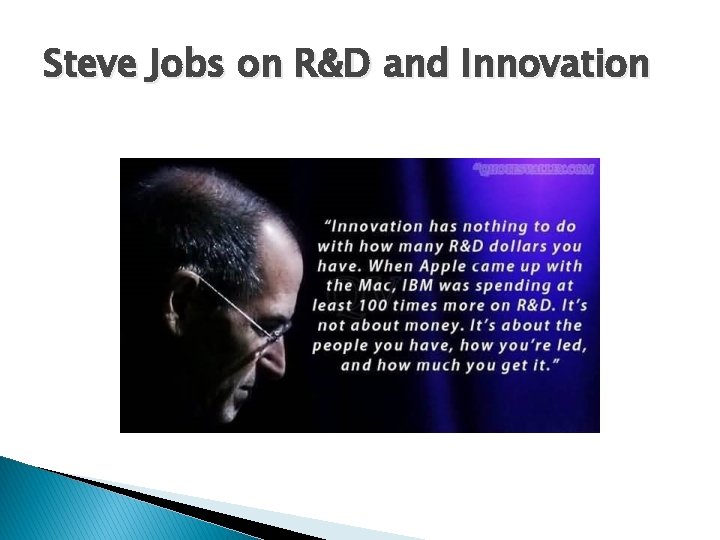
Steve Jobs on R&D and Innovation
Slide 8. 9 R&D in Business Investigative activities that a business makes deliberately. Intention is generally strategic (future growth) Aim is to make a discovery that can either lead to the development: new products or procedures, or to improvement of existing products or procedures. Paul Trott, Innovation Management and New Product Development, 4 th Edition, © Pearson Education Limited 2008
Slide 8. 14 Why is R&D important? Crucial to survival Fast changing environment Continuous technology change Changing consumer preferences Gain intellectual property rights Improve brand image Unique products Long term income Product differentiation Efficient production processes Paul Trott, Innovation Management and New Product Development, 4 th Edition, © Pearson Education Limited 2008
Slide 8. 15 Who are the Key Players? Companies Governments Universities Paul Trott, Innovation Management and New Product Development, 4 th Edition, © Pearson Education Limited 2008
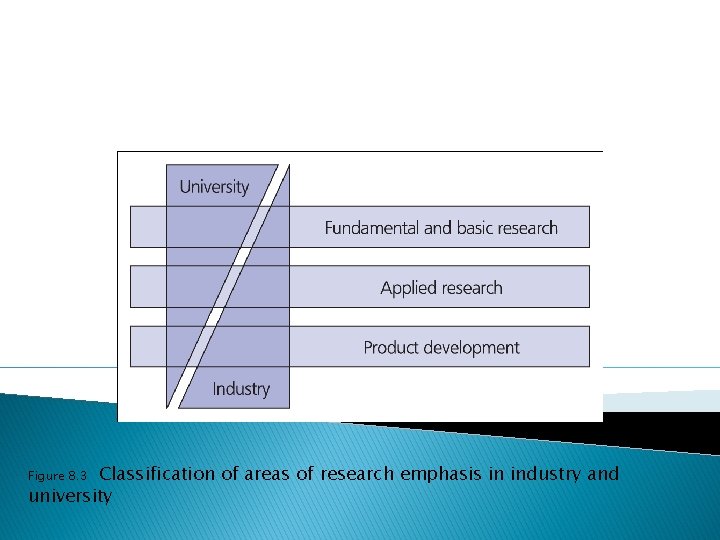
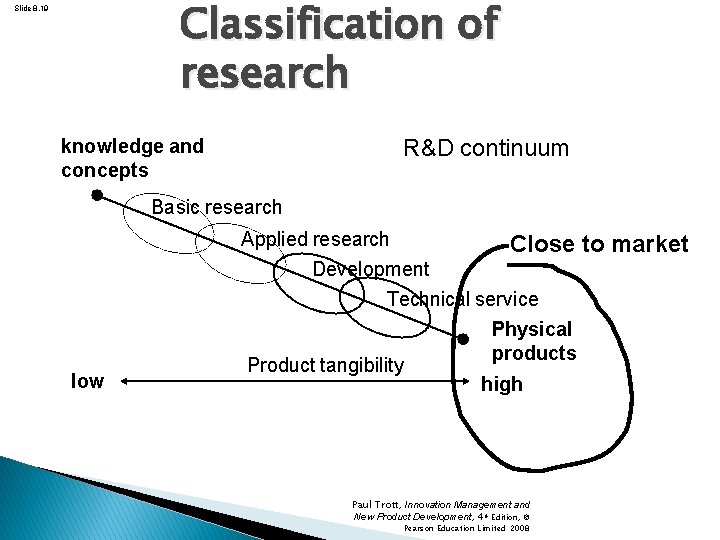
Classification of areas of research emphasis in industry and university Figure 8. 3
Slide 8. 16 R&D in Industry More about application of science to produce new products R&D is a continuous process, difficult to define start and end times Measure outcomes in terms of new products Large proportion of R&D in industry is technology based The diversity of technology means no one firm can gain expertise in all areas. So there is greater reliance on alliances Paul Trott, Innovation Management and New Product Development, 4 th Edition, © Pearson Education Limited 2008
University vs Industry research Slide 8. 18 Universities provide the fundamental and basic research, which tends to be more general Universities concentrate on pursuit of knowledge Industry research focuses more on: product development new technologies understanding of technologies in existing products technologies in manufacturing application of knowledge for commercial purpose Paul Trott, Innovation Management and New Product Development, 4 th Edition, © Pearson Education Limited 2008
Slide 8. 17 Traditional R&D After the Second world war, R&D played an important role in gaining competitive advantage Technical developments in industries such as chemical, electronics, auto, pharmaceuticals, was responsible for economic growth of nations The traditional view has been one of overcoming genuine technological problems, which subsequently lead to business opportunities and a competitive advantage over one’s competitors. Paul Trott, Innovation Management and New Product Development, 4 th Edition, © Pearson Education Limited 2008
R&D was seen as a staged process: moving from research to engineering to manufacture to market Viewed as a linear process It was regarded as an overhead item. Large investments in R&D such as the space race, resulted in many products and fuelled economic growth
Classification of research Slide 8. 19 R&D continuum knowledge and concepts Basic research Applied research Close to market Development Technical service low Product tangibility Physical products high Paul Trott, Innovation Management and New Product Development, 4 th Edition, © Pearson Education Limited 2008
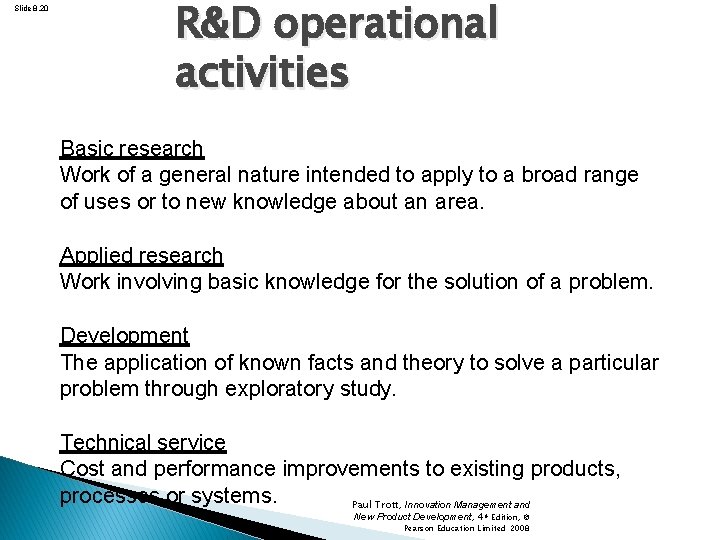
Slide 8. 20 R&D operational activities Basic research Work of a general nature intended to apply to a broad range of uses or to new knowledge about an area. Applied research Work involving basic knowledge for the solution of a problem. Development The application of known facts and theory to solve a particular problem through exploratory study. Technical service Cost and performance improvements to existing products, processes or systems. Paul Trott, Innovation Management and New Product Development, 4 th Edition, © Pearson Education Limited 2008
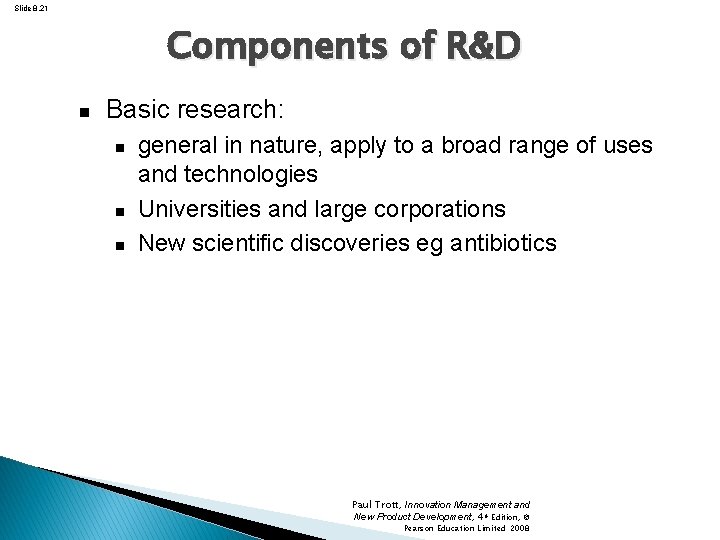
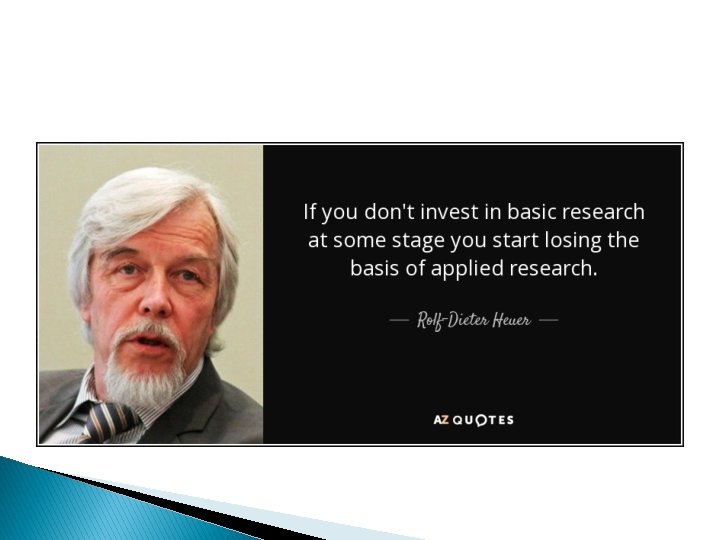
Slide 8. 21 Components of R&D Basic research: general in nature, apply to a broad range of uses and technologies Universities and large corporations New scientific discoveries eg antibiotics Paul Trott, Innovation Management and New Product Development, 4 th Edition, © Pearson Education Limited 2008
Components of R&D (cont. . ) Applied research: Apply existing principles to find new solutions, application of science Moving basic research towards new products eg Dyson vacuum cleaner
Slide 8. 22 Components of R&D (cont. . ) Development: Focuses on products and commercialising these Several prototypes may be developed Design improvements occur Trials, modifications and improvements occur Paul Trott, Innovation Management and New Product Development, 4 th Edition, © Pearson Education Limited 2008
Components of R&D (cont. . ) Technical service: Service support systems around existing products and processes Cost and performance improvements Modifications to specifications to improve costs Marketing considerations
Slide 8. 23 Business strategy A parallel support infrastructure required to ensure business success Need to Match R&D to market realities and opportunities Study and forecast state of the operating environment Capacity to adjust to changes eg climate change Risk analysis Capability analysis Paul Trott, Innovation Management and New Product Development, 4 th Edition, © Pearson Education Limited 2008
Integrating R&D to overall business strategy Slide 8. 24 R&D should not be independent of business strategy R&D is part of the business support infrastructure AIMS: Provide support of existing businesses by keeping them competitive and supporting efficiencies Drive new businesses and opportunities eg 3 M’s discovery of temporary adhesive led to creation of Post-it notes. Broaden and deepen technological capability for long-term benefits Paul Trott, Innovation Management and New Product Development, 4 th Edition, © Pearson Education Limited 2008
R&D Management and its link with business strategy � Planning strategy is as much an art as science. � The planning process would include: ◦ Environmental forecasts �Who will be our competitors in five to ten years? �What technologies do we need to understand to avoid surprises? �What will be the new competitive technologies and businesses?
R&D Management and its link with business strategy (cont…) � Comparative technological cost effectiveness � technologies have life cycles and after a period further research produces negligible benefit. �At this stage a new branch of technology is likely to offer far more promising efforts. RISK �The culture of the org and its attitude will influence risk taking aspects of an organisation. �Usually risk is spread over a portfolio of projects �Risk cannot be eliminated but can be reduced through a process of rational analysis.
R&D Management and its link with business strategy (cont…) � Capability analysis ◦ Companies have to consider their own strengths and weaknesses. ◦ This helps them to ensure that they have the necessary capabilities for the future.
Integration of R&D � R&D needs to be fully integrated with the strategic management process of the business. � European Industrial Research Management Association (EIRMA, 1985) recognise three distinct areas of R&D , each requiring investment. �Defend , support and expand existing businesses. �Drive new businesses. �Broaden and deepen technological capability.
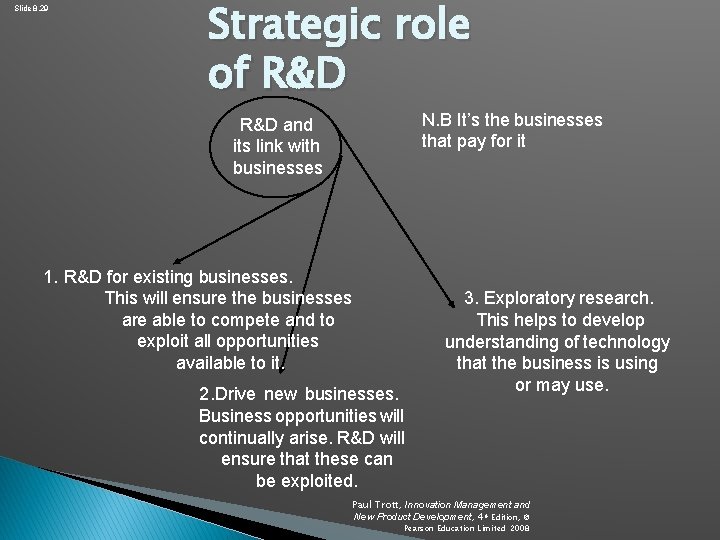
Slide 8. 29 Strategic role of R&D N. B It’s the businesses that pay for it R&D and its link with businesses 1. R&D for existing businesses. This will ensure the businesses are able to compete and to exploit all opportunities available to it. 2. Drive new businesses. Business opportunities will continually arise. R&D will ensure that these can be exploited. 3. Exploratory research. This helps to develop understanding of technology that the business is using or may use. Paul Trott, Innovation Management and New Product Development, 4 th Edition, © Pearson Education Limited 2008
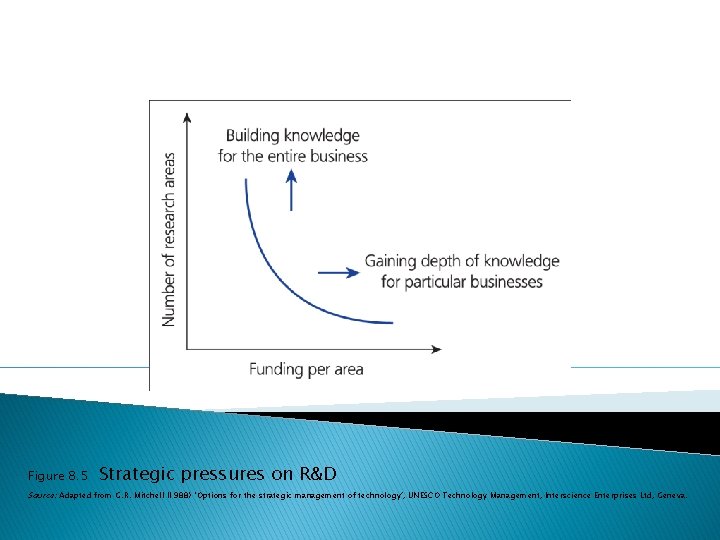
Strategic pressures on R&D
Figure 8. 5 Strategic pressures on R&D Source: Adapted from G. R. Mitchell (1988) ‘Options for the strategic management of technology’, UNESCO Technology Management, Interscience Enterprises Ltd, Geneva.
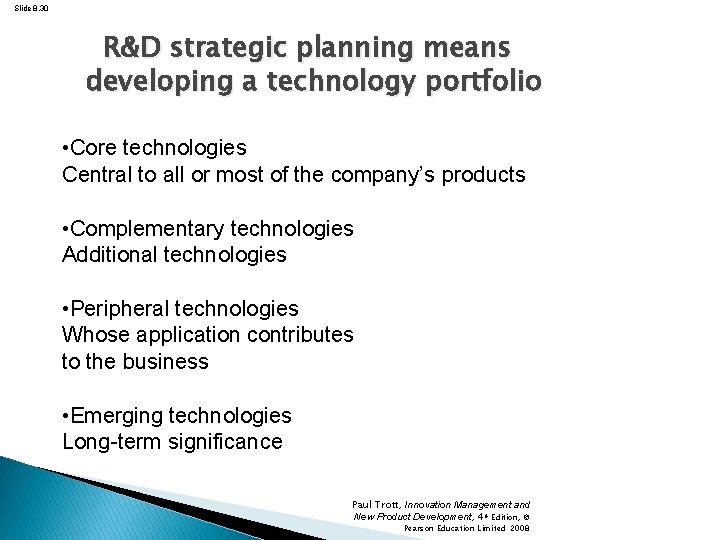
Slide 8. 30 R&D strategic planning means developing a technology portfolio • Core technologies Central to all or most of the company’s products • Complementary technologies Additional technologies • Peripheral technologies Whose application contributes to the business • Emerging technologies Long-term significance Paul Trott, Innovation Management and New Product Development, 4 th Edition, © Pearson Education Limited 2008
WHICH BUISNESS TO SUPPORT AND HOW? � What might the company do? � What can the company do? � What should the company do?
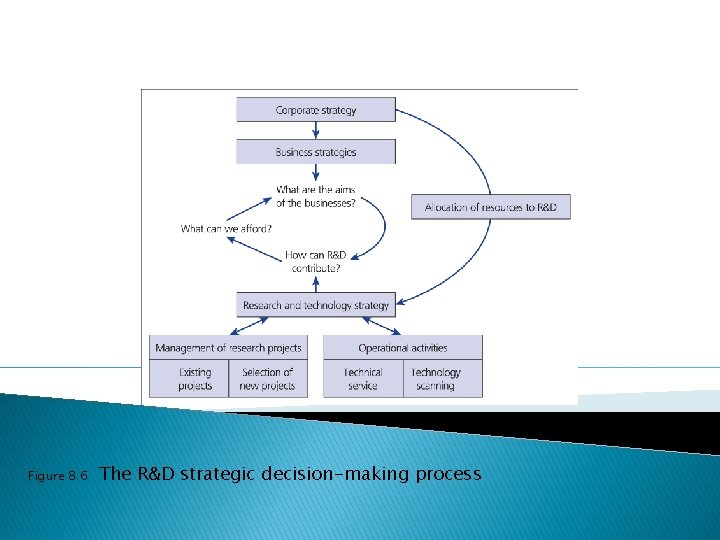
Figure 8. 6 The R&D strategic decision-making process
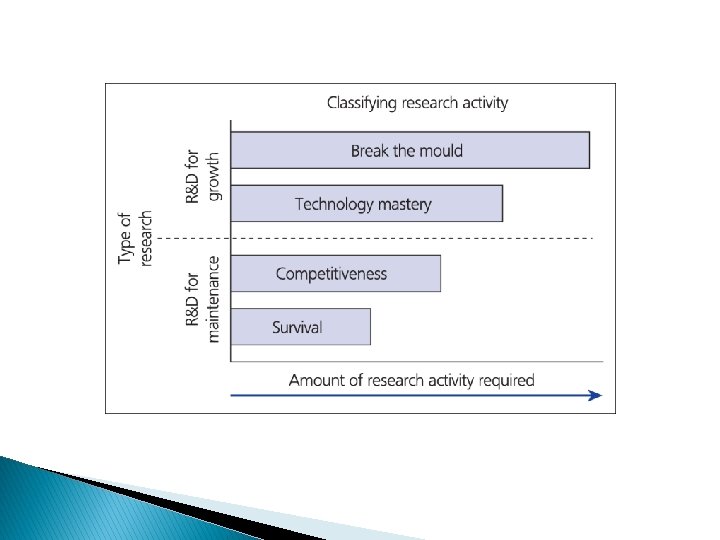
Technology leverage and R&D strategies. � Survival � Competitive � Technology mastery � Break the mould
Allocation of funds to R&D � R&D cannot be managed on an annual budgetary basis � A difficult balancing act � Depends on culture of the organisation
Setting the R&D budget � Key ◦ ◦ factors to be considered : Expenditure by competitors Company’s long term growth objectives The need for stability Distortions introduced by large projects.
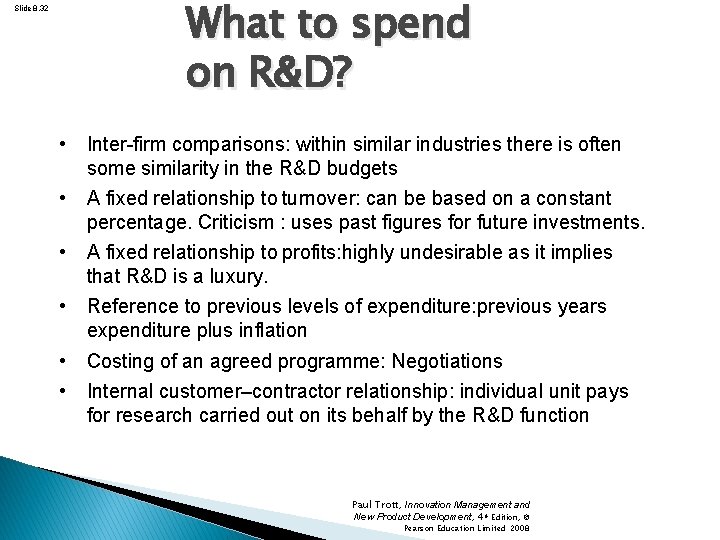
What to spend on R&D? Slide 8. 32 • Inter-firm comparisons: within similar industries there is often some similarity in the R&D budgets • A fixed relationship to turnover: can be based on a constant percentage. Criticism : uses past figures for future investments. • A fixed relationship to profits: highly undesirable as it implies that R&D is a luxury. • Reference to previous levels of expenditure: previous years expenditure plus inflation • • Costing of an agreed programme: Negotiations Internal customer–contractor relationship: individual unit pays for research carried out on its behalf by the R&D function Paul Trott, Innovation Management and New Product Development, 4 th Edition, © Pearson Education Limited 2008