
Slide 7 1 Understanding Sampling Lecture 12 th

- Slides: 18
Slide 7. 1 Understanding Sampling Lecture 12 th Saunders, Lewis and Thornhill, Research Methods for Business Students , 5 th Edition, © Mark Saunders, Philip Lewis and Adrian Thornhill 2009
Slide 7. 2 Why to do sampling? • What is Census? • What is sampling? • Sampling is a valid to a census because; • Entire population survey might be impracticable. • Budget and time constraints restrict data collection. • Need results from data collection quickly. Saunders, Lewis and Thornhill, Research Methods for Business Students , 5 th Edition, © Mark Saunders, Philip Lewis and Adrian Thornhill 2009
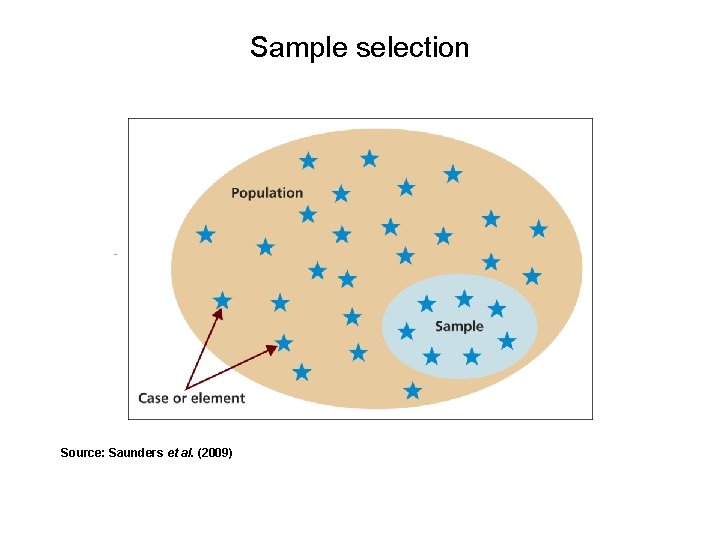
Slide 7. 3 Sample selection Source: Saunders et al. (2009) Figure 7. 1 Population, sample and individual cases Saunders, Lewis and Thornhill, Research Methods for Business Students , 5 th Edition, © Mark Saunders, Philip Lewis and Adrian Thornhill 2009
Slide 7. 4 What is sampling frame ? • The sampling frame for any probability sample is a complete list of all the cases in the population from which your sample will be drawn. Saunders, Lewis and Thornhill, Research Methods for Business Students , 5 th Edition, © Mark Saunders, Philip Lewis and Adrian Thornhill 2009
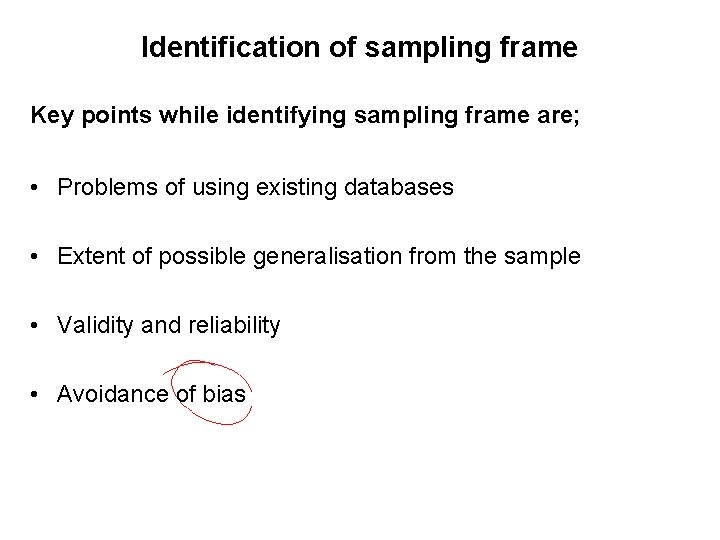
Slide 7. 5 Identification of sampling frame Key points while identifying sampling frame are; • Problems of using existing databases • Extent of possible generalisation from the sample • Validity and reliability • Avoidance of bias Saunders, Lewis and Thornhill, Research Methods for Business Students , 5 th Edition, © Mark Saunders, Philip Lewis and Adrian Thornhill 2009
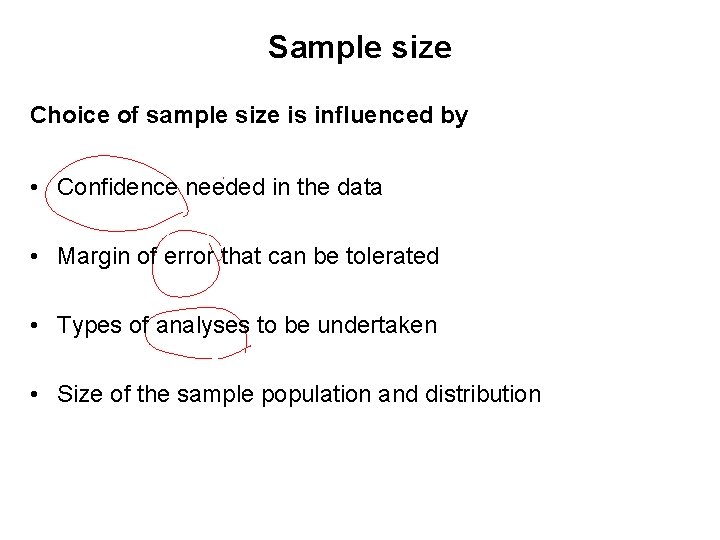
Slide 7. 6 Sample size Choice of sample size is influenced by • Confidence needed in the data • Margin of error that can be tolerated • Types of analyses to be undertaken • Size of the sample population and distribution Saunders, Lewis and Thornhill, Research Methods for Business Students , 5 th Edition, © Mark Saunders, Philip Lewis and Adrian Thornhill 2009
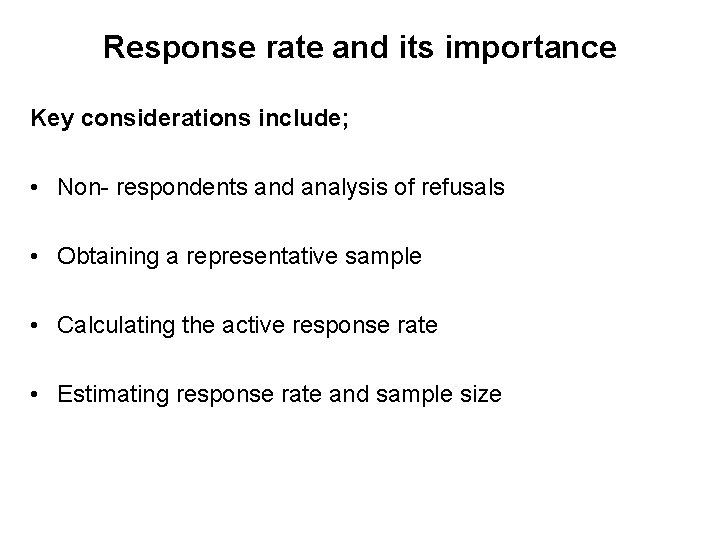
Slide 7. 7 Response rate and its importance Key considerations include; • Non- respondents and analysis of refusals • Obtaining a representative sample • Calculating the active response rate • Estimating response rate and sample size Saunders, Lewis and Thornhill, Research Methods for Business Students , 5 th Edition, © Mark Saunders, Philip Lewis and Adrian Thornhill 2009
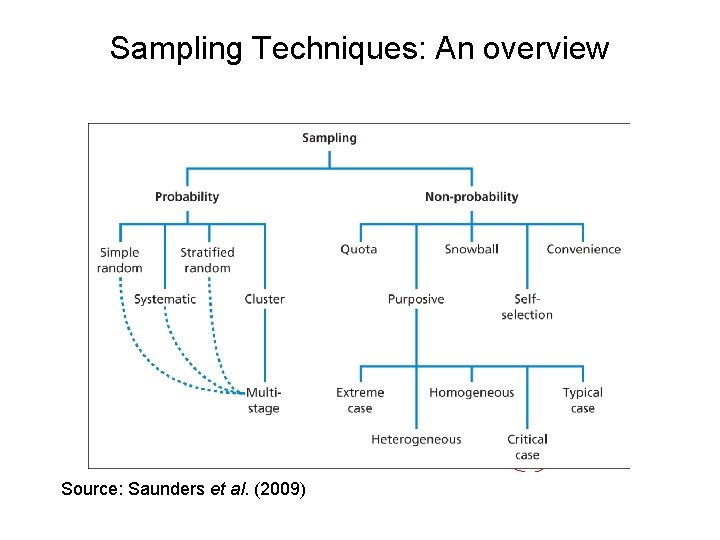
Slide 7. 8 Sampling Techniques: An overview Source: Saunders et al. (2009) Saunders, Lewis and Thornhill, Research Methods for Business Students , 5 th Edition, © Mark Saunders, Philip Lewis and Adrian Thornhill 2009
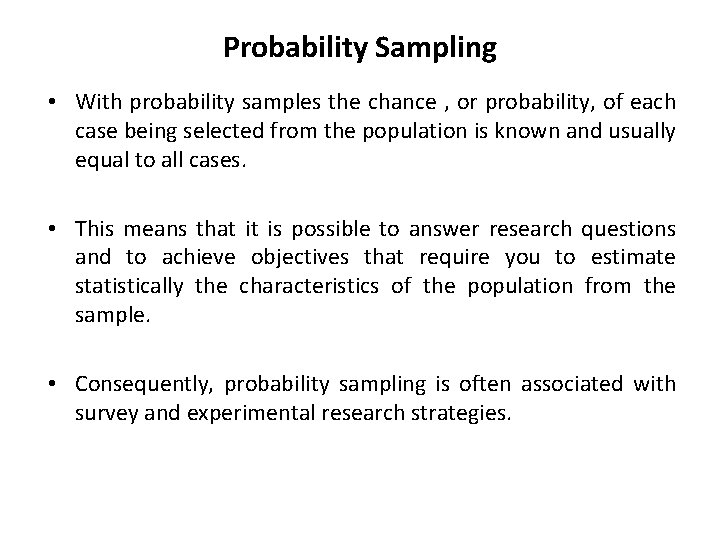
Slide 7. 9 Probability Sampling • With probability samples the chance , or probability, of each case being selected from the population is known and usually equal to all cases. • This means that it is possible to answer research questions and to achieve objectives that require you to estimate statistically the characteristics of the population from the sample. • Consequently, probability sampling is often associated with survey and experimental research strategies. Saunders, Lewis and Thornhill, Research Methods for Business Students , 5 th Edition, © Mark Saunders, Philip Lewis and Adrian Thornhill 2009
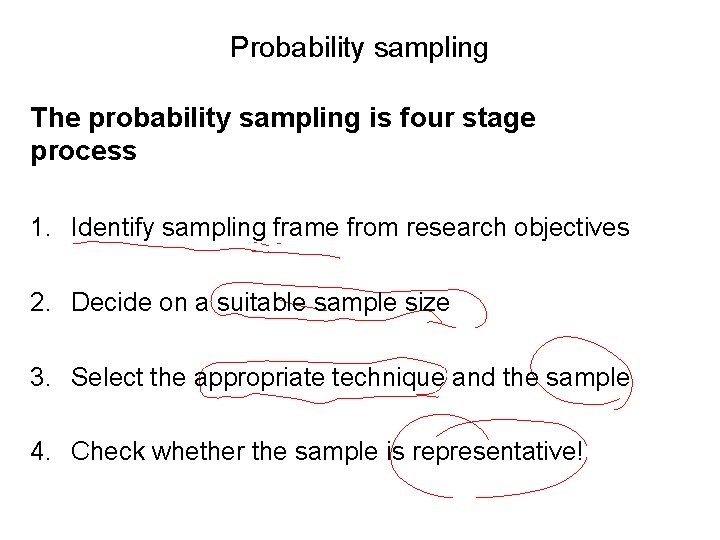
Slide 7. 10 Probability sampling The probability sampling is four stage process 1. Identify sampling frame from research objectives 2. Decide on a suitable sample size 3. Select the appropriate technique and the sample 4. Check whether the sample is representative! Saunders, Lewis and Thornhill, Research Methods for Business Students , 5 th Edition, © Mark Saunders, Philip Lewis and Adrian Thornhill 2009
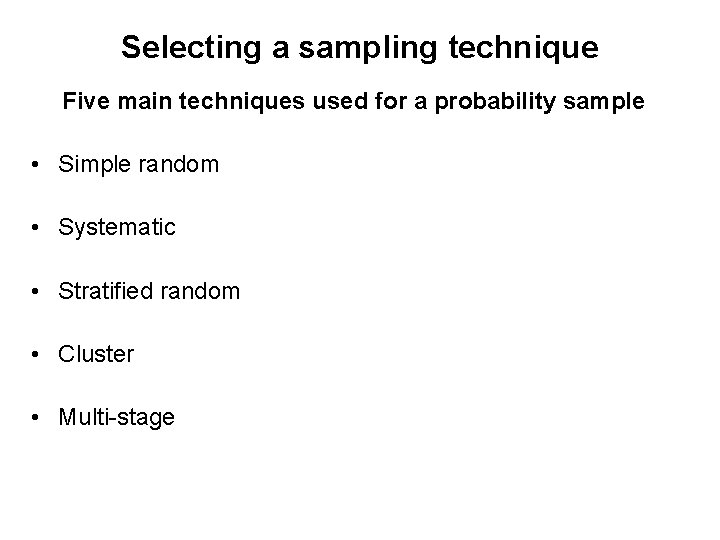
Slide 7. 11 Selecting a sampling technique Five main techniques used for a probability sample • Simple random • Systematic • Stratified random • Cluster • Multi-stage Saunders, Lewis and Thornhill, Research Methods for Business Students , 5 th Edition, © Mark Saunders, Philip Lewis and Adrian Thornhill 2009
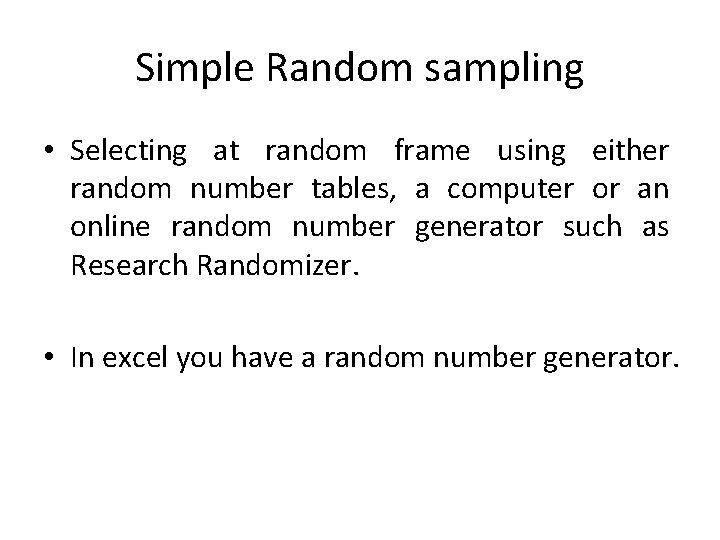
Slide 7. 12 Simple Random sampling • Selecting at random frame using either random number tables, a computer or an online random number generator such as Research Randomizer. • In excel you have a random number generator. Saunders, Lewis and Thornhill, Research Methods for Business Students , 5 th Edition, © Mark Saunders, Philip Lewis and Adrian Thornhill 2009
Slide 7. 13 Systematic sampling • Systematic sampling involves you selecting the sample at regular intervals from the sampling frame. 1. Number each of the cases in your sampling frame with a unique number. The first is numbered 0, the second 1 and so on. 2. Select the first case using a random number. 3. Calculate the sample fraction. 4. Select subsequent cases systematically using the sample fraction to determine the frequency of selection Saunders, Lewis and Thornhill, Research Methods for Business Students , 5 th Edition, © Mark Saunders, Philip Lewis and Adrian Thornhill 2009
Slide 7. 14 Stratified random sampling • Stratified random sampling is a modification of random sampling in which you divide the population into two or more relevant and significant strata based in a one or a number of attributes. • In effect, your sampling frame is divided into a number of subsets. • A random sample (simple or systematic) is then drawn from each of the strata. • Consequently stratified sampling shares many of the advantages and disadvantages of simple random or systematic sampling. Saunders, Lewis and Thornhill, Research Methods for Business Students , 5 th Edition, © Mark Saunders, Philip Lewis and Adrian Thornhill 2009
Slide 7. 15 Cluster Sampling • Similar to stratified as you need to divide the population into discrete groups prior to sampling. • The groups are termed clusters in this form of sampling and can be based in any naturally occurring grouping. • For example, you could group your data by type of manufacturing firm or geographical area. Saunders, Lewis and Thornhill, Research Methods for Business Students , 5 th Edition, © Mark Saunders, Philip Lewis and Adrian Thornhill 2009
Slide 7. 16 Cluster Sampling • For cluster sampling your sampling frame is the complete list of clusters rather than complete list of individual cases within population. • Select a few cluster normally using simple random sampling, . • Data then collected from every case within the selected clusters. Saunders, Lewis and Thornhill, Research Methods for Business Students , 5 th Edition, © Mark Saunders, Philip Lewis and Adrian Thornhill 2009
Slide 7. 17 Multi-stage sampling • It is a development of cluster sampling, it is normally used to overcome problems associated with a geographically dispersed population when face to face contact is needed or where it is expensive and time consuming to construct a sampling frame for a large geographical area. • However, like cluster sampling you can use it for any discrete groups, including those that are not geographically based. • The technique involves taking a series of cluster samples, each involving some from of random sampling Saunders, Lewis and Thornhill, Research Methods for Business Students , 5 th Edition, © Mark Saunders, Philip Lewis and Adrian Thornhill 2009
Slide 7. 18 Saunders, Lewis and Thornhill, Research Methods for Business Students , 5 th Edition, © Mark Saunders, Philip Lewis and Adrian Thornhill 2009