
Slide 6 1 Chapter 6 Inventories Financial Accounting
- Slides: 50
Slide 6 -1
Chapter 6 Inventories Financial Accounting, IFRS Edition Weygandt Kimmel Kieso Slide 6 -2
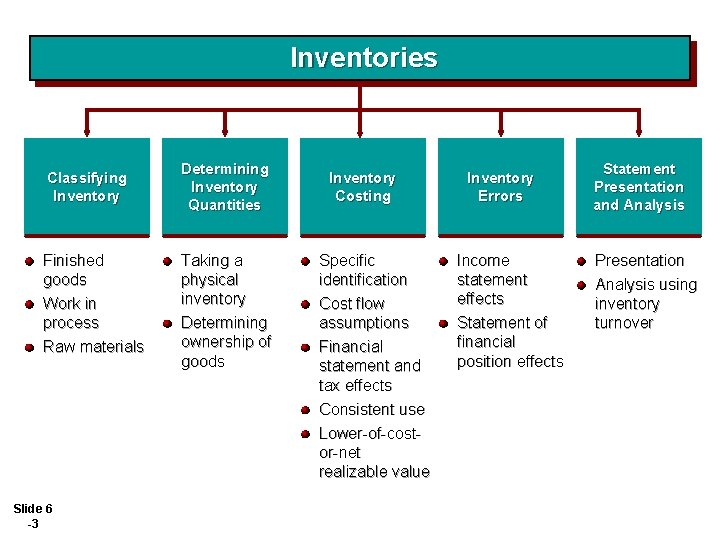
Inventories Classifying Inventory Determining Inventory Quantities Finished goods Work in process Raw materials Taking a physical inventory Determining ownership of goods Slide 6 -3 Inventory Costing Specific identification Cost flow assumptions Financial statement and tax effects Consistent use Lower-of-costor-net realizable value Inventory Errors Income statement effects Statement of financial position effects Statement Presentation and Analysis Presentation Analysis using inventory turnover
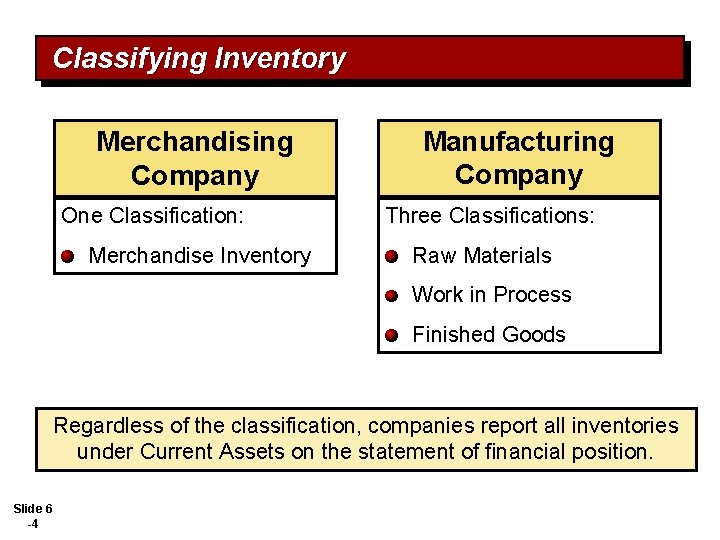
Classifying Inventory Merchandising Company One Classification: Merchandise Inventory Manufacturing Company Three Classifications: Raw Materials Work in Process Finished Goods Regardless of the classification, companies report all inventories under Current Assets on the statement of financial position. Slide 6 -4
Determining Inventory Quantities Physical Inventory taken for two reasons: Perpetual System 1. Check accuracy of inventory records. 2. Determine amount of inventory lost (wasted raw materials, shoplifting, or employee theft). Periodic System 1. Determine the inventory on hand 2. Determine the cost of goods sold for the period. Slide 6 -5 SO 1 Describe the steps in determining inventory quantities.
Determining Inventory Quantities Taking a Physical Inventory Involves counting, weighing, or measuring each kind of inventory on hand. Taken, when the business is closed or when business is slow. at end of the accounting period. Slide 6 -6 SO 1 Describe the steps in determining inventory quantities.
Determining Inventory Quantities Determining Ownership of Goods in Transit Purchased goods not yet received. Sold goods not yet delivered. Goods in transit should be included in the inventory of the company that has legal title to the goods. Legal title is determined by the terms of sale. Slide 6 -7 SO 1 Describe the steps in determining inventory quantities.
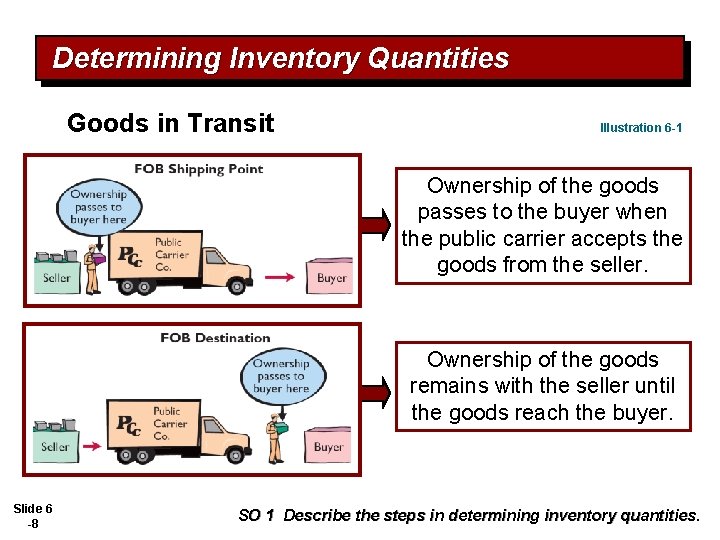
Determining Inventory Quantities Goods in Transit Illustration 6 -1 Ownership of the goods passes to the buyer when the public carrier accepts the goods from the seller. Ownership of the goods remains with the seller until the goods reach the buyer. Slide 6 -8 SO 1 Describe the steps in determining inventory quantities.
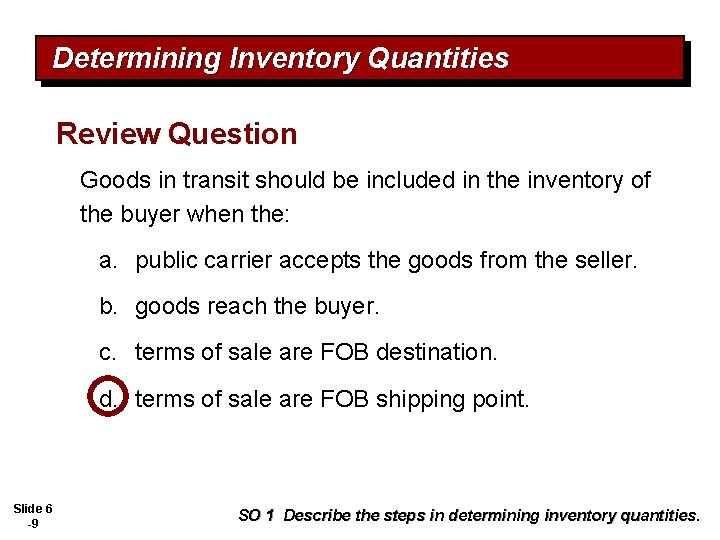
Determining Inventory Quantities Review Question Goods in transit should be included in the inventory of the buyer when the: a. public carrier accepts the goods from the seller. b. goods reach the buyer. c. terms of sale are FOB destination. d. terms of sale are FOB shipping point. Slide 6 -9 SO 1 Describe the steps in determining inventory quantities.
Determining Inventory Quantities Determining Ownership of Goods Consigned Goods In some lines of business, it is common to hold the goods of other parties and try to sell the goods for them for a fee, but without taking ownership of goods. These are called consigned goods. Slide 6 -10 SO 1 Describe the steps in determining inventory quantities.
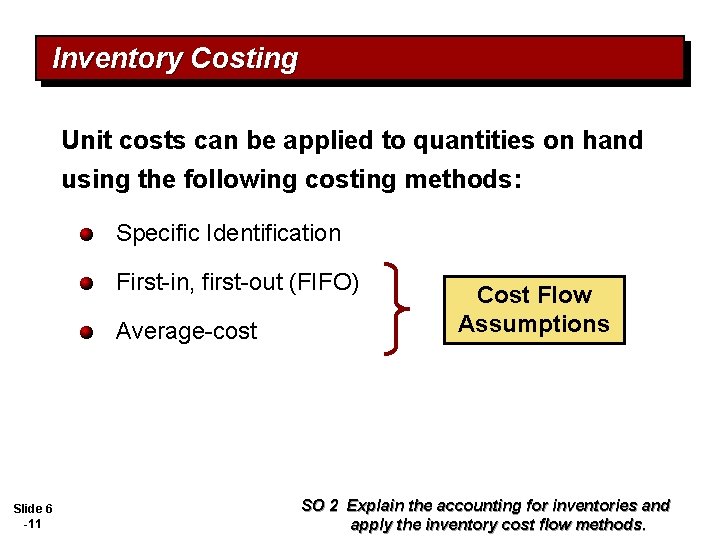
Inventory Costing Unit costs can be applied to quantities on hand using the following costing methods: Specific Identification First-in, first-out (FIFO) Average-cost Slide 6 -11 Cost Flow Assumptions SO 2 Explain the accounting for inventories and apply the inventory cost flow methods.
Inventory Costing Specific Identification Method An actual physical flow costing method in which items still in inventory are specifically costed to arrive at the total cost of the ending inventory. Practice is relatively rare. Most companies make assumptions (Cost Flow Assumptions) about which units were sold. Slide 6 -12 SO 2 Explain the accounting for inventories and apply the inventory cost flow methods.
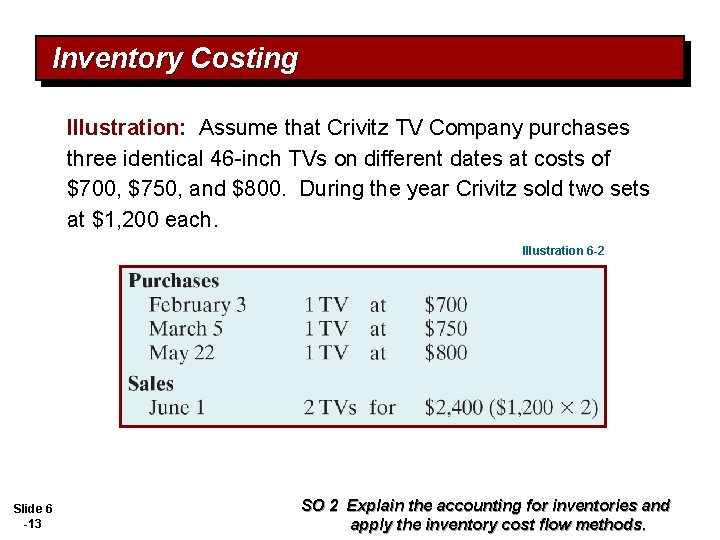
Inventory Costing Illustration: Assume that Crivitz TV Company purchases three identical 46 -inch TVs on different dates at costs of $700, $750, and $800. During the year Crivitz sold two sets at $1, 200 each. Illustration 6 -2 Slide 6 -13 SO 2 Explain the accounting for inventories and apply the inventory cost flow methods.
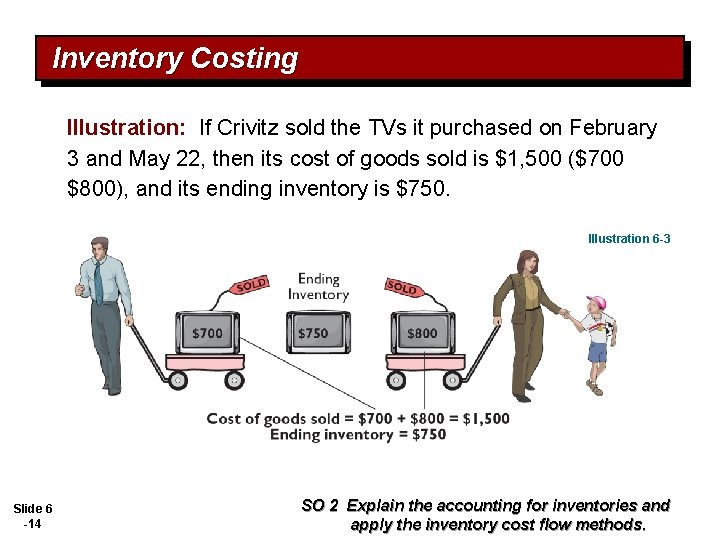
Inventory Costing Illustration: If Crivitz sold the TVs it purchased on February 3 and May 22, then its cost of goods sold is $1, 500 ($700 $800), and its ending inventory is $750. Illustration 6 -3 Slide 6 -14 SO 2 Explain the accounting for inventories and apply the inventory cost flow methods.
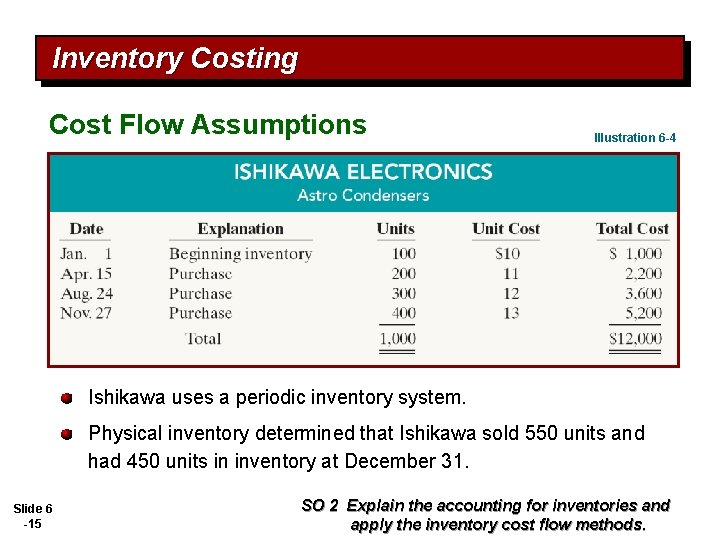
Inventory Costing Cost Flow Assumptions Illustration 6 -4 Ishikawa uses a periodic inventory system. Physical inventory determined that Ishikawa sold 550 units and had 450 units in inventory at December 31. Slide 6 -15 SO 2 Explain the accounting for inventories and apply the inventory cost flow methods.
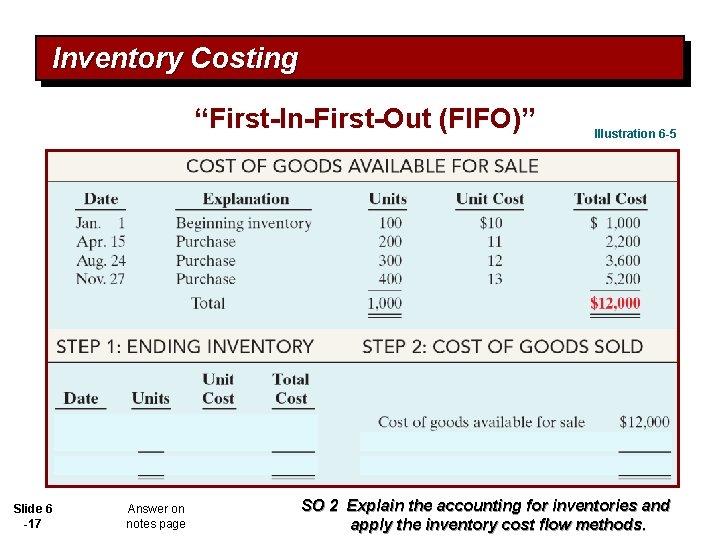
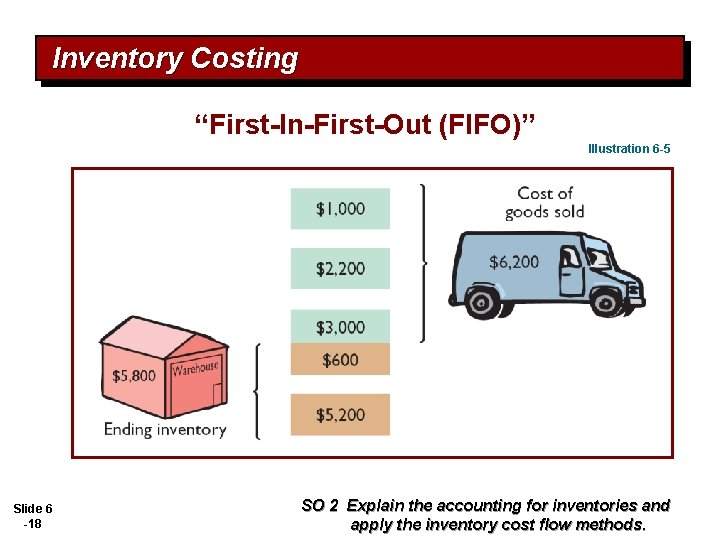
Inventory Costing “First-In-First-Out (FIFO)” Earliest goods purchased are first to be sold. Often parallels actual physical flow of merchandise. Generally good business practice to sell oldest units first. Slide 6 -16 SO 2 Explain the accounting for inventories and apply the inventory cost flow methods.
Inventory Costing “First-In-First-Out (FIFO)” Slide 6 -17 Answer on notes page Illustration 6 -5 SO 2 Explain the accounting for inventories and apply the inventory cost flow methods.
Inventory Costing “First-In-First-Out (FIFO)” Illustration 6 -5 Slide 6 -18 SO 2 Explain the accounting for inventories and apply the inventory cost flow methods.
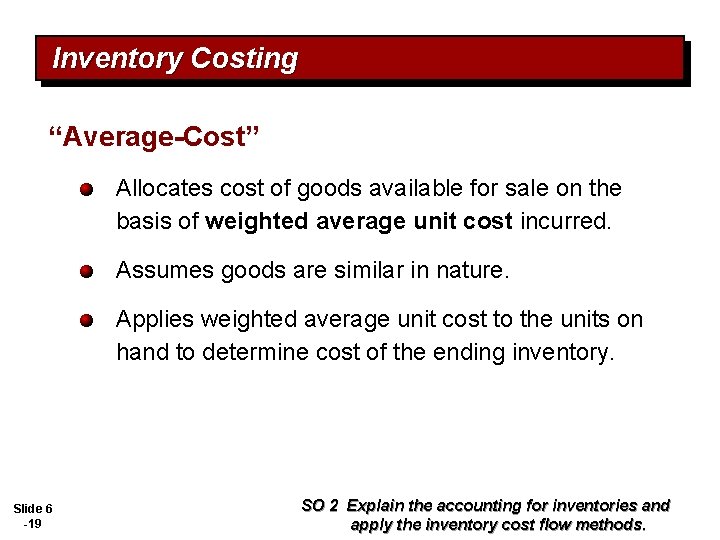
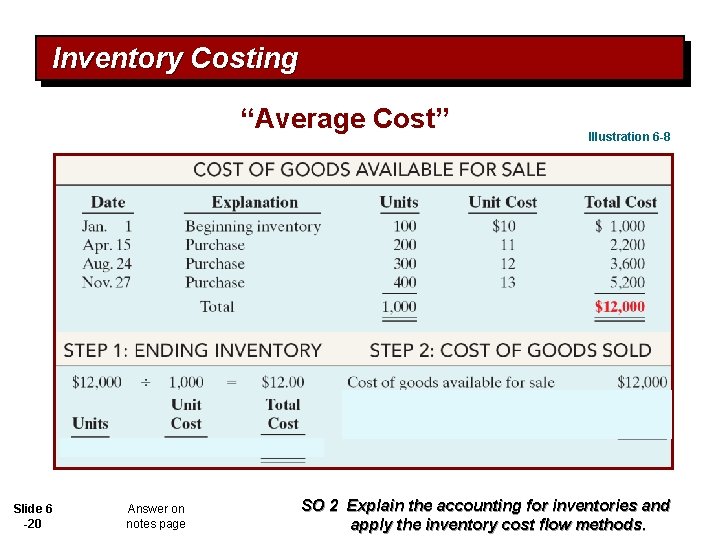
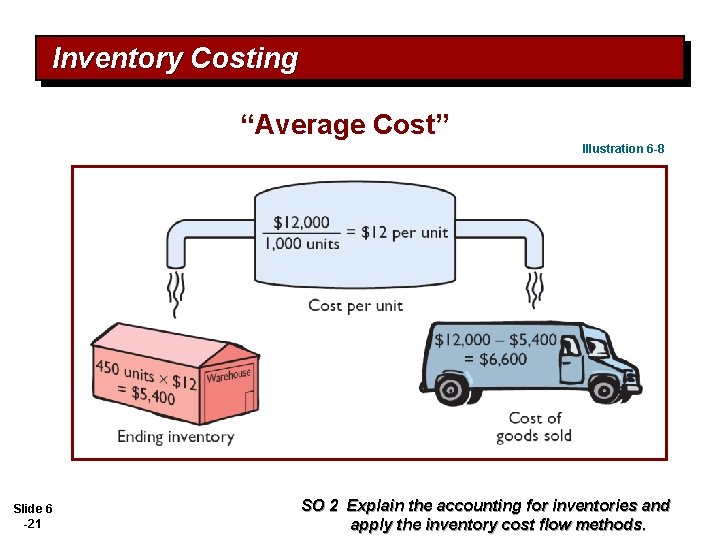
Inventory Costing “Average-Cost” Allocates cost of goods available for sale on the basis of weighted average unit cost incurred. Assumes goods are similar in nature. Applies weighted average unit cost to the units on hand to determine cost of the ending inventory. Slide 6 -19 SO 2 Explain the accounting for inventories and apply the inventory cost flow methods.
Inventory Costing “Average Cost” Slide 6 -20 Answer on notes page Illustration 6 -8 SO 2 Explain the accounting for inventories and apply the inventory cost flow methods.
Inventory Costing “Average Cost” Illustration 6 -8 Slide 6 -21 SO 2 Explain the accounting for inventories and apply the inventory cost flow methods.
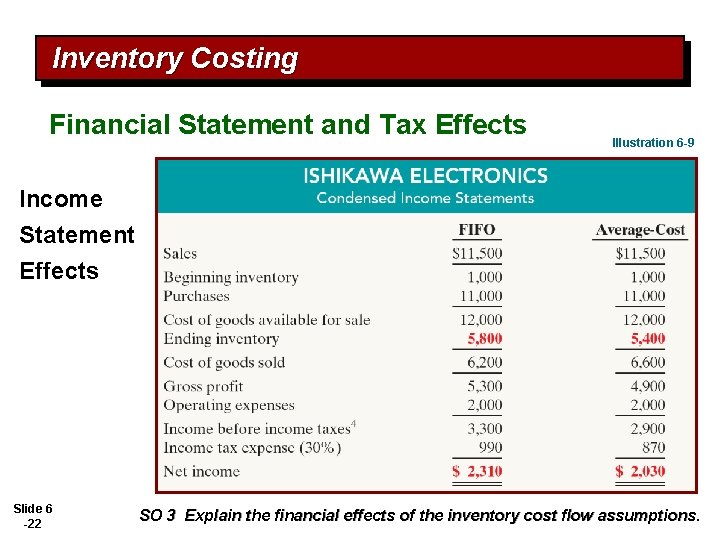
Inventory Costing Financial Statement and Tax Effects Illustration 6 -9 Income Statement Effects Slide 6 -22 SO 3 Explain the financial effects of the inventory cost flow assumptions.
Inventory Costing Statement of Financial Statement Effects Ø A major advantage of the FIFO method is that in a period of inflation, the costs allocated to ending inventory will approximate their current cost. Ø A shortcoming of the average-cost method is that in a period of inflation, the costs allocated to ending inventory may be understated in terms of current cost. Slide 6 -23 SO 3 Explain the financial effects of the inventory cost flow assumptions.
Inventory Costing Tax Effects In a period of inflation: Ø FIFO - inventory and net income higher. Ø AVERAGE Cost - lower income taxes. Slide 6 -24 SO 3 Explain the financial effects of the inventory cost flow assumptions.
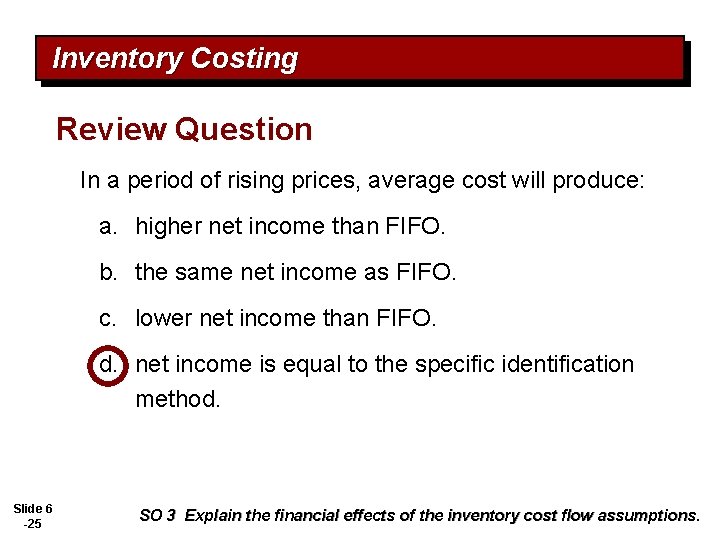
Inventory Costing Review Question In a period of rising prices, average cost will produce: a. higher net income than FIFO. b. the same net income as FIFO. c. lower net income than FIFO. d. net income is equal to the specific identification method. Slide 6 -25 SO 3 Explain the financial effects of the inventory cost flow assumptions.
Inventory Costing Using Cost Flow Methods Consistently Method should be used consistently, enhances comparability. Although consistency is preferred, a company may change its inventory costing method. Slide 6 -26 SO 3 Explain the financial effects of the inventory cost flow assumptions.
Inventory Costing Lower-of-Cost-or-Net Realizable Value When the value of inventory is lower than its cost Companies can “write down” the inventory to its net realizable value in the period in which the price decline occurs. Net realizable value refers to the net amount that a company expects to realize (receive) from the sale of inventory. Slide 6 -27 SO 4 Explain the lower-of-cost-or-net realizable value basis of accounting for inventories.
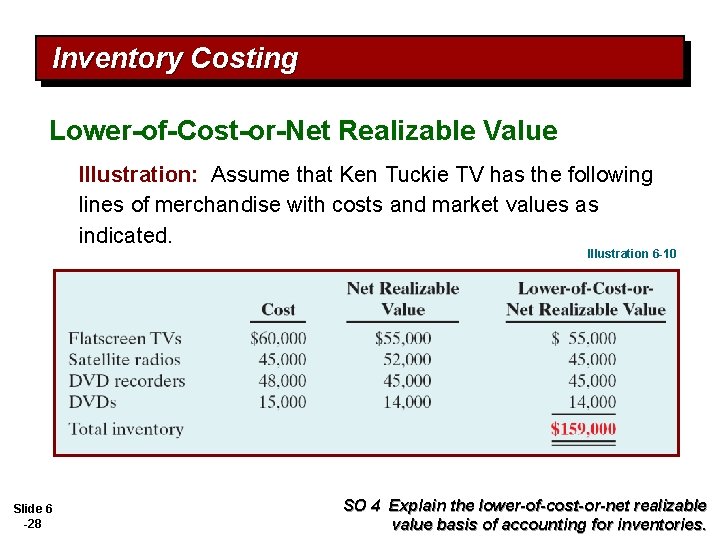
Inventory Costing Lower-of-Cost-or-Net Realizable Value Illustration: Assume that Ken Tuckie TV has the following lines of merchandise with costs and market values as indicated. Illustration 6 -10 Slide 6 -28 SO 4 Explain the lower-of-cost-or-net realizable value basis of accounting for inventories.
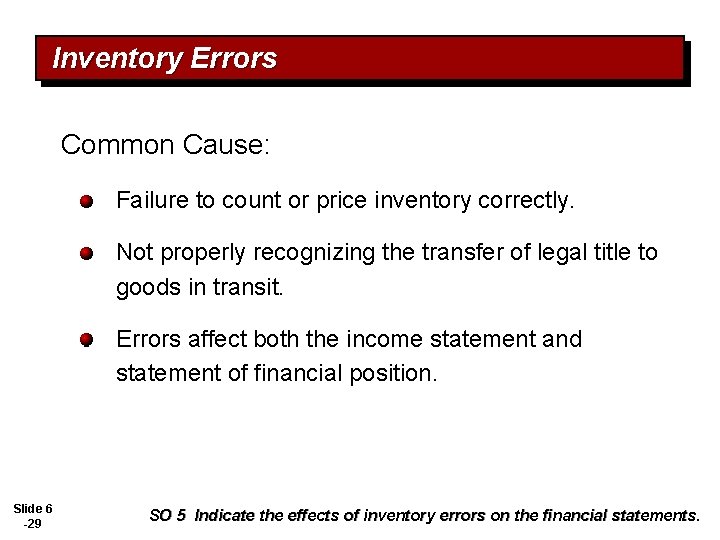
Inventory Errors Common Cause: Failure to count or price inventory correctly. Not properly recognizing the transfer of legal title to goods in transit. Errors affect both the income statement and statement of financial position. Slide 6 -29 SO 5 Indicate the effects of inventory errors on the financial statements.
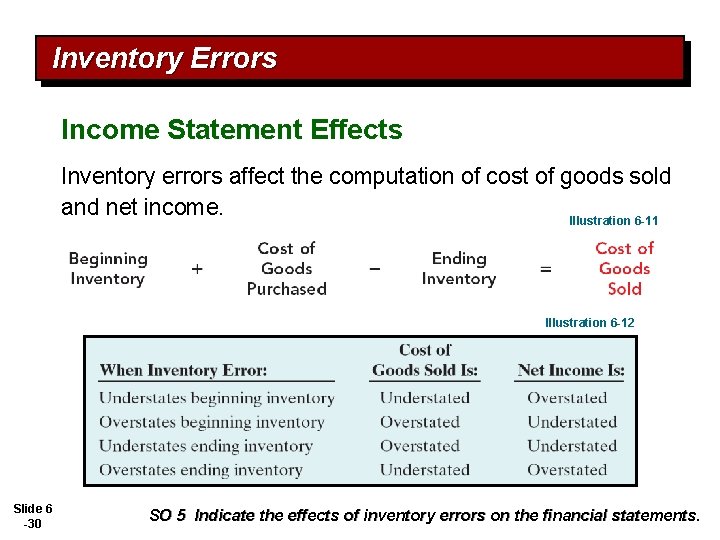
Inventory Errors Income Statement Effects Inventory errors affect the computation of cost of goods sold and net income. Illustration 6 -11 Illustration 6 -12 Slide 6 -30 SO 5 Indicate the effects of inventory errors on the financial statements.
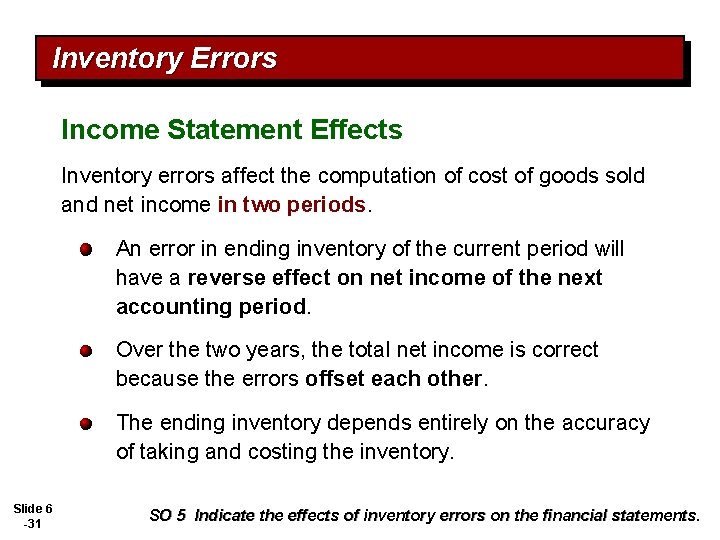
Inventory Errors Income Statement Effects Inventory errors affect the computation of cost of goods sold and net income in two periods. An error in ending inventory of the current period will have a reverse effect on net income of the next accounting period. Over the two years, the total net income is correct because the errors offset each other. The ending inventory depends entirely on the accuracy of taking and costing the inventory. Slide 6 -31 SO 5 Indicate the effects of inventory errors on the financial statements.
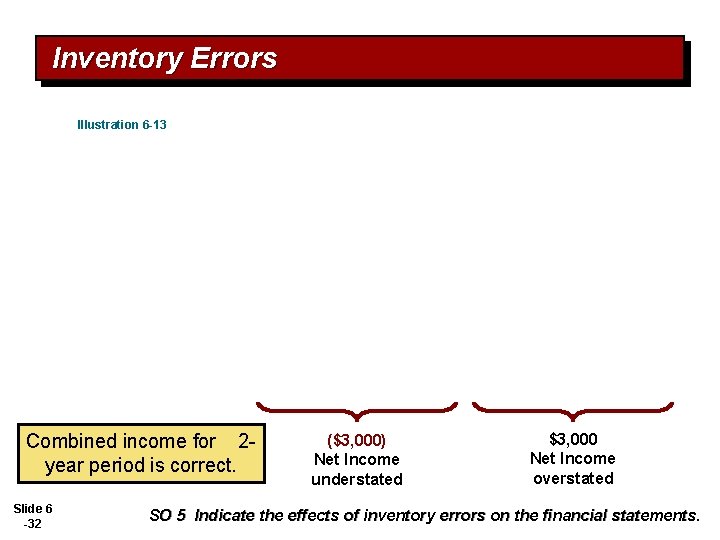
Inventory Errors Illustration 6 -13 Combined income for 2 year period is correct. Slide 6 -32 ($3, 000) Net Income understated $3, 000 Net Income overstated SO 5 Indicate the effects of inventory errors on the financial statements.
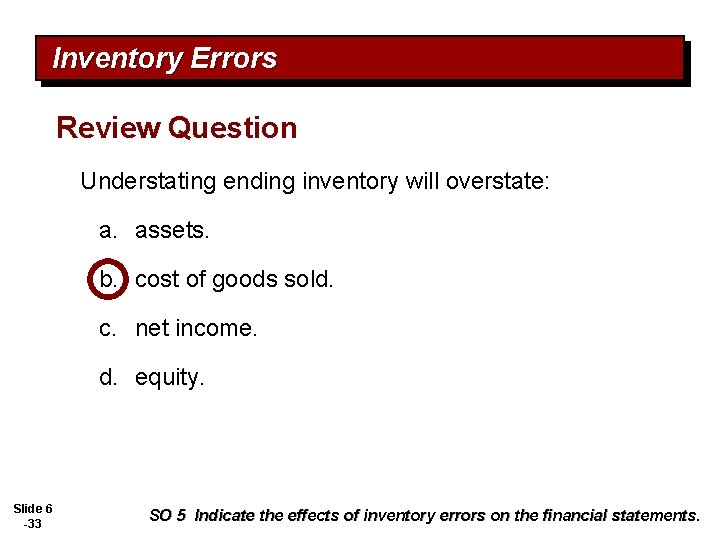
Inventory Errors Review Question Understating ending inventory will overstate: a. assets. b. cost of goods sold. c. net income. d. equity. Slide 6 -33 SO 5 Indicate the effects of inventory errors on the financial statements.
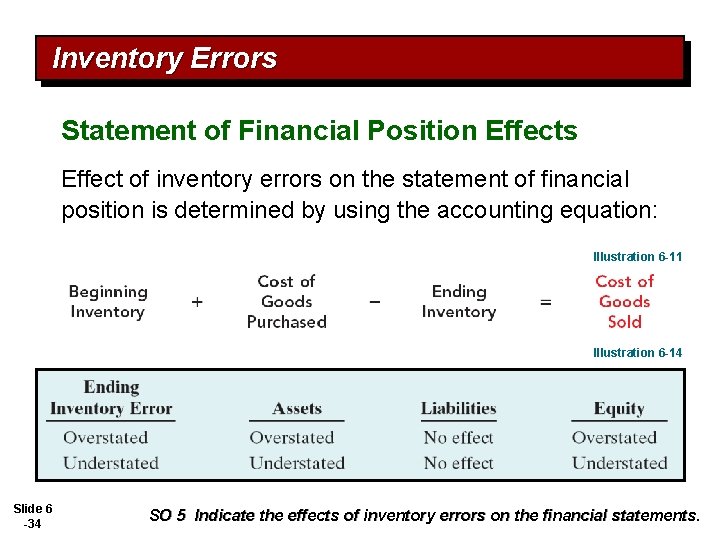
Inventory Errors Statement of Financial Position Effects Effect of inventory errors on the statement of financial position is determined by using the accounting equation: Illustration 6 -11 Illustration 6 -14 Slide 6 -34 SO 5 Indicate the effects of inventory errors on the financial statements.
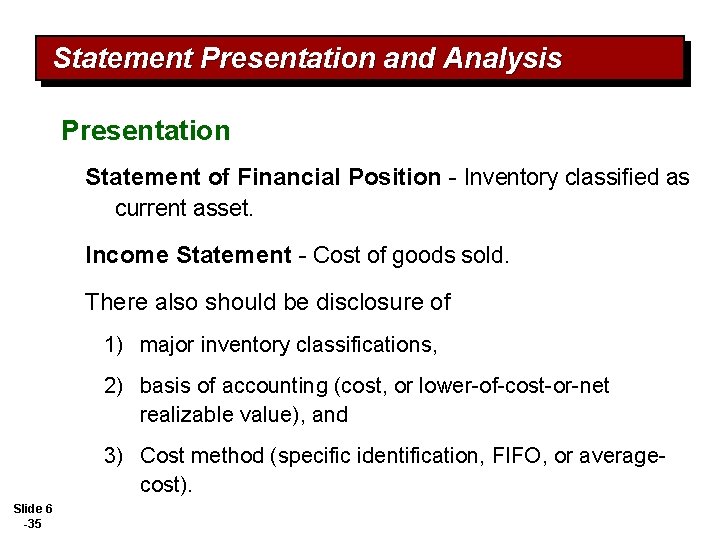
Statement Presentation and Analysis Presentation Statement of Financial Position - Inventory classified as current asset. Income Statement - Cost of goods sold. There also should be disclosure of 1) major inventory classifications, 2) basis of accounting (cost, or lower-of-cost-or-net realizable value), and 3) Cost method (specific identification, FIFO, or averagecost). Slide 6 -35
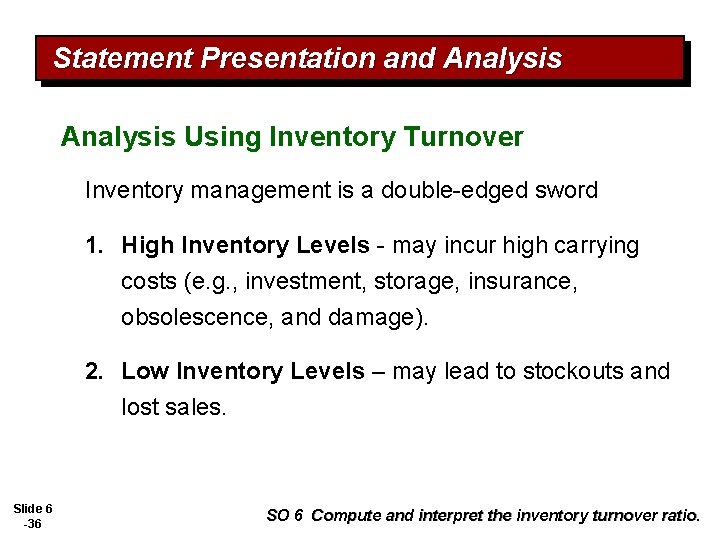
Statement Presentation and Analysis Using Inventory Turnover Inventory management is a double-edged sword 1. High Inventory Levels - may incur high carrying costs (e. g. , investment, storage, insurance, obsolescence, and damage). 2. Low Inventory Levels – may lead to stockouts and lost sales. Slide 6 -36 SO 6 Compute and interpret the inventory turnover ratio.
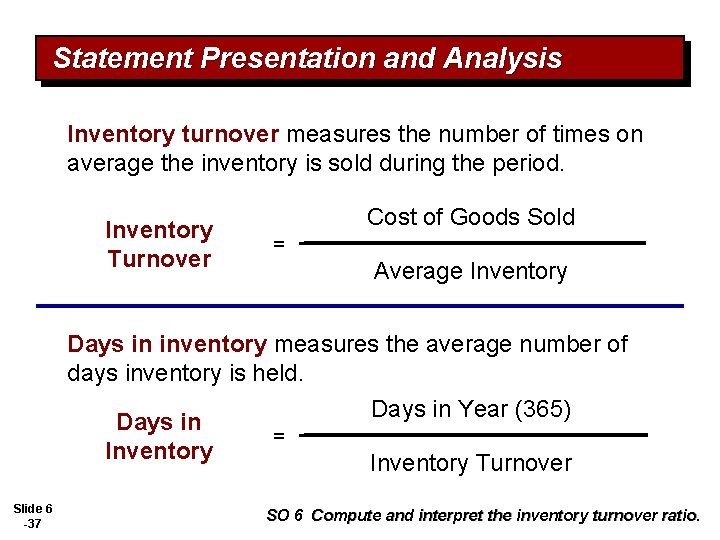
Statement Presentation and Analysis Inventory turnover measures the number of times on average the inventory is sold during the period. Inventory Turnover Cost of Goods Sold = Average Inventory Days in inventory measures the average number of days inventory is held. Days in Year (365) Days in = Inventory Turnover Slide 6 -37 SO 6 Compute and interpret the inventory turnover ratio.
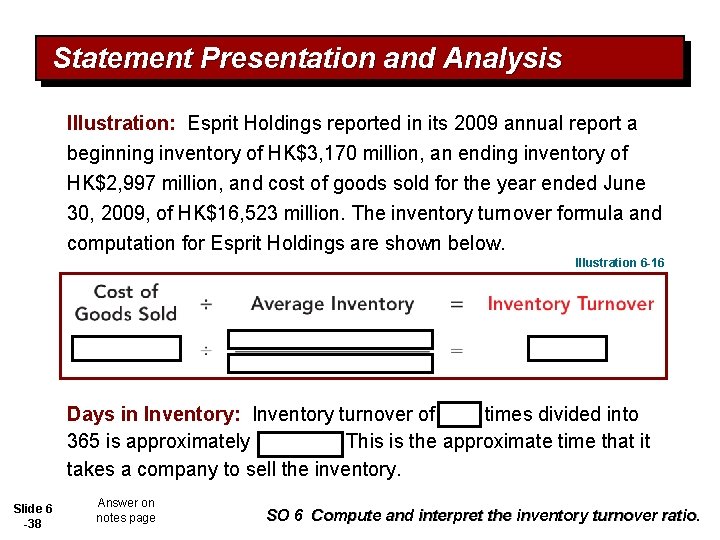
Statement Presentation and Analysis Illustration: Esprit Holdings reported in its 2009 annual report a beginning inventory of HK$3, 170 million, an ending inventory of HK$2, 997 million, and cost of goods sold for the year ended June 30, 2009, of HK$16, 523 million. The inventory turnover formula and computation for Esprit Holdings are shown below. Illustration 6 -16 Days in Inventory: Inventory turnover of 5. 4 times divided into 365 is approximately 68 days. This is the approximate time that it takes a company to sell the inventory. Slide 6 -38 Answer on notes page SO 6 Compute and interpret the inventory turnover ratio.
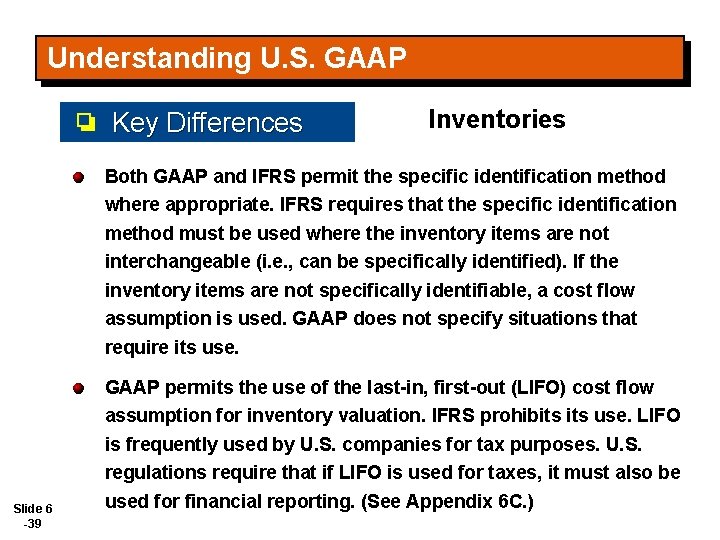
Understanding U. S. GAAP Key Differences Inventories Both GAAP and IFRS permit the specific identification method where appropriate. IFRS requires that the specific identification method must be used where the inventory items are not interchangeable (i. e. , can be specifically identified). If the inventory items are not specifically identifiable, a cost flow assumption is used. GAAP does not specify situations that require its use. Slide 6 -39 GAAP permits the use of the last-in, first-out (LIFO) cost flow assumption for inventory valuation. IFRS prohibits use. LIFO is frequently used by U. S. companies for tax purposes. U. S. regulations require that if LIFO is used for taxes, it must also be used for financial reporting. (See Appendix 6 C. )
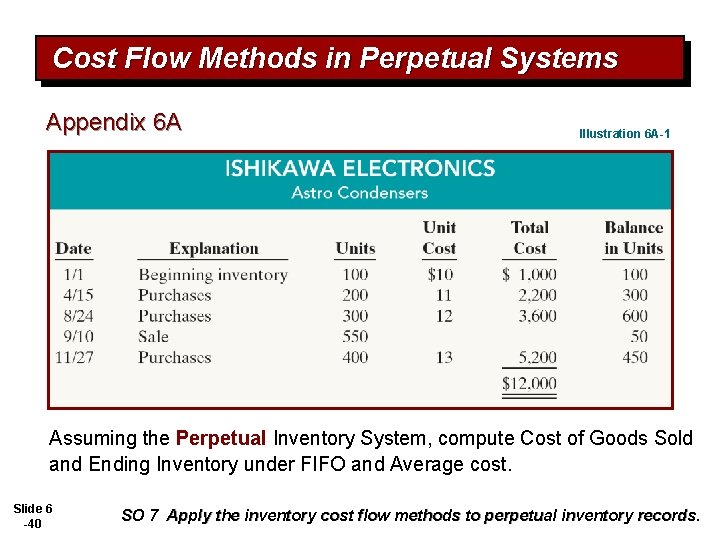
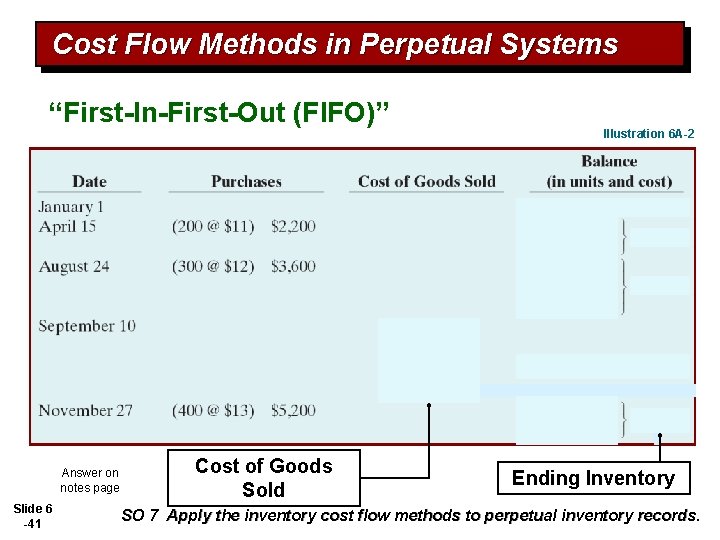
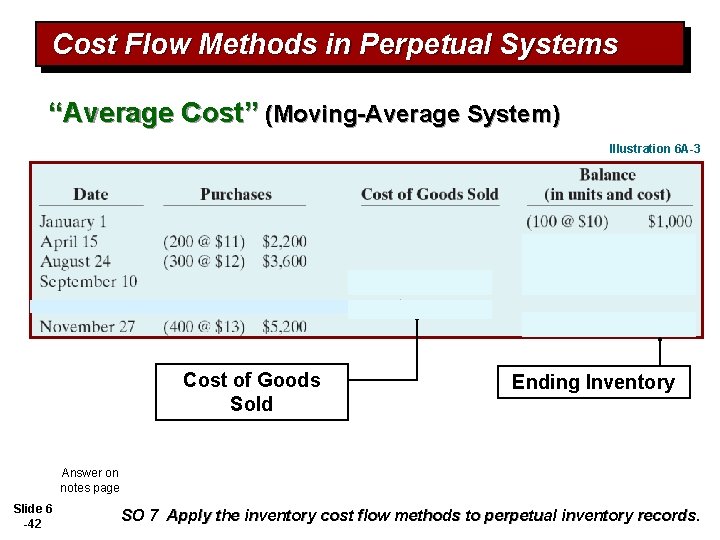
Cost Flow Methods in Perpetual Systems Appendix 6 A Illustration 6 A-1 Assuming the Perpetual Inventory System, compute Cost of Goods Sold and Ending Inventory under FIFO and Average cost. Slide 6 -40 SO 7 Apply the inventory cost flow methods to perpetual inventory records.
Cost Flow Methods in Perpetual Systems “First-In-First-Out (FIFO)” Answer on notes page Slide 6 -41 Cost of Goods Sold Illustration 6 A-2 Ending Inventory SO 7 Apply the inventory cost flow methods to perpetual inventory records.
Cost Flow Methods in Perpetual Systems “Average Cost” (Moving-Average System) Illustration 6 A-3 Cost of Goods Sold Ending Inventory Answer on notes page Slide 6 -42 SO 7 Apply the inventory cost flow methods to perpetual inventory records.
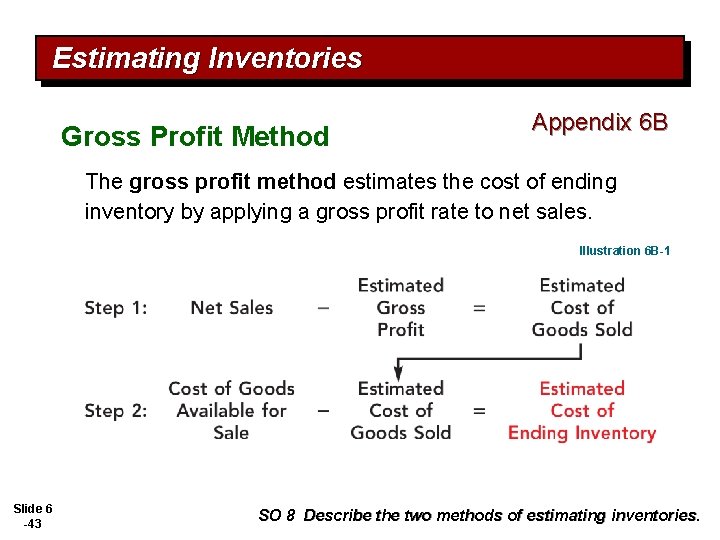
Estimating Inventories Gross Profit Method Appendix 6 B The gross profit method estimates the cost of ending inventory by applying a gross profit rate to net sales. Illustration 6 B-1 Slide 6 -43 SO 8 Describe the two methods of estimating inventories.
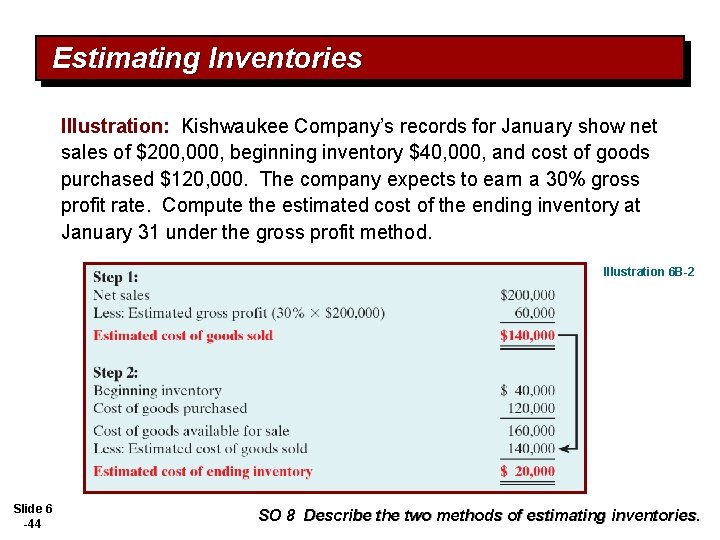
Estimating Inventories Illustration: Kishwaukee Company’s records for January show net sales of $200, 000, beginning inventory $40, 000, and cost of goods purchased $120, 000. The company expects to earn a 30% gross profit rate. Compute the estimated cost of the ending inventory at January 31 under the gross profit method. Illustration 6 B-2 Slide 6 -44 SO 8 Describe the two methods of estimating inventories.
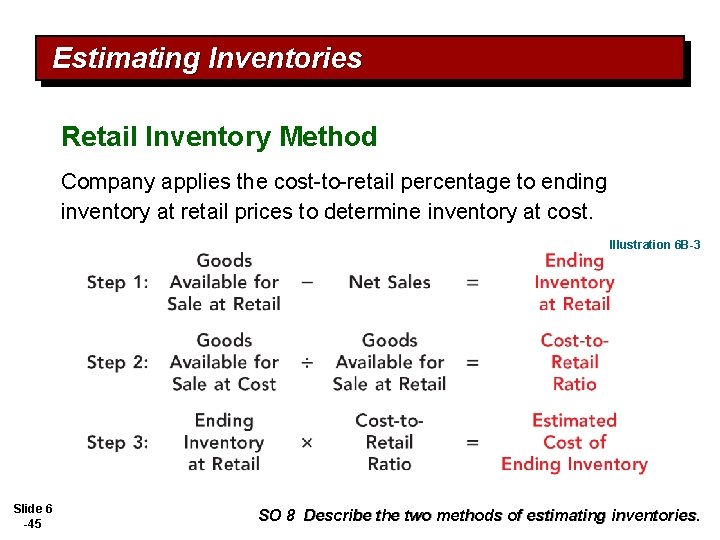
Estimating Inventories Retail Inventory Method Company applies the cost-to-retail percentage to ending inventory at retail prices to determine inventory at cost. Illustration 6 B-3 Slide 6 -45 SO 8 Describe the two methods of estimating inventories.
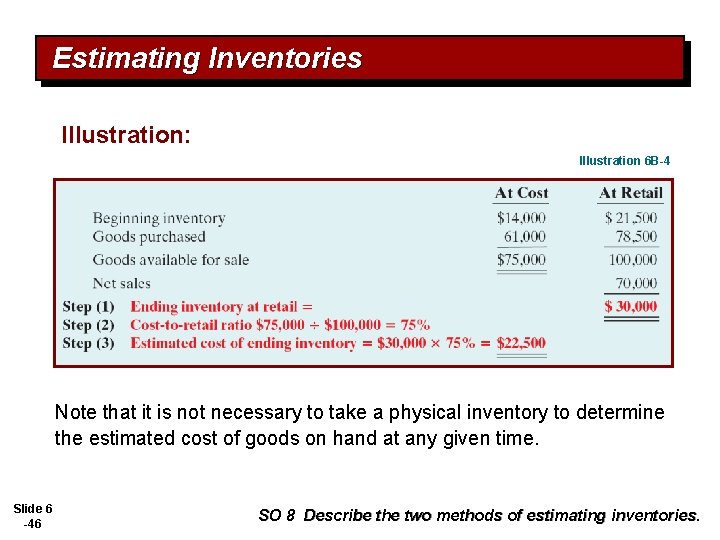
Estimating Inventories Illustration: Illustration 6 B-4 Note that it is not necessary to take a physical inventory to determine the estimated cost of goods on hand at any given time. Slide 6 -46 SO 8 Describe the two methods of estimating inventories.
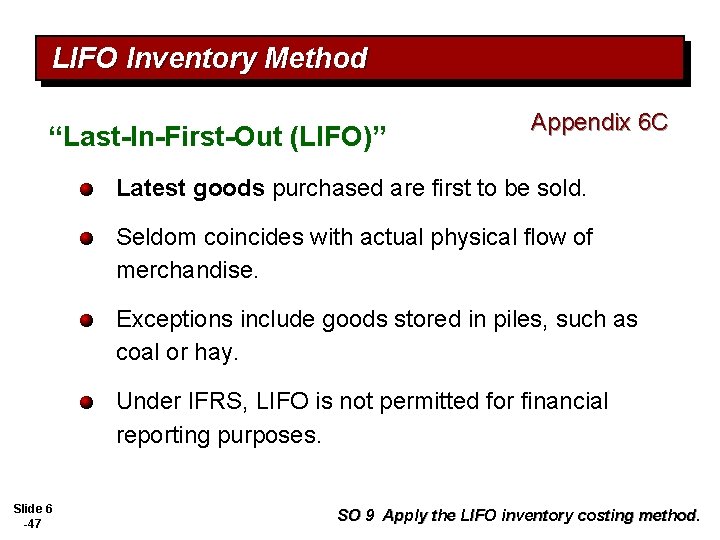
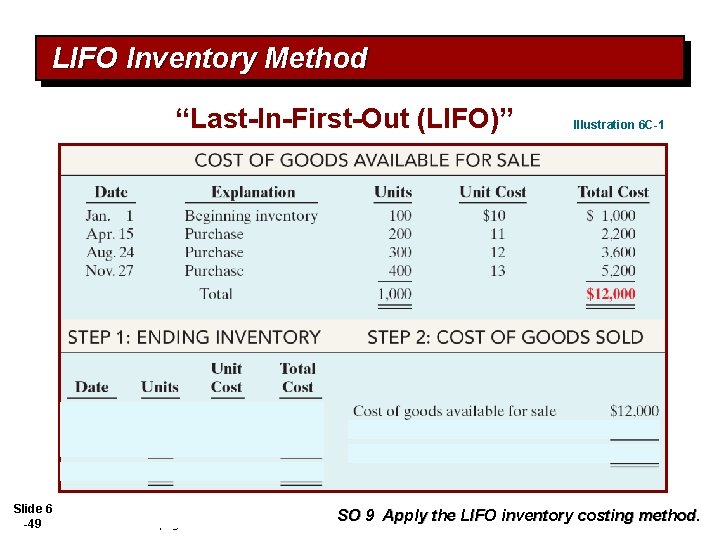
LIFO Inventory Method “Last-In-First-Out (LIFO)” Appendix 6 C Latest goods purchased are first to be sold. Seldom coincides with actual physical flow of merchandise. Exceptions include goods stored in piles, such as coal or hay. Under IFRS, LIFO is not permitted for financial reporting purposes. Slide 6 -47 SO 9 Apply the LIFO inventory costing method.
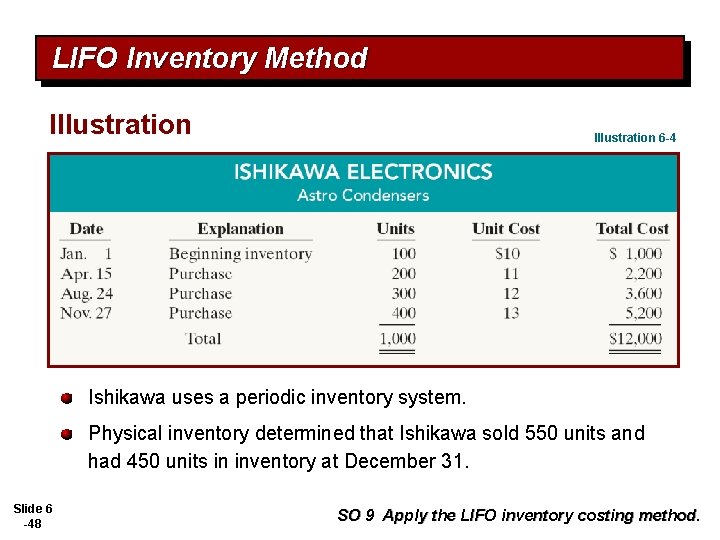
LIFO Inventory Method Illustration 6 -4 Ishikawa uses a periodic inventory system. Physical inventory determined that Ishikawa sold 550 units and had 450 units in inventory at December 31. Slide 6 -48 SO 9 Apply the LIFO inventory costing method.
LIFO Inventory Method “Last-In-First-Out (LIFO)” Slide 6 -49 Solution on notes page Illustration 6 C-1 SO 9 Apply the LIFO inventory costing method.
LIFO Inventory Method “Last-In-First-Out (LIFO)” Illustration 6 C-1 Slide 6 -50 SO 9 Apply the LIFO inventory costing method.