
Slide 3 1 The Strategic Position 3 Strategic


- Slides: 37
Slide 3. 1 The Strategic Position 3: Strategic Capabilities Johnson, Whittington and Scholes , Exploring Strategy, 9 th Edition, © Pearson Education Limited 2011
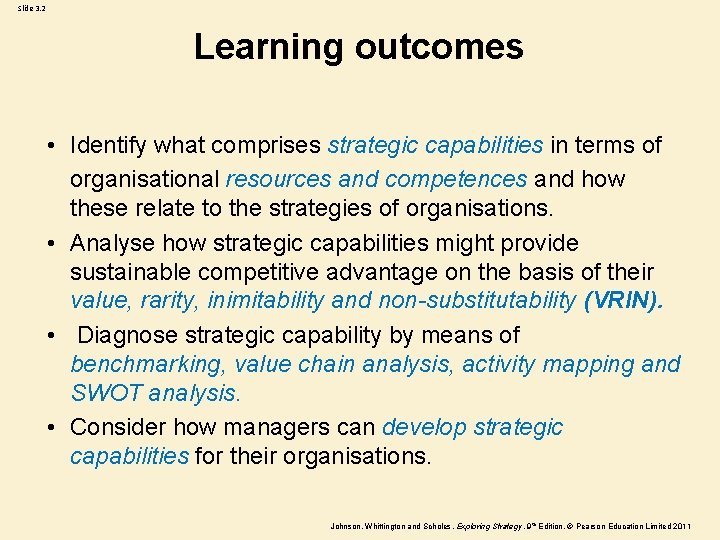
Slide 3. 2 Learning outcomes • Identify what comprises strategic capabilities in terms of organisational resources and competences and how these relate to the strategies of organisations. • Analyse how strategic capabilities might provide sustainable competitive advantage on the basis of their value, rarity, inimitability and non-substitutability (VRIN). • Diagnose strategic capability by means of benchmarking, value chain analysis, activity mapping and SWOT analysis. • Consider how managers can develop strategic capabilities for their organisations. Johnson, Whittington and Scholes , Exploring Strategy, 9 th Edition, © Pearson Education Limited 2011
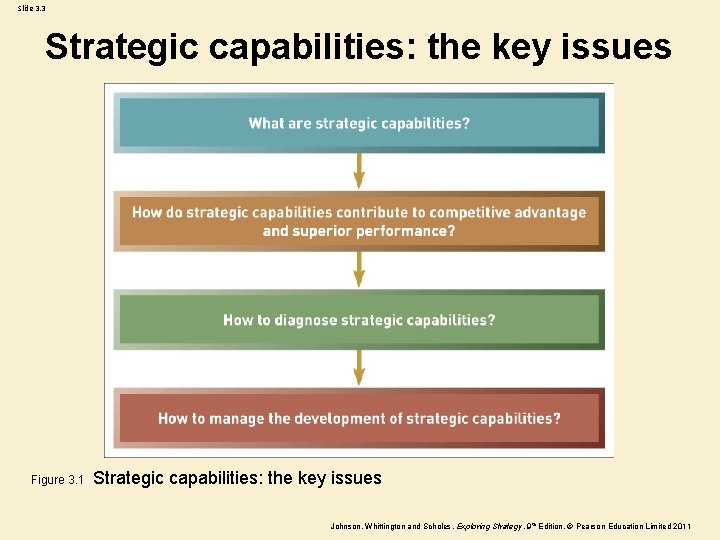
Slide 3. 3 Strategic capabilities: the key issues Figure 3. 1 Strategic capabilities: the key issues Johnson, Whittington and Scholes , Exploring Strategy, 9 th Edition, © Pearson Education Limited 2011
Slide 3. 4 Resource-based strategy The resource-based view (RBV) of strategy asserts that the competitive advantage and superior performance of an organisation is explained by the distinctiveness of its capabilities. Johnson, Whittington and Scholes , Exploring Strategy, 9 th Edition, © Pearson Education Limited 2011
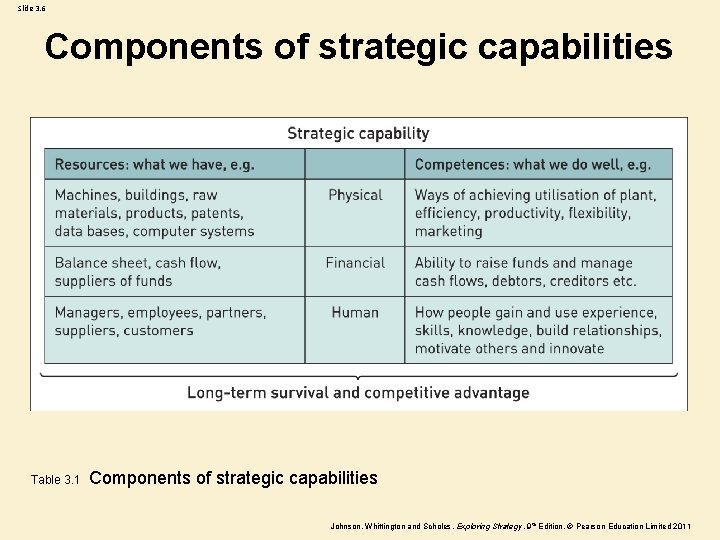
Slide 3. 5 Resources and competences • Resources are the assets that organisations have or can call upon (e. g. from partners or suppliers), that is, ‘what we have’. • Competences are the ways those assets are used or deployed effectively, that is, ‘what we do well’. Johnson, Whittington and Scholes , Exploring Strategy, 9 th Edition, © Pearson Education Limited 2011
Slide 3. 6 Components of strategic capabilities Table 3. 1 Components of strategic capabilities Johnson, Whittington and Scholes , Exploring Strategy, 9 th Edition, © Pearson Education Limited 2011
Slide 3. 7 Redundant capabilities • Capabilities, however effective in the past, can become less relevant as industries evolve and change. • Such ‘capabilities’ can become ‘rigidities’ that inhibit change and become a weakness. Johnson, Whittington and Scholes , Exploring Strategy, 9 th Edition, © Pearson Education Limited 2011
Slide 3. 8 Dynamic capabilities Dynamic capability is the ability of an organisation to renew and recreate its strategic capabilities to meet the needs of changing environments. Johnson, Whittington and Scholes , Exploring Strategy, 9 th Edition, © Pearson Education Limited 2011
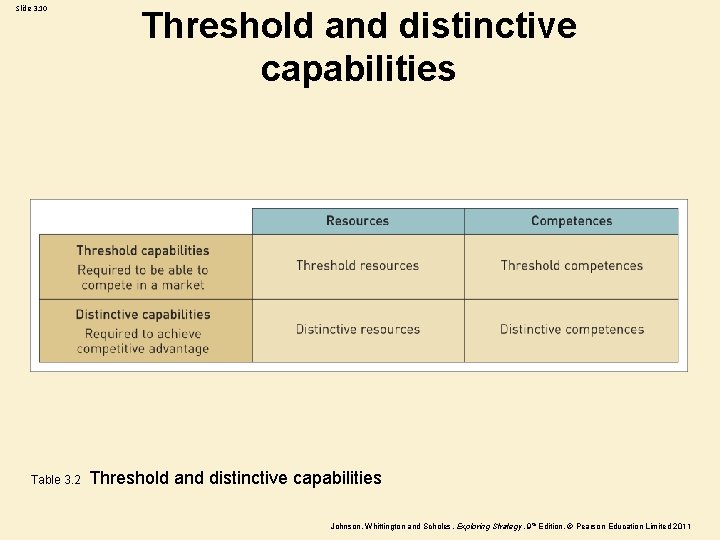
Slide 3. 9 Threshold and distinctive capabilities (1) • Threshold capabilities are those needed for an organisation to meet the necessary requirements to compete in a given market and achieve parity with competitors in that market – ‘qualifiers’. • Distinctive capabilities are those that critically underpin competitive advantage and that others cannot imitate or obtain – ‘winners’. Johnson, Whittington and Scholes , Exploring Strategy, 9 th Edition, © Pearson Education Limited 2011
Slide 3. 10 Table 3. 2 Threshold and distinctive capabilities Johnson, Whittington and Scholes , Exploring Strategy, 9 th Edition, © Pearson Education Limited 2011
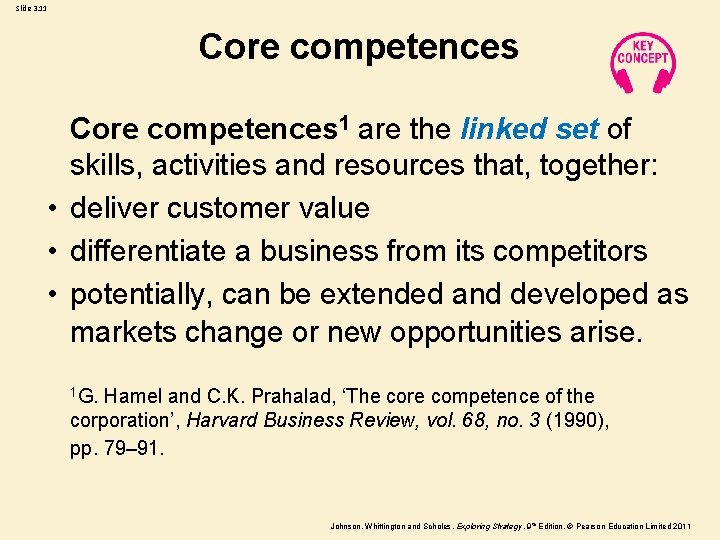
Slide 3. 11 Core competences 1 are the linked set of skills, activities and resources that, together: • deliver customer value • differentiate a business from its competitors • potentially, can be extended and developed as markets change or new opportunities arise. 1 G. Hamel and C. K. Prahalad, ‘The core competence of the corporation’, Harvard Business Review, vol. 68, no. 3 (1990), pp. 79– 91. Johnson, Whittington and Scholes , Exploring Strategy, 9 th Edition, © Pearson Education Limited 2011
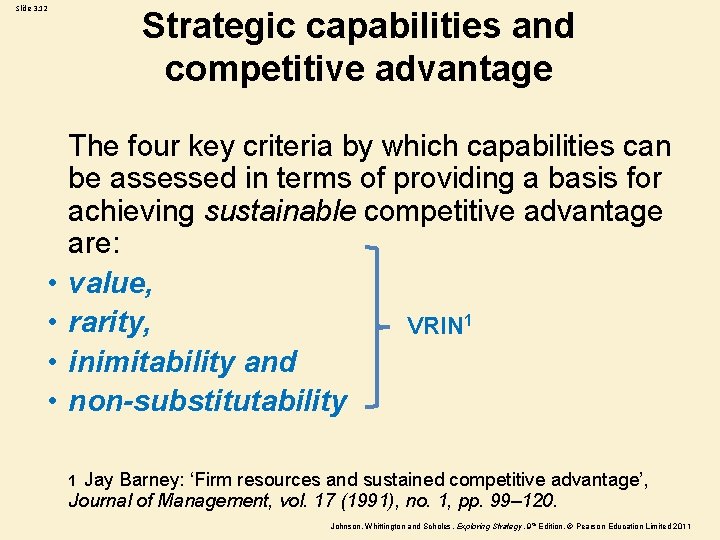
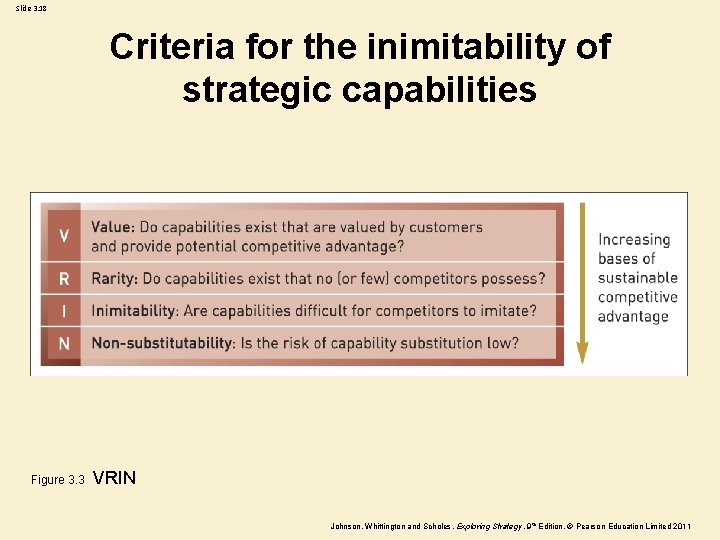
Slide 3. 12 • • Strategic capabilities and competitive advantage The four key criteria by which capabilities can be assessed in terms of providing a basis for achieving sustainable competitive advantage are: value, rarity, VRIN 1 inimitability and non-substitutability Jay Barney: ‘Firm resources and sustained competitive advantage’, Journal of Management, vol. 17 (1991), no. 1, pp. 99– 120. 1 Johnson, Whittington and Scholes , Exploring Strategy, 9 th Edition, © Pearson Education Limited 2011
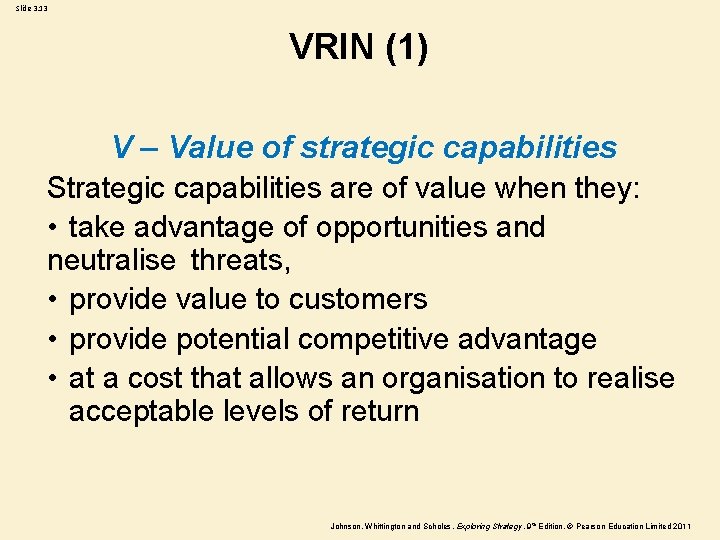
Slide 3. 13 VRIN (1) V – Value of strategic capabilities Strategic capabilities are of value when they: • take advantage of opportunities and neutralise threats, • provide value to customers • provide potential competitive advantage • at a cost that allows an organisation to realise acceptable levels of return Johnson, Whittington and Scholes , Exploring Strategy, 9 th Edition, © Pearson Education Limited 2011
Slide 3. 14 VRIN (2) R – Rarity • Rare capabilities are those possessed uniquely by one organisation or by a few others only. (E. g. a company may have patented products, have supremely talented people or a powerful brand. ) • Rarity could be temporary. (Eg: Patents expire, key individuals can leave or brands can be de-valued by adverse publicity. ) Johnson, Whittington and Scholes , Exploring Strategy, 9 th Edition, © Pearson Education Limited 2011
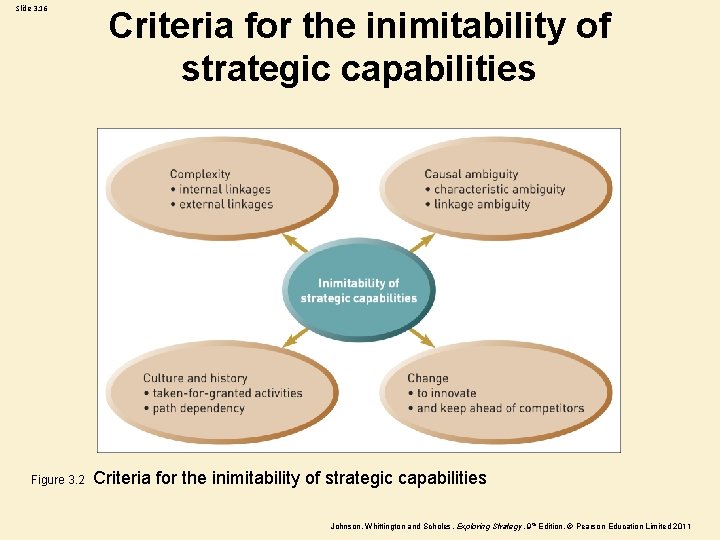
Slide 3. 15 VRIN (3) I – Inimitability Inimitable capabilities are those that competitors find difficult to imitate or obtain. • Competitive advantage can be built on unique resources (a key individual or IT system) but these may not be sustainable (key people leave or others acquire the same systems). • Sustainable advantage is more often found in competences (the way resources are managed, developed and deployed) and the way competences are linked together and integrated. Johnson, Whittington and Scholes , Exploring Strategy, 9 th Edition, © Pearson Education Limited 2011
Slide 3. 16 Figure 3. 2 Criteria for the inimitability of strategic capabilities Johnson, Whittington and Scholes , Exploring Strategy, 9 th Edition, © Pearson Education Limited 2011
Slide 3. 17 VRIN (4) N - Non-substitutability Competitive advantage may not be sustainable if there is a threat of substitution. • Product or service substitution from a different industry/market. For example, postal services partly substituted by e-mail. • Competence substitution. For example, a skill substituted by expert systems or IT solutions Johnson, Whittington and Scholes , Exploring Strategy, 9 th Edition, © Pearson Education Limited 2011
Slide 3. 18 Criteria for the inimitability of strategic capabilities Figure 3. 3 VRIN Johnson, Whittington and Scholes , Exploring Strategy, 9 th Edition, © Pearson Education Limited 2011
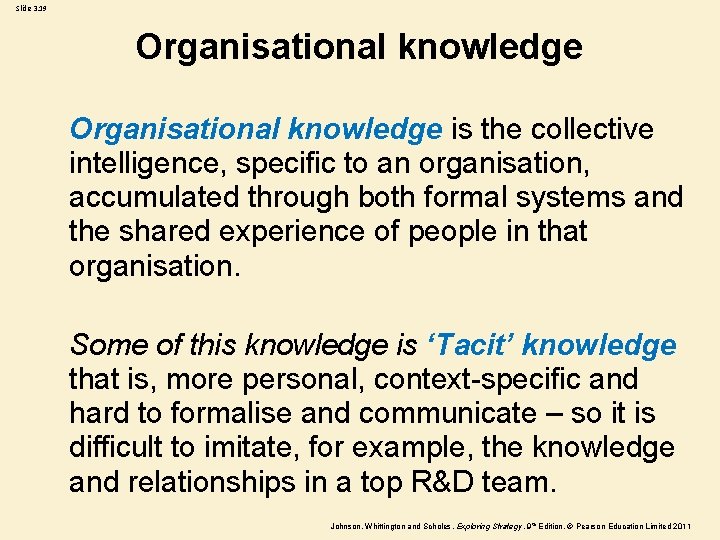
Slide 3. 19 Organisational knowledge is the collective intelligence, specific to an organisation, accumulated through both formal systems and the shared experience of people in that organisation. Some of this knowledge is ‘Tacit’ knowledge that is, more personal, context-specific and hard to formalise and communicate – so it is difficult to imitate, for example, the knowledge and relationships in a top R&D team. Johnson, Whittington and Scholes , Exploring Strategy, 9 th Edition, © Pearson Education Limited 2011
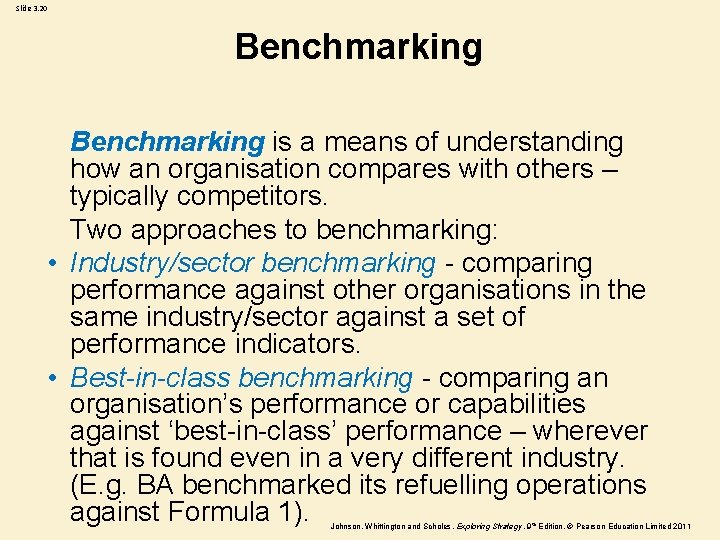
Slide 3. 20 Benchmarking is a means of understanding how an organisation compares with others – typically competitors. Two approaches to benchmarking: • Industry/sector benchmarking - comparing performance against other organisations in the same industry/sector against a set of performance indicators. • Best-in-class benchmarking - comparing an organisation’s performance or capabilities against ‘best-in-class’ performance – wherever that is found even in a very different industry. (E. g. BA benchmarked its refuelling operations against Formula 1). Johnson, Whittington and Scholes , Exploring Strategy, 9 th Edition, © Pearson Education Limited 2011
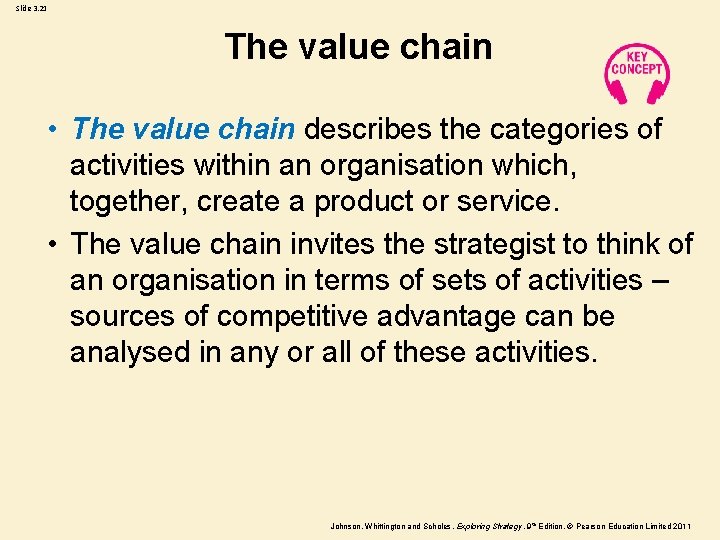
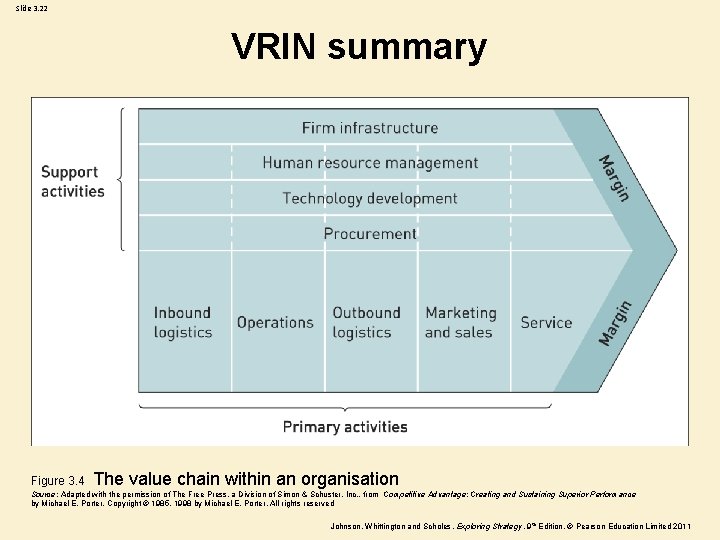
Slide 3. 21 The value chain • The value chain describes the categories of activities within an organisation which, together, create a product or service. • The value chain invites the strategist to think of an organisation in terms of sets of activities – sources of competitive advantage can be analysed in any or all of these activities. Johnson, Whittington and Scholes , Exploring Strategy, 9 th Edition, © Pearson Education Limited 2011
Slide 3. 22 VRIN summary Figure 3. 4 The value chain within an organisation Source: Adapted with the permission of The Free Press, a Division of Simon & Schuster, Inc. , from Competitive Advantage: Creating and Sustaining Superior Performance by Michael E. Porter. Copyright © 1985, 1998 by Michael E. Porter. All rights reserved Johnson, Whittington and Scholes , Exploring Strategy, 9 th Edition, © Pearson Education Limited 2011
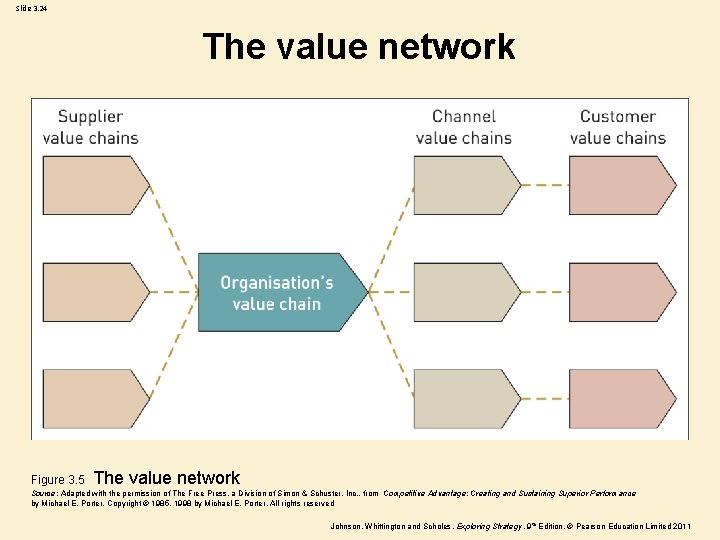
Slide 3. 23 The value network • The value network comprises the set of interorganisational links and relationships that are necessary to create a product or service. • Competitive advantage can be derived from linkages within the value network. Johnson, Whittington and Scholes , Exploring Strategy, 9 th Edition, © Pearson Education Limited 2011
Slide 3. 24 The value network Figure 3. 5 The value network Source: Adapted with the permission of The Free Press, a Division of Simon & Schuster, Inc. , from Competitive Advantage: Creating and Sustaining Superior Performance by Michael E. Porter. Copyright © 1985, 1998 by Michael E. Porter. All rights reserved Johnson, Whittington and Scholes , Exploring Strategy, 9 th Edition, © Pearson Education Limited 2011
Slide 3. 25 Uses of the value chain • A generic description of activities – understanding the discrete activities and how they both contribute to consumer benefit and how they add to cost. • Identifying activities where the organisation has particular strengths or weaknesses • Analysing the competitive position of the organisation using the VRIN criteria – thus identifying sources of sustainable advantage. • Looking for ways to enhance value or decrease cost in value activities (e. g. outsourcing) Johnson, Whittington and Scholes , Exploring Strategy, 9 th Edition, © Pearson Education Limited 2011
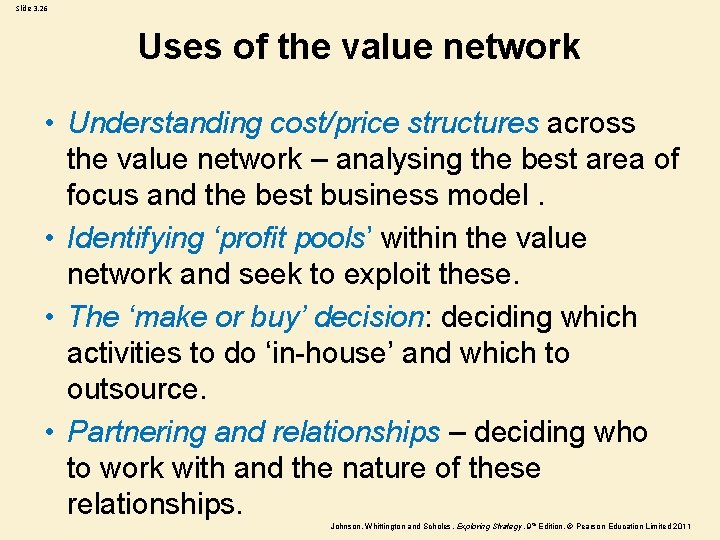
Slide 3. 26 Uses of the value network • Understanding cost/price structures across the value network – analysing the best area of focus and the best business model. • Identifying ‘profit pools’ within the value network and seek to exploit these. • The ‘make or buy’ decision: deciding which activities to do ‘in-house’ and which to outsource. • Partnering and relationships – deciding who to work with and the nature of these relationships. Johnson, Whittington and Scholes , Exploring Strategy, 9 th Edition, © Pearson Education Limited 2011
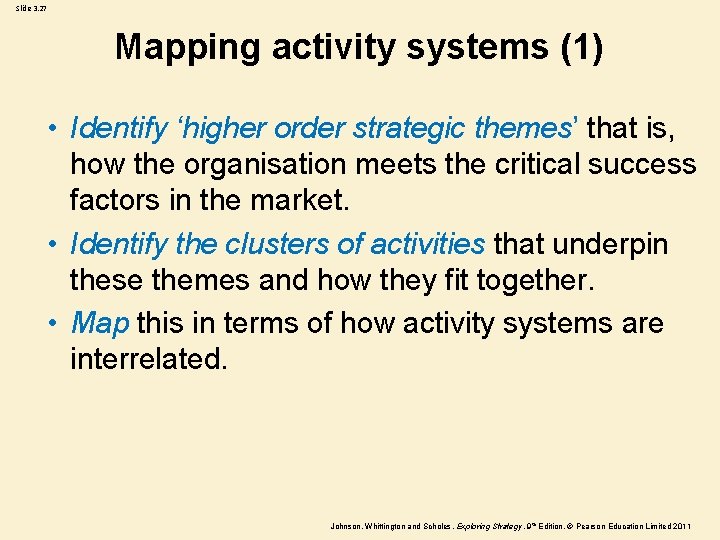
Slide 3. 27 Mapping activity systems (1) • Identify ‘higher order strategic themes’ that is, how the organisation meets the critical success factors in the market. • Identify the clusters of activities that underpin these themes and how they fit together. • Map this in terms of how activity systems are interrelated. Johnson, Whittington and Scholes , Exploring Strategy, 9 th Edition, © Pearson Education Limited 2011
Slide 3. 28 Mapping activity systems (2) Illustration 3. 5 Activity systems at Geelmuyden. Kiese Johnson, Whittington and Scholes , Exploring Strategy, 9 th Edition, © Pearson Education Limited 2011
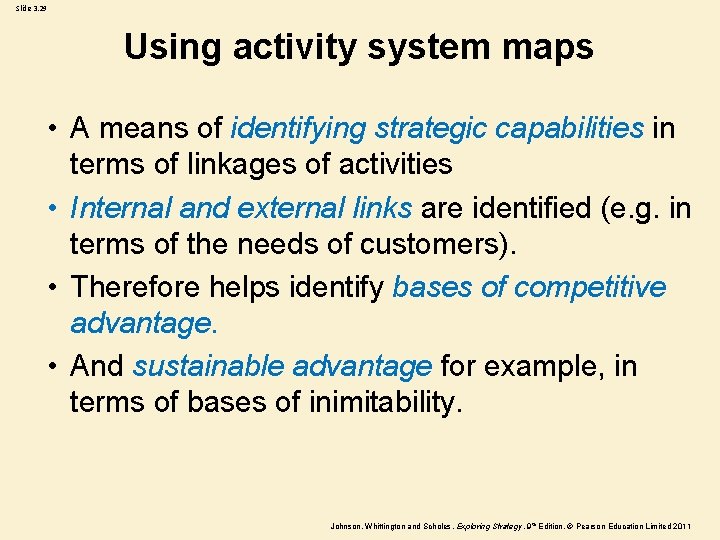
Slide 3. 29 Using activity system maps • A means of identifying strategic capabilities in terms of linkages of activities • Internal and external links are identified (e. g. in terms of the needs of customers). • Therefore helps identify bases of competitive advantage. • And sustainable advantage for example, in terms of bases of inimitability. Johnson, Whittington and Scholes , Exploring Strategy, 9 th Edition, © Pearson Education Limited 2011
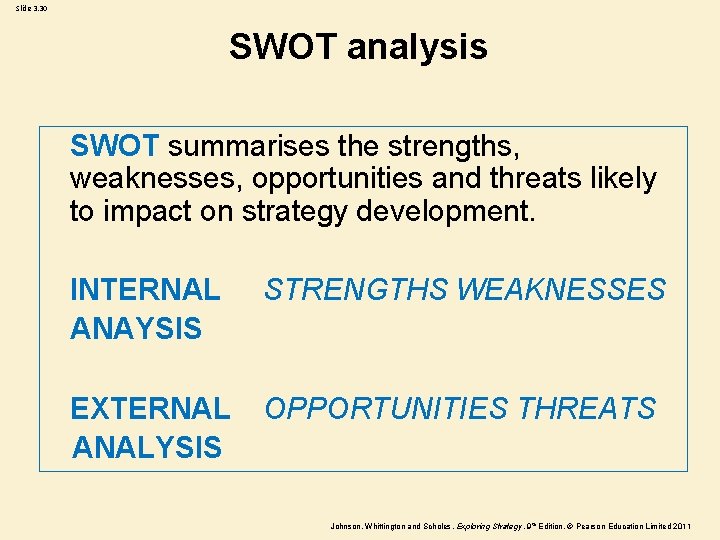
Slide 3. 30 SWOT analysis SWOT summarises the strengths, weaknesses, opportunities and threats likely to impact on strategy development. INTERNAL ANAYSIS STRENGTHS WEAKNESSES EXTERNAL ANALYSIS OPPORTUNITIES THREATS Johnson, Whittington and Scholes , Exploring Strategy, 9 th Edition, © Pearson Education Limited 2011
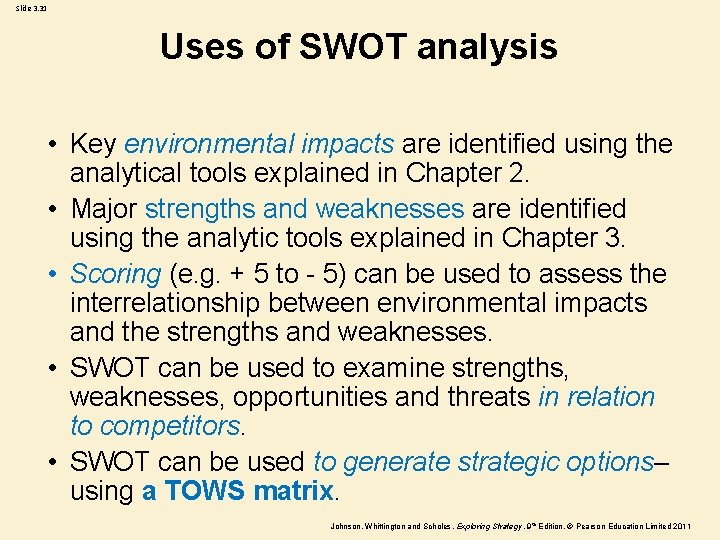
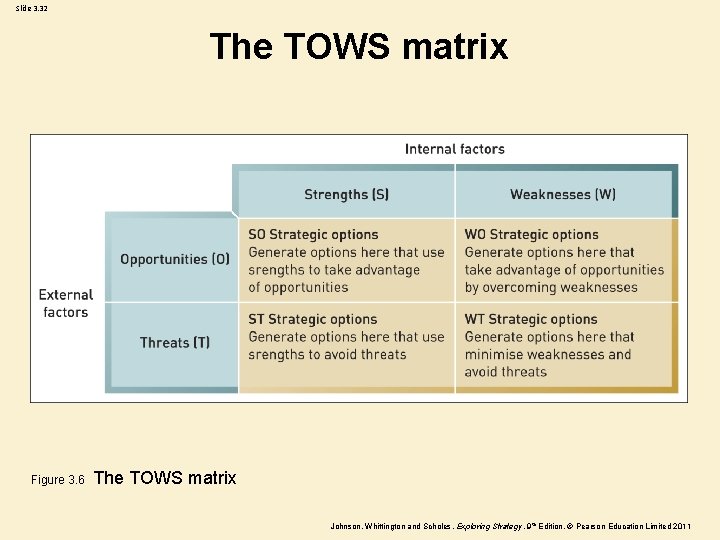
Slide 3. 31 Uses of SWOT analysis • Key environmental impacts are identified using the analytical tools explained in Chapter 2. • Major strengths and weaknesses are identified using the analytic tools explained in Chapter 3. • Scoring (e. g. + 5 to - 5) can be used to assess the interrelationship between environmental impacts and the strengths and weaknesses. • SWOT can be used to examine strengths, weaknesses, opportunities and threats in relation to competitors. • SWOT can be used to generate strategic options– using a TOWS matrix. Johnson, Whittington and Scholes , Exploring Strategy, 9 th Edition, © Pearson Education Limited 2011
Slide 3. 32 The TOWS matrix Figure 3. 6 The TOWS matrix Johnson, Whittington and Scholes , Exploring Strategy, 9 th Edition, © Pearson Education Limited 2011
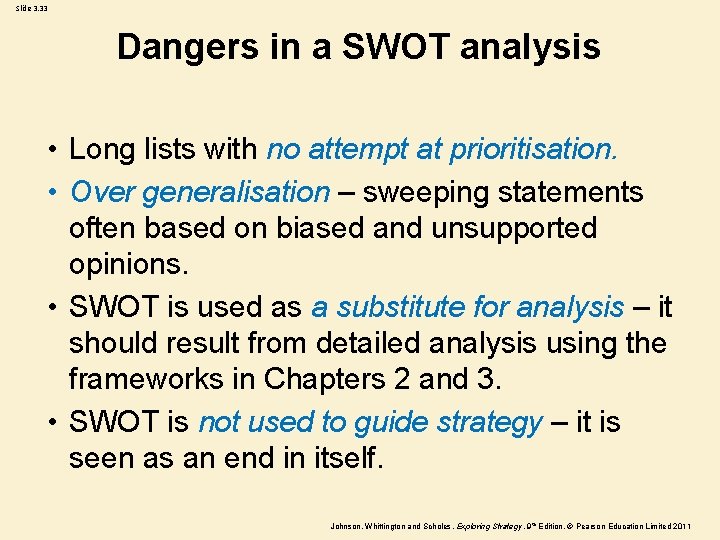
Slide 3. 33 Dangers in a SWOT analysis • Long lists with no attempt at prioritisation. • Over generalisation – sweeping statements often based on biased and unsupported opinions. • SWOT is used as a substitute for analysis – it should result from detailed analysis using the frameworks in Chapters 2 and 3. • SWOT is not used to guide strategy – it is seen as an end in itself. Johnson, Whittington and Scholes , Exploring Strategy, 9 th Edition, © Pearson Education Limited 2011
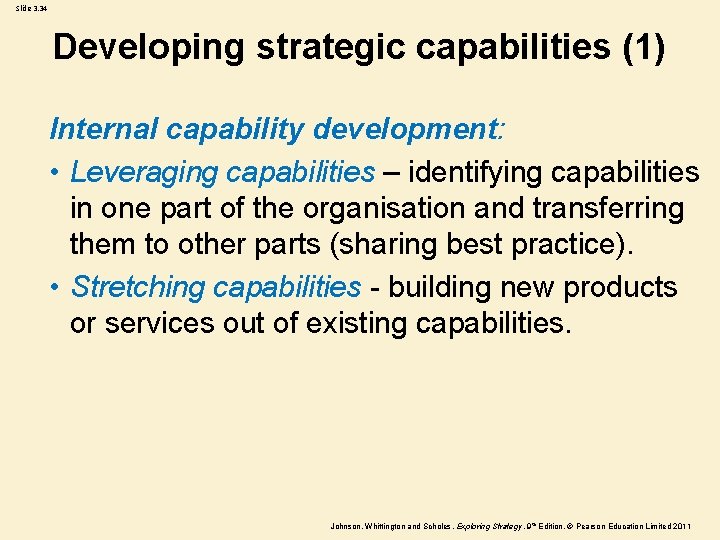
Slide 3. 34 Developing strategic capabilities (1) Internal capability development: • Leveraging capabilities – identifying capabilities in one part of the organisation and transferring them to other parts (sharing best practice). • Stretching capabilities - building new products or services out of existing capabilities. Johnson, Whittington and Scholes , Exploring Strategy, 9 th Edition, © Pearson Education Limited 2011
Slide 3. 35 Developing strategic capabilities (2) • External capability development – adding capabilities through mergers, acquisitions or alliances. • Ceasing activities – non-core activities can be stopped, outsourced or reduced in cost. • Monitor outputs and benefits – to understand sources of consumer benefit and enhance anything that contributes to this. • Managing the capabilities of people – training, development and organisation learning. Johnson, Whittington and Scholes , Exploring Strategy, 9 th Edition, © Pearson Education Limited 2011
Slide 3. 36 Chapter summary (1) • Strategic capabilities comprise both resources and competences. • The concept of dynamic capabilities highlights that strategic capabilities need to change as the market and environmental context of an organisation changes. • Sustainability of competitive advantage is likely to depend on an organisation’s capabilities being of at least threshold value in a market but also being valuable, relatively rare, intimable and nonsubstitutable. Johnson, Whittington and Scholes , Exploring Strategy, 9 th Edition, © Pearson Education Limited 2011
Slide 3. 37 Chapter summary (2) Ways of diagnosing organisational capabilities include: • Benchmarking as a means of understanding the relative performance of organisations. • Analysing an organisation’s value chain and value network as a basis for understanding how value to a customer is created and can be developed. • Activity mapping as a means of identifying more detailed activities which underpin strategic capabilities. • SWOT analysis as a way of drawing together an understanding of strengths, weaknesses, opportunities and threats an organisation faces. Johnson, Whittington and Scholes , Exploring Strategy, 9 th Edition, © Pearson Education Limited 2011