
Slide 3 1 Balance Sheet and Statement of
Slide 3 -1 Balance Sheet and Statement of Cash Flows Chapter 5 Mc. Graw-Hill/Irwin Copyright © 2004 by The Mc. Graw-Hill Companies, Inc. All rights reserved.
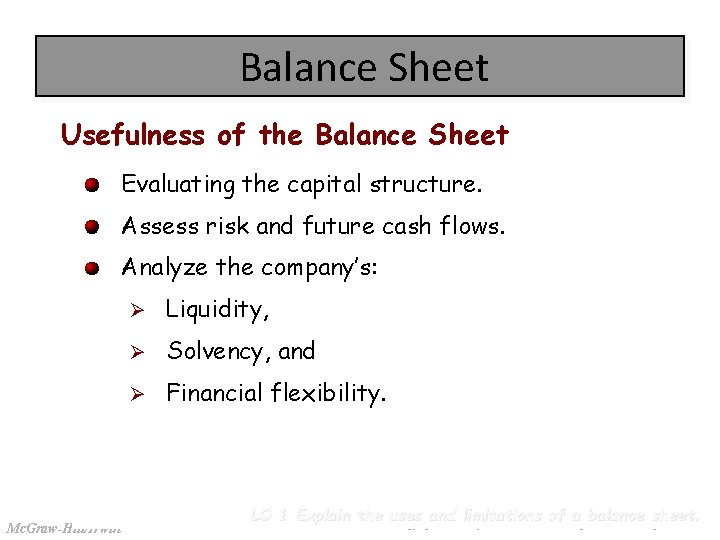
Slide 3 -2 Balance Sheet Usefulness of the Balance Sheet Evaluating the capital structure. Assess risk and future cash flows. Analyze the company’s: Mc. Graw-Hill/Irwin Ø Liquidity, Ø Solvency, and Ø Financial flexibility. LO 1 Explain the uses and limitations of a balance sheet. Copyright © 2004 by The Mc. Graw-Hill Companies, Inc. All rights reserved.
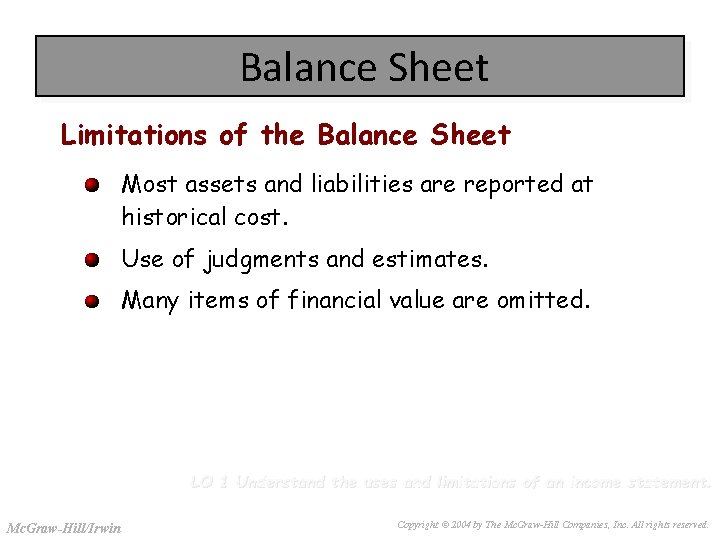
Slide 3 -3 Balance Sheet Limitations of the Balance Sheet Most assets and liabilities are reported at historical cost. Use of judgments and estimates. Many items of financial value are omitted. LO 1 Understand the uses and limitations of an income statement. Mc. Graw-Hill/Irwin Copyright © 2004 by The Mc. Graw-Hill Companies, Inc. All rights reserved.
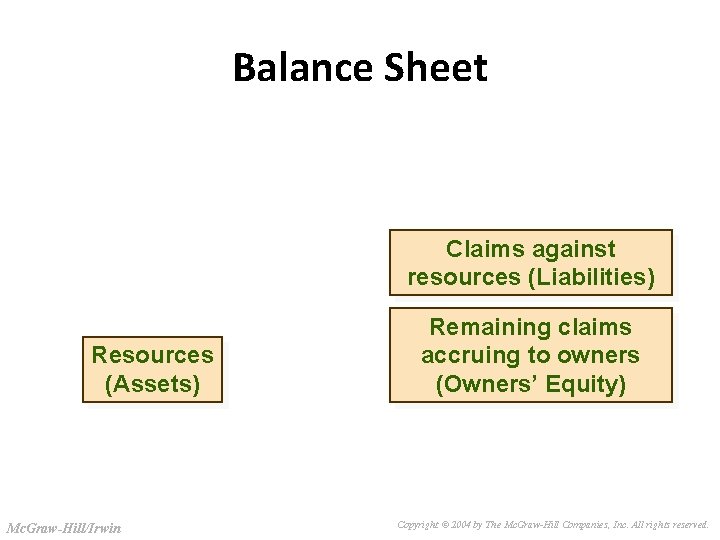
Slide 3 -4 Balance Sheet Claims against resources (Liabilities) Resources (Assets) Mc. Graw-Hill/Irwin Remaining claims accruing to owners (Owners’ Equity) Copyright © 2004 by The Mc. Graw-Hill Companies, Inc. All rights reserved.

Slide 3 -5 Current Assets Cash Receivables Inventories Prepayments Will be converted to cash or consumed within one year or the operating cycle, whichever is longer. Mc. Graw-Hill/Irwin Copyright © 2004 by The Mc. Graw-Hill Companies, Inc. All rights reserved.
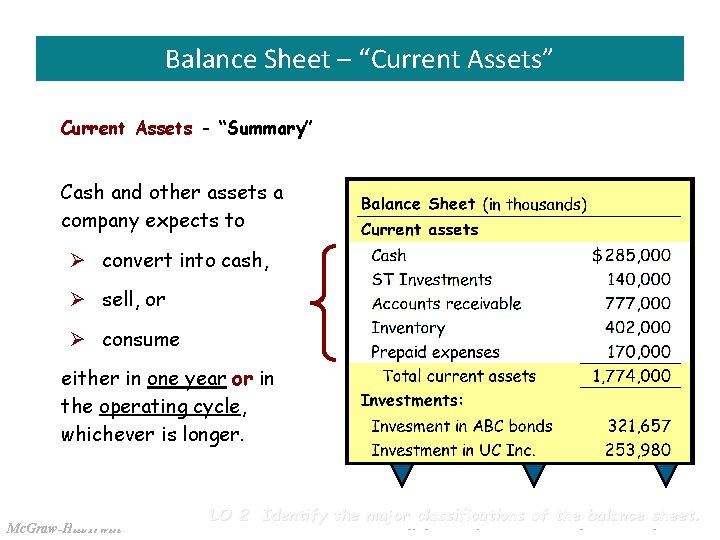
Slide 3 -6 Balance Sheet – “Current Assets” Current Assets - “Summary” Cash and other assets a company expects to Ø convert into cash, Ø sell, or Ø consume either in one year or in the operating cycle, whichever is longer. Mc. Graw-Hill/Irwin LO 2 Identify the major classifications of the balance sheet. Copyright © 2004 by The Mc. Graw-Hill Companies, Inc. All rights reserved.
Slide 3 -7 Balance Sheet – “Current Assets” Receivables Claims held against customers and others for money, goods, or services. Accounts receivable – oral promises Notes receivable – written promises Major categories of receivables should be shown in the balance sheet or the related notes. Mc. Graw-Hill/Irwin LO 2 Identify the major classifications of the balance sheet. Copyright © 2004 by The Mc. Graw-Hill Companies, Inc. All rights reserved.
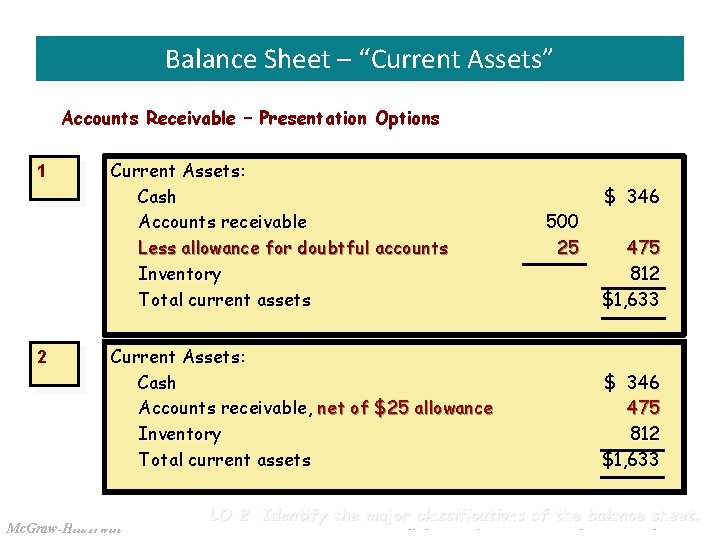
Slide 3 -8 Balance Sheet – “Current Assets” Accounts Receivable – Presentation Options 1 2 Current Assets: Cash Accounts receivable Less allowance for doubtful accounts Inventory Total current assets Current Assets: Cash Accounts receivable, net of $25 allowance Inventory Total current assets Mc. Graw-Hill/Irwin 500 25 $ 346 475 812 $1, 633 LO 2 Identify the major classifications of the balance sheet. Copyright © 2004 by The Mc. Graw-Hill Companies, Inc. All rights reserved.
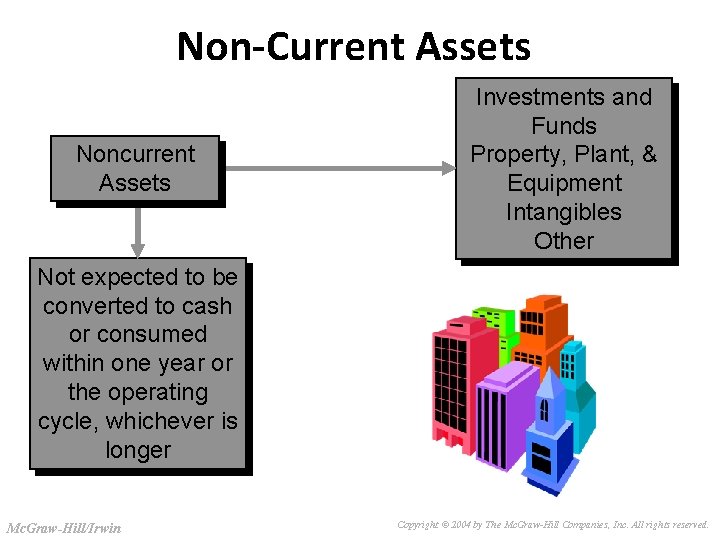
Slide 3 -9 Non-Current Assets Noncurrent Assets Investments and Funds Property, Plant, & Equipment Intangibles Other Not expected to be converted to cash or consumed within one year or the operating cycle, whichever is longer Mc. Graw-Hill/Irwin Copyright © 2004 by The Mc. Graw-Hill Companies, Inc. All rights reserved.
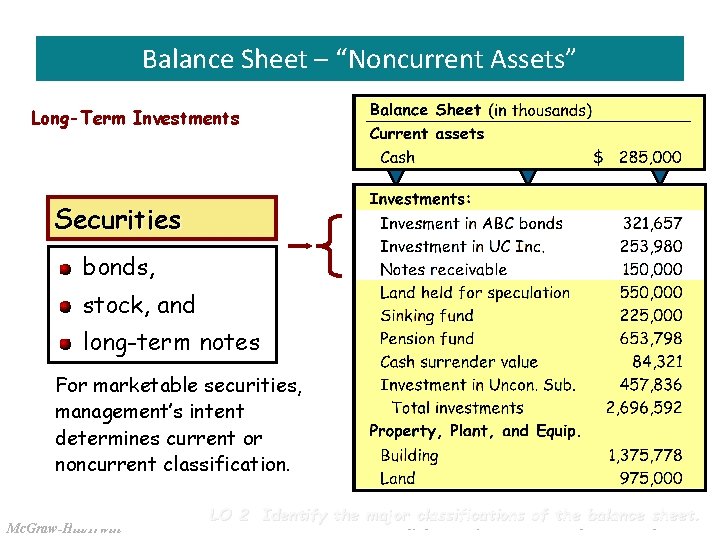
Slide 3 -10 Balance Sheet – “Noncurrent Assets” Long-Term Investments Securities bonds, stock, and long-term notes For marketable securities, management’s intent determines current or noncurrent classification. Mc. Graw-Hill/Irwin LO 2 Identify the major classifications of the balance sheet. Copyright © 2004 by The Mc. Graw-Hill Companies, Inc. All rights reserved.
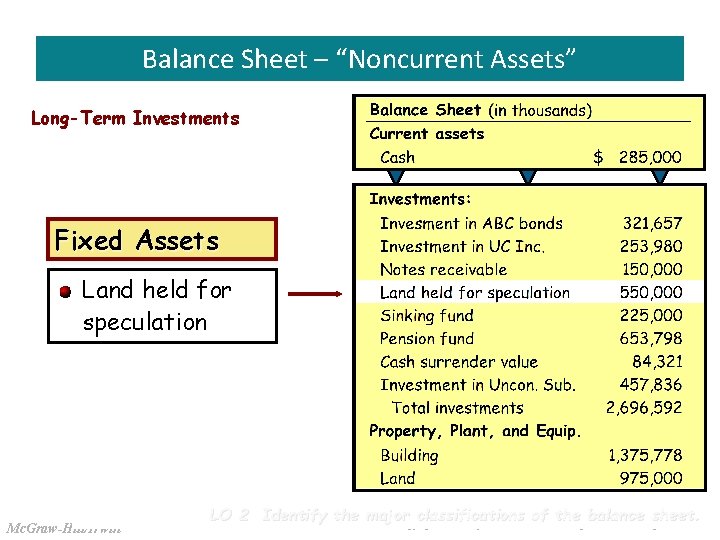
Slide 3 -11 Balance Sheet – “Noncurrent Assets” Long-Term Investments Fixed Assets Land held for speculation Mc. Graw-Hill/Irwin LO 2 Identify the major classifications of the balance sheet. Copyright © 2004 by The Mc. Graw-Hill Companies, Inc. All rights reserved.
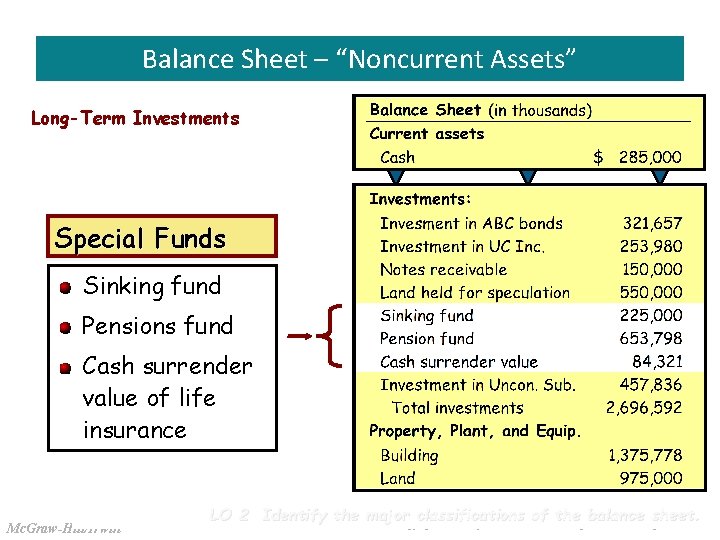
Slide 3 -12 Balance Sheet – “Noncurrent Assets” Long-Term Investments Special Funds Sinking fund Pensions fund Cash surrender value of life insurance Mc. Graw-Hill/Irwin LO 2 Identify the major classifications of the balance sheet. Copyright © 2004 by The Mc. Graw-Hill Companies, Inc. All rights reserved.
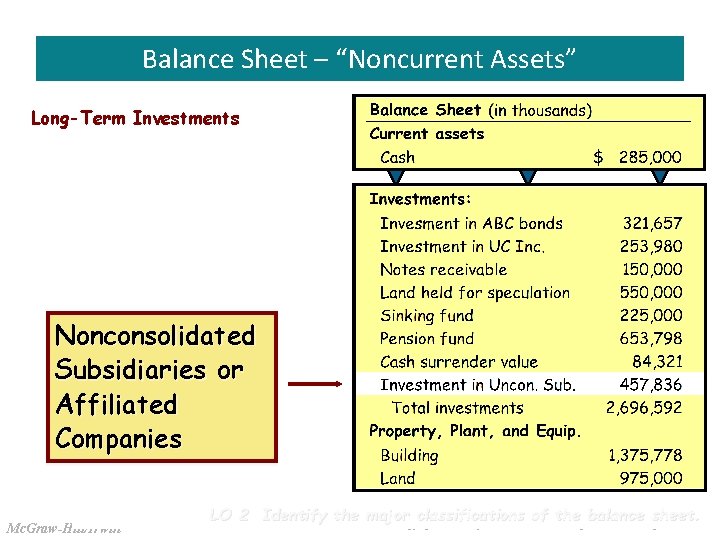
Slide 3 -13 Balance Sheet – “Noncurrent Assets” Long-Term Investments Nonconsolidated Subsidiaries or Affiliated Companies Mc. Graw-Hill/Irwin LO 2 Identify the major classifications of the balance sheet. Copyright © 2004 by The Mc. Graw-Hill Companies, Inc. All rights reserved.

Slide 3 -14 Balance Sheet – “Noncurrent Assets” Property, Plant, and Equipment Assets of a durable nature used in the regular operations of the business. Mc. Graw-Hill/Irwin LO 2 Identify the major classifications of the balance sheet. Copyright © 2004 by The Mc. Graw-Hill Companies, Inc. All rights reserved.
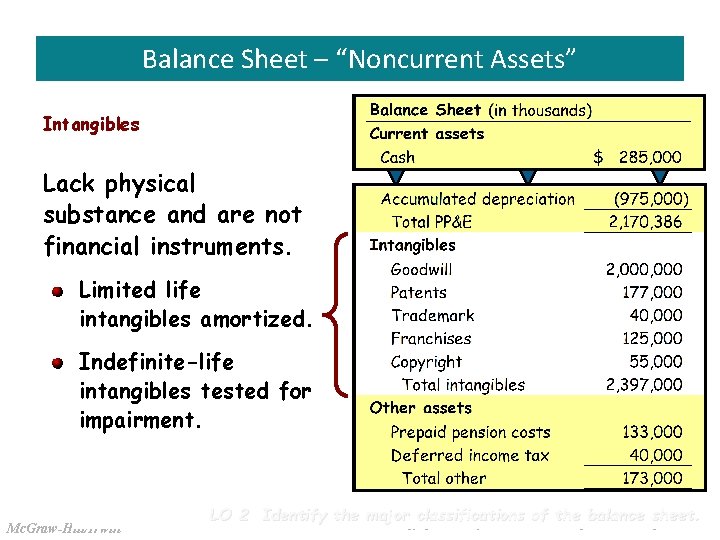
Slide 3 -15 Balance Sheet – “Noncurrent Assets” Intangibles Lack physical substance and are not financial instruments. Limited life intangibles amortized. Indefinite-life intangibles tested for impairment. Mc. Graw-Hill/Irwin LO 2 Identify the major classifications of the balance sheet. Copyright © 2004 by The Mc. Graw-Hill Companies, Inc. All rights reserved.
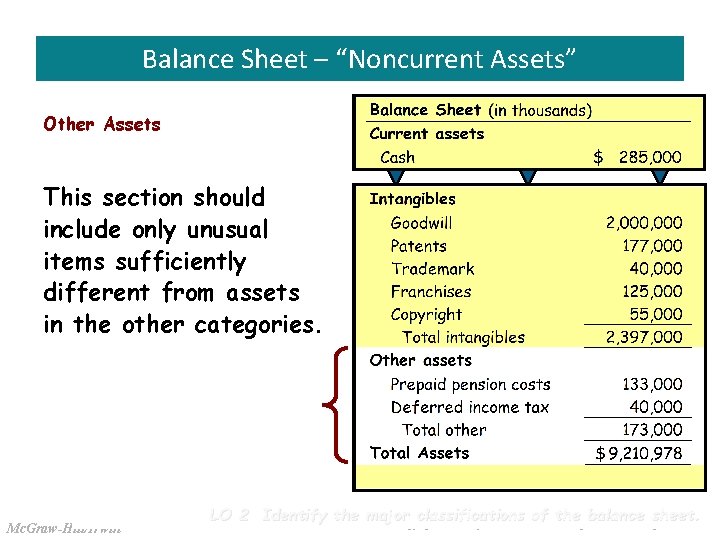
Slide 3 -16 Balance Sheet – “Noncurrent Assets” Other Assets This section should include only unusual items sufficiently different from assets in the other categories. Mc. Graw-Hill/Irwin LO 2 Identify the major classifications of the balance sheet. Copyright © 2004 by The Mc. Graw-Hill Companies, Inc. All rights reserved.
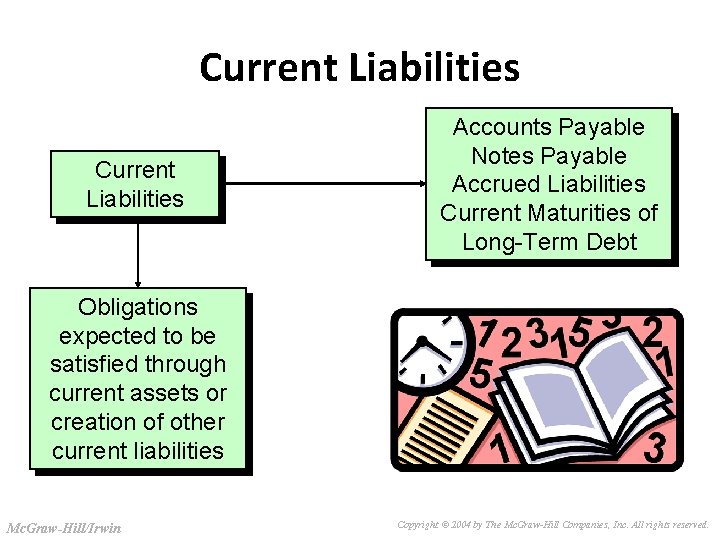
Slide 3 -17 Current Liabilities Accounts Payable Notes Payable Accrued Liabilities Current Maturities of Long-Term Debt Obligations expected to be satisfied through current assets or creation of other current liabilities Mc. Graw-Hill/Irwin Copyright © 2004 by The Mc. Graw-Hill Companies, Inc. All rights reserved.
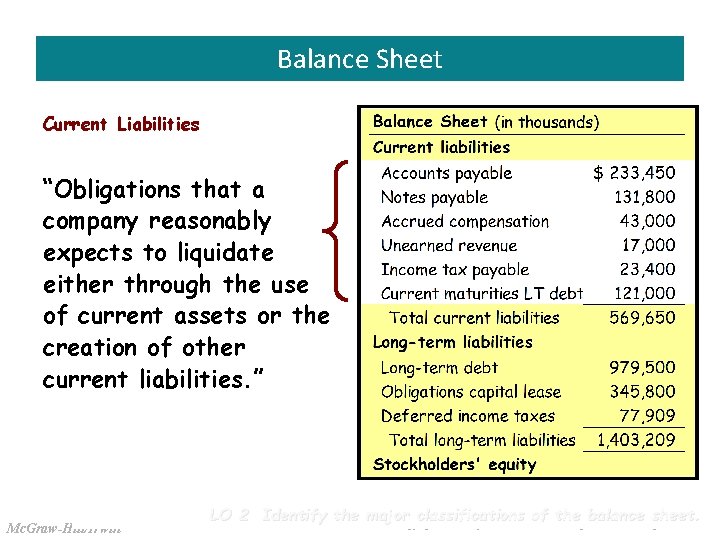
Slide 3 -18 Balance Sheet Current Liabilities “Obligations that a company reasonably expects to liquidate either through the use of current assets or the creation of other current liabilities. ” Mc. Graw-Hill/Irwin LO 2 Identify the major classifications of the balance sheet. Copyright © 2004 by The Mc. Graw-Hill Companies, Inc. All rights reserved.
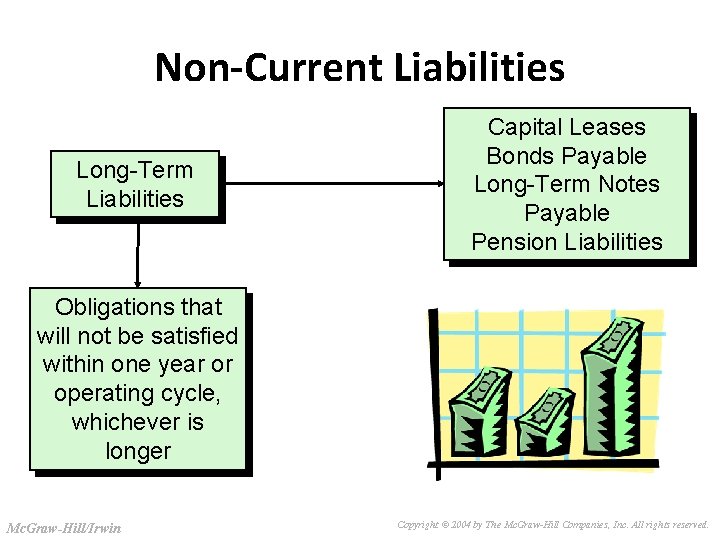
Slide 3 -19 Non-Current Liabilities Long-Term Liabilities Capital Leases Bonds Payable Long-Term Notes Payable Pension Liabilities Obligations that will not be satisfied within one year or operating cycle, whichever is longer Mc. Graw-Hill/Irwin Copyright © 2004 by The Mc. Graw-Hill Companies, Inc. All rights reserved.
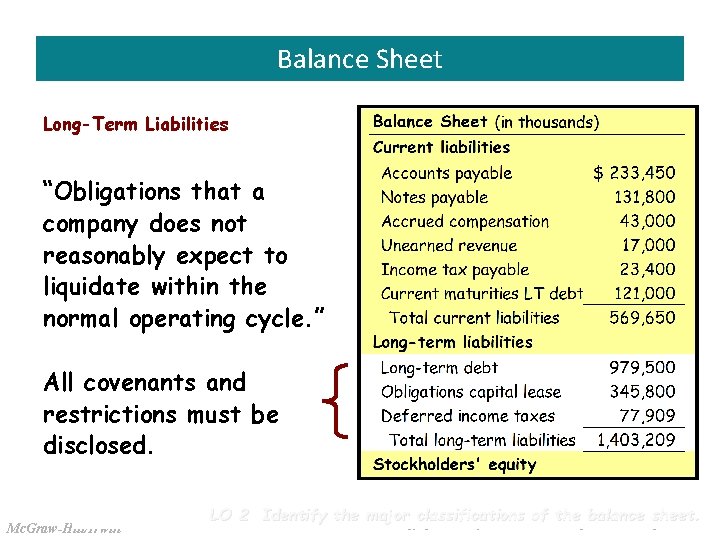
Slide 3 -20 Balance Sheet Long-Term Liabilities “Obligations that a company does not reasonably expect to liquidate within the normal operating cycle. ” All covenants and restrictions must be disclosed. Mc. Graw-Hill/Irwin LO 2 Identify the major classifications of the balance sheet. Copyright © 2004 by The Mc. Graw-Hill Companies, Inc. All rights reserved.
Slide 3 -21 Shareholders’ Equity Capital Stock Other Contributed Capital Retained Earnings Treasury Stock Accumulated Other Comprehensive Income Mc. Graw-Hill/Irwin Copyright © 2004 by The Mc. Graw-Hill Companies, Inc. All rights reserved.
Slide 3 -22 Now, let’s look at some ratios! Mc. Graw-Hill/Irwin Copyright © 2004 by The Mc. Graw-Hill Companies, Inc. All rights reserved.
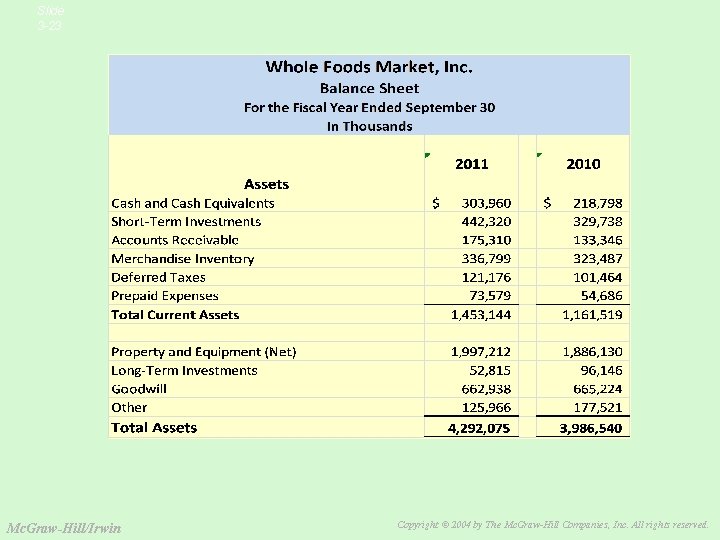
Slide 3 -23 Mc. Graw-Hill/Irwin Copyright © 2004 by The Mc. Graw-Hill Companies, Inc. All rights reserved.
Slide 3 -24 Mc. Graw-Hill/Irwin Copyright © 2004 by The Mc. Graw-Hill Companies, Inc. All rights reserved.
Slide 3 -25 Mc. Graw-Hill/Irwin Copyright © 2004 by The Mc. Graw-Hill Companies, Inc. All rights reserved.
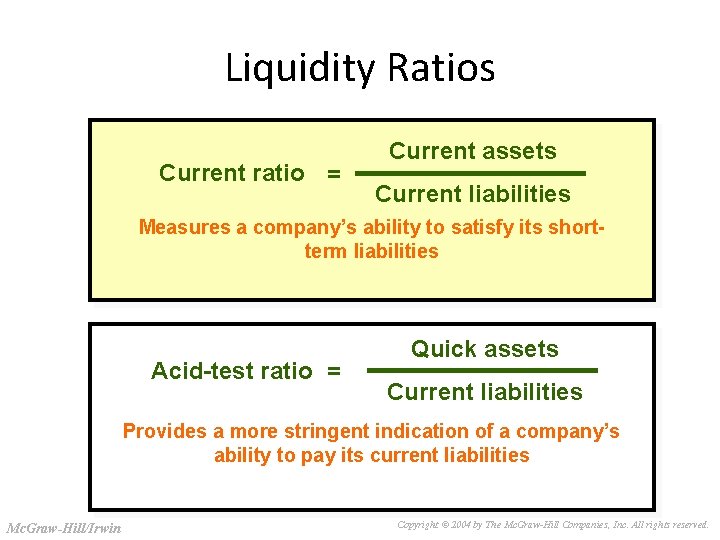
Slide 3 -26 Liquidity Ratios Current ratio = Current assets Current liabilities Measures a company’s ability to satisfy its shortterm liabilities Acid-test ratio = Quick assets Current liabilities Provides a more stringent indication of a company’s ability to pay its current liabilities Mc. Graw-Hill/Irwin Copyright © 2004 by The Mc. Graw-Hill Companies, Inc. All rights reserved.
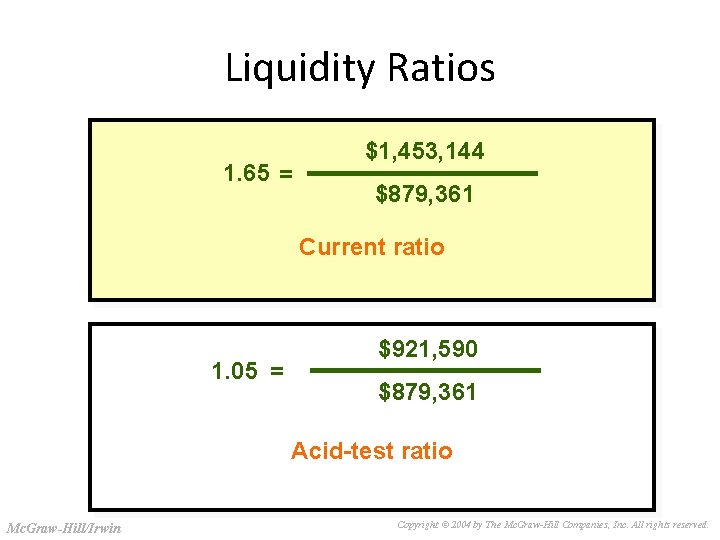
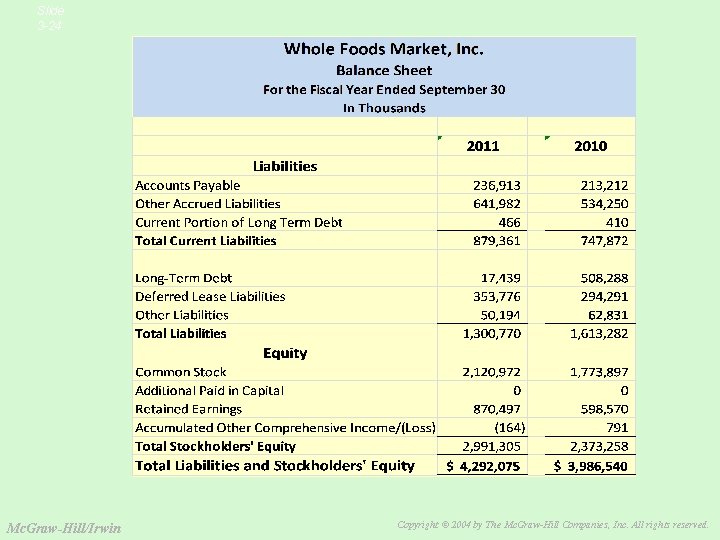
Slide 3 -27 Liquidity Ratios 1. 65 = $1, 453, 144 $879, 361 Current ratio 1. 05 = $921, 590 $879, 361 Acid-test ratio Mc. Graw-Hill/Irwin Copyright © 2004 by The Mc. Graw-Hill Companies, Inc. All rights reserved.
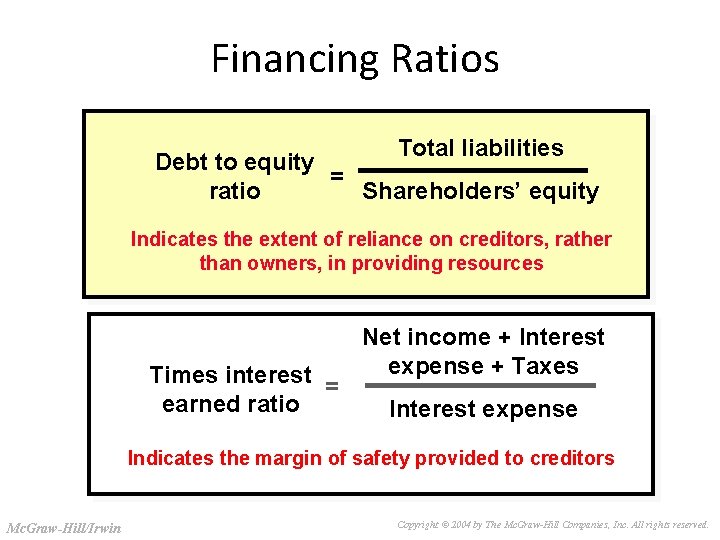
Slide 3 -28 Financing Ratios Total liabilities Debt to equity = Shareholders’ equity ratio Indicates the extent of reliance on creditors, rather than owners, in providing resources Times interest = earned ratio Net income + Interest expense + Taxes Interest expense Indicates the margin of safety provided to creditors Mc. Graw-Hill/Irwin Copyright © 2004 by The Mc. Graw-Hill Companies, Inc. All rights reserved.
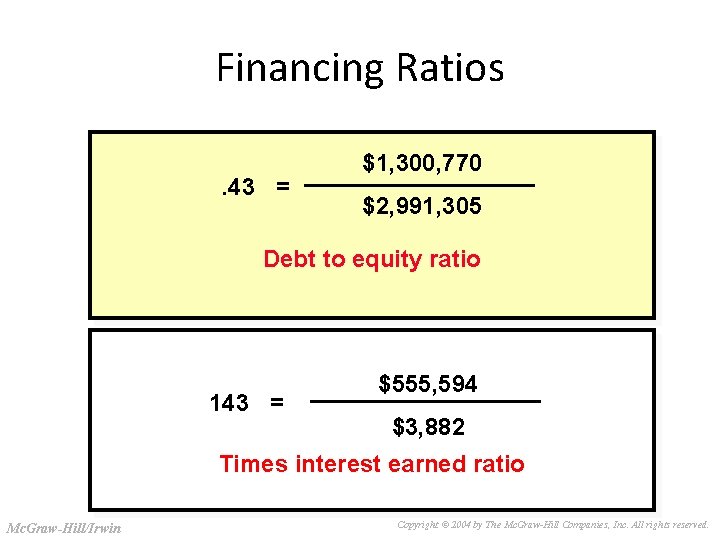
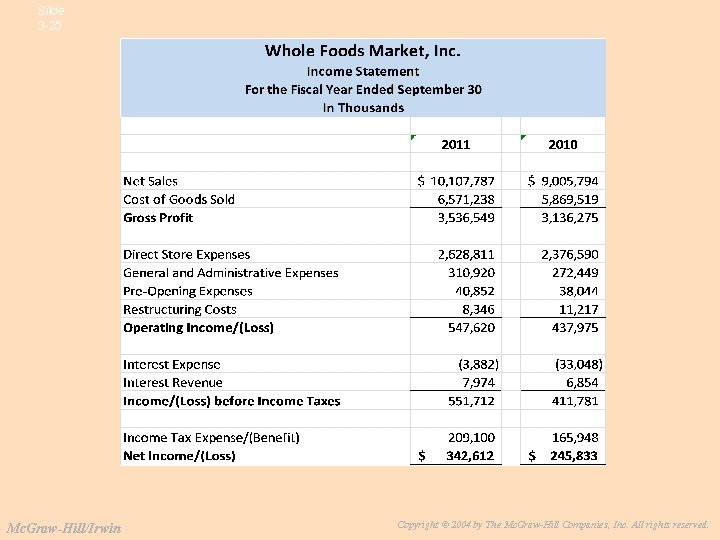
Slide 3 -29 Financing Ratios. 43 = $1, 300, 770 $2, 991, 305 Debt to equity ratio 143 = $555, 594 $3, 882 Times interest earned ratio Mc. Graw-Hill/Irwin Copyright © 2004 by The Mc. Graw-Hill Companies, Inc. All rights reserved.
Slide 3 -30 Now, let’s move on to a new topic. Mc. Graw-Hill/Irwin Copyright © 2004 by The Mc. Graw-Hill Companies, Inc. All rights reserved.
Slide 3 -31 Statement of Cash Flows The Statement of Cash Flows provides relevant information about the cash receipts and cash payments of an enterprise during a period. It provides answers to questions: 1. Where did the cash come from during the period? 2. What was the cash used for during the period? 3. What was the change in the cash balance during the period? Mc. Graw-Hill/Irwin Copyright © 2004 by The Mc. Graw-Hill Companies, Inc. All rights reserved.
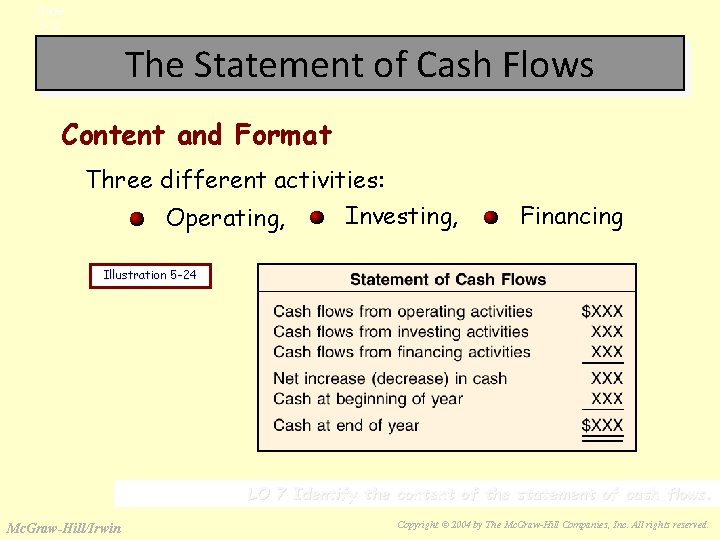
Slide 3 -32 The Statement of Cash Flows Content and Format Three different activities: Investing, Operating, Financing Illustration 5 -24 LO 7 Identify the content of the statement of cash flows. Mc. Graw-Hill/Irwin Copyright © 2004 by The Mc. Graw-Hill Companies, Inc. All rights reserved.
Slide 3 -33 Statement of Cash Flows from Operating Activities Reports the cash effects of transactions that enter into the determination of net income. The direct method and indirect method are two different approaches to report cash flows from operations. Each has its advantages and disadvantages, but each reconciles to the same number for total cash flows from operating activities. Mc. Graw-Hill/Irwin Copyright © 2004 by The Mc. Graw-Hill Companies, Inc. All rights reserved.
Slide 3 -34 Statement of Cash Flows from Investing Activities Reports cash effects of transactions that result in a change in long-term assets. For example: Buying or selling property, plant, or equipment Buying or selling financial investment instruments Mc. Graw-Hill/Irwin Copyright © 2004 by The Mc. Graw-Hill Companies, Inc. All rights reserved.
Slide 3 -35 Statement of Cash Flows from Financing Activities Reports cash effects of transactions that result in a change in long-term liabilities and stockholder’s equity. For example: Acquiring or paying down borrowings Issuing capital stock Paying dividends to stockholders Mc. Graw-Hill/Irwin Copyright © 2004 by The Mc. Graw-Hill Companies, Inc. All rights reserved.
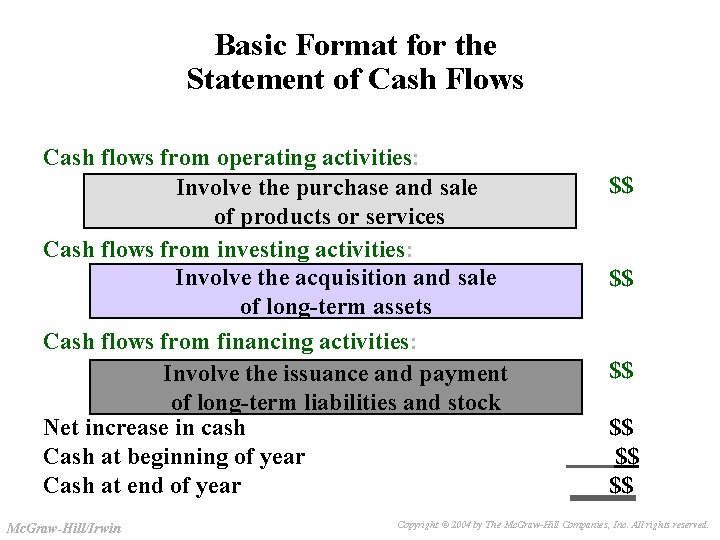
Slide 3 -36 Basic Format for the Statement of Cash Flows Cash flows from operating activities: Involve the purchase and sale of products or services Cash flows from investing activities: Involve the acquisition and sale of long-term assets Cash flows from financing activities: Involve the issuance and payment of long-term liabilities and stock Net increase in cash Cash at beginning of year Cash at end of year Mc. Graw-Hill/Irwin $$ $$ $$ Copyright © 2004 by The Mc. Graw-Hill Companies, Inc. All rights reserved.
- Slides: 36