
Slide 2 1 Views of Human Resource Management
- Slides: 40
Slide 2. 1 Views of Human Resource Management (HRM) • Human resources provide a source for competitive advantage • The quality of HRM is a critical influence on the performance of firms • A strategic approach is a characteristic of HRM • Personnel management is seen as operational • The role of business strategist will be a key role of HR specialists of the future Torrington, Hall & Taylor, Human Resource Management 6 e, © Pearson Education Limited 2005
Slide 2. 2 HR Strategy Physical document…………. Incremental process A useful starting point – ‘the intentions of the corporation both explicit and covert, toward the management of its employees through philosophies, policies, and practices’ (Tyson 1995) Torrington, Hall & Taylor, Human Resource Management 6 e, © Pearson Education Limited 2005
Slide 2. 3 Research on HR Strategy 1980 s – Focus on HR strategy documents to determine whethere was a strategic approach to HR and what the approach was Moved on to accept the idea that strategies are not finished or complete but incremental & piecemeal Torrington, Hall & Taylor, Human Resource Management 6 e, © Pearson Education Limited 2005
Slide 2. 4 Strategic HR Tends to be issue based rather than the formulation of a complete and integrated strategy Torrington, Hall & Taylor, Human Resource Management 6 e, © Pearson Education Limited 2005
Slide 2. 5 Strategy as a Process Not necessarily rational and top down but a political and evolutionary process Not necessarily determined by top management but can be influenced bottom up Is formed rather than formulated Is changed by events, opportunities, & actions of employees Realised strategy can be different from the initial version Torrington, Hall & Taylor, Human Resource Management 6 e, © Pearson Education Limited 2005
Slide 2. 6 Price Waterhouse Strategy Research Organisations with a written HR strategy generated 35% greater revenues than those without (Higginbottom 2002) Torrington, Hall & Taylor, Human Resource Management 6 e, © Pearson Education Limited 2005
Slide 2. 7 Strategy as a Process for Change 1. Sense changes in the environment 2. Develop a resultant strategy 3. Turn strategy into action Torrington, Hall & Taylor, Human Resource Management 6 e, © Pearson Education Limited 2005
Slide 2. 8 The Need to Turn Strategy Into Action Implementing the strategy quickly is an important quality needed by successful companies The capability to implement strategic plans is an important feature of successful HRM (Gensing -Pophel 1999, & Guest 1987) Torrington, Hall & Taylor, Human Resource Management 6 e, © Pearson Education Limited 2005
Slide 2. 9 Problems in Turning Strategy Into Action (1 of 2) Lack of attention to the implementation of strategy (Beaumont 1992) Implementation often patchy and sometimes contradictory (Legge 1995) Torrington, Hall & Taylor, Human Resource Management 6 e, © Pearson Education Limited 2005
Slide 2. 10 Problems in Turning Strategy Into Action (2 of 2) Responsibility for implementation often unclear (Skinner & Mabey 1997) HR strategy only a minor influence on HR policies and procedures used (Kane & Palmer 1995) Torrington, Hall & Taylor, Human Resource Management 6 e, © Pearson Education Limited 2005
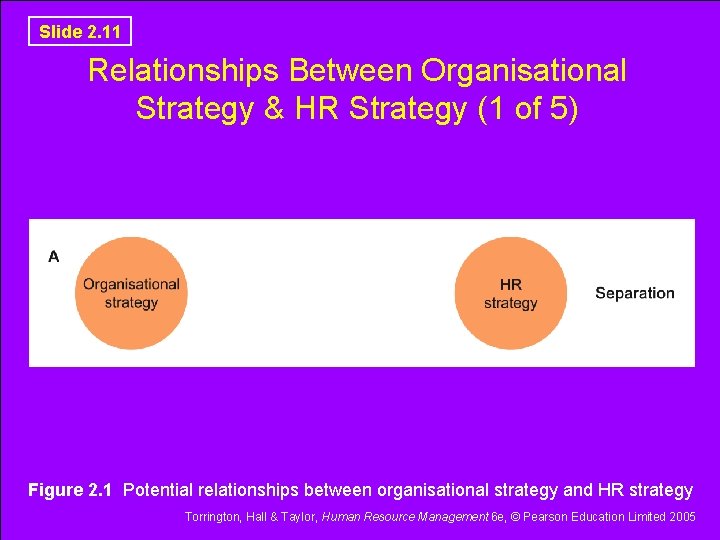
Slide 2. 11 Relationships Between Organisational Strategy & HR Strategy (1 of 5) Figure 2. 1 Potential relationships between organisational strategy and HR strategy Torrington, Hall & Taylor, Human Resource Management 6 e, © Pearson Education Limited 2005
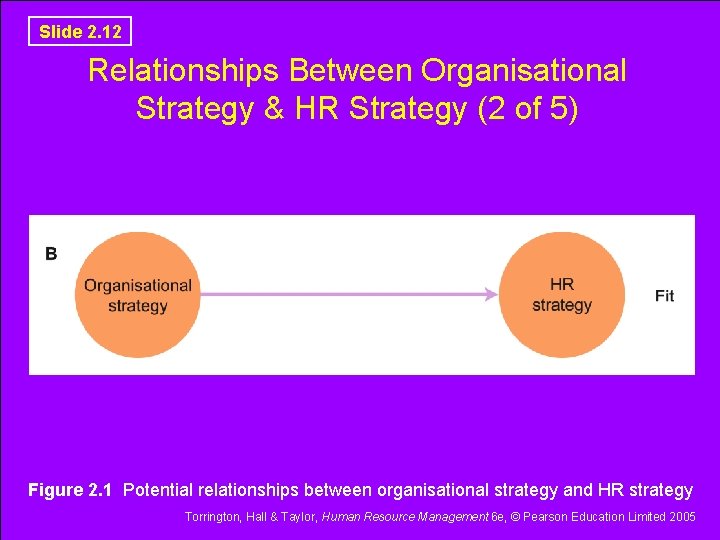
Slide 2. 12 Relationships Between Organisational Strategy & HR Strategy (2 of 5) Figure 2. 1 Potential relationships between organisational strategy and HR strategy Torrington, Hall & Taylor, Human Resource Management 6 e, © Pearson Education Limited 2005
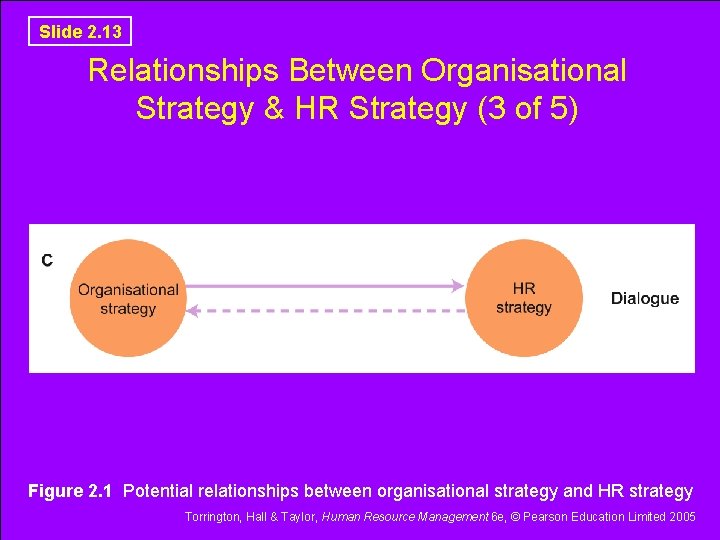
Slide 2. 13 Relationships Between Organisational Strategy & HR Strategy (3 of 5) Figure 2. 1 Potential relationships between organisational strategy and HR strategy Torrington, Hall & Taylor, Human Resource Management 6 e, © Pearson Education Limited 2005
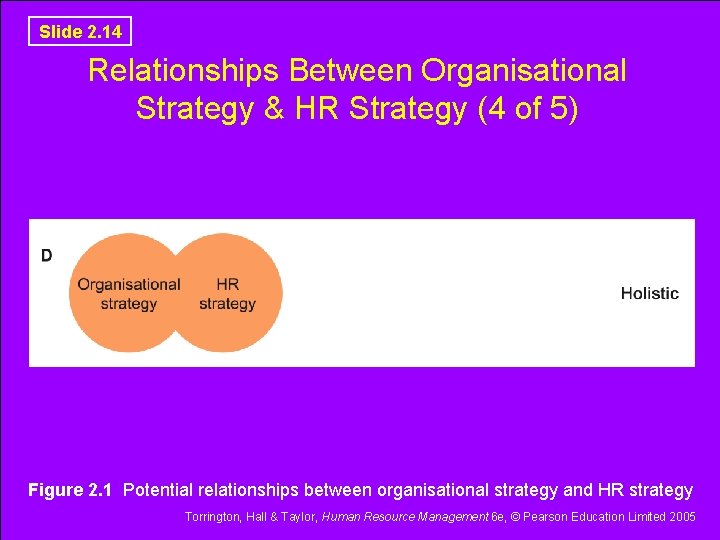
Slide 2. 14 Relationships Between Organisational Strategy & HR Strategy (4 of 5) Figure 2. 1 Potential relationships between organisational strategy and HR strategy Torrington, Hall & Taylor, Human Resource Management 6 e, © Pearson Education Limited 2005
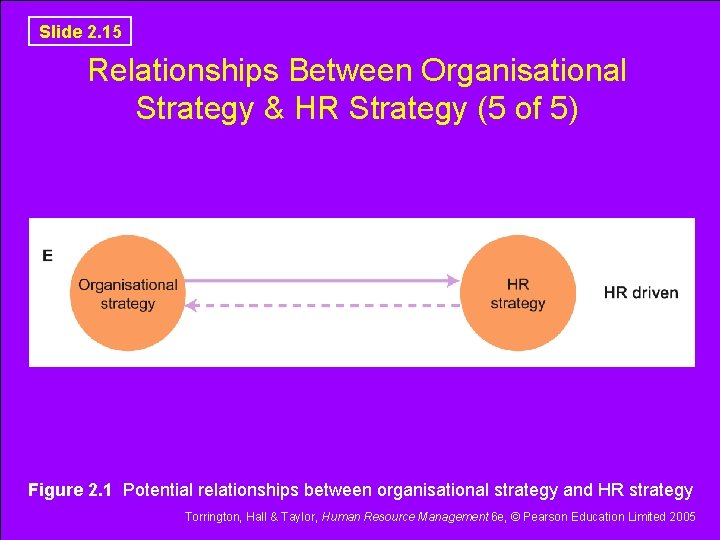
Slide 2. 15 Relationships Between Organisational Strategy & HR Strategy (5 of 5) Figure 2. 1 Potential relationships between organisational strategy and HR strategy Torrington, Hall & Taylor, Human Resource Management 6 e, © Pearson Education Limited 2005
Slide 2. 16 Link Between Business & Strategy (1 of 2) • • • Separation – typical picture of 20 years ago still exists today in smaller organisations Fit – reflects importance of people in achieving organisational strategy Dialogue – recognises the need for two way communication Torrington, Hall & Taylor, Human Resource Management 6 e, © Pearson Education Limited 2005
Slide 2. 17 Link Between Business & Strategy (2 of 2) • Holistic – Organisational staff key to competitive advantage • HR Driven – Places HR strategy in prime position Torrington, Hall & Taylor, Human Resource Management 6 e, © Pearson Education Limited 2005
Slide 2. 18 Theoretical Perspectives of HRM 1. Universalist approach 2. Fit or contingency approach 3. Resource based approach Torrington, Hall & Taylor, Human Resource Management 6 e, © Pearson Education Limited 2005
Slide 2. 19 Universalist Approach • One high commitment model of labour management • Relates to high organisational performance in all contexts • Clarity of goals Torrington, Hall & Taylor, Human Resource Management 6 e, © Pearson Education Limited 2005
Slide 2. 20 Guest’s Theory of HRM • Prescriptive model • Based on 4 HR Policy goals – strategic integration, commitment, flexibility, & quality • All goals need to be achieved Torrington, Hall & Taylor, Human Resource Management 6 e, © Pearson Education Limited 2005
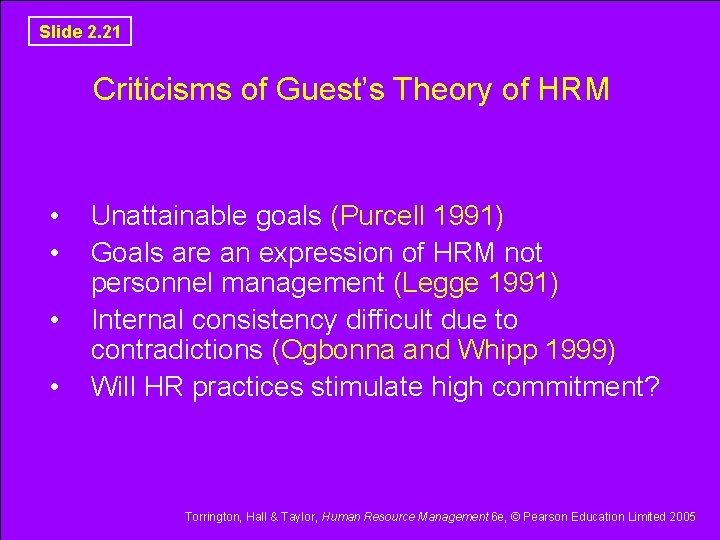
Slide 2. 21 Criticisms of Guest’s Theory of HRM • • Unattainable goals (Purcell 1991) Goals are an expression of HRM not personnel management (Legge 1991) Internal consistency difficult due to contradictions (Ogbonna and Whipp 1999) Will HR practices stimulate high commitment? Torrington, Hall & Taylor, Human Resource Management 6 e, © Pearson Education Limited 2005
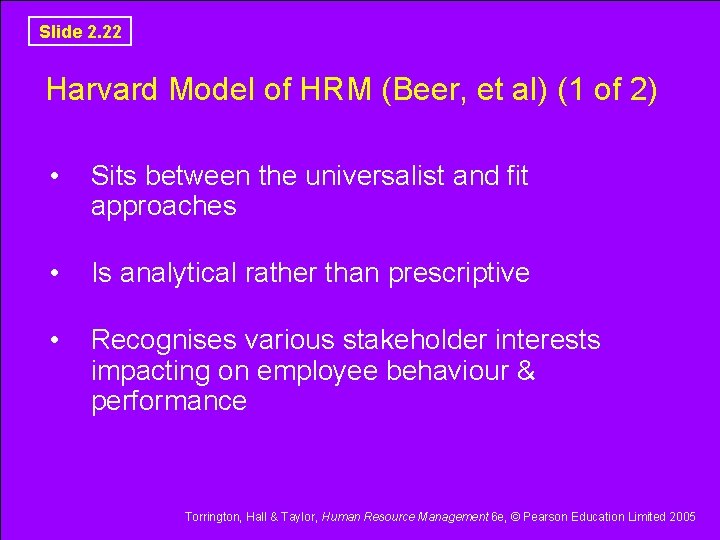
Slide 2. 22 Harvard Model of HRM (Beer, et al) (1 of 2) • Sits between the universalist and fit approaches • Is analytical rather than prescriptive • Recognises various stakeholder interests impacting on employee behaviour & performance Torrington, Hall & Taylor, Human Resource Management 6 e, © Pearson Education Limited 2005
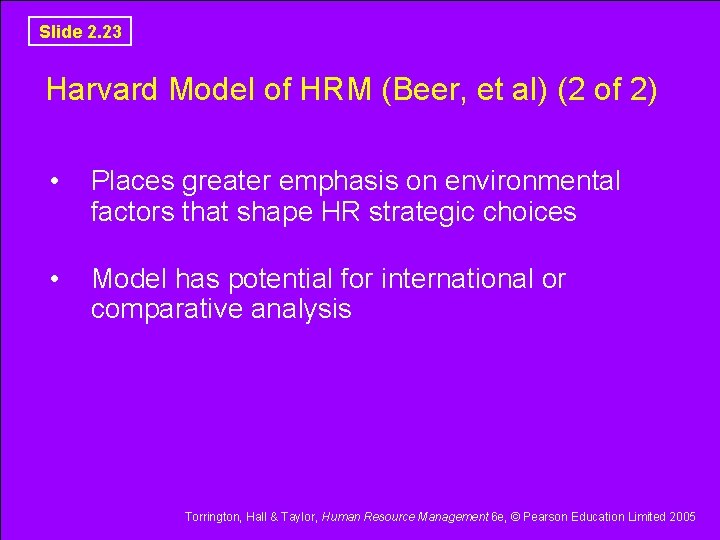
Slide 2. 23 Harvard Model of HRM (Beer, et al) (2 of 2) • Places greater emphasis on environmental factors that shape HR strategic choices • Model has potential for international or comparative analysis Torrington, Hall & Taylor, Human Resource Management 6 e, © Pearson Education Limited 2005
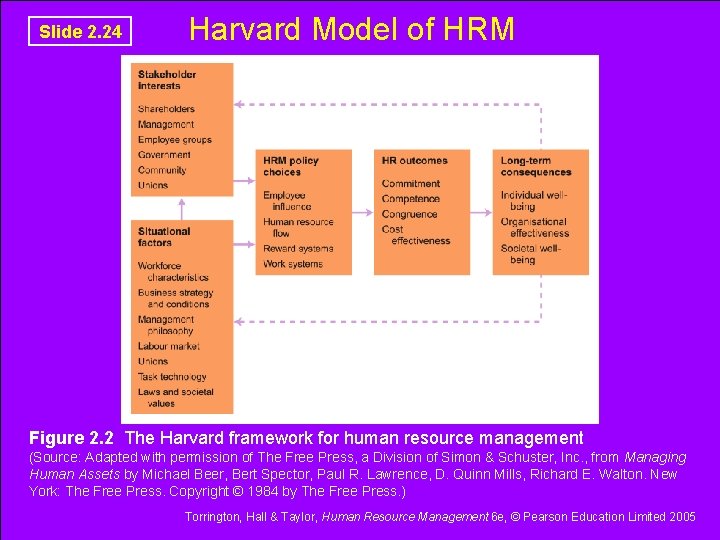
Slide 2. 24 Harvard Model of HRM Figure 2. 2 The Harvard framework for human resource management (Source: Adapted with permission of The Free Press, a Division of Simon & Schuster, Inc. , from Managing Human Assets by Michael Beer, Bert Spector, Paul R. Lawrence, D. Quinn Mills, Richard E. Walton. New York: The Free Press. Copyright © 1984 by The Free Press. ) Torrington, Hall & Taylor, Human Resource Management 6 e, © Pearson Education Limited 2005
Slide 2. 25 Criticisms of the Harvard Model of HRM • There are some prescriptive elements that can lead to some confusion • Prescription is found in the HR outcomes box where specific outcomes are identified as universally desirable Torrington, Hall & Taylor, Human Resource Management 6 e, © Pearson Education Limited 2005
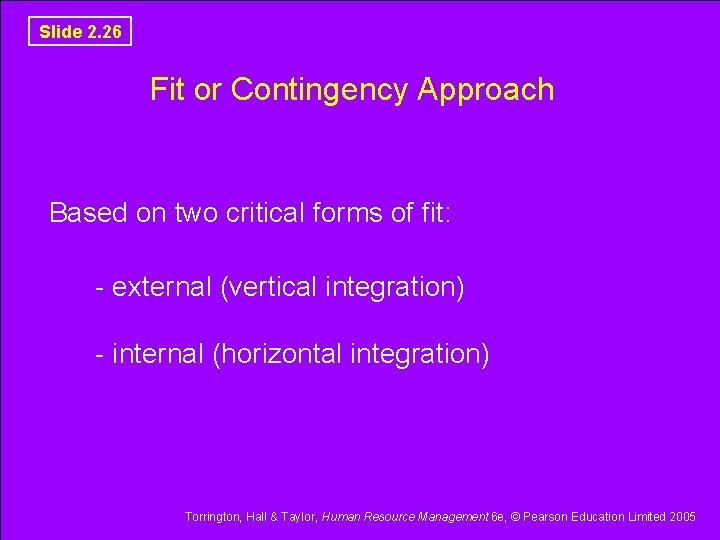
Slide 2. 26 Fit or Contingency Approach Based on two critical forms of fit: - external (vertical integration) - internal (horizontal integration) Torrington, Hall & Taylor, Human Resource Management 6 e, © Pearson Education Limited 2005
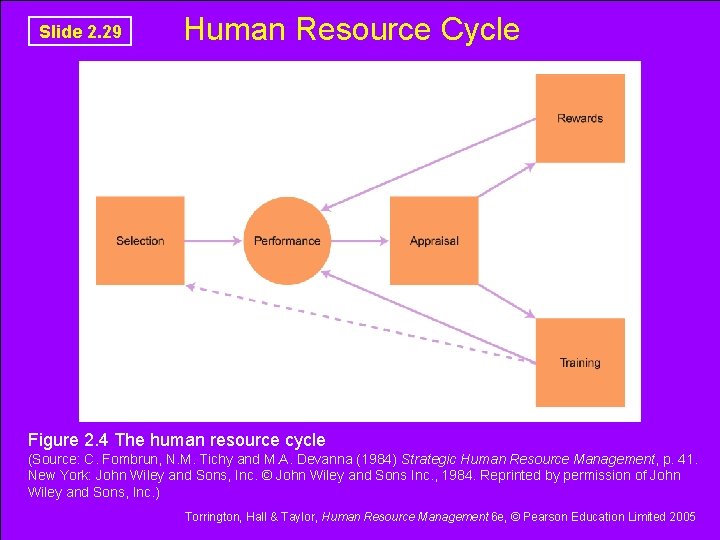
Slide 2. 27 Strength of Fit or Contingency Approach Provides a simple framework that shows how selection, appraisal, development and reward can be mutually geared to produce the required employee performance Torrington, Hall & Taylor, Human Resource Management 6 e, © Pearson Education Limited 2005
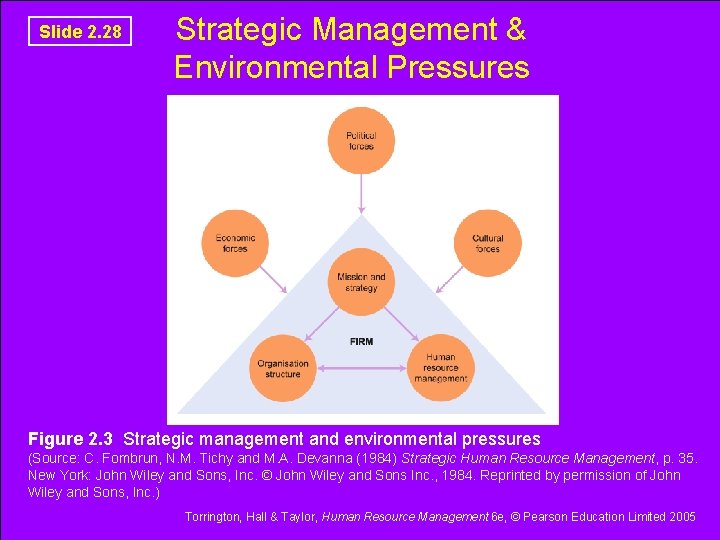
Slide 2. 28 Strategic Management & Environmental Pressures Figure 2. 3 Strategic management and environmental pressures (Source: C. Fombrun, N. M. Tichy and M. A. Devanna (1984) Strategic Human Resource Management, p. 35. New York: John Wiley and Sons, Inc. © John Wiley and Sons Inc. , 1984. Reprinted by permission of John Wiley and Sons, Inc. ) Torrington, Hall & Taylor, Human Resource Management 6 e, © Pearson Education Limited 2005
Slide 2. 29 Human Resource Cycle Figure 2. 4 The human resource cycle (Source: C. Fombrun, N. M. Tichy and M. A. Devanna (1984) Strategic Human Resource Management, p. 41. New York: John Wiley and Sons, Inc. © John Wiley and Sons Inc. , 1984. Reprinted by permission of John Wiley and Sons, Inc. ) Torrington, Hall & Taylor, Human Resource Management 6 e, © Pearson Education Limited 2005
Slide 2. 30 Criticisms of the Fit / Contingency Approach • • • Simplistic response to organisational strategy Does not address - what if it is not possible to produce an HR response that enables the required employee behaviour and performance Dependence on a rational strategy formulation Has a one way organisational strategy relationship Has unitarist assumptions Torrington, Hall & Taylor, Human Resource Management 6 e, © Pearson Education Limited 2005
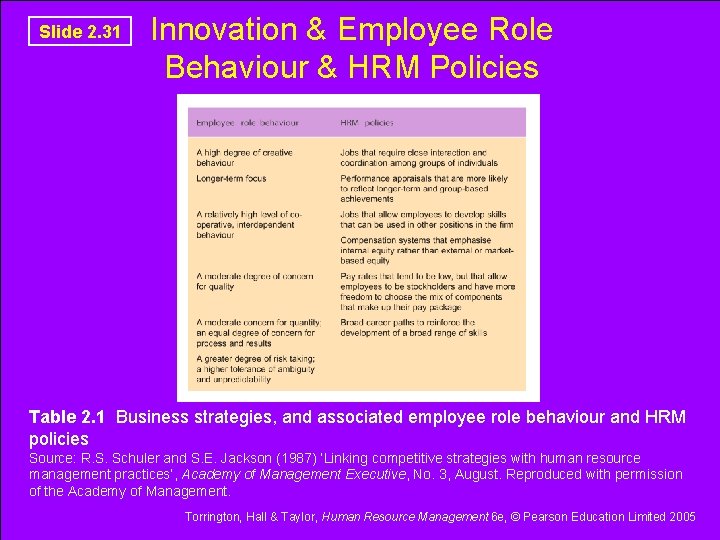
Slide 2. 31 Innovation & Employee Role Behaviour & HRM Policies Table 2. 1 Business strategies, and associated employee role behaviour and HRM policies Source: R. S. Schuler and S. E. Jackson (1987) ‘Linking competitive strategies with human resource management practices’, Academy of Management Executive, No. 3, August. Reproduced with permission of the Academy of Management. Torrington, Hall & Taylor, Human Resource Management 6 e, © Pearson Education Limited 2005
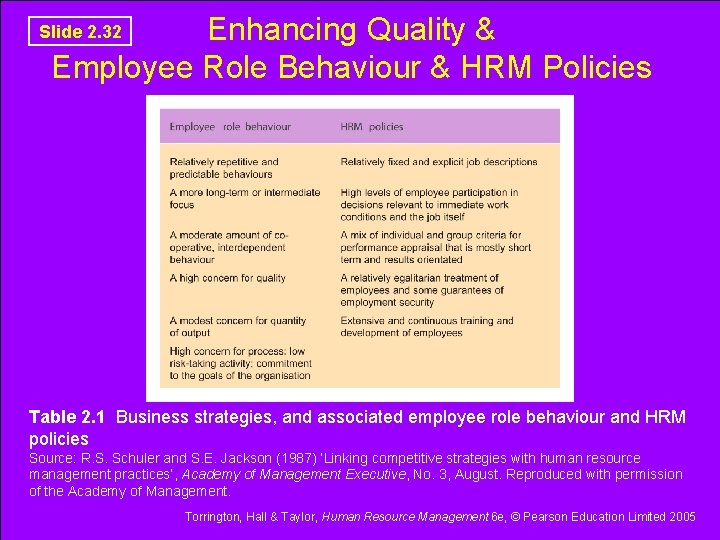
Enhancing Quality & Employee Role Behaviour & HRM Policies Slide 2. 32 Table 2. 1 Business strategies, and associated employee role behaviour and HRM policies Source: R. S. Schuler and S. E. Jackson (1987) ‘Linking competitive strategies with human resource management practices’, Academy of Management Executive, No. 3, August. Reproduced with permission of the Academy of Management. Torrington, Hall & Taylor, Human Resource Management 6 e, © Pearson Education Limited 2005
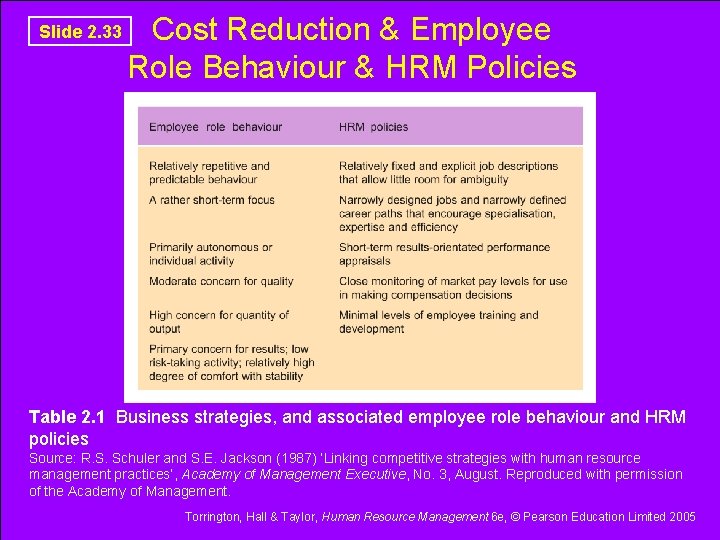
Slide 2. 33 Cost Reduction & Employee Role Behaviour & HRM Policies Table 2. 1 Business strategies, and associated employee role behaviour and HRM policies Source: R. S. Schuler and S. E. Jackson (1987) ‘Linking competitive strategies with human resource management practices’, Academy of Management Executive, No. 3, August. Reproduced with permission of the Academy of Management. Torrington, Hall & Taylor, Human Resource Management 6 e, © Pearson Education Limited 2005
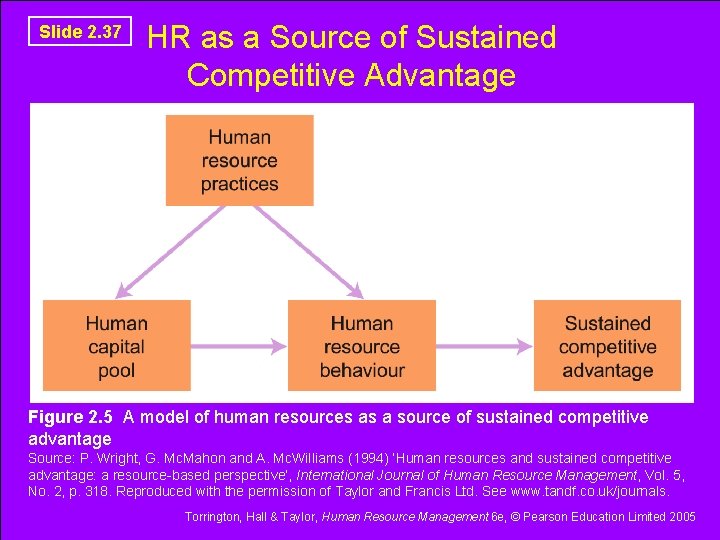
Slide 2. 34 Resource Based Approach (1 of 2) • Concerned with the relationships between internal resources, strategy, & business performance • Focuses on promoting sustained competitive advantage via developing human capital Torrington, Hall & Taylor, Human Resource Management 6 e, © Pearson Education Limited 2005
Slide 2. 35 Resource Based Approach (2 of 2) • HR unique and cannot be copied by others • Focus much wider – also on skills, knowledge, attitudes and competencies • Value created by matching individual competencies to requirements of the business Torrington, Hall & Taylor, Human Resource Management 6 e, © Pearson Education Limited 2005
Slide 2. 36 Resource Criteria Required To Sustain Competitive Advantage 1. Valuable 2. Rarity 3. Inimitable 4. Non substitutable (Wright et al, 1994) Torrington, Hall & Taylor, Human Resource Management 6 e, © Pearson Education Limited 2005
Slide 2. 37 HR as a Source of Sustained Competitive Advantage Figure 2. 5 A model of human resources as a source of sustained competitive advantage Source: P. Wright, G. Mc. Mahon and A. Mc. Williams (1994) ‘Human resources and sustained competitive advantage: a resource-based perspective’, International Journal of Human Resource Management, Vol. 5, No. 2, p. 318. Reproduced with the permission of Taylor and Francis Ltd. See www. tandf. co. uk/journals. Torrington, Hall & Taylor, Human Resource Management 6 e, © Pearson Education Limited 2005
Slide 2. 38 Does Theory Matter? • • • Are there right and wrong approaches? Each theory can be interpreted and applied in different ways Can different theories apply to different groups in the workplace? Understanding theories enables the interpretation of the current HR strategy position Can encourage people to challenge current thinking and open up new possibilities Torrington, Hall & Taylor, Human Resource Management 6 e, © Pearson Education Limited 2005
Slide 2. 39 Factors Affecting The Role of HR Function in Strategy • Senior HR person being member of board of directors • Overall philosophy of the business towards valuing its people • The mindset of the Chief Executive (CE) • The working relationship between the CE and most senior HR person Torrington, Hall & Taylor, Human Resource Management 6 e, © Pearson Education Limited 2005
Slide 2. 40 Summary • • The concept of strategic HRM strategy promotes strategic thinking and adoption of a strategic orientation Link between business strategy and HR strategy is critical Strategic HRM theory – universalist, contingency/fit, and resource based Many factors influence HR specialist role and influence in HR strategy Torrington, Hall & Taylor, Human Resource Management 6 e, © Pearson Education Limited 2005