
Slide 2 1 INTRODUCTION TO CULTURE Browaeys Price
Slide 2. 1 INTRODUCTION TO CULTURE Browaeys & Price, Understanding Cross-Cultural Management, 2 nd Edition © Pearson Education Limited 2011
Slide 2. 2 Determinants of Culture • Facets of culture – What does culture really mean? – Norms and values – Cultural assumptions in management • Levels of cultures – From national culture to culture and management. Browaeys & Price, Understanding Cross-Cultural Management, 2 nd Edition © Pearson Education Limited 2011
Slide 2. 3 The Concept of Culture What culture is? /is not? • Culture is a code of attitudes, norms and values, the way of thinking. . . • Culture determines: – How we see ourselves – How we see the world • Culture is not right or wrong, inherited, about individual behaviour. . . Browaeys & Price, Understanding Cross-Cultural Management, 2 nd Edition © Pearson Education Limited 2011
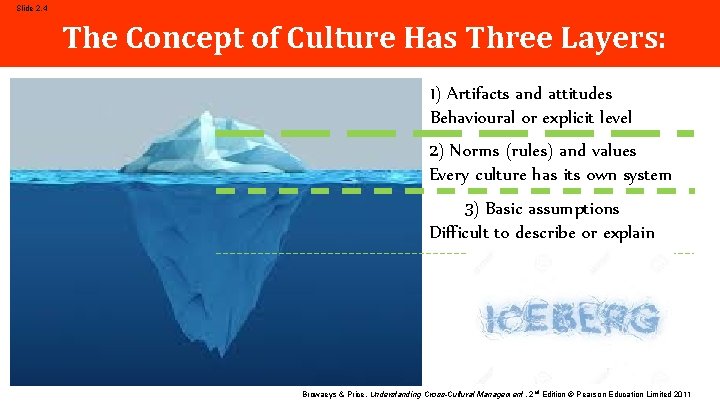
Slide 2. 4 The Concept of Culture Has Three Layers: 1) Artifacts and attitudes Behavioural or explicit level 2) Norms (rules) and values Every culture has its own system 3) Basic assumptions Difficult to describe or explain Browaeys & Price, Understanding Cross-Cultural Management, 2 nd Edition © Pearson Education Limited 2011
Slide 2. 5 Levels of Cultures in A Business Context Cultures can develop at different levels: • Culture and nation • National culture • Organizational culture • Corporate culture • Professional culture • Culture and management Browaeys & Price, Understanding Cross-Cultural Management, 2 nd Edition © Pearson Education Limited 2011
Slide 2. 6 Culture and Nation Influence of culture/nation on organizations: • Macro level – Laws and economic institutions – The nation must be considered by organizations going about their business. • Micro level – The organization is influenced through a number of cultural elements relating to: • employer–employee relationships • behaviour among employees Browaeys & Price, Understanding Cross-Cultural Management, 2 nd Edition © Pearson Education Limited 2011
Slide 2. 7 National Culture • Elements that contribute to the creation of a national culture: – Physical environment – History of the nation • Institutions that contribute to the establishment of a national culture – Family/Religion/Education – Mass communication media – The multinational company as culture-building institution. (Tabey, 2003) Browaeys & Price, Understanding Cross-Cultural Management, 2 nd Edition © Pearson Education Limited 2011
Slide 2. 8 Organizational Culture • In organizations, culture affects the way: – strategy is determined – goals are established – how the organization operates • The personnel of the organization: – are influenced by their cultural backgrounds – share their own values and perceptions. (Schein, 1999) Browaeys & Price, Understanding Cross-Cultural Management, 2 nd Edition © Pearson Education Limited 2011
Slide 2. 9 Cultural Assumptions in Management Edgar Schein defines culture as: ‘a set of basic assumptions – shared solutions to universal problems of external adaptation (how to survive) and internal integration (how to stay together) - which have evolved over time and are handed down from one generation to the next’ (Schein, 2004, p. 4) Browaeys & Price, Understanding Cross-Cultural Management, 2 nd Edition © Pearson Education Limited 2011
Slide 2. 10 Corporate Culture • Corporate culture is a combination of: – Organizational culture – National/regional culture • Two differing views on the influence of corporate culture on a (multi-) national company: – Success depends on it having either 1. A clearly defined corporate culture, or 2. A flexible culture. • Internal factors play an important role, in particular the extent of cultural control. Browaeys & Price, Understanding Cross-Cultural Management, 2 nd Edition © Pearson Education Limited 2011

Slide 2. 11 Professional Culture Three professional cultures in management: • Operators – involved in production (goods/services) • Engineers – design and monitor the technology • Executives – senior managers (Schein, 1996) The question remains: how do these professional cultures co-exist? Browaeys & Price, Understanding Cross-Cultural Management, 2 nd Edition © Pearson Education Limited 2011

Slide 2. 12 Culture and Management Cross-cultural management • Explains the behaviour of people in organizations around the world • Describes and compares organizational behaviour across countries and cultures • Seeks to understand improve the interaction of : co-workers, managers, executives, clients, suppliers and alliance partners. (Adler, 2002) Browaeys & Price, Understanding Cross-Cultural Management, 2 nd Edition © Pearson Education Limited 2011
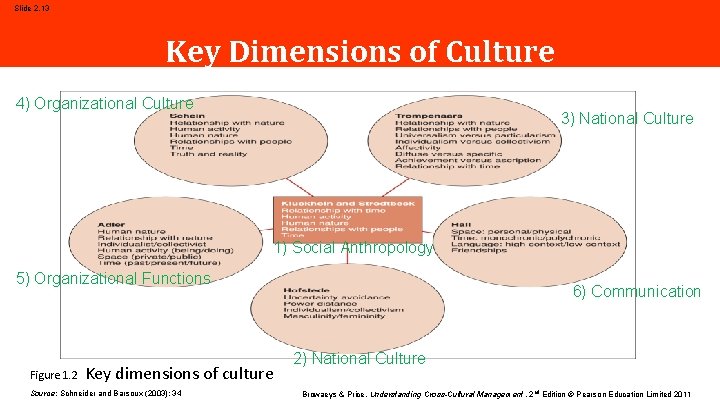
Slide 2. 13 Key Dimensions of Culture 4) Organizational Culture 3) National Culture 1) Social Anthropology 5) Organizational Functions Figure 1. 2 Key dimensions of culture Source: Schneider and Barsoux (2003): 34 6) Communication 2) National Culture Browaeys & Price, Understanding Cross-Cultural Management, 2 nd Edition © Pearson Education Limited 2011
- Slides: 13