Slide 19 LECTURE WEEK 6 Examining Integrated Marketing
- Slides: 36
Slide 19. LECTURE WEEK 6 Examining Integrated Marketing Communications Kotler, Keller, Brady, Goodman and Hansen, Marketing Management, 1 st Edition © Pearson Education Limited 2009
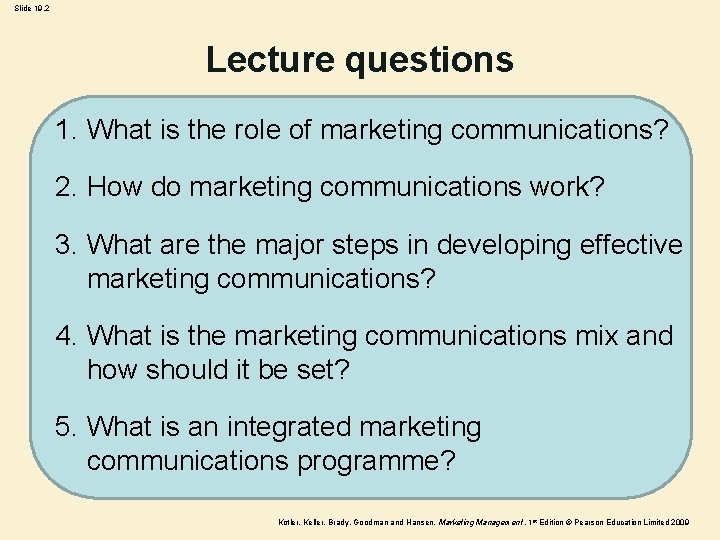
Slide 19. 2 Lecture questions 1. What is the role of marketing communications? 2. How do marketing communications work? 3. What are the major steps in developing effective marketing communications? 4. What is the marketing communications mix and how should it be set? 5. What is an integrated marketing communications programme? Kotler, Keller, Brady, Goodman and Hansen, Marketing Management, 1 st Edition © Pearson Education Limited 2009
Slide 19. 3 What are marketing communications? Marketing communications are the means by which firms attempt to inform, persuade and remind consumers, directly or indirectly, about the products and brands they sell. Kotler, Keller, Brady, Goodman and Hansen, Marketing Management, 1 st Edition © Pearson Education Limited 2009
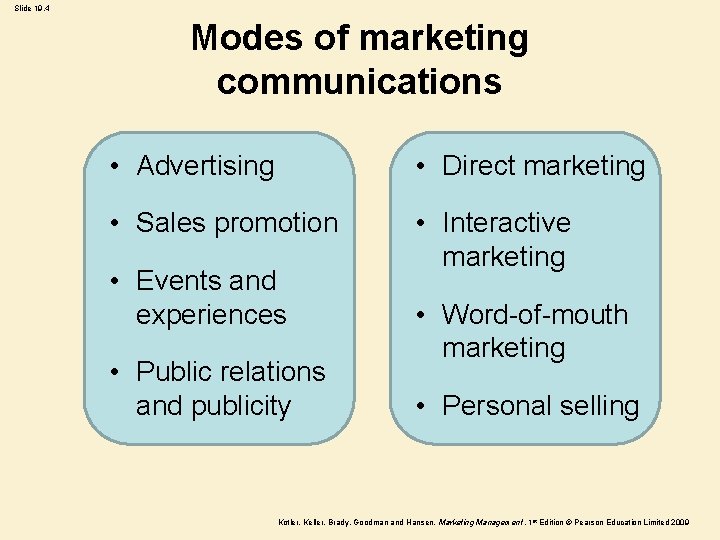
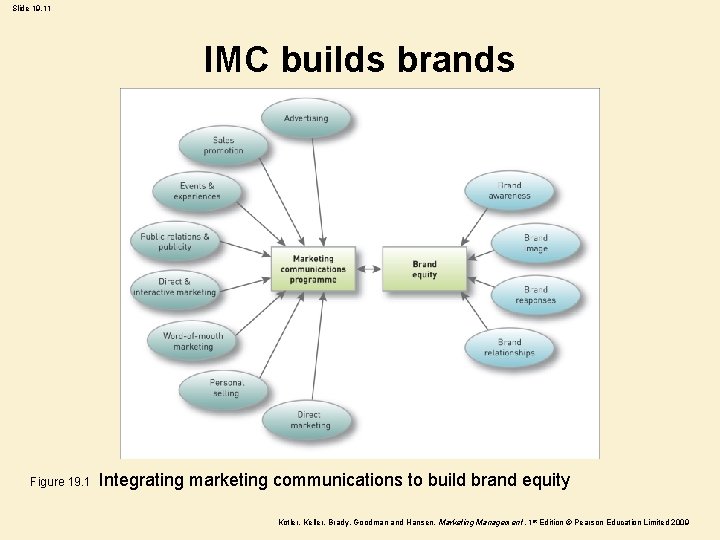
Slide 19. 4 Modes of marketing communications • Advertising • Direct marketing • Sales promotion • Interactive marketing • Events and experiences • Public relations and publicity • Word-of-mouth marketing • Personal selling Kotler, Keller, Brady, Goodman and Hansen, Marketing Management, 1 st Edition © Pearson Education Limited 2009
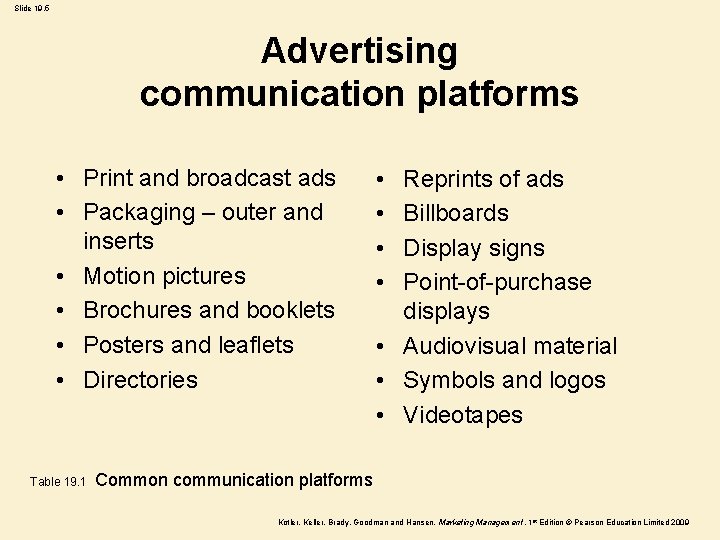
Slide 19. 5 Advertising communication platforms • Print and broadcast ads • Packaging – outer and inserts • Motion pictures • Brochures and booklets • Posters and leaflets • Directories Table 19. 1 • • Reprints of ads Billboards Display signs Point-of-purchase displays • Audiovisual material • Symbols and logos • Videotapes Common communication platforms Kotler, Keller, Brady, Goodman and Hansen, Marketing Management, 1 st Edition © Pearson Education Limited 2009
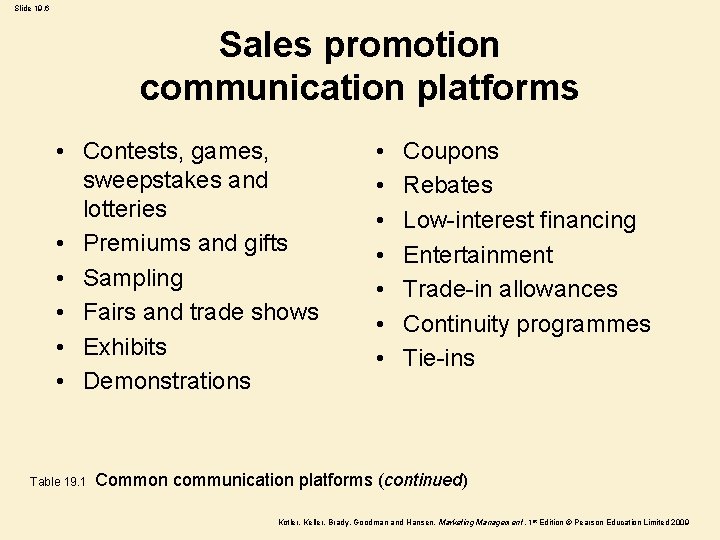
Slide 19. 6 Sales promotion communication platforms • Contests, games, sweepstakes and lotteries • Premiums and gifts • Sampling • Fairs and trade shows • Exhibits • Demonstrations Table 19. 1 • • Coupons Rebates Low-interest financing Entertainment Trade-in allowances Continuity programmes Tie-ins Common communication platforms (continued) Kotler, Keller, Brady, Goodman and Hansen, Marketing Management, 1 st Edition © Pearson Education Limited 2009
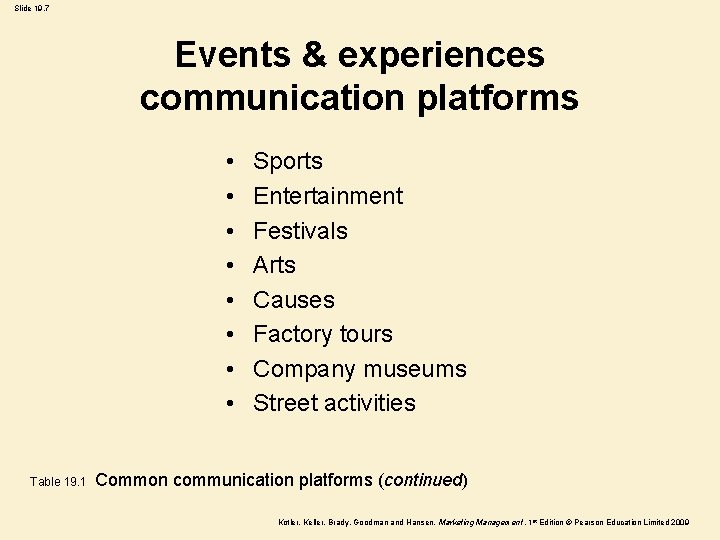
Slide 19. 7 Events & experiences communication platforms • • Table 19. 1 Sports Entertainment Festivals Arts Causes Factory tours Company museums Street activities Common communication platforms (continued) Kotler, Keller, Brady, Goodman and Hansen, Marketing Management, 1 st Edition © Pearson Education Limited 2009
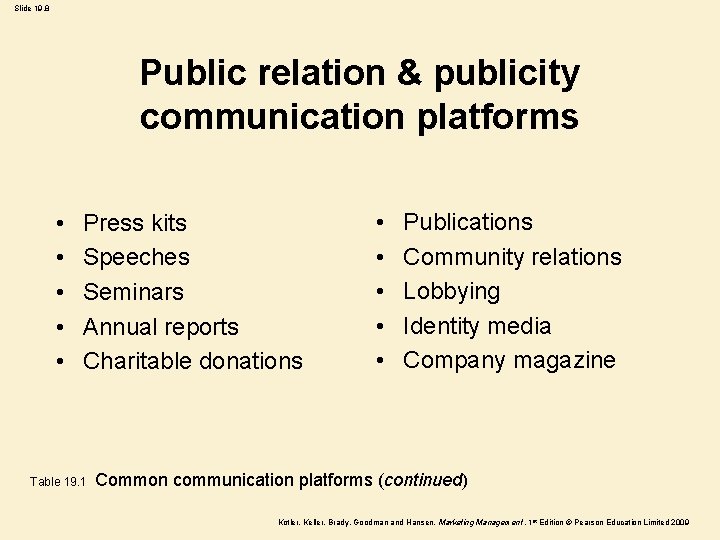
Slide 19. 8 Public relation & publicity communication platforms • • • Press kits Speeches Seminars Annual reports Charitable donations Table 19. 1 • • • Publications Community relations Lobbying Identity media Company magazine Common communication platforms (continued) Kotler, Keller, Brady, Goodman and Hansen, Marketing Management, 1 st Edition © Pearson Education Limited 2009
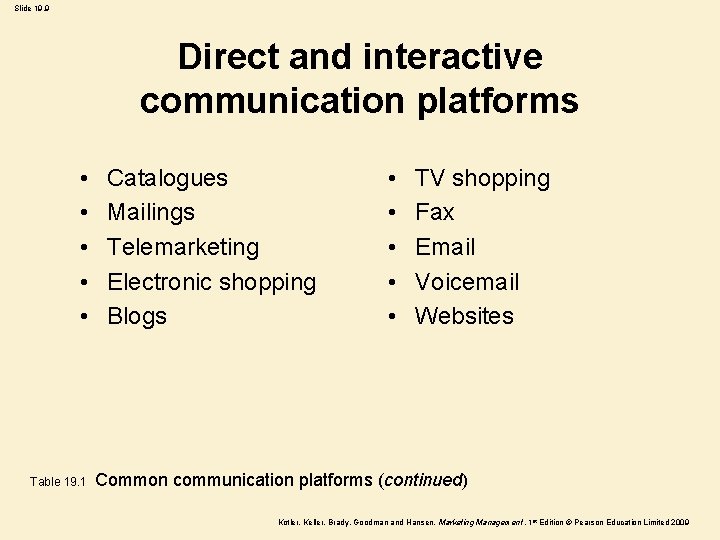
Slide 19. 9 Direct and interactive communication platforms • • • Table 19. 1 Catalogues Mailings Telemarketing Electronic shopping Blogs • • • TV shopping Fax Email Voicemail Websites Common communication platforms (continued) Kotler, Keller, Brady, Goodman and Hansen, Marketing Management, 1 st Edition © Pearson Education Limited 2009
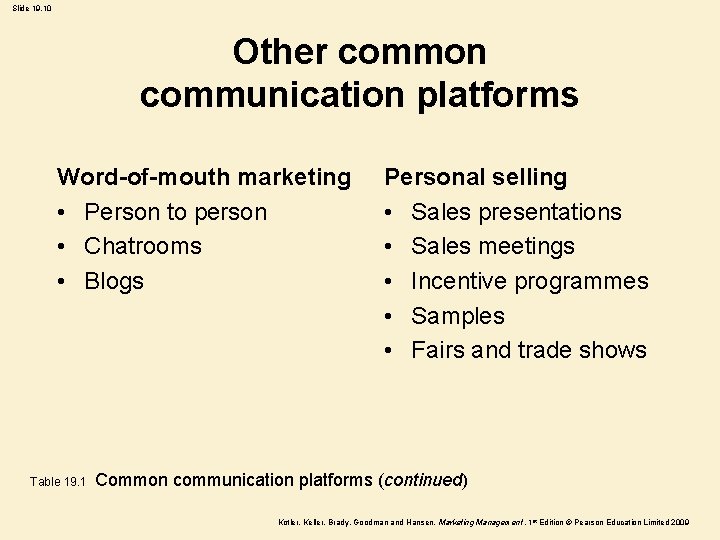
Slide 19. 10 Other common communication platforms Word-of-mouth marketing • Person to person • Chatrooms • Blogs Table 19. 1 Personal selling • Sales presentations • Sales meetings • Incentive programmes • Samples • Fairs and trade shows Common communication platforms (continued) Kotler, Keller, Brady, Goodman and Hansen, Marketing Management, 1 st Edition © Pearson Education Limited 2009
Slide 19. 11 IMC builds brands Figure 19. 1 Integrating marketing communications to build brand equity Kotler, Keller, Brady, Goodman and Hansen, Marketing Management, 1 st Edition © Pearson Education Limited 2009
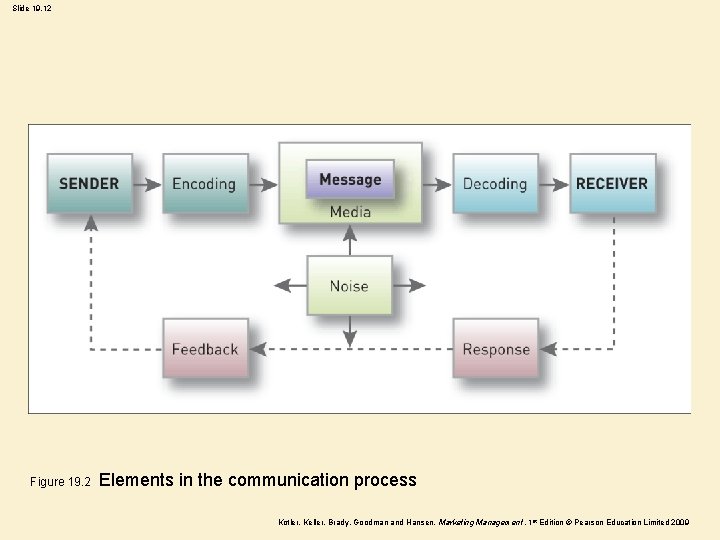
Slide 19. 12 Figure 19. 2 Elements in the communication process Kotler, Keller, Brady, Goodman and Hansen, Marketing Management, 1 st Edition © Pearson Education Limited 2009
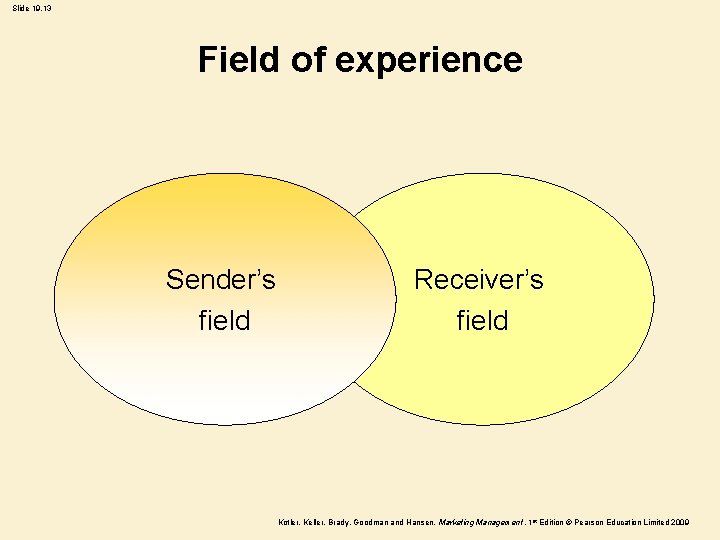
Slide 19. 13 Field of experience Sender’s field Receiver’s field Kotler, Keller, Brady, Goodman and Hansen, Marketing Management, 1 st Edition © Pearson Education Limited 2009
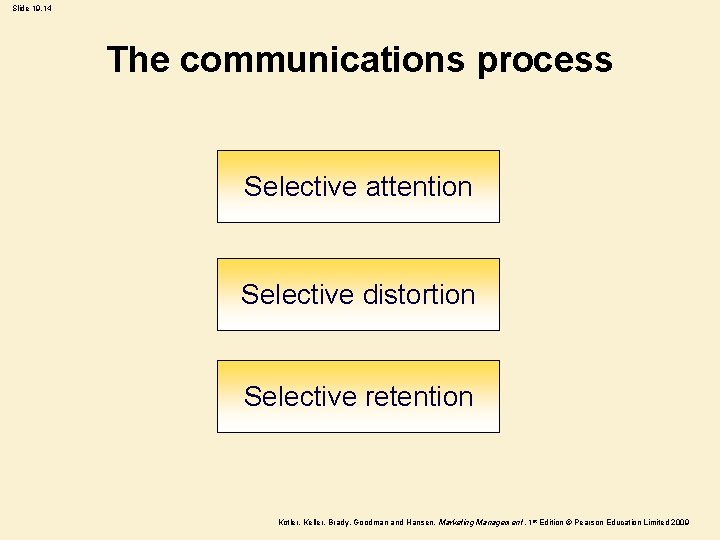
Slide 19. 14 The communications process Selective attention Selective distortion Selective retention Kotler, Keller, Brady, Goodman and Hansen, Marketing Management, 1 st Edition © Pearson Education Limited 2009
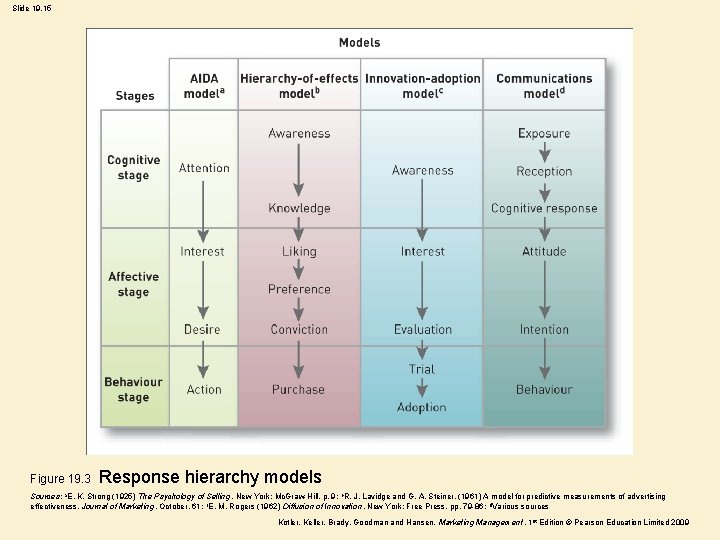
Slide 19. 15 Figure 19. 3 Response hierarchy models Sources: a. E. K. Strong (1925) The Psychology of Selling, New York: Mc. Graw-Hill, p. 9; b. R. J. Lavidge and G. A. Steiner, (1961) A model for predictive measurements of advertising effectiveness, Journal of Marketing, October, 61; c. E. M. Rogers (1962) Diffusion of Innovation, New York: Free Press, pp. 79 -86; d. Various sources Kotler, Keller, Brady, Goodman and Hansen, Marketing Management, 1 st Edition © Pearson Education Limited 2009
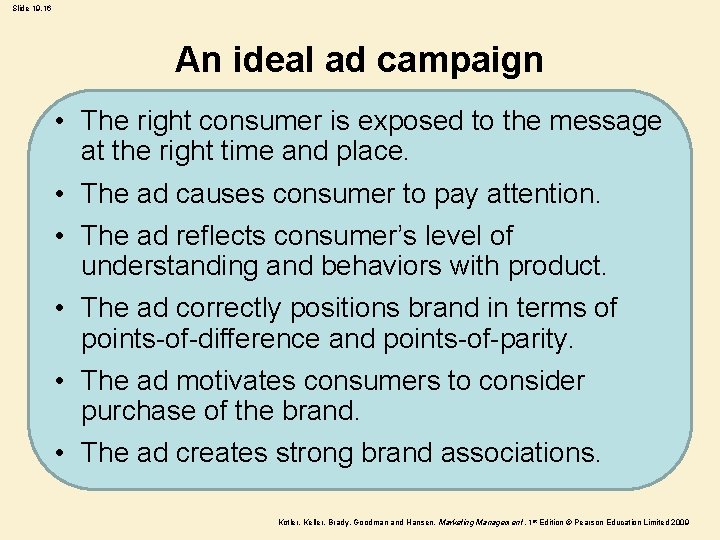
Slide 19. 16 An ideal ad campaign • The right consumer is exposed to the message at the right time and place. • The ad causes consumer to pay attention. • The ad reflects consumer’s level of understanding and behaviors with product. • The ad correctly positions brand in terms of points-of-difference and points-of-parity. • The ad motivates consumers to consider purchase of the brand. • The ad creates strong brand associations. Kotler, Keller, Brady, Goodman and Hansen, Marketing Management, 1 st Edition © Pearson Education Limited 2009
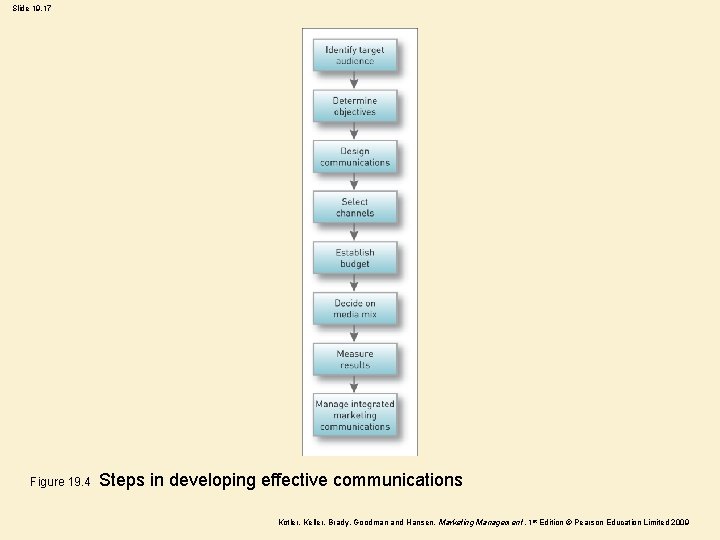
Slide 19. 17 Figure 19. 4 Steps in developing effective communications Kotler, Keller, Brady, Goodman and Hansen, Marketing Management, 1 st Edition © Pearson Education Limited 2009
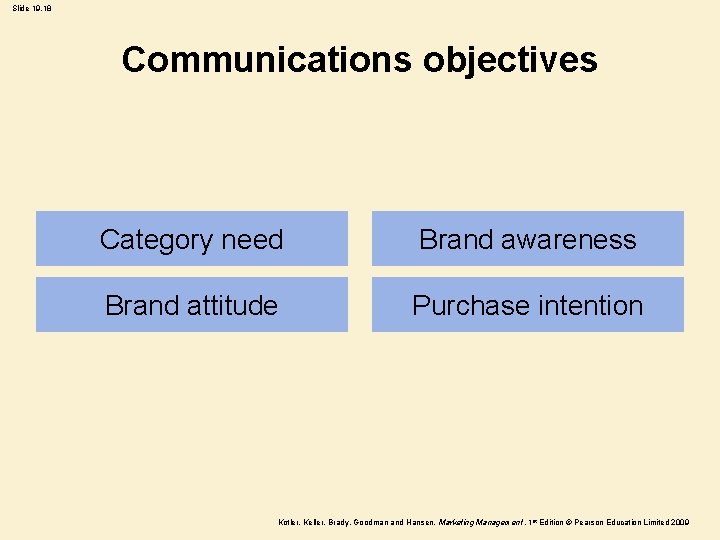
Slide 19. 18 Communications objectives Category need Brand awareness Brand attitude Purchase intention Kotler, Keller, Brady, Goodman and Hansen, Marketing Management, 1 st Edition © Pearson Education Limited 2009
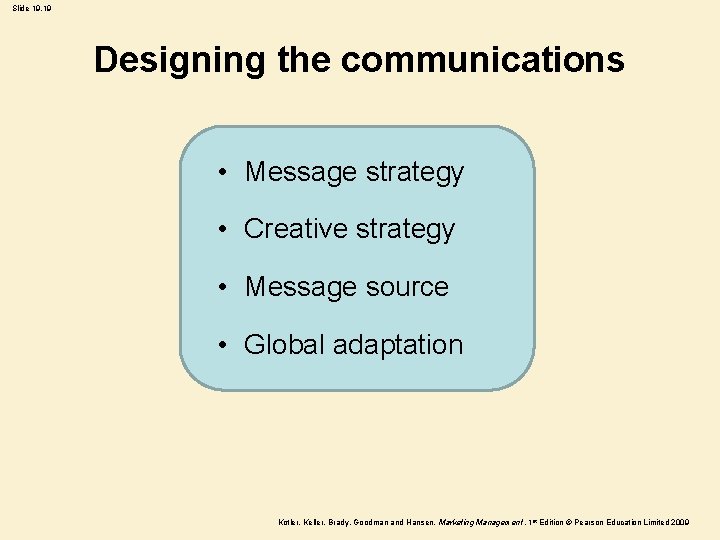
Slide 19. 19 Designing the communications • Message strategy • Creative strategy • Message source • Global adaptation Kotler, Keller, Brady, Goodman and Hansen, Marketing Management, 1 st Edition © Pearson Education Limited 2009
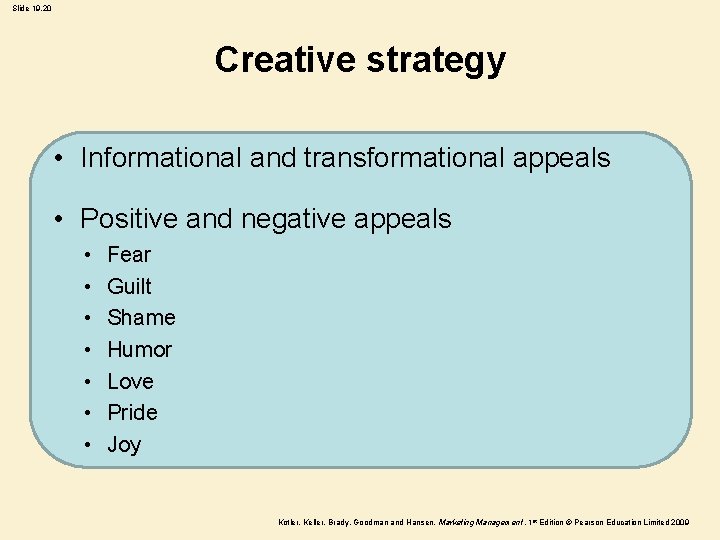
Slide 19. 20 Creative strategy • Informational and transformational appeals • Positive and negative appeals • • Fear Guilt Shame Humor Love Pride Joy Kotler, Keller, Brady, Goodman and Hansen, Marketing Management, 1 st Edition © Pearson Education Limited 2009
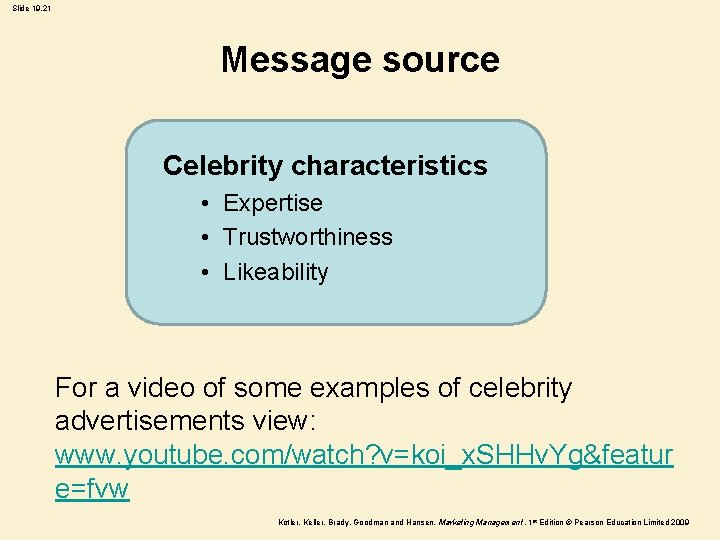
Slide 19. 21 Message source Celebrity characteristics • Expertise • Trustworthiness • Likeability For a video of some examples of celebrity advertisements view: www. youtube. com/watch? v=koi_x. SHHv. Yg&featur e=fvw Kotler, Keller, Brady, Goodman and Hansen, Marketing Management, 1 st Edition © Pearson Education Limited 2009
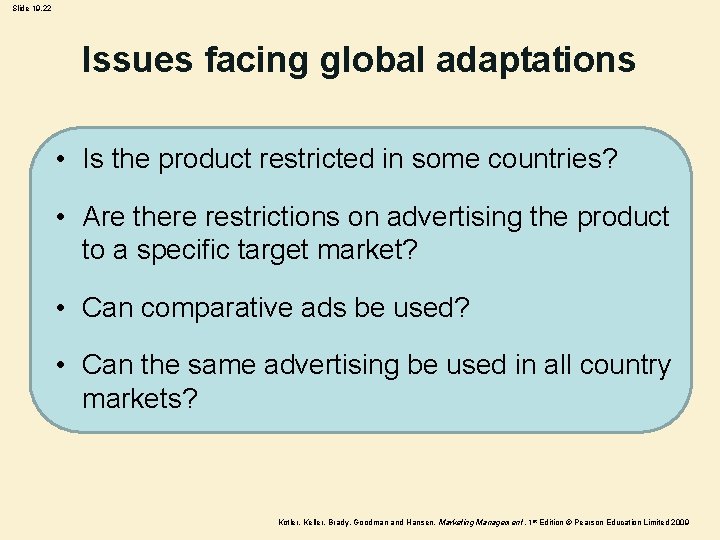
Slide 19. 22 Issues facing global adaptations • Is the product restricted in some countries? • Are there restrictions on advertising the product to a specific target market? • Can comparative ads be used? • Can the same advertising be used in all country markets? Kotler, Keller, Brady, Goodman and Hansen, Marketing Management, 1 st Edition © Pearson Education Limited 2009
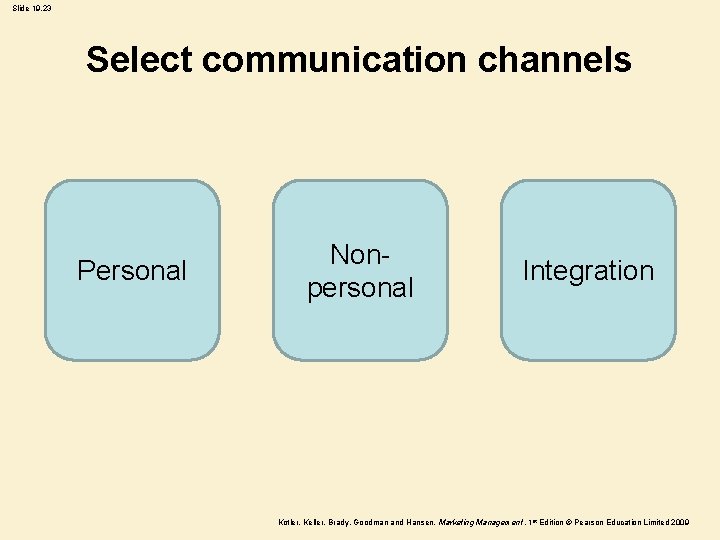
Slide 19. 23 Select communication channels Personal Nonpersonal Integration Kotler, Keller, Brady, Goodman and Hansen, Marketing Management, 1 st Edition © Pearson Education Limited 2009
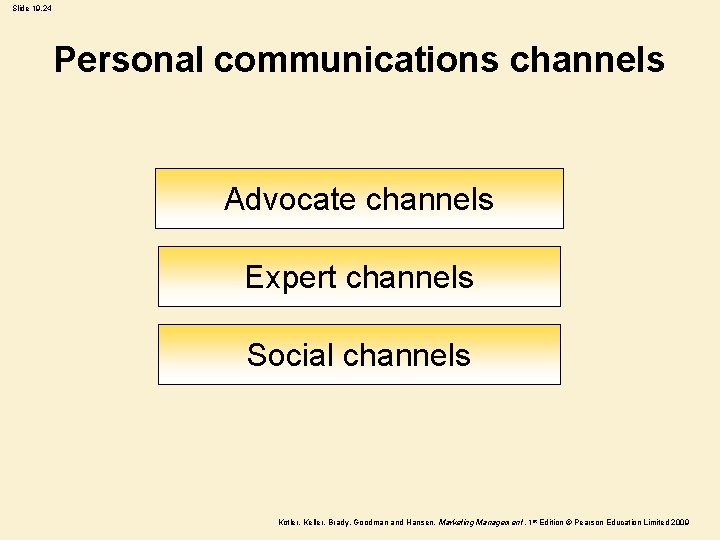
Slide 19. 24 Personal communications channels Advocate channels Expert channels Social channels Kotler, Keller, Brady, Goodman and Hansen, Marketing Management, 1 st Edition © Pearson Education Limited 2009
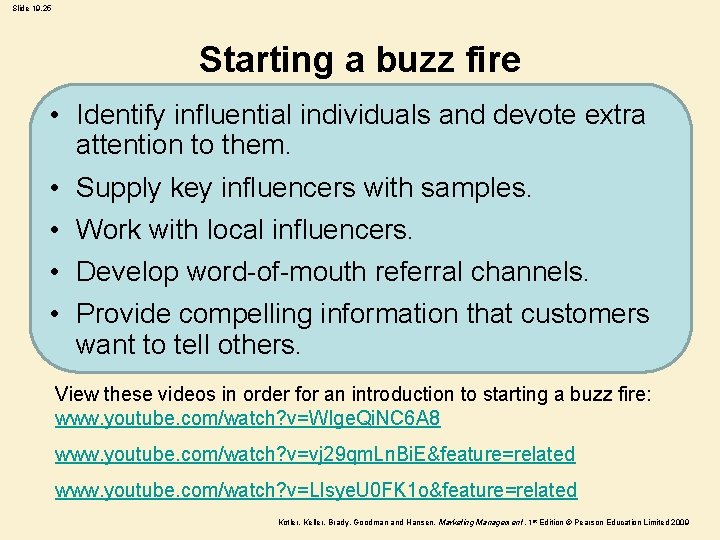
Slide 19. 25 Starting a buzz fire • Identify influential individuals and devote extra attention to them. • Supply key influencers with samples. • Work with local influencers. • Develop word-of-mouth referral channels. • Provide compelling information that customers want to tell others. View these videos in order for an introduction to starting a buzz fire: www. youtube. com/watch? v=WIge. Qi. NC 6 A 8 www. youtube. com/watch? v=vj 29 qm. Ln. Bi. E&feature=related www. youtube. com/watch? v=Llsye. U 0 FK 1 o&feature=related Kotler, Keller, Brady, Goodman and Hansen, Marketing Management, 1 st Edition © Pearson Education Limited 2009
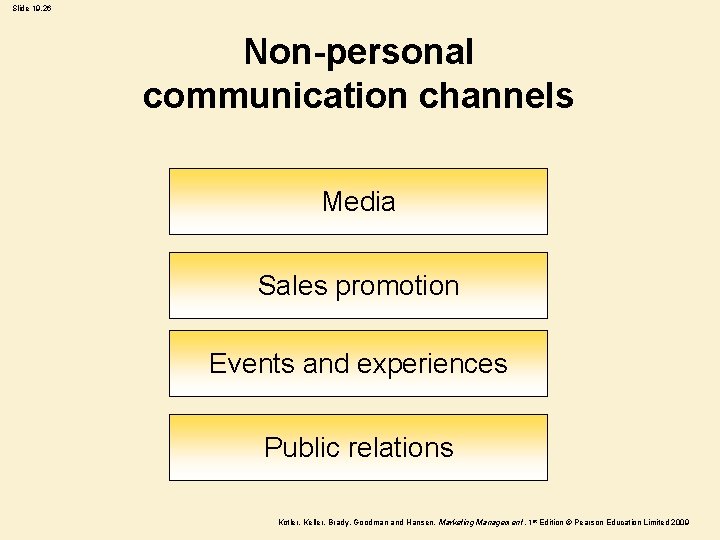
Slide 19. 26 Non-personal communication channels Media Sales promotion Events and experiences Public relations Kotler, Keller, Brady, Goodman and Hansen, Marketing Management, 1 st Edition © Pearson Education Limited 2009
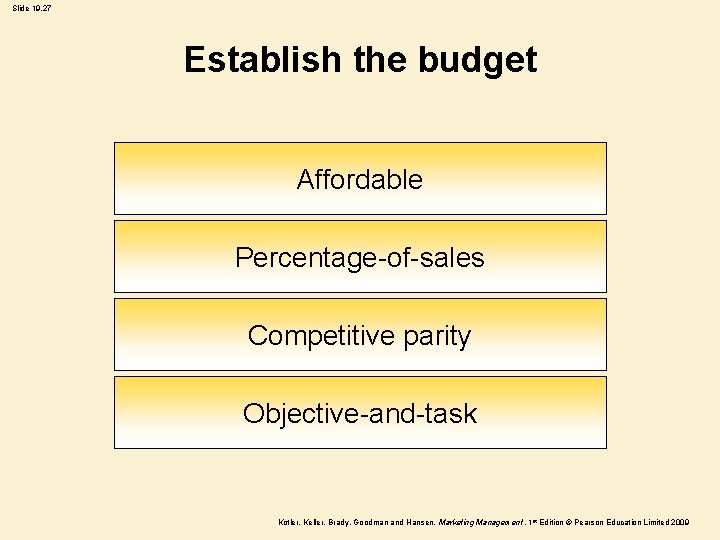
Slide 19. 27 Establish the budget Affordable Percentage-of-sales Competitive parity Objective-and-task Kotler, Keller, Brady, Goodman and Hansen, Marketing Management, 1 st Edition © Pearson Education Limited 2009
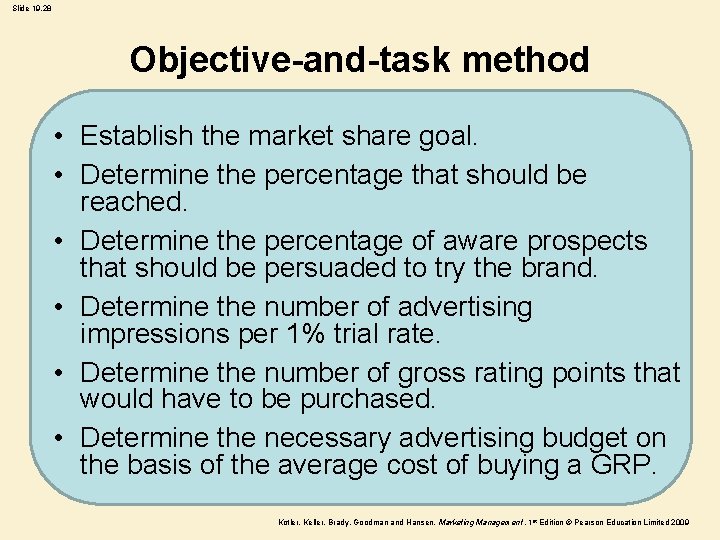
Slide 19. 28 Objective-and-task method • Establish the market share goal. • Determine the percentage that should be reached. • Determine the percentage of aware prospects that should be persuaded to try the brand. • Determine the number of advertising impressions per 1% trial rate. • Determine the number of gross rating points that would have to be purchased. • Determine the necessary advertising budget on the basis of the average cost of buying a GRP. Kotler, Keller, Brady, Goodman and Hansen, Marketing Management, 1 st Edition © Pearson Education Limited 2009
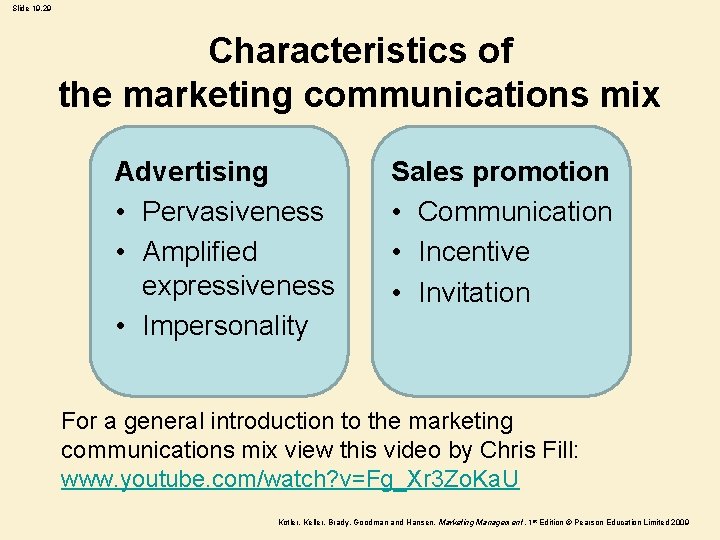
Slide 19. 29 Characteristics of the marketing communications mix Advertising • Pervasiveness • Amplified expressiveness • Impersonality Sales promotion • Communication • Incentive • Invitation For a general introduction to the marketing communications mix view this video by Chris Fill: www. youtube. com/watch? v=Fg_Xr 3 Zo. Ka. U Kotler, Keller, Brady, Goodman and Hansen, Marketing Management, 1 st Edition © Pearson Education Limited 2009
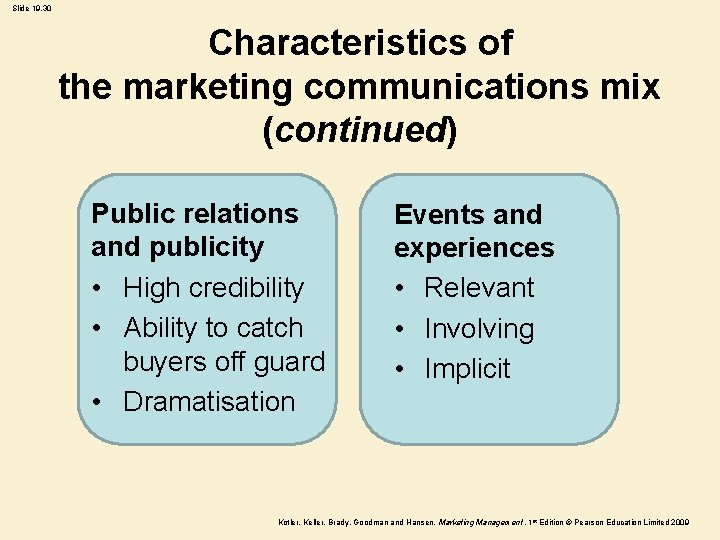
Slide 19. 30 Characteristics of the marketing communications mix (continued) Public relations and publicity • High credibility • Ability to catch buyers off guard • Dramatisation Events and experiences • Relevant • Involving • Implicit Kotler, Keller, Brady, Goodman and Hansen, Marketing Management, 1 st Edition © Pearson Education Limited 2009
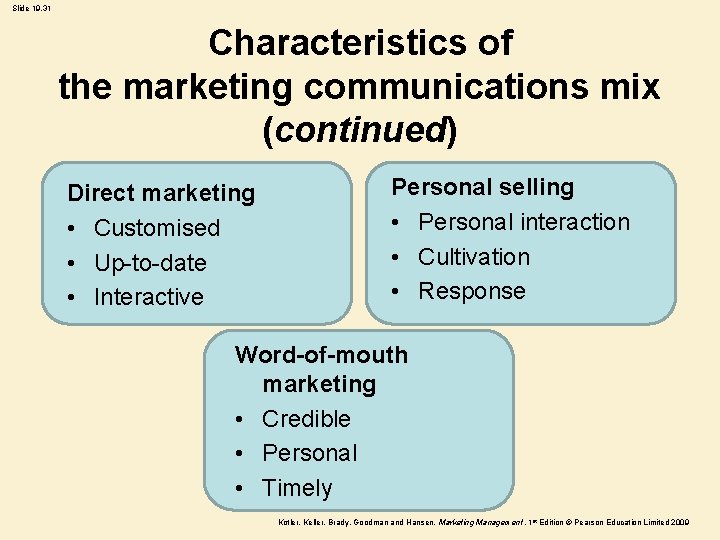
Slide 19. 31 Characteristics of the marketing communications mix (continued) Direct marketing • Customised • Up-to-date • Interactive Personal selling • Personal interaction • Cultivation • Response Word-of-mouth marketing • Credible • Personal • Timely Kotler, Keller, Brady, Goodman and Hansen, Marketing Management, 1 st Edition © Pearson Education Limited 2009
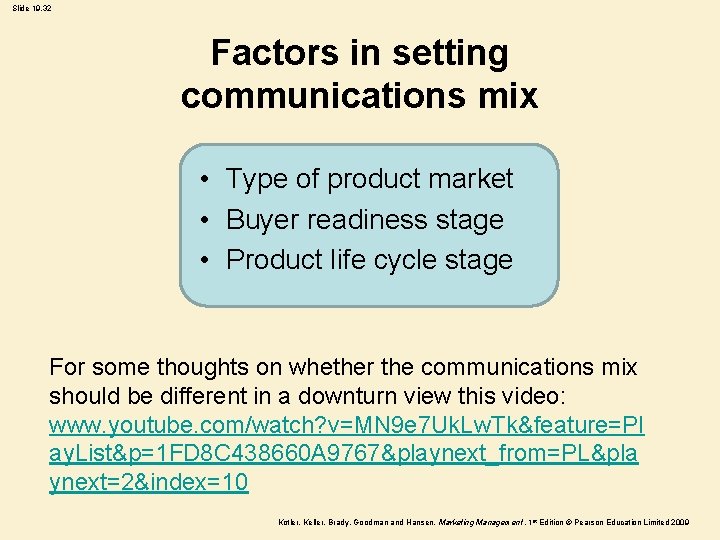
Slide 19. 32 Factors in setting communications mix • Type of product market • Buyer readiness stage • Product life cycle stage For some thoughts on whether the communications mix should be different in a downturn view this video: www. youtube. com/watch? v=MN 9 e 7 Uk. Lw. Tk&feature=Pl ay. List&p=1 FD 8 C 438660 A 9767&playnext_from=PL&pla ynext=2&index=10 Kotler, Keller, Brady, Goodman and Hansen, Marketing Management, 1 st Edition © Pearson Education Limited 2009
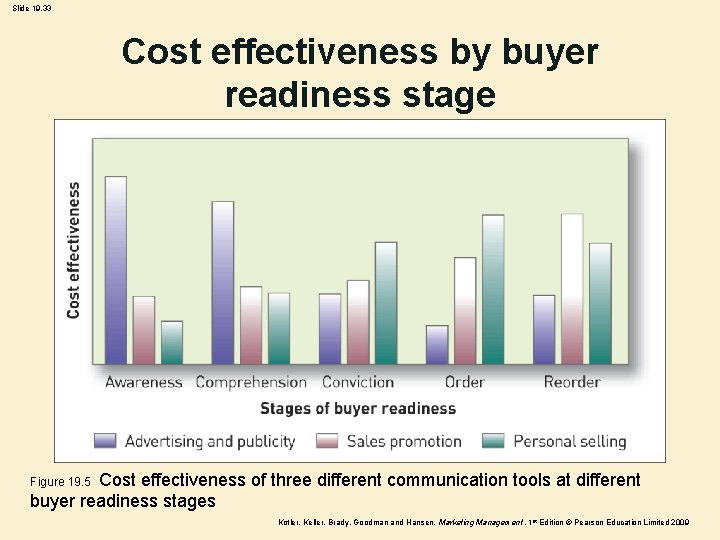
Slide 19. 33 Cost effectiveness by buyer readiness stage Cost effectiveness of three different communication tools at different buyer readiness stages Figure 19. 5 Kotler, Keller, Brady, Goodman and Hansen, Marketing Management, 1 st Edition © Pearson Education Limited 2009
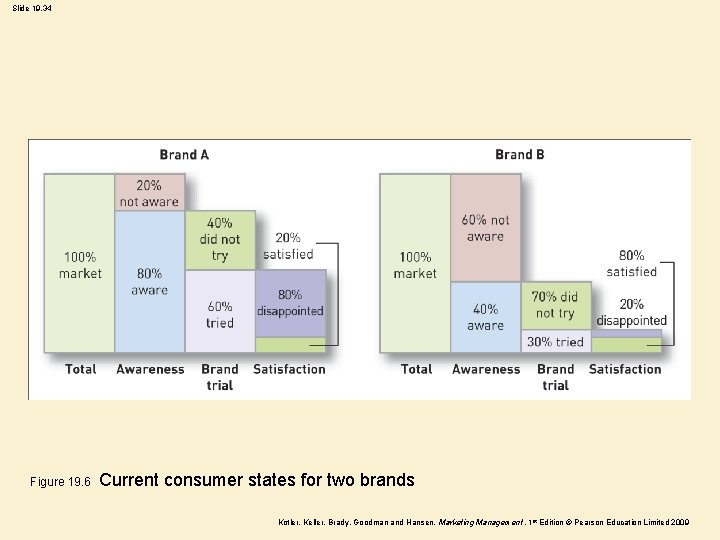
Slide 19. 34 Figure 19. 6 Current consumer states for two brands Kotler, Keller, Brady, Goodman and Hansen, Marketing Management, 1 st Edition © Pearson Education Limited 2009
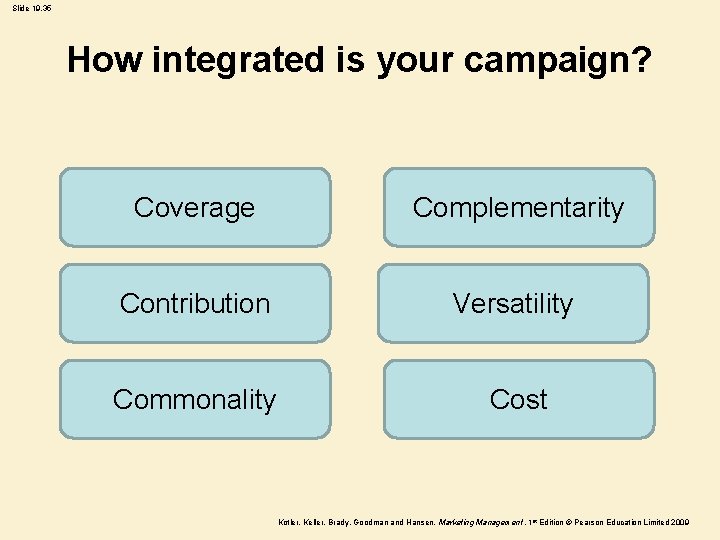
Slide 19. 35 How integrated is your campaign? Coverage Complementarity Contribution Versatility Commonality Cost Kotler, Keller, Brady, Goodman and Hansen, Marketing Management, 1 st Edition © Pearson Education Limited 2009
Slide 19. 36 Recap: can you explain? • What is the role of marketing communications? • How do marketing communications work? • What are the major steps in developing effective marketing communications? • What is the marketing communications mix and how should it be set? • What is an integrated marketing communications programme? Kotler, Keller, Brady, Goodman and Hansen, Marketing Management, 1 st Edition © Pearson Education Limited 2009